A study on formulation of early childhood education teachers’ capabilities to arrange the educational environment
SHIOJI Akiko, YUJI Hiroki, TAMURA Takahiro, KINOSHITA Mitsuji, FUJIHARA Nobuhiko, SONE Naoto*, and SASAKI Akira**
(*Naruto University of Education)
(**Naruto University of Education Attached Kindergarten)
Key Words: early childhood education, teacher’s capability, and educational environment
1. Introduction
There are some forms of early childhood education in Japan. Kindergartens provide three years of education to children between the ages of three and six years. Nursery schools and center for early childhood education and care accept babies, infants, and children under elementary school age.
In 2017, the course of study for kindergarten, nursery school, and center for early childhood education and care was updated. By 2019 autumn, early childhood education for children between the ages of three and six years became free. These facts highlight the rising importance of early childhood education. Moreover, early childhood education is increasing in complexity and diversity. Therefore, early childhood education teachers have important roles to fulfill. Now, there are many young children who want to enroll in early childhood education institutions, and to meet this demand, many new institutions as well as teachers are needed. Even as experienced teachers retire, the numbers of new teachers are increasing.
The formulation of teachers’ capabilities is the need of the hour.
In Japanese early childhood education institutions, there are some types and
philosophies of education. Mainly, the child-centered learning philosophy is considered
important. Kindergarten children play freely and spend their time doing what they want to
do. They also enjoy group activities with their friends, as indicated by classroom teachers. In Japan, the method of early childhood education is called “education through environment.”
Educational environment includes natural circumstances (various plants and insects), a sandbox, outdoor play equipment, indoor play materials (Origami, blocks, and picture books), and so on. Young children select the materials subjectively and play according to their interests, experiencing many things with their friends. Meanwhile, classroom teachers try to understand children’s thoughts and needs, set teaching materials along with educational
intentions and curriculum, and arrange the educational environment. In this educational environment, teachers even play with their students, and help and educate them hospitably.
In fact, it is very difficult for teachers to acquire the capability of teaching young children through the educational environment.
2. Previous studies and our pre-research
Previous studies on formulation of teachers’ capabilities and teacher training are Kimura/Tamura/Tanimura (2017), Kimura/Hashikawa (2008), and Ueyama/Sugimura (2015).
Our research team interviewed experienced as well as new teachers about how to arrange
the educational environment, and created a comic book and videos on early childhood
education and children’s play. Additionally, we published “The Learning Booklet,” which
included worksheets with pictures and case examples, in January 2019. We hope this booklet
can be used effectively to develop teachers’ skills.
< cover of the Booklet>
1 This is a classroom of 4 years old. What do you regard to place materials children use for play?
2 What do you regard to place devices for manual training of 4 years old?
3 There are various materials. What play can children create by using these materials?
4 What do you regard when you display children’s arts that they create during free play?
5 What do you regard when you arrange picture books?
6 Let’s think about “ the teacher’s intention of arranging educational environment” and “ how do children play?”
7 Look over the picture below, and think how children played before.
“The Learning Booklet” includes these questions about pictures and case examples.
From the viewpoint of children
1 What is the thing that children are interested in?
2 How did children work and act?
3 How did children feel?
4 What were the things that children found and thought?
5 How did children have relationship with each other?
From the viewpoint of teachers
1 What is the teachers’ intention to arrange
educational environment?
2 What is the teacher’s intention to react to
children?
3 How did you react to children on the case if you were teacher?
4 What is the thing that you find newly about this case example?
198
<top page of the videos on the web>
3. Research approach
This study aims to prove the efficiency of “The Learning Booklet” to formulate teachers’
capability to arrange the educational environment to accommodate related activities.
The research approach of this study is the questionnaire after we make lectures for early childhood education teachers through “the Learning Booklet”. Research period is from April
to September 2019. Target persons for research are 129 kindergarten teachers, 19 nursery school teachers, 107 center for early childhood education teachers, 1 educational committee teacher, 40 university students and graduate students (including students who are in in- service training in graduate university), and 15 others. Question items of questionnaire are (1) I could learn perspective to arrange the educational environment, (2) I had interest of learning children’s play and arrangement of environment through comic of early childhood
education, (3) many pictures of early childhood education are useful, (4) pictures of early childhood education are appropriate to my education, (5) I would like to learn children’s play and arrangement of educational environment through case examples, (6) I would like to study by myself another part of booklet that are not referred on lecture , (7) “The Learning Booklet”
seems to be useful on my actual job. Participants answered these questions by five-point scale,
and described freely what they learned and thought through “The Learning Booklet”
4.Findings
<1> This study used the SPSS v. 26.0 package for data analysis. One educational committee teacher, 40 undergraduate and graduate students, and 15 others were excluded in the analysis.
Figure 1 shows the percentage of booklets used in workshops held by lecturers and in in- school teacher training. In workshops held by lecturers, Theory of Play and the Environment, Environment <Indoors>, and There Were Beads (Coix lacryma-jobi) Here! were frequently used. In the in-school teacher training, Environment <Indoors>, Theory of Play and the Environment, and Environment <Outdoors> were frequently used. However, the use of case examples and comics in early childhood education was low throughout.
Figure 1. Percentage of Use of Each Booklet
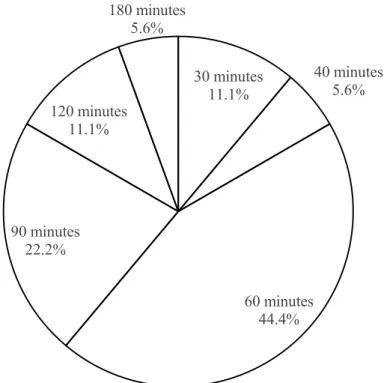
The duration of 60 minutes was the most frequent at 44.4%. Nearly 40% of training lasted 46.9
42.5 25.6
14.2 6.3 4.7 3.1 2.4 2.4 1.6
57.9 68.4 26.3
52.6 21.1
21.1 21.1
26.3 15.8
21.1
0.0 10.0 20.0 30.0 40.0 50.0 60.0 70.0 80.0 Theory of play and the environment
Environment <Indoors>
There were beads(Coix lacryma-jobi) here!
Environment <Outdoors>
Dinosaur art Let's run on the lawn Cherry petals picture book Comic of early childhood education Fossil hunting This sound of "Gasagasa" is good!
In-School Teacher Training(n=19) Workshops Held by Lecturers(n=255)
for 90 minutes or longer.
Figure 3 shows the percentage of training methods employed by teachers using booklets.
Discussion was the most frequent method at 68.4%. More than half of the respondents implemented commentary and question-and-answer methods.
Figure 2. In-School Teacher Training Time for Teachers Using Booklets (in Percentages)
Figure 3. Training Methods Employed by Teachers Using Booklets (in Percentages)
30 minutes 11.1%
40 minutes 5.6%
60 minutes 44.4%
90 minutes 22.2%
120 minutes 11.1%
180 minutes 5.6%
15.8%
42.1%
68.4%
10.5%
0.0%
10.0%
20.0%
30.0%
40.0%
50.0%
60.0%
70.0%
80.0%
Commentary Questions and Answers Discussion Other
Ta ble1 Me dian [ 25% ,75 % qua ti le] a nd Me an (St anda rd D eviation ) b y T ea che rs of E ac h G roup
kindergarten teachersnursery school teachers CECE teachers χ2 n=129 n=19n=107 (1) I could learn perspective to arrange the educational environment.mean(SD)4.74(0.44)4.50(0.62)4.73(0.45) 3.11 Median[25%,75%] 5.00 [4.00, 5.00]5.00 [4.00, 5.00]5.00 [4.00, 5.00] (2) I had interest of learning children’s play and arrangement of environment through comic of early childhood education.mean(SD)4.37(0.73)3.81(0.75)4.52(0.74) 14.89** Median[25%,75%] 4.00 [4.00, 5.00] 4.00 [3.00, 4.00]5.00 [4.00, 5.00] (3) many pictures of early childhood education are useful. mean(SD)4.81(0.42)4.83(0.38)4.72(0.54) 1.30 Median[25%,75%] 5.00 [5.00, 5.00]5.00 [5.00, 5.00]5.00 [5.00, 5.00] (4) pictures of early childhood education are appropriate to my education.mean(SD)4.40(0.70)3.83(0.79)4.05(0.87) 13.90** median[25%,75%] 4.00 [4.00, 5.00]4.00 [3.00, 4.00]4.00 [3.00, 5.00] (5) I would like to learn children’s play and arrangement of educational environment through case examples. mean(SD)4.80(0.42)4.63(0.60)4.80(0.42) 1.96 median[25%,75%] 5.00 [5.00, 5.00]5.00 [4.00, 5.00]5.00 [5.00, 5.00] (6) I would like to study by myself another part of booklet that are not referred on lecture. mean(SD)4.68(0.48)4.72(0.46)4.67(0.51) 0.09 median[25%,75%] 5.00 [4.00, 5.00]5.00 [4.25, 5.00]5.00 [4.00, 5.00] (7) “The Learning Booklet” seems to be useful on my actual job.mean(SD)4.78(0.45)4.83(0.38)4.76(0.48) 0.34 median[25%,75%] 5.00 [5.00, 5.00] 5.00 [5.00, 5.00]5.00 [5.00, 5.00] note: CECE:center for early childhood education n:Number SD: standard deviation ** p <0.01Ta ble2 Me dian [ 25% ,75 % qua ti le] a nd Me an (St anda rd D eviation) b y E ac h g roup of Y ea rs of T ea che r E xpe rie nc e
3 years or less 5-9 years10-19 yearsOver 20 years χ2 n=62n=61n=71n=47 (1) I could learn perspective to arrange the educational environment.mean(SD)4.72(0.45)4.69(0.46)4.70(0.46)4.82(0.39) 2.70 median[25%,75%] 5.00 [4.00, 5.00]5.00 [4.00, 5.00]5.00 [4.00, 5.00]5.00 [4.00, 5.00] (2) I had interest of learning children’s play and arrangement of environment through comic of early childhood education.mean(SD)4.30(0.87)4.30(0.70)4.35(0.77)4.70(0.46) 8.72* median[25%,75%] 4.50 [1.00, 5.00]4.00 [3.00, 5.00]4.00 [2.00, 5.00]5.00 [4.00, 5.00] (3) many pictures of early childhood education are useful. mean(SD)4.67(0.55)4.84(0.37)4.75(0.53)4.86(0.35) 5.19 median[25%,75%] 5.00 [3.00, 5.00]5.00 [4.00, 5.00]5.00 [3.00, 5.00]5.00 [4.00, 5.00] (4) pictures of early childhood education are appropriate to my education.mean(SD)4.02(0.90)4.25(0.81)4.32(0.73)4.45(0.67) 7.05 median[25%,75%] 4.00 [1.00, 5.00]4.00 [2.00, 5.00]4.00 [2.00, 5.00]5.00 [3.00, 5.00] (5) I would like tolearn children’s play and arrangement of educational environment through case examples. mean(SD)4.81(0.40)4.77(0.46)4.75(0.47)4.89(0.32) 2.65 median[25%,75%] 5.00 [4.00, 5.00]5.00 [3.00, 5.00]5.00 [3.00, 5.00]5.00 [4.00, 5.00] (6) I would like to study by myself another part of booklet that are not referred on lecture. mean(SD)4.65(0.48)4.62(0.59)4.60(0.49)4.88(0.32) 10.18* median[25%,75%] 5.00 [4.00, 5.00]5.00 [3.00, 5.00]5.00 [4.00, 5.00]5.00 [4.00, 5.00] (7) “The Learning Booklet”seems to be useful on my actual job.mean(SD)4.75(0.43)4.77(0.50)4.71(0.51)4.88(0.32) 3.69 median[25%,75%] 5.00 [4.00, 5.00]5.00 [3.00, 5.00]5.00 [3.00, 5.00]5.00 [4.00, 5.00] n:Number M:mean SD: standard deviation * p < 0.05Tables 1 and 2 show the median and mean values for teachers from each group. In a comparison made for the variables of teachers from each group and years of teaching experience, the analysis was performed using the non-parametric test, known as the Kruskal–
Wallis test.
As a result, considering Statement 2, “I had interest in learning children’s play and arrangement of environment through comics of early childhood education,” there were significant differences between teachers from each group [χ
2(2)=14.89, p<0.01] and differences based on the length of teaching experience [χ
2(3)=8.72, p<0.05]. The Steel–
Dwass test, which is a non-parametric, post-hoc test for multiple comparisons, has been used.
Kindergarten teachers scored significantly higher than nursery school teachers (p<0.01), and center for early childhood education teachers scored significantly higher than nursery school teachers (p<0.01). Teachers with careers spanning longer than 20 years scored significantly higher than teachers with careers spanning 5–9 years (p<0.05).
Considering Statement 4, “Pictures of early childhood education are appropriate for my teaching,” there was a significant difference between teachers from each group [χ
2(2) = 13.90, p<0.01]. The results of post-hoc tests for multiple comparisons showed that kindergarten teachers scored significantly higher than nursery school teachers (p<0.01), and center for early childhood education teachers scored higher than kindergarten teachers (p<0.01).
Considering Statement 6, “I would like to study by myself another part of the booklet that
is not connected to lecture,” there was a significant difference when considering the years of
teaching experience [χ
2(2) = 10.18, p<0.05]. According to the post-hoc tests for multiple
comparisons, teachers with a career longer than 20 years scored significantly higher than
those with a career of 3 years or shorter (p<0.05) and teachers with a career of 10–19 years.
<2> We analyzed question items, two of which (items 6 and 7) were free-response questions.
We categorized and coded answers, deriving ten code names. Table 3 shows the ten code names and answers from kindergarten, nursery school, center for early childhood education, and educational committee teachers. These code names were “How to use the booklet,”
“Impression of the booklet,” “Difficulty with using the booklet,” “Significance of the booklet,”
“Significance of the pictures,” “Significance of the case examples,” “Significance of the worksheets,” “Significance of the comic,” “How new teachers perceive the booklet,” and
“Request.” Regarding “How to use the booklet,” many teachers answered, “I want to use it personally and slowly,” and “I want to discuss the case examples in a teachers’ workshop in the preschool.” Because there are many pages with pictures and case examples, they want to study it personally. On the other hand, there are no answers to questions in the booklet.
Teachers want to not only answer questions by themselves, but also discuss and exchange ideas. Conversely, for “Difficulty with using the booklet,” teachers answered that they did not have sufficient time to gather for discussions in the preschool. Teachers are very busy because they have to teach and take care of children for long periods during the day.
Moreover, most schools have an inadequate number of teachers. This booklet is useful for new teachers; however, they find answering questions by themselves difficult. It is important for new teachers to make time to discuss teaching in preschool to improve their competencies and skills. As this booklet is concise, it is useful for teachers’ workshops with limited time.
Regarding “Impression of the booklet” and “Significance of the picture,” teachers had good
impressions about the colored pictures and pages. They promoted teachers’ motivation to
learn and understand. For “Significance of the booklet,” teachers answered that it cultivates
educational viewpoint and improves educational environment by studying cases: “we could
think deeply because of the questions in the worksheets.” We want preschool teachers to
learn and study their own educational environment or teaching through this booklet.
Regarding “Request,” most answers are “they want answers to the questions.” When we
developed the booklet, we considered whether answers were needed or not. We concluded
that providing an answer limits preschool teachers’ thinking to one viewpoint. We think it is
important for preschool teachers to think widely and deeply, not just to know the “correct
answer.” However, we consider that preschool teachers do not have enough time to discuss
it at preschool. If answer examples are useful for each teacher, we have to reconsider it. In
addition, there are some opinions that teachers want to know case examples and pictures of
other aged groups. We want to make this our next assignment.
<Table3>
I want to refer to it, because I feel it difficult to teach children food and nutrition.
I see the picture of educational environment that I have never thought, and I want to refer to and practice it.
It's useful for my education from now on.
I want to use personally.
It's useful to think slowly about ingenuity and intention of one situation.
I want to use it as self study because I can imagine the situation from the case examples.
I want to use it and discuss the case examples in a teachers' workshop in the preschool.
I could see what I didn't know, and I want to utilize it.
It's easy to understand for new teachers.
It's easy to understand and enjoyable for every teachers.
It has arrangement of items to read slowly.
It's easy to read by many times.
It uses warm color,so makes me want to read.
It's good to be written by big letters and color printed.
There are not enough numbers of teacher to discuss in the small kindergarten.
We did'nt have sufficient time to discuss in the kindergarten
It's useful to cultivate one's competency to understand I could confirm what was necessary for children's play.
It gives us chance to think about educational environment.
It cultivates educational viewpoint by studying cases.
We could think deeply because there are questions.
It's good for me to know education in another kindergarten.
It's useful to reflect my education, because it indicates viewpoints of thinking and understanding.
The movie is useful.
This booklet is constructed to use instantly at workshop in the kindergarten.
At first, we would do workshop by this booklet and then, we analyze our case.
It gives us catalyst to reflect and improve my educational environment.
How to use the Booklet
Impression of Booklet
Difficult things to use the Booklet
Significance of the Booklet
How to use the Booklet
Impression of the Booklet
Difficulty with using the Booklet
Significance of the Booklet
Many color pictures are useful for me.
As seeing pictures, I want to imitate them.
I can understand children from case examples and I can consider children's thinking and teacher's intention The case examples are useful to think concrately from them.
The case example is a scene that I have experienced when I teach children.
I can place my education on cases and pictures.
Significance of the worksheets
I can reflect my thinking of what to do through
worksheets. Significance of the worksheets
The comic is useful to understand teacher's indication and development of children's play
The comic shows children's imagination of play, and I find children see scene like this.
It is difficult for me to understand intention of
arrangement of educational environment because I am a new teacher.
I consider the case examples more deeply if I discuss with experienced teacher.
The stage1 is easy for new teachers to understand.
I hope that this Booklet is given to every new teacher.
The comic is easy to understand for new teacher.
I would like to study the Booklet written about children between 0 to 2 years old.
I want to see the case examples of 3 and 5 years old children.
I would like to study the next Booklet.
I want the answer sheets.
I want to know intention of teacher who wrote case examples.
I want to know what I have to prepare and where I have to place.
The documentation and portfolio are necessary to imagine.
I want items of reconstructing educational environments.
I don't understand how to use underlines in the case examples.
I want to know new case examples.
Significance of the case examples
Significance of comic
How new teachers think about the Booklet
Request Significance of the pictures
Request
Significance of the pictures
Signidicance of the case examples
Significance of comic
How new teachers perceive the Booklet