Characteristics of partially hydrolyzed egg white and its application on pork meat
A dissertation submitted for the degree of
DOCTOR OF PHILOSOPHY
Presented by Yu Wang Citizen of China
Kyoto, Japan, 2019
ii
To my family
iii
Contents
Abbreviations ……….v
Chapter I General Introduction ... 1
Chapter II Properties of partially hydrolyzed egg white ... 26
Chapter III Effect of egg white hydrolysates on color stability of pork meat slices ... 49
Chapter IV Effect of egg white hydrolysates on the shrinkage, cooking loss and texture of pork meat slices ... 64
Chapter V Summary and conclusion ... 76
Appendix I Summary in Japanese ... 79
Appendix II Publications ... 82
Acknowledgements...………. 83
iv
Appendices
I. Summary in Japanese
II. Publications
v
Abbreviations
ANS: 8-anilino-naphthalene-1-sulonate DH: degree of hydrolysis
EA: emulsifying activity ES: emulsifying stability EW: egg white
EY: egg yolk
hEW: hydrolyzed egg white H0 : surface hydrophobicity nEW: native egg white
NMR: nuclear magnetic resonance spectroscopy OBC: oil-binding capacity
OPA: ortho-phthalaldehyde
ORAC: oxygen radical absorbance capacity pI: isoelectric point
PM: egg white hydrolysate by Protease M® PNY: egg white hydrolysate by Protin NY100®
SDS-PAGE: sodium dodecyl sulfate polyacrylamide gel electrophoresis SEM: scanning electron microscopy
T: egg white hydrolysate by Thermoase PC10F® WHC: water-holding capacity
1
Chapter I
General Introduction
Hen eggs are considered to be the best source of protein, lipids, vitamins, and minerals. And after it was recognized that egg consumption does not cause high serum cholesterol, consumption of table eggs increased substantially. Moreover, continuous investigation of development of the polyfunctional properties of eggs has led to increase its usage as an ingredient in a variety of processed food (Sunwoo and Gujral, 2014). In fact, around 30% of hen eggs produced in the world are processed (Lomakina and Mikova, 2006), including three most well-known properties of egg as an ingredient:
heat-induced coagulation of liquid eggs; foam formation of whipped egg white, as in meringues; and emulsion stabilized by egg yolk lipoprotein, as in mayonnaise (Davis and Reeves, 2002).
1.1 Egg white proteins
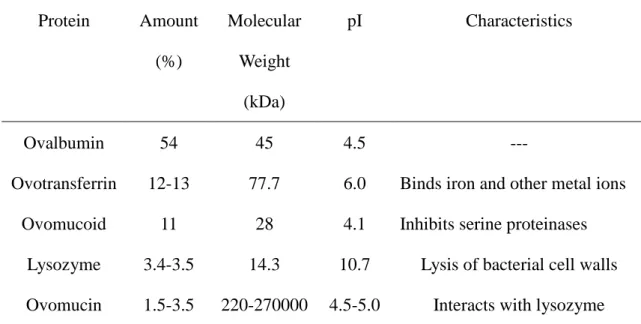
Egg white (EW) represents about 60% of the shell egg by weight, and mainly consists of water (88%) and protein (11%), with the remainder made up of carbohydrates, ash, and trace amounts of lipids (1%) (Li-Chan, Powrie et al.,1995). It is an excellent source of high quality proteins; over 24 different proteins have been identified and isolated from EW. Table1-1 lists selected properties of the major EW proteins. The composition of EW proteins closely matches human requirements for essential amino acids and has a very high digestibility. The bioavailability of egg protein is about 65% in raw egg and is up to 95% in cooked egg protein (Seuss-baum, 2007).
2 1.1.1 Ovalbumin
Ovalbumin accounts for 54% of total EW proteins, making it the most abundant. It is also central to EW’s functional properties in food (Stadelman and Cotterill, 1994).
Ovalbumin is also known as a phosphoglycoprotein with a molecular mass of about 45 kDa (Warner, 1954) with 386 amino acids, consisting of a single peptide chain molecule with a carbohydrate side chain. Amino acid composition of ovalbumin is unique compared with other proteins (Nisbet, Saundry et al., 1981). Ovalbumin does not have a classical N-terminal ladder sequence (Huntington and Stein, 2001), but has three sites of postsynthetic modification in addition to the N-terminal acetylated glycine (Narita and Ishii,1962) and the C-terminal proline , thus ovalbumin is also known as a glycoprotein. Ovalbumin contains four free sulfhydryl groups and one disulfide bridge (Cys74-Cys121), which are inaccessible in the native state (Doi, Koseki et al., 1987).
Furthermore, as shown in Fig 1-1, ovalbumin is a highly structured globular protein.
The secondary structure of ovalbumin has various motifs including α-helix (41%), β-sheet (34%), β-turns (12%), and random coils (13%)( Stein, Leslie et al., 1990;
Huntington et al., 2001). When heated, ovalbumin undergoes a conformational change from its soluble, serpin structure into an insoluble all-β-sheet structure with exposed hydrophobic regions. This causes the protein to aggregate and cause the solidification associated with cooked EW (Hu and Du, 2000).
1.1.2 Ovotransferrin
Ovotransferrin is a monomeric glycoprotein consisting of 686 amino acids with a molecular weight of 76 kDa (Abeyrathne, Lee et al.., 2013) and a pI of 6.1, it is the second most abundant protein in EW, accounting for 12% - 13% of EW proteins.
Moreover, ovotransferrin displays multiple activities. As with other transferrins,
3
ovotransferrin has a strong iron-binding activity. This ability is thought to contribute to antimicrobial properties by depriving microorganisms of the iron necessary for their growth. For example, ovotransferrin has been found to suppress Pseudomonas sp., Escherichia coli, and Streptococcus mutans (Valenti, Antonini et al.., 1982).
Considering its effect on the treatment of acute diarrhea, ovotransferrin has already been suggested and used as an infant formula ingredient (Del, Leone et al., 1985). Wu and Acero-Lopez (2012) also reported that ovotransferrin has an antioxidant effect on poultry meat by establishing a cellular redox environment.
4
Table 1-1: Major egg white proteins and selected properties (Mine, 1995)
Protein Amount (%)
Molecular Weight
(kDa)
pI Characteristics
Ovalbumin Ovotransferrin
Ovomucoid Lysozyme Ovomucin
54 12-13
11 3.4-3.5 1.5-3.5
45 77.7
28 14.3 220-270000
4.5 6.0 4.1 10.7 4.5-5.0
---
Binds iron and other metal ions Inhibits serine proteinases
Lysis of bacterial cell walls Interacts with lysozyme
5
Fig.1-1: The 3-D crystal structure of ovalbumin with the α-helix reaction loop in yellow and main β-sheet A in red (Huntington et al., 2001).
6 1.1.3 Ovomucin
Ovomucin is a sulphated EW glycoprotein which is composed of two subunits:
α-ovomucin with a carbohydrate content of 15% and β-ovomucin with a carbohydrate content of 50%. Two forms of ovomucin exist in EW: insoluble and soluble. Soluble ovomucin is present both in thick and thin albumen, while insoluble ovomucin is found only in thick albumin (Hayakawa and Sato, 1977).
Ovomucin is known to be critical for keeping the high quality and freshness of thick albumen (Wang, Wang et al., 2018). Liu, Oey et al.(2017a) suggested that retaining the ovomucin-depleted EW proteins in solution during processing has potential industry applications, for example, protein fortification of drinks with a minimal solution turbidity. Moreover, recently, researchers are paying more and more attention to ovomucin’s role as a health-promoting component. For example, Kodama and Kimura (1999) found that ovomucin inhibits colonization of Helicobacter pylori.
Ovomucin has similar structures as mammalian mucins: it has a long linear protein chain with a randomly coiled structure, with carbohydrate chains attached to the protein core, in a “bottle brush’ configuration (Bansil and Turner, 2006). These structures suggested that ovomucin may possess protein-resistant p properties. This hypothesis was validated by Sun, Huang et al. (2018), who found that the strong electrostatic and steric repulsions between protein layers could be attributed primarily to the protein-resistant property of ovomucin. This finding demonstrates that ovomucin has antifouling potential with broad applications in the areas of food processing and biomedical implants.
1.2 Enzymatic hydrolysis of food proteins
7
Enzymatic proteolysis is a process with mild reaction conditions and avoidance of undesirable byproduct. It has been extensively studied and described over the last 60 years (Aspmo, Horn et al., 2005). Van der Plancken et al. (2003) studied the effect of heating in the temperature range of 50−92 °C on the susceptibility of ovalbumin and albumen solutions to enzymatic hydrolysis by a mixture of trypsin and α-chymotrypsin at 37 °C and pH 8.0. It was shown that heat treatment resulted in an increase in degree of hydrolysis after 10 min of enzymatic reaction for both ovalbumin and albumen.
Generally speaking, hydrolysis of peptide bonds causes several changes in proteins:
(1) the NH3+ and COO- content of the protein increases, increasing its solubility, (2) the cleavage of peptide bonds, resulting in breakdown of proteins to peptides and amino acids, and
(3) the globular structure of the protein is altered, exposing previously hidden hydrophobic groups (Can-peng, 2005).
Thus enzymatically hydrolyzed proteins possess functional properties, such as low viscosity, increased whipping ability, and high solubility, which make them advantageous for use in many food products (Panyam and Kilara,1996).
Not only the physical functionalities but also the bioactivity of protein hydrolysates have been studied. Dávalos et al. (2004) studied the antioxidant activity of peptides produced by enzymatic hydrolysis of crude EW with pepsin. Results showed that four peptides included in the protein sequence of ovalbumin possessed radical scavenging activity higher than that of Trolox. EW hydrolyzed by pepsin for 3 h was previously found to exhibit a strong angiotensin I–converting enzyme (ACE) inhibitory activity in vitro. Mine et al. (2004) obtained lysozyme hydrolysate by peptic digestion and
8
subsequent tryptic digestion, and found that proteolytic hydrolysis broadened the antimicrobial activity of lysozyme to gram-negative bacteria. Hydrolyzed egg yolks (EY) have been shown to inhibit ACE action in vitro and to suppress the development of hypertension in SHRs after oral administration for 12 weeks (Yoshii, Tachi et al.,
2001). Enzymatic hydrolysis of protein is a promising method with potential to be widely used in the foods and pharmaceutical industries.
1.3 Physical properties of egg white proteins
EW protein is widely utilized as a functional ingredient in the food industry, because of its nutritional and functional properties. Functional properties such as foaming, gelling and emulsifying characteristics can give processed foods unique color, flavor, and texture characteristics. Multiple studies completed in recent decades, showing that many functional properties depend on the exposition of hydrophobic groups in the molecular surface and the interactions of these groups with air (foam), oil (emulsion) or other protein molecules (gels and coagulation) (Li-Chan, 1989).
1.3.1 Foaming property.
Protein molecules act as hydrophilic and hydrophobic groups. The hydrophilic groups are arranged towards the water phase and the hydrophobic groups towards the air phase. During the whipping process air comes into the solution to form bubbles and the hydrophobic regions facilitate adsorption at the interface. Egg albumen has excellent food foaming properties due to its rapidly adsorb on the air-liquid interface during whipping or bubbling and its ability to form a cohesive viscoelastic film by way of intermolecular interactions (Mine, 1995). Having a mixture of proteins allows EW to perform well in foams because each component of EW carries out a different function
9
(Stadelman and Cotterill,1994), even though each component alone has little or no foaming capacity (Johnson and Zabik, 1981).
Lomakina and Mikova (2006) found that this foaming capacity is significantly affected by protein interactions with ovomucin and lysozyme, while ovomucoid, ovotransferrin and ovalbumin had smaller effects. In food processing, pasteurization of liquid EW near 60°C weakens the foaming capacity of EW liquid; in fact, its foaming property begins to be damaged at temperature as low as 54°C (Cunningham,1965).
The quality of EW is another important factor which affects its foaming capacity.
Precisely, the whipping volume of the whole EW has been found to increase slightly with the increasing age of the hen, and storage of egg also has a moderately positive effect on whipping volume (Silversides and Budgell, 2004). This effect was previously studied by Hatta et al.(1996), who found that thick egg albumen proportion changes from 50% in fresh hen eggs to 30% after 12 days storage at 25°C, resulting in a decrease in the viscosity of EW, which may explain the influence of the freshness of EW on its foaming capacity. Moreover, Van der Plancken et al. (2007) studied the effect of moisture content during dry-heating at 80°C on the foaming properties of freeze-dried EW, and found that the foaming capacity of dried EW increased with longer dry-heating time. A high moisture content of the dried EW contributed to an improvement of foaming capacity rapidly.
1.3.2 Emulsifying property.
Emulsification is the most important process in the manufacturing of many formulated foods. Emulsion is a heterogeneous system of one liquid dispersed throughout another in the form of droplets usually exceeding 0.1 µm in diameter. Food emulsion can be categorized as oil in water (O/W) or water in oil (W/O). The former
10
emulsion commonly exhibits a creamy texture, while the latter emulsion has greasy textural properties. Due to their capacity to lower the interfacial tension between hydrophobic and hydrophilic components, proteins play a role as effective surface-active agents. Thus, they participate in the formation of O/W and W/O emulsions and stabilize the emulsions that are formed.
Emulsions stabilized by proteins are of great interest. The emulsifying property of proteins basically depend on two effects: (1) a substantial decrease in the interfacial tension due to the adsorption of the protein at the oil-water interface and (2) the electrostatic, structural and mechanical energy barrier to particle association and phase separation, opposing destabilization processes (Izmailova, Yampolskaya et al., 1999).
The emulsifying capacity of whole eggs, EY and even EW plays a role in baking and other applications. EW emulsifies due to its albumin protein component, while for EY it is its lipoprotein content. Compared with EY, the emulsifying property of EW is low, hence, in order to broaden the application of EW, many studies have investigated how to improve the emulsifying property of EW. Kato et al. (1989) found that after heating at 80°C with 7.5% moisture content for 7 days, the emulsifying properties of EW powder increased with longer heating time, correlating with surface hydrophobicity. Li, Wang et al.(2018) indicated that the foaming/emulsifying properties of EW/EY proteins can be manipulated by altering physicochemical characteristics such as charge, surface tension and particle size.
1.3.3 Gelling property.
Gel is an intermediate between solid and liquid, with both flow and elastic characteristics. Gelation is an important commercial process given the number of cooked consumer products, such as desserts, puddings, reformulated meat products, tofu,
11
and surimi, that rely on protein coagulation, especially the coagulation of egg proteins (Alleoni, 2006). Proteins make gels through coordinate polymerization of molecules, providing a three-dimensional network, and this process occurs by the transformation of the viscous liquid into a viscous-elastic matrix. Both EW and EY have the capacity to form gels upon heating. Gel formation is a two-step process of denaturation followed by aggregation of denatured proteins, as shown in Fig.1-2. In the first step, changes in the conformation (usually induced by heating) or partial denaturation of the protein molecule occur. With denaturation, the dispersion velocity increases as a result of increasing molecular dimensions caused by unfolding of the protein molecule (Ferry 1948). In the second step, a gradual association or molecule aggregations of denatured proteins leads to an exponential increase in viscosity, and to the formation of a three-dimensional network (Hermaneson, 1979; Phillips et al., 1994).
Because of transportation and shelf-life requirements in the egg industry, egg liquid is usually dried and conserved as egg powder, which can withstand high temperatures that allow for the destruction of all pathogens. Kato et al. (1990) found that gel strength of dried EW greatly increased by heating in the dry state at 80°C with initiating the Maillard reaction. In France, two types of treatments are used to improve functional properties (whipping and gelling) of dried EW: standard storage at 67°C for about 15 days and storage at 75 to 80°C for 15 days (Baron, Nau et al., 2003). Moreover, Matsudomi et al. (2002) improved gelling properties of dried EW by modification with galactomannan through the Maillard reaction.
1.4 Bioactivity of egg white protein.
Egg proteins are nutritionally complete with a good balance of the essential amino
12
acids that are needed for building and repairing cells in muscles and other body tissues.
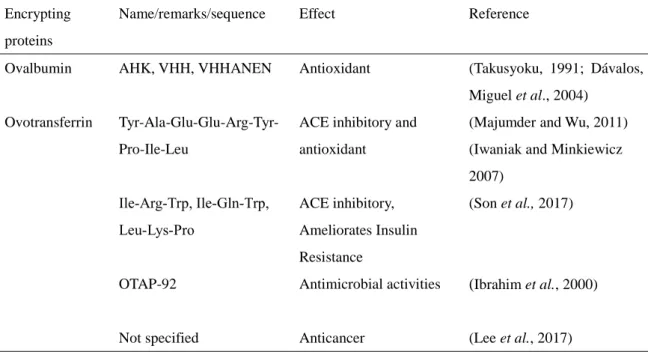
Enzymatic hydrolysis of proteins releases bioactive peptides and different enzymes have different abilities to release such bioactive fractions (Mine, 2007). Research on egg protein-derived bioactive peptides has progressed during recent decades as shown in Table 1-2. These bioactive peptides are mainly derived from ovalbumin and ovotransferrin which are the two most abundant components of EW proteins. These results also broaden the consumption of eggs, giving an innovative way for the egg industry to update conventional egg products to high-value added products.
13
Fig.1-2: Two-step process of gel formation of proteins.
14
Table 1-2. Examples of bioactive egg white-derived peptides.
(Eckert et al., 2013; Liu et al., 2017b)
Encrypting proteins
Name/remarks/sequence Effect Reference
Ovalbumin AHK, VHH, VHHANEN Antioxidant (Takusyoku, 1991; Dávalos, Miguel et al., 2004)
Ovotransferrin Tyr-Ala-Glu-Glu-Arg-Tyr- Pro-Ile-Leu
ACE inhibitory and antioxidant
(Majumder and Wu, 2011) (Iwaniak and Minkiewicz 2007)
Ile‐Arg‐Trp, Ile‐Gln‐Trp, Leu‐Lys‐Pro
ACE inhibitory, Ameliorates Insulin Resistance
(Son et al., 2017)
OTAP-92 Antimicrobial activities (Ibrahim et al., 2000)
Not specified Anticancer (Lee et al., 2017)
15 1.5 Shrinkage of meat
Cooking of meat is essential for sterilizing foodborne pathogens, assuring microbial safety and achieving meat quality (Pathare and Roskilly, 2016). Meat shrinkage and cooking loss have been thought to be the poor meat quality indication by consumers (Barbera and Tassone, 2006). From a nutritional perspective, cooking loss also brings loss of soluble proteins, vitamins and other micronutrients (Yarmand et al., 2013). During cooking, the distinctive meat proteins are heat denatured, resulting in destruction of cell membranes, shrinkage of meat fibers, and aggregation and gel formation of myofibrillar and sarcoplasmic proteins, as well as the shrinkage and solubilization of the connective tissue (Tornberg, 2005; Pathare and Roskilly, 2016).
All meat will shrink in size and weight during cooking. The extent of shrinkage depends on the fat and moisture content of meat, the cooking temperature, and the cooking time. Basically, the higher the cooking temperature, the greater the shrinkage;
overcooking draws out more fat and juices from ground beef, resulting in a dry, less tasty product. In order to avoid or decrease shrinkage and cooking loss of meat, many studies have been conducted. Heating temperature has been shown to affect the texture of meat, with a low cooking temperature yielding a tender product with lower cooking losses (Marshall, Wood et al., 1960; Penfield and Meyer, 1975). Moreover, cooking method was also shown to have an effect on the physical properties and cooking loss of meat. Domínguez, Gómez et al. (2014) proved that microwave cooking resulted in the highest cooking loss of foal meat comparing with other cooking methods (roasting, grilling and frying).
In addition to cooking method, different treatments have been studied to enhance
16
the appearance and flavor of meat products. Polyphosphates are known to change pH value, increase the amount of bound water, decrease weight losses from cooking, improve texture and sensory properties (tenderness, juiciness, color and flavor), extend shelf-life, etc. Therefore, polyphosphates have been widely used in meat processing industry (Long, Gál et al., 2011). However, as cardiovascular morbidity and mortality have been associated with high intake of phosphate additives, the use of polyphosphates faced to criticism (Ritz et al., 2012; Glorieux et al., 2017).
Proteins are very important for sensory properties and quality of meat products.
Omana et al. (2012) thought that lean meat content (protein content) should be sufficient to stabilize emulsion and gel formation during heating. Cereal and legume proteins can be added to meat products to help reduce formulation costs and cooking loss, to improve nutritional value, and to improve in emulsifying property (Correia and Mittal, 2000). Among all the cereal and legume proteins, soybeans are the most commonly used in processed meat products due to their low cost and functional properties (Omana et al., 2012). Soy protein isolate (SPI) as a binder is also widely used in processed meat, resulting in reduced costs and water loss (Homco-Ryan et al., 2003).
However, the U.S. Department of Agriculture set a limit of 3.5% for cereal-based materials incorporated in the meat formulations, and SPI is limited to 2% (Homco-Ryan et al., 2003).
In addition to cereal and legume protein, animal protein like EW is also used in cooked sausages such as frankfurters, due to its ability to form a stable and heat-irreversible gel, which positively contributes to the firmness of low-cost emulsified sausages. The addition rate of EW varies widely; high inclusion levels result in an egg flavor within the finished product (Keeton and Osburn, 2001).
17 1.6 Objectives of the present study
EW has been widely used in the food industries because of its nutritional value and functional properties, such as foaming and gelling. Based on these properties, many foods with different textures have been developed in the past years. Enzymatic hydrolysis has proved to be a moderate and environmentally friendly method to modify protein characteristics to improve the physical properties of proteins. As well, several bioactivities like antioxidative capacity and antimicrobial activity could be reserved in the hydrolysates (certain peptides).
Of the physical properties of EW, the most applied in the food industry are gelling and foaming capacity. Even as a protein with both hydrophilic and hydrophobic sites, however, EW protein shows a quite weak emulsifying property which limits its application in both food and cosmetic industries. In our previous study, the emulsifying activity and emulsifying stability were ameliorated by partial hydrolysis by a thermo-stable enzyme –Protin NY100®, Thermoase PC10F®, Protease M®, combined with a heat treatment at 90°C. Both the enzymatic hydrolysis and heat treatment were proved to be indispensable to obtain an excellent emulsifying property which could even be comparable to that of EY.
In our present study, we tested another two kinds of enzymes, to test their potential and possibilities to be used to improve properties of EW.
Thus, the objectives of this research are:
1 ) to examine characteristics and functional properties of EW hydrolysates by using three different enzymes.
2 ) to study the effect of hydrolysis on an antioxidative capacity of EW
18
hydrolysates, and its potential to suppress color change in pork meat during storage.
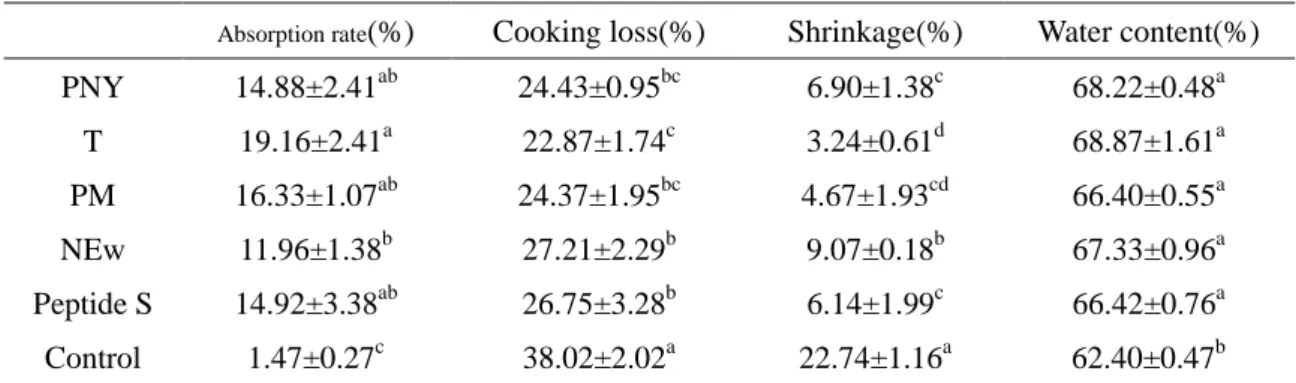
3 ) to investigate cooking loss and shrinkage rate of pork meat slices soaked in different EW hydrolysates solutions.
Chapter II describes how EW proteins were hydrolyzed by three enzymes- Protin NY100®, Thermoase PC10F®, and Protease M®, followed by heat treatment at 90°C, and characteristics and functional properties of these obtained hEWs were examined, including solubility, water-holding capacity (WHC), oil-binding capacity (OBC) and emulsifying capacity in relation to the enzyme types used in the hydrolysis process. Furthermore, in Chapter II, the antioxidative capacity of hEWs were also studied. To study EW’s potential to be used as a natural preservative in meat processing, pork meat slices were soaked separately in each hEWs solution. The effect of hEW on suppressing color change and myoglobin proportions of meat slices was also studied.
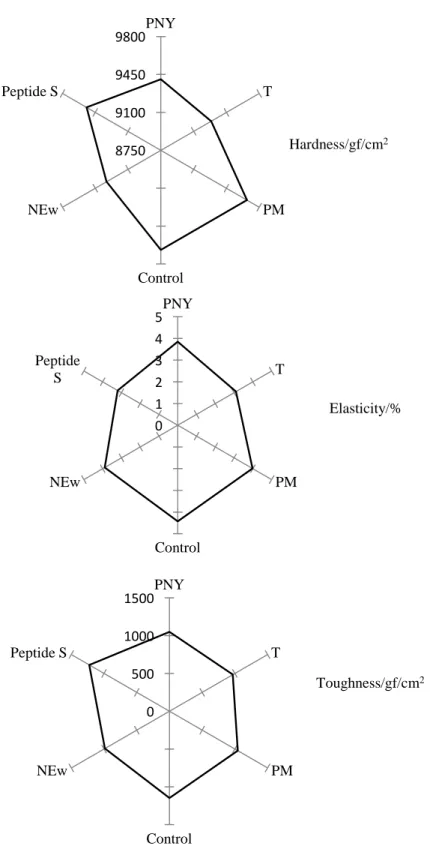
Meat shrinkage and cooking loss are also key factors of meat quality for consumers. In the last part of this project, meat shrinkage and cooking loss were evaluated for pork meat slices treated by soaking in each hEWs solution. In order to understand better, the microstructures of these treated meat slices were also examined.
19
Reference
1. Abeyrathne, E. D. N. S., Lee, H. Y., & Ahn, D. U. (2013). Egg white proteins and their potential use in food processing or as nutraceutical and pharmaceutical agents—a review. Poultry Science, 92(12), 3292-3299.
2. Alleoni, A. C. C. (2006). Albumen protein and functional properties of gelation and foaming. Scientia Agricola, 63(3), 291-298.
3. Aspmo, S. I., Horn, S. J., & Eijsink, V. G. H. (2005). Enzymatic hydrolysis of atlantic cod ( gadus morhua, l.) viscera. Process Biochemistry, 40(5), 1957-1966.
4. Bansil, R., & Turner, B. S. (2006). Mucin structure, aggregation, physiological functions and biomedical applications. Current Opinion in Colloid & Interface Science, 11(2), 164-170.
5. Barbera, S., & Tassone, S. (2006). Meat cooking shrinkage: measurement of a new meat quality parameter. Meat Science, 73(3), 467-474.
6. Baron, F., Nau, F., Guerin-Dubiard, C., Gonnet, F., Dubois, J. J., & Gautier, M.
(2003). Effect of dry heating on the microbiological quality, functional properties, and natural bacteriostatic ability of egg white after reconstitution. Journal of Food Protection, 66(5), 825-832.
7. Canpeng, L. (2005). Studies on phosphorylation of egg white protein by dry-heating in the presence of phosphate. (Doctoral dissertation, Kagoshima University, Japan).
8. Correia, L. R., & Mittal, G. S. (2000). Functional properties of some meat emulsion extenders. International Journal of Food Properties, 3(3), 353-361.
9. Cunningham, F. E. (1965). Stabilization of egg-white proteins to pasteurizing temperatures above 60°C. Food Technology, 19, 1442-1447.
10. Dávalos, A., Miguel, M., Bartolome, B., & Lopez-Fandino, R. (2004). Antioxidant activity of peptides derived from egg white proteins by enzymatic
20
hydrolysis. Journal of Food Protection, 67(9), 1939-1944.
11. Davis, C., & Reeves, R. (2002). High Value Opportunities from the Chicken Egg: A Report for the Rural Industries Research and Development Corporation. RIRDC.
12. Del, G. G., Leone, A. L., & Ferlazzo, A. (1985). Total IgE in newborns treated prophylactically with conalbumin. International Journal of Tissue Reactions, 7(6), 535-537.
13. Doi, E., Koseki, T., & Kitabatake, N. (1987). Effects of limited proteolysis on functional properties of ovalbumin. Journal of the American Oil Chemists’
Society, 64(12), 1697-1703.
14. Domínguez, R., Gómez, M., Fonseca, S., & Lorenzo, J. M. (2014). Effect of different cooking methods on lipid oxidation and formation of volatile compounds in foal meat. Meat science, 97(2), 223-230.
15. Eckert, E., A. Zambrowicz, M. Pokora, A. Polanowski, J. Chrzanowska, M.
Szoltysik, A. Dąbrowska, H. Różański, and T. Trziszka. (2013). Biologically active peptides derived from egg proteins. World's Poultry Science Journal, 69(2):
375-386.
16. Ferry, J. D. (1948). Protein Gels1. Advances in protein chemistry, Elsevier. 4: 1-78.
17. Glorieux, S., Goemaere, O., Steen, L., & Fraeye, I. (2017). Phosphate Reduction in Emulsifi ed Meat Products: Impact of Phosphate Type and Dosage on Quality Characteristics. Food Technology and Biotechnology, 55(3), 390-397.
18. Hatta, H., Hagi, T., & Hirano, K. (1996). Chemical and physicochemical properties of hen eggs and their application in foods. Hen Eggs their Basic and Applied Science. CRC Press, New York, 117-133.
19. Hayakawa, S., & Sato, Y. (1977). Physicochemical identity of α-ovomucins or β-ovomucins obtained from the sonicated insoluble and soluble ovomucins. Agricultural and Biological Chemistry, 41(7), 1185-1191.
21
20. Hermaneson, A. M. (1979). Aggregation and denaturation involved in gel formation functionality and protein structure. ACS Syrup Series, 92, 181.
21. Homco-Ryan, C. L., Ryan, K. J., & Brewer, M. S. (2003). Comparison of functional characteristics of modified corn gluten meal in vitro and in an emulsified meat model system. Journal of Food Science, 68(9), 2638-2643.
22. Hu, H., & Du, H. N. (2000). α-to-β structural transformation of ovalbumin: heat and pH effects. Journal of Protein Chemistry, 19(3), 177-183.
23. Huntington, J. A., & Stein, P. E. (2001). Structure and properties of ovalbumin. Journal of Chromatography B: Biomedical Sciences and Applications, 756(1-2), 189-198.
24. Ibrahim, H. R., Sugimoto, Y., & Aoki, T. (2000). Ovotransferrin antimicrobial peptide (OTAP-92) kills bacteria through a membrane damage mechanism. Biochimica et Biophysica Acta (BBA)-General Subjects, 1523(2-3), 196-205.
25. Iwaniak, A., & Minkiewicz, P. (2007). Proteins as the source of physiologically and functionally active peptides. Acta Scientiarum Polonorum Technologia Alimentaria, 6(3), 5-15.
26. Izmailova, V. N., Yampolskaya, G. P., & Tulovskaya, Z. D. (1999). Development of the Rehbinder’s concept on structure-mechanical barrier in stability of dispersions stabilized with proteins. Colloids and Surfaces A: Physicochemical and Engineering Aspects, 160(2), 89-106.
27. Johnson, T. M., & Zabik, M. E. (2010). Ultrastructural examination of egg albumen protein foams. Journal of Food Science, 46(4), 1237-1240.
28. Kato, A., Ibrahim, H. R., Watanabe, H., Honma, K., & Kobayashi, K. (1990).
Structural and gelling properties of dry-heated egg white proteins. Journal of Agricultural and Food Chemistry, 38(1), 32-37.
29. Keeton, J. T., & Osburn, W. N. (2001). Formed and emulsion products. Poultry
22 Meat Processing, 195.
30. Kodama, Y. and Kimura, N., & Ghen Corp, 2001. Inhibitor of Helicobacter pylori colonization. U.S. Patent 6,235,709.
31. Lee, J. H., Moon, S. H., Kim, H. S., Park, E., Ahn, D. U., & Paik, H. D. (2017).
Antioxidant and anticancer effects of functional peptides from ovotransferrin hydrolysates. Journal of the Science of Food and Agriculture, 97(14), 4857-4864.
32. Li-Chan, E. C., Powrie, W. D., & Nakai, S. (1995). The chemistry of eggs and egg products. Egg Science and Technology, 4, 105-75.
33. Li-Chan, E. C. (1989). Biochemical basis for the properties of egg white. Critical Reviews in Poultry Biology, 2, 21-58.
34. Li, J., Wang, C., Li, X., Su, Y., Yang, Y., & Yu, X. (2018). Effects of pH and NaCl on the physicochemical and interfacial properties of egg white/yolk. Food Bioscience, 23, 115-120.
35. Liu, Y. F., Oey, I., Bremer, P., Carne, A., & Silcock, P. (2017a). Effects of pH, temperature and pulsed electric fields on the turbidity and protein aggregation of ovomucin-depleted egg white. Food Research International, 91, 161-170.
36. Liu, Y. F., Oey, I., Bremer, P., Carne, A., & Silcock, P. (2017b). Bioactive peptides derived from egg proteins: A review. Critical Reviews in Food Science and Nutrition, 1-23.
37. Lomakina, K., & Mikova, K. (2006). A study of the factors affecting the foaming properties of egg white–a review. Czech Journal of Food Sciences, 24(3), 110-118.
38. Long, N. H. B. S., Gál, R., & Buňka, F. (2011). Use of phosphates in meat products. African Journal of Biotechnology, 10(86), 19874-19882.
39. Majumder, K., & Wu, J. (2011). Purification and characterisation of angiotensin I converting enzyme (ACE) inhibitory peptides derived from enzymatic hydrolysate of ovotransferrin. Food Chemistry, 126(4), 1614-1619.
23
40. Marshall, N., Wood, L., & Patton, M. B. (1960). Cooking choice grade, top round beef roasts. Journal of the American Dietetic Association, 36, 341-345.
41. Matsudomi, N., Nakano, K., Soma, A., & Ochi, A. (2002). Improvement of gel properties of dried egg white by modification with galactomannan through the Maillard reaction. Journal of Agricultural and Food Chemistry, 50(14), 4113-4118.
42. Mine, Y. (1995). Recent advances in the understanding of egg white protein functionality. Trends in Food Science and Technology, 6(7), 225-232.
43. Mine, Y., Ma, F., & Lauriau, S. (2004). Antimicrobial peptides released by enzymatic hydrolysis of hen egg white lysozyme. Journal of Agricultural and Food Chemistry, 52(5), 1088-1094.
44. Mine, Y. (2007). Egg proteins and peptides in human health-chemistry, bioactivity and production. Current Pharmaceutical Design, 13(9), 875-884.
45. Nakamura, Y., Yamamoto, N., Sakai, K., Okubo, A., Yamazaki, S., & Takano, T.
(1995). Purification and characterization of angiotensin I-converting enzyme inhibitors from sour milk. Journal of Dairy Science, 78(4), 777-783.
46. Narita, K., & Ishii, J. (1962). N-terminal sequence in ovalbumin. The Journal of Biochemistry, 52(5), 367-373.
47. Nisbet, A. D., Saundry, R. H., Moir, A. J. G., Fothergill, L. A., & Fothergill, J. E.
(2010). The complete amino‐acid sequence of hen ovalbumin. European Journal of Biochemistry, 115(2), 335-345.
48. Omana, D. A., Pietrasik, Z., & Betti, M. (2012). Evaluation of poultry protein isolate as a food ingredient: physicochemical characteristics of low-fat turkey bologna. Poultry Science, 91(12), 3223.
49. Panyam, D., & Kilara, A. (1996). Enhancing the functionality of food proteins by enzymatic modification. Trends in Food Science and Technology, 7(4), 120-125.
50. Pathare, P. B., & Roskilly, A. P. (2016). Quality and energy evaluation in meat cooking. Food Engineering Reviews, 8(4), 1-13.
24
51. Penfield, M. P., & Meyer, B. H. (2010). Changes in tenderness and collagen of beef semltendlnosus muscle heated at two rates. Journal of Food Science, 40(1), 150-154.
52. Phillips, L. G. (2013). Structure-function properties of food proteins. Academic Press, San Diego.
.
53. Ritz, E., Hahn, K., Ketteler, M., Kuhlmann, M. K., & Mann, J. (2012). Phosphate additives in food—a health risk. Deutsches Ärzteblatt International, 109(4), 49.
54. Seuss-baum, I. (2007). Nutritional evaluation of egg compounds. In Bioactive egg compounds (pp. 117-144). Springer, Berlin, Heidelberg.
55. Silversides, F. G., & Budgell, K. (2004). The relationships among measures of egg albumen height, pH, and whipping volume. Poultry Science, 83(10), 1619-1623.
56. Son, M., Chan, C. B., & Wu, J. (2018). Egg White Ovotransferrin‐Derived ACE Inhibitory Peptide Ameliorates Angiotensin II‐Stimulated Insulin Resistance in Skelet al. Muscle Cells. Molecular Nutrition and Food Research, 62(4), 1700602.
57. Stadelman, W. and Cotterill, O (1994). Foaming. Egg Science & Technology . CRC Press.: 418-434.
58. Stein, P. E., Leslie, A. G., Finch, J. T., Turnell, W. G., McLaughlin, P. J., & Carrell, R. W. (1990). Crystal structure of ovalbumin as a model for the reactive centre of serpins. Nature, 347(6288), 99.
59. Sun, X., Huang, J., Zeng, H., & Wu, J. (2018). Protein-resistant Property of Egg White Ovomucin under Different pHs and Ionic Strengths. Journal of Agricultural and Food Chemistry. 66 (42), 11034-11042.
60. Sunwoo, H. H., Gujral, N., Huebl, A. C., & Kim, C. T. (2014). Application of high hydrostatic pressure and enzymatic hydrolysis for the extraction of ginsenosides from fresh ginseng root (Panax ginseng CA Myer). Food and Bioprocess Technology, 7(5), 1246-1254.
25
61. Takusyoku, N (1991). Antioxidative activity of peptides prepared by enzymatic hydrolysis of egg-white albumin. Nippon Nogei Kagakukaishi, 65, 1635-1641.
62. Tornberg, E. (2005). Effects of heat on meat proteins–Implications on structure and quality of meat products. Meat Science, 70(3), 493-508.
63. Valenti, P., Antonini, G., Fanelli, M. R., Orsi, N., & Antonini, E. (1982).
Antibacterial activity of matrix-bound ovotransferrin. Antimicrobial Agents and Chemotherapy, 21(5), 840-841.
64. Van der Plancken, I., Van Remoortere, M., Indrawati,, Van Loey, A., & Hendrickx, M. E. (2003). Heat-induced changes in the susceptibility of egg white proteins to enzymatic hydrolysis: a kinetic study. Journal of Agricultural and Food Chemistry, 51(13), 3819-3823.
65. Van der Plancken, I., Van Loey, A., & Hendrickx, M. (2007). Effect of moisture content during dry-heating on selected physicochemical and functional properties of dried egg white. Journal of Agricultural and Food chemistry, 55(1), 127-135.
66. Wang, Y., Wang, Z., & Shan, Y. (2018). Assessment of the relationship between ovomucin and albumen quality of shell eggs during storage. Poultry science, 0, 1–7
67. Warner, R. C. (1954). Egg proteins. The Proteins Chemistry, Biological Activity, and Methods, Volume 2b, Elsevier: 435-485.
68. Wu, J., & Acero-Lopez, A. (2012). Ovotransferrin: Structure, bioactivities, and preparation. Food Research International, 46(2), 480-487.
69. Yarmand, M. S., Nikmaram, P., Djomeh, Z. E., & Homayouni, A. (2013).
Microstructural and mechanical properties of camel longissimus dorsi muscle during roasting, braising and microwave heating. Meat science, 95(2), 419-424.
70. Yoshii, H., Tachi, N., Ohba, R., Sakamura, O., Takeyama, H., & Itani, T. (2001).
Antihypertensive effect of ACE inhibitory oligopeptides from chicken egg yolks. Comparative Biochemistry and Physiology Part C: Toxicology &
Pharmacology, 128(1), 27-33.
26 Chapter II
Properties of partially hydrolyzed egg white
2.1 Introduction
Egg white (EW) is a significant protein source of dietary protein, accounting for about 58% of the entire mass of an egg, with a protein content of about 10%
(Abeyrathne et al., 2013; Kovacs-Nolan et al., 2005). It is also known as a desirable ingredient for many foods such as bakery goods, meringues, and meat products in which it is mainly used because of its excellent gelling and foaming properties (Mariotti et al., 2012). However, for some applications, it could be useful to improve and to diversify EW properties. In particular, increasing the emulsifying properties of EW could be an innovative way to obtain a pure protein emulsifier, which is a fat-free functional ingredient compatible with “light food” claims.
Enzymatic modifications are efficient for modifying protein functionality (Panyam et al., 1996). Especially, proteolysis has been suggested as an efficient way to improve functional properties by (Lqari et al., 2005). These authors showed that lupin protein and α-conglutin hydrolyzed by alkaline protease (alcalase) had better emulsifying activity (EA) than native lupin protein and α-conglutin, respectively.
Although the emulsifying stability (ES) of hydrolysates of lupin protein and α-conglutin decreased relative to the native proteins, lupin protein hydrolysates were still thought to be potential to be used as ingredients in emulsion-based food formulations such as salad dressing and mayonnaise. Furthermore, thermal treatments that are usually used for inactivating the enzymes have also been shown to affect protein structure (Sanchez and
27
Fremont , 2003), which should be related to protein functionality.
In the present study, physical properties of partially hydrolyzed EW protein by partial hydrolysis were measured, including emulsifying properties, water-binding capacities and oil-binding capacity.
2.2 Materials and Methods
2.2.1 Preparation of egg white hydrolysates.
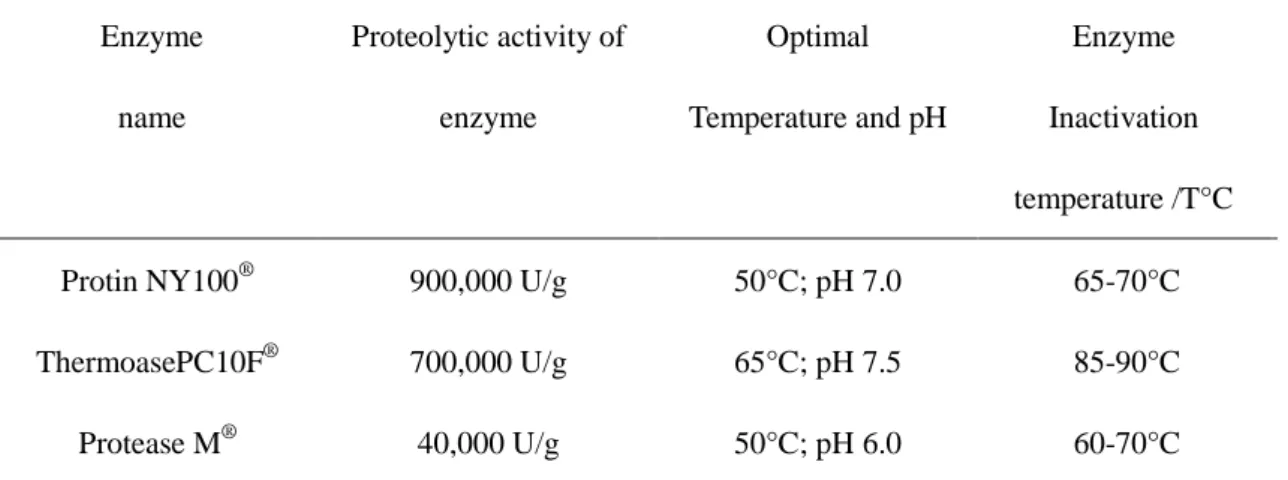
Three kinds of enzymes: Protin NY100®, Thermoase PC10F®, Protease M®, which were provided by Amano Enzyme Inc. (Japan) were used in this study, EW hydrolysates obtained using these three enzymes were named: PNY, T and PM, respectively. Optimal pH and temperature for each enzyme were listed in Table 2-1.
Hen eggs were obtained from a local supermarket (Kyoto, Japan) and were manually broken and separated yolk from EW. EW was mixed using a hand mixer (National MK-210, Japan) at a rotational speed of 540 rpm for 3 s, then filtered by passing through a stainless mesh (sieve size 0.60 mm), any foam was removed. The pH of EW was adjusted to each optimal working pH as shown in Table 2-1 with 10% (w/v) citric acid solution before using for the experiment.
The enzyme was added at a concentration of 0.4% (w/w) after EW being warmed up to 50°C. Enzymatic treatments were conducted as follows: 10 min at 50°C, then adjusted to its corresponding optimal working condition, and maintained for 30 min before inactivation. Inactivation of the enzyme was achieved by holding the resulting hydrolysates at 90°C for 8 min, before homogenization by a mechanical homogenizer (IKA T18 basic, Germany) at Dial 5 (15,000 rpm) for 60 s. To ensure enzyme was completely inactivated, x-ray films (Fuji Film, Japan) were used. The surface of x-ray
28
film is covered with thin gelatin film, which is hydrolyzed by the possible remained active enzyme, leading to the appearance of transparency of films.
EW hydrolysates were then freeze-dried (FreeZone Plus 12 Liter Cascade Console Freeze Dry System, Labconco, Japan) and stored as powder at -30°C in a Biomedical Freezer (MDF-U539-PJ, Panasonic, Japan).
2.2.2 Reference emulsifying peptide.
Runpep® (Pharma Foods International Co. Ltd, Japan) is a mixture of EW peptides with molecular weight lower than 10 kDa (as reported in the product description), it was used as a reference for emulsifying properties. Runpep (80% proteins) was dissolved in distilled water at a concentration of 100 mg (protein) / mL as a reference sample, which was then stored at 4°C until use.
2.2.3 Determination of total protein content.
Determination of total protein content in hEW, nEW, Runpep, and EY was conducted by modified Lowry method (Lowry et al., 1951; Markwell et al., 1978).
2.2.4 Determination of hydrolysis degree.
EW hydrolysate powder was dissolved in distilled water at a concentration of 100 mg/mL before determination of the degree of hydrolysis (DH). Free amino groups were quantified using the o-phthalaldehyde (OPA) micromethod described by Church et al., (1983) and with modifications by Darrouzet-Nardi et al., (2013).
OPA reagent was mixed as follows: 25 mg OPA were dissolved in 2.5 mL methanol; then 2.5 mL SDS 20% and 50 μL β-mercaptoethanol were added, and the solution was filled up to 100 mL with 20 mM potassium tetraborate. The reagent was covered with aluminium foil to protect from light.100 μL OPA reagent were thoroughly mixed with 50 μL hydrolysate samples and incubated at room temperature for 10 min
29
before reading the absorbance at 340 nm by a spectrophotometer (Infinite M200, TECAN). A standard curve was previously prepared using methionine solutions concentration from 9.4 to 53.6 μg / mL).
Total acidic hydrolysate of EW was used as a reference for complete hydrolysis (DH
= 100%). It was prepared by adding 2 mL 6 N HCl to 2 mg EW protein powder before the mixture was heated at 110°C for 18 h. After then, vacuum concentration was used in order to remove the remaining HCl in the hydrolysate, and the hydrolysate volume was adjusted to the original EW sample volume with distilled water.
For each enzymatic hydrolysate, DH was calculated as follows:
Where Lt is the amount of liberated free NH2 at time t min, L0 is the amount of the free NH2 at 0 min, and Ltot is the maximum amount of the free NH2 obtained after complete acidic hydrolysis.
2.2.5 Surface hydrophobicity.
Samples were diluted with phosphate buffer (0.01 M, pH 7.0) before centrifuging at 10,000g for 10 min, and supernatant of each sample was stored at 4°C for further analysis. Protein surface hydrophobicity (H0) was measured using fluorescence probe 1-anilinonaphthalene-8 sulfonic acid (ANS). ANS solution (45 μl, 8 mM) was added to 3 ml sample solution. ANS fluorescence intensity was measured at 470 nm with excitation at 390 nm. Excitation and emission slits were 2.5 nm. The slope of the plots of fluorescence intensity versus protein concentration (0, 0.05, 0.1, 0.15, 0.25 mg/ml) was calculated by linear regression and used as a measurement of H0.
30
Table 2-1 Working condition of enzymes.
Enzyme name
Proteolytic activity of enzyme
Optimal Temperature and pH
Enzyme Inactivation temperature /T°C Protin NY100®
ThermoasePC10F® Protease M®
900,000 U/g 700,000 U/g 40,000 U/g
50°C; pH 7.0 65°C; pH 7.5 50°C; pH 6.0
65-70°C 85-90°C 60-70°C
31 2.2.6 Determination of emulsifying properties.
Emulsifying properties were measured according to the turbidimetric method developed by Pearce et al. (1978) with slight modifications. Briefly, colza oil, hEW (or EY, Runpep, nEW) and water were homogenized with a weight ratio of 3:2:1 by a mechanical dispenser (Polytron PT-MR2100, Switzerland) at 25,000 rpm for 1 min, then 200 μl of emulsion was pipetted from the bottom of the container immediately (T0) and 2 hours (T2h) after homogenization. Each aliquot was diluted 1,000 times with SDS solution (0.1%, w/v). Absorbance of these diluted emulsions (A0 and A2h, respectively) were measured at 500 nm by a spectrophotometer (Unico S1205, USA). A0 indicated emulsifying activity (EA). Emulsifying stability (ES) was calculated as follows:
ES = A0 / (A0-A2h ) 2.2.7 Particle size measurement.
hEW (PNY, T and PM) or native egg white (NEw) was diluted to the final protein concentration of 2% (w/v) with denionized water. Then the protein solutions were mixed with colza oil at a volume ratio of 9:1, followed by pre-homogenizing for 2 min at 13,000 rpm using a homogenizer (Polytron PT-MR2100, Switzeland) equipped with a 5 mm diameter head. The resulting emulsions were sealed and stored at 4°C until analysis. Droplet size distribution profiles of various freshly prepared emulsions were obtained with a laser diffraction particle size analyzer (SALD-2200, Shimadzu, Japan).
Droplet size measurements were reported as the volume-average droplet size, d3, 2 = (∑nidi3
/ nidi2
), where ni is the number of droplets with diameter di (Chang, Niu et al., 2016). All determinations were conducted on individual sample in triplicates.
2.2.8 SDS-PAGE.
Sodium dodecyl sulfate polyacrylamide gel electrophoresis (SDS-PAGE) was
32
performed according to Laemmli (1970). Pre-cast gels of 5-20% acrylamide (C-520L, Atto Corporation, Tokyo, Japan) and protein ladder (WSE-7020, Atto Corporation, Tokyo, Japan) with the molecular weight from 10 kDa to 245 kDa were used.
2.2.9 Solubility.
Solubility was determined using method described by Snyder and Kwon (1987) with slight modifications. An aqueous solution (1.0%, w/v) of samples in deionized water was stirred magnetically for 30 min. Then it was centrifuged at 13,500 rpm for 30 min at 4°C (CFRXⅡ, Hitachi, Japan). After an appropriate dilution with deionized water, protein content of the supernatant was determined by the method of Markwell et al.
(1978). The soluble protein percentage was expressed as (protein content of the supernatant) / (sample protein content) ×100.
2.2.10 Water-holding capacity.
Water-holding capacity (WHC) was determined as described by D'appolonia (1977). Samples (1 g) added to centrifuge tubes (15 mL) containing distilled water (9 mL). Tubes were shaken at room temperature for 2 h. Samples were then centrifuged at 9,000 rpm (CFRXⅡ, Hitachi, Japan) for 30 min at 20°C. Then tubes were inverted and allowed to drain for 10 min, supernatant was decanted, drained weight was determined.
WHC was determined as percent of water retention.
2.2.11 Oil-binding capacity.
Oil-binding capacity (OBC) was determined using a modified method of Homco-Ryan et al. (2003) and Seguchi (1985). Sample (0.3 g) was combined with colza oil (3 mL) in a 15-mL plastic test tube. Tubes were shaken vigorously by a mechanical shaker for 1 min before standing at room temperature for 1h. Then samples were centrifuged at 3,500×g for 25 min at 20°C. Tubes were inverted and allowed to drain for
33
30 min, drained weight was determined. OBC was calculated as: OBC = oil bound (g) / sample (g) × 100.
2.2.12 Statistics analysis.
All experiments were carried out in triplicates. The data were subjected to multifactor analysis of variance (ANOVA), followed by the Least Significant Difference (LSD) test to determine the significant difference between samples at p < 0.05 using the software SPSS V.16.
2.3 Results and Discussion
2.3.1 Degree of hydrolysis.
When analyzed by SDS-PAGE, EW proteins presented a wide range of molecular masses and concentrations. The main EW proteins: ovalbumin (44.5 kDa), ovotransferrin (77.7 kDa), ovomucoid (28 kDa) and lysozyme (14.3 kDa), constitute 54, 12, 11 and 3.4% of the total EW proteins, respectively (Abeyrathne, Lee et al. 2013). As observed in Fig.2-1, Lane I-6 represented band of NEw, the bands for ovotransferrin (around 75 kDa) and lysozyme (around 15 kDa) could be observed easily, but the bands for ovalbumin and ovomucoid were connected to each other. Unlike NEw, the band around 75 kDa for sample PNY, T and PM disappeared completely, which suggested that ovotransferrin could be hydrolyzed easier by Protin NY100®, Thermoase PC10F® as well as Protease M® than ovalbumin. Moreover, Peptide S was hydrolyzed the most, with a DH of 26.0% (Fig.2-2) and an average molecular weight less than 10 kDa shown in Fig.2-1 I. After passing through 0.45 µm of the filter, most bands between 35 kDa to 45 kDa were still visible. Most bands for EW hydrolysates T disappeared after filtration, that means the percentage of water-soluble protein in these three samples are low, which
34
is in accordance with the result of solubility measurement shown in Fig.2-2.
2.3.2 Solubility.
In this study, pork meat slices were planned to be soaked in the hEW solutions thus, solubility of hEW was one of important factors to evaluate its possible application on meat slices. Degradation of proteins by a proteolytic enzyme was widely used to increase the solubility and retain the nutritional values of proteins. According to Table.2, solubility did not differ between NEw and Peptide S, solubility of hEW (PNY, T and PM) decreased compared with NEw. This inconsistence may have occurred due to high temperature (90°C) used for inactivation of enzymes during the preparation of hEW, which led to the appearance of some insoluble aggregates, while freeze drying didn't not affect the high solubility of NEw. The order of solubility of hEW was as follows: PNY >
PM > T.
2.3.3 Surface hydrophobicity.
Surface hydrophobicity was reported to have great significance in elucidating the protein functions (Kato and Nakai, 1980). Fig.2-3 shows the fluorescence intensity of the EW hydrolysates prepared by various enzymes and NEw solutions, as the wavelength changes. It was observed that the solution prepared by T showed the highest fluorescence intensity compared to other samples. Result of surface hydrophobicity was shown in Fig.2-4. Except for small peptide S, solutions prepared by hEW microparticles showed an increase of surface hydrophobicity compared to solution prepared by NEw, this result was in accordance with our former study (Wang et al., 2018), partial hydrolysis contributed to an increase of surface hydrophobicity. High surface hydrophobicity indicating a better molecule flexibility and higher expansion degree of
35
proteins, thus resulted in a better adsorption capacity onto oil/water interface (Chang et al., 2016a; Chang et al., 2016b).
2.3.4 Average droplet size.
The average droplet size, difference between the maximum and minimum diameter of droplets of the dispersed phase and the degree of their dispersion are considered as the significant parameters characterizing a given emulsion (Dajnowiec et al., 2016). The droplet size distribution influences the properties of emulsion in aspects such as degradation rates, long-term stability, texture and optical appearance (Fernandez et al., 2004; Jurado et al., 2007).
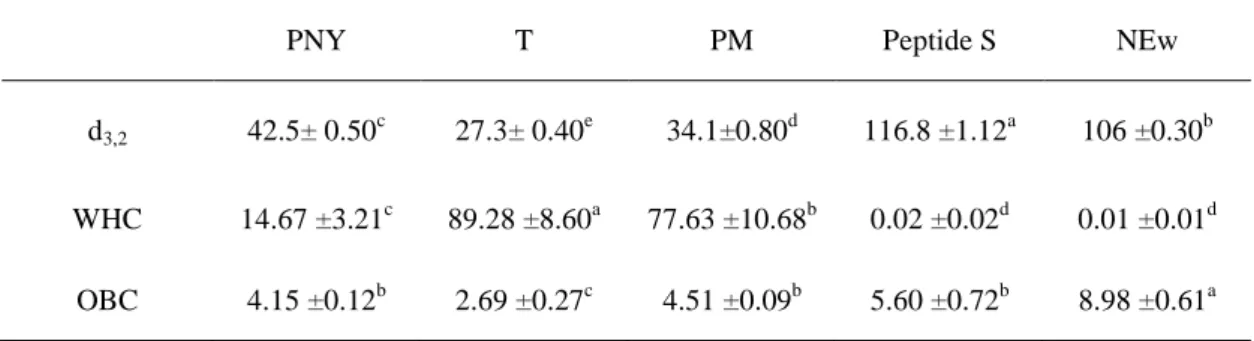
In the current study, oil droplet particle size was used to evaluate the emulsifying properties of hEWs by using different enzymes. Mean diameters of oil droplets (d3,2) in the emulsions stabilized by different hEWs were shown in Table 2-2. The largest particle size was found in Peptide S, referring to lower emulsifying property of Peptide S. The average particle sizes of hEW samples (PNY, T, PM) were observed less than that of NEw and Peptide S. It was reported that smaller particle size allowed the protein to coat the fat or water droplets more efficiently as there were more particles available to form a monolayer (Homco-Ryan et al., 2003).
Droplet size distribution curves were also shown in Fig.2-5. According to the shape of curves, EY and Runpep exhibited single peaked droplet size distribution, the amount of small droplets size (between 0.1 and 1.0 µm) was found to be the most in EY. The smallest and the largest particle size were found in EY and Runpep respectively, referring to the low emulsifying property of Runpep compared to EY. This result is in accordance with that obtained by the former turbidimetric method. Regarding hEWs,
36
shape of droplet size distribution curves became complicated than EY and Runpep, a peak at the point of size less than 10 µm was found for all the hEW samples.
2.3.5 Emulsifying properties.
The ability of a protein to aid the formation of an emulsion is related to its ability to attach to and stabilize the oil-water interface, the more the interfacial area that can be coated by the available protein, EA should be higher (Day et al., 2009). Due to the formation of smaller droplets during emulsification, more light scattering resulted in higher turbidity, and the turbidity increase indicates an increase in EA (Van Vliet et al., 2002). Similarly, the maintenance of a high turbidity value during the storage of an emulsion indicates high ES, while a turbidity decrease indicates instability of the emulsion.
Turbidity measurements of emulsions stabilized by different hydrolysates were performed immediately after emulsification (T0) and after 2h of storage (T2h).
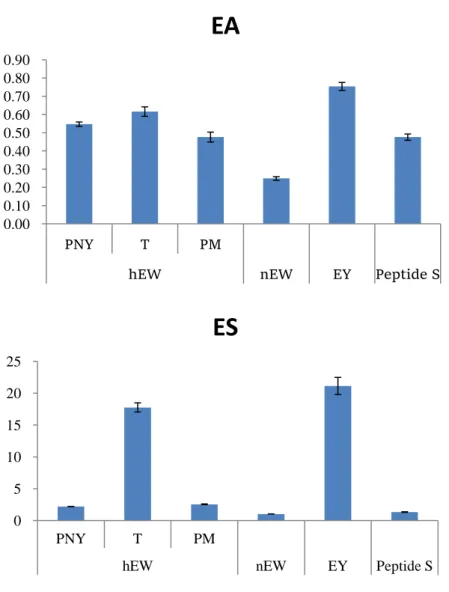
Absorbance (500 nm) observed at T0 was used as an index of EA, ES was calculated by using the equation in the method. Results of EA and ES were shown in Fig. 2-6: among all the hydrolysates, EW hydrolyzed by Thermoase resulted in the best EA and ES, which was comparable to that of EY and much higher than that of NEw. It is noticeable that, regarding EA, almost all the hEW samples were better than NEw, which that partially hydrolysis of egg white contributed to the improvement of EA and ES. Peptide S showed a similar EA with that of PNY and PM, however, ES of Peptide S was such a small value (close to 1), that means turbidity of emulsions after 2h became almost 0, emulsions separated completely. This could suggest that the higher emulsifying properties are obtained for moderate proteolysis. And the highly hydrolyzed products-
37 like Peptide S offered an excellent EA but low ES.
It is well known that protein hydrolysates can be attached to the oil-water interface more efficiently compared to proteins, because of molecular size. However, protein hydrolysates are more difficult to form a network structure due to fewer hydrophobic binding sites (Pokora et al., 2013), resulting in a relative worse ES of protein hydrolysates. Because the complex, folded and coiled protein molecules were cut down into separate units by the previous hydrolysis treatment, the hydrolysate after heating at 90°C (enzyme inactivation temperature) was unable to form a well ordered tertiary network or matrix, resulting in a creamy texture, without causing any gelling or coagulation even heated at 90°C.
2.3.6 Water-holding capacity and oil-binding capacity.
Results of WHC and OBC were shown in Table 2-2. Significant WHC difference existed among hEW (PNY, T and PM), sample T was able to retain nearly 90% of the water that it absorbed. WHC of NEw and Peptide S were fairly low, almost 0, which means that NEw and Peptide S could not retain any water that they absorbed. Regarding OBC, all samples were quite low. Furthermore, OBC decreased after hydrolysis.
2.4 Conclusion
The effects of enzyme kind on the degree of hydrolysis, surface hydrophobicity, and emulsifying properties of EW proteins were evaluated in this part. By using three kinds of enzymes, we could prepare egg white hydrolysates that were all more efficient than native egg white considering emulsifying activity and stability. The optimal enzyme to obtain best emulsifying properties was Thermoase 10F, which is a thermo-stable enzyme. Higher hydrolysis (in the case of Peptide S) resulted in peptides
38
which are with an excellent emulsifying activity but low emulsifying stability. Surface hydrophobicity was found to be an important factor related to the emulsifying activity and stability of hydrolyzed egg white proteins. Moreover, solubility did not differ between NEw and Peptide S, solubility of hEW (PNY, T and PM) decreased compared with NEw. Hydrolysate-T was able to retain nearly 90% of the water that it absorbed, but regarding OBC, all samples were quite low.
39
Fig.2-1 SDS-PAGE for various egg white hydrolysates and native egg white.
I: mixture of water-soluble fraction and water-insoluble fraction. II: water-insoluble fraction. Lane 1: molecular size markers. Lane 2: egg white hydrolyzed by Protin NY100®; Lane 3: egg white hydrolyzed by Thermoase PC10F®; Lane 4: egg white hydrolyzed by Protease M®; Lane 5: highly hydrolyzed commercial egg white peptides;
Lane 6: native egg white.
(kDa)
Lysozyme Ovalbumin Ovotransferrin 75
45
35 25
1 2 3 4 5 6 1 2 3 4 5 6 10
I II
40
Fig.2-2. Solubility and degree of hydrolysis (DH) of egg white hydrolysates. Means within column with no common superscript differ significantly (p < 0.05).
0 20 40 60 80 100
PNY T PM NEw Peptide S
DH (%), Solibility(%)
DH Solubility
a a
b
c d
A
D B
C
E
41
Fig.2-3. Fluorescence emission spectra of ANS in the presence of egg white hydrolysates and native egg white.
0 10 20 30 40 50
400 450 500 550 600
Flurescence Intensity
Wavelength (nm)
PNY T
PM Peptide S
NEw
42
Fig.2-4. Surface hydrophobicity (H0) of hydrolyzed EW samples. The same letters denote the lack of significant differences (p < 0.05).
0 100 200 300 400 500 600
PNY T PM NEw Peptide S
H0
a
b
c d
e
43
Fig.2-5. Particle size distribution of emulsion containing 10% oil and different emulsifiers.
-5 0 5 10 15 20 25 30
0.01 0.1 1 10 100 1000
PNY T PM Peptide S EY
44
Fig. 2-6. Comparison of emulsifying activity (EA) and emulsifying stability (ES).
0.00 0.10 0.20 0.30 0.40 0.50 0.60 0.70 0.80 0.90
PNY T PM
hEW nEW EY Peptide S
EA
0 5 10 15 20 25
PNY T PM
hEW nEW EY Peptide S
ES
45
Table 2-2 Mean diameter of oil droplets (d3,2) in the emulsions stabilized by different egg white hydrolysates, water-holding capacity (WHC) and oil-binding capacity (OBC)
in different egg white hydrolysates and native egg white.
Means ± SD are shown (n=3). In each tested parameter, different superscript letters indicate significant differences between means in the same row (p < 0.05).
PNY T PM Peptide S NEw
d3,2 42.5± 0.50c 27.3± 0.40e 34.1±0.80d 116.8 ±1.12a 106 ±0.30b WHC 14.67 ±3.21c 89.28 ±8.60a 77.63 ±10.68b 0.02 ±0.02d 0.01 ±0.01d OBC 4.15 ±0.12b 2.69 ±0.27c 4.51 ±0.09b 5.60 ±0.72b 8.98 ±0.61a