Japan Advanced Institute of Science and Technology Title
部位特異的RNA編集を用いたインビトロでの青色蛍光タ ンパク質(BFP)から緑色蛍光タンパク質(GFP)への 変換に関する研究
Author(s) Vu, Thi Luyen Citation
Issue Date 2015‑09
Type Thesis or Dissertation Text version ETD
URL http://hdl.handle.net/10119/12982 Rights
Description Supervisor:塚原 俊文, マテリアルサイエンス研究科
, 博士
Study on conversion from blue fluorescent protein (BFP) to green fluorescent protein (GFP) in vitro by using site-directed chemical RNA editing
Tsukahara Laboratory s1040201 VU Luyen Thi 1. Introduction
RNA editing is post-transcriptional process to change one or more nucleotides in the sequences of RNA. This process naturally makes the diversity of protein and various phenotypes [1, 2, 3]. Because the RNA editing is power to recode genetic information of RNA, there are many efforts to control or mimic RNA editing [4, 5]. In this study, we reported a strategy for site-directed non-enzymatic chemical RNA editing that allows application of C-to-U editing. Our method is simple not expensive and non-toxic, and was firstly reported by Prof. Fujimoto.
In his protocol, template-directed DNA photoligation was mediated by artificial oligonucleotides, a short single strand 20-mer target was used and the C-to-U substitution was efficient and sequence-specific in vitro [6]. In our works, this method was studied and developed to apply toward genetic code restoration.
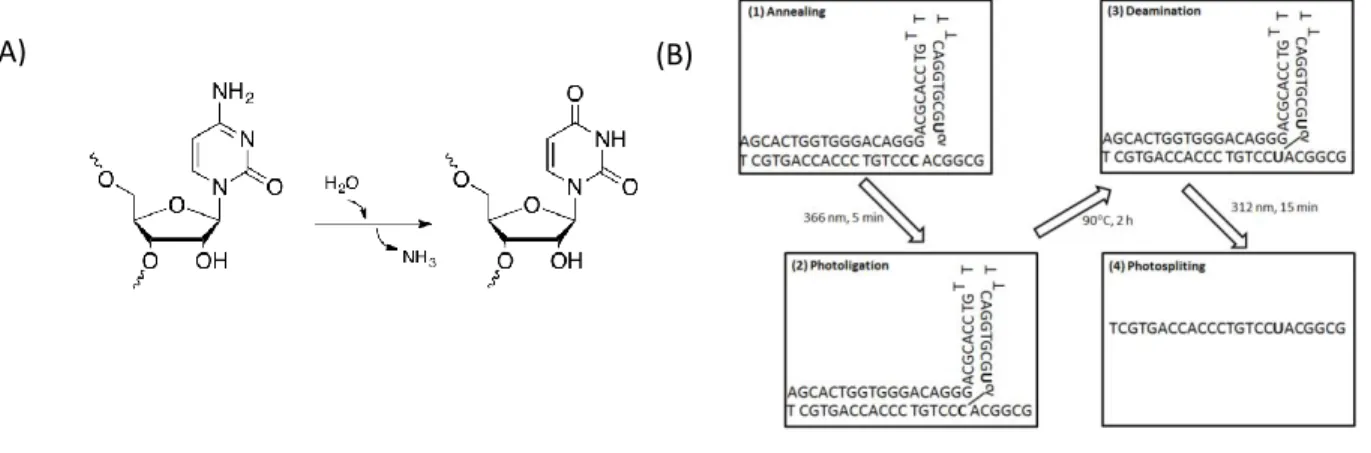
Figure 1: Schematic representation of artificial transition. (A) Deamination of cytidine to uridine. (B) The steps of artificial translation.
2. The application of site-directed chemical RNA editing for treatment of Leigh syndrome
First, a mitochondrial DNA T8993C mutation of Leigh syndrome patient was used as a model. We carried out converted C8993U by artificial site-directed chemical RNA editing.
Figure 2: The efficiency of site-directed deamination. (A) 5 CVU-containing ODNs and a synthetic ss72-nt target at 90 C for 2 h. (B) ODN2 and various targets at 90 C for 2 h. (C) ) ODN2 and various targets at 37 C for 3 days.
(A) (B)
(A) (B) (C)
We designed and synthesized 5 CVU-containing ODNs, and the experimental results revealed that ODN2 could convert C to U most effectively among examined 5 CVU-ODNs (fig.2A). We succeeded a sequence-specific photochemical base substitution toward ss72-nt, ss731-nt, RNA823-nt and total RNA from patient’s cells used as targets at both un-physiological and physiological temperature (fig.2B and 2C). Importantly, we found that almost 10% of full-length RNA was successfully deaminated in vitro under physiological conditions (fig.2C).
3. Change from blue fluorescent protein to green fluorescent protein by chemical RNA editing as novel strategy in genetic restoration
Because of some disadvantages of Leigh syndrome cells in vivo study such as un-well living, slowing growth, unabsorbed exogenous ODN, in order to apply to further in vivo study blue fluorescent protein (BFP), a derivate of green fluorescent protein (GFP) was suggested as new model. BFP differs from GFP by a single nucleotide; a C-to-T change at position 199 transforms the BFP gene into the GFP gene.
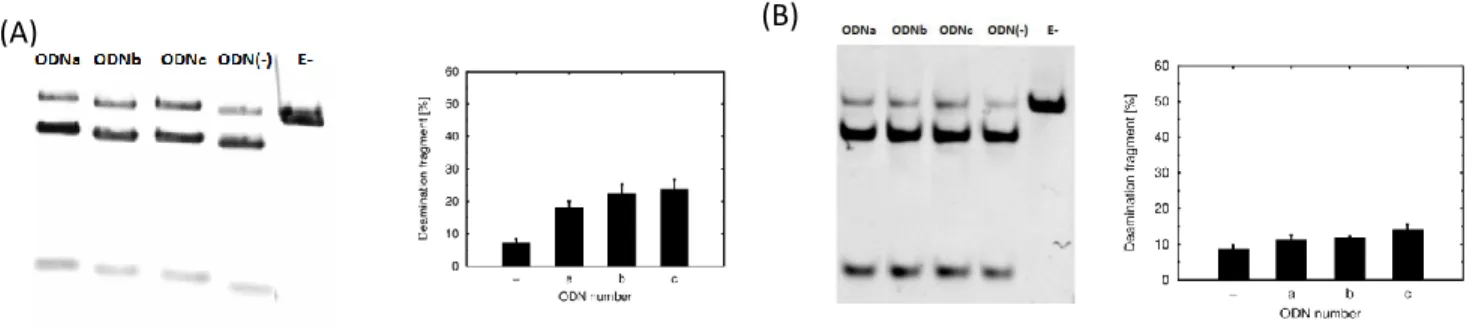
Figure 3: The efficiency of site-directed deamination. (A) 3 CVU-containing ODNs and a synthetic ss100-nt BFP target at 90
C for 2 h and their densitometric results. (B) 3 CVU-containing ODNs and a synthetic ss100-nt BFP target at 37 C for 3 days and their densitometric results.
Figure 4: Efficiency of site-directed deamination between 3 CVU-containing ODNs and a synthetic full-length mRNA BFP target was obtained by measurement of BFP and GFP emission spectra after photochemical deamination at 60 C for 4 h.
We successfully performed site-directed photochemical base substitution in synthetic ss100-nt and in vitro- synthesized full-length BFP mRNA targets. ODNc exhibited most effective C199U transition under both unphysiological and physiological temperature among the three tested CVU-containing ODNs (fig.3, fig.4 and fig.5). ODNc contains longer hairpin sequences than do ODNa and ODNb; this appears to work effectively
(A) (B)
because long sequences increase the stability of ODNs. The C199U transition was more effective in the case of ODNb than in the case of ODNa because the comparatively longer complementary sequence of ODNb will bind more strongly to the target. The relationship between ODN sequences and deamination efficiency is crucial and need further study. We determined that approximate 10% of the full-length mRNA was deaminated in in vitro deamination under physiological temperature (fig.5)
Figure 5: Efficiency of site-directed deamination between 3 CVU-containing ODNs and a synthetic full-length mRNA BFP target was obtained by measurement of BFP and GFP emission spectra after photochemical deamination at 37C for 10 days.
4. The relationships between structures and deamination efficiency of carboxyvinyldeoxyuridine ODNs on chemical RNA editing
The structure and sequence of CVU-containing ODNs are key features of ODNs on its biological functions. To investigate the relationship between the CVU sequences and deamination efficiency, a series of oligodeoxynucleotides (ODNs) were designed and subjected to site-directed non-enzymatic editing.
Figure 6: Efficiency of site-directed deamination between 8 CVU-containing ODNs and (A) synthetic ss100-nt BFP target or (B) a synthetic full-length mRNA BFP target was obtained by measurement densitometric measurements or measurement of BFP and GFP emission spectra after photochemical deamination at 90 C for 2h and 37 C for 10 days respectively.
From these experimental results, we showed that there are strong relationship between the deamination efficiency, and the sequence complementary length and hairpin loop length. The optimal deamination efficiency was achieved with ODNs having a sequence complementary length slightly more than 15nt and a hairpin length of 8nt. In order to confirm our conclusions on the optimum conditions for the ODNs, we designed, synthesized, and surveyed a new ODN with these conditions, i.e., an ODN has a sequence complementary length of 16nt and a hairpin length of 8nt (ODN8). The results were shown that ODN8 has best deamination efficiency comparing to other ODNs (fig.6).
5. Conclusion
We successfully performed site-directed photochemical base substitution to restore the mutated mRNA to a
“healthy RNA” under physiological temperature by using photochemical base substitution. We believe that the site-directed photochemical deamination technology could serve as a new approach for genetic restoration.
(A) (B)
Here, we designed and studied site-directed chemical deamination for genetic restoration in vitro. In vivo studies that include cultured cells and model animals will be conducted in the near future because of the requirement of relatively more complex technology.
References
1. Gray MW. Biochemistry 2012, 51(26): 5235-5242
2. Decher N, Netter MF, Streit AK. Chemical Biology & Drug Design 2013, 81(1): 13-21.
3. Simpson L, Emeson RB. Annual Review of Neuroscience 1996, 19: 27-52.
4. Montiel-Gonzalez MF, Vallecillo-Viejo I, Yudowski GA, Rosenthal JJC. Proc. Natl. Acad. Sci. U.S.A. 2013, 110: 18285–18290.
5. Volgel P, Schneider MF, Wettengel J, Stafforst T. Angew. Chem. Int. Ed. Engl. 2014, 53: 6267–6271.
6. Fujimoto K, Konishi-Hiratsuka K, Sakamoto T, Yoshimura Y. Chem. Commun. 2010, 46: 7545-7547.
Tables of Contents
Chapter I: General Introduction………5 Chapter II: The application of site-directed chemical RNA editing for treatment of Leigh syndrome………..34 Chapter III: Change from blue fluorescent protein to green fluorescent protein by chemical RNA editing as novel strategy in genetic restoration………..53 Chapter IV: The relationships between structures and deamination efficiency of carboxyvinyldeoxyuridine ODNs on chemical RNA editing………77 Chapter V: Final conclusion……….104
List of publications
1. Vu TL, Ooka Y, Alam S, Suzuki H, Fujimoto K, and Tsukahara T: Chemical RNA editing as a possibility novel therapy for genetic disorders. IJAC 2012, 2(6): 237-241.
2. Suzuki H, Takeuchi M, Sugiyama A, Alam AHMK, Vu TL, Sekiyama Y, Dam HC, Ohki S, and Tsukahara T:
Alternative splicing produces structural and functional changes in CUGBP2. BMC Biochemistry 2012, 13:6.
3. Vu TL, Nguyen TKT, Alam S, Sakamoto T, Fujimoto K, Suzuki H and Tsukahara T: Change from Blue Fluorescent Protein to Green Fluorescent protein by Chemical RNA Editing as Novel Strategy in Genetic Restoration. Chemical Biology & Drug Design. doi: 10.1111/cbdd.12592
4. Vu TL, Nguyen TKT, Alam S, Md Thoufic AA, Sakamoto T, Fujimoto K, Suzuki H and Tsukahara T: The Relationship between Structures and Deamination Efficiency of Carboxyvinyldeoxyuridine ODNs on Chemical RNA Editing for Genetic Restoration. In preparation.
Keywords
Chemical RNA editing, deamination, photochemical reaction,