Japan Advanced Institute of Science and Technology
JAIST Repository
https://dspace.jaist.ac.jp/
Title メタンの酸化的カップリングに関するハイスループッ
ト実験と触媒インフォマティクス
Author(s) NGUYEN, THANH NHAT Citation
Issue Date 2020‑09
Type Thesis or Dissertation Text version ETD
URL http://hdl.handle.net/10119/17004 Rights
Description Supervisor:谷池 俊明, 先端科学技術研究科, 博士
High-Throughput Experimentation and Catalyst Informatics for Oxidative Coupling of Methane
Thanh Nhat Nguyen 1720408 Materials informatics (MI) is one rising area, which applies data-oriented approaches to the research and development of materials science. One of fundamental requirements for MI is the presence of a proper dataset in terms of consistency, distribution, and size. Once such a dataset is prepared, an appropriate learning method is selected from the toolbox. While enormous materials data have been accumulated in literature, they suffer from an insufficient scale, non-uniformity, and anthropogenic biases towards good data with the burial of poor data. Moreover, materials properties such as catalyst performance are highly sensitive to process conditions, while individual research groups have commonly employed their own conditions. In order to overcome the problem of the data scarcity in MI, high-throughput experimentation is considered to be the most promising and effective approach. In this thesis, I attempted to establish complete high-throughput experimentation for the generation of a proper dataset, and implement catalyst informatics to extract knowledge from the obtained dataset. The concept was demonstrated by taking oxidative coupling of methane (OCM) reaction as a case study, which is a long researched reaction toward industrialization.
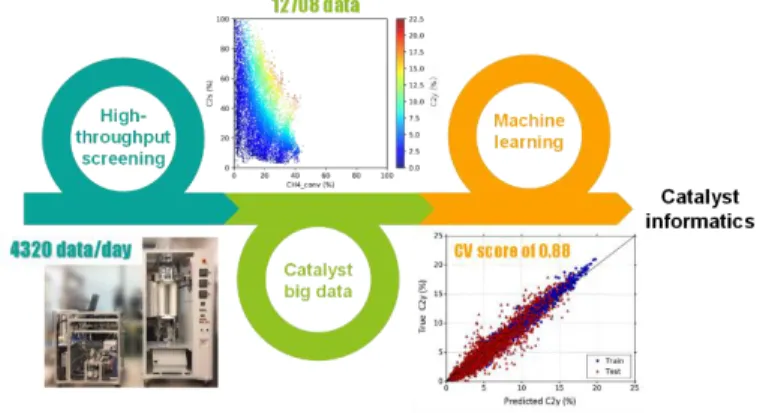
In Chapter 2, a high-throughput screening instrument was successfully developed for automatic performance evaluation of 20 catalysts at a series of predefined conditions in a fixed-bed configuration.
The catalytic test was done in steady states at 900 to 850, 800, 775, 750, and 700 °C. At each temperature, the total flow volume, the CH4/O2 ratio, and the Ar concentration were stepwise varied, leading to 216 conditions per catalysts and 4320 observations for 20 catalysts in a single automated operation. By only 3 operations, 59 catalysts of a Mn-Na2WO4/SiO2 type were successfully evaluated in OCM, which enabled knowledge extraction using common visualization tools and machine learning techniques. It was found that the OCM reaction is generally sensitive to the process conditions, and catalyst design has a great impact on the process dependence. In particular, the modification of Si-based support affects the performance of Mn- Na2WO4 in terms of the low-temperature activation of CH4 and the selectivity tolerance against high O2
concentration.
Figure 1. Concept of catalyst informatics achieved in this thesis.
In order to explore the origin of the low-temperature CH4 activation, in Chapter 3, a series of catalysts were prepared by depositing the Mn–Na–W active phase on various Si-based supports which differed in the pore size, the structure, and the amount of foreign elements (Al, Ti). The OCM performance
of these catalysts was acquired on the developed HTS instrument under various reaction conditions. It was found that high-silica supports were good supports in general, while mesoporous silica supports appeared to be superior at low temperature specifically. From the characterization results, it was elucidated that high- silica supports are advantageous in forming the α-cristobalite phase, which is known to stabilize tetrahedral WO42– and Mn2O3 active species. The mesoporous silica offered the largest accessible surface area to improve the dispersion of the active phase.
In Chapter 4, I aim to discover new catalysts by means of random sampling from a vast materials space, HTS, and data analysis. 300 M1–M2–M3/support catalysts were prepared and evaluated, where M1, M2, M3, and support were randomly selected from a given library. By statistical analysis, I successfully identified individual elements and their binary combinations which are positive for the OCM performance.
Machine learning was employed to generalize the effective catalytic system for OCM. The results not only rediscovered known catalysts obtained in the past three decades, but also newly discovered novel combinations that have never been explored so far.
Based on all of these results, I successfully demonstrated the implementation and power of the MI in the research and development of OCM catalysts, where the presence of high-throughput experimentation was truly indispensable for obtaining a proper dataset.
Keywords: High-throughput experimentation, Catalysts informatics, Oxidative coupling of methane, Machine learning, Combination effect