Japan Advanced Institute of Science and Technology
JAIST Repository
https://dspace.jaist.ac.jp/
Title
アルコキシシラン系外部ドナーとチーグラーナッタ触媒を用いたプロピレン重合の構造性能相関
Author(s)
Poonpong, SupawadeeCitation
Issue Date
2017‑03Type
Thesis or DissertationText version
ETDURL
http://hdl.handle.net/10119/14260Rights
Description
Supervisor:寺野 稔, マテリアルサイエンス研究科,博士
Abstract
The structure-performance relationship of alkoxysilane external donors was explored in terms of catalyst activity, stereospecificity, comonomer incorporation and hydrogen response. Both di- and trialkoxysilanes were used in propylene polymerization.
The introduction of external donor gave lower polymer yield with higher stereoregularity due to the poisoning of the aspecific active sites. The effects of alkoxysilanes depend on the number and size of alkoxy groups as well as those of alkyl groups. The structure-performance relationship of dimethoxysilane was investigated in Chapter 2. It was found that catalyst activity was related to the coadsorption energy of the donors onto MgCl2. Dicyclopentyldimethoxysilane gave not only the highest catalyst activity but also the best stereospecificity from the sterically hindered structure. It can be assumed that structure of alkoxysilanes gives the different ability to prevent deactivation of TiCl4 by alkylaluminum. As results, it was found that an alkoxysilane which adsorbed more strongly on MgCl2 surfaces in DFT calculations tended to give a higher polymer yield. Though the branching at the Cα carbons was a prerequisite for higher isospecificity, the conformation detail around active sites was also important.
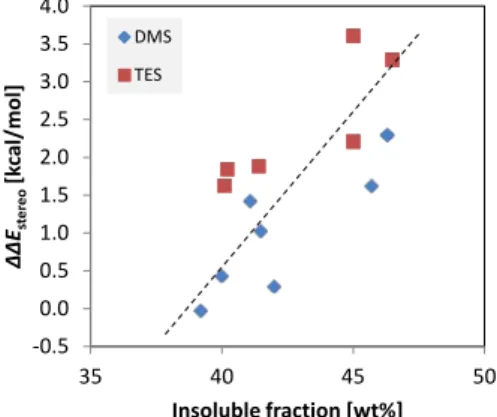
To generalize the structure-performance relationship, effects of triethoxysilane structure on the catalyst performance was also determined and discussed in Chapter 3. It was also found that Similar as dimethoxysilane, an alkoxysilane adsorbed stronger on the MgCl2 surface based on coadsorption model tends to give a higher polymer yield in SF and slurry polymerization while no tendency was found in pressurized polymerization. Moreover, the relationship between insoluble fraction and stereospecificity calculated based on coadsorption model remained valid with the addition of triethoxysilane structures as shown in Figure 1.
From the propylene copolymerization results in Chapter 4, it was found that the presence of ethylene and 1-octene enhanced the polymer yield for all alkoxysilane structures. This can be explained by the enhanced diffusion rate to less-crystalline copolymer. The tendencies of comonomer content in the presence of different types of alkoxysilane were found to be similar for both ethylene and 1-octene, in which alkoxysilane that produced polypropylene with higher isotacticity gives copolymer with less comonomer content. This result indicated that the
incorporation of comonomer was largely governed by the comonomer diffusion. A polypropylene with less tacticity permits better diffusion of comonomer to give a higher incorporation.
To investigate the effect of hydrogen response, propylene polymerization in the presence of hydrogen was conducted using different types of alkoxysilane in Chapter 5. In the absence of hydrogen, molecular weight of the obtained polymer was found to correlate with the stereospecificity. Molecular weight tends to increase with the increase of stereospecificity, probably due to increase of propagation rate. However, this tendency became unclear in the presence of hydrogen. In the presence of hydrogen, triethoxysilanes provided the better hydrogen response compared to dimethoxysilanes. Comparing among dimethoxysilane structures, cyclic alkyl substituents tended to provide better hydrogen response.
The results obtained in this study have provided the information for the developments of new donor system.This study is expected to open the door for the further detailed study of the SPR of other donors in heterogeneous ZN propylene polymerization.
Keywords: Alkoxysilane; Structure-performance relationship; Ziegler-Natta catalyst; propylene polymerization
-0.5 0.0 0.5 1.0 1.5 2.0 2.5 3.0 3.5 4.0
35 40 45 50
ΔΔEstereo[kcal/mol]
Insoluble fraction [wt%]
DMS TES
Figure 1. Correlation between
experimental insoluble fractions from SF polymerization and calculated
stereospecificity of active sites (∆∆Estereo)