
Resultant-factorization Technique for Obtaining Solutions to Ordinary Differential Equations
6
0
0
全文
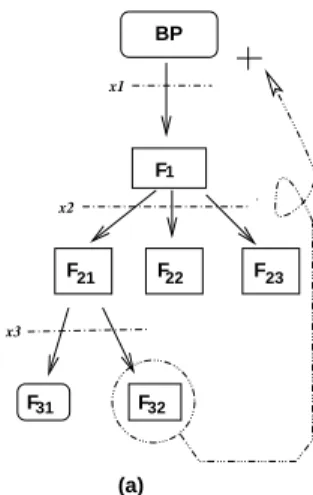
(2) Vol.2011-MPS-84 No.9 2011/7/18 IPSJ SIG Technical Report. to calculate resultants in the next procedure because the resultant of polynomials p and q in x is q r , where q does not contain the variable x and r is the degree of x in p. ( b ) Otherwise, we select a variable as follows: ( i ) We calculate di – the maximum degree of variable xi (1 ≤ i ≤ n) by considering lp. If a single dj is the minimum among di (1 ≤ i ≤ n), xj is returned. ( ii ) If multiple di ’s have the same minimum value, let y1 , y2 , . . . , ym be variables that provide this minimum. We calculate ni , the number of polynomials that contain yi . If a single nj provides the minimum among ni (1 ≤ i ≤ m), yj is returned. ( iii ) If multiple ni ’s provide the same minimum, let z1 , z2 , . . . , zk be the variables that provide this minimum. We calculate ti which means the number of terms in the polynomials that contain zi . Variable zj that provides the minimum and that is calculated first is returned. In (i)-(iii), as an accompanying output, we return the polynomial that contains the returned variable and has the minimum number of terms. ( 7 ) Procedure 7: idealresultant returns a set of resultants on the basis of the output of Procedure 6. We perform Procedures 1,2,. . . ,7 for a given input ideal. Procedure 5 gives rise to branches of Procedures where the main routine is recursively called. Finally, the main routine returns a list of polynomials together with the input original ideal. Prime ideal decomposition can be rapidly performed for each of the polynomials in the list.. BP x1. F1 x2. F21. F22. F23. x3. F31. F32. (a). Fig. 1 Schematic illustration of the resultant-factorization technique. (2) (3) (4). (5). (6). obtained by removing the factors in lp from ideal I. This procedure aims to remove unacceptable factors or mathematically trival factors. Procedure 2: idealclean(ideal I) returns an ideal obtained by removing redundant elements from ideal I. Procedure 3: coefficientcleaner(ideal I, poly p) returns an ideal obtained by removing common factors and p from ideal I. Procedure 4: constant check(ideal I) checks whether or not ideal I has an element composed of only the parameters. If there is such an element , the function returns 0 to indicate the presence of an error in the top-level function. Procedure 5: idealfactorize returns a list of elements that can be factorized over Q in a given ideal; if there are no such elements in the ideal, then √ it returns the given ideal. This is based on the relation < I, f ∗ g > = √ √ < I, f > ∩ < I, g >. Procedure 6: variable choice returns a variable that is to be removed in the next procedure. There are two types of outputs. Let lp be a given list of polynomials. ( a ) In lp, when there is a variable contained in only one polynomial, “variable choice” returns the variable. In this case, it is not necessary. 4. Model In this section, we introduce the Painlev´e VI equation2) ( ) ( ) 1 1 1 1 1 1 1 2 y 00 = + + y0 − + + y0 2 y y−1 y−t t t−1 y−t ( 2 ) α1 α42 t y(y − 1)(y − t) α32 (t − 1) α02 − 1 t(t − 1) + × − + − , t2 (t − 1)2 2 2 y2 2 (y − 1)2 2 (y − t)2. 2. (1). c 2011 Information Processing Society of Japan °.
(3) Vol.2011-MPS-84 No.9 2011/7/18 IPSJ SIG Technical Report. which is an ordinary differential equation. Painlev´e VI equation (1) has four parameters:α0 , α1 , α3 , and α4 . We discuss typical solutions, which are called “rational solutions.” All rational solutions for the equation have been obtained in3) . We can use algebraic geometry for studying the equation (1). However, in general, we cannot use these techniques for all ordinary differential equations. Thus, we treat equation (1) in the condition that we do not know the mathematical structure of the equation (1). We assume rational solutions of the form y(t) = (k0 + k1 t + k2 t2 )/(l0 + t) and substitute these solutions in the equation. We then obtain algebraic equations for the eight variables k0 , k1 , k2 , l0 , α0 , α1 , α3 , and α4 . By using the resultant-factorization technique proposed in the previous section 2, we can determine the solutions. We assume rational solutions of the form y(t) = (k0 + k1 t + k2 t2 )/(l0 + t) and substitute these solutions in the equation (1). Then, we get the following ideal, P = {−k04 × (α1 k0 + (−α1 − α3 )l0 ) × (α1 k0 + (−α1 + α3 )l0 ), . . . , −k24 × (α1 k2 − α1 + α0 ) × (α1 k2 − α1 − α0 )} = {p1 , p2 , . . . , p13 } = 0. (2) For convenience, we define five equations: f1 = α1 k0 + (−α1 + α3 )l0 , f2 = α1 k0 + (−α1 − α3 )l0 , g1 = α1 k2 − α1 + α0 , g2 = α1 k2 − α1 − α0 , and h = k0 − l0 k1 + l02 k2 . Hence, we can divide the original problem(P = 0) to the six cases, P1 = {f1 , p2 , · · · , p12 , g1 } = 0, P2 = {f1 , p2 , · · · , p12 , g2 } = 0, P3 = {f2 , p2 , · · · , p12 , g1 } = 0, P4 = {f2 , p2 , · · · , p12 , g2 } = 0, P5 = {k0 , p2 , · · · , p12 , p13 } = 0, P6 = {p1 , p2 , · · · , p12 , k2 } = 0.. ( 2 ) Step 2: we compute, (0). (0). We factorize R2. (1). (0). S2. (0). (1). (0). T3. (0). (1). (1). (1). (0). (1). (1). (0). (1). (1). (1). (1). (0). (1). (0). T3. (0). T4. Q12 . k2 − 1. (1). = resultantα1 (S2 , S3 ), . . . , T11 = resultantα1 (S2 , S11 ). (0). (0) T11 (1). R2 (1) (0) (1) (0) , R = R3 , . . . , R12 = R12 . l0 (k0 − l0 ) 3. (0). (1). (1). We factorize T2 , · · · , T11 and set T3 , . . . , T11 ,. (1) (1) Q1 , . . . , Q12 , (0). (1). = resultantα4 (R12 , R2 ), . . . , S11 = resultantα4 (R12 , R11 ). (0). (0). (1). (1). We factorize S2 , · · · , S11 and set S2 , . . . , S11 , √ √ (0) (0) ( )2 ( )2 S S3 (0) (1) (1) (0) (1) (1) 4 2 S = l S , S = , S2 = 4l04 S2 , S2 = 0 3 2 4l04 3 l04 ··· √ (0) ( )2 ( )2 S10 (0) (1) (1) (0) (1) 4 2 S10 = l04 S10 S = l (k − 1) , S2 = , S , 0 2 11 11 l04 √ (0) S11 (1) S2 = 4 l0 (k2 − 1)2 ( 4 ) Step 4: we compute,. (0). Q1 = Q1 , . . . , Q11 = Q11 , Q12 = (k2 − 1)Q12 , Q12 =. (1). ( 3 ) Step 3: we compute,. (0). and set. (1). (0). (1). (. (1). = l06 (k2 − 1)2 (k0 − l0 )2 h2 T3. )2. ( )2 (1) (1) = l04 (k2 − 1)2 h2 T4 , T4 =. Q12 = resultantα0 (g1 , p12 ). We factorize. (0). and set R2 , . . . , R12 ,. (0). Q1 = resultantα0 (g1 , f1 ), Q2 = resultantα0 (g1 , p2 ), . . . (0) Q12. (1). R2 = l0 (k0 − l0 )R2 , R2 =. We explain the resultant-factorization technique for the case of P1 = 0 in detail. Thus, we consider the ideal, < f1 , p2 , · · · , p12 , g1 > . We compute solutions in the case of f1 = 0 and g1 = 0 as follows, ( 1 ) Step 1: we compute, (0). (1). R2 = resultantα3 (Q1 , Q2 ), . . . , R12 = resultantα3 (Q1 , Q12 ).. = l04 (k2 − 1)2 h2. (. (1) T11. )2. √ (1) , T11. =. (1). , T3 √. √. =. (0). T3 6 l0 (k2 − 1)2 (k0 − l0 )2 h2. (0). T4 ,··· , l04 (k2 − 1)2 h2 (0). T11 . l04 (k2 − 1)2 h2. ( 5 ) Step 5: from the process of the above-mentioned computation, we can assume the following conditions, k2 6= 1, l0 6= 0, k0 6= l0 , h 6= 0, k0 6= 0.. 3. c 2011 Information Processing Society of Japan °.
(4) Vol.2011-MPS-84 No.9 2011/7/18 IPSJ SIG Technical Report. ( 6 ) Step 6: we compute the Gr¨ obner basis(G0 )4) of the ideal, < (1) (1) T3 , · · · , T11 > . ( 7 ) Step 7: by using saturation technique4) , we remove the component k2 − 1 from the ideal(G0 ), G1 =< G0 , 1 − u(k2 − 1) > . ( 8 ) Step 8: by using saturation technique, we remove the component l0 from the ideal(G1 ), G2 =< G1 , 1 − u(l0 ) > . ( 9 ) Step 9: by using saturation technique, we remove the component k0 − l0 from the ideal(G2 ), G3 =< G2 , 1 − u(k0 − l0 ) > . ( 10 ) Step 10: by using saturation technique, we remove the component h from the ideal(G3 ), G4 =< G3 , 1 − u(h) > . ( 11 ) Step 11: by using saturation technique, we remove the component k0 from the ideal(G3 ), G5 =< G4 , 1 − u(k0 ) > . ( 12 ) Step 12: we can get the ideal(G6 ) by using computation of the following ideal, G6 =< G5 , P1 > . ( 13 ) Step 13: we get solutions(D1 ) from G6 by using prime ideal decomposition.. Table 1 computing Cases f1 = 0 & g1 = 0 f1 = 0 & g2 = 0 f2 = 0 & g1 = 0 f2 = 0 & g2 = 0. time for different cases Time Solutions 4m34s D1 4m46s D2 4m35s D3 4m41s D4. Cases k0 = 0 l0 = 0 k2 = 0. Time 351m56s 45s 146m14s. Solutions D5 D6 D7. Cases k2 = 1 k0 = l0 h=0. Time 7s 78m57s 3s. Solutions D8 D9 D10. D1 = {{α1 + 2, k1 + 2k2 + α4 , −k1 + α3 + 1, 2k2 − α0 − 2, −k1 + 2l0 k2 − l0 , −2k0 + l0 k1 + l0 , (−4k2 + 2)k0 + k12 + k1 }, · · · {k1 + 2k2 − 2, k0 − k2 − l0 + 1, α4 + 2, α1 − α3 − α0 + 1, α3 l0 − α1 + α3 − 1, −α1 k2 + α3 − 1}, · · · } = 0 D5 = {{l0 , k2 , −α3 + α4 + α1 , α0 + 1, −α4 − k1α1 }, · · · {l0 , k1 + k2 − 1, α4 + 1, α0 + α3 + α1 , α3 + k2 α1 }, · · · {l0 , α1 + 1, α4 + k1 + k2 , α3 + k1 − 1, α0 + k2 − 1}, · · · {l0 , k2 , k1 − 1, α3 }, {k2 , k1 − l0 − 1, α1 + 1, −α0 + α3 + α4 , (l0 + 1)α3 + l0 α4 }, · · · {k2 , α4 + 1, α0 + α3 + α1 + 2, (l0 + 1)α3 + α1 + l0 + 1, k1α1 + l0 + 1, k1α3 + k1 − 1}, · · · {k2 , k1 − l0 − 1, α1 − 1, −α0 + α3 + α4 , (l0 + 1)α3 + l0 α4 }, · · · {k2 , α4 + 1, −α0 − α3 + α1 − 2, (l0 + 1)α3 − α1 + l0 + 1, k1α1 − l0 − 1, k1α3 + k1 − 1}, · · · {k1 − l0 k2 , α3 + 1, α0 − α4 + α1 , −α4 + k2 α1 }, · · · {k1 + k2 − l0 − 1, −α3 + α4 − α1 + 2, α0 + 1,. 5. Timing data If we do not use the resultant-factorization technique, we cannot obtain all the solutions for the ideal (2) within 48 h. However, we can compute solutions with Table 1 by using the resultant-factorization technique. Since the solutions of the equation (1) has a large number of irreducible affine varieties, the resultantfactorization technique functions effectively. Table 1 shows the computing times for the different cases. All the algorithms are implemented on Risa/Asir ?1 and measurements are performed on a PC with Intel Core i7 920 and 12 GB of main memory. 6. Solutions We show D1 , D5 , D6 , D7 , D8 , D9 and D10 .. ?1 http://www.math.kobe-u.ac.jp/Asir/asir.html. 4. c 2011 Information Processing Society of Japan °.
(5) Vol.2011-MPS-84 No.9 2011/7/18 IPSJ SIG Technical Report. −α4 − l0 α1 − 1, (k2 − 1)α1 + 1, (−k2 + 1)α4 − k2 + l0 + 1}, · · · {k1 + 1, α3 + 2, α0 − α4 + α1 + 1, l0 α4 + α1 + 1, −α4 + k2 α1 + 1}, · · · {k1 − l0 k2 , α3 + 1, −α0 + α4 + α1 , −α4 − k2 α1 }, · · · {k1 + k2 − l0 − 1, −α3 − α4 − α1 + 2, α0 − 1, α4 − l0 α1 − 1, (k2 − 1)α1 + 1, (k2 − 1)α4 − k2 + l0 + 1}, · · · {k1 + 1, α3 + 2, −α0 + α4 + α1 + 1, −l0 α4 + α1 + 1, −α4 − k2 α1 − 1}, · · · {k2 , k1 − l0 − 1, α1 + 1, α0 + α3 + α4 , (l0 + 1)α3 + l0 α4 }, · · · {k2 , α4 + 1, −α0 + α3 + α1 + 2, (l0 + 1)α3 + α1 + l0 + 1, k1α1 + l0 + 1, k1α3 + k1 − 1}, · · · {k2 , k1 − l0 − 1, α1 − 1, α0 + α3 + α4 , (l0 + 1)α3 + l0 α4 }, · · · {k2 , α4 + 1, α0 − α3 + α1 − 2, (l0 + 1)α3 − α1 + l0 + 1, k1α1 − l0 − 1, k1α3 + k1 − 1}, · · · , {k2 , k1, α4 }, {k1 − l0 k2 , α3 + 1, α0 + α4 + α1 , α4 + k2 α1 }, · · · {k1 + k2 − l0 − 1, −α3 − α4 − α1 + 2, α0 + 1, α4 − l0 α1 − 1, (k2 − 1)α1 + 1, (k2 − 1)α4 − k2 + l0 + 1}, · · · {k1 + 1, α3 + 2, α0 + α4 + α1 + 1, −l0 α4 + α1 + 1, α4 + k2 α1 + 1}, · · · {k1 − l0 k2 , α3 + 1, −α0 − α4 + α1 , α4 − k2 α1 }, · · · {k1 + k2 − l0 − 1, −α3 + α4 − α1 + 2, α0 − 1, −α4 − l0 α1 − 1, (k2 − 1)α1 + 1, (−k2 + 1)α4 − k2 + l0 + 1}, · · · , {k2 − 1, k1 − l0 , α0 }, {k1 + 1, α3 + 2, −α0 − α4 + α1 + 1, l0 α4 + α1 + 1, α4 − k2 α1 − 1}, · · · } = 0. D7 = {{k0 , α4 + 1, α1 + α3 + α0 + 2, (α3 + 1)l0 + α1 + α3 + 1, α1 k1 + l0 + 1, (α3 + 1)k1 − 1}, · · · {k1 − l0 − 1, k0 , α1 + 1, α4 − α3 + α0 , (α4 − α3 )l0 − α3 }, · · · {k0 , α4 + 1, α1 − α3 + α0 + 2, (α3 − 1)l0 − α1 + α3 − 1, α1 k1 + l0 + 1, (α3 − 1)k1 + 1}, · · · {k1 − l0 − 1, k0 , α1 + 1, α4 + α3 + α0 , (α4 + α3 )l0 + α3 }, · · · {k1 , k0 , α4 }, {k0 − l0 k1 , α1 − α4 + α3 , α0 + 1, α1 k1 − α4 }, · · · {k0 + k1 − l0 − 1, α3 − 1, α1 − α4 + α0 + 2, (α4 − 1)l0 + α1 , α1 k1 + l0 − α1 , (α4 − 1)k1 − α4 }, · · · {k1 + l0 , −α1 + α4 − α3 − 1, α0 + 2, (−α1 − 1)l0 − α4 , −α1 k0 + (α4 − 1)l0 , (−l0 − α4 )k0 + (−α4 + 1)l02 }, · · · {k1 + l0 , −α1 + α4 − α3 + 1, α0 + 2, (−α1 + 1)l0 − α4 , −α1 k0 + (α4 + 1)l0 , (l0 − α4 )k0 + (−α4 − 1)l02 }, · · · {k0 − l0 k1 , α1 + α4 + α3 , α0 + 1, α1 k1 + α4 }, · · · {k0 + k1 − l0 − 1, α3 − 1, α1 + α4 + α0 + 2, (α4 + 1)l0 − α1 , α1 k1 + l0 − α1 , (α4 + 1)k1 − α4 }, · · · {k1 + l0 , −α1 − α4 − α3 − 1, α0 + 2, (−α1 − 1)l0 + α4 , −α1 k0 + (−α4 − 1)l0 , (−l0 + α4 )k0 + (α4 + 1)l02 }, · · · {k1 + l0 , −α1 − α4 − α3 + 1, α0 + 2, (−α1 + 1)l0 + α4 , −α1 k0 + (−α4 + 1)l0 , (l0 + α4 )k0 + (α4 − 1)l02 }, · · · {k0 − l0 k1 , α1 + α4 − α3 , α0 + 1, −α1 k1 − α4 }, · · · {k0 + k1 − l0 − 1, α3 + 1, α1 + α4 + α0 + 2, (α4 + 1)l0 − α1 , α1 k1 + l0 − α1 , (α4 + 1)k1 − α4 }, · · · {k1 + l0 , −α1 − α4 + α3 − 1, α0 + 2, (α1 + 1)l0 − α4 , α1 k0 + (α4 + 1)l0 , (−l0 + α4 )k0 + (α4 + 1)l02 }, · · · {k1 + l0 , −α1 − α4 + α3 + 1, α0 + 2, (α1 − 1)l0 − α4 , α1 k0 + (α4 − 1)l0 , (l0 + α4 )k0 + (α4 − 1)l02 }, · · · {k0 − l0 k1 , α1 − α4 − α3 , α0 + 1, −α1 k1 + α4 }, · · · {k0 + k1 − l0 − 1, α3 + 1, α1 − α4 + α0 + 2, (α4 − 1)l0 + α1 , α1 k1 + l0 − α1 , (α4 − 1)k1 − α4 }, · · · {k1 − 1, k0 − l0 , α3 }, {k1 + l0 , −α1 + α4 + α3 − 1, α0 + 2, (α1 + 1)l0 + α4 , α1 k0 + (−α4 + 1)l0 , (−l0 − α4 )k0 + (−α4 + 1)l02 }, · · · } = 0. D6 = {{k2 , k0 + k1 − 1, α1 , α3 + 1, α4 + α0 + 2, (α4 + 1)k1 − α4 }, · · · {k1 + 2k2 − 2, k0 − k2 + 1, α1 , α4 + 2, α3 + 1, α0 }, · · · {k1 + k2 − 1, k0 , α4 + 1, α1 + α3 + α0 , α1 k2 + α3 }, · · · {k2 , k0 , α1 + α4 − α3 , α0 + 1, −α1 k1 − α4 }, · · · {k0 , α1 + 1, k1 + k2 + α4 , k1 − α3 − 1, k2 + α0 − 1}, · · · {k1 + k2 − 1, k0 , α4 + 1, α1 + α3 − α0 , −α1 k2 − α3 }, · · · {k1 , k0 , α3 + 1, α1 + α4 + α0 , α1 k2 + α4 }, · · · {k1 , k0 , α3 + 1, α1 + α4 − α0 , −α1 k2 − α4 }, · · · {k2 , k1 , α1 , α4 , α3 + 1, α0 + 2}, · · · , {k2 , k1 − 1, k0 , α3 }, {k2 , k1 , k0 , α4 }, {k2 − 1, k1 , k0 , α0 }} = 0. 5. c 2011 Information Processing Society of Japan °.
(6) Vol.2011-MPS-84 No.9 2011/7/18 IPSJ SIG Technical Report. D8 = {{k1 + 1, k0 , α1 + 1, α4 , α3 + 2, α0 }, · · · , {k1 − l0 , k0 , α0 }, {k0 − l0 k1 + l02 , α1 + 1, k1 − l0 + α4 + 1, k1 − l0 + α3 − 1, α0 }, · · · {k1 − l0 , 2k0 − l02 − l0 , α1 + 2, l0 + α4 + 2, l0 + α3 − 1, α0 }, · · · {k0 − l0 k1 + l02 , α1 + 1, k1 − l0 + α4 + 1, k1 − l0 − α3 − 1, α0 }, · · · {k1 − l0 , 2k0 − l02 − l0 , α1 + 2, l0 + α4 + 2, l0 − α3 − 1, α0 }, · · · {k1 , k0 − l0 , α1 + 1, α4 + 2, α3 , α0 }, · · · } = 0. References 1) H. Yoshida, K. Kimura, N. Yoshida, J. Tanaka, and Y. Miwa: Algebraic approaches to underdetermined experiments in biology, Vol.3, pp.62–69 (2010). 2) K. Kajiwara, T. Masude, M. Noumi, Y. Ohta, and Y. Yamada: Determinant formulas for the Toda and discrete Toda equations, Funkcial. Ekvac., Vol.44, pp.291–307 (2001). 3) M. Mazzocco: Rational solutions of the Painlev´e VI equation, J. Phys. A: Math. Gen., Vol.34, pp.2281–2294 (2001). 4) T. Shimoyama and K. Yokoyama: Localization and primary decomposition of polynomial ideals, J. Symbolic Comput., Vol.22(3), pp.247–277 (1996). 5) T. Sturm and A. Weber: Investigating genetic methods to solve Hopf bifurcation problems in algebraic biology, Algebraic Biology (K.Horimoto, G. Regensburger, M. Rosenkranz, and H.Yoshida, ed.), Lecture Notes in Computer Science, Vol.5147, Springer(Heidelberg), pp.200–215 (2008). 6) Y. Kawano, K. Kimura, H. Sekigawa, M. Noro, K. Shirayanagi, M. Kitagawa, and M. Ozawa: Existence of the exact CNOT on a quantum computer with the exchange interaction, Quantum Inf. Process., Vol.4(2), pp.65–85 (2005).. D9 = {{l0 , k1 , α3 − 1, α1 − α4 − α0 , α1 k2 − α4 }, · · · {l0 , k2 − 1, k1 , α0 }, · · · {2l0 − 1, 2k2 − 1, k1 − 1, α1 − 2, α4 + 2, α3 − 2, α0 − 1}, · · · {2l0 − 1, 2k2 + 1, k1 + 1, α1 − 2, α4 + 2, α3 − 2, α0 − 3}, · · · {k2 − 1, k1 − l0 , α1 l0 − α1 + α4 , α0 , l02 − l0 + 1, α12 l0 − α12 + α32 + 1}, {k2 − l0 , k1 − l0 + 1, α1 l0 − α4 , α3 − 1, α1 l0 − α1 + α0 , l02 − l0 + 1}, · · · {k2 − 1, k1 − l0 , α0 , l02 − l0 + 1, α12 l0 − α12 + α32 + 1}, {k2 − 1, k1 − l0 , α0 , l02 − l0 + 1}} = 0 D10 = {{k2 , k1 , α4 }, {k1 − l0 k2 , α3 + 1, α1 + α4 + α0 , α1 k2 + α4 }, · · · {k2 − 1, k1 − l0 , α0 }, {k2 , α1 + α4 + α3 , α0 + 1, α1 k1 + α4 }, · · · {k1 + (−l0 + 1)k2 − 1, α4 + 1, α1 + α3 + α0 , α1 k2 + α3 }, · · · {α1 + 1, k1 + (−l0 + 1)k2 + α4 , k1 − l0 k2 + α3 − 1, k2 + α0 − 1}, · · · {k1 + (−l0 + 1)k2 − 1, α4 + 1, α1 + α3 − α0 , −α1 k2 − α3 }, · · · {α1 + 1, k1 + (−l0 + 1)k2 + α4 , k1 − l0 k2 + α3 − 1, k2 − α0 − 1}, · · · {k2 , α1 + α4 − α3 , α0 + 1, −α1 k1 − α4 }, · · · , {k2 , k1 − 1, α3 }, {k1 + (−l0 + 1)k2 − 1, α4 + 1, α1 − α3 + α0 , α1 k2 − α3 }, · · · {α1 + 1, k1 + (−l0 + 1)k2 + α4 , k1 − l0 k2 − α3 − 1, k2 + α0 − 1}, · · · {k1 + (−l0 + 1)k2 − 1, α4 + 1, α1 − α3 − α0 , −α1 k2 + α3 }, · · · {α1 + 1, k1 + (−l0 + 1)k2 + α4 , k1 − l0 k2 − α3 − 1, k2 − α0 − 1}, · · · } = 0 7. Conclusion We proposed the technique for obtaining solutions to ordinary differential equations. And, we also demonstrated the implementation of this technique and showed its timing data. If we do not use the resultant-factorization technique, we cannot obtain all the solutions for the ideal (2) within 48 h. However, we can compute solutions with Table 1 by using resultant-factorization technique.. 6. c 2011 Information Processing Society of Japan °.
(7)
図

関連したドキュメント
We investigate the existence and nonexistence of positive solutions of a system of second- order nonlinear ordinary differential equations, subject to integral boundary
By con- structing a single cone P in the product space C[0, 1] × C[0, 1] and applying fixed point theorem in cones, we establish the existence of positive solutions for a system
Some new sufficient conditions are obtained for the existence of at least single or twin positive solutions by using Krasnosel’skii’s fixed point theorem and new sufficient conditions
This approach is not limited to classical solutions of the characteristic system of ordinary differential equations, but can be extended to more general solution concepts in ODE
Some classes of FDE that can be reduced to ordinary differential equations are considered since they often provide an insight into the structure of analytic solutions to equations
Kostin, On the question of the existence of bounded particular solutions and of particular solutions tending to zero as t → +∞ for a system of ordinary differential equations.
The theory of generalized ordinary differential equations enables one to inves- tigate ordinary differential, difference and impulsive equations from the unified standpoint...
Keywords and Phrases: Calculus of conormal symbols, conormal asymptotic expansions, discrete asymptotic types, weighted Sobolev spaces with discrete asymptotics, semilinear
