
Performance Comparison of Power-Proportional Approaches in Power Saving of Storage Systems
2
0
0
全文
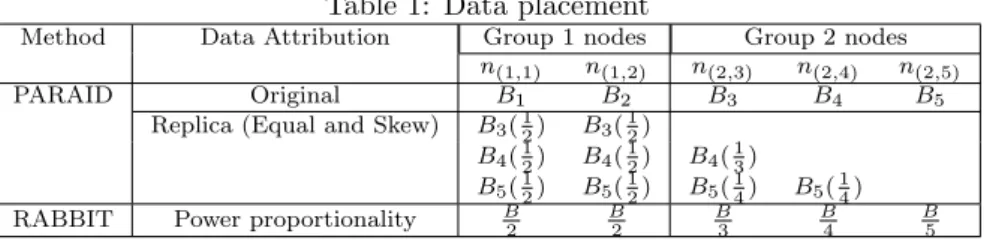
(2) 情報処理学会第 73 回全国大会. Table 1: Data placement Method. Data Attribution. PARAID. Original Replica (Equal and Skew). RABBIT. Read performance [MB/s]. 20. B 2. Power proportionality. 16 14 12 10 8 1. 2. 3 4 5 6 Number of active nodes. 7. 8. 4. Figure 1: Read only performance comparison sidered to be able to provide the power-proportional characteristic that performance is proportional with the power consumption of the system. Table 1 gives an example of data placement of both methods for 5-node cluster storage system with 2 groups. Here, the system can operate in 2 gears, Gear 1 with Group 1 nodes are power on and Gear 2 with all nodes are active.. 3. B 2. Group 2 nodes n(2,3) n(2,4) n(2,5) B3 B4 B5 B4 ( 13 ) B5 ( 14 ) B 3. B5 ( 14 ) B 4. B 5. needs at least 7 nodes to fully store 2-replica 10 GB dataset. It can be seen from this results is that both two approaches were success in providing the powerproportionality to system as the read throughput was improved as the number of active nodes increased. In addition, PARAID gained better performance than RABBIT for both cases because of better load balancing between active nodes. Here, it is well recognized that the load balancing function in [4] is still not implemented yet. The further experiment to reconfirm these results is left as future work.. PARAID RABBIT. 18. Group 1 nodes n(1,1) n(1,2) B1 B2 B3 ( 12 ) B3 ( 12 ) B4 ( 12 ) B4 ( 12 ) B5 ( 12 ) B5 ( 12 ). Experiments. In this section, the empirical experiments to compare complete read performance of two approaches is reported. We decided to implement the data placement of both approaches over HDFS. Our testbed consisted a server performing functions of a namenode and a rack containing a number of storing nodes which play roles of datanodes as in HDFS. Each storing node was designed for low power consumption, which is used as a node of autonomous disks and consisted Transmeta Efficeon TM8600 1.0 GHz processor, 512 MB DRAM memory, 250 GB disk (2.5 inch) with Linux 2.6.18 kernel, JDK-1.6.0 and HDFS’s stable version 0.20.2. The block size was kept as default value in HDFS (64MB). The 10 GB-dataset was at first written into the system and then was requested to be fully read by a client. The number of replica in RABBIT was fixed to 2. The number of active nodes was specified through command line and the memory cache was cleared between runs. Figure 1 shows the performance result for reading all the storing dataset from system when the number of active nodes was set to 2 and 7. Here, it means that Gear 1 needs 2 active nodes while Gear 2 need all 7 nodes to be active. Note that in our case, RABBIT. Conclusion. The empirical experiment to evaluate performance of PARAID and RABBIT was reported in this paper. Through the results, it is seen that both approaches were able to provide power-proportionality to systems. In the future, evaluations on power consuming and other performance metric with workloads would be considered.. Acknowledgement This work is partly supported by Grants-in-Aid for Scientific Research from Japan Science and Technology Agency (A) (#22240005) and MEXT (#21013017).. References [1] B.L. Andre, and H. Urs, “The Case for EnergyProportional Computing,” Computer, vol. 40, no. 12, pp. 33–37, 2007. [2] W. Charles, O. Mathew, Q. Jin, W.A.I. Andy, R. Peter, and K. Geoff, “PARAID: A GearShifting Power-Aware RAID,” Trans. on Storage, vol. 3, 2007. [3] B. Mao, D. Feng, H. Jiang, S. Wu, J. Chen, and L. Zeng, “GRAID: A Green RAID Storage Architecture with Improved Energy Efficiency and Reliability,” in the Proc. IEEE International Symposium on Modeling, Analysis and Simulation of Computers and Telecommunication Systems., pp. 1–8, 2008. [4] A. Hrishikesh, C. James, G. Varun, G. Gregory R., K. Michael A., and S. Karsten, “Robust and Flexible Power-Proportional Storage,” in the Proceeding of the 1st ACM Symposium on Cloud Computing, pp. 217–228, ACM, 2010. [5] “Hadoop,” http://hadoop.apache.org.. 1-534. Copyright 2011 Information Processing Society of Japan. All Rights Reserved..
(3)
図
関連したドキュメント
An example of a database state in the lextensive category of finite sets, for the EA sketch of our school data specification is provided by any database which models the
A functor L which preserves the structure of a topos must be left exact (preserve finite limits) and preserve power objects in the sense that L applied to each power object
We study a refinement of the depth of the external node of rank s, with 0 ≤ s ≤ 2n, where the external nodes are ranked/enumerated from left to right according to an
We argue inductively for a tree node that the graph constructed by processing each of the child nodes of that node contains two root vertices and that these roots are available for
The main idea of computing approximate, rational Krylov subspaces without inversion is to start with a large Krylov subspace and then apply special similarity transformations to H
Then it follows immediately from a suitable version of “Hensel’s Lemma” [cf., e.g., the argument of [4], Lemma 2.1] that S may be obtained, as the notation suggests, as the m A
In this paper, for each real number k greater than or equal to 3 we will construct a family of k-sum-free subsets (0, 1], each of which is the union of finitely many intervals
Definition An embeddable tiled surface is a tiled surface which is actually achieved as the graph of singular leaves of some embedded orientable surface with closed braid
