ロバスト
Nash
均衡問題に対する解の一意存在性について
The
uniquenessofthe robust Nashequilibrium
in $N$-person
noncooperativegames
京都大学・情報学研究科 西村亮一 (Ryoichi Nishimura)
林俊介(ShunsukeHayashi)
福島雅夫(MasaoFukushima)
GraduateSchool ofInfomatics, Kyoto University
1
lntroduction
In this
paper, we
consider N-person noncooperative games with uncertain data. For them,distribution-freemodels based
on
the worst-case analysis attractmuchattentioninrecentyears
[1, 13].In such models, each player makes
a
decision according to the idea of robustoptimization [5, 6, 8].Originally, robust optimization is
a
technique for handling optimization problems with uncertainparameters, inwhichthose uncertain parameters
are
assumed tobelong to so-called uncertaintysets,andthen the objectivefunctionis minimized(ormaximized)by takingintoaccountthe worst possible
case.
An equilibrium resulting from the robust optimization by each player is called a robust Nashequilibrium, and theproblem offinding
a
robust Nash equilibriumis calleda
robustNashequilibriumproblem. Hayashi, Yamashita, andFukushima [13]defined the conceptof robust Nash equilibria for
bimatrix
games.
Under the assumption that uncertain setsare
expressed bymeans
ofthe Euclideanor the Frobenius norm, they showed that each player’s problem reduces to
a
second-ordercone
program
(SOCP) [2] andtherobustNash equilibriumproblemcan
be reformulatedas
a
second-ordercone
complementarity problem (SOCCP) [11, 12]. In this paper, we extend the definition ofrobustNash equilibria in [1] and [13] to N-person non-cooperative gameswith nonlinearcost functions. In
particular,
we
showexistence
of robust Nash equilibria under theassumption that each player’scostfunction is
convex
with respect to his strategy, while [1] and [13] only considered the linearcase.
Moreover,
we
givesome
sufficientconditionsforuniquenessofa
robust Nash equilibrium. In orderto
solve certainclassesof robust Nash equilibriumproblems,
we
reformulatethem tosecond-ordercone
complementarityproblems.
Throughoutthe
paper, we use
thefollowingnotations. Fora
set $X,$$\mathcal{P}(X)$ denotesthe setconsistingofallthesubsets of X. $\Re_{+}^{n}$ denotesthenonnegativeorthantin$\Re^{rl}$,that is, $\Re_{+}^{n};=\{x\in\Re^{n}|Xi\geq 0(i=$
$1,$
$\ldots,$$n)\}$
.
Fora
vector$x\in\Re^{n},$ $||x||$ denotesthe Euclideannorm
defined by $||x||$ $:=\sqrt{x^{T}x}$.
Forama-trix$M=(M_{ij})\in\Re^{nxm},$ $||M||_{F}$ is theFrobenius
norm
$de!ined$by $||M||_{F}$ $:=( \sum_{i=l}^{n}\sum_{j=1}^{m}(M_{\iota’j})^{2})^{1/2}$.
2 Robust Nash
equilibrium
In this
paper, we
consideran
$N$-personnon-cooperativegamein whicheachplayertriestominimizehis
own
cost. Let$x^{i}\in\Re^{m_{i}}$, $Si\subseteq\Re^{m_{i}}$, and$f_{i}$ : $\Re^{m_{i}}x\Re^{m-j}arrow\Re$beplayer$i$’s strategy, strategyset,andcost function,respectively. Moreover,
we
denote$\mathcal{I}:=\{1, \ldots, N\}$, $\mathcal{I}_{-i};=\mathcal{I}\backslash \{i\}$,
$m:= \sum_{j\in \mathcal{I}}m_{j}$, $m_{-i}:= \sum_{j\in \mathcal{I}_{-j}}m_{j}$,
$x:=(x^{j})_{j\in \mathcal{I}\in\Re^{m}}$, $x^{-i}:=(x^{j})_{j\in \mathcal{I}_{-j}}\in\Re^{\prime n_{-j}}$, $S:= \prod_{j\in \mathcal{I}}S_{j}\subseteq\Re^{m}$, $s_{-i}:= \prod_{j\in \mathcal{I}_{-i}}s_{j}\subseteq\Re^{ln-i}$
.
When the complete information is assumed, each player $i$ decides his
own
strategy by solving thefollowing optimizationproblemwith theopponents’ strategy$x^{-i}$ fixed:
minimize $f_{i}(x^{i}, x^{-i})$
$x^{\dot{\iota}}$
(2.1)
subject to $x^{i}\in S_{i}$
.
A tuple $(\overline{x}^{1},\overline{x}^{2}, \ldots , \overline{x}^{N})$ satisfying $x^{\neg} \in\arg\min_{x^{i}\in S;}f_{i}(x^{ii}\overline{x})$ for each player $i=1,$
$\ldots$ ,$N$ is
called
a
Nash equilibrium. In other words,ifeachplayer$i$ choosesthe strategy$\overline{x}^{i}$,then
no
player hasan
incentive tochange hisown
strategy. TheNashequilibrium is well-definedonly when each playercan
estimatehisopponents’ strategiesand evaluate hisown
cost exactly. In the real situation,however,any
information maycontain uncertainty suchas
observationerrors or
estimationerrors.
Thus, in thispaper,
wefocuson games withuncertainty.To deal with such uncertainty,
we
introduce uncertainty sets $U_{i}$ and $X_{i}(x^{-i})$, andassume
thefol-lowing statements for each player$i\in \mathcal{I}$
:
(A) Player $i$’s costfunction involves
a
parameter $\hat{u}^{i}\in\Re^{v_{l}}$, i.e., itcan
be expressedas
$f_{i}^{\hat{u}^{i}}$:
$\Re^{m_{i}}x$$\Re^{m-l}arrow\Re$
.
Although player$i$ do notknow the exact value of $\hat{u}^{i}$ itself, hecan
estimatethat it
belongsto
a
givennonempty set $U_{i}\subseteq\Re^{v_{l}}$.
(B) Although player $i$ knows his opponents’ strategies $x^{-i}$, his actual cost is evaluated with $x^{-i}$
replaced by $\hat{x}^{-i}=x^{-i}+\delta x^{-i}$, where $\delta x^{-i}$ is
a
certainerror
or
noise. Player$i$ cannot know theexactvalue of$\hat{x}^{-i}$
.
However,he
can
estimatethat$\hat{x}^{-i}$belongsto
a
ceitainnonempty set$X_{j}(x^{-i})$.
Then, each playeris requiredto address thefollowing family of problems involving uncertain param-eters $\hat{u}^{i}$
and$\hat{x}^{-i}$:
minimize $f_{i}^{\hat{u}^{j}}(x^{t},\hat{x}^{-i})$
$x^{i}$ (2.2)
subjectto $x^{j}\in S_{i}$,
where$\hat{u}^{i}\in U_{i}$ and$\hat{x}^{-i}\in X_{i}(x^{-i})$
.
Wefurtherassume
that each playerchooseshis strategyaccordingtothefollowing criterion:
(C) Player$i$ triestominimizehisworst costunderassumptions(A)and(B).
From assumption(C), eachplayer considers the worst costfunction $\overline{f_{\dot{\iota}}}$ ;
$\Re^{m_{i}}x\Re^{m-i}arrow(-\infty, +\infty]$
defined by
$\tilde{f_{i}}(x^{i}, x^{-i})$ $:= \sup\{f_{i}^{\hat{u}^{i}}(x^{i},\hat{x}^{-i})|\hat{u}_{i}\in U;,\hat{x}^{-\dot{\iota}}\in X_{i}(x^{-l})\}$, (2.3)
and solves thefollowingworst costminimization problem:
nunimize $\tilde{f_{i}}(x^{i}, x^{-i})$
$X^{j}$ (2.4)
subject to $x^{j}\in S_{i}$
.
Note that(2.4) isregarded
as
acompleteinformation gamewithcostfunctions $\tilde{f_{i}}$. Basedon
theabove
discussions,
we
define the robust Nash equilibrium.Definltion2.1. Let $\tilde{f_{i}}$ be
defined
by(2.3)for
$i=1,$ $\ldots$ , N. A tuple$(\overline{x}^{i})_{i\in \mathcal{I}}$is calleda robust Nash
equilibrium
of
game (2.2),if
$\overline{x}^{i}\in\arg\min_{x^{i}\in S_{l}}\tilde{f_{i}}(x^{i},\overline{x}^{-i})$for
all$i$, i.e., a Nash equilibriumof
game3
Existence
of
robust Nash
equilibria
Inthis section,
we
give sufficientconditions fortheexistence
ofa
robust Nash equilibria. Notethat$X_{i}(x^{-\iota})$ given in(B)
can
be regardedas
a set-valuedmapping$X_{i}$$($
.
$)$ withvariable$x^{-i}$.
Inwhatfollows, we
suppose
that$X_{i}(\cdot),$ $U_{i},$ $f^{u^{i}}$ and$S_{i}$ in(A) and(B) satisfythe following
assump-tion.
Assumption1. For
every
$i\in \mathcal{I}$, thefollowingstatementshold.(a)
Thefunction
$G_{i}$ : $\Re^{\prime n}lx\Re^{m_{-t}}x\Re^{v_{i}}arrow\Re$defined
by$G_{i}(x^{i}, x^{-i}, u^{i})$ $:=f_{i}^{u^{i}}(x^{\iota’}, x^{-i})$is continu.
$ous$
.
(b) The set-valued mapping $X_{i}$
:
$\Re^{m_{-i}}arrow \mathcal{P}(\Re^{m_{-i}})$ is continuous, and $X_{i}(x^{-i})$ is nonempty andcompact
for
any$x^{-i}\in S_{-i}$.
(c) Theset$U_{i}\subseteq\Re^{\nu_{i}}$ isnonempty andcompact.
(d) Theset
Si
isnonempty, compactand convex,andfunction
$f_{i}^{u^{i}}(\cdot, x^{-i})$ : $\Re^{m}iarrow\Re$ isconvex
on$S_{i}$
for
anyfixed$x^{-i}$ and$u^{i}$.
UnderAssumption 1, thefunction $\tilde{f_{i}}(x^{i}, x^{-i})$ defined by(2.3)hasthefollowing
properties:
$\bullet$ $\tilde{f_{i}}(x^{i}, x^{-i})$ iscontinuous and finite
atany $(x^{j}, x^{-i})\in S_{i}xS_{-i}$
.
$\bullet$ For
any
fixed$x^{-i}\in S_{-i}$,function $\tilde{f_{i}}(\cdot, x^{-i})$:
$\Re;n_{j}arrow\Re$ isconvex
on
$S_{i}$.
The continuityand finiteness of$\tilde{f_{i}}$
can
be verified from [4, Theorem1.4.16], while the convexity of
$\tilde{f_{i}}(\cdot, x^{-i})$follows from [7,
Proposition $1.2.4(c)$].
Thefollowing lemmais
a
well-known resultfor N-personnon-cooperativegames.Lemma 3.1. [3, Theorem 9.1.1] Suppose that,
for
every player $i\in \mathcal{I},$ $(i)$ the strategy setSi
isnonempty,
convex
and compact, (ii) the costfunction
$f_{i}$:
$\Re^{m}ix\Re^{m-i}arrow\Re$ is continuous, and(iii) $f_{i}(\cdot, x^{-i})$ is
convex
for
any$x^{-i}\in S_{-i}$.
Then, game(2.1)hasatleastoneNash equilibrium.
By thislemma,
we
obtain thefollowingtheorem for theexistenceofa
robustNashequilibriumingame(2.2). For the proofof the followingtheorem, refer to [14].
Theorem 3.2. Suppose that Assumption 1 holds. Then, game (2.2) has at least
one
robust Nashequilibrium.
4 Uniqueness
of
the
robust Nash
equilibrium
Inthe previoussection,
we
have studied sufficientconditionsforexistenceofrobust Nash equilibria.Undersuch conditions, there exist
a
numberofrobustNash equilibria in general, andit is difficulttofindthemall. In this section,
we
therefore smdy conditions for uniqueness ofa
robust Nashequilib-rium.
For complete information games, Rosen [15] gave
some
conditions forthe uniqueness ofa
Nashequilibrium. Thoseconditions
are
essentially equivalenttothestrictmonotonicityofthe vector-valuedfunctioninvolved in the equivalentvariational inequalityproblem (VIP) [9]. Moreover, such
a
worst costfunction $\tilde{f_{i}}$ definedby (2.3)is ingeneralnondifferentiable,theVIP
reformulationapproach
cannotbeapplied directly. This fact promptsus toconsider thegeneralizedVIP(GVIP), which is
de-fined by
means
ofa
set-valued mapping. Then,byusing the uniquenessresults forGr,we
establishsufficient conditions for theuniqueness of
a
robustNash equilibrium.For
a
given set-valued mapping $\mathcal{F}$:
$\Re^{n}arrow$$\mathcal{P}(\Re^{n})$ and
a
nonempty closedconvex
set $\Omega$,GVIP$(\mathcal{F}, \Omega)$ istofind
a
vector$x\in\Omega$suchthatGVIP$(\mathcal{F}, \Omega)$ : ヨ$\xi\in \mathcal{F}$(x), $\{\xi,$ $y-x)\geq 0$ $\forall y\in\Omega$
.
(4.1)If the set-valuedmapping $\mathcal{F}$is givenby $\mathcal{F}(x)=\{F(x)\}$ for
a
vector-valued function $F$ :$\Re^{n}arrow\Re^{n}$,
then the GVIP reducestothefollowingVIP:
VIP$(F, \Omega)$
:
$\{F(x), y-x\}\geq 0$ $\forall y\in\Omega$.
(4.2)Itiswellknown thatifthe function $F$ is strictlymonotone,thenVIP(4.2)hasat most
one
solution[9].Infact,
a
similarresultholds forGVIP [10]. Recall that the set-valued mapping$\mathcal{F}$:
$\Re^{n}arrow \mathcal{P}(\Re^{n})$ issaid tobemonotone (strictly monotone)
on
a
nonemptyconvex
set$\Omega\subseteq\Re^{n}$ if$(x-y,$$\xi-\eta\}\geq(>)0$
for all$x,$$y\in\Omega(x\neq y)$ and$\xi\in \mathcal{F}(x),$ $\eta\in \mathcal{F}(y)$
.
ProposItlon4.1. Suppose that the set-valuedmapping $\mathcal{F}$ : $\Re^{n}arrow \mathcal{P}(\Re^{n})$ isstrictly
monotoneon S).
Then, GVIP(4.1) hasat most
one
solution.Next,
we
reformulatea
robust Nash equilibrium problemas
a
GVP. Specifically, the robust Nashequilibrium problem(2.4)is equivalenttoGVIP$(\tilde{\mathcal{F}}, \Omega)$ with$\tilde{\mathcal{F}}$
:
$\Re^{m}arrow \mathcal{P}(\Re^{m})$ and$\Omega$defined by$\overline{\mathcal{F}}(x):=(\partial_{i}\tilde{f_{i}}(x^{j}, x^{-i}))_{i\in \mathcal{I}}$ (4.3)
and$\Omega:=S=S_{1}x\cdots xS_{N}$,respectively. Here, $\partial_{j}\overline{f_{i}}$ denotes the subdifferential of$\tilde{f_{i}}$ withrespect to
player$i$’sstrategy$x^{i}$
.
If Assumption 1 holds, then there exists at least
one
robust Nash equilibrium from Theorem 3.2.Moreover,byProposition4.1, if the set-valuedmapping$\tilde{\mathcal{F}}$
definedby (4.3)is strictlymonotone, then
game(2.2) hasauniquerobustNash equilibrium.
Next,
we
give sufficient conditions for $\tilde{\mathcal{F}}$to be strictly monotone. To this end, we introduce the
following assumption:
Assumption2. Foreach $i\in \mathcal{I}$, thefollowingconditions hold:
(a) Theset$X_{j}(x^{-i})$ isgiven by$X_{i}(x^{-i})=x^{-i}+D_{i}$
for
anonempty compact set$D_{i}\subseteq\Re^{m_{-i}}$.
(b) Function $f_{i}^{u^{l}}$ isexpressedas$f_{i}^{u’}(x^{i}, x^{-i})$ $:=g_{i}^{u^{i}}(x^{i})+ \sum_{j\in \mathcal{I}_{-j}}(x^{j})^{T}A_{ij}x^{j}$witha
convexfiunction
$g_{i}^{u^{i}}$
:
$\Re^{m}iarrow\Re$ andmatrices$A_{ij}\in\Re^{mxm_{1}}i(j\in \mathcal{I}_{-i})$
.
(c) Either
of
thefollowing statementsholds:(c-i) For any $u^{i}\in U_{i}$ and $i\in \mathcal{I}$, the
fiinction
$g_{i}^{u^{i}}$ is strongly convex withmodulus $\gamma$ $>$
$-\lambda_{\min}(\overline{A}_{0})$, where$\lambda_{\min}(\overline{A}_{0})$ denotes theminimumeigenvalue
of
$\overline{A}0$ $:=(A_{0}+A_{0}^{T})/2$with$A_{0}:=[_{A_{N1}}^{A_{21}}0$ $A_{N2}A0^{12}$
$.\cdot.\cdot$
.
(c-ii) $U_{i}$ isasingleton, i.e., $U_{i}=\{u^{t}\}$,
and the set-valuedmapping $\mathcal{F}$ :
$\Re^{m}arrow \mathcal{P}(\Re^{\prime\prime\iota})$
defined
$by$
$\mathcal{F}(x):=(\partial_{j}f_{i}^{lr^{l}}(x^{i}, x^{-i}))_{i\in \mathcal{I}}$
(4.4)
isstrictly monotone.
Under the above assumption,
we
have the following lemma. For the proofofthe lemma, refer to[14].
Lemma
4.2.
Suppose thatAssumption 2 holds. Then, theset-valued mapping $\tilde{\mathcal{F}}$defined
by (4.3) isstrictlymonotone.
By the abovelemmas,
we
obtain the followingtheoremon
the uniqueness ofa
robustNashequilib-rium. For theproof ofthetheorem,referto[14].
Theorem 4.3.
Suppose that Assumptions 1 and 2 $hou$ Then, game (2.2)hasa
unique robust Nashequilibrium.
5 SOCCP
formulatlon
of
robust Nash
equilibrium problem
In this section,
we
focuson
thegame
in which each player takesa
mixed strategy andminimizesa
convex
quadratic costfunctionwithrespect tohisown
strategy. We show that therobustNashequilib-riumproblem thenreduces to
an
SOCCP. We also discuss theexistence anduniqueness propertiesbyusingthe resultsobtainedheretofore.
Here,
we
consideran
SOCCP[11, 12] oftheform$\mathcal{K}\ni M\zeta+q1N\zeta+r\in \mathcal{K}$, $C\zeta=d$ (5.1)
with variable $\zeta\in\Re^{l+\tau}$ and constants $M,$ $N\in\Re^{lx(l+\tau)},$
$q,$$r\in\Re^{l},$ $C\in\Re$‘$x(l+\tau)$ and $d\in$
$\Re^{\tau}$
.
SOCCPcan
be solved by
some
existing algorithms suchas
a
smoothing and regularizationmethod[12].
Throughoutthis section,thecostfunctionsandthestrategy sets
are
givenas
follows.(i) Player$i$’scostfunction $f_{i}^{\hat{u}^{j}}$ isgiven by
$f_{j}^{\hat{u}^{I}}(x^{i}, \hat{x}^{-\iota})=\frac{1}{2}(x^{i})^{T}\hat{A}_{ii}x^{i}+(x^{i})^{T}(\sum_{j\in \mathcal{I}_{-i}}\hat{A}_{ij}\hat{x}^{j}+\hat{c}^{i})$, (5.2)
where$\hat{A}_{ij}\in\Re^{\prime n_{f}xm_{j}}(j\in \mathcal{I})$ and$\hat{c}^{i}\in\Re^{n\iota}i$
are
given constants involvinguncertainties.
(ii) Player$i$ takes
a
mixed strategy,i.e.,$\ovalbox{\tt\small REJECT}=\{x^{j}|x^{i}\geq 0, e_{m_{i}}^{T}x^{i}=1\}$, (5.3)
where$e_{m_{i}}$ denotes thevector $($1, 1,
$\ldots,$ $1)^{T}\in\Re^{m}i$
.
We call $\hat{A}_{ij}$ and$\hat{c}^{i}$
a
costmatrixand
a
cost vector,respectively. Note that theseconstantscorrespondtothecost functionparameter$\hat{u}^{i}$,i.e.,
$\hat{u}^{i}=$
vec
$[\hat{A}_{i1}\cdots\hat{A}_{iN}\hat{c}^{i}]\in\Re^{m(m+1)}i$where
vec
denotes the vectorization operator that createsan
nm-dimensional vector $[(p_{1}^{c})^{T}$. . . $(p_{m}^{C})^{T}]^{T}$ from amatrix $P\in\Re^{nxm}$ withcolumnvectors
$p_{1}^{c},$ $\ldots$ , $p_{1n}^{c}$.
5.1
Uncertainty
in the
opponents’
strategy
In this subsection,
we
considerthecase
where eachplayer knows the costmatrices and vectorsex-actly buttheopponents’ strategies uncertainly. More specifically,
we
suppose
thefollowing assumptionholds.
Assumption3. Foreach$i\in \mathcal{I}$, uncertaintysets$X_{i}(\cdot)$and
$U_{i}(i\in \mathcal{I})$
are
$given\cdot as$follows.
(a) $X_{i}(x^{-i})= \prod_{j\in \mathcal{I}_{-t}}X_{ij}(x^{j})$, where $X_{ij}(x^{j})$ $:=\{x^{j}+\delta x^{ij}|||\delta x^{ij}||\leq\rho_{ij}, e_{m_{j}}^{T}\delta x^{ij}=0\}$ witha
givenconstant$\rho_{ij}\geq 0$
.
(b) $U_{j}$ is a singleton, i.e., $U_{i}$ $:=\{u^{i}\}=$ $\{$
vec
$[A_{i1}\cdots A_{iN}c^{i}]\}$.
Moreover, $A_{ii}$ is symmetric andpositive
semidefinite.
In Assumption 3(a), the condition $e_{m_{j}}^{T}\delta x^{ij}=0$ is provided
so
that $e_{m_{j}}^{T}(x^{j}+\delta x^{ij})=1$ holds for$x^{j}\in S_{j}$. Underthis assumption,the worstcostfunction$\tilde{f_{i}}$
can
be expressedexplicitlyasfollows: $\tilde{f_{i}}(xi, x-j)=\frac{1}{2}(x^{i})^{T}A_{ii}x^{;}+(x^{i})^{T}\sum_{j\in \mathcal{I}_{-t}}A_{ij}x^{j}+(c^{i})^{T}x^{i}+\sum_{j\in \mathcal{I}_{-i}}\rho_{ij}||\overline{A}_{ij}^{T}x^{i}||$, (5.5)where$\tilde{A}_{ij}$ $:=A_{ij}(I_{m}J-m_{j}^{-1}e_{m_{j}}e_{m_{j}}^{T})$
.
5.1.1
Reformulation
as
SOCCPWe first show that the robust Nash equilibrium problem reduces to the SOCCP(5.1). By using
the explicit expression (5.5) of $\tilde{f_{i}}$ and auxiliary variables
$y_{ij}\in\Re(j\in \mathcal{I}_{-i})$, player$i$’s worst cost
minimizationproblem (2.4)
can
bereformulatedas
thefollowing SOCP:$\min_{x^{i}}i,mize\mathcal{Y}jj$ $\frac{1}{2}(x^{i})^{T}A_{\iota’i}x^{i}+(x^{j})^{T}\sum_{j\in \mathcal{I}_{-l}}A_{ij}x^{j}+(c^{j})^{T}x^{i}+\sum_{j\in \mathcal{I}_{-i}}\rho_{ij\mathcal{Y}ij}$
subject to $||\tilde{A}_{ij}^{T}x^{i}||\leq y_{ij}(j\in \mathcal{I}_{-i})$, $x^{i}\geq 0$, $e_{m_{i}}^{T}x^{i}=1$
.
Moreover, the Karush-Kuhn-Tucker(KKT)conditions ofthis problem
can
bewrittenas
the followingSOCCP:
$\mathcal{K}^{m_{j}+1}\ni[_{\lambda}^{\mu}\#]\perp\{\begin{array}{ll}l 00 \tilde{A}_{ij}^{T}\end{array}\}[_{x^{l}}^{y_{i}}\dot{J}]\in \mathcal{K}^{m_{j}+1}(j\in \mathcal{I}_{-i})$
$\Re_{+}^{m;}\ni x^{i}\perp A_{ii}x^{i}+\sum_{j\in \mathcal{I}_{-i}}(A_{ij}x^{j}-\tilde{A}_{ij}\lambda^{ij})+c^{i}+e_{m}$
,
$si\in\Re_{+}^{m_{i}}$, $e_{n_{i}}^{T}x^{i}=1$, $\mu_{ij}=\rho_{ij}(j\in \mathcal{I}_{-i})$,where $\lambda^{ij}\in\Re^{m_{j}}$ and$si\in\Re$
are
Lagrange multipliers, and$\mu_{ij}\in\Re$
are
auxiliary variables.Notic-ing that the above KKT conditions hold for all players simultaneously, the robust Nash equilibrium
5.1.2
Exlstence
and uniqueness of robustNash
equi$\ovalbox{\tt\small REJECT} lbrlum$Next,
we
study existence and uniqueness of the robust Nash equilibrium under Assumption 3. Inthe followinganalyses,
we
makeuse
of the results from Theorems3.2
and4.3.
Fortheproofs ofthefollowingtheorems,referto [14].
Theorem 5.1. Suppose that the cost
functions
and the strategy setsare
given by (5.2) and (5.3),respectively. Suppose
further
that Assumption 3 holds. Then, there exists at leastone
robust Nashequilibrium.
Theorem
5.2.
Suppose that thecostfiunctions
andthe strategysetsare
givenby(5.2)and(5.3),respec-tively. Suppose
fiurther
thatAssumption 3 holds. Then there existsa unique robust Nashequilibrium,provided that
$A:=\{\begin{array}{llll}A_{l1} A_{12} \cdots A_{lN}A_{21} A_{22} \vdots| \ddots \vdots A_{N1} \cdots \cdots A_{NN}\end{array}\}\succ 0$
.
(5.6)
5.2
Uncertainty in the cost matrices
and
vectors
Inthissubsection,weconsider the
case
whereeachplayercan
estimatethe opponents’ strategiesex-actly,butestimateshis costmatricesand vectors uncertainly. Wefirstmake the following assumption.
Assumption4. Foreach$i\in \mathcal{I}$, uncertaintysets
$X_{i}(\cdot)$and$U_{i}(i\in \mathcal{I})$are givenas
follows.
(a) $X_{i}(x^{-l}):=\{x^{-i}\}$
.
(b) $U_{i}$ $:=( \prod_{j_{\in \mathcal{I}}}D_{A_{ij}})xD_{c^{l}}$ with $D_{A_{ij}}$ $:=\{A_{ij}+\delta A_{ij}|||\delta A_{ij}||_{F}\leq\rho_{ij}\}\subseteq\Re^{m_{j}xm_{j}}$
and $D_{c^{f}}$ $:=$
$\{c^{i}+\delta c^{i}|||\delta c^{i}||\leq\gamma_{i}\}\subseteq\Re^{nt_{i}}$
for
some
nonnegativescalars $\rho_{ij}$ and $\gamma_{i}$.
Moreover, $A_{ii}+\rho_{ji}$I issymmetricand positive
semidefinite.
Under this assumption,the worst costfunction $\tilde{f_{i}}$ in(2.4)
can
berewrittenas
follows:
$\tilde{f_{i}}(x^{i}, x^{-i})=\frac{1}{2}(x^{i})^{T}(A_{ii}+p_{ii}l)x^{i}+(c^{i})^{T}x^{i}+\sum_{j\in \mathcal{I}_{-i}}((x^{i})^{T}A_{ij}x^{j}+\rho_{ij}||x^{i}\Vert||x^{j}\Vert)+\gamma_{i}||x^{i}||$
.
(5.7)
5.2.1
Reformulation
as
SOCCP
We firstreformulatethe robust Nash equilibriumproblem
as
SOCCP(5.1) underAssumption4. Byusing(5.7) and
an
auxiliary variable$\mathcal{Y}i\in\Re$, the minimizationproblem (2.4)can
berewrittenas
thefollowingSOCP:
$\min_{x^{l}}imize\mathcal{Y}i$ $\frac{1}{2}(x^{i})^{T}(A_{ii}+\rho_{ii}I)x^{i}+(c^{i})^{T}x^{i}+\sum_{j\in \mathcal{I}_{-i}}((x^{i})^{T}A_{ij}x^{j}+p_{ij}||x^{j}||y_{i})+\gamma_{i}y_{i}$
(5.8)
andits KKTconditions
are
givenby$\mathcal{K}^{\iota n_{i+l}}\ni[_{x}^{y}:]\perp[\sum_{(A_{ii}+\rho_{ii}l)x^{i}+^{j\in \mathcal{I}_{-j}\rho_{ij}\Vert x^{j}||+\gamma_{i}}\sum_{j\in \mathcal{I}_{-j}}A_{ij}x^{j}+e_{m_{i}}s_{i}-\lambda^{i}+c^{\dot{l}}}]\in \mathcal{K}^{m;+1}$
(5.9) $\Re_{+}^{m_{i}}\ni\lambda^{i}\perp x^{i}\in\Re_{+}^{m\prime}$, $e_{m_{i}}^{T}x^{i}=1$,
where$\lambda\in\Re^{m}i$ and$St\in\Re$
are
Lagrange multipliers. Itisnotstraightforwardtoreformulatetherobust
Nash equilibrium problem
as
SOCCP(5.1),since theKKTconditions(5.9)containsthenonlinearterm$||x^{j}||$
.
However, byintroducing auxiliary variables$z_{j}\in\Re,$$u^{j}\in\Re^{m_{j}}$,
we can
rewrite(5.9)as
follows:$\mathcal{K}^{m_{j}+1}\ni[_{x^{i}}^{\mathcal{Y}i}]\perp[j\in \mathcal{I}_{-i}\in \mathcal{K}^{m_{l+l}},$ $e_{m}^{T_{i}}x^{\dot{l}}=1$, $\Re_{+}^{m_{j}}\ni\lambda^{i}1x^{i}\in\Re_{+}^{m;}$, $\mathcal{K}^{m}!^{+1}\ni[_{x^{j}}^{Zj}]\perp[_{u^{j}}^{y_{j}}]\in \mathcal{K}^{m}1+1(j\in \mathcal{I}_{-i})$
.
(5.10)
So,
we can
reformulatethe robust Nashequilibriumproblemas
SOCCP(5.1).5.2.2
Existence and uniqueness of robustNash
$equilibr\dot{\ovalbox{\tt\small REJECT}}um$Next,
we
studyexistenceanduniqueness ofthe robust Nash equilibrium underAssumption4. Unliketheanalyses inSubsection5.1.2,Assumption4cannotimply Assumption 1(d), 2(b)
or
2(c). So,we
donot
use
theresults fromTheorems3.2 and4.3. Instead of them,we
exploit the concretestmcture(5.7)of the worstcostfunction $\tilde{f_{i}}$
.
Forthe proof of thefollowingtheorem,referto [14].
Theorem 5.3. Suppose that the cost
functions
and the strategy setsare
given by (5.2) and (5.3),respectively. Suppose
further
thatAssumption 4 holds. Then, there exists at leastone robust Nashequilibrium.
Wenextgive sufficient conditionsfortheuniqueness of
a
robust Nashequilibrium. Tosimplifythenotations,
we
define the$fo\mathbb{I}ow\dot{m}g$vectorand matrices:$A:=(A_{ij})_{i\epsilon \mathcal{I},j\in \mathcal{I}},$ $P:=(p_{ij})_{i\in \mathcal{I},j\epsilon \mathcal{I}}$
$Q(x):= diag[(\frac{1}{||x^{i}||}\sum_{j=1}^{N}p_{ij}||x^{j}||)(l-v^{j}(v^{i})^{T})]$,
$V(x)$ $:=$ diag$(0^{1},$
$\ldots,$$v^{N})$, where
$t)^{i}$ $:=x^{j}/\Vert x^{i}||$
.
Then, we havethefollowinglemma. For theproof of thelemma,referto [14].
Lemma5.4. For each$i\in \mathcal{I}$, let$\tilde{f_{i}}$
:
$\Re^{m_{i}}arrow\Re$ and$Si\subset\Re^{m}$ be givenby(5.7)and(5.3), respectively.
Then,
for
any$x\in S$, the set-valuedmapping $\tilde{\mathcal{F}}$given by(4.3)
satisfies
$\tilde{\mathcal{F}}(x)=\{\tilde{F}(x)\}$ with $\tilde{F}(x)$ $:=$$(\nabla_{i}\tilde{f_{i}}(x^{i}, x^{-i}))_{i\in \mathcal{I}}$
.
Moreover, thefollowingstatementshold.(a) Function $\tilde{F}$
is
differentiable
atany$x\in S$ with theJacobian $\nabla\tilde{F}(x)^{T}=A+V(x)PV(x)^{T}+$ $Q(x)$.
$(b)Q(x)\succeq O$for
any$x\in S$.
$(c)$If
$P\succ 0$, then $V(x)PV(x)^{T}+Q(x)\succ 0$for
any$x\in S$.
We
now
obtain the following theorem. For theproof ofthetheorem,referto [14].Theorem 5.5. Supposethatthe
costfiunctions
and thestrategy setsaregiven by(5.2)and(5.3),respec-tively. Suppose$fi\ell rther$that Assumption4holds. Then, there existsa unique robust Nash equilibrium,
6
Numerical
experiments
In this section, we solve
some
robustNash equilibrium problems with various sizes ofuncertaintysets, by using the SOCCP reformulation approaches discussed in the previous section. Then,
we
change the size ofuncertain sets variously, and
see
the trajectory of the robust Nash equilibria. Forsolving the reformulated SOCCPs,
we
apply the Newton-type method combined witha
smoothingregularization technique [12]. All
programs are
coded in MATLAB 7 andmn
on
acomputer with3.$06GHz$ CPUand lGB memories.
We consider another game where the cost functions
are
defined by (5.2) with cost matnices andvectors: $A_{11}=\{\begin{array}{lll}l2.486 1.249 5.6501.249 2.5l6 4.3615.650 4.36l l3.980\end{array}\},$ $A_{12}=\{\begin{array}{l}-5.095-7.403-4.152-l.459-8.215-2.5ll-6.228-3.783-5.306\end{array}\},$ $A_{13}=\{\begin{array}{l}-8.250-8.514-7.0l5-8.l78-2.222-l.091-2.\alpha)4-5.367-4.486\end{array}\}$ $A_{21}=\{\begin{array}{l}-7.236-2.175-5.223-1.980-7.579-3.l41-3.180-4.678-1.155\end{array}\}A_{22}=[_{3228}^{2.\cdot.064}30412.3^{-}416.5633.041134.7202.234218],$ $A_{23}=\{\begin{array}{l}-5.420-1.l53-l.5l4-4.874-6.610-3.6\omega-7.74l-7.763-5.577\end{array}\}$ $A_{31}=\{\begin{array}{l}-2.338-2.98l-6.l97-7.629-4.076-4.096-5.475-6.967-6.298\end{array}\},$ $A_{32}=\{\begin{array}{l}-3.912-3.988-1.043-4.867-l.407-1.98l-4.844-7.212-3.992\end{array}\}A_{33}=\{\begin{array}{ll}34.478 -13.084-l.478-13.084 17.336-l.243-1.478 -l.24320.047\end{array}\}$ $c^{1}=c^{2}=c^{3}=[0$ $0$ $0]^{T}$
.
This gamehasthefollowing three Nashequilibria$*1_{;}$
1: $(\overline{x}^{1}, \overline{x}^{2},\overline{x}^{3})=(($0.490, 0.510,$o.(no)$, (0.000,0.688,0.312), $(0.195$,0.360,0.443) $)$
.
2: $(\overline{x}^{1}, \overline{x}^{2},\overline{x}^{3})=((0.715,0.011,0.274),$ $(].(no, o.\infty 0,0.000), (0.234,0.501,0.266))$,
3: $(\overline{x}^{1},\overline{x}^{2},\overline{x}^{3})=((0.671,0.304,0.025),$ $(0.596,0.208,0.196),$ $(0.208,0.456,0.335))$ ,
Moreover,
we
consider the robustNash equilibriumproblems underAssumption4 with parameters$\{\begin{array}{lll}\rho_{l1} \rho_{12} \rho_{l3}\rho_{21} \rho_{22} \rho_{2l}\rho_{31} \rho_{32} p_{33}\end{array}\}=[0.01$ $0_{0.01}^{0.01}01+k$ $0.oi+k00.0011]$
$\gamma_{1}=\gamma_{2}=\gamma_{3}=0$,
where$k$is chosen
as
$k=0.1,0.5,1.0$, 1.1485,1.5. Inorder toobtain
as many
equilibriaas
possible,we
solve the equivalent SOCCP with randomly generated 100 starting points$*2$.
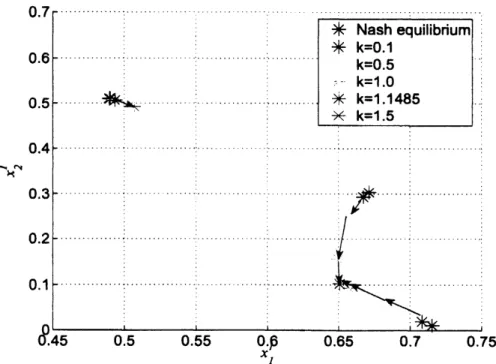
Table 1 shows theconcrete values ofobtained robust Nash equilibria. For $k=0.1,0.5,1.0$, 1.1485,
we
obtain threerobustNash equilibria. However, for $k=1.5$,
we
obtain onlyone
robust Nash equilibrium. Figure1 shows the trajectory ofplayer l’s strategies at the robust Nash equilibria for each $k^{*3}$, in which
the verticalandhorizontal
axes
denotethe first and second components of therobust Nash equilibria,respectively. Figure 1 indicates that two ofthe three equilibria
are
getting closer to each otheras
$k$
.
increases, and they almost coincide at $k=1.1485$.
Furthermore, at $k=1.5$, the two equilibriadisappearandonlyone equilibrium is obtained.
$*1$
Wecanfind all Nash equilibria by usingabranchandbound basedapproach. $*2$
Sinceweemployaniterativemethod,wecanchoose anarbirrary startingpoint. Indeed,itisexpectedthatadifferent
startngpointcanleadtoadifferentsolution when theSOCCPhas multiple solutions.
$*3$
Table 1 Sizes ofuncertaintysetsand obtained robust Nash equilibria
Figure 1 Trajectory of player l’s strategiesatthe robust Nash equilibria
7 Concluding remarks
Inthis
paper, we
haveextendedtheconceptofrobustNash equilibrium to N-personnon-cooperativegameswithnonlinearcostfunctions,andderivedsufficient conditionsforexistence and umiqueness of
the robust Nash equilibria by
means
of the GVIPor
VIP reformulation techniques. In addition, wehave shown that the robust Nash equilibriumproblems with quadratic costfunctions and uncertainty
problem, and observedsomenumericalproperties.
We still have
some
fumre issues to be addressed. One importantissue is to weaken the sufficientconditions foruniqueness oftherobustNash equilibrium. Infact, theuniquenessconditionsshown in
the
paper
are
rather restrictive, and thereseems
to remainmuchroom
for the improvement. Anotherissue isto considerthe SOCCP reformulationforthe robust Nash equilibrium problemin whichboth
the cost function parameters and theopponents’ strategies
are
uncertain. In thispaper, we
have onlyconsidered the
case
where either of them is uncertain. However, in the real situation, it would benatural to
assume
thatboth of them involveuncertainties.References
[1] M. AGHASSI AND D. BERTSIMAS, Robust game theory, Mathematical Programming, 107
(2006),
pp.
231-273.[21 F. ALIZADEH AND D. GOLDFARB, Second-order
cone
programming, MathematicalProgram-ming,
95
(2003),pp.
3-51.[3] J.-P. AUBIN,Mathematical Methods
of
Gameand EconomicTheory, North-Holland PublishingCompany, Amsterdam, 1979.
[41 J.-P. AuBiN ANDH. FRANKOWSKA, Set-ValuedAnalysis, Birkhauser, 1990.
[5] A. BEN$-$TAL AND A. NEMiROvsKi,Robustsolutions
of
uncertainlinearprograms, OperationsResearchLetters,25 (1999),
pp.
1-13.[6] –, Selected topics in robust
convex
optimization, Mathematical Programming, 112 (2008),pp. 125-158.
[7] D. P. BERTSEKAS, Convexanalysisandoptimization,AthenaScientific,2003.
[8] L. ELGHAOUiAND H. LEBRET,Robustsolutionstoleast-squaresproblem withuncertaindata,
SIAMJoumal
on
Matrix AnalysisandApplications, 18 (1997),pp.1035-1064.
[9] F. FACCHINEI AND J.-S. PANG, Finite-Dimensional Variational Inequalities and
Complemen-tarityProblems,Springer-Verlag, NewYork, 2003.
[10] S. C. FANG AND E. L. PETERSON, Generailizedvariational inequalities, Joumal of
optimiza-tion theory and applicaoptimiza-tions,38 (1982),pp.
363-383.
[11] M. FUKUSHIMA, Z.-Q. LUO, AND P. TSENG,Smoothing
functionsfor
second-orderconecom-plementarityproblems,SIAM Joumal
on
optimization, 12 (2001),pp.
$436-i60$.
[121 S. HAYASHI, N. YAMASHITA,ANDM. FuKusHiMA,A combinedsmoothing andregularization
methodfor
monotonesecond-orderconecomplementarityproblems,.SIAMJoumalonOptimiza-tion, 175 $(2\alpha)5)$,
pp.
335-353.. [13] –2 Robust Nash equilibria and second-order
cone
complementarlty problems, Joumal ofNonlinearandConvex Analysis, 6(2005),pp. 283-296.
[14] R. NISHIMURA,S. HAYAsHi, AND M. FUKUSHIMA,Robust Nash equilibria in N-person
non-cooperative games: Uniqueness and reformulation, Technical Report, 2008-003, Department
of AppliedMathematics andPhysics, Graduate School ofInformatics,KyotoUniversity, April,
2008.
[15] J. B. ROSEN, Existence and uniqueness