JAIST Repository
https://dspace.jaist.ac.jp/
Title スマートグリッド向けの住宅コミュニティエネルギー
システムのデマンドサイドマネジメント
Author(s) CHAROEN, Prasertsak Citation
Issue Date 2020‑06
Type Thesis or Dissertation Text version ETD
URL http://hdl.handle.net/10119/16722 Rights
Description Supervisor: 丹 康雄, 先端科学技術研究科, 博士
Demand-Side Management in Residential Community Energy System for the Smart Grid
Prasertsak CHAROEN
Japan Advanced Institute of Science and Technology
Doctoral Dissertation
Demand-Side Management in Residential Community Energy System for the Smart Grid
Prasertsak CHAROEN
Supervisor : Professor Yasuo TAN
Graduate School of Advanced Science and Technology Japan Advanced Institute of Science and Technology
Information Science June, 2020
Copyright c2020 by Prasertsak CHAROEN
Abstract
The electrical grid has operated on a centralized, top-down model for the past century and heavily relied on fossil fuels for energy production. Grid operators are responsible for the reliable delivery of electricity to consumers where electricity generation must be matched with the total demand at all times. The main driving costs and capacity requirements are the electricity demand that occurs during peak periods. These peaks in demand require utility companies to operate costly and inefficient generators. Moreover, a concern of climate change and greenhouse gas emission leads to an expected widespread demand-side adoption of distributed energy resources (DERs), including renewable energy. The higher penetration of renewable energy resources causes the challenges of the grid operators to exacerbate. The intermittent nature of renewable resources and uncoordinated operation of DERs substantially limit the ability of the supply adaptation to the fluctuating demand and reverse power flow. One of the foreseeable solutions is to manage how end-users consume their energy. Demand-side management (DSM) is a technique to exploit the flexibility in the demand-side and change the consumption pattern of the end-users such that demand profiles match better with the supply and thus lower energy costs.
In this dissertation, a DSM method for a residential community with high penetration of DER is presented. In the proposed DSM method, a local energy sharing scheme is incorporated into a price-based demand response to exploit the value of DER, benefiting both the utility company and its customers. On the one hand, the utility company can adopt the DSM method to motivate the customers to shift their energy consumption and production such that peak demand and export energy can be reduced. As a result, the aggregate consumption curve becomes more flat and smooth. Therefore, the utility com- pany can lower energy costs from the costly peak-time energy procurement and mitigate the problem of reverse power flow. On the other hand, the customers will be incentivized from participating in DSM and motivated to share their energy locally. Thus, increasing their energy bill savings and self-consumption, which maximize the value of DER.
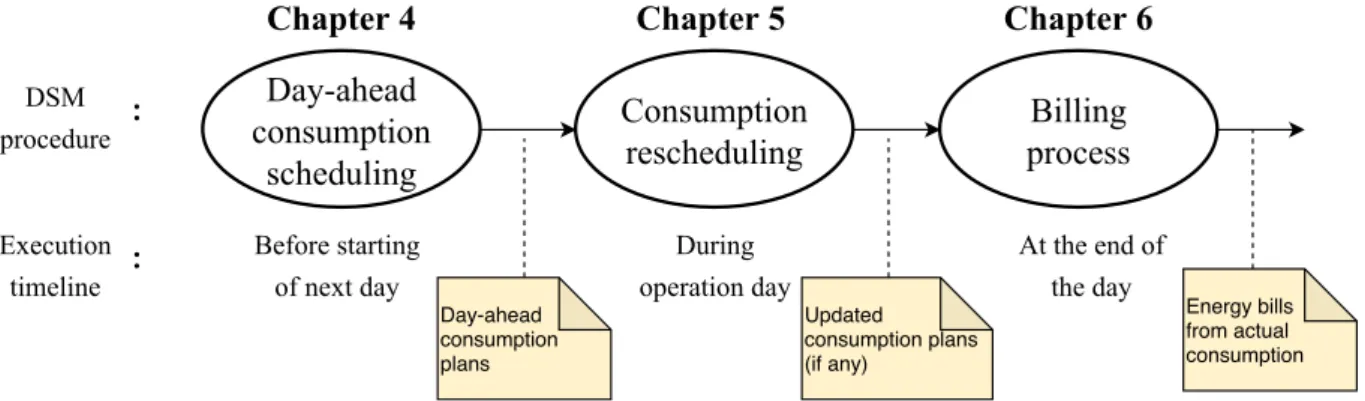
We define a procedure of DSM into three sequential processes: day-ahead consumption scheduling, consumption rescheduling, and energy billing. In the day-ahead consumption scheduling, we propose energy price functions to motivate users to plan their energy consumption and formulate an energy bill minimization problem for each user based on appliance specifications and preferences. Then, we present an iterative distributed algorithm to solve for optimal consumption schedules while preserving the privacy of the users.
Furthermore, we aim to improve the practicality aspect of the proposed DSM model by addressing the uncertainty of human behavior and energy billing fairness issues. We propose the consumption rescheduling algorithm to allow the users to change their prefer- ences during operating periods and recalculate consumption schedules for the remaining time in order to avoid unnecessary costs. The energy billing mechanism with a penal- ty/reward system is proposed to fairly allocate any energy bill discrepancy to users based on their deviated consumption from the assigned schedules.
Simulation results indicate the effectiveness of the proposed DSM model in terms of peak demand and export energy reduction while maximizing the energy bill savings of the users. Simulation on the impact of battery, PV generation, and user participation in the system performance is carried out. Furthermore, the simulation results of the proposed consumption rescheduling algorithm show improved consumption profile of the community in response to the changing preferences of users. Finally, the results of the proposed energy billing mechanism show the fair allocation of energy bills to each user proportion to the amount of deviated consumption.
Keywords: Demand-Side Management, Distributed Energy Resource, Energy Consumption Scheduling, Local Energy Sharing, Smart Grid
Acknowledgments
Firstly, I wish to express my sincere appreciation to my supervisor, Professor Yasuo Tan of Japan Advanced Institute of Science and Technology, who has guided me through my Ph.D. journey. His guidance, attention, and encouragement have led this research to its successful. I am also thankful to my second advisor, Associate Professor Yuto Lim, for his thoughtful comments and recommendations on this dissertation. I would like to thank Associate Professor Chalie Charoenlarpnopparut for his valuable advice and contribution throughout my minor research project and Ph.D. study.
I also would like to extend my appreciation to the members of the doctoral dissertation examination committee, Professor Yoichi Shinoda and Research Associate Professor Razvan Beuran, for their valuable comments and suggestions to improve the quality of this dissertation.
I also wish to show my gratitude to Assistant ProfessorSaher Javaidfor her suggestion and comments on various research topics throughout this study.
I am always thankful for the support and friendship of Dr. Marios Sioutis through the struggle and joy of these past few years. In addition, I am grateful for the support of all the members of TAN and LIM lab during my life in JAIST.
Lastly, many thank to my wife and daughter for their support and scarify. Without them, I would never be able to finish my Ph.D. Love you.
Contents
Abstract i
Acknowledgments iii
List of Figures viii
List of Tables x
List of Abbreviations and Symbols xi
1 Introduction 1
1.1 World Energy Crisis . . . 1
1.2 Overview of the Electrical Grid Today . . . 2
1.3 Challenges - Peak demand, Reverse Power Flow, the Duck Curve . . . 4
1.4 The Grid of the Future . . . 8
1.5 Purpose of the Dissertation . . . 9
1.6 Structure of the Dissertation . . . 10
2 Background and Literature Reviews 12 2.1 Smart Grid and Demand-Side Management . . . 12
2.2 Demand Response . . . 14
2.2.1 Incentive-based DR . . . 15
2.2.2 Price-based DR . . . 16
2.2.3 Price-based DR - Literature Review . . . 18
2.3 Local Energy Sharing . . . 22
2.3.1 Local Energy Sharing - Literature Review . . . 24
2.4 Research Motivations and Objectives . . . 25
2.5 Chapter Summary . . . 28
3 Residential community energy structure 30 3.1 Residential Community Energy System . . . 30
3.2 Residential User Model . . . 32
3.2.1 Household Appliances . . . 34
3.2.2 Photovoltaics System . . . 35
3.2.3 Battery Storage System . . . 36
3.2.4 Net Energy Consumption . . . 37
3.3 Demand-Side Management Model . . . 38
3.3.1 Utility Company Model . . . 39
3.3.2 Community Energy Coordinator Model . . . 40
3.3.3 Demand-Side Management Procedure . . . 41
3.4 Chapter Summary . . . 43
4 Day-ahead Consumption Scheduling 44 4.1 Price-based Demand Response with Local Energy Sharing Model . . . 44
4.1.1 Grid Energy Pricing Model . . . 45
4.1.2 Local Energy Pricing Model . . . 46
4.2 Energy Bill Minimization Problem Formulation . . . 49
4.3 Iterative Distributed Decision-Making Approach . . . 50
4.4 Simulation Results . . . 53
4.4.1 System Performance Metrics . . . 53
4.4.2 Simulation Setting . . . 54
4.4.3 Case Scenarios . . . 59
4.4.4 Energy Consumption Profiles . . . 60
4.4.5 Case Scenario Comparison . . . 63
4.4.6 Analysis of the ProposedLES+DGP Case . . . 65
4.4.7 Analysis of Computation Time and Convergence . . . 69
4.4.8 Performance with Various Numbers of Users with Battery Storage Systems . . . 71
4.4.9 Performance with Various PV Generation . . . 72
4.4.10 Performance with Various Numbers of Users Participating in the DSM Programs . . . 73
4.5 Chapter Summary . . . 74
5 Consumption Rescheduling 76 5.1 Energy Consumption Rescheduling Algorithm . . . 76
5.2 Simulation Results . . . 80
5.2.1 Simulation Setting . . . 81
5.2.2 Results of Consumption Rescheduling . . . 82
5.3 Chapter Summary . . . 84
6 Fair Billing Mechanism 85 6.1 Energy Billing Mechanism . . . 85
6.1.1 Energy Bill Difference . . . 86
6.1.2 Penalty and Reward Factors . . . 87
6.1.3 Proposed Billing Function . . . 88
6.1.4 Fairness Index . . . 90
6.2 Simulation Results . . . 90
6.2.1 Simulation Setting . . . 91
6.2.2 Results of the Proposed Billing Mechanisms . . . 91
6.3 Chapter Summary . . . 94
7 Discussions 95 7.1 Toward Decentralized Layered Grid Structure . . . 95
7.2 Impact on Key Actors . . . 97
8 Conclusions and Future Work 99 8.1 Conclusions . . . 99 8.2 Future Work . . . 101
Bibliography 102
Publications 113
List of Figures
1.1 Overview of the conventional electrical grid. . . 3
1.2 Decentralization ratio of electricity generation by country [1]. . . 4
1.3 Solar PV injection into low-voltage distribution networks causing voltage rise problem . . . 6
1.4 The duck curve of demand curve in California. (Figure source: CAISO [2]) 7 1.5 The smart grid . . . 9
2.1 Categories of demand-side management programs . . . 15
2.2 Conceptual design of price-based DR. . . 18
2.3 Full P2P and mediator-based energy sharing designs. . . 23
3.1 A residential community energy system for the proposed DSM. . . 32
3.2 A typical household with HEMS and DERs. . . 33
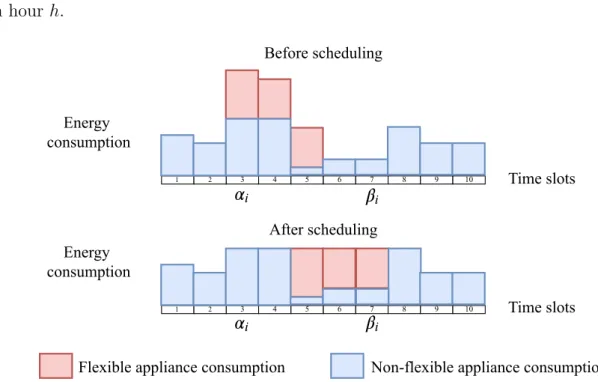
3.3 Example for the energy consumption pattern of appliances before and after scheduling. . . 35
3.4 A block diagram of the proposed DSM model with the community energy coordinator in a residential community. . . 39
3.5 A flow diagram of the DSM procedure. . . 41
4.1 Example of grid energy cost and price as a function of energy. . . 46
4.2 A relationship between local energy prices and SDR. . . 48
4.3 Flow chart of the iterative distributed decision-making algorithm . . . 52
4.4 Simplified CREST demand generation model [3]. . . 57
4.5 Aggregate energy profiles of P2G + OTS case scenario (base case) . . . 62
4.6 Aggregate energy profiles of LES + DGP case scenario (proposed) . . . 62
4.7 Net energy consumption of P2G + OTS (base case), P2G + DGP, LES and LES + DGP (proposed) case scenarios . . . 64
4.8 Demand curve and the corresponding sources of energy in the proposed LES+DGP case . . . 67
4.9 Battery’s SOC level of all users equipped with battery system in the com- munity . . . 67
4.10 Grid and local energy prices . . . 68
4.11 Convergence of the proposed LES+DGP case . . . 68
4.12 Computation time of individual house per number of flexible appliances . . 70
4.13 Number of iterations required for convergence . . . 70
4.14 Maximum number of houses in the community for the extreme case . . . . 71
5.1 Flow chart of the proposed rescheduling algorithm . . . 80
5.2 Aggregate net energy consumption profiles of 100 users in the case of unco- ordinated P2G+OTS, perfect commitment, deviated schedule without and with rescheduling algorithm . . . 83
6.1 Example of the proposed billing mechanism . . . 89
6.2 Energy bills of users with the conventional billing mechanism . . . 92
6.3 Energy bills of users with the proposed billing mechanism . . . 93
6.4 The corresponding deviated consumption and penalty/reward cost . . . 93
7.1 A conceptual diagram of the decentralized layered grid structure . . . 96
List of Tables
2.1 Comparison between traditional grid and smart grid . . . 12 4.1 Feature summary of case scenarios . . . 60 4.2 Comparison performance of difference case scenarios . . . 65 4.3 System assessment metrics with different percentage of PV-battery system
owners . . . 72 4.4 System assessment metrics with different amount of PV generation . . . . 73 4.5 System assessment metrics with different user participation percentage . . 74 5.1 System performance comparison of uncoordinated P2G+OTS, perfect com-
mitment, deviated schedule without and with scheduling algorithm cases . 84 6.1 Comparison of fairness index . . . 94 8.1 List of appliances. . . 117
List of Abbreviations and Symbols
Abbreviations
AMI Advanced Metering Infrastructure BS Bill Sharing
CEC Community Energy Coordinator CPP Critical Peak Pricing
CREST Centre for Renewable Energy Systems Technology DB Demand Bidding/Buyback
DER Distributed Energy Resource DGP Dynamic Grid Pricing
DLC Direct Load Control DR Demand Response
DSM Demand-Side Management DSO Distribution System Operator
EDRP Emergency Demand Response Program EV Electric Vehicle
FIT Feed-in-Tariff
HEMS Home Energy Management System I/C Interruptible/Curtailable
ICT Information and Communication Technology LDA Local Distribution Area
LES Simulation scenario where DSM is implemented. Users trade energy through the CEC and able to share energy locally. Dynamic of grid price is not incorporated in local energy market.
LES+DGP Simulation scenario where DSM is implemented. Users trade energy through the CEC and able to share energy locally. Dynamic of grid price is incorporated in local energy market.
LSE Load Serving Entity MMR Mid-Market Rate
OTS Off-the-Shelf battery operation P2G Peer-to-Grid
P2G+DGP Simulation scenario where DSM is implemented. Users trade energy directly to the utility company. DSM is implemented where grid energy price is depended on aggregate community consumption.
P2G+OTS Simulation scenario where users trade energy directly to the utility company and apply “off-the-shelf” battery control strategy. No DSM is implemented.
P2P Peer-to-Peer
PAR Peak-to-Average Ratio PV Photovoltaic
RTP Real-Time Pricing
SDR Supply-Demand Ratio SOC State-of-Charge
TD Transmission-Distribution TOU Time-of-Use
TSO Transmission System Operator Symbols
αi Earliest time that flexible appliance i can start its operation α0i New earliest time that flexible appliance i can start its operation βi Deadline time that flexible appliance i need to finish its operation βi0 New deadline time that flexible appliance i need to finish its operation
∆ˆlhn Sum of consumption deviation from rescheduling process for user n in time slot h
∆˜lhn Sum of consumption deviation from sudden violation for user n in time slot h
∆Bh Different between realized and expected community energy bill in time slot h
∆bn Total energy bill difference of user n
∆Lh Total community energy deviation in time slot h
∆ln Total amount of deviated energy consumption of the user n
∆lhn Amount of energy deviation for user n in time sloth
∆lhmax Maximum energy deviation among individual users in time sloth ηc Charging efficiency of battery
ηd Discharging efficiency of battery
zn Vector containing energy consumption of appliances and battery operation sched- ules for user n
An Set of flexible appliances for user n A0m Set of rescheduling appliances for user m
H Scheduling window for demand-side management
H0 Remaining scheduling window for consumption rescheduling process M Set of rescheduling users
N Set of users
Zn Set of feasible energy consumption of the flexible appliances and battery operation for user n
Zn0 Updated set of feasible energy consumption of the flexible appliances and battery operation for user n
Ωhn Reward factor for user n in time slot h Θhn Penalty factor for user n in time slot h
ah Energy cost and price coefficient in time slot h An Number of flexible appliance for user n
bh Energy cost and price coefficient in time slot h Bn Total daily energy bill for user n
bhn Energy bill for user n in time slot h b∗n Realized energy bill of user n
bn,conv Realized energy bill of user n
bn,DA Expected day-ahead energy bill of user n
bn,prop Proposed energy bill for user n
bhn,prop Proposed energy bill for user n in time slot h bhn,RL Realized energy bill for user n in time slot h
Bproph Sum of proposed energy bills from all user in time slot h BRL Total community daily realized energy bill
BRLh Total community realized energy bill in time slot h Ch Energy cost of the utility company in time slot h
dhn Total energy consumption for household appliances of user n in time sloth Ebh Total local energy demand in time slot h
Esh Total local energy supply in time slot h
Eb,−nh Sum of all users’ buying energy demand except user n ehb,n Amount of buying energy for user n in time slot h ei Total daily energy requirement for flexible appliance i Es,−nh Sum of all users’ selling energy surplus except user n ehs,n Amount of selling energy for user n in time sloth F Fairness index
gnh PV generation of user n in time sloth h Hour h
i i-th flexible appliance
Lh Aggregate energy consumption of the community in time slot h lnh Net energy consumption of user n∈ N in time slot h
Lh−n Sum of all users’ net energy consumption except user n in time slot h ln,RLh Actual load for user n in time sloth
m m-th rescheduling user n n-th user
phl Local electricity prices
phg,b Electricity price for users to buy electricity from the utility company (grid buying price)
phg,s Electricity price for users to sell electricity to the utility company (grid selling price)
phl,b Electricity price for users to buy electricity from the CEC (local buying price) phl,DA Expected day-ahead local energy price in time slot h
Pl,RLh Realized local energy price in time slot h
phl,s Electricity price for users to sell electricity to the CEC (local selling price) Qn Battery capacity for user n
SDRh Supply and demand ratio in time slot h SOCn0 Initial state of charge of battery for user n
SOCnh State of charge of battery for user n in time sloth SOCnmax Maximum stage of charge level of battery for user n SOCnmin Minimum stage of charge level of battery for user n t Time that user request for consumption rescheduling w Load deviation weight of sudden consumption violation
xhn Sum of energy consumption of all flexible appliance of user n in time slot h xhn,0 Sum of energy consumption of all non-flexible appliance of user n in time slot h xhn,i Energy consumption for flexible appliance i of user n in time slot h
xh,maxn,i Maximum energy consumption for flexible appliance i of user n in time sloth xh,minn,i Minimum energy consumption for flexible appliancei of user n in time slot h yhn Battery charging/discharging energy of user n in time slot h
ymaxn Maximum charging/discharging rate of battery for user n
Chapter 1 Introduction
1.1 World Energy Crisis
Human civilization has mainly relied on energy from fossil fuels to produce electricity in order to propel our society forward. With the rise of the global population and industri- alization in developing countries, the global demand for energy has reached extraordinary levels. Burning coal, oil, and gas have been the primary reason behind the rising levels of greenhouse gases in the Earth’s atmosphere, which is a leading contributor to climate change. To prevent environmental disasters, humanity needs to reduce its energy demand that relies on fossil fuel. Renewable energy resources, which are cleaner and emit less greenhouse gas emissions such as solar and wind energy, could provide an alternative for energy sources.
However, integrating these new energy sources into existing grids pose many challenges.
One of the big challenges is the intermittent nature of energy production. Wind and solar energy are highly dependent on the weather and the time of day, and their production may not necessarily coincide with the peaks in demand. Since storing a large quantity of electricity is still impractical, shaping the demand to match the supply is another viable solution. By coordination between supply and demand sides, we can manage how the energy is consumed or produced more efficiently with cleaner energy resources.
In this dissertation, we are exploring a solution to manage energy usage from the
demand-side with coordination from the supply in order to efficiently balance supply and demand, promote renewable energy resources, and limit the use of fossil fuel for a global sustainable energy practice.
1.2 Overview of the Electrical Grid Today
Before we go further into details, an introduction to the contemporary electrical grid is necessary. Since the electrical grid first started growing in earnest in the early 20th century, it has worked on a centralized, top-down model. The grid is divided into four main components: generation, transmission, distribution, and consumption. Power is generated at large-scale power plants, usually far from end-use customers, and fed into high-voltage transmission lines. After being carried over a long-distance, power is injected from the transmission system into local distribution areas (LDAs) via substations at transmission- distribution (TD) interfaces, where the voltage is step-down by transformers. Finally, power is carried along distribution wires in various directions to reach end-use consumers.
In general, the transmission network is managed by transmission system operators (TSOs) to ensure the reliability of the transmission grid. In some countries or regions, utility companies also own power plants and distribute electricity to their customers as load-serving entities (LSEs). Whereas in other areas, the gird operation has been restruc- tured, separating distribution from the transmission. In restructured areas, distribution utilities do not own power plants and buy power from wholesale markets and resell it to their local customers in retail markets. The wholesale markets, where competing power generators selling their power, are administered by TSOs. The distribution utility com- panies are acted as distribution system operators (DSOs), responsible for the reliability of distribution networks and provide energy connection to end-users. The nature of electric- ity is that it cannot be stored (in large quantity) and have to be consumed instantaneously after being generated. Thus, utility operators need to balance supply and demand by gen- erating electricity to meet demand at all times. The current electrical grid is designed through a vertically integrated electric utility structure and one-way power flow with the
objective to serve the reliability of the grid by investing in the infrastructure to meet peak load conditions. Fig. 1.1 shows the overview structure of the electrical grid.
Generation
Transmission (TSO)
Consumption Distribution
(DSO)
TD
LDA
Wholesale market
Retail market One-way
power flow
Figure 1.1: Overview of the conventional electrical grid.
As the technology progress and environmental concern, electrical grids around the world are in the state of significant transition toward the decentralization of electricity genera- tion. Fig. 1.2 shows increasing trend in decentralization ratio of electricity generation by country around the world [1]. The rise of distributed energy resources (DERs) and re- newable energy are the leading driving technologies. DERs can be referred to small-scale generation units that are located on the electricity end-users side, including solar PV sys- tem, battery storage, electric vehicles, and other resources such as load shifting. Over the past decade, there has been an acceleration of the infusion of the PV system, mainly due
to the reduction in investment costs, advanced communication and control technologies, and environmental concern. Moreover, battery storage technologies and costs are catching up with the PV system and will be widely available in the consumer markets [1]. Accord- ing to the Commonwealth Scientific and Industrial Research Organisation (CSIRO) [4], a grid-connected PV and battery storage system will produce electricity more cheaply than buying it from the grid in the near future. The Bloomberg New Energy Finance [5]
estimates that by 2050, half of all residential buildings will have solar PV systems, and about one-third will also have battery storage.
2012 2016 2020 2025 2030 2035 2040 Year
0%
5%
10%
15%
20%
25%
30%
35%
40%
45%
50%
Decentralization ratio
Australia Germany Italy Japan Brazil Thailand Mexico USA India
Figure 1.2: Decentralization ratio of electricity generation by country [1].
1.3 Challenges - Peak demand, Reverse Power Flow, the Duck Curve
In this section, we present some of the challenges that the grid operator is facing in the current electrical grid structure: matching peak demand, reverse power flow, and dispersion of consumption profile.
The electrical grid operators had only control over the supply. Since demand needs to be matched instantaneously, the grid needs to build with enough power plants to satisfy the highest possible peak in demand. However, most of the time, those costly “peak”
power plants are not operating and idle since they operate only during peak consumption periods, which occur briefly. To meet the peak demand, the operators have to use those costly power plants. Since a marginal cost of generating electricity increases with the required demand, matching the peak demand increases the costs of the utility company.
That is, ideally, the utility operator would desire for a constant, flat, and smooth demand curve in which they can achieve the most cost-effective power generation.
Furthermore, the rapid penetration of DER installation in the distribution networks poses technical challenges for the network operator, including voltage maintenance, re- verse power flow, and lack of DER generation visibility. Although consumers benefit from having DER as it can reduce their electricity bills from self-consumption and/or become prosumers to sell surplus energy to their retailers or local utility companies to earn ad- ditional revenue in a feed-in-tariff (FIT) program [6], the aggregation of uncoordinated behavior of DERs could impact the net energy consumption that the network operator must serve. An example of DER’s impact on a low-voltage distribution network consists of households equipped with PV systems is shown in Fig. 1.3. During day-time when PVs generate energy simultaneously, and there is not enough load to absorb all the generated energy, the surplus will be fed back to the network causing the voltage to rise and po- tentially overcome the maximum voltage limit of the network. Another example is when the operation of battery storage systems (act independently without coordination) could coincidentally inject energy with the time of high solar irradiance [7], which causes even more energy injection to the main distribution line and lead to violation of voltage and thermal limits.
Transformer
Voltage
Max
Min
Figure 1.3: Solar PV injection into low-voltage distribution networks causing voltage rise problem
Both peak demand and over-generation PV create highly fluctuation in the consumption profiles. As reported by the California Independent System Operator (CAISO) [2], the net energy consumption could exhibit ”The Duck Curve,” (see figure 1.4) where a deep drop of demand appears in the mid-afternoon due to over-generation and quickly raises to the peak demand in the evening. This quick fluctuation of the consumption profile causes the operator a challenge to adjust the energy supply rapidly with more cost-expensive generators to meet the demand. Such operations are expensive and difficult to navigate.
Figure 1.4: The duck curve of demand curve in California. (Figure source: CAISO [2])
The conventional solution used by distribution companies to manage the energy export of DER is to curtail or limit how much DER energy can be injected into the grid. However, the consumers lost financial benefits and letting clean, zero-carbon energy go to waste.
Thus, decrease the value of DER. Upgrading current distribution infrastructures such as transformers, conductors, or feeding lines to expand the network capacity is also possible solutions. However, investing in new equipment and assets would only solve the issue in the short-term and not sustainable solutions. Besides, current power system management is only done in the supply-side of the electrical grid, whereas the end-use customers in the demand-side are considered passive and lack of participation in the management. The retail energy price used to bill customers is mostly a flat-tariff scheme. In this scheme, customers have no incentive to shift their consumption from peak-demand periods to off-peak demand periods.
Hence, based on the above challenges, coordinate energy management from both supply and demand sides is urgently required. If demand loads can be controlled, it can provide energy flexibility and an option for the grid operator to balance supply and demand more efficiently. Furthermore, a consideration of a more sophisticated active DER management
method in the demand-side is needed to exploit the full potential value of DER while limiting physical threats pose on the grid.
1.4 The Grid of the Future
One of the foreseeable solutions is to revise the structure of the electrical grid and how it operates. A new paradigm of the electrical grid has emerged as “The smart grid”.
The smart grid is a digitally enabled grid, facilitated by an advance in information and communication technology (ICT), smart meter, and home energy management system (HEMS), which can potentially overcome the existing limitation in the current electrical grid.
Instead of operating the electrical grid from a top-down one-way energy flow, a bottom- up two-way energy flow operation approach could be an alternative. With DER, end-use customers are seeking more control and choice over their energy uses and sources, as well as the societies, are becoming more concerned about environmental impacts and climate change. We can envision the future where DER can be managed from the demand-side to help smooth out the variations in demand and renewable energy production locally, with little supply from distant power plants. This would revise the electrical grid structure as the DSO could be the responsibility for balancing supply and demand within its LDAs by using flexibility from local DERs. Then, DSO presents the remaining aggregate supply or demand into a single virtual unit to the TSO through a TD interface. Thus, reduce operation complexity for the TSO. Fig. 1.5 shows a concept of the smart grid.
Electrical line Communication link
Industrial Commercial
Residential
DER Smart appliances
HEMS Smart meter Distribution
Transmission Generation
TSO
Two-way power flow
DSO
LDA
Figure 1.5: The smart grid
In order to shape the consumption demand, a demand-side management (DSM) pro- gram is one of the methods proposed for the smart grid to manage the consumption and production of the end-users in the demand-side of the electrical grid. Previously, DSM has focused on industrial and commercial consumers but, with an increasing number of DER, the residential end-user sector also gained attention from both academic and industrial.
The price-based demand response (DR) method [8] is one of the DSM programs that the utility company employs an energy pricing strategy to encourage consumers to change their consumption behavior. Using different electricity prices at different times, the con- sumers can have incentives to shift their energy consumption from high price periods to low price periods. Thus, the design of energy price function and its character play an important role for the utility to achieve the desired consumer’s response outcome.
1.5 Purpose of the Dissertation
The purpose of this dissertation is to develop a DSM method for a residential community with high penetration of DER to achieve“win-win”strategies for both the utility company and its customers. On the one hand, the utility company influences its customers to change their energy consumption pattern by adopting a dynamic energy pricing strategy
such that aggregate peak demand and export energy of the community can be reduced.
Therefore, the utility company can lower the energy cost from the costly peak-time energy procurement and mitigate the problem of reverse power flow. On the other hand, the users gain financial benefits from participating in DSM by providing flexibility from the demand-side. Based on the energy prices, the users can plan their energy consumption to minimize their energy bills. Also, the excess generation from DER can be shared among users through the local energy market, which is incentivized by local energy prices. Thus, increasing users’ energy bill savings and self-consumption, which maximize the value of DER. Furthermore, we also consider improving the practicality aspect of the proposed DSM model by addressing the uncertainty of human behavior and energy billing fairness issues.
1.6 Structure of the Dissertation
The rest of the dissertation is organized as follows. Chapter 2 introduces the relevant background topics for the discussed research, which includes an overview of the smart grid, DSM, DR, and local energy sharing methods. Then, we present the motivations and objectives of our proposed DSM method.
In Chapter 3, the structure of the residential community energy system proposed in the dissertation is explained in detail, along with the definition and role of a utility company, a community energy coordinator, and residential users. Then, we introduce the process of the proposed DSM model.
Chapter 4 presents the day-ahead consumption scheduling, which includes the proposed energy pricing functions, local energy sharing mechanism, and energy bill minimization problem. An iterative distributed decision-making approach used to find optimal con- sumption schedules of all users in the community is described. The simulation results obtained are analyzed and discussed, and the impact of DER on the proposed system is demonstrated.
Chapter 5 presents the consumption rescheduling process to deal with an uncertainty
of human behavior. The proposed rescheduling algorithm is described and evaluated by simulation. The results obtained are analyzed and discussed, demonstrating the impact of human behavior uncertainty and the effectiveness of the proposed algorithm.
Chapter 6 presents the proposed energy billing mechanism to address the fairness issue when consumption schedules are violated. The proposed penalty and reward factors are defined. Then, a billing function is presented for distributing any energy bill discrepancy fairly to all users. The simulation results are illustrated to confirm the feature of the proposed billing mechanism.
Chapter 7 presents a discussion of the proposed DSM model and its application in the future of the electrical grid.
Finally, Chapter 8 concludes the dissertation and suggests future work.
Chapter 2
Background and Literature Reviews
In this chapter, we present related background research topics, which include an overview of the smart grid, DSM, DR, and local energy sharing methods. Then, we describe limitations in the existing literature, leading to the motivations of the proposed DSM method. In the end, we summarize our research objectives.
2.1 Smart Grid and Demand-Side Management
The smart grid is a term that describes the modernization of the traditional electric grid that delivers electricity from energy sources to end-use customers. Various advancements in modern digital technologies reconstruct the traditional grid; it allows for two-way communication between the utility and its customers, real-time data monitoring and sensing along the transmission lines, and control automation [9]. Table 2.1 summarizes the main features of the smart grid.
Table 2.1: Comparison between traditional grid and smart grid Traditional grid Smart grid
One-way communication Two-way communication Centralized generation Distributed generation
Passive consumers Active prosumers Limited number of sensors Full grid sensor throughout
Manual restoration Self-healing Failures and power outages Adaptive and islanded
In the residential sector, two critical enabling technologies are HEMS [10] and Ad- vanced Metering Infrastructure (AMI) [11]. The application of HEMS is intended to automatically facilitate users in optimizing the use of household appliances and energy consumption. HEMS also equipped with the capability of data collection, data processing, data representation, and interaction with the user. With the installation of smart meter and AMI, information related to the cost of energy, energy usage, and grid status can be provided to the user from the utility company. This enhances the ability for HEMS to optimally control the use of electric devices, e.g., to reduce peak power and electricity bill.
DSM is one of the main feature technologies in the smart grid. Traditionally, utility companies design the electricity grid for peak demand rather than the average demand to achieve the high reliability required in power systems. This results in an under-utilization of the designed system. Improving the utilization in power grids become a crucial point due to the increasing demand for quantity and quality, limited energy resources, and costly to exploit new resources and built new generations. Also, new types of loads, such as electric vehicles (EVs) have emerged, which can potentially double the residential load.
Expanding the generation to meet the increasing demand faces great concern regarding various environmental issues. For example, to meet the peak demand, oil and coal-fired power plants are widely used, which emit a large amount of carbon dioxide and other greenhouse gases. Thus, the development of DSM methods to manage the load in the demand-side has emerged as an alternative solution, instead of increasing supply to meet the demand. DSM has been invented and practiced since the 1980s by the Electric Power Research Institute (EPRI) [12] as a series of activities that utility companies initiate to change the user’s load profile of energy consumption for maximizing benefit, delaying investment, and enhancing reliability. DSM is mainly categorized into two groups:
• Energy efficiency: A program in which promoting the reduction of energy require- ment for the provision of services or products.
• Demand response: A program which defined by the US department of energy as
“changes in electrical usage by end-use customers from their normal consumption patterns in response to changes in the price of electricity over time or to incentive payments designed to induce lower electricity use at times of high wholesale market prices or when system reliability is jeopardized” [13].
The energy efficiency programs are aiming for a long-term goal to reduce the amount of energy consumption by promoting the adaptation of a more efficient technology and production process. For example, switching to LED lighting, replacing old inefficient home appliances, or installing wall insulation for better indoor temperature control. Although this approach proved to be a cost-effective strategy, it requires long-term and wide-area of adaptation. On the other hand, the DR programs are focusing on a short-term strategy to change the consumption pattern of consumers. Utilities can implement and tailor DR strategy in order to achieve their designed system outcomes by the response from the demand. The detail of various types of DR programs is presented in the following section.
2.2 Demand Response
Among different techniques considered for DSM, the DR program is one of the most effective tools to shape the load profiles to improve the reliability and efficiency of the power grid. It can be considered as the means or tariffs that the utility company takes to incentivize users to change their energy usage patterns [14]. With the recent investment in smart grid technologies, especially the large roll-out installation of smart meters, the potentials of DR are fully exploited on a large scale, including a residential sector. DR programs are further categorized into two main branches: incentive-based and price-based programs. Summary of DR and DSM categories is shown in Fig. 2.1.
Demand-side management (DSM)
Demand-response
(DR) Energy efficiency
Incentive-based DR Price-based DR
DLC I/C EDRP TOU CPP RTP
Figure 2.1: Categories of demand-side management programs
2.2.1 Incentive-based DR
In the incentive-based DR, an incentive is paid to the participating users for a reduction of demand. Based on an event, triggered by system congestion or peak load, the program provides load modification incentives to those users in addition to or separation from electricity payments. Example of program variations are listed as follows:
• Direct load control (DLC): In the DLC program, the utility company has permission from the participating users to remotely control specific electrical devices, e.g., air conditioner and water heater, whenever necessary. Based on agreements, incentive payments are provided for the demand reduction. Thus, the utility company can mitigate peak loads during high demand periods without the need for a more costly generation.
• Interruptible /Curtailable Service (I/C): In the I/C program, a discount or credit in electricity bill is provided to the participating users for agreeing to change energy consumption when necessary, such as during system contingencies.
• Demand bidding/buyback (DB): In the DB program, a specific price or reward is given to large customers for a specified amount of load reduction. This program is mainly offered to larger industrial customers or aggregated small-customers with a third party representing them for bidding.
• Emergency Demand Response Program (EDRP): In the EDRP program, a short- notice load reduction request is sent to the participating users during emergency events. The users receive incentive payments in reply to their load reductions.
Since the incentive is done through a contract with each individual customer, the incentive-based DR is more suitable for commercial and industrial power users where the amount of available demand flexibility is large. However, for residential users, due to the smaller consumption scale and a large number, dynamic energy tariff strategies are seen as a more suitable approach.
2.2.2 Price-based DR
In price-based DR, information on different electricity prices at a different time is provided to the participating users as an alternative to the legacy flat-rate tariffs. Based on the price information, users are motivated to use less electricity when prices are high and vice versa. Thus, the utility company can design the electricity prices such that peak demand can be reduced. In other words, opposed to the direct control method, the price-based DR can be seen as an indirect load control method that induces users to change their energy usage patterns according to the variance of electricity prices. To get maximum benefits of the price-based DR program, HEMS and automate device control are required to facilitate the load shifting of the users. Fig. 2.2 shows the conceptual design of price-based DR.
Example of program variations are listed as follows:
• Time-of-Use (TOU) Pricing: The TOU pricing is an electricity rate plan, which varies according to the time of day, season, and type of day. Peak demand hours are subjected to higher prices, and off-peak demand hours are subjected to lower
prices. This price structure provides price signals to energy users to shift energy consumption from peak hours to off-peak hours. Depending on the design, multiple pricing tiers can be implemented: on-peak, mid-peak, and off-peak [15]. In order to induce users to shift their loads over high-peak periods, high prices are imposed compared to off-peak prices. TOU pricing is usually determined and announce to the users in advance and keeps unchanged for an extended period of time [16–19].
• Critical peak pricing (CPP): The CPP is similar to the TOU pricing, except the high-peak price is replaced by an extremely high price. The CPP is only imple- mented on a small number of days in a year where the grid reliability is jeopardized, e.g., extreme hot or cold day during summer or winter. Outside of CPP duration, TOU pricing is typically employed [20–24].
• Real-time pricing (RTP): The RTP is also referred to as dynamic pricing, where the electricity prices vary at a different time on an hourly or sub-hourly basis. The price is adjusted based on the dynamic of the wholesale electricity market and intended to convey the actual generation cost to the end-user. The RTP usually announces on a day-ahead or hour-ahead basis. It has been widely considered more efficient than other price-based DR programs [8, 25–32].
The implementation of the price-based DR is to announce energy prices to the target customers in advance. The users then plan for their energy consumption, usually day- ahead, to respond to different prices at different times. Once the energy consumption plan is determined, the utility can determine its energy dispatch with more cost-efficient from the flatter demand curve. Literature related to the price-based DR is presented in the following section.
Energy consumption
Utility company DSO Wholesale
market
Retail market
Residential community Energy price
Figure 2.2: Conceptual design of price-based DR.
2.2.3 Price-based DR - Literature Review
Time-varying price structures in price-based DR are designed with the aim of shifting the timing of energy consumption so that peak demand is reduced. The ability to shift demand depends on the type of users and the corresponding load specification. According to the Smart Energy Demand Coalition (SEDC), residential DR relies mainly on price-based DR while industrial and commercial sectors are primarily subjected to incentive-based DR [33].
Various TOU and CPP residential DR pricing strategies have been studied in the early literature [14, 16–24, 34–36]. They commonly designed the price strategy to exploit the flexibility of the demand-side end-users by providing them particular energy price signals in order to achieve some desired outcomes, e.g., reducing energy cost and production, lower peak demand, and flattening the demand curves. Although TOU and CPP pricing schemes show benefits to the overall power system, they cannot reflect variations of the prices in the wholesale market in real-time, and thus are unable to effectively incentivize customers to lower their energy usages during peak-demand periods or to shift their energy
usages from high-demand periods to low-demand periods. RTP is an effective solution to the above problem.
RTP schemes have been considered in [8, 26–31], where the energy price strategies are commonly related to the generation cost of the utility company. This generation cost is usually formulated to reflect the dynamic of the wholesale market. The results of RTP schemes show a better response from the customers in terms of peak and energy cost reduction as well as economic benefits improvement for an individual user, compare to less dynamic TOU and CPP schemes.
Some existing works in the literature also considered the context of high penetration of DER in price-based DR schemes [37–44]. In [37], a day-ahead optimization is formulated to minimize the cumulative monetary expense of each active user on the demand-side by the scheduling of distributed energy production and storage. A dispatch strategy of shared battery storage between customers and distribution network operators was pro- posed in [38] to effectively respond to energy prices and network conditions. Authors in [39] presented a game-theoretic approach analysis for interaction between users and the utility in the presence of storage with selling-back to grid option. In [40], an energy management scheme was carried out to minimize total energy cost to the central power station while maximizing user benefits using the proposed utility and cost models with DERs. In [41], energy consumption and storage optimization problem was formulated to minimize the load deviation from the average demand over the consideration scheduling horizon. Centralized and distributed algorithms were proposed to solve scheduling prob- lems. The DR scheme with an aggregator was proposed in [42] to schedule dynamic loads influenced by real-time pricing. The outcomes show a great reduction in PAR and overall energy cost compared to other different pricing scenarios. In [43], a peak power-limiting DR scheme was proposed for scheduling controllable loads, storage, and generation to meet the demand of households in a dynamic pricing environment. However, the option for selling energy back to the grid was omitted. A DSM scheme in [44] was proposed with an option for the users to sell excess energy back to the grid, considering energy cost minimization and comfort maximization in a distributed manner.
Consideration of uncertainty in the DR system is discussed in [32, 45–48]. In [45], the DR program is studied in the presence of an uncertain supply of renewable energy. An online-DR algorithm is proposed to maximize the social welfare over two timescales: day- ahead and real-time. The optimization problem is formulated as a dynamic program and solved by a distributed heuristic algorithm. The simulation results show the performance and impact of renewable energy on the maximum social welfare. The uncertainty of re- newable energy sources is considered in the supply side in [46]. Power available from the renewable is modeled using a discrete-time Markov chain. With knowledge of the steady-state probabilities and, users can compute consumption schedules and choose an energy supplier to minimize their energy costs. The results confirm cost reduction from the proposed DSM by selecting an energy supplier and shifting of appliances. In [48], fore- casting error of renewable generations is considered in microgrids. A two-stage real-time algorithm is proposed using dynamic optimization to compensate for the uncertainties.
Numerical simulation results show the proposed method performs better than other ex- isting methods when dealing with the uncertainties in terms of economic benefit and netload characteristics. In [47], the uncertainty of renewable energy resources is handled via information gap decision theory to reduce undesirable costs with maximum tolerable a given worse-case procurement cost due to generation uncertainty. The simulation re- sults show that the proposed method can reduce the impact of renewable energy source uncertainty on the energy cost. In [32], forecast error in load and generation is addressed.
The author proposed a real-time DR scheme to update the forecast values and recalcu- late the consumption schedule of every user in each hour during the operation day. This process required all users to re-adjust their schedules to compensate for the forecast error.
The results showed better cost saving compared to a day-ahead scheduling scheme, which suffered from the forecast error.
Another interesting aspect in DR is Fairness. While many works in DR can achieve system optimality, they need contribution from all participants. To encourage users to continue their contribution in the program, a proper design of the system fairness must be done. Various fairness criterion in DR has been considered in [49–60]. In [49], a fair
pricing model is proposed by considering the various type of fairness criteria such as type of user, appliance category, and income level. Although the results showed improvement in fairness level, detailed information of users might be difficult to access in order to compute the energy bill in practice. In [50], a billing mechanism is proposed to fairly bill the users by considering the load flexibility of each user. The billing rewards to the users with a more flexible load by taking into account the exact shape of users’
load profiles. The results showed improvement in the fairness level in the DSM system.
Later, the same author extends her work in [51, 52] to address the trade-off between system fairness and optimality. An alternative fair billing mechanism using the concept of Shapley value is proposed to allocate energy costs across the users based on their contribution to minimizing the total cost of the system. They concluded that there is a trade-off between improving the fairness level and achieving an optimal solution. Fairness consideration of the user’s discomfort was studied in [53]. They showed that when load- adjustment and load-shifting become more effective, discomfort level increases and leads to a system with unfairness. Again, they also observed a performance trade-off in the design of DR programs. Authors in [54, 55] also considered fairness using the Shapley value in their proposed billing mechanism. Both works used a sampling-based approach that approximates the Shapley value. The results showed better savings, flattening the load, and avoids peaks while maintaining fairness level. In [56], a billing mechanism is proposed to fairly compensate a group of residential consumers who collectively reduce demand during a load curtailment event. A weighted voting game and the Shapley value are used to assess the fairness among users. The impact of the power loss and the voltage deviation from each participating user is considered as a fairness measurement in [57].
In [58], the authors proposed a fairness index to compare the existing billing mechanisms in the literature. They claimed that a fair mechanism should reflect the cost user induces to the system. Works in [59,60] considered improving fairness level in energy billing when the user’s actual consumption is different from the assigned schedules. A penalty is given to each user based on the amount of deviated consumption. However, they did not take into account the possibility when consumption decreases from the assigned level. That is
when including DER in the system, consumption deviation can occur in both directions;
upward and downward.
2.3 Local Energy Sharing
The recent developments of the smart grid have opened an opportunity for consumers to become more active players in the power system, instead of being passive energy end-users.
The new active users can participate in the energy generation and consumption process by utilizing their local energy resources, managing their demand, and communicating with other users. Although a high penetration of DER in the distribution networks could cause network management issues, DER offers many potential benefits to the end-users.
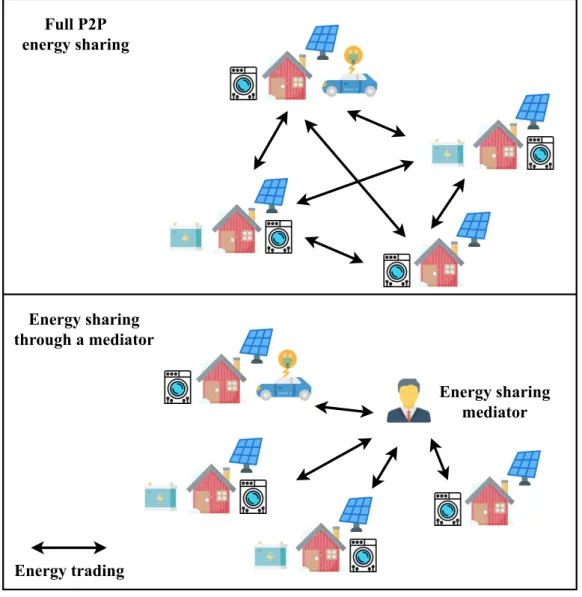
Recently, an idea of local utilization of DER has emerged as local energy sharing, where excess generation from DER can be shared among prosumers, instead of only exporting back to the grid [61]. This energy sharing needs a local market to manage transactions among different users. Local energy sharing can be classified into two categories based on the interaction of the market players: full peer-to-peer and energy sharing through a mediator:
• Peer-to-peer (P2P): In the P2P market, all participating users directly interact with each other to sell or buy energy. Users can negotiate their preferred energy price and amount of trading energy. There is no need for an intermediary entity.
• Energy sharing through a mediator: In this case, a third-party entity is presented as an intermediary interface between energy buyers and sellers. It manages energy transactions on behalf of all participating users and allocates energy from sellers to buyers. The market rules and energy pricing also set up by the mediator.
Fig. 2.3 shows a simple example to illustrate the full P2P and mediator-based energy sharing classification.
Energy sharing mediator
Energy trading Full P2P energy sharing
Energy sharing through a mediator
Figure 2.3: Full P2P and mediator-based energy sharing designs.
Although the full P2P local energy sharing market shows great potential in utilizing DER to its full value, advanced communication networks and technologies are required to sustain the market designs. Blockchain technology can be the key factor in deploying a P2P market in the energy sector [62–64]. However, with complexity involving the negotiation process and transaction of energy from all peers, it is expected that the energy sharing through a mediator or a platform would be the intermediate step toward the full P2P markets [65]. Thus, in this research, we focus on the local energy sharing with a mediator, which has the potential to be realized in the near future. Literature related to local energy sharing with a mediator is presented in the following section.
2.3.1 Local Energy Sharing - Literature Review
Recent local energy sharing schemes with mediators have been presented in the litera- ture [66–78]. In [66], a joint load scheduling and power trading was proposed. The users with excess generation offer their surplus and determine selling prices in order to max- imize their revenues. The results showed a reduction in energy cost and reverse power flows. A local energy sharing scheme facilitated by an intermediate entity was proposed in [67] to manage the energy sharing inside a community. Internal sharing prices are calculated using the ratio of local supply and demand. The users schedule their loads to maximize bill saving. The proposed system achieved cost saving compared to the FIT scheme, where users can only sell the surplus to the grid. Maximizing the profit of a microgrid operator while considering the user’s utility in local energy sharing microgrid was considered in [68]. The results confirmed that the profit of the operator and the utility of the users increased by coordinating the energy sharing between users. In [69], a discriminate energy sharing price model was proposed to maximize the sum benefits of users while ensuring fairness among them. In the proposed system, the users sell surplus energy to a shared facility controller inside the community, and a cake cutting game has been proposed to calculate the energy prices. The results showed a better total monetary benefit of the users compared to the FIT scheme. In [70], a distributed community-based market framework was proposed to allow users to actively optimize their DER sharing. A third-party node, e.g., community manager, was introduced to influence the users’ energy dispatch decision as well as revenue and payments. Various possibilities of community objectives and fairness measures are presented using the proposed market framework.
In [71], the centralized control strategy of battery storage and local energy pricing model was proposed to maximize the economic benefits of the community. Individual users’ bill saving was ensured using a compensate pricing strategy. A mid-market rate based energy pricing scheme was proposed in [72]. The proposed energy trading scheme, inspired by a canonical coalition game, achieved sustainable participation of active users with guarantee cost-saving benefits. In [73], the benefit of energy storage in the local electricity market is
presented with two different setups: decentralize and centralized storage. Improvement in savings for the users can be achieved by the proposed market designs compared to the case without local energy trading. Performance comparison of three different energy sharing mechanisms was carried out in [74]: supply and demand ratio (SDR), mid-market rate (MMR), and bill sharing (BS). The results showed that all local energy sharing schemes have the potential for improving both economic and technical benefits. The SDR mecha- nism outperforms other mechanisms in overall performance. In [75], a local energy sharing market was proposed to integrate prosumer communities into the day-ahead and intra- day market operations. A two-stage stochastic programming approach was developed for a decision-making process under the uncertainty of generation and prices. The results showed a significant decrease in electricity bills for the users while increasing the commu- nity’s self-sufficiency. A concept of multi-class energy management in energy trading has been presented in [76], which treat energy as a heterogeneous product accounting for in- dividual prosumer energy preferences. The proposed energy market platform coordinates energy trading between prosumers and the wholesale electricity market to minimize the cost associated with losses and battery depreciation. In [77], an energy trading among prosumers in a community was proposed as a game-theoretic model. The trading process consists of two separate competitions: seller’s price competition and selection of seller among buyers. The results showed that significant financial and technical benefits to the community could be achieved from DER. Technical constraints of the network were con- sidered in [78] under the proposed energy trading scheme. The proposed method ensures that no network constraint is violated during energy sharing transactions among pro- sumers. The results confirm the economic benefits of the users while keeping the network under the limits comparing to other curtailment methods.
2.4 Research Motivations and Objectives
In this section, we will discuss the limitations of the existing literature and highlight our research motivations and objectives.
In order to design a DSM method for high penetration of DER in the residential commu- nity, proper designs of energy price functions and interaction among entities are required.
Despite the aforementioned work have provided valuable methods and results, there are still notable gaps in the existing literature in terms of DR pricing function: Firstly, the existing research has failed to design the price signal to encourage the use of DER and mainly focused on the aggregate energy consumption profiles. Secondly, the full potential value of generated DER energy is still yet to exploit. In most of the price-based DR works, the surplus energy is exported back to the grid or being limited to export to prevent from damaging the power network. Therefore, the benefit to the user owning DER is reduced.
Noticing these shortcomings, the first motivation in our research is to design a DSM model that taking into account various types of DER and exploiting the possibility of managing the generated DER energy more efficiently.
On the other hand, inspired by the works in local energy sharing research, we notice the potential to share the DER energy locally and leverage the benefit of DER. The design of local energy markets in the existing literature mainly focused on the dynamic of local supply and demand and incentivized the users to share their DER surplus. However, they have failed to consider the possibility of interacting with the utility company and ignored the outcome of the community consumption profiles. Without the dynamic of grid conditions, the local energy market could influence the user’s consumption behavior in an undesirable way, e.g., peak consumption during high-demand periods. Hence, our second motivation for designing the DSM model is to consider the interaction of the utility company in a local energy market mechanism. Thus, combining the first and second motivations inspire us to incorporate local energy sharing mechanism with the price- based DR and propose local energy price functions that depend on the dynamic of both grid condition and local DER. We aim to encourage users to change their consumption patterns to align with the system objectives, e.g., reducing peak demand and export energy, while maximizing energy bill savings of the users by sharing energy locally.
Furthermore, since the DSM methods commonly consider energy consumption planning ahead of time, e.g., day-ahead scheduling, various type of uncertainty can cause the
realized consumption to be different from the expected consumption plan, resulting in compromised outcomes. The most common uncertainty consideration is a forecast error in renewable generation, e.g., PV and wind energy. The existing literature has proposed various methods to address the issue, including real-time recalculation of the consumption schedules during the operation periods. However, we notice a lack of consideration in the existing research on user behavior uncertainty. While the production of renewable energy resources can be predicted with high accuracy in short periods, the behavior of users could be difficult to predict [79]. To cope with such uncertainty, we propose a consumption rescheduling algorithm to allow users to request for change and recalculate the consumption schedule in order to minimize the impact of the uncertainty to the overall system and their bill savings. Different from the existing approaches, our consumption rescheduling algorithm only allows the user who changes his preference to recalculate the consumption schedule while other users kept their assigned schedule unaffected, preventing from frequent schedule alternation.
Finally, to have an effective DSM program, consideration of improving fairness also an important aspect. A DSM program which treats the participating users fairly would be able to maintain active participation and able to exploit the available flexibility to its full capacity, while the program with lack of fairness could discourage the users from participating in the DSM activity and possibly opt-out from the program. As the above- mentioned works related to fairness in price-based DR, fair allocation of energy cost (or energy billing) to all users based on specific fairness criteria is a common approach.
Considering the existing fairness criteria, we notice that the realized energy consumption could deviate from the optimal assigned schedules and cause unfair billing to users in the community. Thus, we further propose an alternative fair billing mechanism in our DSM model. Since we considered the residential community with high penetration of DER, where energy consumption could deviate in both upward and downward directions, the existing fair billing mechanisms are not applicable to our system. Thus, to fairly address any billing discrepancy, we introduce penalty and reward factors based on the user’s violation and commitment in our proposed billing mechanism.

![Figure 1.2: Decentralization ratio of electricity generation by country [1].](https://thumb-ap.123doks.com/thumbv2/123deta/6131059.1079491/24.892.164.719.406.828/figure-decentralization-ratio-electricity-generation-country.webp)