Posted at the Institutional Resources for Unique Collection and Academic Archives at Tokyo Dental College, Available from http://ir.tdc.ac.jp/
antagonist of fixed prostheses Author(s) 神原, 常道
Journal , (): ‑
URL http://hdl.handle.net/10130/3430 Right
Wear behavior between zirconia and titanium as antagonist on fixed prostheses Tsunemichi KANBARA
ABSTRACT
The aim of this in vitro study was to investigate the wear behavior of the abrader when tetragonal zirconia polycrystal (TZP) and titanium (Ti and Ti alloy) were used for the antagonist on fixed prostheses. Both hemisphere abrader specimen and flat substrate specimens were prepared using TZP, cp-Ti (CpTi) and Ti-6Al-4V alloy (TiAlV). Two-body wear tests were performed in distilled water, and wear volume (V) of worn surfaces of the abrader specimen was measured to evaluate the wear behavior. In addition, SEM observation and EPMA analysis were performed to investigate the underlying mechanism of wear. The wear volume of CpTi and TiAlV abrader specimen showed approximately twenty times larger than those of TZP abrader specimen against all substrate specimens. This is due to the differences in hardness between the ultra-hardness of TZP and comparatively low hardness of titanium. The wear volume of CpTi and TiAlV abrader specimen against TZP substrate was significantly smaller than CpTi and TiAlV substrates despite the hardness of TZP was much larger than those of CpTi and TiAlV. These phenomena may be based on the adhesive wear mechanism. Particles of Ti, Al and V originating in the TiAlV substrate were detected adhering to the abrader CpTi specimen. These results suggest that Ti and Ti alloy fixed prostheses are susceptible to wear against not only TZP but also Ti / Ti alloy in contrast to TZP fixed prostheses.
Key words: antagonist, two-body wear, zirconia, TZP, titanium
INTRODUCTION
Tetragonal zirconia polycrystals (TZP) are widely used in the dental field as materials for fixed prostheses due to their white color, mechanical and chemical properties. Though TZP frameworks have been veneered with translucent feldspathic or glass ceramic materials for esthetics, the chipping in the veneering materials was frequently reported1).
In order to overcome the chipping problem, it is possible today to produce TZP fixed dental prostheses (FDPs) without veneering ceramic, called monolithic TZP reconstructions.
It is also reported that the monolithic TZP reconstructions had less enamel wear characteristics compared to porcelain antagonist 2, 3, 4)
. In addition, the manufacturing costs could be reduced by automatic designing and milling to a full-anatomical contour by computer-aided design and manufacturing (CAD/CAM) technologies. The technique-sensitive veneering process would no longer be necessary, thus guaranteeing a more consistent quality of the restorations. Accordingly, monolithic TZP reconstructions with only polishing have been used even though opaque (non-translucent) TZP. Several manufacturers offer the TZP materials that improved the esthetic by adding coloring pigments5).
Utilizing of cp-titanium (Ti) and Ti alloy has been also increasing for fixed prostheses as the superstructure of oral implant system, because fixed prostheses with the same composition as the fixture materials, mainly Ti, could be avoid the galvanic action between the superstructure and fixture with using the dissimilar metals for each.
However, one concern associated with the use of monolithic TZP- fixed prostheses is the possible abrasiveness of Ti and Ti alloy. When the TZP and Ti were used for the antagonist, excessive wear could occur. In particular, as severe wear of titanium fixed prostheses is expected when TZP is used as an antagonist due to large differences in hardness between the two types of material. This has raised serious concern and subsequent wear may
lead to metallosis originating in metal-wear debris 6-9). Therefore, the behavior between TZP and Ti as an antagonistic material would be of interest clinically.
Concerning the human enamel wear, several investigators have demonstrated that, in general, dental ceramic substrates cause greater abrasive wear of human enamel compared with dental alloys 10-12), even though the wear mechanism is unclear. However, less is also known about the wear behavior of TZP for dental applications. While some basic studies of zirconia–zirconia combinations have shown catastrophic wear 13), others have demonstrated excellent wear resistance 14, 15), mainly due to different test conditions. Recently, it is reported the wear behavior of TZP against Ti and/or Ti alloy under the assumption of wear between TZP implant abutments and Ti retaining screws16). They reported that Ti was more susceptible to wear by both TZP and Ti in contrast to TZP. This report, however, did not evaluate the wear behavior of antagonists for fixed prostheses. Furthermore, there were no reports about the wear behavior between TZP and titanium as an antagonist on fixed prostheses.
The aim of this in vitro study was focused on the wear behavior of the abrader when the TZP and titanium (Ti and Ti alloy) were used for the antagonist on fixed prostheses using a two-body wear test.
MATERIALS AND METHODS Materials
Three kinds of materials, yttria-stabilized tetragonal zirconia polycrystal (Y-TZP, TZ-3YB-E, Tosoh, Tokyo, Japan), commercially pure titanium (CpTi, grade 4, Tokyo Titanium, Saitama, Japan) and titanium alloy (TiAlV, Ti-6Al-4V, Tokyo Titanium, Saitama, Japan) were used in this study as shown in Table 1. Each material was used for the abraders or the substrates that was corresponding to abraders as shown in Fig.1-b and Fig.2-a.
Making of the abrader specimen
One end of each cylinder with hemisphere (10 mm in length and 5 mm in diameter with a radius of curvature of 5 mm) was used for the abrader specimen using a CAD/CAM machine (DENTAL CAD/CAM GN-1, GC, Tokyo, Japan). These specimens were finally polished with 6-µm diamond pastes.
Making of the substrate specimen
Disks of 13 mm in diameter and 1 mm in thickness were prepared as the substrate materials, and these specimens were also polished with 6-µm diamond pastes. Both abrader and substrate specimens showed mirror-like surfaces with less than 0.1 μm of surface roughness (Ra).
Wear test and evaluation of abrader wear volume
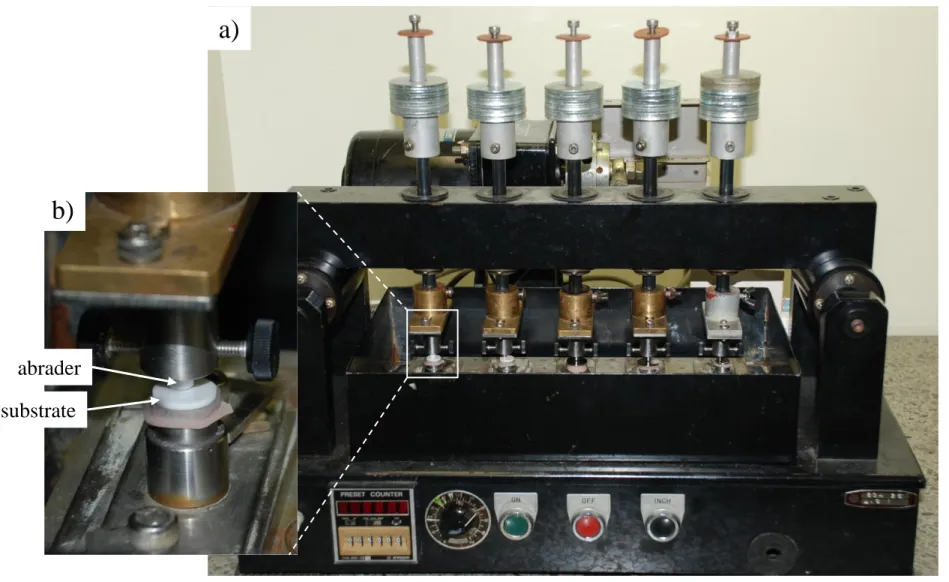
A wear test was performed using an experimental wear simulator as shown in Fig 1 according to pervious study17). As seen in Fig 2a, each abrader specimen was moved back and forth on the substrate specimen over a distance of 3 mm for 30,000 cycles at a speed of 90 cycles/min and with a vertical load of 10 N. The test was carried out at room temperature with distilled water circulated through a water chamber in order to remove abrasion debris.
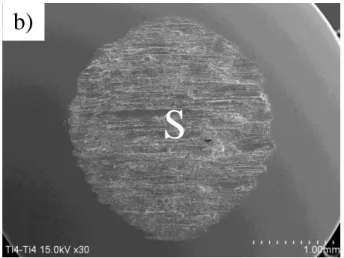
After 30,000 cycles of wear test, the worn surfaces of abrader specimens were observed using a scanning microscope (SEM, SU-6600, HITACHI, Hitachi, Japan). Subsequently, the wear area (S) of the abrader specimen was measured using an image analyzer (HDS-N1, HIROYA, Tokyo, Japan), finally the wear volume (V) was calculated (Fig 2b). Five specimens were used for each combination.
Electron probe micro-analysis (EPMA)
An X-ray characteristic image analysis of the abrader specimens was performed to identify
abraded particles that had adhered to the abrader specimens from the substrate specimens using an electron probe micro-analyzer (EPMA, JXA-8200, JEOL, Tokyo, Japan).
Statistical analysis
For the statistical analysis, an analysis of variance (ANOVA) was used for the wear volume in the wear test, followed by the Scheffe test for a post hoc comparison between groups.
RESULTS
Wear behavior of abrader specimens
The wear area of abrader specimens against various substrate specimens were shown in Table 2. Significantly small wear area was recognized in TZP abraders compared to CpTi and TiAlV abraders.
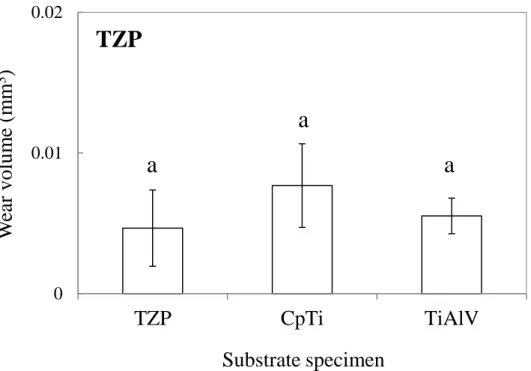
Fig3 shows wear volume of TZP abrader specimen against various substrate specimens.
TZP abrader specimen showed quite a small wear volume against all substrate specimens, and no significant difference in wear volume was recognized among the substrate specimens.
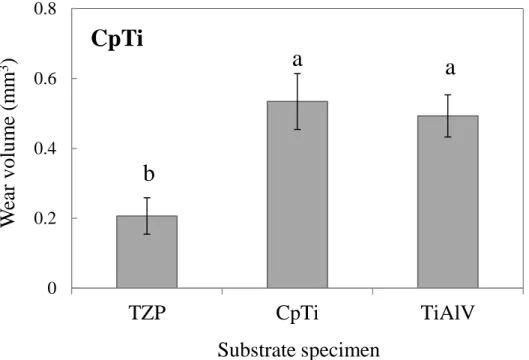
Fig4 shows wear volume of CpTi abrader specimen against various substrate specimens.
The wear volume of CpTi abrader specimen showed approximately twenty times larger than those of TZP abrader specimen (Fig.3). The wear volume of CpTi abrader specimen against TZP substrate was significantly smaller than against CpTi and TiAlV substrates (P<0.01).
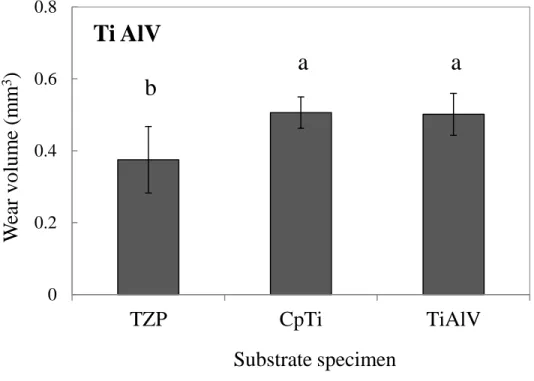
Fig5 shows wear volume of TiAlV abrader specimen against various substrate specimens.
The large wear volume was recognized on TiAlV abrader same as CpTi abrader (Fig.4). The wear volume of TiAlV abrader specimen against TZP substrate was significantly smaller than against CpTi and TiAlV substrates (P<0.05), even though the comparative large wear volume was shown compared to CpTi abrader (Fig.4).
Table 3 shows multiple comparisons between groups on the wear volume of abrader
specimens. The wear volumes of TZP abraders were significantly smaller than those of CpTi and TiAlV abraders. The wear volumes of CpTi and TiAlV abraders against TZP substrates were significantly smaller than those against CpTi and TiAlV substrates.
SEM observation of worn surfaces of abrader specimens
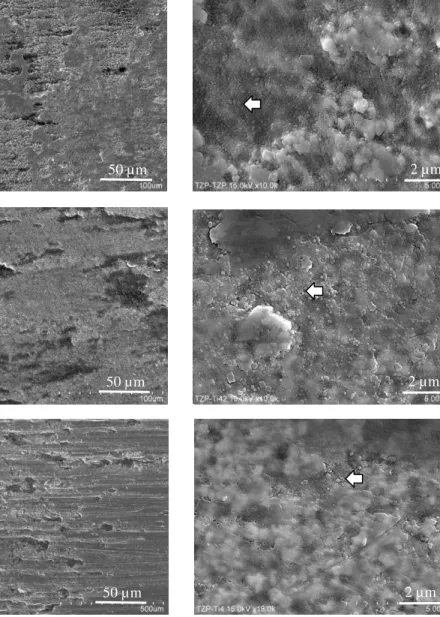
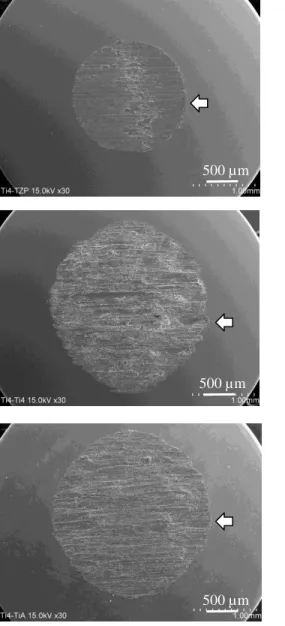
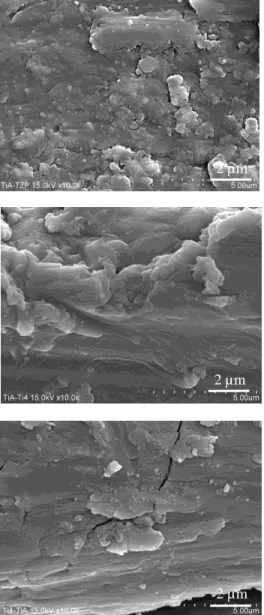
Representative SEM images of worn surfaces of abrader specimens are shown in Figs. 6-8.
When TZP was used as the abrader specimens (Fig. 6), comparatively small circles originated by wear against TZP, CpTi and TiAlV substrates were observed under low magnification (left). Small particles that were originated by TZP grains as a row material were randomly observed under high magnification (right, arrows).
When CpTi was used as the abrader specimens (Fig. 7), the wear morphologies were altered depended on the substrate specimens. In addition to the size of abraded circle, the peripheral morphology of the abraded circle was different between TZP (upper) and CpTi (lower) as the substrate specimen. A very sharp periphery was recognized when TZP was used as the substrate specimen (arrow in Fig.7 upper). On the contrary, when CpTi was used as the substrate specimen (arrow in Fig.7 middle and lower), irregular peripheries were observed, suggesting that some fractions of the substance had been pulled off.
When TiAlV was used as the abrader specimens (Fig. 8), the wear morphologies had a same tendency as the CpTi abrader specimen, despite the size of abraded circle was larger than CpTi abrader.
EPMA analysis
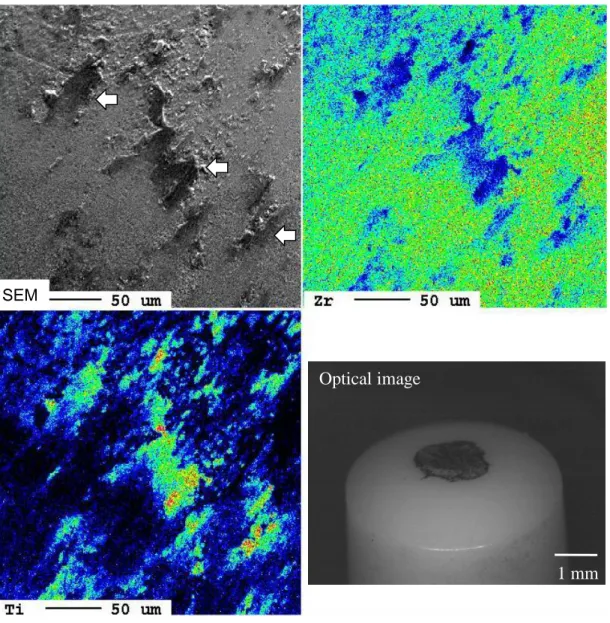
X-ray characteristic images of the worn surface of the TZP abrader specimen against CpTi substrate are shown in Fig. 9. Optical image of TZP abrader specimen with black-colored staining after wear test is also given in the figure. Ti particles were identified as abraded
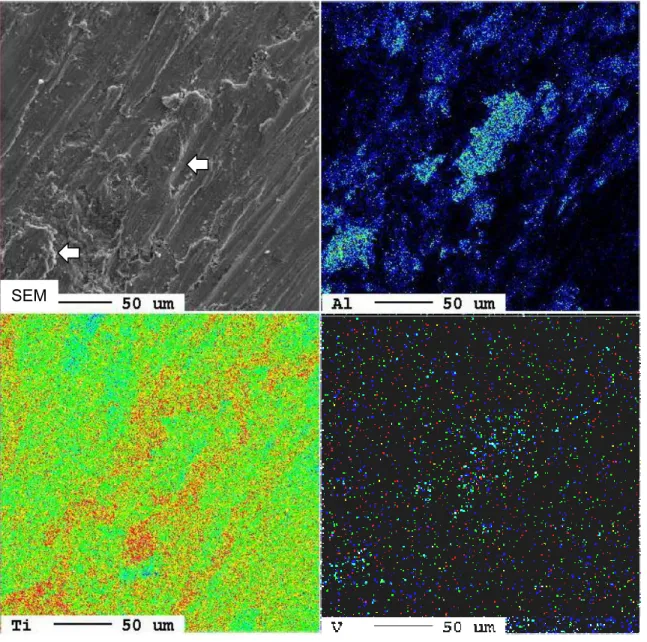
particles that had adhered to abrader specimens from the CpTi substrate (arrows). Fig. 10 shows X-ray characteristic images of the worn surface of the CpTi abrader specimen against TiAlV substrate. Particles of Al and V as well as Ti originating in the TiAlV substrate were detected adhering to the CpTi abrader specimen (arrows).
DISCUSSION
The aim of this study was to estimate the wear behavior when the TZP and titanium (Ti and Ti alloy) were used for the antagonist on fixed prostheses using a two-body wear test.
In this study, the wear behavior was evaluated by estimating the wear volume of the abrader specimen as the antagonist according to the previous reports2-5, 17). Silva et al.
evaluated the volumetric loss of lithium disilicate glass-ceramic and TZP restorations in in vivo study18). Kim et al. al also evaluated the wear volume of the abrader specimens using feldspathic porcelain cusp as well as the cusp of the premolar teeth in in vitro study2). Accordingly, the use of abrader specimen with hemisphere is considered to be beneficial for evaluating the wear behavior between antagonists.
TZP abrader specimen showed quite a small wear volume against all substrate specimens in this study. In contrast, the wear volume of CpTi and TiAlV abrader specimen showed approximately twenty times larger than those of TZP abrader specimen against all substrate specimens. This is considered mainly due to the differences in hardness between the TZP and titanium that have the hardness (Hv) of 1356, 177 and 256 on TZP, CpTi and TiAlV, respectively 16). This indicates that the operating mechanism of wear between the titanium and the TZP was abrasive wear due to the ultra-hardness of the TZP.
In the present study, the wear volume of CpTi and TiAlV abrader specimen against TZP substrate was significantly smaller than CpTi and TiAlV substrates despite the hardness of TZP was much larger than those of CpTi and TiAlV. These phenomena can be explained by
the adhesive wear mechanism 19). Adhesive wear occurs when two bodies slide over each other, or are pressed into one another, which promotes material transfer between the two surfaces. In initial contact, fragments of one surface are pulled off and adhere to the other, due to the strong adhesive interaction between two surfaces with similar physicochemical properties such as metal to metal20, 21). This supposition is supported by the differences in the coefficient of friction between the materials used in this study. The previous study revealed that the coefficient of friction between CpTi and CpTi showed a higher value than the CpTi/TZP combination, showing that a strong adhesive interaction had occurred on the CpTi/
CpTi combination16). This is also supported by SEM observation of the worn surfaces on CpTi/CpTi combination (Figure 7, lower left, arrow), in which irregular shapes at peripheral morphology had resulted from eroded particles from the substrate specimens adhering to the abrader specimens.
Another possible mechanism can be underlying the microstructure of TZP. The grain size of the TZP is less than 0.5µm with a homogenous distribution of crystal sizes and orientations.
The grain size is an important parameter, which determines the surface topography and the tribological behavior of the materials. The fine grain size of TZP may lead to very smooth surfaces after polishing, leading to less susceptible of the antagonist wear behavior.
In the present study, the comparative large wear volume on TiAlV abrader specimen was shown compared to CpTi abrader specimen against TZP substrates. Though the reason for these results is still unclear, the existence of β phase in the TiAlV is possibly responsible for the abrasion behavior in contrast to homogeneous structure of CpTi.
In the EPMA analysis, Ti was detected on TZP abrader specimen when CpTi was used as the substrate. In addition, particles of Al and V originating in the TiAlV substrate were detected adhering to the CpTi abrader specimen, showing that the worn particles of CpTi and TiAlV had attached to the opposite specimens, which would represent a hazard to health from
the presence of metal particles. On the other hand, the TZP was less susceptible to wear by either TZP or titanium. Thus, it would be better to carry out metal-free restoration using TZP in fixed prostheses in order to successfully avoid metallosis originating in worn particles.
In the present study, we used opaque (non-translucent) monolithic TZP that has been increased for using as the FDPs without veneering ceramics due to the less enamel wear characteristics compared to porcelain antagonist. However, using a translucent TZP is more appropriate in the interest of aesthetic dental treatments. Further study is necessary to clarify the wear behavior using a translucent TZP instead of conventional opaque TZP that used in this study. The two-body wear test was used to evaluate the abrader wear behavior in this study. However, this test method does not truly simulate the clinical chewing situation. The wear behavior using the chewing simulator with thermo-mechanical loading and simultaneous thermal stress should be addressed5).
In conclusion, the results in the present study showed that titanium fixed prostheses (Cp-Ti and Ti alloy) are susceptible to wear against not only TZP but also Cp-Ti and Ti alloy in contrast to TZP fixed prostheses. These results may provide useful information to clinical application of zirconia and titanium fixed prostheses from the point of view of the cusp abrasion.
ACKNOWLEDGMENTS
This research was supported partly by an Oral Health Science Center Grant HRC7 from Tokyo Dental College and a Project for Private Universities: matching fund subsidy from MEXT (Ministry of Education, Culture, Sports, Science and Technology of Japan, 2006-2011).
REFERENCES
1 ) Sailer I, Fehér A, Filser F, Gauckler LJ, Lüthy H, Hämmerle CHF. Five-year clinical results of zirconia frameworks for posterior fixed partial dentures. Int J Prosthodont 2007;
20: 383-388.
2) Kim MJ, Oh SH, Kim JH, Ju SW, Seo DG, Jun SH, Ahn JS, Ryu JJ. Wear evaluation of the human enamel opposing different Y-TZP dental ceramics and other porcelains. J Dentistry 2012; 40: 979-988.
3) Mitov G,. Heintze SD, Walz S, Woll K, Muecklich F, Pospiech P. Wear behavior of dental Y-TZP ceramic against natural enamel after different finishing procedures. Dental Materials 2012; 28: 909-918.
4) Preis V, Weiser F, Handel G, Rosentritt M. Wear performance of monolithic dental ceramics with different surface treatments. Quintessence Int 2013;44:393-405.
5) Stawarczyk B, Özcan M, Schmutz F, Trottmann A, Roos M, Hämmerle CHF. Two-body wear of monolithic, veneered and glazed zirconia and their corresponding enamel antagonists. Acta Odontologica Scandinavica 2013; 71: 102-112.
6 ) Uo M, Asakura K, Yokoyama A, Ishikawa M, Tamura K, Totsuka Y, Akasaka T and Watari F X-ray absorption fine structure (XAFS) analysis of titanium-implanted soft tissue. Dental Mater J 2007; 26: 268-273.
7 ) Egusa H, Ko N, Shimazu T and Yatani H. Suspected association of an allergic reaction with titanium dental implants: a clinical report. J Prosthet Dent 2008; 100: 344-347.
8 ) Witt JD and Swann M. Metal wear and tissue response in failed titanium alloy total hip replacements. J Bone Joint Surg Br 1991; 73: 559-563.
9 ) Sicilia A, Cuesta S, Coma G, Arregui I, Guisasola C, Ruiz E and Maestro A. Titanium allergy in dental implant patients: a clinical study on 1500 consecutive patients. Clin Oral Implants Res 2008; 19: 823-835.
10) Seghi RR, Rosenstiel SF, Bauer P. Abrasion of human enamel by different dental ceramics in vitro. J Dent Res 1991; 70: 221–225.
11) Hacker CH, Wagner WC, Razzoog ME. An in vitro investigation of the wear of enamel on porcelain and gold in saliva. J Prosthetic Dent 1996; 75: 14–17.
12) Metzler KT, Woody RD, Miller 3rd AW, Miller BH. In vitro investigation of the wear of human enamel by dental porcelain. J Prosthetic Dent 1999; 81: 356–364.
13) Oonishi H, Ueno M, Okimatsu H, Amino H. Investigation of the wear behavior of ceramic on ceramic combinations in total hip prosthesis. In: Nakamura T, Miyaji F, Kokubo T, editors. Bioceramics: proceedings of the 9th international symposium on ceramics in medicine, vol. 9, I. Kldlington, United Kingdom: Pergamon Press; 1996. p.
503–6.
14) Willmann G, Fruh HJ, Pfaff HG. Wear characteristics of sliding pairs of zirconia (Y-TZP) for hip endoprostheses. Biomaterials 1996; 17: 2157–2162.
15) Clarke IC, Good V, Yamamoto K, Schroeder D, Gustafson A. High wear resistance of alumina and zirconia ceramic combinations in THR wear study. In: Transactions of the sixth world biomaterials congress. 2000.
16) Kanbara T, Yajima Y, Yoshinari M. Wear behavior of tetragonal zirconia polycrystal versus titanium and titanium alloy. Biomed Mater 2011; 6: 021001, doi:10.1088/1748-6041/6/2/021001
17) Takarabe M. An experimental study on sliding-induced abrasion of natural teeth and materials used for crowns. Shikwa Gakuho1982; 82: 949-1004, in Japanese.
18) Silva NRFA, Thompson Van P, Valverde GB, Paulo G, Powers JM, Farah JW, Esquivel-Upshaw J. Comparative reliability analyses of zirconium oxide and lithium disilicate restorations in vitro and in vivo. JADA 2011; 142 (suppl 2):4S-9S.
19) Kato K. Classification of wear mechanisms/models. Proc Inst Mech Eng Part J, J Eng Tribology 2002; 216: 349-355.
20) Rodrigues DC, Urban RM, Jacobs JJ, Gilbert JL. In vivo severe corrosion and hydrogen embrittlement of retrieved modular body titanium alloy hip-implants. J Biomed Mater.
Res 2009; 88B: 206-219.
21) Hallab NJ, Messina C, Skipor A, Jacobs JJ. Differences in the fretting corrosion of metal-metal and ceramic-metal modular junctions of total hip replacements. J Orthop Res 2004; 22: 250-259.
Figure Legends
Fig 1 (a) Experimental wear simulator. (b) is higher magnification of areas shown in rectangle in (a).
Fig 2 (a) Schematic illustrations of the wear test
(b) Wear area (S) of the worn surface of abrader specimen observed with SEM (c) Wear volume (V) of the worn surface of abrader specimen.
Fig.3 Mean wear volume of TZP abrader specimen against various substrate specimens.
Standard deviations are shown by error bars.
Identical letters indicate no significant difference (p>0.05).
Fig.4 Mean wear volume of CpTi abrader specimen against various substrate specimens.
Standard deviations are shown by error bars.
Different letters indicate significant difference (p<0.01).
Fig.5 Mean wear volume of TiAlV abrader specimen against various substrate specimens.
Standard deviations are shown by error bars.
Different letters indicate significant difference (p<0.05).
Fig. 6 Representative SEM images of worn surfaces of abrader specimens (TZP).
Fig. 7 Representative SEM images of worn surfaces of abrader specimens (CpTi).
Fig. 8 Representative SEM images of worn surfaces of abrader specimens (TiAlV).
Fig. 9 X-ray characteristic images of the worn surface of the TZP abrader specimen against CpTi substrate. Optical image of TZP abrader specimen with black-colored staining after wear test is also given in the figure.
Fig. 10 X-ray characteristic images of the worn surface of the CpTi abrader specimen against TiAlV substrate.
Material Manufacturer Composition (mass%) Code Yttria-stabilized tetragonal zirconia
polycrystals (TZ-3YB-E) Tosoh ZrO
2: balanced, Y
2O
3: 5.16,
Al
2O
3: 0.25 TZP
Cp-titanium grade 4 Tokyo Titanium Ti > 99.0 CpTi
Titanim alloy (Ti-6Al-4V) Tokyo Titanium Ti : balanced, Al: 6.2, V:4.2 TiAlV
Substrate
Abrader TZP CpTi TiAlV
TZP 0.53 (0.16) 0.69 (0.14) 0.59 (0.07) CpTi 3.99 (0.28) 5.73 (0.42) 5.51 (0.33) TiAlV 4.89 (0.49) 5.58 (0.24) 5.56 (0.31)
Unit: mm
2, ( ):SD
Abrader/Substrate, -: NS, *: P<0.05, **: P<0.01
TZP/TZP TZP/CpTi TZP/TiAlV CpTi/TZP CpTi/CpTi CpTi/TiAlV TiAlV/TZP TiAlV/CpTi TiAlV/TiAlV
TZP/TZP - - ** ** ** ** ** **
TZP/CpTi - ** ** ** ** ** **
TZP/TiAlV ** ** ** ** ** **
CpTi/TZP ** ** ** ** **
CpTi/CpTi - * - -
CpTi/TiAlV * - -
TiAlV/TZP * *
TiAlV/CpTi -
TiAlV/TiAlV
Fig 1 (a) Experimental wear simulator.
(b) is higher magnification of areas shown in rectangle in (a).
b)
substrate
abrader
Fig 2 (a) Schematic illustrations of the wear test
(b) Wear area (S) of the worn surface of abrader specimen observed with SEM (c) Wear volume (V) of the worn surface of abrader specimen.
S
V
S
c)
φ=5mm
r=5mm Abrader specimen
Substrate specimen
Fig. 3 Mean wear volume of TZP abrader specimen against various substrate specimens.
Standard deviations are shown by error bars.
Identical letter indicates no significant difference (p>0.05).
a
a
a
0 0.01
TZP CpTi TiAlV
W ear v o lu m e (m m
3)
Substrate specimen
TZP
a
b
a
Fig. 4 Mean wear volume of CpTi abrader specimen against various substrate specimens.
Standard deviations are shown by error bars.
Different letters indicate significant difference (p<0.01).
0 0.2 0.4 0.6
TZP CpTi TiAlV
W ear v o lu m e (m m
3)
Substrate specimen
CpTi
a b
a
Fig. 5 Mean wear volume of TiAlV abrader specimen against various substrate specimens.
Standard deviations are shown by error bars.
Different letters indicate significant difference (p<0.05).
0 0.2 0.4 0.6
TZP CpTi TiAlV
W ear v o lu m e (m m
3)
Substrate specimen
Ti AlV
Fig 6 Representative SEM images of worn surfaces of abrader specimens (TZP ).
50 µm 500 µm
Abrader : TZP Substrate: CpTi
2 µm
50 µm
500 µm 2 µm
Abrader : TZP Substrate: TiAlV
50 µm
500 µm 2 µm
Fig 7 Representative SEM images of worn surfaces of abrader specimens (CpTi).
Abrader : CpTi Substrate: CpTi
50 µm
500 µm 2 µm
50 µm
500 µm 2 µm
Abrader : CpTi Substrate: TiAlV
50 µm
500 µm 2 µm
Fig 8 Representative SEM images of worn surfaces of abrader specimens (TiAlV).
50 µm 500 µm
Abrader : TiAlV Substrate: CpTi
2 µm
2 µm 50 µm
500 µm 2 µm
Abrader : TiAlV Substrate: TiAlV
2 µm 50 µm
500 µm
Fig 9 X-ray characteristic images of the worn surface of the TZP abrader specimen against CpTi substrate.
Optical image of TZP abrader specimen with black-colored staining after wear test is also given in the figure.
Optical image
1 mm