• 検索結果がありません。

Factors related to quality of life of patients with adult spinal deformity and chronic low back painOriginal article

N/A
N/A
Protected

Academic year: 2021

シェア "Factors related to quality of life of patients with adult spinal deformity and chronic low back painOriginal article"

Copied!
8
0
0

読み込み中.... (全文を見る)

全文

(1)

Abstract

 There is no consensus on the association among spinal alignment with back pain, physical func- tion, and quality of life (QOL) of patients with adult spinal deformity (ASD). Moreover, research on elderly patients with ASD is limited. Therefore, this study aimed to clarify the factors associated with QOL of patients with ASD and chronic low back pain. Physical functions associated with QOL, which reflects physical activity, were exam- ined. A total of 43 patients with chronic back pain (age 70.0 ± 4.7 years) persisting for over 3 months and ASD according to the Scoliosis Research So- ciety–Schwab classification were included. Radio- graphic spinopelvic parameters, Japanese Ortho- paedic Association Back Pain Evaluation Questionnaire score, visual analogue scale score, mobility of lumbar extension (LL-Ext) and flexion (LL-Flex), six-minute walk test (6MWT) score, and Timed Up and Go test (TUG) scores were used. Gait QOL was significantly correlated with 6MWT score (r = 0.38), LL-Flex (r = 0.42), LL- Ext (r = 0.58), and pelvic tilt (r = 0.31). Social QOL was significantly correlated with 6MWT

score (r = 0.43), LL-Ext (r = 0.47), and pelvic in- cidence–lumbar lordosis (r = 0.31). Multiple re- gression analysis identified 6MWT score (β = 0.563, p < 0.001) as a significant factor for Gait QOL and VAS score as a significant factor for So- cial QOL (β = 0.504, p < 0.001). As a conclusion, QOL (Pain QOL, Lumbar QOL, Gait QOL, and Social QOL) of the patient with spinal deformity and chronic low back pain was related to each oth- er, and especially, it was indicated that Gait QOL and Social QOL had the very strong relevance from the relationship between walking function and VAS score.

Introduction

 Aging causes kyphoscoliosis [1], and such deformations in adulthood are described as adult spinal deformities (ASD) [2]. The primary symp- toms of ASD include back pain due to deformities and mental instability due to external problems [3]. In epidemiological studies involving large co- horts, ASD was identified in approximately 70%

of the elderly [4]. Exercise therapy is considered the first choice as a general treatment for ASD;

Takuya Kitamura

1,2,3,4

, Masaru Kanda

2,3,4

, Naritoshi Sato

2,3,4

, Hideaki Onishi

2

, Kei Watanabe

4,5

1

Department of Rehabilitation, Niigata University of Rehabilitation, Niigata, Japan

2

Graduate School of Health and Welfare, Niigata University of Health and Welfare, Niigata, Japan

3

Research Center for Locomotive Syndrome Prevention, Niigata University of Health and Welfare, Niigata, Japan

4

Niigata Rehabilitation Hospital, Niigata, Japan

5

Department of Orthopaedic Surgery, Niigata University Medical and Dental General Hospital, Niigata, Japan

Keywords: chronic back pain, adult spinal deformity, quality of life Received: 25 November 2019 / Accepted: 9 January 2020

Factors related to quality of life of patients with adult spinal deformity and chronic low back pain

Corresponding author: Takuya Kitamura

Niigata University of Rehabilitation, 2-16 Uenoyama, Murakami, Niigata 950-0053, Japan

TEL: +81-254-56-8292, FAX: +81-254-56-8291, E-mail: [email protected]

(2)

factors associated with the QOL of patients with ASD and chronic low back pain and explore the physical functions associated with QOL, which reflect physical activity.

Materials and Methods

 A total of 51 patients (age 69.0 ± 6.3 years) who visited the Orthopedic Department of Hospital B located in A Prefecture between April 2015 and May 2019 were enrolled in this study. According to the exclusion criteria, 43 subjects (age 70.0 ± 4.7 years) were included in the analysis (Figure 1).

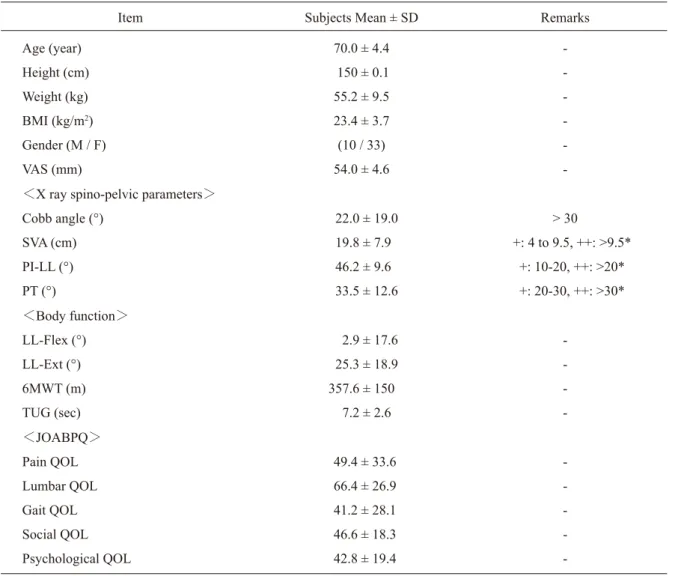
The basic information of the subjects is summa- rized in Table 1. The exclusion criteria were age of

< 65 years, mild deformities without any Scoliosis Research Society (SRS)-Schwab class [13], ma- lignant neoplasms, psychiatric disorders, and seri- ous medical disorders. The SRS–Schwab classifi- cation assesses spinal deformities from the frontal and sagittal planes. Frontal plane deformations are classified according to the Cobb angle and the sag- ittal plane ones according to the overall antever- sion angle of the sagittal vertex axis (SVA) and the pelvis form [13]. Radiographic spinopelvic pa- rameters, Japanese Orthopaedic Association Back Pain Evaluation (JOABPEQ) score, visual ana- logue scale (VAS) score, mobility of lumbar ex- tension (LL-Ext) and flexion (LL-Flex), six-min- ute walk test (6MWT) score, and Timed Up and Go test (TUG) results were evaluated. The radio- graphic spinopelvic parameters were measured by an orthopedic surgeon who was proficient in measuring the following items: Cobb angle, SVA, pelvic incidence–lumbar lordosis (PI-LL), pelvic tilt (PT), LL-Flex, and LL-Ext. JOABPEQ classi- however, in cases with severe deformation, spinal

fusion is often performed without exercise therapy to correct the deformation [5,6]. For this surgery, the trunk bending forward motion, extension mo- tion, and rotation motion are restricted to repair a wide range of intervertebral fixations involving the spinal deformation region; however, postoper- ative QOL often declines in such cases [7]. These facts underscore the importance of slowing the progress of deformation with exercise therapy be- fore it becomes severe.

 Although various factors associated with ASD affect QOL, sagittal plane posture shows the most influential evidence [8,9]. Kyphotic changes lead to thoracic kyphosis, lumbar lordosis, and pelvic posterior tilt [10], and the greater the degree of these changes, the lower the QOL [8]. Therefore, the goal of surgical treatment for ASD in patients with severe kyphotic deformities is an ideal sagit- tal orientation [9].

 However, certain factors such as the necessity of improvement of physical function in physical function have not been clarified in studies evaluat- ing the QOL of patients with ASD conducted to date. Often, patients with ASD are young, and they present with only moderate spinal deformi- ties. In studies with high evidence reported to date, patients presented with moderate kyphotic de- formities and were < 65 years of age. Moreover, research on elderly patients with severe deformi- ties is limited, and the association between physi- cal function and QOL remains to be clarified.

Chronic back pain is a symptom observed in sev-

eral patients with patients, and exercise therapy is

the first choice for treatment in these patients [11]

(3)

evaluations, and JOABPEQ scores are strongly correlated with the 36-Item Short Form Survey (SF-36) and Oswestry Disability Index, which have a high reliability worldwide [15-17]. 6MWT includes a series of examinations that assess walk- ing ability on the basis of the distance a subject can walk within 6 minutes; its reproducibility and reliability have been verified for various diseases [18]. TUG includes a series of examinations that synthetically evaluate the operational ability of standing up, walking, and turning; it is one of the indispensable evaluations mainly used in the re- search on falling [18].

 Normality of all data was tested by the Shap- iro-Wilk test. The associations between the do-

mains of JOABPEQ was obtained by Spearman’s correlation analysis. Two separate multiple regres- sion (stepwise method) analysis were performed with the identified domains as dependent variables and the remaining variables except JOABPEQ do- mains as independent variables. All statistical analyses were performed using R-2.8.1, and a p value of < 0.05 was considered statistically signif- icant.

 This study was approved by the Ethics Commit- tee of Hospital B (Approval No: 2015-06) and per- formed in accordance with the Helsinki Declara- tion. Written informed consent was obtained from all the subjects before collecting the data.

Enrolled: n = 51

mean age: 69.0 ± 6.3 y.o.

㸺Excluded (total n = 8) because㸼

< 65 years old (n = 3)

mild deformities not included any SRS-schwab classification (n = 2)

malignant neoplasms (n = 1)

psychiatric disorders (n = 1)

serious medical disorders (n = 1)

Analyzed: n = 43䠄㻌mean age: 70.0 ± 4.7 y.o.䠅

Figure 1. Analysis and selection of subjects.

(4)

Table 1. Basic information of subjects (n = 43).

Item Subjects Mean ± SD Remarks

Age (year) 70.0 ± 4.4 -

Height (cm) 150 ± 0.1 -

Weight (kg) 55.2 ± 9.5 -

BMI (kg/m

2

) 23.4 ± 3.7 -

Gender (M / F) (10 / 33) -

VAS (mm) 54.0 ± 4.6 -

<X ray spino-pelvic parameters>

Cobb angle (°) 22.0 ± 19.0 > 30

SVA (cm) 19.8 ± 7.9 +: 4 to 9.5, ++: >9.5*

PI-LL (°) 46.2 ± 9.6 +: 10-20, ++: >20*

PT (°) 33.5 ± 12.6 +: 20-30, ++: >30*

<Body function>

LL-Flex (°) 2.9 ± 17.6 -

LL-Ext (°) 25.3 ± 18.9 -

6MWT (m) 357.6 ± 150 -

TUG (sec) 7.2 ± 2.6 -

<JOABPQ>

Pain QOL 49.4 ± 33.6 -

Lumbar QOL 66.4 ± 26.9 -

Gait QOL 41.2 ± 28.1 -

Social QOL 46.6 ± 18.3 -

Psychological QOL 42.8 ± 19.4 -

Body Mass Index (BMI).

Gender:Male (M), Female (F).

Visual analogue scale (VAS).

Sagittal vertebral axis (SVA), Pelvic incidence (PI), Pelvic tilt (PT).

Lumbar Flexion (LL-Flex), Lumbar Extention (LL-Ext).

*SRS- schwab classfication; Moderate (+), Severe (++).

Six-minute walk test (6MWT).

Timed up and go test (TUG).

Japanese orthopaedic association back pain evaluation questionare (JOABPEQ). Pain related disorders QOL (Pain QOL),Lumbar dysfunction

(5)

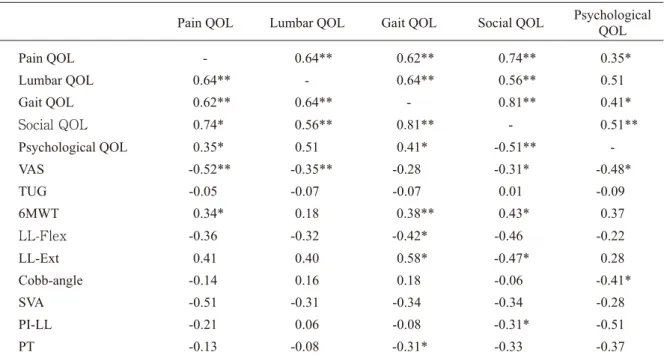
Each domain of JOABPEQ achieved significant correlations, and the correlation coefficient (r = 0.81) of Gait QOL and Social QOL was the high- est. Multiple regression analysis was performed with Gait QOL and Social QOL as dependent var- iables and factors with significant correlations in univariate analysis as independent variables. Mul- tiple regression analysis identified 6MWT score (β

= 0.563, p < 0.001) as a significant factor for Gait QOL and VAS score as a significant factor for So- cial QOL (β = 0.504, p < 0.001) (Table 3). Factors with correlation coefficients of ≥ 0.7 were exclud- ed in consideration of multicollinearity.

Results

 Pain QOL was significantly correlated with VAS score (r = -0.52, p < 0.01) and 6MWT score (r = 0.34, p < 0.05). Lumbar QOL was correlated with VAS score (r = -0.35, p < 0.01). Gait QOL was significantly correlated with 6MWT score (r = -0.38, p < 0.01), LL-Flex (r = 0.42, p < 0.05), LL- Ext (r = 0.58, p < 0.05), and pelvic tilt (r = 0.31, p

< 0.05). Social QOL was significantly correlated with VAS score (r = -0.31, p < 0.05), 6MWT score (r = 0.43, p < 0.05), LL-Ext (r = 0.47, p < 0.05), and PI-LL (r = 0.31, p < 0.05). Psychological QOL was correlated with VAS score (r = 0.48, p < 0.05) and Cobb angle (r = 0.41, p < 0.05) (Table 2).

Table 2. Factors associated with quality of life (n = 43).

Pain QOL Lumbar QOL Gait QOL Social QOL Psychological QOL

Pain QOL - 0.64** 0.62** 0.74** 0.35*

Lumbar QOL 0.64** - 0.64** 0.56** 0.51

Gait QOL 0.62** 0.64** - 0.81** 0.41*

Social QOL 0.74* 0.56** 0.81** - 0.51**

Psychological QOL 0.35* 0.51 0.41* -0.51** -

VAS -0.52** -0.35** -0.28 -0.31* -0.48*

TUG -0.05 -0.07 -0.07 0.01 -0.09

6MWT 0.34* 0.18 0.38** 0.43* 0.37

LL-Flex -0.36 -0.32 -0.42* -0.46 -0.22

LL-Ext 0.41 0.40 0.58* -0.47* 0.28

Cobb-angle -0.14 0.16 0.18 -0.06 -0.41*

SVA -0.51 -0.31 -0.34 -0.34 -0.28

PI-LL -0.21 0.06 -0.08 -0.31* -0.51

PT -0.13 -0.08 -0.31* -0.33 -0.37

*: p < 0.05, **: p < 0.01 Spearman’s correlation analysis.

The above values indicate the correlation coefficient.

Japanese orthopaedic association back pain evaluation questionare (JOABPEQ). Pain related disorders QOL (Pain QOL),Lumbar dysfunction QOL (Lumbar QOL), Gait disturbance QOL(Gait QOL), Social life dysfunction QOL (Social QOL), Psychological disorders QOL (Psychological QOL).

Visual analogue scale (VAS).

Timed up and go test (TUG).

Six-minute walk test (6MWT).

Lumbar Flexion (LL-Flex), Lumbar Extention (LL-Ext).

Sagittal vertebral axis (SVA), Pelvic incidence - Lumbar lordosis (PI-LL),Pelvic tilt (PT).

(6)

VAS score affected Social QOL. Some questions in Gait QOL such as “Do you have difficulty in walking more than 15 minutes?” and “Because of lower back pain, you walk only short distances”

are related to “walking distance.” 6MWT evalu- ates the distance walked in 6 minutes, which ex- plains the result that 6MWT score, which reflects the long-distance walking ability, affected Gait QOL. Conversely, questions on Social QOL such as “How much work was interrupted by the pain?”

and “I do not do any work at home that I usually do because of low back pain” are mainly related to activity. Nonetheless, this domain can also reflect pain.

 These results suggest that a physical therapy in- tervention focusing on improvements in walking function and pain relief will be effective to im- prove the QOL of patients with ASD and chronic low back pain. The five domains of JOABPEQ were correlated with one another, and Gait QOL and Social QOL were particularly strongly corre- lated. 6MWT and VAS scores were extracted as factors influencing Gait QOL and Social QOL. In the meantime, it is reported that the lumbar exten- sion range of motion is related to the QOL in the Discussion

 This study was conducted to determine the fac- tors associated with the QOL of patients with ASD and chronic low back pain. The results revealed that 6MWT score was correlated with the Gait QOL, and VAS score was correlated with Social QOL.

 Therefore, the QOL of patients with ASD and chronic back pain was associated with different QOL domains, and Gait QOL and Social QOL were particularly strongly correlated with each other. In addition, five JOABPEQ domains were associated with one another. A moderate correla- tion has been previously reported among Lumbar QOL, Social QOL, and Gait QOL [19]. Social QOL and Gait QOL may be reflected as functional disorders rather than pain intensity [19]. Although all the five domains were independently evaluated, some questions were reflected in multiple do- mains. Gait QOL comprises five questions and So- cial QOL comprises four. Among these questions,

“Do you have difficulty in walking more than 15 minutes?” is included in both Gait QOL and So- cial QOL. The results of the present study indicate that 6MWT, which reflected data related to this

Table 3. Factors affecting Gait QOL and Social QOL (n = 43).

Dependent variable Predictor variable Standard β β F value p value

Gait QOL 6MWT -0.103 -0.563 15.35 0.001

Social QOL VAS -3.649 -0.504 11.24 0.002

Stepwise multiple regression analysis.

Standard partial regression coefficient (β).

Multiple correlation coefficient (squared): 0.317.

Six-minute walk test (6MWT).

Visual analogue scale (VAS).

(7)

apy for 3 months could improve pain relief, walk- ing ability, and QOL [24]. Based on previous re- ports and the results of this study, physical therapy for pain, gait function, and lumbar range of motion may be effective for improving QOL. However, in our report and previous studies, pain relief was only approximately 50%. In the future, it will be necessary to characterize patients who are expect- ed to benefit from physical therapy.

 There were several limitations in this study, pain intensity and deformation degree were ana- lyzed without classification, which is one of the limitations of this study. Also, because lower ex- tremity function was not evaluated in this study, it is difficult to consider 6MWT and TUG. There- fore, future studies should aim at analyzing data by severity. In addition, because the duration of illness and dosing status were not investigated, more diversified investigations should be conduct- ed to include these factors.

 As a conclusion, QOL (Pain QOL, Lumbar QOL, Gait QOL, and Social QOL) of the patient with spinal deformity and chronic low back pain was related to each other, and especially, it was indicated that Gait QOL and Social QOL had the very strong relevance from the relationship be- tween walking function and VAS score.

Acknowledgments

 We would like to express our deepest apprecia- tion to all those who have contributed to the com- pletion of this research. We specially thank Profes- sor Naritoshi Sato of Niigata University of Health and Welfare, Assistant Professor Masaru Kanda, Professor Hideaki Onishi, and Dr. Kei Watanabe of Niigata University for their practical and tech- nical support, including English language correc- tion.

Conflicts of Interest

 There are no conflicts of interest to declare.

References

1.  Katzman WB, Wanek L, Shepherd JA, et al.

Age related hyperkyphosis: Its causes, conse- quences, and management. Journal of Ortho- paedic & Sports Physical Therapy. 2010; 40:

352-360.

2.  Lyer S, Sheha E, Fu MC, et al. Sagittal spinal alignment in adult spinal deformity: An over- view of current concepts and a critical analy- sis review. JBJS Reviews. 2018; 1-13.

3.  Iida T, Suzuki N, Kono K, et al. Minimum 20 years long-term clinical outcome after spinal fusion and instrumentation for scoliosis:

Comparison of the srs-22 patient question- naire with that in nonscoliosis group. Spine.

2015; 40: 922-928.

4.  Schwab F, Dubey A, Gamez L, et al. Adult scoliosis: Prevalence, SF-36, and nutritional parameters in an elderly volunteer population.

Spine. 2005; 30: 1082-1085.

5.  O’connell NE, Cook CE, Wand BM, et al.

Clinical guidelines for low back pain: A criti- cal review of consensus and inconsistencies across three major guidelines. Best Practice &

Research Clinical Rheumatology. 2016; 30:

968-980.

6.  Kado DM. The rehabilitation of hyperkyphot- ic posture in the elderly. European Journal of Physical and Rehabilitation Medicine. 2009;

45: 583-593.

7.  Togawa D, Hasegawa T, Yamato Y, et al. Post- operative disability after long corrective fu- sion to the pelvis in elderly patients with spi- nal deformity. Spine. 2018; 43: 804-812.

8.  Glassman SD, Bridwell K, Dimar JR, et al.

The impact of positive sagittal balance in adult spinal deformity. Spine. 2005; 30: 2024- 2029.

9.  Klineberg E, Schwab F, Smith JS, et al. Sagit- tal spinal pelvic alignment. Neurosurgery Clinics. 2013; 24: 157-162.

10. Roussouly P, Pinheiro-Franco JL. Biome-

chanical analysis of the spino-pelvic organi-

(8)

tee of the Japanese orthopaedic association on low back pain and cervical myelopathy evalu- ation. JOA back pain evaluation questionnaire (JOABPEQ) / JOA cervical myelopathy eval- uation questionnaire (JOACMEQ). The report on the development of revised versions. April 16, 2007. The Subcommittee of the clinical outcome committee of the Japanese orrhopae- dic association on low back pain and cervical myelopathy evaluation. Journal of Orthopae- dic Science. 2009; 14: 348-365.

18. Kim B, Fiona D, Rana H. Measures of physi- cal performance assessments. Arthritis Care and Research. 2011; 63: 350-370.

19. Matsui S. Evaluation of nonspecific low back pain using the daily meeting low back pain evaluation questionnaire (JOABPEQ). The Journal of Japanese Society of Lumbar Spine Disorders. 2009; 15: 157-164.

20. Ishikawa Y, Miyakoshi N, Hongo M, et al.

Relationships among spinal mobility and sag- ittal alignment of spine and lower extremity to quality of life and risk of falls. Gait Posture.

2017; 53: 98-103.

21. Hashimoto Y, Mizuura M. Age related chang- es in thoracic and lumbar mobility. Japan Journal of Physical Education, Health and Sport Sciences. 2010; 55: 333-342. (in Japa- nese)

22. Iwasaki H, Umeda T, Danue K, et al. Relation- ship between spinal range of motion and body function. Journal of Physical Fitness, Nutri- tion and Immunology. 2011; 21: 265-267. (in Japanese)

23. Gordon R, Bloxham S. A systematic review of zation and adaptation in pathology. European

Spine Journal. 2011; 20: 609-618.

11. Dreisinger TE. Exercise in the management of chronic back pain. The Ochsner Journal.

2014; 14: 101-107.

12. Lewis C, Diaz R, Lopez G, et al. A prelimi- nary study to evaluate postural improvement in subjects with scoliosis: Active therapeutic movement version 2 device and home exer- cises using the mulligan’s mobilization with movement concept. Journal of Manipulative and Physiological Therapeutics. 2014; 37:

502-509.

13. Schwab F, Ungar B, Blondel B, et al. Scoliosis Research Society-Schwab adult spinal de- formity classification: A validation study.

Spine. 2012; 37: 1077-1082.

14. Hashizume H, Konno S, Takeshita K, et al.

Japanese orthopaedic association back pain evaluation questioner (JOABPEQ) as an out- come measure for patients with low back pain: Reference values in healthy volunteers.

Journal of Orthopaedic Science. 2015; 20:

264-280.

15. Fukui M, Chiba K, Kawakami M, et al. Japa- nese orthopedic association back pain evalua- tion questionnaire. part 2. verification of its reliability: The subcommittee on low back pain and cervical myelopathy evaluation of the clinical outcome committee of the Japa- nese orthopedic association. Journal of Ortho- paedic Science. 2007; 12: 526-532.

16. Fukui M, Chiba K, Kawakami M, et al. Japa-

nese orthopedic association back pain evalua-

tion questionnaire. part 3. validity study and

Table 1.  Basic information of subjects (n = 43).
Table 2.  Factors associated with quality of life (n = 43).
Table 3.  Factors affecting Gait QOL and Social QOL (n = 43).

参照

関連したドキュメント

Nov, this definition includ.ing the fact that new stages on fundamental configuration begin at the rows 23 imply, no matter what the starting configuration is, the new stages

Standard domino tableaux have already been considered by many authors [33], [6], [34], [8], [1], but, to the best of our knowledge, the expression of the

H ernández , Positive and free boundary solutions to singular nonlinear elliptic problems with absorption; An overview and open problems, in: Proceedings of the Variational

Keywords: Convex order ; Fréchet distribution ; Median ; Mittag-Leffler distribution ; Mittag- Leffler function ; Stable distribution ; Stochastic order.. AMS MSC 2010: Primary 60E05

Theorem 5 was the first result that really showed that Gorenstein liaison is a theory about divisors on arithmetically Cohen-Macaulay schemes, just as Hartshorne [50] had shown that

Inside this class, we identify a new subclass of Liouvillian integrable systems, under suitable conditions such Liouvillian integrable systems can have at most one limit cycle, and

Within the family of isosceles 4-simplices with an equifacetal base, the degree of freedom in constructing an equiareal, equiradial, but non-equifacetal simplex is embodied in

Wro ´nski’s construction replaced by phase semantic completion. ASubL3, Crakow 06/11/06