Our Songs Can Drown out the Bomb! : Musical Change in Vietnam since the War
著者(英) Phong T. Nguyen
journal or
publication title
Senri Ethnological Reports
volume 65
page range 147‑165
year 2007‑01‑11
URL http://doi.org/10.15021/00001528
“Our Songs Can Drown out the Bomb!”:
Musical Change in Vietnam since the War
Phong T. Nguyen
Institute for Vietnamese Music
Prologue
“Code Name: Rolling Thunder; date: March 2, 1965: United States jets begin overt bombing missions within and beyond South Vietnam.”
1This strategic plan would continue for eight years. It reached its climax on December 18, 1972, when President Richard Nixon ordered the bombing of the North Vietnamese cities of Hanoi (or Hà Nội) and Haiphong (or Hải Phòng). Seven months earlier, on May 8, the U.S. had begun mining Haiphong Harbor, marking the first major aggression against the North.
2From December 18 to 28, nearly three thousand sorties were flown through the heavily populated corridor between Hanoi and Haiphong dropping some forty thousand tons of bombs. During these eleven days, the costs to the U.S.
of this massive campaign were, however, not inconsequential: “the North Vietnamese shot down twenty-six U.S. aircraft, among them fifteen B-52s, and ninety-three pilots and crew members were lost, thirty-one of them captured” (Karnaw 1997:
667-68).
3“Hanoi was carpeted with flames, bullets, and bombs. Bombs exploded all around me. Never mind! I needed to see Hanoi defending itself from above with my own eyes,” recalls Phan Nhân, a composer freshly graduated from the Liszt Academy of Music in Hungary. “With dignity, Hanoians were confident that they would achieve victory by creating ‘a melody to drown out the bomb.’ The ‘Điện Biên Phủ-like’ air attack
4first began with ‘the bombs blasting our songs’ but now ends with ‘our songs drowning out the bomb’” (Phan Nhân 1989: 378-9) (emphasis added). During the war years, the idea that singing voice could be used as a powerful weapon to overcome war itself was enthusiastically embraced by countless Vietnamese. Phan Nhân’s phrase “Our Songs Can Drown out the Bomb!” was eventually adopted as the name of a nationwide movement to use music to bring the war to an end.
While witnessing this enormous destruction, Phan Nhân wrote his song Hà nội:
Niềm tin và hy vọng (“Hanoi: Perseverance and Hope,” 1972) (Figure 1), which was
eventually awarded the first prize by the Vietnam Composers’ Union. Over the next
several years Phan Nhân became one of Vietnam’s best known composers using the
then-popular “anti-B-52 bomber” theme in his lyrics. This is just one example of
how war and music are closely connected, particularly in the recent history of
Vietnam.
Hanoi — Perseverance and Hope
The Sword Lake shimmers, reflecting clouds and sky The scent of flowers spreads through the capital A breeze is blowing through all the city’s streets,
Toward the Five Gates.
Though you may hear laughter, don’t forget the suffering.
Oh, Hanoi is the confidence, the love, and the hope of the country, Today and tomorrow.
I walk proudly and without fear.
Figure 1 The notation and English translation of Hà nội ― Niềm tin và hy vọng
Look! See the cannons aimed high in the sky.
Oh, Đông Đô! The Sacred Hùng Has left its ancient imprint here.
Oh, Thăng Long! Today, victory Brightens the country’s mountains and rivers.
Hanoi, our beloved city, our beloved capital, Is our brightening morning star,
Its light illuminating the darkness of the Trường Sơn And penetrating the depths of the Mekong River.
The stealthy footsteps of our military Are woven into a song
That drowns out the bombs’ roar.
Our Hanoi resounds with our beloved song That drowns out the bombs’ roar.
Translation: Phong T. Nguyen & David Badagnani
The U.S. operations Flaming Dart, Flaming Dart II, and other attack-and- retaliation bombing campaigns that began in 1964 proved disastrous for the entire country. Musicians, in particular, had to endure many special hardships. Because of the danger that they might be damaged by bombing, many instruments of the National School of Music in Hanoi (especially larger ones like pianos and double basses) had to be moved to underground hiding places in the outskirts of the capital, often for months at a time. When no motor vehicles were available, wooden carts would be used to transport the instruments. Damaged or lost instruments were replaced by the School so that the students could continue their studies.
5From the start, music played an important role in the war, both in Vietnam and the United States.
6As early as 1964, a political song dealing with the bombing attacks appeared: Sẳn sàng, bắn! (“Are You Ready? Fire!”) was composed by Tô Hải during the first U.S. aerial bombing. In an article written twenty-five years later, another composer, Hoàng Hiệp, recounts an extraordinary story. American jets had discovered a supply unit on their way to Cồn Cỏ Island, in central Vietnam. The Vietnamese boat was severely damaged. The crew clung to the broken pieces of wood for three days without food or water. Their spirits were only sustained by songs during this ordeal (Hoàng Hiệp 1989: 161). This and countless other stories circulated among resistance fighters and anti-war activists show a strong belief in the power of music.
The Background
Who were the composers of these wartime songs? In order to answer this question, one needs to look at the musical institutions in Vietnam during that period, their role in shaping the nation’s musical thinking, and their influence on the mass media.
In 1956, after the reunification of Vietnam failed, both North and South Vietnam instituted many new developments in the areas of musical performance, instruction, and research. Foremost among these developments were the new schools of music founded in Hanoi in the North, and Saigon in the South (Arana 1999: 51; Le 1998:
87).
7After nearly thirty years of war, peace was finally restored in 1975; the country was reunified and led by a single socialist regime with Hanoi as its capital city. The aforementioned schools of music were renamed the Hanoi National Conservatory of Music and its branch, the Conservatory of Music in Hồ Chí Minh City (formerly Saigon). This organizational shift made the school one of the largest musical institutions in all Southeast Asia.
The founders of Vietnam’s current conservatory system possessed much
experience in both music and war. During their younger years, they had come into
contact with European and American music through French schools, military bands,
Boy Scouts, and Catholic missionaries. For example, composer Tô Hải mentioned
above was originally trained in a Catholic music school during the French colonial period. Many others were self-taught, using French instructional books to learn solfège and harmony, or learning from their friends or neighbors. Their first musical instruments included mandolin, banjo, guitar, harmonica, accordion, and violin; for most of them the piano was a luxury they could not afford. At nightclubs and concert halls in the 1930s and 1940s they listened to songs by such artists as Josephine Baker, Tino Rossi, Bing Crosby, and Bob Hope; those with access to Western classical instruments performed works by such composers as Bach, Beethoven, Schubert, and Chopin. Also during this time some of these musicians composed the first Vietnamese popular songs, which they called nhạc cải cách (literally “reformed music”) or tân nhạc (“modern music”).
These original songs, many of which were romantic or sentimental in nature, were quickly dismissed as frivolous by many nationalists when the second war against the French broke out in 1947. They recognized a need for patriotic songs that could help their cause and began to promote the composition of such songs.
According to Huy Du, a prominent composer educated in Moscow, romanticism was thus slowly but surely replaced by revolutionary songs (Văn Hóa Nghệ Thuật 1981:
47). While some musicians and composers remained in the cities (which were under the control of the pro-French government), many others joined the Resistance living and fighting in the mountains and countryside. Using Western compositional idioms and techniques, they wrote anti-French songs to motivate the population toward a war of independence, disseminating them across the country via low-powered radio transmitters and word of mouth. A few songs also promoted the Communist ideology. It is said that Hồ Chí Minh himself translated the words of the Internationale (the Communist anthem), by the French Marxist poet Eugène Pottier, into the Vietnamese language for the first time while in a French prison (Văn Phác 1990: 6).
8Four of the best-known writers of modern revolutionary songs were Văn Cao,
Lưu Hữu Phước, Nguyễn Xuân Khoát, and Đỗ Nhuận, whose activities centered
around Hanoi. Văn Cao (1939-95), although most famous for his romantic ballads,
also composed several patriotic songs; his Tiến quân ca (“March to the Front”) was
eventually adopted as Vietnam’s national anthem. Lưu Hữu Phước (1921-89) was a
leading composer during the patriotic movement of the 1940s and, paradoxically,
the author of the national anthems of both the Republic of Vietnam (also called
South Vietnam) and the National Liberation Front of South Vietnam (a resistance
movement allied with North Vietnam) before 1975. Unlike Văn Cao and Lưu Hữu
Phước, who wrote mostly popular songs, Nguyễn Xuân Khoát and Đỗ Nhuận
excelled in both Western-style orchestral and chamber works as well as popular
songs for the Resistance.
Let us take the case of Đỗ Nhuận (1922-91) to illustrate the early period of modern Vietnamese music. While imprisoned by the French in early 1950s in Hải Dương, Hànội, and in a remote labor camp on the mountain of Sơn La, Đỗ Nhuận made his own instruments from materials he found there and trained himself in musical composition. In Sơn La prison, he wrote, among others, Chiều tù (“A Prisoner in the Dusk”), Hận Sơn La (“Revulsion in Sơn La”), and Du kích ca (“Guerrilla’s Song”). During this time Đỗ Nhuận attempted several times to escape to rejoin the Resistance.
He began to create orchestral and chamber compositions only after his training at the Tchaikovsky Conservatory of Music in Moscow from 1960 to 1962; some of his most famous works include Mùa xuân trên rừng (“Spring in the Jungle,” 1963), Tây nguyên (“The Central Highlands,” 1964), Điện biên (“Điện Biên Phủ,” 1965), and Giao hưởng thơ Dimitrov (“Symphony on a Poem by Dimitrov,” 1981).
The first composers in the Democratic Republic of Vietnam (i.e., North Vietnam) to receive formal training overseas earned fellowships from the Socialist countries beginning in 1954, the year of victory at Điện Biên Phủ. The first of these were Huy Du, Nguyễn Đình Tấn, and Hoàng Vân, who studied in the Soviet Union.
Over the next two decades, succeeding musicians studied in Russia, Poland, Ukraine, East Germany, Kazakhstan, Uzbekistan, Mongolia, Hungary, Bulgaria, China, and North Korea under the sponsorship of, or via exchange programs with, those countries. As part of these exchange programs, teachers from the Soviet Union, China, and North Korea also came to Hanoi to train Vietnamese students at the Vietnam School of Music. Other classes were also organized by the Composers’
Union, founded in 1957. Russian and other foreign teachers and musicians were, therefore, familiar to the Vietnamese during the period from the 1960s to the mid- 1970s. Some Vietnamese composers who studied in the Soviet Union achieved such distinction that their orchestral works were featured on Russian radio and television.
While most of these works were composed in a primarily Western classical style, a few composers experimented with traditional Vietnamese instruments or musical materials. Similarly, traditional musicians and folk singers from Hanoi also performed in Moscow, Leningrad, and other cities in Eastern Europe on a regular basis. Most, if not all, musicians who today lead Vietnam’s musical institutions were educated in the former Socialist bloc. Recent and current directors of the Vietnamese conservatories of music are graduates of the conservatories of Moscow (Trọng Bằng), Kiev (Trần Thu Hà), and Poland (Hoàng Cương).
The Institutionalization of Music
The Westernization (or “modernization”) of music is generally recognized as a
worldwide phenomenon. Although it may not always be true for every culture, one
statement by Bruno Nettl (1985: 13) could be realistically applied to Vietnam:
“every society had its own music that remained essentially unchanged, except when disturbed by the military and colonial expansion of Western society.” Although Vietnamese music has undergone change over previous centuries, partly through contacts with neighboring nations, the impact of Western music in the twentieth century was more sudden and drastic.
The institutionalization of music in Vietnam, as exemplified by its present conservatory system, began in the early twentieth century, when the French organized military bands made up of Vietnamese serving in French military regiments.
9Đỗ Nhuận’s father started his music career as a member of the lính kèn tây (military brass band) in Haiphong in the 1920s. The sound of his father’s brass band, imprinted in Đỗ Nhuận’s memory during his childhood, would later be featured in his anti-French compositions.
In late 1946, a popular movement rose throughout Vietnam to fight for national independence and oust the French colonial government. Resistance music groups called đoàn văn công were rapidly formed to assist this movement (Photo 1). They were the first Vietnamese musical organizations in modern times to provide systematic Western-style training and present performances in an extensive and flexible manner. Recruiting members was the first and most difficult step for the organizers of these groups. While a soldier with the anti-French resistance forces, Tô Hải led a đoàn văn công with a membership that fluctuated between 30 and 120 singers and instrumentalists (playing primarily Western instruments). He trained, conducted, and arranged music for his group. This herculean assignment, given to him by leaders of the Resistance, required day-and-night self-training. Before
Photo 1 Luu Huu Phuoc (center), author of the Resistance National Anthems, is surrounded by members of the đoàn văn công or Resistance Music Group.
joining the Resistance, Tô Hải‘s musical experience was admittedly slim. He had learned the basics of music from an old friend who had been a conductor of a French military band (Tô Hải 1989: 129).
Tô Hải’s experience typifies the early musical career of most Vietnamese musicians, conductors, and composers now affiliated with the nation’s academic system. Due to the subversive, and thus extremely dangerous, nature of such activities, all of these groups operated in secrecy and had no fixed location for the rehearsals or performance. The leaders of the đoàn văn công directed their members to move from place to place in order to avoid bomb attacks, but they were also armed so they could engage in combat if it was necessary to defend themselves.
Most of the time, they remained in rear support (hậu cần), where their function was to entertain and inspire soldiers and civilians. Although đoàn văn công of various sizes were active throughout the country, the two most prominent were quite large and well organized. These were namely the Đoàn Văn Công Nhân Dân Trung Uơng (Central People’s Resistance Music Group) and Đoàn Văn Công Tổng Cục Chính Trị (General Political Commission Music Group). At the local and military division levels, smaller đoàn văn công were founded. Besides these institutions, the Đoàn Quân Nhạc ([National] Military Band) offered extensive training in brass music and conducting.
10After the Geneva Agreement in 1954, all đoàn văn công groups returned to Hanoi and the other cities on the northern side of the seventeenth parallel.
11Two years later the Trường Âm Nhạc Việt Nam (Vietnam School of Music) was founded in Hanoi, with most of the leaders of the đoàn văn công assuming their first non- military tasks. Indeed, it was they who filled most of the new school’s faculty and administrative positions. This school was reorganized in 1975 to become the present-day Nhạc Viện Quốc Gia Hà Nội (Hanoi National Conservatory of Music), as mentioned above.
12As a result of this organizational change, traditional music subgroups of the đoàn văn công were combined to form the present Đạị Học Sân Khấu và Điện Ảnh (University of Theater and Cinematography).
The complex structure of Vietnam’s educational system can be difficult to comprehend. For example, musical education is not placed under the oversight of the Ministry of Education, but rather the Ministry of Culture and Information. This ministry, also made up primarily of Resistance veterans, governs all official performances, instruction, and institutions related to culture and the arts, basing their decisions on their past experiences, and using the arts to fulfill strategic and revolutionary needs. Vietnam’s musical and performing institutions are as follows:
Hanoi National Conservatory of Music
Ho Chi Minh City Conservatory of Music
University of Theater and Cinematography
Institute of Theater Institute of Culture and Art University of Art in Hue Colleges of Culture and Art Vocational High Schools of Art
Within the tow conservatories in Hanoi and Ho Chi Minh City, there are nine departments:
1. Department of (Western) Music Theory, Composition, and Conducting 2. Department of Piano
3. Department of Traditional Instruments 4. Department of String Instruments 5. Department of Wind and Percussion 6. Department of Voice
7. Department of Accordion, Guitar, and Jazz
8. Department of Marxism-Leninism and General Studies 9. Department of Culture
Most of these institutions (with the exception of the University of Theater and Cinematography) have at least a department or section teaching music. The curricula for all of these music divisions are prepared by teachers and administrators who graduated from the conservatories, and the Hanoi National Conservatory of Music provides all the other institutions with instructors. The Conservatory thus has great authority in shaping the official musical education of the entire nation.
Musical Change and Related Issues
Examining Vietnamese music in the context of the rapidly changing world of the 1960s and early 1970s, there appears during this period an acute sense of agony and challenge among its performers and composers. Never in the history of Vietnam had there been such appalling destruction and the loss of so many lives as in this war with the U.S. A report from Hanoi by correspondent Harrison Salisbury, published in the New York Times on December 25 and 27, 1972, showed conclusively that the U.S. was deliberately targeting even the civilian populace (Dudley 1998: 95-96).
Music became, for many Vietnamese, a potent force that could be used to oppose such violence; many songs written during the period reinforced their determination to bring the war to an end.
One such song, Phan Nhân’s Hà nội: Niềm tin và hy vọng, mentioned above,
achieved great popularity due to its hopeful message. Its lyrics describe the streets
of Hanoi, a few days after the cessation of the U.S. bombardment in December
1972, in a romantic and poetic manner. Whether consciously or not, it is clear that in this song Phan Nhân drew on the characteristic style of Vietnam’s popular music movement—commonly known as nhạc tiền chiến or “pre-war music” —which had begun in the 1940s.
The development and increasing popularity of nhạc tiền chiến, according to many scholars, signaled a major change in the nation’s musical culture.
13Interestingly, the essentially romantic aesthetic ideals of this movement, which had developed before the second war with the French colonialists, were maintained during the revolutionary period. Musicians in the Resistance, many of whom came from urban backgrounds and were thus quite familiar with nhạc tiền chiến, made extensive use of the style in their newly composed resistance songs.
While it might seem incongruous for these musicians to have favored a style modeled on European idioms while actively resisting colonial domination, they justified this by calling the style of their songs lãng mạn cách mạng or “revolutionary romanticism.”
14Songs of this genre (called ca khúc, translating simply as “song”) by Phan Nhân, his teachers, and colleagues typify a period in which Western musical elements (harmony, orchestration, vocal techniques, etc.) began to be applied in the academic setting. Such songs were created first by the upper class in the cities, especially Hanoi and Saigon, were adopted by the Resistance when it moved into the countryside, and finally returned to the cities after the victory at the battle of Điện Biên Phủ in 1954. The Westernization of music can thus be seen to have been first promoted by the educated leaders of the Revolution, and then, once these leaders took their places as the leaders of the Conservatory in 1975, instituted on a nationwide level, reshaping Vietnam’s music according to the models they had developed over the previous decades.
Today, Vietnam’s conservatory graduates take pride in their training, and in the relatively high social status that such training confers on instrumentalists, vocalists, and composers. Equally, they are grateful for the efforts of the Conservatory’s founders, who had used their talents to defend the nation and promote the Revolution.
Elevating the role of the Conservatory to a matter of national pride, however, has provoked controversy. The following issues are of concern to most scholars of traditional music in Vietnam:
1. From a national standpoint, the Conservatory’s curricula have consistently excluded traditional music genres. Although traditional musical instruments are taught, students are provided little or no understanding about traditional concepts of Vietnamese chamber music. Typical chamber music genres like ca trù, ca huế, and tài tử have no place in these institutions.
Furthermore, in a nation with a traditional musical culture characterized
by regional distinctions, educational institutions replace this diversity with
a standardized, modernized repertoire that is taught throughout the country. By governmental directive, traditional instruments were placed in the service of new music, in the name of nhạc dân tộc (“people’s music”).
15The rush to modernize Vietnam’s music and to create a pan- Vietnamese “national music,” initiated by the leaders of the Hanoi conservatory during the wartime years, led to the forging of a new kind of music called nhạc dân tộc cải biên, which involves the performance of newly composed pieces played on traditional (and “modernized” traditional) instruments (Photo 2). Scholar Miranda Arana, in her extensive research on nhạc dân tộc cải biên, translates the genre as “neo-traditional music”
(Arana 1999). In the eyes of the government, the use of traditional instruments would serve to reinforce a national consciousness among the population. Such ideological pressure, however, unfortunately left little time for planning and reflection, and thus most nhạc dân tộc cải biên compositions, while retaining some traditional elements, are essentially Western in conception and idiom as many traditional and ethnic instruments are retuned (Photos 3 and 4). This has raised the issue of authenticity of Vietnamese music among traditional music scholars. “Instead of using the indigenous concept of improvisation, structure of lớp (section), câu (phrase), as well as the monophonic, heterophonic textures of the earlier genres, modern composers of nhạc dân tộc cải biên have resorted primarily to Western classical and pop music compositional techniques, with multi-part, chordal, homophonic, and polyphonic textures” (Lê 1991:
Photo 2 The klongput bamboo aerophone of the Central Highlands minorities are retuned to Western scales for the nhạc dân tộc cải biên or neotraditional music.
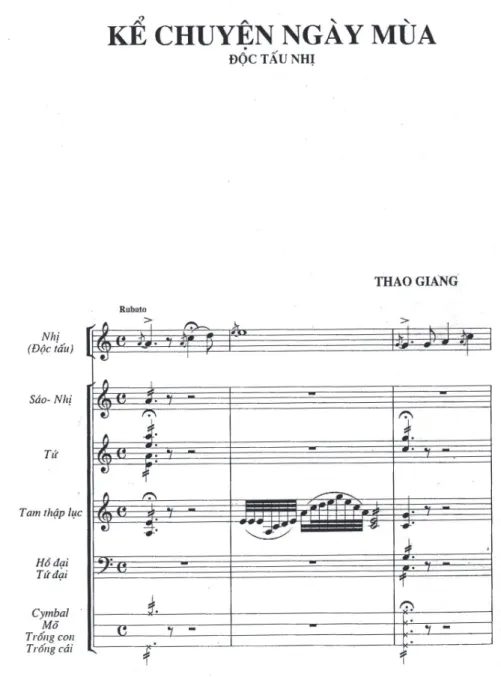
85-7). When asked about his motives behind the composition of his Kể Chuyện Ngày Mùa (“A Story of the Harvest Day,” 1972) (Figure 2), one of the best known contemporary compositions for traditional instruments, Thao Giang enthusiastically explained the three principal motivations of composers of the time: 1) to bring the traditional instruments to the same social level with Western instruments in professional performances; 2) to serve the farmers, workers, and the soldiers in the anti-American bombardment movement; and 3) to fulfill his assigned duty within the
Photo 4 A student player of cải biên music on a chromatic t'rung bamboo xylophone.
Photo 3 The author is testing a modernized lithophone tuned to Western chromatic scale.
Figure 2 The notation of Kể Chuyện Ngày Mùa
field of music.
16Thao Giang’s Kể chuyện ngày mùa is “illustrative of a 1970s trend in composition that involved a passage from vocal music to instrumental music” and “while the melodic feel of Kể chuyện ngày mùa is reminiscent of chèo (theater), the rhythmic and harmonic structure, form, instrumental technique, and overall conception are similar to those of Chinese erhu (two-stringed fiddle) compositions of the 1940s to 1960s (with harmonic accompaniment and rhythmic patterns derived from Western classical music)” (Arana 1999: 84-6). The instruments used for this piece include a solo đàn nhị (two-stringed fiddle), accompanied by an ensemble consisting of sáo (bamboo flute), tam thập lục (hammered dulcimer), hồ đại (large fiddle), tứ đại (four-stringed lute), and percussion (Photo 5). The musical form of this composition is: prelude, fast A section, slow B section, cadenza, A section, and coda. This new musical realization reflects Western idioms in both form (repeat, contrast, harmony) and instrumentation (soloist and accompaniment). The pitches and melodic contours used are, however, drawn from traditional music.
Photo 5 The “Young Talents” First Prize winner performing Kể Chuyện Ngày Mùa by Thao Giang at the National Opera House.