UltrasonographyHelpsFormMaternalConsciousnessinEarlyPregnancy:
BasedonInterviewsConductedinPregnantWomen inTheTohokuRegionofJapan
〔研究ノート〕
Izumi Matsuo1) Akifumi Kagiya2)
1)Aomori University of Health and Welfare
2)Tsugaru Seihokugo Region Union Tugaru General Hospital Abstract:
Thisstudyhadobjecttoinvestigatehowultrasonographyhelpsformanddevelopmaternalcon- sciousnessinearlypregnancy.InJapan,ultrasonographyiscommonlyusedtomonitorfetaldevel- opmentinhealthexaminationforpregnantwomen.Semi-structuredinterviewswereconducted inwomeninearlypregnancyresidinginprefecture–ZintheTohokuregionofJapanwhogave theirconsenttoparticipateinthisstudy.Intheinterview,wecollectedinformationregarding theirexperienceofultrasonography.Thecollecteddatawereanalyzedinductivelyusingthecon- tinuouscomparisonmethodtocharacterizematernalconsciousnessinearlypregnancyandelu- cidatehowmaternalconsciousnessdevelops.Atotalof200(average:12±4)responses,includ- inghowtheyfeltorwhattheythoughtaboutfetalsonogramsandaboutbeingamother,were obtainedfrom17womeninearlypregnancy(gestationperiod:5to16weeks).Bothcontextand literalitywerereviewedandanalyzed.Theresultsindicatedthatseeingthefetalsonogramsand obtaininginformationfrommedicalprofessionalshelpwomeninearlypregnancyattainmaternal consciousnessandincreasethesenseofhavinganinternallocusofcontrol,whiletheyimagine theassumedcourseofpregnancybeforetheactualprogressofgestationandsharethepregnancy experiencewiththeirfamily,supporters,etc.Ultrasonographywasanimportanttriggerforthe formationanddevelopmentofmaternalconsciousnessinwomeninearlypregnancy.Thisresult suggestedthattheuseofultrasonographyinhealthexaminationforpregnantwomenishelpful inmonitoringhealthduringpregnancyandinprovidingpsychosocialsupportforwomeninearly pregnancytobuildasenseofmaternalconsciousness.
Keywords: Ultrasonography,womeninearlypregnancy,maternalconsciousness, inductiveanalysis,healthlocusofcontrol
drenareoftenregardedasasacredgift,andchild rearingistraditionallytheroleofthemother4). However, high expectations on women to be an idealmothersometimescausemotherstoloseself- confidence and can lead to postpartum anxiety aboutchildrearing,whichcanresultinchildabuse.
Thisisregardedasasocialproblem.Womenwho become pregnant need psychosocial support to formmaternalconsciousnesssothattheycantake anactiveroleintheirpregnancy/childbirth/child rearing5)6).However,mostpreviousstudieswere Introduction
Thedefinitionofmotherhoodvaries.Inthenar- rowsense,motherhoodisthephysiologicalprocess of childbirth followed by child rearing1). At the same time, motherhood is the sense of being a mother.Maternalconsciousnessrepresentsthecog- nitivesideofmotherhood,involvingbehaviorand valuesplacedonpregnancy/childbirth/rearingby women2)3).Thesebehaviorsandvaluesbeginto formatthetimewhenawomanfirstrealizesshe isabouttobecomeorisamother.InJapan,chil-
orinwriting.Theywereinformedthatparticipa- tion in this study was voluntary, that interview data were analyzed statistically, and that their confidentialitywouldbeprotected.Inaddition,they wereinformedthatdatawouldbeusedonlyfor thisstudyandwouldbedestroyedpromptlyafter completion of study. This study was conducted afterobtaininginformedconsentfromthemand approvalfromtheEthicsCommitteeofHirosaki University Graduate School of Medicine(serial number:2008-038).
Study methods 1.Preliminarystudy
First, the cultural and social backgrounds of theintervieweeswereinvestigatedbyattending themothers’classesandhealthguidancecourses heldatthemedicalinstitutionsthatmadethese classesandcoursesavailabletotheinterviewees.
Asapreliminarystudy,semi-structuredinterviews wereconductedin3womenwithdifferentbaseline characteristicsforabout30minuteseach.Basedon theadviceandopinionsofresearchers(nursesand doctors),andmedicalstaff(maternitynursesand publichealthnurses)attheparticipatingmedical institutions,theinterviewitems,interviewmeth- ods,andthemethodofrecordingwererevised.
2.Methodsofdatacollection
Interviewees:Pregnant women who were re- ferredbythemedicalstaff(maternitynursesand publichealthnurses)attheparticipatingmedical institutions that consented to participate in the studyandagreedtohelprecruittheinterviewees.
3.Interviewitems
1)Baselinecharacteristics:Age,historyofpreg- nancy/delivery,occupationalstatus,presence/ab- senceoffamilylivingtogether,presence/absence ofchildren,classificationofthepresentpregnancy
(intended/unintended), method of conception, courseofpregnancy,andsubjectiveevaluationon thepresenthealthstatus(good/bad)
2)Interview guide:The following items were usedinallinterviews:“Howdidyoufeelwhenyou sawthesonogramsofyourbaby?”“Howdoyou feelaboutbeingamother,”and“Doyouhaveany concerns?”
3)Field notes:With regard to the interview data,thecourseofpregnancywasmappedusing graphpapersothattherelationshipbetweenthe objective course of pregnancy and the pregnant women’s interpretation/maternal consciousness couldbeanalyzedintwodimensions.
4)Interview method:The interview was con- ductedinthemedicalinstitutions.Theinterview conducted in postpartum/parenting women, and
womeninearlypregnancyhaverarelybeenstud- ied7~9).
Inprefecture-Awherethisstudywasconducted, there are not enough perinatal care providers available.Thus,regardlessoftheexistenceofany medicalproblems,mostpregnantwomenreceive uniform pregnancy care10~13). This often makes pregnant women more reliant on medical care.
In particular, ultrasonography is widely used in generalhealthexaminations,andpregnantwomen areeligibletoreceiveultrasonographyforfreein healthexaminationforpregnantwomen14).Because ultrasonography allows women to see the fetal heartrate,fetalmovement,andgestationalsac,ul- trasonographyisregardedasanenjoyablemedical examinationforthepregnantwomanandherfam- ily15).However,theeffectultrasonographyhason theformationofmaternalconsciousnessinwomen inearlypregnancyremainsunknown.
Thisstudywasconductedtocontributetoapsy- chosocialsupportprograminhealthexamination forpregnantwomen.Inthisstudy,thecharacter- isticsandtheformation/developmentofmaternal consciousnesswerestudiedbasedontheultraso- nography-relatedresponsesobtainedthroughin- terviewsconductedinwomeninearlypregnancy livingintheTohokuregionofJapan.
Methods 1.Studydesign
Thiswasaqualitativestudyconductedtoclarify thecharacteristics,formation,anddevelopmentof maternal consciousness by inductive analysis of data from ultrasonography experiences in early pregnancy16~18).Moreover,theresultsofthisstudy wereusedtodevelopapsychosocialsupportmod- el,whichcanbeusedbymedicalprofessionalswho providesupporttopregnantwomenandtheirfam- iliesatthetimeofhealthexaminationforpregnant women.
2.Researchperiod
ThestudywasconductedfromMay2008toAu- gust2008.
3.Interviewees
Pregnantwomenwhowererecipientsofhealth examinationforpregnantwomenincludingultraso- nographyinmedicalinstitutionsforperinatalmedi- calcareinprefecture-AintheTohokuregionof Japan.
4.Ethicalconsiderations
Responsiblepersonsatparticipatingmedicalin- stitutionsandtheintervieweeswereprovidedwith anexplanationofthestudyinanoralpresentation
Table 1 Examination method and results
item result
Investigationarea Aomori,Japan
Consultationperiod FromMaytoAugust2008
Participant Numberofsubjects(17):Multipara(5)/Primipara(12)
5to19-weekpregnantwomenwhocameformedicalexam.
Interviewdata Totalinterviewtime640(Average:35±10)min.
Totalepisodes:200episodes(Average:12±4)episodes
Dataanalysis Interviewdataanalyzedbycontinuationcomparisontoextractacategory.Weusedthe QDAanalysissoftwareMAXqda2007fordataediting.
Table 2 List of research subjects No Occupation Family
makeup* Thestartof
pregnancy Currentcourseofpregnancy
1 Nurserystaff H/C Intended Threatenedmiscarriageinthepreviouspregnancy 2 Homemaker H/P Intended Stillbirthlasttime
3 Homemaker H/P/C Intended
4 Clerk H Intended Secondexternalfertilization.
5 Nurse H Intended Treatmentfor2years,andartificialinsemination 6 Homemaker C Intended 10yearsoftreatmentforinfertility
7 Homemaker H Intended Plannedpregnancy
8 Clerk H Unplanned StillbirthatWeek39lasttime
9 Farmer H/P Unplanned
10 Medicalclerk H Unplanned 5yearsoftreatmentforinfertility 11 Homemaker H Intended
12 Clerk H Intended
13 Technician H Intended
14 Clerk H Unplanned Undertreatmentformiscarriage
15 Clerk H Unplanned Undertreatmentforhyperemesisgravidarum
16 Clerk H/C Unplanned Miscarriagelasttime.Undertreatmentforthreatenedmiscarriage 17 Clerk H Unplanned Pregnancyafterlongtreatmentforinfertility
* Familymakeup;husbandasH,/childasC/parentsasP
Table 3 Outline of narratives of fetal images and maternal experience triggered by ultrasonography
No Outlineofnarratives*
1 Itismychild.Ifeelreassuredbyhyperemesisgravidarumbecauseitisasignofcontinuedpregnancy.
2 Ifeelreassuredandcanconfirmmypregnancyonseeingtheimage.
3 Theimage,eventhoughitismerelyablackhole,makesmerealizethepresenceofthefetus.
4 Ifeltasifitwassomeoneelse'sproblematfirst.Theimagemademerealizeitasmyownissue.
5 Itisnotaboutmybody,butjust information.
6 Theimageenablesmeandmyhusbandtobeinvolvedinthegrowthofthechild.
7 Wecanseeourcollaborativework.
8 Theimagemakesmefeelasifthechildwasborn.IhavepreparedmyselfasIsawtheimage.
9 Ihavejustbeensurprisedbythefirstpregnancyin13years.Ifinditdifficulttobehaveasapregnantwoman.
10 Theimagereassuresme.Itisajourneytonurturehopesandties.
11 Itismerelyablackdot.I am still worriedevenwhenbeingtolditisachild.
12 Ireceivedthephotobutcannot explain it to my family.
13 Itwasjustadotwithoutanythingelse.Idonotfeelthebabyisthere.
14 Iwantedtoseethebabysoon,buttheimagelookedjust like a sack.
15 Istillfinditunrealisticevenafterexplained.I am worried about the hyperemesis gravidarum.
16 Iwillkeepworryinguntilmybellybecomesbigenough.
17 Myhusbandisalsopuzzledwithmypregnancy.Itisjustinformationseparatefrommyownfeelings.
*Outlineofnarrativesoffetalimagesandmaternalexperiencewhichwereexpressedpositivelyandnegatively.
theseresponses,bothpositiveandnegativeexpres- sionswereusedtonarrateexperiencesrelatedto thediagnosisofpregnancy,existenceanddevel- opment of the fetus, receiving information from medicalprofessionals,supportreceivedfromother people,andchangesovertimeintheirinterpreta- tion/impressionofbeingpregnant20)(Table 2,3).
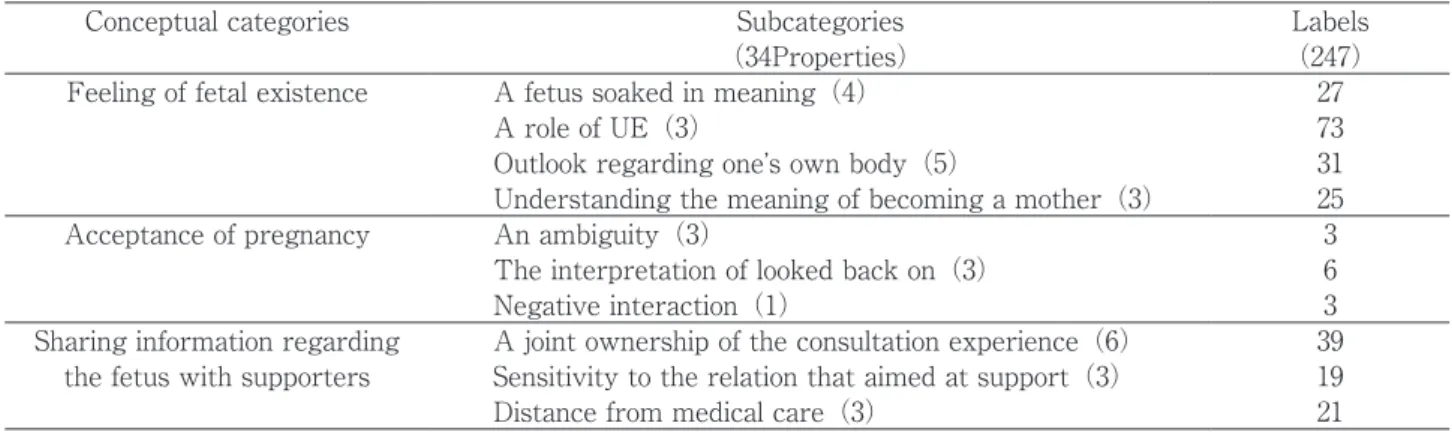
Theinterviewdataweredecontextualized,and 35labelsand10subcategoriesthatrepresentthe characteristicsanddimensionsofthedatawereex- tracted.Moreover,thefollowing3Conceptualcat- egoriesintegratedthematernalconsciousnessin earlypregnancy(hereinafter,expressionsusedby intervieweesareindicatedwithquotationmarks
“ ”)(Table 4, Fig1).
2.Realizationofthepresenceofthefetus
Ultrasonographymakespregnantwomenreal- ize that the visualized fetus is really theirs, as expressedas“so, it’s really my baby,”andthis realizationcomesbeforetheybecomefullyaware ofbeingpregnant.Inthebeginning,expressions usedbytheintervieweesincluded“a black hole,”
“that,”and“belly.”Afterrealizingandaccepting thepregnancy,intervieweesusedsuchexpressions as“baby,” “child,”and“dear(baby’s name).”
Theseexpressionswereusedbytheinterviewees regardless of differences in their age, history of pregnancy/delivery, intended/unintended preg- nancy,andmethodofconception(e.g.,invitrofer- tilization).
Worseningofhealthstatus(e.g.,morningsick- ness)wasacceptedasanormalpartofpregnancy.
Theintervieweesusedthefollowingexpressions toexpresstheirthoughts:“this proves the good health of the baby,” “as a message from the baby,”or“I will get over it for the sake of my unborn baby.”However,twooftheinterviewees who had severe morning sickness, intrauterine bleeding, or threatened miscarriage expressed theirdecreasedinterestinthefetus.Inthesewom- wasaudiorecordedafterobtainingconsentfrom
theinterviewee.Aftertheinterview,thedataex- tracted from the audio record were verified by theinterviewee.Thedatawerethenstoredina PCspecificallypreparedforthisstudy,andthePC waslockedinacabinet.
4.Methodofanalysis
Theinterviewdatawereencodedinaccordance withRubin’smethod,andinductivelyanalyzedus- ingthecontinuouscomparisonmethoddescribedin thegroundedtheoryapproach,andlabeledbased on the properties and dimensions of individual data19).
Next,thedataweregroupedintosubcategories basedonthetermsusedbytheinterviewees.Last- ly,majorconceptsinvolvedintheformationand developmentofmaternalconsciousnesswerepre- sentedascoreconceptsinthemodel.Thequality dataanalysissoftwareMAXQDA2007wasused toeditthedatainordertosecureobjectivityand effectiveness as material for supplementary ex- aminations.Themethodofanalysiswasdeveloped takingtheadviceandopinionsofnursingscience researchersintoaccount(Table 1).
Results
1.Descriptionoftheintervieweesandoutlineof theexperiencesnarratedbytheinterviewees Theintervieweeswererecruitedat6medical institutions:acityhospitalincity-Binprefecture- A,auniversityhospitalincity-B,ageneralhospital incity-B,aclinicthatprovidesassistedreproduc- tionservicesandin-hospitalcareincity-C,anda clinicwithoutanin-hospitalcarefacility.Thestudy includedatotalof17womeningestationperiods of5to16weeks,withameanageof26±8years.
Thetotallengthofallinterviewswas640minutes
(30to40minutesperinterviewee),andatotalof 200responseswerenarratedbytheinterviewees
(average:12±4responsesperinterviewee).In
Table 4 The conceptual categories about the maternal consciousness in early pregnancy
Conceptualcategories Subcategories Labels
(34Properties) (247)
Feelingoffetalexistence Afetussoakedinmeaning(4) 27
AroleofUE(3) 73
Outlookregardingone’sownbody(5) 31
Understandingthemeaningofbecomingamother(3) 25
Acceptanceofpregnancy Anambiguity(3) 3
Theinterpretationoflookedbackon(3) 6
Negativeinteraction(1) 3
Sharinginformationregarding Ajointownershipoftheconsultationexperience(6) 39 thefetuswithsupporters Sensitivitytotherelationthataimedatsupport(3) 19
Distancefrommedicalcare(3) 21
help my baby because it wants to be born,”and
“I don't know what will happen in the future, but I will take care of my baby(fetus).”
4.Sharingthepregnancyexperiencewithothers Becauseafetalbabysymbolizes“family ties”
and“collaboration with the husband,”thein- tervieweesactivelytransmittedinformation(e.g., showing and explaining the printed sonograms theyobtainedfromthemedicalinstitution)about theirfetusinordertosharethisinformationwith theirfamily/supporters.However,insomecases wheretherelationshipbetweentheinterviewees andtheirfamily/supporterswassomewhatnega- tive,theintervieweesexpressedthepresentpreg- nancyassomething“unwanted,”andsharingthe informationaboutthegrowthofthefetuswasin- terpretedassomethingthatcausedtheinterview- eestofeel“constraint” or stress d超音波断層診 断法tothepossibilitythatsharingtheinformation
“may cause their family/supporters concern.”
In early pregnancy, the presence of the fetus cannotbefelt,however,sonogramsmadetheinter- vieweesfeelasif“the baby is already born.”The interviewees developed maternal consciousness throughthe“journey to nurture hopes and ties”
withpeopleclosetothem,whileobservingfetal growthandgainingknowledgeaboutpregnancy.
Withregardtotheroleofmedicalprofessionals, 16oftheintervieweesevaluatedthedoctors/ma- ternitynursesasinformationproviders,stating“I would like the doctor to consider and give me the diagnosis and information, and I have no particular information I would like to know,”
en,thesonogramsshowingtheirfetusaremerely thedatashowingthepositiveresultforpregnancy.
Thus,thesewomen,havingobservedthevisual- izedfetuses,didnotrefertoababyintheirspeech, butratherusedsuchexpressionsas“pregnancy means nothing more than a positive test re- sult,”and“this is only data.”
3.Acceptingthepregnancy
Ultrasonography helped the pregnant women realizeandaccepttheirpregnancy.In10ofthe 17interviewees,thepregnancywasconsidereda positiveexperience.Theseintervieweesincluded 3womenwhobecamepregnantunintentionally,a situationwhichwasexpressedas“This is(actual- ly)an unplanned pregnancy. I had thought it fi- nancially impossible,”and“I had not expected a baby.”However,apositivechangewasobserved inthese3women,whichcouldbeinferredfrom theirexpressionssuchas“The baby wants to be born,”and“That was merely a black dot. Since I was told that I was pregnant, I have to pre- pare myself for it.”
After the pregnant women were treated as a
“mother”fromthetimewhentheywerefirstseen byadoctor,andreceivedarangeofinformation frommedicalprofessionals,theywereabletograsp themeaningandpurposeof“nurturing the fetal baby shown in the image,”and“ultrasonogra- phy made these women become involved in the growth of(the baby).”Ultrasonographyhelped these women develop an increased sense of an internallocusofcontrolinrelationtothegrowth oftheirchild,whichwasexpressedas“I want to
Figure 1 Process and concept of development material consciousness Sharing
information regarding the
fetus with supporters Positive
interaction
Ultrasonography is My baby
It is information different from my feelings
Negative interaction The baby appears
to have been born
A journey to nurture hopes and ties
A joint ownership ofthe consultation experience Distance from medical care
Ultrasonography is Just Information
TheWHOshowsthatanimportantroleofmedi- cal professionals is to provide patient education inordertopromoteaself-relianthealthylife28)29). However, the result of this study indicated that there is little interaction between the pregnant womenandthemedicalprofessionals.Itseemed thatthemedicalprofessionalone-sidedlyprovides image information about the sonograms even though, for pregnant mothers, seeing the sono- gramsoftheirfetusisthesameasmeetingwith their own child. Psychosocially, ultrasonography providesimportanteducationalmaterial.Psychoso- cialsupportcanbeprovidedatthetimeofultra- sonographybydevelopingamutualunderstanding withpregnantwomenandtheirfamiliesandshar- ingthevisualimageofthefetus.
3.Futureresearch
Thiswasacross-sectionalresearchstudycon- ductedin17womeninearlypregnancy.Thedata arelimited,andtheresultscannotbegeneralized, theoreticalsaturationcannotbeattained30).Further studyneedstobeconductedinadifferentregions ordifferentpopulation,andthedataneedtobean- alyzedusingmixedmethodsofobjectiveevaluation inordertocomparetheseresultswithprevious studiesandsupporttheresults31)33).
Conclusion
Thepresentstudywasconductedinwomenin earlypregnancyresidingintheTohokuregionof Japan.Thesepregnantwomenwereinterviewed, and information on ultrasonography experiences wascollectedtoclarifythecharacteristicsofma- ternalconsciousnessandhowthepregnantwomen formanddevelopmaternalconsciousness.Atthe sametime,amethodofprovidingpsychosocialsup- portforpregnantwomenwasproposedbasedon thestudyresult.
1.Ascharacteristicsofmaternalconsciousness, the following common core concepts were ex- tracted:“realizing the presence of the fetus,”
“accepting the pregnancy,”and“sharing the in- formation with others.”
2.Seeingthesonogramsofthefetuswas“equiv- alent to experiencing childbirth.” The study resultsindicatedthatpregnantwomenformand developmaternalconsciousnesswhilesharingthe presenceandgrowthofthefetuswiththeirfami- lies and people close to them, in a“journey to nurture hopes and ties”thatprecedesthereality.
3.Medicalprofessionalsshouldbeawareofthe educationalinfluenceoftheinformation,including thesonogramsofthefetusprovidedatthetimeof ultrasonography,onwomeninearlypregnancyand or“I think I should not ask any question re-
garding the diagnosis in order to show my trust, but I want to know many things because I have a chance to receive such information.”
Some interviewees stated“the doctor is a trustworthy advisor, and the maternity nurses are strict but give me advice and information that helps me visualize the fetus,”or“I appre- ciate and trust the medical care I am receiv- ing.” However, none of the interviewees talked aboutthedevelopmentoftherelationshipbetween themedicalprofessionalsandthepregnantwomen throughtheuseofultrasonography.Thisindicated thatmedicalprofessionalswerenotrecognizedas importantpsychosocialsupporters.
Discussion
Basedonthestudyresults,thepsychosocialef- fects of ultrasonography in early pregnancy are discussedbelow.
1.Characteristicsofmaternalconsciousnessin earlypregnancy
The formation of maternal consciousness in earlypregnancywastriggeredbytherealization ofthepresenceofthefetus,whichwasfollowed bytheestablishmentofarelationshipwiththefe- tus,anddevelopmentofmaternalidentity21)22).For those who accepted the pregnancy, undergoing ultrasonographyisa“journey to nurture hopes and ties,”andseeingthefetusonsonogramswas perceived“as if the baby is already born.”How- ever,theclarityofmaternalconsciousnessinthe pregnantwomenvariedinresponsetochangesin theirhealthandinaccordancewiththeirinterpre- tationofthecourseofpregnancy.Inthisstudy, correctivenarrativeswereoftenobserved.Accord- ingtoBenner,correctivenarrativesareconsidered tobethepracticalrationalizationrequiredtoac- ceptthematernalrole.
However,whenanyabnormalitywasfoundin thecourseofpregnancyorwhenworseningofthe relationshipwithpeopleclosetopregnantwomen occurs,thepregnantwomenbecamehesitantto showthesonogramsoftheirfetusastheirchildren to others, and to explain the results of medical testsduringpregnancy.Notbeingabletosharethe informationabouttheirfetusmayhinderthedevel- opmentofmaternalconsciousness23)24)Atthetime ofultrasonography,aninterpretationmodelshould be obtained to learn what the pregnant woman thinksaboutherselfandthefetusandwhatshe worriesabout25~27).
2.Suggestedpsychosocialsupportforwomenin earlypregnancy
cal Oncology,42(2),139-147,2012
12)KurachiK.Evaluationoffetaldevelopmentby real-timeultrasonicdiagnosis,Research Paper on Persons with Mental and Physical Disor- ders, Ministry of Health and Welfare, 19-22, 13)NishimuraM,TakemoriK,YamamotoH.Life1980 eventsandlifestyleofwomenintheir20sand 30s:influenceofmarriage,pregnancy,giving birth,andchild-care.Japanese Journal of Public Health,55(8),503-510,2008
14)Tamahiyo Books, Hajimete no Tamago Club, Benesse Corporation, Tokyo, 64-72, 2008(in Japanese).
15)SatoI.Introduction of Practical Quality Data Analysis, Shin-yo-sha, Tokyo, 2008(in Japa- nese).
16)Reva R. Maternal Identity and the Maternal Experience Beyond Normalizing: The Role of Narrative in teenage Mothers Transition to Mothering,1986
17)Benner.Interpretive Phenomenology,translation supervised by Sagara Rosenmeier, Ishiyaku Pub.Inc,Tokyo,2006
18)GlaserBGandStraussAL.The Discovery of Grounded Theory,translatedbyTakashiGoto, Setsuo Mizuno, and Harue Ode, Shinyo-sha, Tokyo,1996
19)Rothman. Women and Prenatal Diagnosis, translationsupervisedbySeikoHoriuchi,Axel Springer Japan Publishing, Tokyo, 297-314, 1986
20)MercerRT,HackleyKC,BostromAG.Relation- shipofpsychosocialandperinatalvariablesto perceptionofchildbirth.Nursing Research,32
(4),202-207,1983
21)ManabeAandOkadaS.Psychologicalimpact of fetal three-dimensional imaging on feto- maternalrelationship,Journal of Medical Ul- trasonics,25(1),3-9,1998
22)KandaA,etal.Usefulnessofsubjectivehealth as a measure of health status. Journal of HealthandWelfareStatistics,47(5),33-37, 23)NakagamaH.Relationshipbetweenmulti-gen-2000
erationsandmentalcrisis,(editedby)Nihon KazokuShinriGakkai(JapaneseAssociation ofFamilyPsychology).Kazoku Shinri Gaku annual report 18,Genderdiseases,unnoticed familypathology,KazokuShinriGakuannual report18,135-145,2013
24)L.SmithBattle:BeyondNormalizing:TheRole ofNarrativeinunderstandingteenage Moth- ers’TransitiontoMothering,1992
shouldprovidebothhealthcareandpsychosocial supporttopregnantwomen.
Acknowledgements
Theauthorsthankpeoplewhohelpedadminister thisstudyattheparticipatingmedicalinstitutions andaswellasthosewhoansweredtheinterview- ees.Partofthestudywaspresentedatthe14th EastAsianForumofNursingScholars(EAFONS)
in2011.
References
1)Deutsch,H.1944The psychology of women:
A psychoanalytic interpretation. Vol. I. NY:
GruneandStratton.TranslatedbyKaketa-K andHara-M,NipponKyobun-sha,1964
2)Ohinata-M:Problemsinmaternalresearch.The Annual report educational psychology in Japan, 40,146-156,2001
3)Hanasawa-S:Bosei-Sinnrigaku(Maternal psy- chology).Igaku-shoin,1992(inJapanese).
4)JapanFamilyPlanningAssociation.3rd Report on Life and Attitudes of Men and Women.
Knowledge of, attitudes towards, and behavior related to sex.Tokyo.JapanFamilyPlanning Association,2007(inJapanese).
5)EgawaT.Astudyonpsychologicalwell-being of adult women engaging in childrearing.
Publichealth,Japanese Association for Mental Health,2006
6)ShindoS,WadaS.Psychosocial aspects of moth- erhood and nursing care.Tokyo,Igaku-Shoin, 1990
7)MitsubayashiM.Theeffectsofhealthlocus ofcontrolandsocialsupportonphysicaland mentalhealth.The Japanese Journal of Person- ality.9(1),11-21,2000
8)JapaneseversionoftheEdinburghPostnatal DepressionScale.Psychiatric Diagnosis,525- 533,1996
9)Ui-M,Hori-H,Yamamoto-M:Gender role and psy- chometric scale.Saiensu-sha,138-172,2001 10)MatsuoI,KagiyaA,NishinoK,ChibaT,and
SuzukiM.AnalysisofperinatalcareinAomori Prefectureandsuggestionof“PuremamaItsu- mo-noto(handbookformothers-to-be)”Journal of the Aomori Society of Obstetricians and Gy- necologists,23(1),37-47,2008(inJapanese).
11)MatsudaT,MarugameT,andJapanCancer SurveillanceResearchGroup.Cancerincidence andincidenceratesinJapanin2006:basedon data from 15 population-based cancer regis- triesinthemonitoringofcancerincidencein Japan(MCIJ)project.Japanese Journal of Clini-
25)Waldenstrem.U:Thechildbirthexperience:A studyof295newmothers.BIRTH23(3),144- 153,1996
26)SuganoS.Recognitionandannouncementre- gardingfetus.Reinterpretation of the Faltering Gender, Changing Medical Care and Sexuality, Health and Gender,Chapter4,Possibilityof unknown,editedbyNaomiNemura,Akashi- shoten,Tokyo,91-122,2007
27)GreenLandJohnsonK.Handbook of Health, Health Care and the Health Professions,745, 28)WHO.TranslatedbyRitsukoToda,59Rulesof1983 Childbirth,GuidetoPracticalCareforChild- birth.RuralCultureAssociationJapan,Tokyo, 1997
29)YatsuH.Expressions in the Art of Nursing- Based on the Care Practiced by Expert Obstet- ric Nurses.Kazama-shobo,Tokyo,2002
30)KataiM.Gendermedicineandwomen'sclinic.
Human Mind,Nippon-Hyoron-Sha,141,55-60, 31)NoraJ.Pender.Pender Health Promotion in 2008 Nursing Practice,Tokyo,JapaneseNursingAs- sociationPublishing,1997
32)Glanz K, Rimer BK, Viswanath, K. Health BehaviorandHealthEducation:Theory,Re- search,andPractice.JohnWiley&SonsNew York,23-38,2008
33)LefcourtHM,Davidson-KatzK.LocusofCon- trol and Health. In C. R. Synyder & D. R.
Forsyth(Ed).Handbook of social and clinical Psychology.NewYork,PergamonPress,1991