• 検索結果がありません。

Infectious Diseases, Influenza, Varicella, Child care center,

N/A
N/A
Protected

Academic year: 2021

シェア "Infectious Diseases, Influenza, Varicella, Child care center,"

Copied!
11
0
0

読み込み中.... (全文を見る)

全文

(1)

A Report on Infectious Disease Occurrence in a Japanese Child Care Center Situation 保育所における感染症発生状況に関する検討

Satoko Yokota

1)

要約

 保育所は,子どもが長時間接触しながら生活をしているため,感染症が発生するとすぐに広がる環境であ り,感染症対策が重要である.本研究は,感染症伝播動態メカニズムを分析するうえで基本となる,A保育 所の感染発生動向調査の結果を報告する.対象者は,2016 年 4 月 1 日から 2017 年 3 月 31 日まで保育所 に所属した 0 ~ 5 歳児.月ごとの最大在籍者数は 294 名であった.感染症を発症した子供の総数は 141 名 であった.最も多く報告された感染症はインフルエンザで,次に水痘であった.月別の感染症報告件数の比 較から、インフルエンザが 1 月に、水痘が 5 月に多く発生した結果となった。感染の流行が最も多かった 症状は,発熱,風邪,および胃腸炎であった.本調査結果から,A 保育所におけるインフルエンザと水痘の 集団感染の発生が示唆された.今後保育所における集団感染の要因、および感染経路を明らかにしていく必 要がある.

感染症,インフルエンザ,水痘,保育所
Abstract

When infection occurs in a child care center setting, pathogenic bacteria and viruses spread easily among the children, and outbreaks are reported in child care centers throughout the year. For this reason, measures taken by child care centers against infectious diseases are an important con- sideration. The present survey analyzed the pattern of infectious disease occurrence in one child care center over one year, in order to investigate infectious disease transmission mechanisms. Sub- jects were children aged birth to 5 years of age who were enrolled in a child care center from April 1, 2016, to March 31, 2017. The maximum monthly total number of enrolled children was 294. The total number of children who developed infectious diseases in one year was 141. The most com- monly reported infection was influenza, and the second most frequently reported infection was var- icella. The numbers of children with the most common symptoms were as follows: fever, common cold, and gastroenteritis. The most frequently reported types of infection were influenza, which was most often reported in January. The second most frequently reported type of infection was varicel- la, which was most often reported in May. In the child care center, air infection, droplet infection, and contact infection were reported. From this study, epidemics of influenza and varicella were sus- pected. Various infectious diseases occurred throughout the year. Therefore, in future it would be necessary to clarify the route of infection in outbreaks at child care centers.

Infectious Diseases, Influenza, Varicella, Child care center,

Faculty:1) Asahi University

(2)

Introduction

The Ministry of Health, Labor and Welfare, which has responsibility for child care centers, stat- ed at the beginning of their Preventive Action Guidelines (2012, revised edition) that they will pre- serve children's health and safety and support their mental and physical health and growth (Ministry of Health, Labor and Welfare, 2012). In recent years, the labor force participation rate of spouses of women aged 25 to 34 years has increased sharply, and in 2017 the number of infants who used child care centers also increased by 3.6% compared to 2016 (Ministry of Health, Labor and Welfare, 2017). Child care centers take care of children from birth to 6 years of age, and these children are in close contact for extended periods of time. When infection occurs in a child care center setting, pathogenic bacteria and viruses spread easily among the children, and outbreaks are reported in child care centers throughout the year. For this reason, measures taken by child care centers against infectious diseases are an important consideration.

The Centers for Disease Control and Prevention (CDC) in the United States established a na- tional hospital infection surveillance system (National Nosocomial Infections Surveillance) in 1970.

Systems for controlling infections in Europe and the United States have been adopted in Japan, and surveillance has been practiced and used on a daily basis in Japanese medical institutions. Infection guidelines have also been prepared for child care centers. A child care center surveillance system, established in 2010 by the Infectious Information Center of the National Institute of Infectious Dis- eases Research, is able to gather information on child care absentee or symptomatic onset in real time (Wada, 2011). Nevertheless, various infectious diseases appear in child care centers year- round (Yoshikawa, 2016).

Infants and toddlers are in developmental stages and necessarily grow up in close contact with other children and adults. Maternal antibodies protect infants from infectious diseases, but these antibodies decline over time. Therefore, antibodies against infectious diseases must be obtained by arbitrary or recommended immunization from 2 months after birth (Kou, 2009). The most frequent diseases seen in clinical practice in pediatrics are infectious diseases, mostly upper respiratory in- flammation caused by viral infections and acute gastroenteritis (Uchiyama, 2013). Infectious dis- eases can easily become severe, leading to high hospitalization rates (National Institute of Infectious Diseases, 2014).

In order to clarify the actual condition of infectious diseases in child care centers, it is im-

portant to know not only the nationwide status of infectious diseases but also the state of infection

occurrence in each child care center by examining its current situation. Although there have been

few studies on the occurrence of infectious diseases in nurseries, several research reports have been

published on the occurrence of certain infectious diseases, such as measles and varicella, as well

as infection routes in child care centers (Wada, 2006; Araya, 2013; Yoshikawa, 2016). The present

survey analyzed the pattern of infectious disease occurrence in one child care center over one year,

in order to investigate infectious disease transmission mechanisms.

(3)

Methods 1. Study design

The surveillance study procedure consisted of a review of absence notes from the attendance records in one child care center from April 2016 to March 2017. The data were analyzed by simple aggregation and statistical methods.

2. Study subjects

Subjects were children aged birth to 5 years of age who were enrolled in a child care center from April 1, 2016, to March 31, 2017. The maximum monthly total number of enrolled children was 294; actual numbers of children per month were as follows: for 2016, 278 in April, 282 in May, 282 in June, 290 in July, 291 in August, 293 in September, 294 in October, 294 in November, and 294 in December; and for 2017, 292 in January, 292 in February, and 291 in March.

3. Data collection method

We explained the purpose of the research and provided a research summary and a request state- ment to the facility manager of the child care center from which internal consent was to be obtained.

On the following day, we contacted the manager to ask whether or not research cooperation was possible. After confirming permission for research cooperation, the manager signed and returned the consent form. The facility manager released an attendance chart, from which the names of the children were deleted, and data were collected from the line list. The contents of the line list includ- ed five items: the date of the infection report, and age, class, date of onset of absence, and absence reason (diagnosed infectious disease or symptom) of the absentee.

4. Analysis method

The five items in the line list were analyzed for the occurrence of infectious diseases. We clas- sified the main infection routes as air infection, droplet infection, and contact infection, and for each infection, we calculated the number of occurrences and the occurrence ratios (CDC, 2007; Yoshi- kawa, 2016). We also examined the number of occurrences and occurrence rate of the classified infections and symptoms by classroom and age category. We performed chi-square analysis using js-STAR version 9.1.0j.

5. Definition

When medical institutions make a diagnosis, it is defined as an infectious disease.

An Outbreak was assumed to occur when infectious diseases with an unknown route of infec- tion occur in more than 10 people in the facility within a week.

6. Ethical considerations

The Research Ethics Review Committee of the Asahi University School of Health Sciences De-

partment of Nursing approved research implementation (Certification number 30001). This research

was explained by verbal and written statements to the manager of the child care center, who signed

the consent form. Data collection was carried out under the supervision of the facility manager,

who gave permission for use of one room at the facility. We codified the class names and made

each anonymous so that it could not be identified. Password management was maintained for the

(4)

USB drive that stored the data, so that data could be browsed only by the researchers who were in charge of the analysis. The USB drive was kept in a locked location within the university's research laboratory.

Results 1. Reasons for absence due to sickness

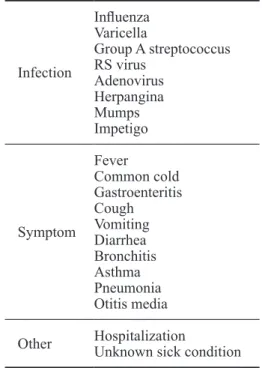
Reasons for absence due to sickness were clas- sified as "infection" and "symptoms," for which the corresponding diseases were not specified. Infections included influenza, varicella, and Group A streptococcus, among others, and symptoms were fever, common cold, and gastroenteritis, among others.

2. Monthly incidence of infectious diseases and symptoms

The total number of children who developed infectious diseases in one year was 141 (with duplication). Hospitalizations and unknown sick conditions were deleted because infectious dis- eases and symptoms were unknown. The most commonly reported infection was influenza, with 88 (62.4%) children in April 2016 and from December 2016 to March 2017. The second most fre- quently reported infection was varicella, with 37 (26.2%) children from April to June 2016. The third most frequently reported infection was streptococcal disease (group A streptococcus), with 6 (4.3%) children reported from January to March 2017. The fourth most frequently reported infec- tions were RS virus and adenovirus infections, with 3 (2.1%) children with each infection. Respi- ratory syncytial virus (RS virus) infections occurred in April and October. Adenovirus infection occurred in May and January-February. Herpangina was reported for 2 (1.4%) children in July.

Mumps was reported for 1 (0.7%) child in August and infectious impetigo for 1 (0.7%) child in July.

A total of 322 children had symptoms in one year (with duplication). The numbers of children with the most common symptoms were as follows: 196 (60.9%) children with fever, 36 (11.2%) children with the common cold, 25 (7.8%) children with gastroenteritis, 22 (6.8%) children with cough, 17 (5.3%) children with vomiting, 10 (3.1%) children with diarrhea, and 7 (2.2%) with symptoms of pneumonia.

Table 1. Reasons for absence due to sickness

Infection

Influenza Varicella

Group A streptococcus RS virus

Adenovirus Herpangina Mumps Impetigo

Symptom

Fever

Common cold Gastroenteritis Cough Vomiting Diarrhea Bronchitis Asthma Pneumonia Otitis media Other Hospitalization

Unknown sick condition

(5)

Table 2. Monthly incidence of infectious diseases and symptoms 2016 2017 Apr

(% ) May (% ) Jun (% ) Jul (% ) Aug (% ) Sep (% ) Oct (% ) Nov (% ) Dec (% ) Jun (% ) Feb (% ) Mar (% ) Total

(% ) n 279 282 288 290 291 293 294 294 294 292 292 291 Infections Influenza 2

(2.3

) 7

(8.0

) 49

(55.7

) 28

(31.8

) 2

(2.3

) 88

(62.4

) Varicella 2

(5.4

) 32

(86.5

) 2

(5.4

) 1

(2.7

) 37

(26.2

) Group A streptococcus 1 (16.7

) 1

(16.7

) 4

(66.7

) 6

(4.3

) RS virus 1 (33.3

) 2

(66.7

) 3

(2.1

) Adenovirus 1 (33.3

) 1

(33.3

) 1

(33.3

) 3

(2.1

) Herpangina 2 (100

) 2

(1.4

) Mumps 1 (100

) 1

(0.7

) Impetigo 1 (100

) 1

(0.7

) Total

(% ) 5 (3.5

) 33

(23.4

) 2

(1.4

) 3

(2.1

) 1

(0.7

) 0 2

(1.4

) 0 8

(5.7

) 51

(36.2

) 30

(21.3

) 6

(4.3 ) 141 (100

) Symptoms Fever 16

(8.2

) 17

(8.7

) 25

(12.8

) 18

(9.2

) 7

(3.6

) 24

(12.2

) 31

(15.8

) 14

(7.1

) 5

(2.6

) 10

(5.1

) 8

(4.1

) 21

(10.7 ) 196 (60.9

) Common cold 5 (13.9

) 6

(16.7

) 4

(1 ) 1.1 1 (2.8

) 1

(2.8

) 6

(16.7

) 7

(19.4

) 3

(8.3

) 2

(5.6

) 1

(2.8

) 36

(1 ) 1.2 (24.0 Gastroenteritis 6

) 4

(16.0

) 1

(4.0

) 0

(0.0

) 5

(20.0

) 4

(16.0

) 2

(8.0

) 1

(4.0

) 2

(8.0

) 25

(7.8

) Cough 1

(4.5

) 1

(4.5

) 4

(18.2

) 2

(9.1

) 7

(31.8

) 3

(13.6

) 2

(9.1

) 1

(4.5

) 1

(4.5

) 22

(6.8

) Vomiting 1

(5.9

) 6

(35.3

) 1

(5.9

) 0

(0.0

) 1

(5.9

) 1

(5.9

) 7

(41.2

) 17

(5.3

) Diarrhea 2 (20.0

) 2

(20.0

) 0

(0.0

) 1

(10.0

) 1

(10.0

) 1

(10.0

) 3

(30.0

) 10

(3.1

) Bronchitis 1 (25.0

) 1

(25.0

) 1

(25.0

) 1

(25.0

) 4

(1.2

) Asthma 1 (25.0

) 1

(25.0

) 1

(25.0

) 1

(25.0

) 4

(1.2

) Pneumonia 2 (28.6

) 1

(14.3

) 2

(28.6

) 1

(14.3

) 1

(14.3

) 7

(2.2

) Otitis media 1 (100

) 1

(0.3

) Total

(% ) 32 (9.9

) 38

(1 ) 1.8 38 (1 ) 1.8 22 (6.8

) 7

(2.2

) 34

(10.6

) 36

(1 ) 1.2 30 (9.3

) 24

(7.5

) 18

(5.6

) 16

(5.0

) 27

(8.4 ) 322 (100

)

1. Zero is not shown 2. "Other symptoms" not included

(6)

3. Occurrence of infectious diseases and symptoms by age category and incidence rate

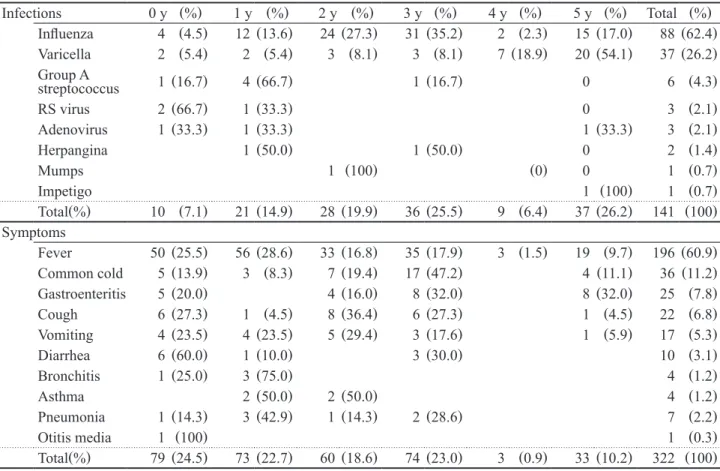
For the infection type with the most reports, influenza, the age group distribution was as fol- lows: 4 (4.5%) below 1-year-old, 12 (13.6%) 1-year-olds, 24 (27.3%) 2-year-olds, 31 (35.2%) 3-year-olds, 2 (2.3%) 4-year-olds, and 15 (17.0%) 5-year-olds. The second most frequently report- ed infection type, varicella, was seen in the follow age groups: 2 (5.4%) children below 1-year-old, 2 (5.4%) children 1-year-old, 3 (8.1%) children 2 years old, 3 (8.1%) children 3 years old, 7 (18.9%) children 4 years old, and 20 (54.1%) children 5 years old.

The most common symptoms were fever: 50 (25.2%) 0-year-olds, 56 (28.6%) 1-year-olds, 33 (16.8%) 2-year-olds, 35 (17.9%) 3-year-olds, 3 (1.5%) 4-year-olds, and 19 (9.7%) 5-year-olds;

common cold: 5 (13.9%) 0-year-olds, 3 (8.3%) 1-year-olds, 7 (19.4%) 2-year-olds, 17 (47.2%) 3-year-olds, and 4 (11.1%) 5-year-olds; gastroenteritis: 5 (20.0%) children below 1-year-old, 4 (16.0%) children 2 years old, 8 (32.0%) children 3 years old, and 8 (32.0%) children 5 years old.

Table 3. Outbreaks of Varicella per Month Varicella

4.1.2016 - 3.31.2017 infected Not infected P- value

May 32

(17.56) 250

(-17.56) p<0.01

Other months 5

(-17.56) 3193 (17.56)

Note. Ajusted stadardized residuals appear in parentheses below group frequencies

Table 4. Outbreaks of Influenza per Month Influenza

4.1.2016 - 3.31.2017 infected Not infected P- value

Jan.2017 49

(16.20) 243

(-16.20) p<0.01 Other months 39

(-16.20) 3149 (16.20)

Note. Ajusted stadardized residuals appear in parentheses below group frequencies

Table 5. Infectious incidence by age

Infections 0 y (%) 1 y (%) 2 y (%) 3 y (%) 4 y (%) 5 y (%) Total (%) Influenza 4 (4.5) 12 (13.6) 24 (27.3) 31 (35.2) 2 (2.3) 15 (17.0) 88 (62.4) Varicella 2 (5.4) 2 (5.4) 3 (8.1) 3 (8.1) 7 (18.9) 20 (54.1) 37 (26.2) Group A

streptococcus 1 (16.7) 4 (66.7) 1 (16.7) 0 6 (4.3)

RS virus 2 (66.7) 1 (33.3) 0 3 (2.1)

Adenovirus 1 (33.3) 1 (33.3) 1 (33.3) 3 (2.1)

Herpangina 1 (50.0) 1 (50.0) 0 2 (1.4)

Mumps 1 (100) (0) 0 1 (0.7)

Impetigo 1 (100) 1 (0.7)

Total(%) 10 (7.1) 21 (14.9) 28 (19.9) 36 (25.5) 9 (6.4) 37 (26.2) 141 (100) Symptoms

Fever 50 (25.5) 56 (28.6) 33 (16.8) 35 (17.9) 3 (1.5) 19 (9.7) 196 (60.9) Common cold 5 (13.9) 3 (8.3) 7 (19.4) 17 (47.2) 4 (11.1) 36 (11.2)

Gastroenteritis 5 (20.0) 4 (16.0) 8 (32.0) 8 (32.0) 25 (7.8)

Cough 6 (27.3) 1 (4.5) 8 (36.4) 6 (27.3) 1 (4.5) 22 (6.8)

Vomiting 4 (23.5) 4 (23.5) 5 (29.4) 3 (17.6) 1 (5.9) 17 (5.3)

Diarrhea 6 (60.0) 1 (10.0) 3 (30.0) 10 (3.1)

Bronchitis 1 (25.0) 3 (75.0) 4 (1.2)

Asthma 2 (50.0) 2 (50.0) 4 (1.2)

Pneumonia 1 (14.3) 3 (42.9) 1 (14.3) 2 (28.6) 7 (2.2)

Otitis media 1 (100) 1 (0.3)

Total(%) 79 (24.5) 73 (22.7) 60 (18.6) 74 (23.0) 3 (0.9) 33 (10.2) 322 (100)

1. Zero is not shown

(7)

4. Classify infections occurred by transmis- sion types

In the child care center, 37 cases of air infection (26.2%), 98 cases of droplet infec- tion (69.5%), and 6 cases of contact infection (4.3%) were reported.

Discussion 1. Outbreaks

In this survey, multiple infections occurred throughout the year, in particular, epidemics of in- fluenza and varicella. The Ministry of Health, Labor and Welfare states that if the infection route is the same, disease occurrence in two or more people per week is classified as an outbreak, and if the route of infection is unknown, occurrence in about 10 or more people per week is an outbreak (Ministry of Health, Labor and Welfare, 1970). Child care centers are obliged to report to the public health center if more than 10 infected persons are recognized. Because the number of occurrences from January to February was 10 or more, according to the definition of the Ministry of Health, La- bor and Welfare, the occurrences of influenza could be considered an outbreak. Similarly, varicella, with 32 cases in May, could also be considered an outbreak.

Influenza was first reported in December and was reported continuously until March, with the most frequent reports in January. Influenza is characterized by strong symptoms such as high fe- ver, sudden appearance of headache, arthralgia, and muscle pain. It is an infectious disease which rarely becomes severe if it occurs in childhood (Yamauchi, 2013). But the occurrence of infections in more than 10 children at the ages of 1, 2, 3, and 5 years of age suggests that secondary infections were present in these classes. The characteristics of the seasonal influenza epidemic in 258 cases were investigated, and the frequency of influenza outbreaks in child care centers was higher than in other facilities, and also the epidemic period was long (Shimoda, 2016). Also, secondary infectious diseases tend to occur frequently in day care centers, and infections tend to continue for a long time (Shimoda, 2016). An investigation of influenza in the United States revealed that children 2 to 17 years old have the highest infection rates (Fowlkes, 2015). Thus it is important to report influenza trends in child care centers and to implement measures to prevent the spread of influenza infection.

Varicella was reported from April to June, and most frequently reported in May. In this child care center, the highest varicella infection rates were among 5-year-olds (20, or 54.1%) and also 4- year-olds (7, or 18.9%). Varicella is an acute infectious disease caused by the varicella zoster virus (VZV). According to a survey of trends of infectious diseases following the Infectious Disease Act of April 1999, about 3,000 to 9,500 varicella infections are reported weekly from about 3,000 pedi- atric fixed-care institutions. Although varicella infectivity is weaker than that of measles, it is said to be stronger than mumps or rubella, and the occurrence rate with home contact is reported as 90%.

Seasonally, it is high every year from December to July and decreases in August and November,

Table 6. Classification of infections by transmission type Number of

infected children (%)

Airbone Varicella 37 (26.2)

Droplet

98 (69.5) Influenza

Mumps

Group A streptococcus Adenovirus

Contact

6 (4.3) RS virus

Herpangina

Impetigo

(8)

with most of the infected aged 9 years or younger (NIID, 2001). On October 1, 2014, vaccination with varicella vaccine was introduced as a periodically inoculated disease (type A disease) vaccine for children 12 to 36 months old in Japan. The age distribution of varicella infection was almost constant between 2005 and 2011, about 75% from age 0 to 4 years, but it decreased after 2012 to 53.5% in 2015 (NIID, 2016). According to the report of infected people, some children had been inoculated with varicella vaccine but they did not become severely ill (Vally, 2007). As a result, varicella vaccination has been requited since 2014, but infection control measures with varicella are nevertheless necessary in child care centers where children are in close proximity, and it is also nec- essary to investigate the vaccination history of the children.

2. Infectious symptoms

The most common symptom of infectious disease according to records of absentees was fever, followed by cold and infectious gastroenteritis symptoms. Fever was reported in 196 cases (60.9%), with more than half developing at age 3 and below. Children who enter a child care center in the first year after birth have upper respiratory tract infections and otitis media at an earlier age, and when they stay in a nursery for 6 to 12 months, they consume healthcare resources at a greater rate than non- attendees (De Hoog, 2014). Infants and young children lack the development and under- standing necessary for good sanitation (Brady, 2005). Because infants are particularly susceptible to infections, child care professionals must pay attention to infection prevention.

The occurrence of symptoms of infectious diseases was high from April to June and from September to November. Schuez-Havupalo found a rapid increase in respiratory infections after the onset of childcare and a relatively rapid decline during continued childcare (Schuez-Havupalo, 2017). The present study revealed not only respiratory infection symptoms but also gastrointestinal infectious symptoms. From the time Japanese child care centers open in April, the children’s envi- ronment changes, and they tend to be susceptible to infectious diseases.

The incidence of gastrointestinal infections was high from April to June and in December. To-

gether with respiratory infections, gastrointestinal infections are the most frequently reported during

pediatric consultations (Ushijima, 2015). Norovirus, rotavirus, adenovirus, and sapovirus are highly

causative factors of infectious gastroenteritis in infancy (NIID, 2014). Among these, norovirus is

the most common cause of infectious disease. Norovirus has been reported worldwide and infects

all humans, from infants to the elderly. Although designated medical institutions report the occur-

rence of infectious diseases, not all affected persons are reported, and it is thus difficult to grasp

the scope of actual epidemics. In many cases, the pathogen is not identified by the norovirus test

kit, and the precise occurrence of norovirus infection is uncertain (Oonishi, 2013). However,

norovirus epidemics gradually increase from September, peak in the winter from November to De-

cember, and gradually decrease after January (NIID, 2017). There were cases in which the infection

of Norovirus caused secondary infections at a child care center that resulted in a food poisoning

outbreak. (Katayama, 2014). In reports of outbreaks in child care facilities, the epidemic curve is

bimodal, and the possibility of secondary infection is suspected, but the source of infection and the

route of transmission are difficult to identify (Aikawa, 2016). In the present study, gastrointestinal

symptoms were not identified as being caused by norovirus. However, given the possibility that

all children with symptoms are not examined, it is necessary to suspect infectious agents such as

norovirus and take preventive measures against infection when gastrointestinal symptoms occur.

(9)

3. Classification of infections by transmission types

Droplet transmission diseases were common infections in this child care center, and influen- za, group A streptococcus, and adenovirus were also reported. Other studies have also shown that droplet transmission is the most common cause of infectious disease in child care centers, such as hand-foot and mouth disease, influenza, roseola infantum, group A streptococcus, and adenovirus (Yoshikawa, 2016; Omoya, 2005). A single patient room is preferred for patients who require drop- let prevention, and healthcare workers should wear masks for intimate contact with infectious dis- ease patients, with masks generally worn when entering the patient room (CDC, 2007). However, in a child care center situation, it is difficult to practice droplet precautions, and it is difficult to keep young children isolated from other children.

The next most common type of transmission was airborne transmission of varicella. Airborne infectious diseases frequently result in outbreaks in communities. For this reason, measures against infections such as measles and varicella are being implemented by regular vaccination. Airborne in- fection isolation rooms are arranged for patients requiring airborne precautions, and caregivers need to wear masks according to disease-specific recommendations (CDC, 2007). However, in a child care center situation, it is difficult to practice airborne precautions. Vaccine is effective in prevent- ing the onset of infectious diseases, and it is important for the child care center administrator to con- firm vaccination histories from parents. Children who were vaccinated twice with varicella vaccine had lower morbidity rates than children with one vaccination, and their symptoms were milder and less complicated than non-inoculated children (Okabe, 2015).

Contact transmission diseases, such as RS virus, hepangina, and impetigo were also reported in this child care center. RS virus infection by contact infection is prevalent in nursery schools ir- respective of the season (Matsunaga, 2014). For patients who require contact precautions, a single patient room is preferred, and professionals caring for patients on contact precautions should wear a gown and gloves during all interactions that may involve contact with the patient or potentially con- taminated areas in the patient’s environment (CDC, 2007). The result of examining the pathogen of a child with a cold symptom at a nursery school showed that the child was infected not only by a single pathogen but by many pathogens. (Shintani, 2016). These prevention measures are import- ant for prevention of all infectious diseases, considering the fact that airborne and droplet-infected pathogens have contact infection characteristics, although in the present study the number of mor- bidity cases due to contact infection was small.

Conclusion

Various infectious diseases and symptoms were related to reasons for absence from the child

care center in 2016 and early 2017. From this study, epidemics of influenza and varicella were sus-

pected. Especially, for infectious diseases in which outbreak was observed, it is necessary to clarify

the infection route in class. Reasons for absence due to sickness, fever, respiratory symptoms, and

gastrointestinal symptoms were reported. It turned out that influenza occurred seasonally. Fe-

ver was reported especially in 0- to 3-year-olds, and there is a possibility of becoming serious from

symptoms of respiratory infection. Care must be taken to change the physical condition of the child

because it shows fever and cold symptoms at the time of starting day at the child care center. Many

reports of droplet infections, followed by airborne infections, were reported. Various infectious

(10)

diseases occurred throughout the year, but the infectious routes remain unknown. There is a limit to understanding the occurrence of infectious diseases in child care centers based only on absence reports. It is necessary to analyze the present situation of infectious diseases in such facilities using epidemiological investigation methods in order to clarify the routes of infection.

ACKNOWLEDGMENT

I wish to express my sincere gratitude to the “anonymous” Director of the Daycare Center for providing me an opportunity to do my project work in the center.

I also want to express my gratitude to the two anonymous reviewers for their insights.

References

Aikawa A (2016). Prevention of infectious diseases to nurseries-Work on health centers-. Journal of Outpatient Surgery. Vol (19). 444. (in Japanese).

Bradley, Robert H (2003). Child care and common communicable illnesses in children aged 37 to 54 months. Archives of Pediatrics & Adolescent Medicine Chicago. Vol 157. Iss. 2. 196-200.

Brady Michael. (2005). Infectious Disease in Pediatric Out-of-Home Child Care. American Jour- nal of infection control. 33 (5). 276-285.

Center of Disease Control and Prevention CDC (2007).Guideline for Isolation Precaution. [Cited 1 Sep 2018]. Available from URL:https://www.cdc.gov/infectioncontrol/pdf/guidelines/isola- tion-guidelines.pdf.

De Hoog, Venekamp P, Van E, Schilder A, Sanders M, et al. (2014). Impact of early daycare on healthcare resource use related to upper respiratory tract infections during childhood: Prospec- tive WHISTLER Cohort Study. BMC Medicine. 12 (107).

Fowlkes A, Steffens A, Temte J, Lonardo S, McHugh L, Martin K, et al. (2015). Incidence of med- ically attended influenza during pandemic and post-pandemic seasons through the Influenza Incidence Surveillance Project, 2009-13. Lancet Respire Med. 3 (9). 709-718.

Katayama K (2014). What is Norovirus Infection; Virus Characteristics · Epidemic Transition · Clinical Condition. Journal of Infection Control Team ICT. Vol 9(4).283-296. (in Japanese).

Kou A. (2009). Best practice NEW infection control nursing. Gakken. 224-225. (in Japanese) Ministry of Health, Labor and Welfare. (1970). A Special Case Report on Epidemic Dis-

ease Outbreak. [Cited 1 Oct 2018]. Available from https://www.mhlw.go.jp/web/t_doc?- dataId=00ta0234&dataType=1&pageNo=1.

Matsunaga K. (2014) .Meteorological Epidemiology of RS Virus Infection in Children; Experience the epidemic of RS virus infections in the summer of 2011. Nara Prefectural Medical Associa- tion Annual Report. 27 (1). 56-60. (in Japanese).

Ministry of Health, Labor and Welfare. (2012). Infectious disease countermeasure guidelines in nurseries (2012).(in Japanese). [Cited 1 Sep 2017]. Available from URL: www.mhlw.go.jp/

bunya/kodomo/pdf/hoiku02.pdf.

Ministry of Health, Labor and Welfare. (2016).Act on the Prevention of Infectious Diseases and

Medical Care for Patients with Infectious Diseases (Act No. 114 of October 2, 1998). (in Japa-

nese). [Cited 1 Sep 2017]. Available from URL: .http://elaws.e- gov.go.jp/search/elawsSearch/

(11)

elaws_search/lsg0500/detail?lawId=410AC0000000114&open erCode=1.2018.0.7

Ministry of Health, Labor and Welfare. (2017) Daycare center etc. related situation summary. (in Japanese). [Cited 1 Sep 2017]. Available from URL: www.mhlw.go.jp/file/04- Houdouhap- pyou-11907000...Hoikuka/0000098603.pdf.

National institution on Infectious Diseases NIID (2001). Varicella. (In Japanese). [Cited 1 Sep 2018]. Available from URL: https://www.niid.go.jp/niid/ja/kansennohanashi/418-varicella- in- tro.html.

National institution on Infectious Diseases NIID. (2014). Survey trend of infectious diseases survey yearly report number list (Sentinel surveillance). (in Japanese). [Cited 1 Sep 2017] Available from URL:https://www.niid.go.jp/niid/ja/survei/2085-idwr/ydata/5679-report- jb2014.html.

National institution on Infectious Diseases NIID (2016). Information on Pathogenic Microorgan- isms: Monthly Report. Infectious Agents Surveillance Report (IASR), Vol 37. 6 (436). 14-16.

(in Japanese)

National institution on Infectious Diseases NIID (2017).Information on Pathogenic Microorgan- isms: Monthly Report. Infectious Agents Surveillance Report (IASR). Vol.38 (1). https://

www0.niid.go.jp/niid/idsc/iasr/38/443.pdf. (in Japanese).

Okabe T, Hida M, Takeda S, Takase N. (2015). Clinical Comparison between Vaccinated and Non- Vaccinated Children of Varicella Outbreak; Questionnaire Survey. Journal of Child Health Re- search.74 (1) 130-135. (in Japanese)

Omoya K, Aoki M, Matsukuma E, Kawamoto N, Fukao T, Kondo N (2005). Investigation on Prop- agation Situation of Outbreak Infection by Adenovirus Type 3. Japan Pediatric Society Jour- nal. 109 (12). 1434-1438. (in Japanese).

Ohnishi K (2013). Frontiers of medicine and medicine Infectious gastroenteritis Norovirus infec- tion. Japan Internal Medicine Journal.102 (6).1492—1498. (in Japanese).

Schuez-Havupalo L, Toivonen L, Karppinen S, Kaljonen A, Peltola V. (2017). Daycare attendance and respiratory tract infections: a prospective birth cohort study. BMJ Open. London. 7 (9).

Shimoda T, Thukui S, Takahashi A. (2016). Epidemiological Studies on the Characteristics of the Seasonal Influenza Outbreak of Welfare Institutions and their Factors on the Prolongation and Expansion. Infectious Disease Journal. 90 (2). 99-104. (in Japanese).

Shintani N, Obuthi M. (2016). A consideration on respiratory virus double infection after entering nursery school. Journal of Outpatient Surgery. 19 (1) 93-96. (In Japanese).

Uchiyama H (2013). Standard pediatrics. IGAKU-SHOIN. 334-337. (in Japanese)

Ushijima H,Takanashi S. (2015). Current Status of Viral Gastroenteritis in Japan; Infectious Gastro- enteritis. Latest medical journals. 70. 24—32. (in Japanese).

Vally H, Dowse GK, Eastwood K, Cameron S. (2007). An outbreak of chickenpox at a child care center in Western Australia. Costs to the community and implications for vaccination policy.;

Aust N Z J Public Health. 31 (2), pp. 113-119.

Wada N. (2011). Measures against infectious diseases in kindergartens · nursery schools. Child In- fection Immunity. 23 (1). 35-42. (in Japanese).

Yoshikawa H,Yano H (2016). A Study on the Infectious Disease Occurrence and Infection Path

Ways in Child Care Centers-Questionnaire Survey-. Bulletin of Nagoya City University School

of Nursing. 15, 23-27. (in Japanese).

Table 1.  Reasons for absence due to sickness
Table 2. Monthly incidence of infectious diseases and symptoms 20162017 Apr(%)May(%)Jun(%)Jul(%)Aug(%)Sep(%)Oct(%)Nov(%)Dec(%)Jun(%)Feb(%)Mar(%)Total(%) n279282288290291293294294294292292291 Infections Influenza2(2.3)7(8.0)49(55.7)28(31.8)2(2.3)88(62.4) Va
Table 5.  Infectious incidence by age
Table 6.  Classification of infections by transmission type Number of infected children (%) Airbone Varicella 37 (26.2) Droplet 98 (69.5)InfluenzaMumps Group A streptococcus Adenovirus Contact 6 (4.3)RS virus Herpangina  Impetigo

参照

関連したドキュメント

Anttonen,A (2001) “The politics of social care in Finland : Child and elder dare intransitio” Care Work: The quest for security , International Labour Office , Geneva,

The ratios of childcare givers who reported having classes with &#34;children with special care needs&#34; increased with the age of the children. Problems associated with

 The present study was performed to determine items required in mother and child health checkups performed at different types of facility, and problems in mother and child health

When attempting to communicate with parents of children with special care needs, childcare workers faced difficulties in such aspects as Lack of professional skills on the

Kaplan – Meier plot of overall survival after hepatic arterial infusion chemotherapy commenced, according to Child – Pugh class and Child–Pugh score.. The mean Child – Pugh scores

This research was an observational cohort study under routine healthcare; it did not specify what inter- ventions, such as medication or patient guidance, were to be used during

Nursing care is the basis of human relationship, is supported by how to face patients and to philosophize about care as a

We investigated a financial system that describes the development of interest rate, investment demand and price index. By performing computations on focus quantities using the