Radioactivity in the air and human health effect
著者 Cherednichenko A.I.
journal or
publication title
金沢大学21世紀COEプログラム主催国際シンポジ ウム「東アジアの大気環境汚と健 康・生態系への 影響」講演要旨集(金沢)
page range 14‑16
year 2006‑09‑25
URL http://hdl.handle.net/2297/2441
Radioactivity in the air and human health effect
A.I. Cherednichenko
Far Eastern Branch of the Russian Academy of Sciences Institute of Chemistry
e
Abstract
Radioactivity is the natural process by which some atoms spontaneously disintegrate, emitting particles and energy and transform into different, more stable atoms. The particles or energy released during radioactive decay refers to radiation.
Natural radiation arising from the earth and from outside the earth. The radiation we receive from outer space is called cosmic radiation or cosmic rays. The radiation emitted may be in the form of particles, such as neutrons, alpha particles, and beta particles, or waves, such as gamma and X-rays.
Radioactivity is measured in terms of disintegrations, or decays, per unit time. Common units of radioactivity are the Becquerel (Bq), equal to 1 decay per second, and the Curie (Ci), equal to 37 billion decays per second.
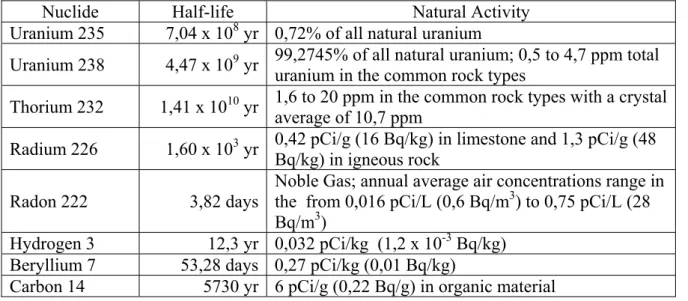
The radionuclides decay at a characteristic rate that remains constant regardless of external influences, such as temperature or pressure. The time that it takes for half the radionuclide to disintegrate or decay is called half-life (table 1).
Table 1. Main radionuclides in nature
Nuclide Half-life Natural Activity
Uranium 235 7,04 x 10
8yr 0,72% of all natural uranium
Uranium 238 4,47 x 10
9yr 99,2745% of all natural uranium; 0,5 to 4,7 ppm total uranium in the common rock types
Thorium 232 1,41 x 10
10yr 1,6 to 20 ppm in the common rock types with a crystal average of 10,7 ppm
Radium 226 1,60 x 10
3yr 0,42 pCi/g (16 Bq/kg) in limestone and 1,3 pCi/g (48 Bq/kg) in igneous rock
Radon 222 3,82 days
Noble Gas; annual average air concentrations range in the from 0,016 pCi/L (0,6 Bq/m
3) to 0,75 pCi/L (28 Bq/m
3)
Hydrogen 3 12,3 yr 0,032 pCi/kg (1,2 x 10
-3Bq/kg) Beryllium 7 53,28 days 0,27 pCi/kg (0,01 Bq/kg)
Carbon 14 5730 yr 6 pCi/g (0,22 Bq/g) in organic material
Effects of radiation vary with the type and energy. Radiation can decrease the normal functioning of the cells. A measure of the risk of biological harm is the dose of radiation
- 14 -
that the tissues receive. The unit of absorbed radiation dose is the sievert (Sv). An average radiation exposure due to all natural sources is about 2,4 mSv a year (table 2).
During the 1950s the effects of atmospheric testing of atomic and hydrogen bombs became a source of major concern. The danger of radioactive pollution of the air and the fallout of radioactive particles to the surface of the Earth stimulated serious investigation, resulting in the discovery of potentially dangerous conditions. It was observed, that radioactive materials of many kinds, such as radioactive iodine and strontium, are concentrated in living tissue and can cause damage even when the general level of environmental contamination is low. Atmospheric testing of nuclear bombs was stopped in the United States and the Soviet Union, and radioactive fallout from this source has declined.
Table 2. Average annual background exposure, mSv
Source of Radiation External exposure Internal exposure Total dose
Cosmogenic 0,355 0,015 0,37
Radioisotopes of Earth:
Potassium-40 Uranium-238 Thorium-232
0,15 0,1 0,16
0,18 1,24 0,18
0,33 1,34 0,34
Natural background exposure 0,77 1,62 2,38
Another source of radioactive pollution is accidents at nuclear power plants. In 1978 the Three Mile Island nuclear power plant in the USA suffered a severe accident leading to partial meltdown of its radioactive core. Although most of the radiation was contained within the plant structure, the prospects of massive contamination of nearby cities and towns resulted in plans for the evacuation of hundreds of thousands of people. In 1986 the Chernobyl nuclear power plant near Kiev, in the Ukraine, suffered a fire and partial meltdown, resulting in a major release of radioactive particles (table 3).
Table 3. Individual and collective average effective dose equivalent
Source of Radiation Individual dose, mSv/year
Collective dose, pers.*Sv/year
Collective expected dose, pers.*Sv Natural radioactivity 2,4 12 000 000
Flights 4 300
Medical exposure (diagnostics,
radiotherapy) 0,4 8 500 000
Nuclear Power Station fuel cycle 0,025 10 730 3 400 (for 1 GWt*year)
Solid radioactive waste 6 500 000
Industry (organic fuel combustion, metal ore mining, construction building materials, fertilizer)
0,1 485 000
- 15 -
Nuclear weapon testing 0,2 840 000 30 000 000 Accident in Windscale (Great
Britain), 1957 1 300
Accident in Three Mile Island
(USA), 1979 35
Accident in Chernobyl NPS, 1986 0,14 (average for Belarus 2,2)
400 000 1 200 000 (for 70 years)
The health effects of radiation are well studied. A large dose delivered to the body over a short time will result in the death of the exposed person within days. The health effects of exposure to radiation do not appear unless a certain quite large dose is absorbed. Many other effects, especially cancers are detectable and occur more often in those with moderate doses. At lower doses and dose rates, there is a degree of recovery in cells and in tissues.
- 16 -