4
DOI: http://dx.doi.org/10.14246/irspsd.2.3_4
Copyright@SPSD Press from 2010, SPSD Press, Kanazawa
The Framework of Social Sustainability for Chinese Communities: Revelation from Western Experiences
Yu Wang1*
1 Department of Geography and Planning, University of Liverpool
* Corresponding Author, Email: [email protected] Received 21 October, 2013; Accepted 20 March 2014
Key words: Community Development, Social Sustainability, Planning Process, Sustainability Assessment
Abstract: The purpose of this paper is to explore the framework of community social sustainability for China. The paper gives a brief introduction to the concept of social sustainability and its core inclusions in literatures at the beginning.
Social sustainability, nevertheless, has not only been tested in theoretical research debates, but also already been practiced and traced in western context.
The key ideas and systems are summarized after reviewing and analysing social sustainability concerns in western countries like US, UK and Canada by several case studies. Furthermore, comparing the evolution of this concept in China, a literature-review based analysis also discusses how the western- originated social sustainability idea should be understood and redeveloped in the distinctive Chinese context. Following these findings, a new framework of social sustainable communities is summarized that includes three layers:
individual needs, social network and community development. The paper finally gives some extended discussions on the current community planning system in China and related issues concerning this topic. It is also proposed that developing detailed indicators under the framework, although is insufficient at the moment, can be a systematic process integrated with the updating of community planning mechanism in future during a public-evolved social planning process, a positive attempt toward social sustainability in practice as well.
1. THE CONCEPT OF COMMUNITY SOCIAL SUSTAINABILITY
1.1 A review of sustainable development and its social dimension
In the past twenty years one significant focus in urban planning has been the key idea of ‘sustainability’. Although emerged for years, this notion is still difficult to be accurately explained at present. Tracing its history, it is commonly accepted that this idea starts to make profound influences after the report ‘Our Common Future’ broadcasted by the UN and World Commission. It can be unscrambled as ‘the needs of the present without compromising the ability of future generations to meet their own needs’
(Brundtland, 1987) for that period and some common goals claimed for the
future have been initially generated as sustainable policies. However sustainable development, which is ‘not only an object, but a dynamic process’ (Lock, 2003), definitely requires further exploration and closer scrupling as time goes on. This all-embracing concept also needs to be decomposed and reconstructed into different dimensions for detailed study and practice. Generally sustainability can be understood by a subdivision using a three-dimension framework represented by environmental, economic and social perspectives (Jones and Evans, 2008, Jenks and Jones, 2010).
At a local scale, this planning concept has been gradually introduced and applied in the context of community planning (Lock, 2003, Rudlin and Falk, 2009, McDonald et al., 2009). Following this three-dimensional composition, it is clear that a community’s sustainability should be achieved as a balance of environmental, economic and social aspects (McDonald, 1996, Roseland, 2000, Jones and Evans, 2008). However, more criticizes are upon the less of comprehensive consideration during the decision making process of planning policy, as negative social influence has gradually emerged after the construction of some community/housing projects (Page, 2000, Oliveira, 2012). Although relevant studies are abundant (Bärsch, 2002, Eastaway and Støa, 2004, Rudlin and Falk, 2009, Jenks and Jones, 2010) and complex sustainable planning methods have been discussed (Roseland, 2000, Lapping, 2006, Brownill and Carpenter, 2009), some (Marcotullio, 2001, Newton, 2012) are still criticizing that ‘urban sustainability’ has mainly been concerned with clear environmental and economic requirements, which however, have often neglected the vital social aspects and the new social role needed to be rediscovered (Yiftachel and Hedgcock, 1993). Furthermore, many planning concepts such as ‘new urbanism’ and
‘compact city’ are all claiming to promote the development of sustainability.
However, issues also occur with great debates on the various influences from those ‘sustainable’ claimed planning strategies. For example, the ‘compact city’ has been constantly questioned in terms of the linkage with social sustainable criterion and principles and whether they have really been incorporated, implemented (Burton, 2000, Burton, 2001, Neuman, 2005, Peng, 2008). Today more social-goal oriented planning (Friedmann and Chen, 2009, Cuthill, 2010) are proposed and advocated towards the safeguard of living quality, social equity and human rights, which also makes an emphasis of planning social perspective and claims this should not be sacrificed by other perspective goals such as land economy or urban aesthetics (Roseland, 2000). In sum, ‘social sustainability’ has appeared to be an issue which is increasingly highlighted in both theoretical and practical explorations (Colantonio and Dixon, 2009, Dempsey et al., 2011, Berkeley, 2012, Magee et al., 2012) and thus has begun to play a significant component which ought to be incorporated in revisiting and improving planning strategies.
1.2 A review of community social sustainability and its inclusions in western context
Social sustainability has emerged within a large volume of published literatures in western research. Undoubtedly, it is an extreme complicated big concept that may contain multiple layers. Some scholars have attempted to give comprehensive explanation on its definition. ‘Social sustainability occurs when formal and informal processes, systems, structures and relationships actively support the capacity of future generations to create
healthy and liveable communities. Socially sustainable communities are equitable, diverse, connected and democratic and provide a good quality of life.’ (Barron and Gauntlett, 2002). From a process view, ‘Social sustainability is a life-enhancing condition within communities, and a process within communities that can achieve that condition.’ (McKenzie, 2004, P12). Now there is a considerable amount of interdisciplinary studies on this topic (Ghahramanpouri et al., 2013), which have greatly enriched the research levels and results, however, at same time, they make mess and confusions.
Here firstly the meaning of ‘community’ may vary in different subjects.
So when deeper explorations are made to interpret of the inclusions of social sustainability, various points of view would be generated from their diversified starting backgrounds. The planning research focus has to be narrowed to a geographical concept: urban or rural communities at a local neighbourhood scale approximately. It may be found some sociological research are also exploring sustainability of some ‘vital communities’, however, these may not be very helpful to planning scholars who prefer to focus on geographical communities.
Back to the key point of ‘social sustainability’ itself, although being a grand concept, it is not an illusory in fact. Current research results (Colantonio, 2010) have proved that it can be identified and measured by key inclusions and elements. Research under micro individual perspective mostly follows a ‘basic need theory’ and takes residents as their main research object. Their living quality, tested quantitatively by a ‘satisfied- level’ as well as their social interactions and sense of belongings are often being deemed as the core elements of social sustainability. Although ‘basic needs’ or ‘individual quality of life’ have been widely recognized and listed in literature (He and Wu, 2007, Ha, 2008), any simple equalization of these notions to the bigger notion ‘social sustainability’ may not be appropriate, as there is also another important view of at a higher level. On the other side, the macro perspective research would like to take some entire considerations of communities as their most important body. The infrastructure and amenities, social equity and justice, safety control and crime prevention are analysed as community ‘common criterions & value’. Some (Dempsey et al., 2011) mainly discuss individual quality of life and the function of the whole community society, and thinks these two components are the core of social sustainability.
It is helpful to make reviews and analyses on the most frequent themes of social sustainability mentioned or listed in relevant academic contents, although impossible to quantitatively calculate them thoroughly. Individual part mainly contains a grade assessment on housing quality, walkability, access to facilities, average amount of green space, average possessions of public space and so on. Social activity frequency, public participation, the sense of place and the safety level of community will be the highest discussions on the community’s common sense. Basic social infrastructure, resident perceptions of the quality of life, sense of the community, social interaction and networks and the whole operation of community are listed as useful ways of measurements, according to their research findings (Dempsey et al., 2011, Karuppannan and Sivam, 2011, Magee et al., 2012, Landorf, 2011).It can also be understood from literature review that although social sustainability is mostly based on human concern, differences still exist when representing the structure and inclusions of social sustainability regarding research perspective, which may also be described as research logics. And
undoubtedly this will also lead to different ways of assessing social sustainability.
1.3 Social sustainability concept in China
Although less discussed than western researchers, social sustainability is now impossible to be ignored in China, particularly considering recent new highlights on social reform and a tendency of improving national social equity in the new era. The voice of updating planning with social concern has also appeared under this background (Jin and Zhu, 2011). The following discussions from research would give some further explanations with the localization of social sustainability in the Chinese context. Concerning the quick development of new urban communities in 1990s, research (Lu, 1999) had stated some components were of high importance to community sustainability, such as the provision of necessary community amenities and the design of high-quality public space. It could be regarded as the starting stage of discussing community sustainability academically in China.
However, those were found mostly about the physical factors of communities and the function-based quality of life concerns.
The research stage in the 21st century had an obvious extension on the discussions of social sustainability. One scholar argued that the community development at that time (around year 2000) in China was ‘feeble and futile’
considering the profit-led orientation in the massive real estate growing market and their main focus in planning and design was only on the physical environment of communities (Zhang, 2000). That research indicated that future community development should establish a higher sprit pursuit rather than the basic satisfaction on enough facilities. Also suggested as a key important planning issue in future, more considerations should be given on social justice, social capital, territorial sense and public participation; a higher standard should be set up toward sustainability and its long-term goal.
A study (Yu, 2005) also reported that community planning should be designed with different layers of purpose considering social sustainability: to improve residents’ life satisfaction; to promote social interactions and establish social network; to build up distinctive local characteristics; create specific social-environment factors and finally to make functional and social integration within community space.
Other Chinese scholars (Jin and Zhu, 2011) discussed that the construction of social sustainable communities should contain four components by both ‘external’ and ‘internal’ considerations: the physical design of community(which already included traditional planning method like architectural feature, the space texture and environmental atmosphere);
the social organization and management of community; the customs, habits and social interaction of their residents; and the value orientation of community, like humanistic spirit and social psychological attitude.
Following the grounded theory, one study (Wang, 2012) made a new conceptualization and decomposed social sustainability into three parts:
continuation of tradition, connotation of development and transformation of process and this research wished to show the importance of the agreements and common goals of a whole community. More practical planning guidance on community social planning and emphasizes on public participation are also advocated by some studies (Friedmann and Chen, 2009).
2. CASE STUDY: SOCIAL SUSTAINABILITY ASSESSMENT FRAMEWORK IN WESTERN PLANNING PRACTICE
2.1 A review of sustainability assessment
In recent western planning practice there is a trend of assessing social sustainability which tries to link social outcomes with the planning inputs (Colantonio, 2008, Bramley et al., 2009, Berkeley, 2012). However, if we date back to its prototype ‘sustainability assessment’ we can find that it has emerged for over 20 years and has created a considerable number of different methodologies as well. Some studies (Devuyst, 1999, Jenny et al., 2004, Alwaer et al., 2008, Sharifi and Murayama, 2013) have given comparisons on their assessment methodologies and show several of distinctive ways to implement sustainable assessments. In terms of different disciplines, economists may prefer to use a ‘monetary aggregation’ method, whereas the adaption of a physical indicator method is more popular among most social science researchers (Rajesh Kumar et al., 2009). The assessments may be designed totally different by using ‘top-down’ or
‘bottom-up’ perspectives (also stated in this paper earlier) and can also be diverse considering their conceptual origins, driving forces and even stakeholders.
After reviewing those evaluation methods, the research suggests that the
‘indicator-system’ is still the most widely and effectively adopted method in assessing sustainable development at present. However, it is not easy to construct a distinctive indicator system for a reasonable assessment that could fully represent the mega concept ‘sustainability’ or any its special sub- three dimension. The indicator system should be able to provide visual layers or themes that could be easily understood, normally constituted by a detailed comparable ‘sustainability index’ at the end. The assessment systems, most of which now we could see are in western context, seem to be mostly designed quantitatively and sometimes would have a specific focus on a certain period (like past 3 years) or a certain area (like a region), if applicable.
Not only being accepted as a fundamental work of developing an useful theoretical method, in practice the establishing of sustainability indicators could also be deemed as a comprehensive construction of a statistical platform being applied in various ways of estimating, analysis, monitoring, evaluating and predicting the status of sustainable development. It can not only represent the conceptual idea of sustainability but also need to be converted into a practical framework by providing its series of indicators.
What’s more, it is also regarded as an important criterion to transform the principles of sustainable development into an effective public behaviour guidance.
2.2 A review of typical western systems of assessing social sustainability
It has been illustrated that there have never been any mainstream or common indicator system that could simply be applied to the entire urban context (Colantonio, 2010). Despite this, more and more indicator systems have been gradually designed and tested, especially in western context. First developed in 1993, ‘Sustainable Seattle’ is now a relative mature product in
the US. It is a city- level sustainable assessment which has five key components including environment, population & resources, economy, youth & education and health& community. The five parts are indicated by a series of 40 sub-indices. The selection and re-selection of the indicators of this model has become a long-term dynamical process by years-efforts with successful public participations and continuing result monitories. The Seattle model has a clear goal settled by the elites from the leader team ‘S2’ and this assessment mainly comes from the experience accumulated via continuing practice and feedbacks. Assessments which are similar to the ‘Sustainable Seattle’ have been largely increased recently (Koichiro and Aris, 2012, Vehbi and Hoşkara, 2009, Gallego, 2006) and the trend has also been extended globally with more Asian countries and cities getting evolved (Huang et al., 1998, Lee and Huang, 2007). Despite of its achieved success and wide acceptance, it must be recognized that this is an empirical plan acted under a general leading goal, which could only reflect the characteristics of Seattle local region itself. In contrast, assessment models with a ‘theory-oriented’ purpose seem to be more popular in recent research activities (Jenny et al., 2004, Valdes-Vasquez, 2011), because complicated mammoth work like Seattle’s goal-oriented action would hardly be possible in research background. At the same time, a gap seems to lie in their viewing scale, as most sustainable assessments have only been implemented at city- level so far. The focus at the scale of local communities (the basic cell of cities), especially with a unique social perspective, is still inadequate at the moment.
After reviewing many of the western systems, this research finds that whether to follow a ‘bottom-up’ or a ‘top-down’ perspective will inevitably determine their indicator system structures, which actually will shape different research logics and further steps. In 2005, city of Vancouver enacted a social development plan for the whole city and developed an ad hoc social sustainability framework (City of Vancouver, 2005). Its overarching principles includes equity, inclusion, adaptability and security, which are then further divided into several sub-themes (Figure 4.1), also ranging from ‘living’ to ‘moving’. This indicator system is a typical
‘bottom-up’ model developed from the individual perspective, like the
‘quality of life’ is deduced from the ‘basic needs theory’ and accounted for daily activities of local residents. Another social sustainability framework published in the UK contained four elements considering a community’s long-term development (Woodcraft et al., 2011). It can be seen as a typical
‘top-down’ model that takes a community as a whole. Its key compositions of social sustainability are: amenities and social infrastructure; social and cultural life; voice and influence; and space to grow. The indices of these elements are internally linked with each other. The overall structure of this elaborate ‘indicator system’ has almost covered all the related social aspects of a community, also with a strong logical consideration of the basic shaping process of new urban communities, gradually developed from physically to ideologically. Some indices of this system are not clear enough. It may be further integrated to make this indicator system model more concise and convenient, such as mutual related community assets and infrastructure.
What’s more, in terms of practice, some indices of this model would meet difficulties on their detailed measurements. Nevertheless, this new top-down framework of community social sustainability has a highly positive significance and many detailed indicators are also quite constructive.
Figure 1. The Framework for social sustainability assessment in Vancouver, elaborated from GVRD (2004a, 2004b) and CoV (2005)
3. SOCIAL SUSTAINABILITY OF CHINESE COMMUNITIES: DEVELOPING A NEW PERSPECTIVE AND A NEW FRAMEWORK 3.1 The lack of a ‘community-based’ perspective in
current planning system
The idea of urban community in China late emerged in late 1980s when more and more world knowledge exchange opportunities came in after the implementation of ‘open and reform policy’. The first term used for a
‘planned community’ in national planning documents was called ‘urban residential area’. But it has then created three levels of words to describe their size and scale (Ministry of Construction, 1993), which will be discussed in the later part of this chapter. But it seemed that the focus on the planning guide book, however, is only on dwellings, not on people at that time. It was gradually recognized that a community would be a large populated area with necessary public service and should be identified by their members, its territorial boundaries as well as their social interactions.
Later some Chinese planning academic books introduced that a community referred to ‘a fixed geographical area with members of society who together lives within this environment and social norms, functions and networks are created as well’(Li, 2000).
In general, the community and its planning idea are relative new concepts that need deeper understandings and further concerns. Besides the criticisms of the monotonousness of modern communities, the voices appearing on some social problems seem to express their disappointments on the lacking of human concerns in new urban area and vast real estates development torrents. Some residents have felt the obvious reducing of neighbours’
outdoor activities with the disappearing of public places at the basic community level. The highly instability and the mobility of some redeveloped or resettled urban communities also have their negative social facts, such as the social unconcern and misidentification. A lot of new real estate development has destroyed the formerly rounded form of cities and shaped great distinctions between them and poor urban villages; rich gated communities also inevitably cause an isolation of social class. So far adequate reviews, inspections or examinations have been little made upon the Chinese communities’ social sustainable perspective. From the value of planners, most attention had been paid to the great growth in quantity and height of our cities and towns that all could be counted when they made the
plans and construction. This had also brought in the next new confusion: the other unquantifiable variables for that stand for the dimension of human nature, the form with community’s diversity and pleasant relationship between neighbourhoods were beastly neglected. It seems that in China we are under a risk of gradually losing the social goal and human value of city development.
3.2 Reconstructing social sustainability framework
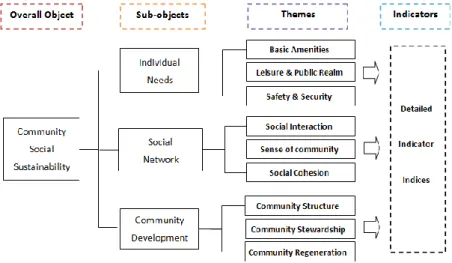
A systematic reconstruction of the ensemble structure and inclusions of social sustainability is necessary and crucial for community related planning research in China. Attention has been drawn to level-based focus on this context. One research (Yang, 2004) divided the community into three levels, individual social capital at microscopic level; organizational social capital at medium level and finally, group social capital at the macro level. This paper also agrees on this logic. Further more, the new framework must consider with community’s shaping process. The people living inside would be the bottom cells which are all connected with complex relationships with each other; meantime the community however is also the basic unit that shapes bigger city images. From individual living satisfactions to community network built-up and finally to entire community development in the society, the framework of social sustainability can be systematically built up (Figure 2).
The first individual layer is still claimed by researchers (Zhao and Zhao, 2002) that play an important role to better promote community social sustainability; thus planning has a high priority to improve the physical environment in order to satisfy basic needs. It would be an emphasis on the necessary foundation of this comprehensive framework. This study also implies from individual to internal networks and then to the external wholeness, another two layers are even more important to the whole social sustainability concept, which may not be well considered at the moment.
They are working as common rule and law behind the scenes. Good inhabitant relationship and network make the community stronger and it is interesting to identify how the social groups could be formed within a community’s social networks and how they could to be promoted by planning. The community development, definitely related to the community participation what now be greatly emphasised as, ‘participation approach’, will benefit to establish community self-supervision and self-governance that forming a community’s entire capability, credibility and reliability.
To be summarized, the understanding of social sustainability should give more attentions on the deeper lifestyle and behaviour characteristics of local community residents as well as their inner bonds and linkages in their common culture and values, and the entire operation and management of community will also be important. As a systematic reconceptualization of community social sustainability, the new framework should be able to identify the fundamental common characteristics of communities and provide the inclusions of social sustainability in a stratified order.
However, to evaluate sustainability of communities under this framework, further research works are required to follow up. It takes time to develop indicators under each themes of social sustainability. According to the discussions of indicator methods (Wong, 2006, Ghosh et al., 2006, Wong, 2003, Hemphill et al., 2004), it can be summarized that these indicators are formulated through a four-step process: determine the dimension; choose index; make evaluation method; and test results (Wong, 2006). Not to be
neglected, there is also some voice from other scholars criticizing prevalent evaluations by indicators (Lan, 2004). It is illustrated that some indicator systems seem to be too numerous and jumbled and the disequilibrium issue of evaluating indices has also been remarked frequently as well. To produce a reasonable sustainability evaluation model, there is a long way to go in future. Like the long-term developing procedure of Seattle model in the US, the progress of designing detailed indicators for social sustainability assessment Chinese communities needs great efforts in future.
Figure 2. Community social sustainability framework by this research
4. DISCUSSIONS AND CONCLUSION:
PROCESSING A NEW SOCIAL PLANNING ORIENTATION AND PLANNING MECHANISM 4.1 Issues of current planning system
There is a mechanism-based issue in practicing social sustainability in China. It could also be described as a "two schemes" phenomenon of urban community system: the big divergence exists between community’s four- level urban governance system1 and its three-level urban planning system2. At the bottom of this urban governance system, the community has an administrative role in China, however, whose responsibility is only limited in small pieces of social affairs like normal birth control, hukou (population registration) without getting any feedback from local community residents on their daily lives or community development. The master plans in all the Chinese cities terminate at the ‘district’ level, and the next stage regulatory and site plan, which control the demarcated urban blocks, roads, and building sites, have no idea of ‘planning a comprehensive community’. The
1 Overall in China there is a four-level urban government system established for years: city, district, sub-district/street and community offices with affiliated administrative officers/civil servants. At the community level, the population is theoretically around 700 households, however now in many mega cities it could be even over 3,000 households.
2 In the three level urban planning system built up in the last century, normally urban residential space will be categorized into urban residential areas, urban residential quarters and clusters, with detailed planning regulation indices. In a population based hierarchy view, a ‘residential area’ plans about 30,000-50,000 population; a ‘residential quarter’ and a ‘residential cluster’ each plans about 10,000-15,000 and 1,000-3,000 accordingly.
linkage between planning and governance of community areas seems to have never been explained at all under this ‘two-system’ scheme. It is common to see in actual cases, the boundaries of an urban community is great different from the nearby block areas defined by planning. The great gap between community’s administrative boundaries and planned boundaries not only makes ciaos in daily community managements but also influences their residents’ identity and sense of belongings (Gu et al., 2008). This research would indicate that the big issue of social sustainability may be to discuss where and how to implement our suggested ‘social assessment’ toward social sustainability under current Chinese urban planning and governance systems.
The practical approach may be to bring in a new ‘community planning’
system in order to join the current two systems of different local authority departments. Presuming social sustainability is regarded by the research as a process of human ecological evolution toward justice and reform, meanwhile, the improvement from the bottom communities can be its foundation and the operational mechanism to make assessment and monitory is also essential. The framework seems to do something theoretically, however practically it call for collaborative works. It means the inevitability of reconciling of interests between different departments and different stakeholders in community planning, development and governance. So the processing of social sustainability in practice phase is definitely more difficult than our research framework phase. Nevertheless, the possibility of achieving it is not low; the performance of national political and social reforms is bringing in big hopes and chances for practicing social sustainability.
In sum, the establishing of a supervising mechanism towards open, fair and well collaborated planning targets will be of great significance to achieve the suggested social sustainability by the west. Now more and more planning information has been released to the public in China. However, it must be realized that what this system should open is not only the ‘planning results’ but also the ‘planning process’. Improving community residents’
participation via legal process could now be an early stage to promote the cities and communities’ social sustainable growth. For planners, ethic improvement in daily planning works with more concern of people's lives would help planning to eventually return to the human and social community concern itself.
4.2 Conclusion
Social sustainability has become a world increasing trend in planning and community development nowadays. However, so far this issue has not been given enough concern in China either by theoretical research or practical implementation. Relevant theories and thoughts have been shortly reviewed to retrieve how the social sustainability idea is developed and implanted in urban planning and integrated within local community development policy, especially with a western research context. The paper also gives specific focus on the Chinese context, based on the new community development in China since late of 1990s.
The paper also shows that more comprehensive and balanced planning principles are proposed and advocated as social perspective has become an increasing worldwide concern compared with other goals. Impossibly to be totally and undisputedly presented, however, this has already been acknowledged and formulated as an important indicator in Europe and North
America community planning research framework. Case study is applied as a research approach to understand the development of western social sustainability frameworks, which takes several social sustainability assessment projects in the world as instances. The research has made analysis on their sustainability idea, inclusions as well as planning process, where the research has found that collaborative planning and public participation have been established and operated for years. They are proved by this paper to have a great positive impact on achieving and maintaining community social sustainability. Although similarity could be drawn from those cases, differentia should never be neglected on the case’s different backgrounds, logic contract as well as and practicing mechanism.
The research has drafted an initial framework, a three-level constitution with sub-themes that present the key inclusions of social sustainability to Chinese communities. Considering the immature community planning system in China, this is only a theoretical attempt, definitely far from planning practice. Further detailed indicators are worth working to figure out a new assessment model in future. Great planning efforts in achieving social sustainability have all happened during the community planning system in the US, UK and Canada. Their contributions to planning not only lie in the initial proposals on the sustainability frameworks but also in the public involved planning process that shaped by years of constant practice.
Regarding to social sustainability theoretical and practical findings, future attempts in developing social sustainability indicators and the corresponding community planning mechanism should be encouraged in China’s planning battlefield.
REFERENCES
Alwaer, H., Sibley, M. & Lewis, J. (2008). “Different Stakeholder Perceptions of Sustainability Assessment”. Architectural Science Review (University of Sydney), 51, 48- 59.
B Rsch, J. (2002). Sustainable Communities (Book). Housing Studies, 17, 925.
Barron, L. & Gauntlett, E. (2002). Housing and Sustainable Communities Indicators Project:
Stage 1 Report–Model of Social Sustainability. WACOSS Housing and Sustainable Communities Indicators Project.
Berkeley, T. (2012). Creating strong communities: how to measure the social sustainability of new housing developments. Surrey.
Bramley, G., Dempsey, N., Power, S., Brown, C. & Watkins, D. (2009). “Social sustainability and urban form: evidence from five British cities”. Environment and Planning A, 41, 2125-2142.
Brownill, S. & Carpenter, J. (2009). “Governance and `Integrated' Planning: The Case of Sustainable Communities in the Thames Gateway, England”. Urban Studies, 46, 251-274.
Brundtland, G. H. (1987). Our common future / World Commission on Environment and Development, Oxford; Oxford University Press, c1987.
Burton, E. (2000). “The Compact City: Just or Just Compact? A Preliminary Analysis”. Urban Studies (Routledge), 37, 1969-2006.
Burton, E. (2001). The Compact City and Social Justice. Housing, Environment and Sustainability, Housing Studies Association Spring Conference. University of York.
Colantonio, A. (2008). Measuring Social Sustainability:Best Practice from Urban Renewal in the EU. Oxford: Oxford Institute for Sustainable Development (OISD), Oxford Brookes University.
Colantonio, A. (2010). Urban social sustainability themes and assessment methods.
Proceedings of the ICE - Urban Design and Planning, 163, 9.
Colantonio, A. & Dixon, T. (2009). Measuring Socially Sustainable Urban Regeneration in Europe. Oxford: Oxford Brookes University: Oxford Institute for Sustainable Development (OISD).
Colantonio, A. & Dixon, T. J. (2011). Urban regeneration & social sustainability [electronic book] best practice from European cities / Andrea Colantonio, Tim Dixon, Chichester, West Sussex, UK ; Wiley-Blackwell, 2011.
Collison, P. (1954). “Town Planning and the Neighbourhood Unit Concept”. Public Administration, 32, 463.
Cuthill, M. (2010). “Strengthening the 'social' in sustainable development: Developing a conceptual framework for social sustainability in a rapid urban growth region in Australia”. Sustainable Development, 18, 362-373.
Dempsey, N., Bramley, G., Power, S. & Brown, C. (2011). “The social dimension of sustainable development: Defining urban social sustainability”. Sustainable Development, 19, 12.
Devuyst, D. (1999). “Sustainability Assessment: The Application of a Methodological Framework”. Journal of Environmental Assessment Policy and Management, 1, 459-487.
Douvlou, E. & Ryder, A. (2007). “Sustainability and urban regeneration: the community and the city”. Management of Natural Resources, Sustainable Development and Ecological Hazards, 99, 115-125.
Eastaway, M. & St A, E. (2004). “Dimensions of housing and urban sustainability”. Journal of Housing and the Built Environment, 19, 1-5.
Friedmann, J. & Chen, F. (2009). “Towards Sustainable Neighborhoods: the Role of Social Planning in China - a Case Study of Ningbo, Zhejiang Province”. Urban Planning International (in Chinese), 24, 9.
Gallego, I. (2006). “The use of economic, social and environmental indicators as a measure of sustainable development in Spain”. Corporate Social Responsibility & Environmental Management, 13, 78-97.
Ghahramanpouri, A., Lamit, H. & Sedaghatnia, S. (2013). “Urban Social Sustainability Trends in Research Literature”. Asian Social Science, 9, 185-193.
Ghosh, S., Vale, R. & Vale, B. (2006). “Indications from Sustainability Indicators”. Journal of Urban Design, 11, 263-275.
Gu, Z., Hou, Q. & Xia, N. (2008). “Studies of the Construction of Residents’ Committee in Urban Community: Taking the Construction of Hangzhou Community in Hangzhou as Example”. Architectural Journal (in Chinese), 3.
Ha, S.K. (2008). “Social housing estates and sustainable community development in South Korea”. Habitat International, 32, 349-363.
He, S. & Wu, F. (2007). “Socio-spatial impacts of property-led redevelopment on China's urban neighbourhoods”. Cities, 24, 194-208.
Hemphill, L., Mcgreal, S. & Berry, J. (2004). “An indicator-based approach to measuring sustainable urban regeneration performance: Part 2, empirical evaluation and case-study analysis”. Urban Studies, 41, 757-772.
Huang, S. L., Chen, T. C. & Wong, J. H. (1998). “A framework of indicator system for measuring Taipei's urban sustainability”. Landscape and Urban Planning, 42, 15-27.
Jenks, M. & Jones, C. (2010). Dimensions of the Sustainable City, Springer.
Jenny, P., David, A. & Angus, M.S. (2004). “Conceptualising sustainability assessment”.
Environmental Impact Assessment Review, 24, 595-616.
Jin, F. & Zhu, C. (2011). “Integration of Space and Society: Exploring on Social Sustainability in Chinese Urban Community Development”. Journal of Chongqing Architectural University (Social Science Edition), 2, 5.
Johnson, D. L. (2002). “Origin of the Neighbourhood Unit. Planning Perspectives”, 17, 227- 245.
Jones, P. & Evans, J. (2008). Urban regeneration in the UK: theory and practice London, Sage.
Karuppannan, S. & Sivam, A. (2011). “Social sustainability and neighbourhood design: an investigation of residents' satisfaction in Delhi”. Local Environment, 16, 849-870.
Koichiro, M. & Aris, C. (2012). “Review of sustainability indices and indicators: Towards a new City Sustainability Index (CSI)”. Environmental Impact Assessment Review, 32, 94- 106.
Lan, G. (2004). “Study on Construction and Application of Indexes System of Sustainable Development”. Doctoral Degree, Tianjin University.
Landorf, C. (2011). “Evaluating social sustainability in historic urban environments”.
International Journal of Heritage Studies, 17, 463-477.
Lapping, M. B. (2006). “Planning for Sustainability: Creating Livable, Equitable, and Ecological Communities, The Sustainable Urban Development Reader, Drafting a Conservation Blueprint: A Practitioner’s Guide to Planning for Biodiversity”. Journal of Planning Education and Research, 25, 334-336.
Lee, Y.J. & Huang, C.M. (2007). “Sustainability index for Taipei”. Environmental Impact Assessment Review, 27, 505-521.
Li, D. (2000). Urban Planning Theory, China Architecture Industry Press (in Chinese)
Lock, D. (2003). Planning for sustainable communities. In: NEAL, P. (ed.) Urban villages and the making of communities. London: London; Spon Press, an imprint of Taylor & Francis, 2003.
Lu, B. (1999). “Planning Principles and Practice of Sustainable Communities”. Urban Planning Overseas (in Chinese), 4.
Magee, L., Scerri, A., James, P., Thom, J. A., Padgham, L., Hickmott, S., Deng, H. & Cahill, F. (2012). “Reframing social sustainability reporting: towards an engaged approach”.
Environment, Development and Sustainability, 1-19.
Marcotullio, P. J. (2001). “Asian urban sustainability in the era of globalization”. Habitat International, 25, 577-598.
Mcdonald, G. T. (1996). “Planning as Sustainable Development”. Journal of Planning Education and Research, 15, 225-236.
Mcdonald, S., Malys, N. & Malienė, V. (2009). “Urban Regeneration for Sustainable Communities: A Case Study”. Technological and Economic Development, 15, 49-59.
Mckenzie, S. (2004). Social Sustainability: Towards Some Definitions. Magill, South Australia: Hawke Research Institute, University of South Australia.
Ministry Of Construction, C. (1993). The planning and design code for urban residential area (revised in 2002). Beijing: China Architecture & Building Press.
Neuman, M. (2005). “The Compact City Fallacy”. Journal of Planning Education and Research, 25, 11-26.
Newton, P. W. (2012). “Liveable and Sustainable? Socio-Technical Challenges for Twenty- First-Century Cities”. Journal of Urban Technology, 19, 81-102.
Oliveira, F. P. (2012). “Social Sustainability in Planning Law”. US-China Law Review, 9, 45- 52.
Page, D. (2000). Communities in the balance: the reality of social exclusion on housing estates / David Page, York: YPS for the Joseph Rowntree Foundation, c2000.
Peng, H. (2008). “Rethinking of Compact City: Key Issues in the application of Compact City Theory in China”. City Planning Review (in Chinese), 23, 5.
Rajesh Kumar, S., Murty, H. R., Gupta, S. K. & Dikshit, A. K. (2009). “Review: An overview of sustainability assessment methodologies”. Ecological Indicators, 9, 189-212.
Roseland, M. (2000). “Sustainable community development: integrating environmental, economic, and social objectives”. Progress in Planning, 54, 73-132.
Rudlin, D. & Falk, N. (2009). Sustainable Urban Neighbourhood: Building the 21st Century Home, Oxford, Boston, MA, Architectural Press.
Seattle, S. (1998). Sustainable Seattle: Indicators of sustainable community 1998. Seattle.
Sharifi, A. & Murayama, A. (2013). “A critical review of seven selected neighborhood sustainability assessment tools”. Environmental Impact Assessment Review, 38, 73-87.
Valdes-Vasquez, R. (2011). Social sustainability considerations during planning and design:
A framework of processes for construction projects. Ph.D. 3469567, Clemson University.
Vallance, S., Perkins, H. C. & Dixon, J. E. (2011). “What is social sustainability? A clarification of concepts”. Geoforum, 42, 342-348.
Vehbi, B. O. & Hoşkara, Ş. Ö. (2009). “A Model for Measuring the Sustainability Level of Historic Urban Quarters”. European Planning Studies, 17, 715-739.
Wang, S. (2012). Research of Social Sustainability and Form of Urban Community. Master Dissertation, Dalian University of Technology.
Wong, C. (2003). “Indicators at the Crossroads: Ideas, Methods and Applications”. The Town Planning Review, 74, 253-279.
Wong, C. (2006). Indicators for urban and regional planning [electronic book]: the interplay of policy and methods / Cecilia Wong, London; Routledge, 2006.
Woodcraft, S., Hackett, T. & Caistor-Arendar, L. (2011). Design for social sustainability. A framework for creating thriving new communities: the Young Foundation.
Xuan, M. (2002). “Community organizations and community development:A sociological exploration on its concept definition and relation elaboration”. Science & Technology and Economy, 15, 4.
Yang, R. (2004). “The Absence and Rebuilding of Social Capital”. Journal of Shandong University of Science & Technology (Social Sciences), 6, 5.
Yiftachel, O. & Hedgcock, D. (1993). “Urban social sustainability: the planning of an Australian city”. Cities, 10, 139-157.
Ying, L. (2004). “On Establishing a New Urban Planning System with Residential community As Basic Unit”. Urban Planning Review (in Chinese), 28(6).
Yu, W. (2005). Study on the Theory and Method of Community Planning. Doctoral Dissertation, Zhejiang University.
Zhang, J. (2000). The combination of social form and spatial form: the soul of community planning and design Planners (in Chinese), 2.
Zhao, W. & Zhao, M. (2002). “Residential Planning or Community Planning”. Urban Planning Forum (in Chinese), 142, 5.