The Cognitive Construal of Motion‑Events and Motion‑Expressions in English and Japanese
著者 松本 瑞枝
著者別表示 Matsumoto Mizue journal or
publication title
博士論文本文Full 学位授与番号 13301乙第2066号
学位名 博士(文学)
学位授与年月日 2015‑03‑23
URL http://hdl.handle.net/2297/42378
Creative Commons : 表示 ‑ 非営利 ‑ 改変禁止 http://creativecommons.org/licenses/by‑nc‑nd/3.0/deed.ja
The Cognitive Construal of Motion-Events and Motion-Expressions in English and Japanese
田 中(松 本)瑞 枝
平成
26
年6
月博 士 論 文
The Cognitive Construal of Motion-Events and Motion-Expressions in English and Japanese
金沢大学大学院人間社会環境研究科
田 中(松 本)瑞 枝
I Table of Contents
LIST OF FIGURES ... III LIST OF TABLES……….…. VI ACKNOWLEDGEMENTS ... VII ABBREVIATIONS………...VIII
CHAPTER 1 INTRODUCTION……….1
CHAPTER 2 MOTION-EVENTS AND MOTION-EXPRESSIONS ... 5
2.1. Introduction ... 5
2.2. Motion Expressions in Typological Studies ... 6
2.2.1. Talmy’s Typology (1985)………..7
2.2.2. Talmy’s Typology (1991)... 12
2.2.3. The Typology of Croft, Barddal, Hollmann, Sotirova, and Taoka (2010) ... 16
2.3. How to Construe a Path in the Cognitive Approach ... 19
2.3.1. Physical Motion and Non-physical Motion ... 21
2.3.2. Time and the Path of Physical Motion ... 24
2.3.3. Cognitive Scheme (Langacker 2008) and Mode of Cognition (Nakamura 2004) 27 CHAPTER 3 MOTION-EXPRESSIONS IN JAPANESE ... 37
3.1. The Scheme of “ni” ... 38
3.1.1. Previous Studies of “ni” ... 41
3.1.2. The Diachronic View and the Sequence of “ni” ... 46
3.1.2.1. The Nara era (Up to about A.D. 800) ... 47
3.1.2.2. Extension of the Scheme of the Nara era ... 57
II
3.1.2.3. The New Ways Seen in the Heian era
(From about A.D. 800 to about A.D.1200) ... 65
3.1.2.4. The New Ways Seen in the Kamakura era (From about A.D. 1200 to about A.D. 1350) ... 69
3.1.2.5. The New Ways Seen in the Muromachi era (From about A.D. 1350 to about A.D. 1570) ... 71
3.1.2.6. The New Ways Seen after the Muromachi era (From A.D. 1570) ... 73
3.1.3. The Extension and the Integrated Scheme of “ni” ... 76
3.1.4. The Comparison with “o”, “de”, “kara”, and “ni yotte” ... 77
3.1.5. The Cognitive Process of the Motion Expression Using “ni” ... 85
3.2. The Scheme of “e” ... 87
3.3. The Scheme of “made” ... 95
CHAPTER 4 MOTION-EXPRESSIONS IN ENGLISH ... 103
4.1. The Scheme of “to” ... 103
4.1.1. Previous Studies of “to” ... 105
4.1.2. The Diachronic View and the Extensin of “to” ... 112
4.1.2.1. The Extension of “to” as a Branch ... 116
4.1.2.2. The Extension of “to” as the Mainstream ... 123
4.2. The Motion Expressions Including Satellites Except for “to” ... 130
4.2.1. The Motion Expressions with [S MV P Y] Construction ... 131
4.2.2. Destinaitonal Directivity (Ikegami 1981) ... 139
4.2.3. The Network of [S MV G] Construction ... 143
4.2.4. Construction-led and Lexical unit-led Forms... 147
III
4.2.5. The Cognitive Process of [S MV G] construction………150
CHAPTER 5 THE TENDENCY OF COGNITIVE PROCESS ON MOTION EXPRESSIONS IN JAPANESE AND ENGLISH……….……..152
CHAPTER 6 CONCLUSION……….158
BIBLIOGRAPHY……….164
REFERENCE MATERIALS……….174
List of Figures FIGURE 2-1: PREPOSITION (LANGACKER 2008) ... 22
FIGURE 2-2: SCANNING OF INTO AND ENTER (LANGACKER 2008) ... 25
FIGURE 2-3 THE CONCEPTUALIZING RELATIONSHIP OF SUBJECT AND OBJECT (LANGACKER 2008) ... 28
FIGURE 2-4 THE CONNECTION BETWEEN THE GROUND AND THE ONSTAGE SITUATION (LANGACKER 2008) ... 29
FIGURE 2-5 MODE OF COGNITION (NAKAMURA 2004) ... 32
FIGURE 2-6 THE COGNITIVE CONSTRUAL OF THE PLURAL PATHS ... 36
FIGURE 3-1 THE CORE SCHEME OF “NI” (OKA 2013)... 44
FIGURE 3-2 THE STARTING POINT OF EXCHANGE (OKA 2013) ... 44
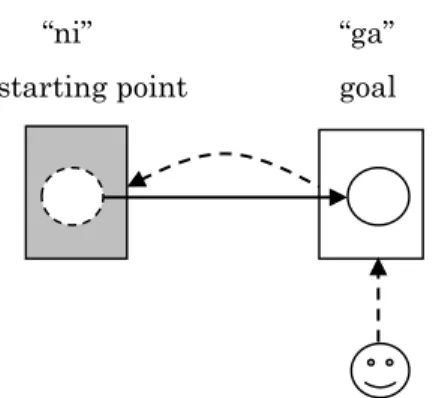
FIGURE 3-3 “NI” EXPRESSING AGENT IN DIRECTIVE PASSIVE (OKA 2013) ... 46
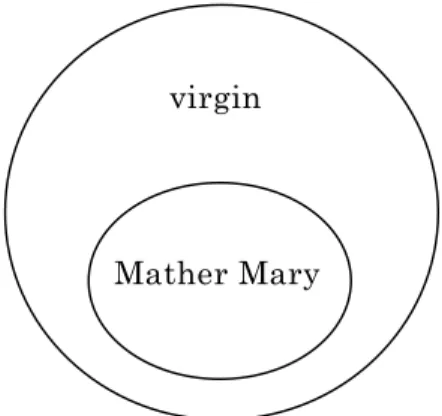
FIGURE 3-4 THE PREDICTIVE LOGIC OF “MATHER MARY IS VERGIN.” (NAKAMURA 1989) ... 52
FIGURE 3-5 THE SCHEME OF “NI” IN NARA ERA ... 56
IV
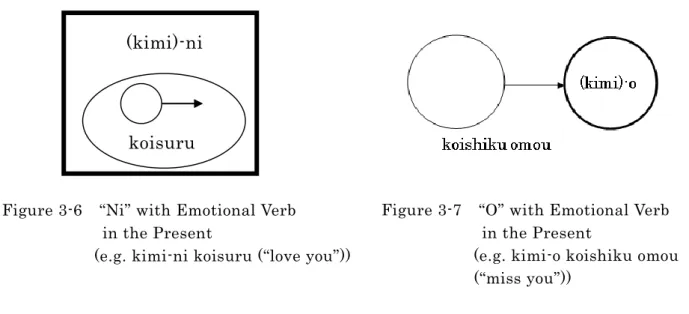
FIGURE 3-6 “NI” WITH EMOTIONAL VERB IN THE PRESENT ... 61
FIGURE 3-7 “O” WITH EMOTIONAL VERB IN THE PRESENT ... 61
FIGURE 3-8 “NI” OF INTERACTIVE RELATION ... 62
FIGURE 3-9 IMAGE SCHEMES OF “HITO-NI WAKARU” ... 64
FIGURE 3-10 OPPONENT OF EXCHANGE ... 68
FIGURE 3-11 AGENT OF CAUSATION ... 71
FIGURE 3-12 PASSIVE OF AGENT ... 73
FIGURE 3-13 ORIGIN OF EXCHANGE ... 76
FIGURE 3-14 THE DIACHRONIC MEANING NEXTWORK OF “NI” ... 77
FIGURE 3-15 THE INTEGRATED MEANING SCHEME OF “NI” ... 77
FIGURE 3-16 THE COGNITIVE CONSTRUAL OF “NI” ... 86
FIGURE 3-17 THE CONCEPTION OF “E” ... 92
FIGURE 3-18 THE COGNITIVE CONSTRUAL OF “E” (1) ... 93
FIGURE 3-19 THE COGNITIVE CONSTRUAL OF “E” (2) ... 94
FIGURE 3-20 THE DIACHRONIC TRANSITION OF THE COGNITIVE CONSTRUAL OF “E” ... 95
FIGURE 3-21 THE COGNITIVE CONSTRUAL OF “MADE” ... 99
FIGURE 4-1 THE PROTO-SCENE OF “TO” (TYLER AND EVANS 2003) ... 107
FIGURE 4-2 THE PROTO-SCENE OF “TO” (KUNIHIRO 2005) ... 109
FIGURE 4-3 SO-CALLED THE WAY OF “AFFILIATION (KATO, HANASAKI, AND HANASAKI 2014) ... 111 FIGURE 4-4 EARLY EXAMPLES OF USAGE AND MEANINGS OF “TO” AS GIVEN IN
THE OED AND HYPOTHESIS REGARDING THE MEANING EXTENSION
V
OF “TO” ... 113
FIGURE 4-5 ARRIVAL AND ATTACHMENT ... 115
FIGURE 4-6 DIRECTION AND AIM ... 115
FIGURE 4-7 THE WAY TO CONSTRUE A DIRECTIONAL REGION ... 117
FIGURE 4-8 LOCATION OF A THING IN A DIRECTION (THE DIRECTION FOR A PARTICULAR AGNENT)... 117
FIGURE 4-9 LOCATION OF A THING IN A DIRECTION (THE DIRECTION FOR A CONCEPTUALIZER) ... 119
FIGURE 4-10 PURE LOCATION ... 122
FIGRUE 4-11 ATTACHMENT ... 122
FIGURE 4-12 LIMITATION ... 124
FIGURE 4-13 COMPARISON AND PROXIMITY RELATION ... 124
FIGURE 4-14 ORIGINAL POSITION ... 127
FIGURE 4-15 THE DIACHRONIC MEANING EXTENTION OF “TO” ... 129
FIGURE 4-16 A MOTION EVENT AND A MOTION EXPERSSION RELATING TO DRIVING ... 132
FIGURE 4-17 A MOTION EXPRESSION RELATING TO DRIVING (LINGUISTIC LEVEL “SHE DROVE TO THE SHOP.”) ... 133
FIGURE 4-18 THE ESTMATED CONCEPTION OF THE PREPOSITION IN [S MV P Y] .. 135
FIGURE 4-19 THE TWO TYPES OF THE CONCEPTION OF [S MV P Y] ADOPTING A LOCATIONAL PREPOSITION “UNDER” AS P ... 137
FIGURE 4-20 THE TWO TYPES OF THE CONCEPTION OF [S MV P Y] ADOPTING A LOCATIONAL PREPOSITION “BEHIND” AS P ... 137
VI
FIGURE 4-21 THE DIACHRONIC EXTENSION OF “NI” FROM THE LOCATIONAL
MEANING TO THE ARRIVAL MEANING ... 141 FIGURE 4-22 THE NETWORK OF [S MV G] COSTRUCTION ... 147 FIGURE 4-23 THE COGNITIVE PROCESS OF [S MV G] CONSTRUCTION ... 151 FIGURE 5-1 THE DIACHRONIC TRANSITION
OF THE COGNITIVE PROCESS OF “NI” ... 153 FIGURE 5-2 THE DIACHRONIC TRANSITION
OF THE COGNITIVE PROCESS OF “E” ... 154 FIGURE 5-3 THE COGNITIVE PROCESS OF “MADE” ... 155 FIGURE 5-4 THE DIACHRONIC TRANSITION
OF THE COGNITIVE PROCESS OF “TO” ... 156 FIGURE 5-5 THE COGNITIVE PROCESS OF [S MV G] CONSTRUCTION ... 157
List of Tables
TABLE 2-1 THE LINGUISTIC PHENOMENA REFLECTED IN THE CONSTRAST OF I- MODE AND D-MODE (NAKAMURA 2004) ... 34 TABLE 3-1 GENERAL DIVISION OF “NI” ... 39 TABLE 4-1 THE EXAMPLES OF THE CLASSIFICATION OF “TO”
IN PREVIOUS STUDIES ... 104 TABLE 4-2 THE COMBINATION OF MEANING REGION AND THE OBJECT
EXPRESSED BY “TO” (KATO, HANASAKI, AND HANASAKI 2004) ... 110
VII
Acknowledgements
I would like to thank all the people who gave me help and support to complete this dissertation.
First of all, I would like to express my profound gratitude to my supervisor,
Yoshihisa Nakamura. He introduced me to this field of cognitive linguistics and kept leading me since the first day I came to Kanazawa University. His invaluable advice and broad knowledge greatly helped me clarify my idea and improve my work, and also made my world broaden. Without his guidance and hearty encouragement, this dissertation would not have completed.
I would like to express sincere appreciation to Yuko Horita, who gave me valuable advice and encourage me many times to forward my work since I entered the master course in Kanazawa University. I would also like to express my gratitude to Wataru Takei,
Yoshiharu Takeuchi, and Yoshinori Nishijima for giving me helpful guidance and comments and being on this dissertation’s committee. Their insightful suggestions made this study rigorous.
I also wish to give special thanks the seniors of my course in the department of linguistics at Kanazawa University ― Takeshi Koguma, Sadashi Mori, Li Qu and Kyoko Kawabata ― for their helpful advice and suggestions. An additional thanks goes out to my classmates and roommates throughout the time at Kanazawa University ― Takashi Kobayashi, Kosuke Matsumoto, Keisei Maki, Rie Mukai, Akira Takashima, Atsushi Hirota, Sayaka Oshima, Hiromi Nakatani, Kimi Chen, Chiemi Hidaka and Yiling Yang― for their
VIII
friendship and encouragement during tough times.
Finally, I would like to thank my parents, Hirosuke and Akiko Tanaka who have always stood by my side with love and kept encouraging me.
Abbreviations
ACC: Accusative C: Cause
CL: Classifier DAT: Dative F: Figure G: Ground GEN: Genetive H: Honorifics L: Locative M: Manner
NOM: Nominative
P: Path
PASS: Passive PAST: Past tense Q: Interrogative SAT: Satellite SUB: Subject TOP: Topic V: Verb
3p: The third person
1
The Cognitive Construal of Motion-Events and Motion-Expressions in English and Japanese
Chapter 1
Introduction
The purpose of human languages is to facilitate communication with others, which proceeds via the sharing of conception. Although human beings use various expressions in different languages, this does not mean that no commonality exist between the different expressions because each expression constitutes the symbolization of a conception that is recognized through the cognitive abilities with which all human beings are equally gifted.
For example, Imai (2010:114) refers to the influence of cognitive abilities on linguistic expressions. In an experiment performed by Malt, Gennari, Imai, Ameel, Tsuda and Majid (2008), the subjects, who were English, Spanish, Japanese and Dutch speakers, watched 24 video clips. Each video clip depicted a phase of a human being’s gradual movement from walking to running on a treadmill. The subjects were required to express linguistically what the person was doing in each video clip. The result shows that all four languages differ in the methods of encoding: two verbs, “aruku (walk)” and “hashiru (run),” were used in Japanese, “caminar (walk),” “trotar (walk like running),” and “corer (run)” were used in Spanish, “walk,” “jog,” “run,” and “sprint” were used in English, and seven different verbs were used in Dutch. However, the distinction between “aruku (walk)” and “hashiru (run)”
2
was equally defined in all languages. Thus, although the way in which this gradual change in motion is expressed and encoded differs with each language, there is a discernible border between the two conceptions expressed by “aruku” and “hashiru,” which is construed by common cognitive ability existing in all human beings. This result suggests that the commonalities between human cognitions must precede the emergence of linguistic expressions.
The aim of this dissertation is the precise comprehension and accurate description of motion expressions in English and Japanese. To achieve this, the study examines human cognition that necessarily operates as the base for the construal of motion events and leads the construction of motion expressions. This study also considers the possibility of the existence of similarities or tendencies in motion expressions within the two languages in relation to the construal of motion events.
Furthermore, to accomplish its aim, this thesis tracks the diachronic transition or extension of meaning that is included in a particular lexical units. This approach could unify some meanings that have been considered as separated polysemy, leading to the meanings of terms to be viewed as sequential. For example, a spatial lexeme “ni” in Japanese has been regarded as one that has two opposite meanings: one is “goal” and the other is “source.” Although both examples (1-1) a and (1-1) b express the transfer of a book,
“ni” can operate here as either “goal” or “source.”
(1-1) a. Taro-wa Jiro-ni hon-o kashi-ta Taro-TOP Jiro-ni a book-OBJ lend-PAST.
“Taro lent a book to Jiro.”
3
b. Taro-wa Jiro-ni hon-o kari-ta
Taro-TOP Jiro-ni a book-OBJ borrow-PAST.
“Taro borrowed a book from Jiro.”
However, the polysemy of one lexical unit can be understood as the result of diachronic transition. For example, the phrase “be going to” expresses an intention, in addition to a motion and a goal, as in example (1-2).
(1-2) a. I’m going to the post office.
b. I’m going to deliver this letter.
(Bybee 2010:109) c. I’m gonna deliver this letter.
Bybee (2010:109) argues that the pragmatic influences gradually created the polysemy of
“be going to.” The phrase “be going to” was originally used only to express a progressive motion toward some place, as in example (1-2) a. However, having been used repeatedly in the context that the motion of “go” precedes doing something as in (1-2) b, “be going to” has finally expressed this intention without including any motion, as in (1-2) c. From a diachronic point of view, the changes in the three ways of (1-2) can be understood as being gradual rather than constituting individual meaning as in polysemy. Thus, confirming the gradual development can give a reasonable explanation to separate meanings. Moreover, the consideration of diachronic change may provide clues in examining the existence of
4
similarities of motion expressions between different languages, as generated by human cognition.
This dissertation comprises six chapters. Chapter 2 explains the typological viewpoint with regard to motion expressions as examined in previous studies and raises question about this approach. Further, the chapter confirms some of the main cognitive factors that affect motion expressions and considers the relation between the basic motion events and the motion expressions in English and Japanese from a cognitive perspective.
Chapter 3 argues that motion expressions in Japanese, in particular, involve the spatial lexeme that lead to a goal—this operates as the core of motion expressions in Japanese.
Chapter 4 examines motion expressions in English, a language that has two strategies for indicating a path of motion. The first functions via the lexical item as a particle and in this regard, this dissertation concentrates on the word “to” that has been regarded as a typical satellite that expresses a path. The second functions via construction, an idea that suggests that a particular construction can extract a path holistically. Chapter 5 summarizes the relationship between motion expressions and cognitive processes that generate them, hypothesizing that there is a common tendency between English and Japanese motion expressions by examining the result of Chapter 3 and 4. Chapter 6 summarizes the argument and the remaining assignments.
5 Chapter 2
Motion-Events and Motion-Expressions
2.1. Introduction
One particular motion event can be encoded and depicted in various ways. This is because a motion event and a motion expression are not simply connected together in pairs;
rather, human cognitive ability is involved when motion events are construed and projected on to motion expressions. For example, when we depict the simple motion event of John’s movement toward Mary’s house, there are at least two different expressions that can be used, as shown in (2-1). Here the vantage point1 makes a differences in the construal of a motion event.
(2-1) a. John went to Mary’s house.
b. John came to Mary’s house.
The final goal of this thesis is to clarify the character of motion expressions in
1 Langacker (2008:75) explains the viewing arrangement as follows. First, the default vantage point is at the actual location of the speaker and hearer. Moreover, the v antage point can be allocated anywhere to view even the same event, resulting in different construals. For example, the concepts of “in front of” and “behind” rely on the vantage point to specify the locational relation between two things.
6
English and Japanese that are concerned in the cognitive process used to capture motion events. As the first step toward achieving the goal, Chapter 2 considers the nature of motion events as recognized by human beings. The following will argue that it is not only objective factors, such as path, goal, and motion that are especially important elements for the specification of motion expressions as has been found in previous research, but that cognitive factors are necessarily related to our construal of motion events. The chapter will give a panoramic view of the relationship between a motion events and motion expressions, via our cognitive process.
2.2. Motion Expressions in Typological Studies
Motion expressions came to attract attention in the field of linguistic in relation to the linguistic typology elaborated by Talmy, which is based mainly on motion expressions (Talmy 1985, 1991 etc.). Talmy finally suggests that all languages can be divided approximately into two groups, depending on the linguistic characters, and that motion expressions in particular reflect the characteristic of each of these groups. Following Talmy’s reserch, many other scholars continues to investigate this typological dichotomy, seeking a more nuanced definition of the groups. This study does not seek to challenge the concept of linguistic typology; however, here, it is appropriate to examine the analyses of motion expressions via a typological dichotomy in order to start considering the relationship between motion events and motion expressions for our purposes. To this end, Sections 2.2.1 and 2.2.2 introduce Talmy’s (1985, 1991) two main typologies and analyze motion expressions in English and Japanese in relation to these ideas. Section 2.2.3 shows another
7
typology suggested by Croft et al. (2010), which has some differences from the Talmy’s typology. These sections in Chapter 2 also pinpoint some examples of motion expressions in English and Japanese that cannot easily be incorporated into these typologies.
2.2.1. Talmy’s Typology (1985)
Although Talmy suggests two kinds of typology, both classifications are based on a combination pattern that is composed of meaning and form.2 The first typology introduced by Talmy (1985) classifies languages into three patterns, depending on the difference in the conception as expressed upon a fixed form. As a premise of this typology, Talmy assumes the existence of “macro event” as a conceptual complex.3 The macro event is a mixture of two simple event conceptions, which is formed as a result of re-conceptualization. Further, Talmy suggests that the types of conceptions that are conflated to be macro events function in such a manner that they decides the character of a language. In particular, motion expression is usually generated via the following conceptions: fact of Motion, Manner and Cause, Path, and Figure. The first typology classifies languages using a combination of these conceptions as expressed upon a verb in motion sentence, as (2-2).
2 More precisely, Talmy (1985:57) describes meaning and form in terms of semantic element (including “meaning” factors as motion, path, figure, ground, manner, and cause) and surface elements (including “form” factors as verb, adposition, subordinate clause, and satellite). In cognitive grammar, these elements correspond to semantic structure and phonological structure.
3 Although the explanation of a macro event is only given in detail in Talmy (1991), the first typology (in Talmy 1985) cannot be understood without using this idea as its foundation.
8
(2-2) a. fact of Motion + Manner / Cause (English, Indo-European minus Romance) b. fact of Motion + Path (Romance, Caddo, Nez Perce, Japanese)
c. fact of Motion + Figure (Atsugewi)
These three patterns are converged into two patterns in the second typology presented by Talmy (1991). However, what is worthy of special mention is that the first typology of Talmy (1985:65) defines and specifies the central conceptions included in motion expressions as shown in (2-3), and these terms have been considered of use in subsequent studies of motion expressions.4
(2-3) a. Figure: the basic motion event consists of one object (the ‘Figure’) moving or located with respect to another object (the reference-object or ‘Ground’)
b. Path: the course followed or site occupied by the Figure object with respect to the Ground object.
c. Motion: refers to presence per se in the event of motion or location (“movement” or
“to be”).
d. Ground 5
(Talmy 1985:61 slightly modified)
4 The “motion event” that Talmy refers to includes static events, not only dynamic events.
5 This “Ground” means the location as an object. It differs from the “Ground” that cognitive grammar regards as the place where the conceptualizer lies.
9
Talmy also gives us the concept of “satellite” that is an important element in linguistic typology, as in (2-4).6
(2-4) Satellites are certain immediate constituents of a verb root other than inflections, auxiliaries, or nominal arguments. They relate to the verb root as periphery (or modifiers) to a head. A verb root together with its satellites forms a constituent in its own right, the “verb complex”, also not generally recognized.
(Talmy 1985:102)
(2-5) a. The rock slid / rolled / bounced down the hill.
(Talmy 1985:62) b. John tore the book apart.
(2-6) a. I ran out of the house.
b. (After rifling through the house,) I ran out [of it].
(Talmy 1985:103)
In example (2-5) a, in English, “the rock” is the Figure and each verb expresses Motion and Manner (English, therefore, is basically classified as using the type of fact of Motion + Manner / Cause in (2-2)). “The rock” as the Figure forms a motion in connection with “the
6 Talmy (1985) raises some meaning elements that satellites express as follows: Path (English, Into-European), Path + Ground (Atsugewi, (English)), Patient
(Figure/Ground) (America Indian (e.g. Caddo)), Manner (Nez Perce), Cause (Atsugewi).
10
hill” as the Ground. The course followed by “the rock” with respect to “the hill” is the Path.
The Path in English is fully expressed by the combination of satellite and the preposition as in (2-6) a, but usually the satellite can appear alone as (2-6) b. Talmy (1985:105) emphasizes the necessity of distinguishing between the satellite and the preposition. First, the preposition disappears simultaneously with the Ground nominal when it is eliminated.
For example, the “of” in (2-6) is a preposition because if “the house” is omitted, the “of” that accompanies it is eliminated as (2-6) b. Next there are some forms with only one function
(SAT: together, apart, forth. PREP: from, at, toward.). The word “apart” in (2-5) b acts only as a satellite. On the other hand, some forms that serve in both functions have a different meaning to each function. Talmy (1985:105) argues that the satellite “over,” in its sense of
“rotation around a horizontal axis,” does not have a close semantic counterpart in the prepositional “over” that means “above” or “covering.” Finally, many languages of Indo- European languages, such as Latin, Greek and Russian, can have two occurrences of the same form as a satellite and a preposition in one sentence. The sentences of (2-7) and (2-8) show such instances in Russian.
(2-7) SAT. PREP. Ground
v- v + ACC> ‘into’
na- na + ACC> ‘onto’
s- s +GEN> ‘off of ’
pod- pod + ACC> ‘(to) under’
(Talmy 1985:104 slightly modified)
11 (2-8) Ya vbeial (v dom)
I in ran (into house (ACC))
“I ran in (-to the house).”
(Talmy 1985:105)
From the frequent existence of these phenomena, a valid distinction can be made between the satellite and the preposition. However, the English language lacks clarity with regard to this point. Observe the two general cases in English, where a preposition does not seem to appear with the satellite. In the first instance, as we confirmed, the satellite in English usually appears alone as in (2-6) b, compared with (2-6) a. In this case, a preposition leading a nominal is omitted because the hearer can identify the Ground from the anaphoric context.
In the second case, as the feature of English, a number of forms as “past” that behave like ordinary satellite when there is not a nominal as in (2-9) a appear without a preposition when there is a nominal as in (2-9) b. The form of “past” in the latter example inherits the properties of both a satellite and a preposition; while it is accented with the heavy stress upon its function as a satellite, it is followed by a nominal as a preposition. Diachronically speaking, this is the consequence of the positional relation of a satellite and a preposition, which were located next to each other and have been conflated in their development.
Although Talmy admits these forms adhere clearly to the properties of satellites in terms of expressing a path, he leaves some room for determining them as satellites conflating with a zero-formed preposition or a satellite-prepositions.
(2-9) a. (I saw him on the corner but) I just drove past.
12 b. I drove past him.
(Talmy 1985:106)
2.2.2. Talmy’s Typology (1991)
Next, we move to Talmy’s second typology (1991), which posits the existence of the universal framing event in some macro events as a motion event, temporal contouring, and state change etc. In a motion event, the conception of a path works as the core scheme of the framing event. Whether the conception of a path is expressed by a verb or a satellite divides languages into Satellite-framed Language and Verb-framed Language. This is contrary to the first typology in the sense that the kind of form that expresses a fixed conception determines the frame of the language. For example, English is a satellite-framed language, since a path is expressed by a satellite as “into” in (2-10) a. On the other hand, Spanish is a verb-framed language because a path is expressed by a verb as “entró” in (2- 10) b. Moreover, the same event can be translated as shown in (2-11) in Japanese. Since the path is expressed by “hait-ta” as a path verb, Japanese is a verb-framed language. The languages included in each language frame are listed in (2-12).
(2-10) a. The bottle floated into the cave.
b. La botella entró flotando a la cueva.
“The bottle entered (MOVED-in) floating to the cave”
(Talmy 1991:488)
13
(2-11) Bin-ga dokutsu-ni nagare-te hait-ta.
bottle-NOM cave-to floate-and enter-past.
“The bottle entered floating”
(2-12) Satellite-framed Language: most Indo-European minus Romance, Finno-Ugric, Chinese, Ojibwa, and Warlipiri.
Verb-framed Language: Romance, Semitic, Japanese, Tamil, Polynesian, most Bantu, most Mayan, Nez Perce, and Caddo.
(Talmy 1991:486)
For now, we have explained the two typologies introduced by Talmy, which are based on motion expressions. However we can find some instances in English and Japanese that cannot fit into these typology easily. First, Japanese, as a verb-framed language, cannot usually accomplish motion expressions using only a manner-motion verb as in (2- 13) a. This sentence requires “it-ta (go-PAST),” expressing a path as a path-verb, in order to be complete. However, not every motion expression in Japanese requires a path verb. As seen in (2-13) b and c, motion-manner verbs stand alone.
(2-13) a. John-wa eki-ni *arui-ta / arui-te-it-ta
John-TOP station-to *walk-PAST / walk-and-go-PAST *“John walked to the station.”
b. John-wa eki-he arui-ta / arui-te-it-ta
14
John-TOP station-toward walk-PAST / walking-and-go-PAST “John walked toward the station.”
c. John-wa eki-made arui-ta / arui-te-it-ta
John-TOP station-until walk-PAST / walking-and-go-PAST “John walked until the station.”
These are good examples to show that the way of expressing a path is not fixed on each language.7 This thesis assumes that the deciding option is one that exists in several expressions and is affected by the construal of motion. Besides this, languages differ in terms of trends and tastes for construal. In example (2-13), each of the postpositions “-ni,”
“-he,” and “-made” that follows “eki (station)” expresses a particular construal to the same motion event. We will consider these spatial postpositions in Japanese and the characteristics of the construals expressed by them in Chapter 2.
The following is another question that can be asked in relation to Talmy’s explanation. As presented in (2-3), Talmy (1985) defines the Path as being located by the relation between the Figure and the Ground object. This means that the Path and the Ground are independent conceptual elements, based on this assumption. However, Talmy also admits the possibility that both the Path and the Ground can be expressed by one form as the conflated conception of [Path + Ground]. For example, in example (2-14), in Atsugewi,
“ipsnu” as a satellite expresses this conflated conception of the Path and the Ground.
7 Talmy does not strictly suggest that each language has only one frame. However, this study emphasizes that a path may come out in a gestalt way, while Talmy and Croft state that a path is expressed in one form as either a verb or a satellite.
15
(2-14) / ’-w- ma- -sṫaq- ipsnu -ik- -a / 3p C M & F P & G deictic 3p SUB SAT V SAT SAT SUB
Literal: ‘He caused it that runny icky material move hither into a volume enclosure by acting on it with his feet.’
Instantiated: ‘He tracked up the house (coming in with muddy feet.)’
(Talmy 1985:108)
The same way of encoding can also be seen in English, as in (2-15). In example (2-15) a,
“home” as a satellite expresses the conflated conception of a home as the Ground and the way to the home as the Path. In example (2-15) b, which is an instance of state-change event, “shut” as a satellite expresses both the closed state as the Ground and the way to the closed state as the Path. Talmy (1991) admits this conflation of the Ground and the Path as the core scheme of one conception, as shown in (2-16) a.
(2-15) a. She drove home (to her cottage in the suburbs).
b. The gate swung shut (across the entryway).
(Talmy 1985:107)
(2-16) … either the relating function8 alone or this together with the particular
8 Here, “relating function” is equal to the Path in a motion event.
16
selection of involved ground elements can be considered the schematic core of the framing event …
(Talmy 1991:483)
Talmy’s typology (1991) regards the conception of a path as the core element of motion event and the key to the government of the typology. Although this dissertation supports this suggestion, we will strive to solve the questions that remain. First, how can this be reconciled with cases where a manner-motion verb accomplishes a motion
expression without a path verb in Japanese? Seconds, what is the difference between the Path located by the Ground and the Path conflated with the Ground?
2.2.3. The Typology of Croft, Barddal, Hollmann, Sotirova, and Taoka (2010)
In addition to Talmy’s two typologies, the typology of Croft, Barddal, Hollmann, Sotirova, and Taoka (2010) (ab. Croft et al. (2010)) is also relevant here. Croft et al. modify Talmy’s typology and offer a new classification. This new typology begins with the suggestion that the Talmy’s typology defines the verb ambiguously. In many languages, the form expressing a path is not only a bare verb, but also may be a participle—a transformation from a verb stem and a compound verb. However, Talmy does not define what branches of bare verb are identified as verbs, and as a result, the satellite that is defined as constituting the “immediate constituents of a verb” is also ambiguous. To make clear this indistinctness, Croft et al. (2010) define elements that can be predications by
17
themselves as verbs, and consider all other elements to be satellites. It means, this definition differs from the Talmy’s in the sense that the verb and the satellite have a mutual complementary relationship. Based on this distinction between a verb and a satellite, Croft et al. (2010) present seven pattern framings that are dependent on the types of conception being expressed by a verb or a satellite, as in (2-17).
(2-17) Verb framing (Path is expressed on verb.) (Romance)
Symmetircal (Path and other related element are expressed on verb.) 9 i) Coordinate (Kiowa)
ii) Serial (Mandarin) iii) Compounding (Amele)
Satellite framing (Path is expressed on satellite.) (English) Double framing (Path is expressed on both satellite and verb.)
(French, Russian)
Regarding every element expect for the verb as a satellite, Croft et al. (2010) emphasize that prepositions should be included in the category of satellite. As evidence, Croft et al.
(2010) suggests that it is strange that only the word “over” in example (2-18) a is not a satellite because both “over” obviously express a Path.
(2-18) a. The bird flew over the house.
b. The bird flew over.
9 i) to iii) differ in their degree of compounding.
18
(Croft et al. 2010:5 slightly modified)
However, Talmy’s typology shows the existence of the satellite conflating with zero preposition or satellite-preposition for some forms as “past” in (2-9) b, which obviously expresses a path, even though it connects directly with a nominal as a Goal, without a preposition. Although Talmy does not clarify which name should be selected to describe the character of these forms, he states clearly that they have the properties of both a satellite and a preposition. In this way, both “over” in (2-18) a and b can be identified as the same element.
Here, Croft et al. (2010) raise the question of which form—a satellite or a preposition—expresses the conception of a path. Talmy also uses the same strategy when classifying languages. However, interestingly, some motion expressions that do not include any form that expresses the conception of a path can still evoke the idea of a path. In example (2-19) a, “under” is generally regarded as a preposition, following a nominal Ground that expresses a position, not a path. However, Yoneyama (2009) argues that (2-19) a is usually construed as an event that includes a path, similar to (2-19) c, or a path to a goal, as in (2-19) d; not as the event in a location like example (2-19) b. Both Talmy and Croft et al. classify languages based on the assumption that the conception of a path must be expressed by one form. However, this assumption cannot explain the motion expression that clearly implies a path even when no single element in the motion expression expresses a path by itself.
(2-19) a. The mouse ran under the table.
19
(Yoneyama 2009:43)
b. =? The mouse ran around under the table.
c. = The mouse ran through under the table.
d. = The mouse ran to under the table.
Thus far, we have examined the motion expressions investigated in the linguistic typologies of Talmy (1985, 1991) and Croft et al. (2010). All three typologies treat the Path as the central conception of motion event and place attention on the form that expresses this Path. However, there are some unsolved issues. First, in Japanese, what is the difference between the motion expressions that require a path verb and the motion expressions that does not? Second, in English, some motion expressions can imply a path even when the forms that construct the motion expression do not express a path by themselves. This problem seems to be related to the complex conception of [Ground + Path]
existing in one form. This thesis suggests that the two issues are deeply concerned with the cognitive process of the conceptualizer. The following chapters will examines the relationship between the motion event and the cognitive factors required for its construal.
2.3. How to Construe a Path in the Cognitive Approach
In 2.2, we confirmed that in field of typology, languages are classified based on the path of a motion event as the pivotal element. Talmy (1991) defines Path as the path followed or the site occupied by the Figure in relation to the Ground, as in (2-20).10
10 This definition of the Path is almost same as the one in Talmy (1985), shown in (2 -3).
20
(2-20) …the Path, i.e., the path followed or the site occupied by the figure with respect to the selected ground elements.
(Talmy 1991:488)
For examples, in example (2-21) a, “to” expresses the Path through which “John” as a Figure passes in relation to “the station” as a Ground. In example (2-21) b, “on” expresses the Path upon which “the pencil” is located in relation to “the table” as a Ground. However, whether or not the satellites in (2-22) function as Paths is not clear.
(2-21) a. John went to the station.
b. The pencil lay on the table.
(Talmy 1985:61)
(2-22) a. The clock tower faces to the east.
b. She looked to her left / the distant hills.
c. He is pointing to the clump of grass.
(Tyler and Evans 2003:149)
In example (2-22) a, “to” does not express a path or a site that a Figure goes through or occupies; rather, it signifies a direction—the idea that “the clock tower” is facing toward
“the east” as the Ground. However, as speakers of English, we certainly feel that any path is indicated by “to.” Actually, as the term “path” has been defined in numerous ways, it
21
becomes difficult to discuss because the terminological meaning of “path” is usually slightly different form the conception that we generally conceive of as being a path. Section 2.3.1 discusses the conception that we construe as a path in our cognition and compares it with
“Path” as a linguistic term.11
2.3.1. Physical Motion and Non-physical Motion
The conception of a path defined by Tyler and Evans (2003) presupposes the Langacker’s explanation of the role of a preposition in Cognitive Grammar. Langacker (2008) names the most prominent participant in an indicated (profiled) relation as the
“trajector” (TR) and the other participant secondly focused as the “landmark” (LM). In motion events, either the Figure itself or the Path in which a Figure exists is TR. The Ground as the secondly focused object is LM. This is inferred from the character of a proposition in English that expresses the relationship between two entities. While the entity focused as TR is put on the foreword of preposition, the other entity focused as LM
follows the preposition (e.g., “the dust under the bed. / It’s hot under the bed”. (Langacker 2008:117)). The character of the preposition is shown in Figure 2-1.
11 The consideration of “to” of (2-23) is shown in 4.1.
22
Langacker (2008:117) also explains that the encoded relationship between the trajector and the landmark in the form of preposition does not develop along the time axis (which differs from the real event). Conceptualized holistically at once without time sequence (also known as summary scanning; see section 2.3.2), the relation is captured as one unity. Based on this idea, Tyler and Evans (2003) suggests that we should distinguish a Path that is assumed by summary scanning in our motion cognition from a Trajectory that is accompanied by a physical movement of TR on it, as in (2-23).
(2-23) …We have implicitly distinguished between trajectory and path throughout this book.
This represents a departure from previous analyses… Our view is that the trajectory is inseparable a motile TR and represents the course of motion the TR undergoes.
(Tyler and Evans 2003:218 underlined by author)
Tyler and Evans (2003) explains this with the following examples: in example (2-24) a, a cat undertakes a physical motion by jumping over a wall. The relation between “the cat” as TR and “the wall” as LM is captured by summary scanning and conceptualized by a
tr
lm
Figure 2-1 Preposition (Langacker 2008:116)
23
preposition. Along with this conception, the actual motion of the cat jumping over the wall is Trajectory. This distinction is valid when we consider some expression as (2-24) b. Here, the relation between “the tunnel” as TR of “through” and “Vale Mountain” as LM is construed holistically by summary scanning. However, “the tunnel” as TR does not move physically and thus a Trajectory does not exist. If some path is evoked from this expression, it is because a tunnel just functions as one means of passing, which is easy to be tied to the conception of a path based on our experience. This example means that what is conceived as a path is not qualified by the existence of a physical motion; rather, it is determined by the cognitive construal of the conceptualizer. Tyler and Evans (2003) defines the existence of physical motion as the “Trajectory”, while the conception that can be regarded as a path is named the “Path”.
(2-24) a. The cat jumped over the wall.
(Tyler and Evans 2003:9)
b. The tunnel through Vale Mountain was finished in the 1980s.
(Tyler and Evans 2003:218)
Thus, a conceptualizer easily assume the conception of a path (Path), even in a non-physical event. The existence of Path in a non-physical event is not achieved blindly, but is generated by the common cognitive process as the one by which a physical motion event is generated. For example, (2-25) a expresses a physical motion, with “rise” as a verb.
Although example (2-25) b depicts a non-physical motion event, a Path is still implied.
When the event of examples (2-25) a and b are construed by a conceptualizer, both of them
24
require a cognitive process whereby the conceptualizer lifts up his/her eyes. It is the verb
“rise” that expresses this cognitive process. In this case, this cognitive process of moving one’s eyes upward indicates the conception of a path in (2-25) b, which is a non-physical motion.
(2-25) a. The balloon rose rapidly.
b. The trail rises quite steeply.
(Langacker 1991:327)
As shown above, we even have an ability to encode an event that does not include any actual motion that can be considered a path, depending on the common cognitive process that is used to construe an actual path in physical motion. This means that the targets that should be treated as Paths ought to extend into many events in various domains that might not automatically be included in the category. However, this dissertation limits these targets and concentrates on physical motion events and their expressions. That is to say, the focus here is on the Path accompanied by a Trajectory.
2.3.2. Time and the Path of Physical Motion
In section 2.3.1, we saw that a Path can be discerned by our cognitive abilities even in a non-physical event. This thesis chooses to focus on the target to the Path with a Trajectory (it will be noted as “a path” below). This section will argue that time is in close connection with motion events and the cognitive processes for their construal.
25
First, English can depict a path using a preposition or a verb. Although each sentence in example (2-26) expresses the same motion event— Mike went into the dining room—the first sentence expresses a path via “into” as a preposition, while the second sentence expresses a path using “enter” as a verb.
(2-26) a. Mike ran into the dining room.
b. Mike entered the dining room (by running).
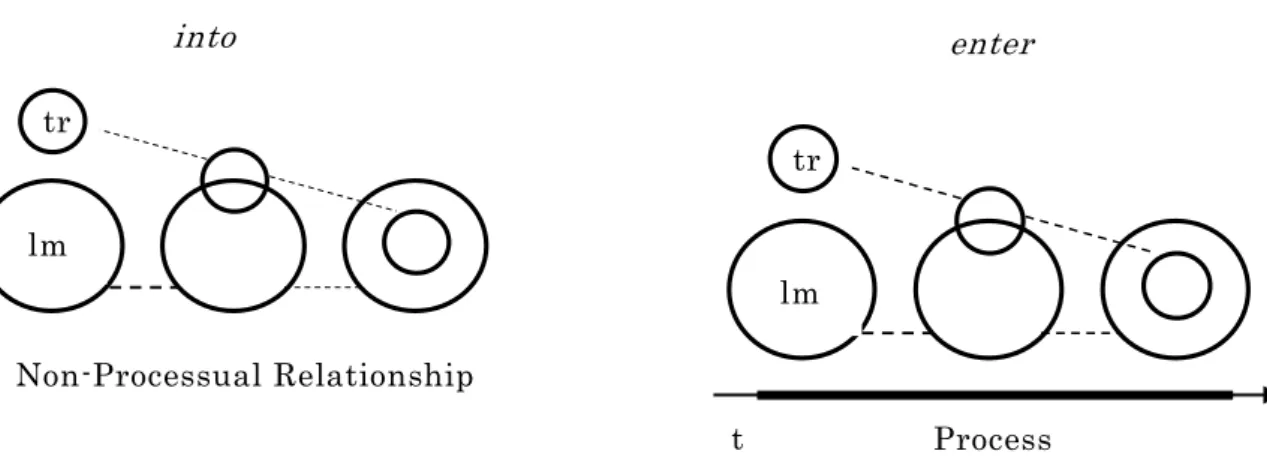
In actual fact, the physical motion proceeds along a real time sequence. When we investigate motion expressions cognitively, however, we need to assume the existence of another time; that which is taken to construe and encode the conception of a path in our cognition. In section 2.3.1, we examined the suggestion of Lancakger (2008), who states that the path expressed by a preposition is construed by summary scanning. On the other hand, Langacker also suggests that the path expressed by a verb is captured by sequential scanning. The difference between “into” as a preposition and “enter” as a verb as understood by Langacker can be seen in Figure 2-2.
Non-Processual Relationship tr
lm
into enter
tr
lm
Process t
Figure 2-2 Scanning of Into and Enter (Langacker 2008:117)
26
Both motion events described by “into” and “enter” are same; they develop alongside a real time process. However, while “enter” as a verb expresses a dynamic relation between TR and LM that is construed by degrees along the time scale (sequential scanning), “into” as a preposition expresses a complete relation between TR and LM that has been construed as the whole (summary scanning). Here, it is certain that even the expression of a motion event by a preposition develops along a real time; however, when a conceptualizer conceptualizes a motion event in a summary fashion, the temporal dimension remains in the background. For example, motion expressions that include plural paths clearly reflect the differences between cognitive processes in the case of a verb and in the case of a preposition. While example (2-27) a shows a series of three paths by using prepositions, example (2-27) b expresses the same paths by using verbs. In (2-27) a, each path is expressed using “through,” “across,” and “into” as prepositions. The verb “ran” is a manner- motion verb and does not express a path. “Ran” expresses the manner of “John,” which implies that this manner of running continues until “John” arrives in “the kitchen” that is the final point of all the paths. This means that the conceptualizer regards the three paths as one long path and construes them as being integrated into one conception. On the other hand, in (2-27) b, the paths are expressed by “pass,” “cross,” and “enter” as verbs. Moreover, it is possible to attach different manners as “by running,” “by walking,” and “by hopping”
to each clause. In this case, it means that the conceptualizer still construes the three paths one by one.12
12 The consideration of the cognitive process relative to plural paths was based on the manuscript presented at The 12th Japan Cognitive Linguistics Association at Nara University of Education on September, 2011, which was compiled in Tanaka (2012b).
27
(2-27) a. John ran through the hallway, across the dining room, and into the kitchen.
b. John pass the hallway (by running), cross the dining room (by walking), and enter the kitchen (by hopping).
Thus, a conceptualizer has more than one way of scanning in order to construe and encode motion events. Although we basically construe sequential motion events along the real time sequence, we can also re-construe a sequential motion event as one holistic event by cutting it off from the real time. Cognitive ability is concerned in this separation, where the human being objectively re-construes the event that is construed subjectively.
2.3.3. Cognitive Scheme (Langacker 2008) and Mode of Cognition (Nakamura 2004)
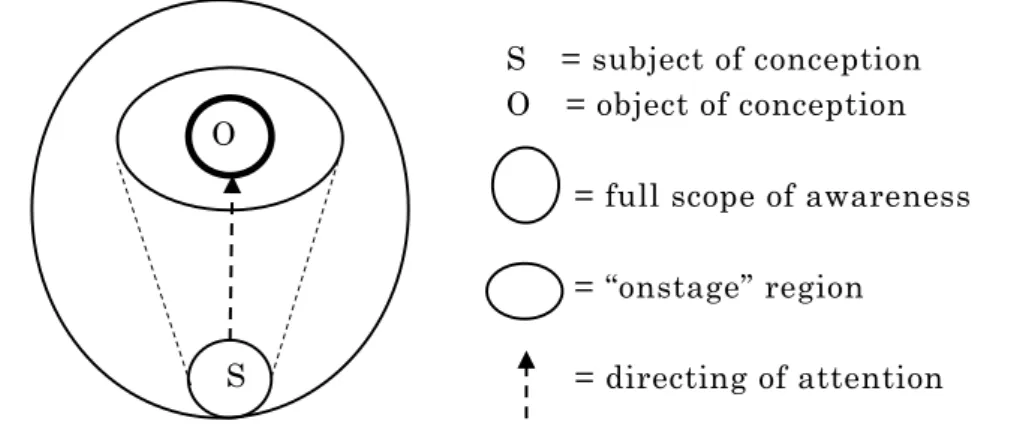
Langacker (2008) suggests that grounding is the reflection of asymmetry between the subject and the object of conception. This means that grounding determines a basic relation between a discourse content that is conceptualized by a nominal or a clause and a discourse participant as the conceptualizer. Figure 2-3 shows the basic relation of them. An essential aspect of the subject is the directing of attention, and the subject is not conceived by itself although it is within the locus of a conceptual experience. On the other hand, the object is what is conceptualized as being focused upon in the onstage region to which the subject directs his attention. For example, when a conceptualizer takes his glasses off and looks at them, the glasses are the objects toward which the attention of the conceptualizer
28
is directed. Here, the glasses are construed objectively. When a conceptualizer put his glasses on, the conceptualizer is not conscious of the glasses and the glasses become a part of him. Here, the glasses are subjectively construed.
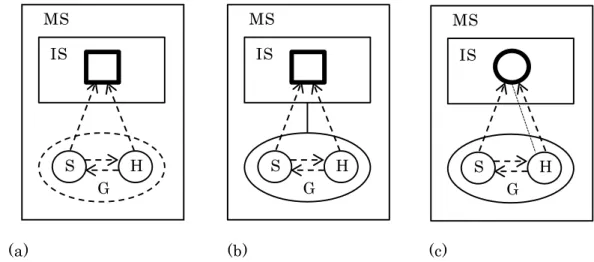
The above explanation does not manifest that any subjective element does not affect the glasses, which is construed as an object. The conceptualizer as a speaker and a hearer is relevant to the establishment of the conception—the meaning of glasses—to no small extent. This minimal basic scheme is shown as Figure 2-4 (a). The thick square represents the obviously indicated meaning by a linguistic expression. The outer frame is the maximal scope (MS), which is the maximal region that concerns the conceptualization of this linguistic expression. The inner frame is the immediate scope (IS), which is the region that is directly relevant to conceptualization in the maximal scope. The speaker (S) and the hearer (H) are located in the maximal scope; from them, dashed arrows point to the thick square. This expresses that the speaker and the hearer as conceptualizers have some influence over the conceptualization. Besides this, regarding this conceptualization, the
O
S
S = subject of conception O = object of conception = full scope of awareness
= “onstage” region = directing of attention
Figure 2-3 The Conceptualizing Relationship of Subject and Object (Langakcer 2008:260)
29
speaker and hearer direct attentions to each other and keep on interacting. This location of interaction for interlocutors is named the “ground” (G).
Although this diagram (a) in Figure 2-4 shows the basic scheme for a linguistic expression, many expressions invoke not only the speaker and the hearer, but also some aspect of the ground. A notable example is the term “tomorrow,” when it is needed to refer to the time of speaking in order for the conception to be identifiable. However, the time of speaking is not indicated obviously and put on the onstage. There, the ground is associated with the onstage by itself and the conception expressed by “tomorrow” is construed subjectively (in diagram (b) of Figure 2-4), the ground is emphasized with a solid line and in bound directly to the immediate scope). However this relation between the ground and the immediate scope is not limited to deictic expressions, rather, it is inherited in any expressions. This causes the expressions to include a particular speaker’s attitude or social situation with the object.
S H
G MS
IS
S H
G MS
IS
S H
G MS
IS
(a) (b) (c)
Figure 2-4 The Connection between the Ground and the Onstage Situation (Langacker 2008:261)
30
To put it more specifically, a part of the ground is construed objectively, being put on the onstage. For example, in the diagram (c) of Figure 2-4 showing “you,” the conception is connected to the hearer with a dashed line. To construe the conception of “you,” the subjective judgment of the speaker or the hearer is required: the conception of “you” equals the interlocutor for the speaker or himself for the hearer.
Thus, in the cognitive scheme of Langacker, any conception is described objectively, based on the contrast between the subject and the object, except for the difference in the degree of subjective construe. However, in actual usages, there are some expressions that cannot be regarded as a predication that reflect a conception that is construed objectively.
For example, when “samui!” in Japanese is translated into English, “I’m cold.” or “It’s cold.”
are assumed to be the appropriate candidates. However, both “I’m cold.” that also objectively expresses that the speaker indicated by “I” feels cold, and “It’s cold” that also objectively expresses that the environment is cold, are not the same as the conception of
“samui!”. Nakamura (2009:361) explains that “samui!” is said in a situation where the conceptualizer cannot distinguish between the cold in his body and the cold of the environment. That is to say, “samui!” is the manifestation of the very perception of the conceptualizer. Some expressions, such as “Oh!,” are introduced as the realization of the subjective perception of a conceptualizer. In this phase, the conceptualizer does not have any consciousness about ruminating himself and devotes himself to his own perception.
(2-28) samui!
cold
“I’m cold. / It’s cold.”
31
(Nakamura 2009:361)
However, this phase is not specific to the particular expressions like “samui!” and “Oh!”.
Nishida (1926) refers to construing and knowing an object in the locational logic as (2-29) a, which is translated in (2-29) b.
(2-29) a. 意識の野は真に自己を空しうすることによって、対象をありのままに映すことができ
るのである。この場合、対象が対象に自身に於てあると考えられるかも知らぬが、単 に 対 象 が そ れ 自 身 に 於て あ る な ら ば 、 い わ ゆる 意 識 内 容 の 標 準 と なる こ と は で き な い 。 対 象 の 於 て あ る 場所 は い わ ゆ る 意 識 も また こ れ に 於 て あ る 場 所で な け れ ば な ら
ぬ。
Kitaro Nishida. Genshogaku (1926) (ed. Ryosuke Ohashi (1998:100))
b. Being brought to naught, the region of our conscious can project an object as it is. In this case, it might be thought that an object would be in the object itself.
However, if an object were just in the object itself, the object could not become the standard of the content of our conscious. The location in which an object is
must be also the location in which our conscious is.
(The Translation of (2-29) a by Author)
Thus, Nishida argues that the object is not characterized by a property that is in the object (i.e., a conceptualizer does not just construe the property objectively) and that the object is only construed by being reflected into the region of our conscious where especially removed
32
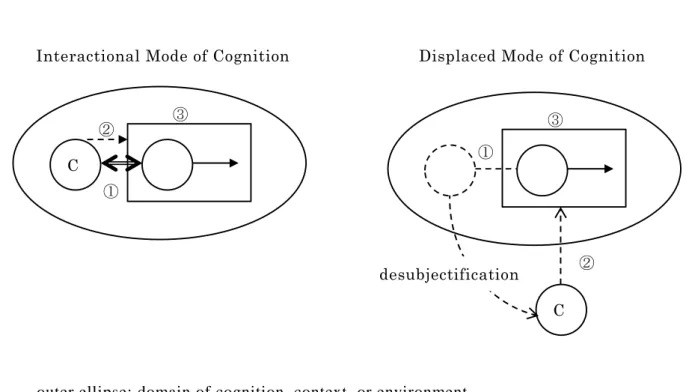
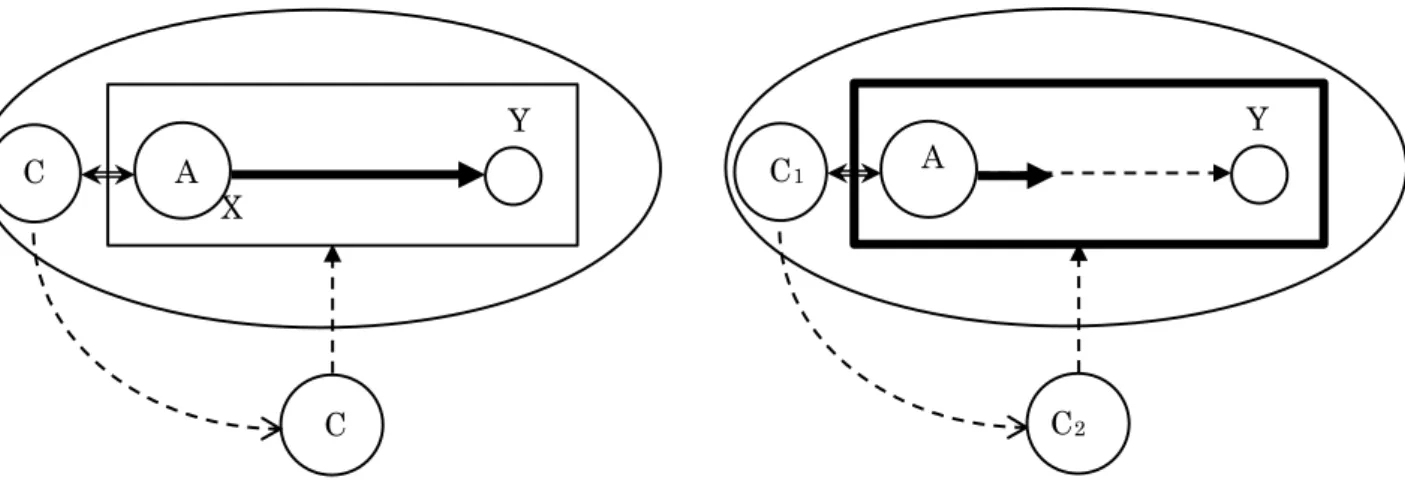
ourselves maximally (i.e., a specification or a conceptualization starts in the un-conscious region of a conceptualizer). Nakamura (2004:36) suggests that the essence of cognition is in the undifferentiated interaction between the conceptualizer and the object and that this intrinsic mode of cognition (Interactional Mode of Cognition) tends to shift from the mode of cognition that forms an objective image (Displaced Mode of Cognition) through the desubjectification, as in Figure 2-5.
Interactional Mode of Cognition Displaced Mode of Cognition
Referring to the cognition of the sun, Nakamura (2004:36) explains this twofold modes of cognition. Originally, we, as conceptualizers on the Earth, construe the sun through our interaction with the sun and express it as “the sun rises.” However, when the Copernican
C
③
①
②
C
③
②
①
desubjectification
outer ellipse: domain of cognition, context, or environment C: conceptualizer
① both directive double allows: interaction (e.g. the positional interaction between a conceptualizer on the earth and the sun. The small circle in the square indicates the sun as the object.
② dashed allow: cognitive process (e.g. moving one’s eyes upward)
③ square: the event which is construed by the cognitive process (e.g. the sun’s rising)
Figure 2-5 Mode of Cognition (Nakamura 2004:36)
33
theory was put forward, we can leave the original ground where we catch the sun’s move and easily re-construe the image of the interaction between the sun and us on the earth objectively. Thus, the mode of cognition in which a conceptualizer construes an object in their interaction is named as Interactional Mode of Cognition (I-mode) and the other method in which the conceptualizer leaves the place of interaction and objectively construes the object is named as Displaced Mode of Cognition (D-mode). Though the image formed by D-mode is virtual, the image construed objectively, based on the obvious confrontation between the subject and the object, is preferred because of the convenience in our life.
Nakamura (2004:48) shows many instances of the shift from I-mode to D-mode.
One example is the transition of middle-construction from child to adult, as shown in (2- 30). Example (2-30) a is an utterance by a child (2 years and 8 months) who sees flowers in a garden. Example (2-30) b is another utterance by a child (2 years and 4 months) who is squeezing a rubber toy. Both middle-constructions are uttered in the direct interaction between the child and the object. On the other hand, the typical middle-constructions as (2- 30) c (often used by adults) expresses a general characteristic that the object is regarded to possess. That is to say, when the characteristic is captured in the direct relationship, it is re-construed by desubjectification and comes to be expressed as an intrinsic characteristic of the object itself.
(2-30) a. That flower cuts.
b. This can’t squeeze.
(Clark 2001: 396-397) c. The door opened easily.
34
(Langacker 2008:385)
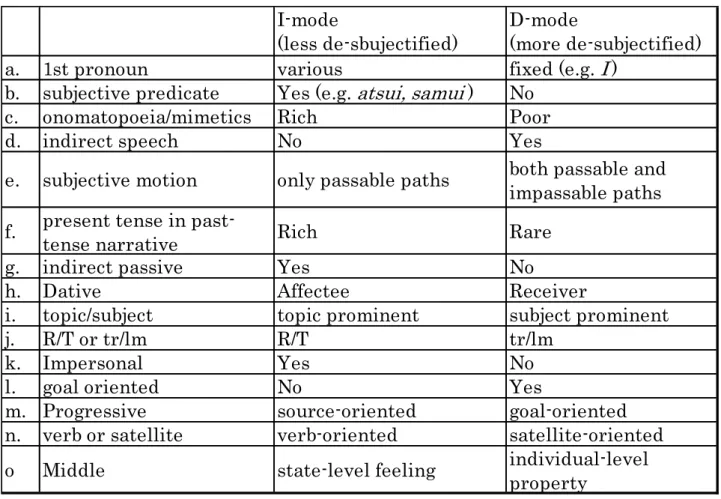
Table 2-1 shows other linguistic phenomena that reflect these two cognitive modes.
As seen in Table 2-1, the two cognitive modes emerge as the result of various linguistic phenomena. Each language has stronger tendency, whether I-mode or D-mode, which can be seen by the linguistic phenomena that are used often in each language. The result shows that English tends more toward the D-mode, while Japanese favors the I-mode.
Table 2-1 The linguistic phenomena reflected in the contrast of I-mode and D-mode (Nakamura 2004:41, [translated by Koguma (2007)])
We will continue to consider the motion expressions, including plural paths in
I-mode
(less de-sbujectified)
D-mode
(more de-subjectified)
a. 1st pronoun various fixed (e.g. I )
b. subjective predicate Yes (e.g. atsui, samui ) No
c. onomatopoeia/mimetics Rich Poor
d. indirect speech No Yes
e. subjective motion only passable paths both passable and impassable paths f. present tense in past-
tense narrative Rich Rare
g. indirect passive Yes No
h. Dative Affectee Receiver
i. topic/subject topic prominent subject prominent
j. R/T or tr/lm R/T tr/lm
k. Impersonal Yes No
l. goal oriented No Yes
m. Progressive source-oriented goal-oriented n. verb or satellite verb-oriented satellite-oriented
o Middle state-level feeling individual-level
property
35
English and Japanese. In example (2-31), the same motion event is depicted by the most typical form of expression in each language.
(2-31) a. John ran through the hallway, across the dining room, and into the kitchen.
b. John-wa rōka-o hashiri-nuke, shokudo-o John-TOP the hallway-ACC run-pass, dining room-ACC
hashit-te-yokogiri, daidokoro-e kake-konda.
run-and-cross, kitchen-to run-enter-PAST
First, Japanese, as a verb-framed language in Talmy’s typological terms, expresses a path using a verb. In example (2-31) b, three path verbs (“nuke,” “yokogiri,” “konda”) are tied to manner-motion verbs that mean running (“hashiri,” “hashit,” “kake”) and form three compound verbs. Therefore, the three paths, representing each manner, are construed individually. This means that the conceptualizer assimilates to the agent and construes and encodes a path that appears before his eyes gradually, piece by piece. This is a stronger reflection of the I-mode and is shown in Figure 2-6 (a). The rectangles means each of the goal of the path. When the conceptualizer faces the goal of the first path, he is not consci ous of the latter paths that are depicted as dashed lines. After having construed the first path, the conceptualizer starts to move toward the goal of the next path. On the other hand, in (2-31) a, English as a satellite-framed language, expresses three paths by three satellites one by one. However, the manner-motion verb “run” that accompanies the first satellite
36
explains the whole manner of the agent until the goal of the third path is reached. This means that the conceptualizer construes and encodes all three paths as one long path. This is only achieved when the conceptualizer assimilating to an agent places his vantage point out of the domain of cognition, as in Figure 2-6 (b). To indicate that the conceptualizer has conceived of the whole motion event when he starts to express the event, all paths up to the third goal are depicted by solid lines.
Thus, a Japanese user is likely to assimilate with an agent and tends, rather, to encode an event in the time. On the other hand, an English user moves out of the domain of cognition and construes the event objectively. There, the conception of time moves into the background and the event is conceptualized summarily. However, these modes of construal exist only by default. As confirmed at the end of section 2.2, there are some expressions that do not fit into the typical framings of English and Japanese. Following this chapter, we will consider which cognitive processes are operating upon these specific expressions and examine the shift from I-mode to D-mode further.
(a) Interactional Mode of Cognition (b) Displaced Mode of Cognition Figure 2-6 The Cognitive Construal of the Plural Paths
C
C
37 Chapter 3
MOTION-EXPRESSIONS IN JAPANESE
The event of path is identified with a motion toward some goal. When we depict a path event with language, a certain place has to be expressed as the goal to reach. Although there are some ways to indicate a place as the goal, such as using markers or taking special orders, both English and Japanese basically use a handful of particular markers to indicate goals. However, their appearances differs a little from one language to the other;
prepositions like “to,” “in,” “on,” and “at” are attached prior to a word of place in English, while on the other hand, postpositions like “ni,” “e,” and “made” are placed at the back of a word of place in Japanese. These words does not possess the conception of goal in themselves; rather, what they indicate in sentences varies depending on the surrounding in which they occur. For example, in English, “ran in the house” expresses a motion toward the house, where a preposition “in” operates as a marker of destination, whereas “in” does not work in the same way in a phrase like “lived in the house”. Also, in Japanese, the postposition “ni” indicates “library” as a destination in “tosyokan-ni itta (library-ni go- PAST) [went to the library],” while “ni” in “John-ni karita (John-ni borrow-PAST) [borrow (something) from John]” does not make “John” a destination but, rather, a source of motion.
Therefore, though these prepositions and postpositions seem to indicate destination in motion expressions, their intrinsic qualities are not marker of destination. To realize their real natures, it is necessary to examine their appearances in various expressions. Both