【Research Note】
Market Risk Disclosures: A Comparison between Companies in Japan and China
Shaomin Xie Samir Nissan Hiromasa Okada*
Abstract
This paper presents a comparative analysis of market risk disclosure by Japanese and Chinese companies whose stocks are traded on New York Stock Exchange(NYSE)as American Deposi- tory Receipts(ADRs)as well as on stock exchange of their own home country. All the compa- nies selected in this study made quantitative disclosures on Item11in their20‑F reports to the U.S. Securities and Exchange Commission(SEC).However, in Japan, only two companies made quantitative disclosures outside the financial statements and none of them disclosed infor- mation specified for market risks in their notes to the financial statements in their annual securi- ties reports. In China, only one company made quantitative disclosures outside the financial statements in their A-shares reports and the number of companies making quantitative dis- closures in the notes to the financial statements in the20‑F reports exceeded those in their A- share reports. It appears that the Japanese companies disclose information specifically required by the SEC but not disclosing them anywhere else. It also appears that the Chinese companies don't disclose identical information in the U.S. and China although the financial statements reported in the U.S. used International Financial Reporting Standards(IFRS)and Hong Kong financial reporting standards and those reported in China used China's accounting standards which are similar to IFRS.
Key words: market risk disclosure, quantitative disclosures, qualitative disclosures
1.Introduction
In Japan, the Accounting Standards Board of Japan(ASBJ)that is in private sector plays main role in convergence, but there is the other accounting standards setting body, Business Accounting Deliberation Council(BADC)in public sector. In China, the Ministry of Finance of the People's Republic of China(MOF)plays main role.
Shaomin Xie: Former Professor, School of Accountancy, Shanghai University of Finance and Economics.
Samir Nissan: Professor, College of Business, California State of University, Chico.
Hiromasa Okada: Professor, Faculty of Economics, Nagasaki University.
*Okada is supported the Grant-in-Aid for Scientific Research(C).
On August8,2007,the Tokyo Agreement between the ASBJ and the International Ac- counting Standards Board(IASB)was announced on achieving the convergence of Japanese accounting standards with International Financial Accounting Standards(IFRS)by2011.1 In Japan, there are25Accounting Standards which are published by the ASBJ as well as8ac- counting standards published by BADC. On June10,2011,the ASBJ and the IASB an- nounced the achievement of convergence under the Tokyo Agreement.2
In2006,the MOF issued38Accounting Standards for Business Enterprises(ASBE)with full convergence with IFRS. ASBEs are divided into three groups:general accounting stan- dards, special accounting standards and accounting standards for financial reporting. The MOF also published one Basic Accounting Standards that clarifies basic accounting concepts.
Accounting has two functions:one is called operational accounting, the other is called equity accounting. Operational accounting relates to providing decision useful information for inves- tors, and equity accounting relates to reconciliation of interest of stake holders. Style of ac- counting system in a country depends on the correlation of two functions.3
Both functions relate resource allocation through disclosure of qualitative information as well as quantitative information. The market risk information includes both qualitative and quantitative information. Proper risk disclosure is considered as crucial for investors and other users of financial statements(CESR,2009).
The objective of this paper is to compare market risk disclosures of Chinese and Japanese companies and to examine the financial transparency of listed companies in both countries. In order to achieve the objectives, this paper selects Japanese and Chinese non-financial corpora- tions whose stocks are traded on New York Stock Exchange(NYSE)as American Depository Receipts(ADRs).The stocks of the selected companies are traded on Tokyo Stock Ex- change(TSE)or on Shanghai Stock Exchange(SSE)as A-shares. The reason for the selec- tion of the companies whose stocks are traded as ADRs as well as traded on the stock ex- change in their home countries is to highlight the institutional differences. Non-financial com- panies were selected in order to eliminate the effects which may be inherent in the specific characteristics of the financial industry.
This paper is organized as follows. Section2summarizes the market risk disclosure require- ments of the U.S. Securities Exchange Commission(SEC),ASBJ, Japan Financial Services Agency(FSA),China's MOF and China Securities Regulatory Commission(CSRC).Sec-
1 Press release8/August/2007 The ASBJ and the IASB announce Tokyo Agreement on achieving conver- gence of accounting standards by2011 (https://www.asb.or.jp/asb/asb̲e/asbj/pressrelease/pressrelease̲ 20070808̲e.pdf)(access2011/10/30)
2 Press release10/June/2011 IASB and ASBJ announce their achievements under the Tokyo Agreement and their plans for closer co-operation(13th meeting) (https://www.asb.or.jp/asb/asb̲e/asbj/pressrelease/ pressrelease̲20110610̲e.pdf)(access2011/10/30).But the minister of financial service announced that Japan postpones final decision on mandate application of IFRS to Japanese companies.
3 Tax accounting also has an influence on accounting practice in each country.
tion3introduces twelve selected Japanese companies as sample and compares the market risk disclosures between the annual reports of foreign corporations(20‑F)filed with SEC and the annual security report filed with FSA for the financial period ended December31,2008or March31,2009.Section4introduces nine Chinese companies as sample and compares the market risk disclosures between the annual reports of foreign corporations(20‑F)filed with SEC and the annual report of A‑shares filed with CSRC for the financial period ended Decem- ber31,2008.
2.Comparison of Market Risk Disclosure Requirements among Japan, China and US
In1997,the SEC issued Financial Reporting Release No.48 Qualitative and Quantitative Market Disclosure (FRR48).FRR48defines market risk as the risk of a loss arising from adverse changes in market rates and prices, such as interest rates, foreign currency exchange rates, commodity prices, and other relevant market rate or price changes(e.g.,equity prices) (SEC,1997,p.5,footnote[12])and requires companies to disclose the following four types of market risks:interest rates, foreign exchange rates, commodity prices, and equi- ty prices(SEC,1997,p.8).
These disclosures are presented within the section of Management Discussion and Analy- sis (MD & A)under Item17in form20‑F for foreign corporations trading in the U. S. as ADRs(SEC,1997,p.57).4 FRR48requires companies to disclose potential loss in one of three formats:tabular disclosure(SEC,1997,pp.68‑69),sensitivity analysis(SEC,1997,
pp.70‑71),and value at risk(VaR)(SEC,1997,pp.71‑73).For sensitivity analysis and VaR, a company may report the potential loss/gain in terms of income, cash flow or fair value.
Therefore, for any type of risk, a company may choose any one of the seven distinct formats as shown in Table1.
The ASBJ released a revised Accounting Standard Statement No.10 Accounting Stan- dard for Financial Instruments (AS10)and issued revised Implementation Guidance No.19 ASBJ Guidance on Disclosures about Fair Value of Financial Instruments (IG19)on March25,2011.5 AS10requires the disclosure of qualitative information on financial instru- ments and quantitative disclosures on the fair value of financial instruments. Qualitative dis- closures include the objectives of holding financial instruments, the description and risks of financial instruments, risk management etc. as items of note to financial statements(para.40‑
2 (1)).For this requirement, IG19requires quantitative disclosures of market risks. The
4 Qualitative Disclosure about Market Risk part of FRR48sais that SEC believes qualitative information about market risk is important to investors and shows examples of information(SEC,1997,pp.76‑78).
5 The revision of IG19relates to the revision or AS12 Accounting Standards for Quarterly Financial Report- ing .
Table1:Formats Used to Disclosea Market Risk
A Use tabular format B1 Use VaR for fair value B2 Use VaR for cash flow B3 Use VaR for income
C1 Use sensitivity analysis for fair value C2 Use sensitivity analysis for cash flow C3 Use sensitivity analysis for income
market risks include currency risk, interest rate risk, and others(para.3).According to this paragraph, companies, whose assets and liabilities are made up mostly of financial instruments which are sensitive to changes in market risks, should disclose information based on quantita- tive analysis used in risk management of the financial instruments or sensitivity analysis in the disclosures of fair value of financial instruments(para.3 (3)).The annual security report, Form3,submitted to prime minister is regulated by the Cabinet Office Ordinance on Dis- closure of Corporate Information etc.(COOD).COOD requires companies to disclose all the risk factors which may affect the decision of investors in Item2‑4titled Business Risk of Form3.Such factors may include unusual changes in the financial position, the results of operations and cash flows of the company;and disclose any dependence on specific customers, suppliers, products and technologies.
In China, the MOF in2006issued the ASBE No.37 (ASBE37) Presentation of Financial Instruments .ASBE37is in full convergence with IFRS7 Financial Instruments:Dis- closures .It requires sensitivity analysis of the impact of a change in each type of market risk on income statement or owners equity(Article43).When VaR or similar method is used in sensitivity analysis, ASBE37requires the disclosure of the objectives, main parameters, as- sumptions of the model used, and the disclosure of any possibility of not capturing the fair value of financial instruments(Article44).In2007,CSRC announced the prospectus about the Standard Concerning the Contents and Formats of Information Disclosure Offering Securities to the Public No.1 (SCF).SCF requires that companies should disclose all the significant risk factors that may adversely affect the achievement of the company's future strategy and operating objectives, including macro policy risk, market or business risk, finan- cial risk, technology risk, and others(Section4).The concept of market risk in SCF is differ- ent from that of FRR48.
3.Market Risk Disclosures of Japanese Companies
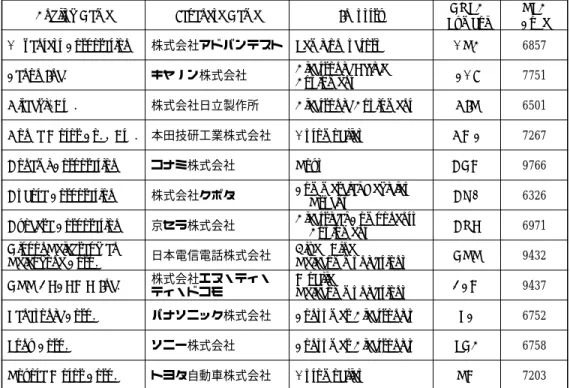
The selected Japanese companies for this study have ADRs traded on NYSE and shares(J- Shares)traded on TSE. Table2shows the name of the companies, in Japanese and English, as
Table2:Sampled Japanese Companies
English Name Japanese Name Industry NYSE
Symbol
TSE Code
Advantest Corporation 株式会社アドバンテスト Semiconductors ATE 6857
Canon Inc. キヤノン株式会社 Electronic Office
Equipment CAJ 7751
Hitachi, Ltd.Þ 株式会社日立製作所 Electronic Equipment HIT 6501
Honda Motor Co.,Ltd. 本田技研工業株式会社 Automobiles HMC 7267
Konami Corporation コナミ株式会社 Toys KNM 9766
Kubota Corporation 株式会社クボタ Commercial Vehicles
& Trucks KUB 6326
Kyocera Corporation 京セラ株式会社 Electrical Components
& Equipment KYO 6971
NipponTelegraph and
Telephone Corp. 日本電信電話株式会社 Fixed Line
Telecommunications NTT 9432
NTT DOCOMO Inc. 株式会社エヌ・ティ・
ティ・ドコモ
Mobile
Telecommunications DCM 9437
Panasonic Corp. パナソニック株式会社 Consumer Electronics PC 6752
Sony Corp. ソニー株式会社 Consumer Electronics SNE 6758
Toyota Motor Corp. トヨタ自動車株式会社 Automobiles TM 7203
ÞHitachi released announcement that delisting of its ADR from NYSE became effect from April27,
2012.(http://www.hitachi.com/New/cnews/f̲120427a.pdf)(access2012/05/27)
well as their symbols on NYSE and their codes on TSE.
The financial statements filed by the Japanese companies with the SEC and FSA are all based on U.S.GAAP. It is reasonable to conclude that the financial statements in annual reports of the ADRs and the J-shares filed with the FSA are equivalent. If there are any differ- ences in market risk disclosures, they must be caused by regulations other than those of the SEC, and/or the intention of managements.
Table3shows information about the disclosures of market risks in their reports of the ADRs filed with the SEC. The20‑F form is used by foreign corporations to file their annual reports with the SEC. Item11on20‑F form is used to report quantitative and qualitative information required by the SEC in respect to market risk disclosures. Item17or18on20‑F are used to file the financial statements and their notes.
Table3shows that all companies made quantitative disclosures in Item11and none of the companies made quantitative disclosures within Item17.Ten companies use the tabular for- mat. Sony(SNE)used value at risk(VaR)for the three types of risks;equity price risk, cur- rency risk and interest rate risk. Toyota Motor(TM)used sensitivity analysis for fair value for equity price risk and interest rate risk, and used value at risk(VaR)for currency risk.
Table3:Market Risk Disclosure in the Annual Reports(20‑F)for the Japanese ADRs Filed with the SEC NYSE
Symbol Equity price risk Currency risk Interest risk Commodity price risk ATE
Item 11 Item 17
A
−
A
Qualitative & A
No long‑term debt
−
−
CAJ:
Item 11 Item 17
A
−
A
Qualitative & A
Insignificant
−
−
− HIT:
Item 11 Item 17
A
−
A
Qualitative & A A
Qualitative & A
−
− HMC:
Item 11 Item 17
Qualitative
−
A
Qualitative & A A
Qualitative & A
−
− KNM:
Item 11 Item 17
A
−
A
Qualitative & A A
−
No open derivative
− KUB:
Item 11 Item 17
A
−
A
Qualitative & A A
Qualitative & A
−
− KYO:
Item 11 Item 17
A
−
A
Qualitative & A A
Qualitative & A
−
− NTT:
Item 11 Item 17
A
−
Not material Qualitative & A
A
Qualitative & A
−
− DCM:
Item 11 Item 17
A
−
No forward contract Qualitative & A
A
Qualitative & A
−
− PC:
Item11 Item17
A
−
A
Qualitative & A A
−
A
Qualitative & A SNE:
Item 11 Item 17
B1
−
B1
Qualitative & A B1
Qualitative & A
−
− TM:
Item 11 Item 17
C1
−
B3
Qualitative & A C1
Qualitative & A
No derivative
− Note
̲̲̲: No information was provided A:Use tabular format
B1: Use Value at Risk (VaR) for cash flow B3: Use Value at Risk (VaR) for income C1: Use sensitivity analysis for fair value
Table4provides information on the disclosures of market risks in their annual security reports filed with the FSA. All the information is for fiscal years ended March31,2009,ex- cept for Canon Inc. whose fiscal year ended on December31,2008.Table4shows that the J- shares reports also have two locations for market risk disclosures:one is Item2‑4 Business Risk or Item2‑7 Analysis of Financial Position, Operation Result and Cash Flow ;the other is Item5‑1 Consolidated Financial Statements under Financial Conditions .Item2
‑4is not specified for market risk disclosures. In fact, the qualitative information is the same to that of Item3D in20‑F reports.
Table4:Market Risk Disclosure in the Annual Reports for J-Shares Filed with the FSA NYSE
Symbol Equity price risk Currency risk Interest risk Commodity price risk ATE:
Item2‑4 Item5‑1
−
−
Qualitative Qualitative & A
−
−
−
− CAJ:
Item2‑4 Item5‑1
Qualitative
−
Qualitative Qualitative & A
Qualitative
−
−
− HIT:
Item2‑4 Item5‑1
−
−
Qualitative Qualitative & A
− Qualitative & A
−
− HMC:
Item2‑4 Item5‑1
Qualitative
−
A
Qualitative & A A
Qualitative & A
−
− KNM:
Item2‑4 Item5‑1
−
−
− Qualitative & A
−
−
−
− KUB:
Item2‑4 Item5‑1
Qualitative
−
Qualitative Qualitative & A
Qualitative Qualitative & A
Qualitative
− KYO:
Item2‑7 Item5‑1
Qualitative
−
A & A Qualitative & A
A
Qualitative & A
−
− NTT:
Item2‑4 Item5‑1
−
−
− Qualitative & A
− Qualitative & A
−
− DCM:
Item2‑4 Item5‑1
−
−
− Qualitative & A
− Qualitative & A
−
− PC:
Item2‑4 Item5‑1
Qualitative
−
Qualitative Qualitative & A
Qualitative
−
Qualitative Qualitative & A SNE:
Item2‑4 Item5‑1
−
−
Qualitative Qualitative & A
Qualitative Qualitative & A
−
− TM:
Item2‑7 Item5‑1
−
−
Qualitative Qualitative & A
− Qualitative & A
−
−
As shown on Table4,under Item2‑4or Item2‑7of their J-shares reports, ten companies provided qualitative disclosures for one or more types of risks, and two companies, Honda Mo- tors(HMC)and Kyocera Corporation(KYO),provided quantitative data using the tabular format for currency risk and interest rate risk and qualitative information for the other market risks. Under Item5‑1,all the companies provided qualitative information and quantitative in- formation presented in a tabular format. The qualitative information are disclosed in note un- der the heading Derivative Financial Instruments or Derivatives and Hedging Activities ,in- cluding the discussion of objectives for derivatives, description of the general way risk is
managed and the types of derivatives and instruments used. The quantitative information presented in a tabular format includes contract amounts or fair values of derivative instru- ments. There are two types of disclosures. One type is to disclose the types of risk, for exam- ple separate disclosure of foreign currency exchange rate risk management and interest rate risk management. The other type is to disclose information without indicating the types of risk. None of the disclosures are forward looking information specified for market risk.
Table5presents comparative data on the sampled Japanese companies in their market risk disclosures in their ADRs reports and those filed with the FSA. The majority of companies use the tabular format in their ADRs reports. The tabular format used in ADRs reports differed by
Table5:Number of Japanese Companies Providing Risk Disclosures by the Disclosure Type in their reports to the SEC and the FSA
Type of Annual Report
Type of Risk ADRs J-shares
Item 11 Item 17 Item2‑4 Item5‑1
Equity risk
Qualitative disclosure only 1 0 5 0
Tabular format (A) 9 0 0 0
Sensitivity analysis (B1) 1 0 0 0
Value at risk (C1) 1 0 0 0
Total 12 0 5 0
Currency risk
Qualitative disclosure only 2 0 6 0
Tabular format(A) 8 12 2 12
Sensitivity analysis (B1&B3) 2 0 0 0
Value at risk 0 0 0 0
Total 12 12 8 12
Interest risk
Qualitative disclosure only 2 0 4 0
Tabular format (A) 8 8 2 12
Sensitivity analysis (B1) 1 0 0 0
Value at risk (C1) 1 0 0 0
Total 12 8 6 12
Commodity price risk
Qualitative disclosure only 2 0 2 0
Tabular format (A) 1 1 0 1
Sensitivity analysis 0 0 0 0
Value at risk 0 0 0 0
Total 3 1 2 1
the type of market risk disclosed. The tabular format used for disclosures of interest rate risk as required by the SEC disclosed debt, for example, for each of the next five years and, under one column, for years after the fifth. Companies have the discretion of selecting the informa- tion reported when using the tabular format for disclosures on the risk of changes in foreign currency exchange rates.
4.Market Risk Disclosures of Chinese Companies
Table6shows the name of sampled companies, in Chinese and English, as well as their sym- bols on NYSE and codes of A-shares on SSE.
Table6:Sample Chinese Companies
English Name Chinese Name Industry NYSE
Symbol
SSE Code Aluminum Corporation
of China, Ltd. 中国 股©有限公司 Aluminum ACH 601600
China Eastern Airlines
Corp. Ltd. 中国 方航空股©有限公司 Airlines CEA 600115
China Petroleum &
Chemical Corp. 中国石油化工股©有限公司 Integrated Oil & Gas SNP 600028
China Southern Airlines
Co. Ltd. 中国南方航空股©有限公司 Airlines ZNH 600029
Guangshen Railway
Co. Ltd. 广深 路股©有限公司 Travel & Tourism GSH 601333
Huaneng Power
International Inc. 能国 力股©有限公司 Conventional
Electricity HNP 600011
PetroChina Co. Ltd. 中国石油天然气股©有限公司 Integrated Oil & Gas PTR 601857 Sinopec Shanghai
Petrochemical Co. Ltd.
中国石化上海石油化工股©有
限公司 Commodity Chemicals SHI 600688
Yanzhou Coal Mining
Co. Ltd. 州煤 股©有限公司 Coal YZC 600188
The financial statements filed by the sampled Chinese companies with the SEC are based on IFRS except for Aluminum Corporation of China(ACH)which is based on Hong Kong Finan- cial Reporting Standards. The auditing standards used in these reports are Auditing Standards by PCAOB except for Aluminum Corporation of China which used Hong Kong Standards on Auditing.
The financial statements filed by the Chinese companies with CSRC are based on ASBE.
The auditing standards used in these reports are Auditing Standards for CPAs of China. Since ASBE is equivalent to IFRS, it is reasonably to say that the financial statements in ADRs an- nual reports and A-shares annual reports are equivalent. If there are any differences in market risk disclosures, they must be caused by regulations other than those of the SEC, and/or the intention of management.
Table7provides information on the disclosures of market risk by the Chinese companies in
Table7:Market Risk Disclosure by the Chinese Companies in their2008Annual Report to the SEC NYSE
Symbol Equity price risk Currency risk Interest risk Commodity price risk ACH:
Item11 Item17
−
−
Not significant Same above
A
C3(post-tax profit) A
C3(post-tax profit) CEA:
Item11 Item17
−
−
C3(profit and loss) A
C3(interest costs) C3(profit and loss)
C1
C3(profit and loss) SNP:
Item11 Item17
− C3(net income and retained earnings)
A
C3(net income and retained earnings)
A
C3(net income and retained earnings)
−
−
ZNH:
Item11 Item17
−
−
A
C3(loss after taxes and accumulated losses)
A
C3(loss after taxes and accumulated losses)
Same below All the fuel option expired in 2008
GSH:
Item11 Item17
− Qualitative
C1
A & C3(post-tax profit)
C3(post-tax profit) Same above
Qualitative
−
HNP:
Item11 Item17
Qualitative Same above
A
C3(exchange gains) A
C3(interest expenses) A Qualitative PTR:
Item11 Item17
−
−
A Qualitative
A Qualitative
Qualitative Same above SHI:
Item11 Item17
−
−
A
A&C3(net profit and retained earnings)
A
C3(net profit and retained earnings)
−
−
YZC:
Item11 Item17
Not significant Same above
C3(profit and loss) A&C3(profit and loss)
C3(net income) Not significant
Qualitative
− Note:
̲̲̲: No information was provided A: Use tabular format
C1: Use sensitivity analysis for fair value C3: Use sensitivity analysis for income
their2008ADRs reports filed with the SEC. As shown on Table7,Chinese companies used qualitative information, tabular format and sensitivity analysis of fair value and income within both Item11and Item17.Eight of the companies used the tabular format.
Table8provides information on the disclosures of market risk by the Chinese companies in their2008A-shares reports filed with the CSRC. Just like the annual reports of J-shares, the A- share reports also have two locations for market risk disclosures:one is outside the financial statements within the section of management discussion and analysis(MD&A);the other is under the Notes of Financial Statements. The location outside the financial statements is not specified for market risk disclosures. For example, Aluminum Corporation of China disclosed price risks within the part of the Chairman's Statement under Item of Risk Factors.
Table8:Market Risk Disclosure in2008Annual Report by the Chinese Companies in their A-Shares Filed with the CSRC
NYSE
Symbol Equity price risk Currency risk Interest risk Commodity price risk ACH:
Item Item
−
−
−
−
−
−
−
− CEA:
Item8‑1 Item12
−
−
Qualitative Qualitative
Qualitative Qualitative
C1 C3、C1 SNP:
Item12‑14 Item16
− C3(net income and retained earnings)
Qualitative C3net income and retained earnings)
Qualitative C3(net income and retained earnings)
Qualitative
−
ZNH:
Item Item11
−
−
− C3(net income and equity)
− C3(net income and equity)
− All the fuel option expired in 2008 GSH:
Item7‑2 Item10
−
−
Qualitative
C3(income & equity)
Qualitative Not significant
Qualitative
− HNP:
Item8‑1 Item
−
−
Qualitative
−
Qualitative
−
Qualitative
− PTR:
Item12‑2 Item16
Qualitative Qualitative
− Not significant
Qualitative Same above SHI:
Item9‑1 Item12
−
−
− C3(profit and retained earnings)
− C3(profit and retained earnings)
Qualitative
−
YZC:
Item8‑2 Item
−
−
−
−
−
−
Qualitative
− Note:
̲̲̲: No information was provided A: Use tabular format
C1: Use sensitivity analysis for fair value C3: Use sensitivity analysis for income
As shown on Table8,Chinese companies used tabular format, qualitative information, and sensitivity analysis of fair value and income to disclose their market risks within notes of finan- cial statements. As on Table8,only one company, China Eastern Airlines(CEA),made quantitative disclosures related to the risk of changes in prices of commodities outside of finan- cial statements voluntarily. China Eastern Airlines reported large unrealized losses from the fair value changes of the fuel hedging derivatives. It made sensitivity analysis that if the oil price decreased or increased by5%compared to the closing price as December31,2008,the fair value losses would increase or decrease by approximately RMB500million. Obviously, the disclosures are good explanation for the losses incurred in2008as well as a signal that the loss- es will be reduced with the recovery from the worst situation of oil market in2009.It may in-
dicate that companies will voluntarily make market risk disclosures when it is helpful in ex- plaining unfavorable situations.
Table9presents the methods used to disclose market risks for each type of market risk by the sample Chinese companies. It showed that for the currency risk and interest risk the gener- al qualitative and quantitative disclosure requirements of FRR48and IFRS7were followed by almost all the sample Chinese companies. However, not all the nine companies made quantita- tive disclosures required by ASBE. As shown on Table9,three companies did not make any market risk disclosures within the financial statements in2008.There are several reasons for companies not to disclose any information on any market risk:they do not use derivatives; they have no significant exposure to market risk;the management is reluctant to disclose in- formation because of the desire not to disclose or the lack of transparency. The information disclosed in ADRs reports can be used as observable information to verify why the companies do not disclose the same information in their reports to the CSRC. As shown on Table8,nine companies made quantitative disclosures in Item11and17in their reports to the SEC. This may indicate that the Chinese companies disclose different information under different juris- dictions.
Table9:Number of Chinese Companies Providing Risk Disclosures by the Disclosure Type in their reports to the SEC and the CSRC
Type of Annual Report
Type of Risk ADRs A-shares
Outside Within Out Within
Equity risk
Qualitative disclosure only 2 3 0 0
Sensitivity analysis 0 1 0 1
Total 2 4 0 1
Currency risk
Qualitative disclosure only 1 2 5 2
Tabular format 5 1 0 0
Sensitivity analysis 3 6 0 4
Total 9 9 5 6
Interest risk
Qualitative disclosure only 0 2 5 3
Tabular format 6 0 0 0
Sensitivity analysis 3 7 0 3
Total 9 9 5 6
Commodity price risk
Qualitative disclosure only 4 3 6 2
Tabular format 2 0 0 0
Sensitivity analysis 1 2 1 1
Total 7 5 7 3
5.Concluding Remarks
This study examined the variations of disclosures made by Japanese and Chinese companies in disclosing market risks in their20‑F in NYSE and security reports in home markets. The findings in this study illustrate that the sample companies made different disclosures for the SEC, FSA, and CSRC.
In their ADRs reports, all the selected companies made quantitative disclosures on Item 11in their20‑F reports. Even though the companies have observable information(disclosures in ADRs reports),most of the companies did not make quantitative disclosure outside finan- cial statements with their reports for shares traded in TSE or SSE except two Japanese com- panies and one Chinese company. On the basis of the facts, Japanese and Chinese companies response to mandated disclosures requirements actively, but are reluctant to disclose informa- tion which are not mandatory.
References
Accounting Standards Board of Japan(ASBJ).2008.Accounting Standard Statement No.10‑Accounting Stan- dard for Financial Instruments
−.2008.Implementation Guidance No.19‑Guidance on Disclosures about Fair Value of Financial Instruments China Securities Regulatory Commission(CSRC).2007.Standards Concerning the Contents and Formats of In-
formation Disclosure by Companies Offering Securities to the Public No.1 ‑Prospectus(Revision2003) Committee of European Securities Regulators(CESR).2009.Application of Disclosure Requirements Related to
Financial Instruments in the2008Financial Statements
Financial Services Agency(FSA).2009.Cabinet Office Ordinance on Disclosure of Corporate Affairs and Other Related Matters(Revised2009)
International Accounting Standards Board(IASB).2005.International Financial Reporting Standard7‑Finan- cial Instruments:Disclosures
Ministry of Finance of the People's Republic of China(MOF).2006.Accounting Standards for Enterprises No. 37‑Presentation of Financial Instruments.
Securities and Exchange Commission(SEC).1997.Disclosure of Accounting Policies for Derivative Financial Instruments and Derivative Commodity Instruments and Disclosure of Quantitative and Qualitative Informa- tion about Market Risk Inherent in Derivative Financial instruments, Other Financial Instruments, and Derivative Commodity Instruments. Release Nos.33‑7386; 34‑38223;IC‑22487;FR48;International S- eries No.1047;File No.s7‑35‑95.Washington, D.C.:Securities and Exchange Commission.(http://
www.sec.gov/rules/final/33‑7386.txt)(access2011/10/30)