Qing “Government Caravans” in Kiakhta:
The Activities of Bederge Muslims*
YANAGISAWA Akira
Introduction
From 1760 (Qianlong 乾隆 25) to 1778 (Qianlong 43), the Qing dynasty dispatched government caravans of Muslim merchants known as Bederge Muslims (Man. bederge hoise) to Kiakhta to trade with Russia in order to procure furs and so on for use in the imperial court. The aim of this article is to present a full picture of these government caravans, about which little has been known.
Trade between Qing China and Russia prior to the eighteenth century can be broadly divided into the Beijing trade undertaken by Russian caravans (late seventeenth century to 1750s) and trade at Kiakhta. Research on the Beijing trade has been accumulating since an early stage, and it is safe to say that it has by and large been elucidated.1) With regard to the Kiakhta trade, too, there exists a body of research based primarily on Russian sources,2) and more recently Morinaga Takako has vividly described the activities of Russian merchants involved in the Kiakhta trade.3) Meanwhile, as regards the Qing system for administering the Kiakhta trade, the activities of merchants, and so on, references can be found in several monographs and general works,4) but in many cases these merely piece together fragmentary information gleaned from later compilations such as the Shuofang beicheng 朔方備乘 by He Qiutao 何秋濤 and collections of archival sources published in recent years, supplementing them with Russian sources and research, and it has to be said that a full picture of the Kiakhta trade is far from having been delineated.
Nor has there been any full-scale examination of the government caravans of Muslim merchants to be considered here. There is a study by Lai Huimin about the purchasing of furs at Kiakhta by the Qing Imperial Household Department (neiwufu 内務府), and she clarifies the quantities of furs purchased and how they were processed and distributed,5) but almost no mention is made of the Bederge Muslims. In addition, Saguchi Tōru has pointed out that the Gaozong shilu 高宗實錄 (Veritable Records of Gaozong [= Qianlong]) mentions that Bederge Muslims (bode’erge huiren
伯德爾格回人) were engaged in the
Kiakhta trade,6) but he does not examine this in any depth. But Manchu- language copies of palace memorials (lufu zouzhe 錄副奏摺) in the fond of the Council of State (Junjichu quanzong
軍機處全宗) held by the First Historical
Archives of China and the archives of the Office of the Grand Minister Superintendent of Küriy-e (Ch. Kulun banshi dachen yamen 庫倫辦事大臣衙門;Mon. Хүрээнд сууж хэрэг шийтгэгч сайдын яам) held by the National Central Archives of Mongolia include a considerable number of documents related to the Kiakhta trade from the 1750s onwards, and these include a not insignificant amount of information about the government caravans.
In the following, making use of these archival sources, I accordingly first survey the background to the Qing dynasty’s launching of these operations as well as the framework for administering government caravans and their actual activities. Further, in 1763 (Qianlong 28) there occurred an incident in which private merchants were suspected of having obstructed the activities of government caravans, and by reconstructing the course of events I show that the Qing government at the time—especially the Qianlong emperor himself—
was taking a strong interest in government caravans. Lastly, I also wish to examine the circumstances that led to the suspension of government caravans in 1778 (Qianlong 43) and the reasons for their suspension.
It should be noted that proper names appearing in quotations from Manchu sources are as a rule given in their Manchu transcriptions, and words enclosed in square brackets have been supplemented by the present author.
I. The Background to and Objectives of the Dispatch of Government Caravans I. 1. The Background: Changes in the Kiakhta Trade in the 1750s and 1760s
The market7) in Kiakhta was, needless to say, established on the basis of the provisions of the 1728 Treaty of Kiakhta. But according to Russian records, initially the Kiakhta trade does not appear to have prospered to any great extent.8) In Qing archival documents, too, there is only very limited information about the Kiakhta trade up until the 1740s. This could be said to be a manifestation of the fact that the Qing government at the time had no particular interest in the Kiakhta trade.
By the 1750s–60s, however, the Kiakhta trade began to pick up in conjunction with the Russian government’s reforms of customs duties policies and the liberalization of fur exports. At the same time, the dispatch of Russian government caravans to Beijing became increasingly less frequent, and they were in effect suspended in 1754–55.9) Meanwhile, an examination of the
relationship between the Qing government and the Kiakhta trade around the same time reveals that after 1755, as military action was being taken against the Junghars and Huijiang 回疆, there emerged plans to purchase government horses from Russia at Kiakhta, and in 1759 some were actually bought.10) In addition, since the establishment of the market in Kiakhta an official from a bureau of the Board of Colonial Affairs (lifanyuan
理藩院) had been permanently
stationed in Kiakhta to monitor trade, and in the same year (1759) officials stationed in both Küriy-e and Kiakhta were issued with official seals (guanfang關防) on account of the fact that “they were getting busier day by day with
duties pertaining to trade” (庫倫,恰克圖地方貿易事務日繁).11)It may be supposed that a factor in the overall background to the dispatch of government caravans to Kiakhta was this vitalization of the Kiakhta trade.
But additionally it could be surmised that another factor was that the supply of furs and so on for the Qing court had been drying up because of the termination of the Beijing trade formerly conducted by Russian caravans and the Imperial Household Department was compelled to secure an alternative supply.
I. 2. The First Government Caravan
To date there has not been discovered any source that describes in detail the circumstances leading to the dispatch of government caravans. But a general idea can be gained from a letter sent to Sangjaidorji, vice general of Khalkha, by the Board of Colonial Affairs in the fourth month of 1760 (Qianlong 25).
Fu, Grand Minister of the Imperial Household Department Concurrently Controlling the Imperial Guardsmen (ling shiwei nei dachen 領侍衛内大臣) and Loyal and Brave Duke (zhongyong gong 忠勇公; Man. tondo baturu gung), and others respectfully memorialized, as excerpted by the Council of State on the 24th day of the fourth month in Qianlong 25: “By imperial decree we summoned seventeen Bederke12) Muslims, including Aitme, and asked, when these Ūlet had previously traded with Russia, what sort of goods they took, what sort of goods they bought from Russia, how many people went at one time…… whereupon Aitme and the others said:
‘Close to a thousand of us gathered at one time, and we took the goods that each had with him. Usually, at one time we would take to the salt lake in Russia close to a hundred horses, more than a hundred cattle, two or three hundred sheep, two or three hundred liang 両 of gold, and close to twenty or thirty thousand liang of silver, as well as goods such as lynx [furs]
(Man. silun), fox [furs], leopard skins, wolf [skins], Muslim cloth, patterned cotton cloth (ilgangga boso), and so on, which were loaded on more than a thousand camels, and we would buy as much as we could obtain of goods such as their oxhides (bulgar sukū: lit. Russian leather [Юфть in Russian]), otter (or sea otter?) [furs] (hailun), silver (or blue?) fox [furs] (boro dobihi), grey squirrel (?) [furs] (yacin ulhu), white (or silver) squirrel (?) [furs] (šanyan ulhu), damask velvet (cekemu), felt (jafu), pearls, coral, gold and silver brocade damask (aisin menggun sese i suje),….’ On investigating, it was found that because when the Ūlet had previously gone to trade, close to a thousand people had gathered and gone, they had thus taken loads for more than a thousand camels at one time.… Although such numbers of people are not necessary now, a dozen or so Muslims would still be too few. Following due consultation, this time when they go, apart from seventeen Muslims, we wish to select, having considered their wishes, a further thirteen from among the Muslims here, who are their sons, making thirty in total, and send them off, with Bureau Vice Director (yuanwailang
員外郎) Liobooju and Vice Overseer [of the Imperial Household
Department] (fu guanling 副管領) Kimboo being dispatched by imperial decree to escort them. There is no need for them to take furs and other goods. We will give them 10,000 liang of silver and have them buy at their discretion goods to take with them and purchase as much as they can obtain of goods such as Russian leather, lynx [furs], silver (or blue?) fox [furs], grey squirrel (?) [furs], white (or silver) squirrel (?) [furs], damask velvet, felt, pearls, coral, gold and silver brocade damask,… from Russia.The reason for sending Muslims on this occasion is solely to have them trade by way of experiment. Since Fan Qingzhu 范清注 has been trading there for some time, we wish to give him, too, 20,000 liang of silver and send him to Kiyaktu [Kiakhta] to trade in the same way that he traded last year. For this journey, apart from Fan Qingzhu, who will be sent at his own [expense] as last year, when the Muslims go, we wish to send them from the capital to Zhangjiakou 張家口 using relay stations. For their journey, we wish to send them to Kiyaktu with camels for carrying the goods and silver provided in accordance with the example of Fan Qingzhu’s camels for commercial use. We wish to leave it to Junghing, Commander-in-Chief of Chahar (or Chakhar), to supply the animals they will ride and load and the tents and pots they will use. There is no need to provide them separately with preparation money (dasatara menggun) or money for food (kunesun i menggun). That is to say, from the 10,000 liang they will take, we wish to provide each of the thirty Muslims with 10 liang
for preparation and 2 qian
錢 daily for food, Liobooju with 80 liang as
preparation money and 8 qian daily as money for food, and Kimboo with 60 liang as preparation money and 6 qian daily as money for food.”13) It is evident from the above account that the bederge hoise who would be sent to Kiakhta were originally merchants under the umbrella of the Junghars (Ūlet) who had been engaged in large-scale trading activities with Russia. The Muslims who participated in this first caravan numbered thirty and were provided with funds of 10,000 liang (taels), while Liobooju, a bureau vice director of the Board of Colonial Affairs, and Kimboo, a vice overseer of the Imperial Household Department, were sent as officials to lead the caravan.Although not mentioned in the above source, it is known from other sources that the funds for government caravans were disbursed from the Storage Office (guangchusi 廣儲司) of the Imperial Household Department.14)
Previously government merchants under the umbrella of the Imperial Household Department had been purchasing furs at Kiakhta. For example, it is clear from the above source that in the year prior to the dispatch of the government caravan (1759) Fan Qingzhu, a well-known government merchant from Shanxi, had been buying in goods at Kiakhta.15) Examples of government merchants involved in buying goods for the imperial court and selling surplus stock can be widely seen and were not limited to Kiakhta. But in the case of ordinary government merchants, the Imperial Household Department would as a rule only entrust them with funds or goods and would not become involved in business matters, leaving these to the merchants, and it was a sort of contract system. In the case of the Muslim caravans, on the other hand, government officials led the party of merchants, the means of transport were also provided by the government, a fixed allowance was paid to the merchants, and everything was supplied by the government. It is for this reason that the term “government caravan” is used here.
The first caravan set out from Zhangjiakou on the 28th of the sixth month of 1760 and reached Kiakhta on the 22nd of the eighth month. Trading then began, but because the trading season in Kiakhta at the time was from winter to spring and no notable merchants or goods had yet arrived from Russia in early autumn, the caravan’s stay was prolonged. But the transactions themselves generally seem to have gone well, and Liobooju, one of the caravan leaders, noted that “the Muslims are fairly good at business.” As a result, in addition to the initial funding of 10,000 liang, a further 1,500 liang were given to the government caravan from Fan Qingzhu’s funds.16) On the 1st of the third month in the following year, having finished trading, the caravan started on its return
journey,17) and upon its arrival back in Beijing the Qianlong emperor granted the caravan members a special audience at which he thanked them for their trouble and rewarded them with silver.18) Thereafter, although the funding and number of caravan members varied, government caravans were basically sent every year.
I. 3. Bederge Muslims
As is indicated in the source quoted in the previous section, Bederge Muslims were originally people who had been engaged in wide-area trade under the umbrella of the Junghars. The Bederge of the Junghar period have been touched on by Saguchi Tōru, as mentioned earlier, and more recently Onuma Takahiro has discussed how they formed an otoq in Ili.19) After the fall of the Junghars, they submitted to the Qing dynasty, and some of them seem to have migrated to Beijing. At the time, quite a large number of Muslims were relocated from Xinjiang to Beijing by the Qing authorities. According to Onuma’s research, those with titular ranks such as khwāja were placed under the jurisdiction of the Board of Colonial Affairs, while musicians, artisans, and so on were organized into a company (niru) under the supervision of the Imperial Household Department and resided in the “Muslim Camp” (huiziying
回子營) outside the West Chang’an 西長安 Gate.
20) There has not been found any source definitely attesting to the fact that Bederge Muslims belonged to the Muslim niru, but judging from the fact that Bai Hojo 白和卓, captain of the Muslim niru, was involved in the selection of personnel to be dispatched to the Afghans (Ai’ugan 愛烏罕), to be discussed below, there can be no doubt that they had connections with the Muslim niru.The reason that they were employed for buying furs at Kiakhta was that it was hoped that they would make use of their experience in trading with Russia to the advantage of the Qing court,21) and, as noted above, these hopes do not appear to have been disappointed. However, as is indicated by the following report submitted by the bureau secretary (zhushi 主事) Fafuri, who led the third caravan in 1762–63, not all of the Muslim merchants were conversant in Russian, and they were of varying ability.
As I watched carefully when trading by imperial decree with Russia at Kiyaktu on this occasion, there was no one better than Mirdza among the thirty Muslims. Because he is conversant in the language of Russia and is also good at telling the differences between goods, Russians trust him deeply, and if they have any fine goods, they immediately bring them out
and show them when Mirdza comes. The other Muslims are each doing their best, but because few of them are conversant in the language of Russia, even if [the Russians] have some fine goods, they do not bring them out and show them. Even though I, Fafuri, learnt a little when trading on this occasion, I do not yet understand the Russians very well, and this year’s buying and selling was reasonably successful only on account of Mirdza’s competence in trade.22)
In 1762, when an Afghan embassy arrived in Beijing, the Qing authorities made plans to include some Muslim merchants among the embassy’s escort and instructed Bai Hojo of the Muslim niru to select some suitable men, whereupon he recommended, in addition to some men in Beijing, Mirdza and Ibariyem, who were engaged in trade at Kiakhta. The Council of State accordingly ordered Fafuri to send them back to Beijing at once.23) But because, as described above, Mirdza’s absence would cause problems, Fafuri asked for permission to keep him in Kiakhta, and Mirdza ended up turning back en route to Beijing and returning to Kiakhta.24)
I. 4. The Aims behind the Use of Muslim Merchants
What, then, were the aims of the Qing authorities when they came up with the idea of government caravans made up of Muslim merchants and gave some thought to how best to make use of these caravans? Of course, the direct reason would have been a desire to make use of the Muslim merchants’ experience, mentioned above. Nonetheless, if it were merely a question of ensuring a steady supply of furs and so on for the imperial court, there are unlikely to have been any problems had it been left to an ordinary government merchant such as Fan Qingzhu. I therefore wish to consider this question in a little more detail.
As mentioned, there is a dearth of information about the circumstances leading to the dispatch of the first caravan, and consequently nothing definite is known. However, the following memorial, thought to have been submitted in 1761 after the dispatch of the first caravan, provides some clues.
On investigating by imperial decree trade with Russia,… The fixed place for trade between our people and the Russians was originally Kiyaktu.
Every year Russian merchants all take goods to Kiyaktu and trade with our people. Were one to go to another town, there would be no merchants at all since there would be no fixed [trading] place. Even if there were [some merchants], if we did not send a notification to inform Russia
beforehand and if their leaders did not order them to do so, their merchants would not take it upon themselves to trade with our people.
The reason that we last year sent thirty Muslims, including the Bederge Aitme, was simply to have them trade by way of experiment. Because we did not notify the Russians beforehand at all, we sent them to trade as usual at Kiyaktu. Once Liobooju and so on return, we will question them, and then we wish to confer anew and submit a memorial about how to conduct trade.25)
Because the Qianlong emperor’s instructions on which the consultations and memorial were premised have not been found, some points remain unclear.
But sending caravans to places other than Kiakhta to trade with Russia is here clearly a topic of discussion, and it can be inferred, albeit indirectly, that at the time the Qianlong emperor had plans to take over the trade between eastern Inner Asia and Siberia formerly controlled by the Junghars and to further develop trade with Russia over a wider area. But unfortunately it is not known whether members of the first caravan were questioned upon their return or whether any concrete measures were taken to push these plans forward.
In addition, another aim of the Qing authorities can be glimpsed in the following conversation that the trader Aitma,26) a leading merchant in the first caravan, had with some Russian merchants.
On the day we arrived, after the Russians had come to meet the Muslims Aitma and so on, Aitma and so on spoke as follows: “Among the Russians and [Russian] Muslims who have recently come one after another, there are some whom we know by sight. Because they all asked why we had come, we said, ‘We were originally bederge of the Jungar G‘aldan cering.
Because the Ūlet of Jungar recklessly committed atrocities, His Majesty saw what was happening, took pity on sentient beings, sent in generals, ministers, and troops, promptly captured Dawaci, and destroyed in no time all the extremely cruel Jungar evildoers without leaving any trace of them.… At this Šultaša, han of Badakšan, Šuršamet, han of Bolor, Mirmangsur of Wahan, the akim bek of the lands of Gundu, Sigana, Cocon, and so on … all submitted one after another. The sons they each sent, as well as the akim bek and chieftains of the lands of Yerkem, Hasigar, and so on, were made to come to Beijing one after another and revere the Great Sovereign’s visage, favours were bestowed on them, banquets were held with much ado, and they were richly rewarded. This spring they were sent back to their respective lands.…’ Thereupon they said, ‘… Many years have
passed since the market was built at Kiyaktu by the grace of His Majesty the Han. We are trading most peacefully. Since you have now all become subjects of His Majesty the Han, let us trade peacefully with one another.’
They each happily spoke thus and left.”27)
Judging from the fact that the caravan leaders Liobooju and so on expressly reported Aitma’s statement, it should be assumed that his words were not spoken on his own free initiative and that the aims of the Qing dynasty lay behind them. It is to be surmised, in other words, that the dispatch of Muslim merchants also had the aim of strongly impressing upon the Russians the fact that the former coexistence of the Qing dynasty and the Junghars had been replaced by the Qing’s hegemony over the world of Inner Asia by having this fact conveyed by the merchants.
In addition, this period immediately after the conquest of the Junghars was also a time when the Qing dynasty was attempting to make use in various ways of the human resources of Huijiang (southern East Turkistan). A typical example of this was the attempt to settle so-called Taranchi in the area around Ili, establish a Muslim farm (huitun 回屯), and assign them the task of supplying the government troops stationed there with provisions.28) Although the people involved and the objectives were completely different, the relocation of artisans, musicians, and so on from Huijiang to Beijing and their organization into a Muslim niru could also be said to have been based on the idea of making use of competent Muslims. In a rather unusual case, it was proposed in 1760, the same year that the first government caravan was dispatched, to settle Taranchi from Huijiang in Hulunbuir (Man. Hulun Buir; Mon. Kölün buyir) because of a deterioration in the living conditions of the Solon and Barga (Man. Barhū;
Mon. Barγu) troops there and have the Taranchi teach them irrigation farming.29) It would also be possible to understand the sending of Bederge Muslims to Kiakhta as a similar undertaking.
II. The Operations of Government Caravans II. 1. Establishing a Framework
Following the provisional success of the first caravan, government caravans began to be sent regularly from 1761 onwards. On the other hand, there are no records of Fan Qingzhu, who had bought goods in Kiakhta in 1759–61, having made similar purchases thereafter,30) and since no other government merchants are known to have been active in this capacity, it is thought that all purchases
for the Imperial Household Department at Kiakhta were subsequently made by the Muslim caravans.
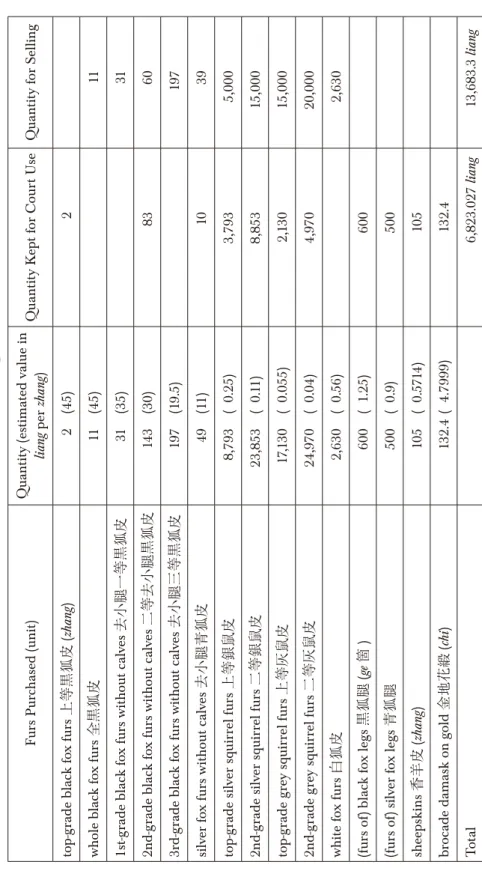
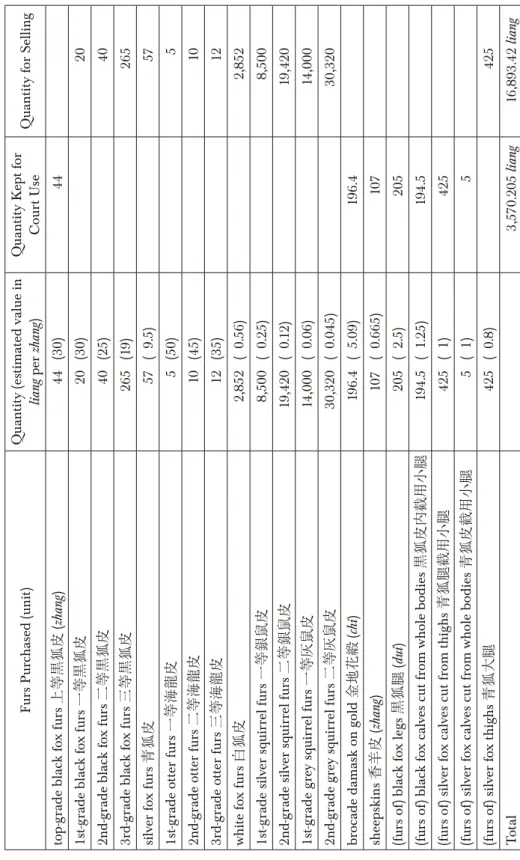
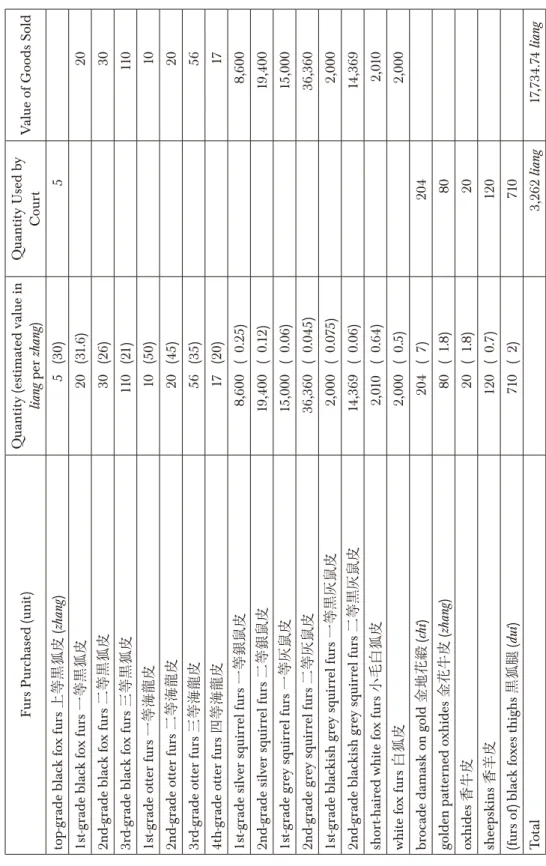
A framework for administering the caravans was also gradually put in place and became standardized. Information found in archival documents about the number of personnel, the amount of funding, the length of its stay in Kiakhta, and so on for each caravan has been summarized in Table A. Caravans generally arrived in Kiakhta in the tenth month and stayed until the second or third month of the following year, engaging in trade during this time.31) As mentioned, initially thirty Muslims accompanied the caravan, but because one died of illness during the second caravan in 1761–62, the next caravan had twenty-nine, and from the fourth caravan in 1763–64 the number was reduced to ten. When a caravan was sent again in 1768, following the suspension and resumption of the Kiakhta trade, their numbers were supplemented: “Among the Muslims who went previously, now only four remain in Beijing. Because this is not enough, we wish to select from among Muslims six more who are conversant in the language of Russia and able to do business and take ten with me.”32) But judging from the fact that their numbers subsequently fell again, it seems that even if vacancies arose, they were not filled. On the occasion of the first caravan the Imperial Household Department provided 10,000 liang, but from the second caravan onwards the sum was fixed at 20,000 liang (except in 1768–69). Further, initially funding was provided only in cash, and all the goods for trading were purchased at Zhangjiakou and elsewhere. But from the third caravan in 1762–63 a kind of brocade damask (Man. liyang hūwa suje) from the palace storehouses was provided together with cash.33)
Initially there were either one or two caravan leaders, and their number was not fixed. But from 1771–72 the number was fixed at two, with one being sent from the Imperial Household Department and one from the Board of Colonial Affairs. Furthermore, a system was adopted whereby as a rule the same person was sent in two successive years, with one of the two being replaced each year.34)
From the time of the first caravan the allowance given to the merchants remained unchanged at 10 liang per person, with an additional daily allowance of 2 qian for food. Depending on their rank, the caravan leaders were given preparation money ranging from 60 liang (bureau secretary) to 100 liang (bureau director [langzhong 郎中]) and a daily allowance ranging from 6 qian to 1 liang.
As for means of travel and transportation, relay stations were used from Beijing to Zhangjiakou, and the horses, camels, and so on used from Zhangjiakou onwards were provided by the commander-in-chief of Chahar. When animals became exhausted en route, they were replaced at Küriy-e. Tents, pots, and
OfficialsNumber of MuslimsFundingDate of Arrival at Kiakhta (yy/mm/dd)*Date of Departure from KiakhtaRemarks Liobooju (bureau vice director)3010,000 liang25/08/2226/03/011,500 liang added from goods carried by Fan QingzhuKimboo (vice overseer) Kimboo (bureau vice director)3020,000 liang26/11/1?27/03/middle ten days Fafuri (bureau secretary)2920,000 liang27/10/1528/02/16 Kimboo (bureau vice director)1020,000 liang28/10/0629/03/last ten days Kimboo (bureau vice director)1040,000 liang34/04/03 (date of commencement of trade)24/05/09 Fafuri (bureau director)?20,000 liang34/10/2235/03/25 Bandarša (bureau director) Bandarša (bureau director)920,000 liang35/10/1636/03/13 Bandarša (bureau director)820,000 liang36/10/2737/03/19 Taipingga (bureau vice director) Taipingga (bureau vice director)820,000 liang37/11/0338/03/03 Haišao (bureau vice director) Haišao (bureau director)820,000 liang38/10/1339/02/21 Lunghing (bureau vice director) Lunghing (bureau vice director)8?20,000 liang**39/10/1340/02/11 Heidase (bureau vice director) Bandarša (bureau director)8?20,000 liang42/10/1543/03/13 Baši (bureau director)
Table A: Government Caravans Sent from Qianlong 25 (1760) to 43 (1778) * According to the lunar calendar **According to Lai Huimin (op. cit., p. 106), the funding for this year was 15,904 liang. But in the relevant Manchu Lufu zouzhe it is stated that 800 bolts of brocade damask and more than 15,900 liang of silver were received from the palace storehouses (Lufu zouzhe 2589-51 / 103-1282, report of Lunghing [Qianlong 39/7/26]), and so it may be assumed that the total amount of funding came to 20,000 liang.
Purchased Items1760–61 (Qianlong 25–26)1761–62 (Qianlong 26–27)1762–63 (Qianlong 27–28)1763–64 (Qianlong 28–29) cikiri boro dobihi226300 黒狐青狐皮190 zhang張589 zhang hailun41 šanyan ulhu13,90018,150 銀鼠皮61,668 zhang44,400 zhang cikiri boro dobihi fatha103 dui対 boro dobihi i fatha252 dui 黒狐青狐腿618 dui 灰鼠皮4,000 zhang10,000 zhang 猞狸猻皮19zhang suwayan yacin fulgiyan safiya140 勲羊皮 (yellow, red, black)196 zhang suwayan fulgiyan sahaliyan safiya300 香羊皮 (yellow, red, black)118 zhang 黒細羊皮60 zhang kara mejin jafu5 zhengkuai整塊1,451 chi尺 8 cun寸 (in Russian foot) 哆囉呢 (red, black, blue)10kuai塊 (427 chi 12cun in Muslim foot) 洋氈 (red, green, blue)10kuai (406 chi) 金花牛皮50 zhang aisin ilhai bulgar76 香牛皮 (red, black)20 zhang aisin sese i ilha noho suje1 kuai (32 chi)394 chi 8½ cun (in Russian foot) menggun sese i ilha noho suje1 kuai (10 chi) 襍色地金銀花緞14kuai, large and small (222 chi 7 cun in Muslim foot) 金銀花緞5 kuai (38 chi 15cun) aisin menggun sese akū ilha noho suje1 kuai (40 chi) aisin tonggo70 ba把 menggun tonggo14 aisin tonggo i hiyatame araha šentu8 liang 5 qian
Table B: Items Purchased by Government Caravans from 1760 (Qianlong 25) to 1764 (Qianlong 29)
Purchased Items1760–61 (Qianlong 25–26)1761–62 (Qianlong 26–27)1762–63 (Qianlong 27–28)1763–64 (Qianlong 28–29) cikiri boro dobihi226300 黒狐青狐皮190 zhang張589 zhang hailun41 šanyan ulhu13,90018,150 銀鼠皮61,668 zhang44,400 zhang cikiri boro dobihi fatha103 dui対 boro dobihi i fatha252 dui 黒狐青狐腿618 dui 灰鼠皮4,000 zhang10,000 zhang 猞狸猻皮19zhang suwayan yacin fulgiyan safiya140 勲羊皮 (yellow, red, black)196 zhang suwayan fulgiyan sahaliyan safiya300 香羊皮 (yellow, red, black)118 zhang 黒細羊皮60 zhang kara mejin jafu5 zhengkuai整塊1,451 chi尺 8 cun寸 (in Russian foot) 哆囉呢 (red, black, blue)10kuai塊 (427 chi 12cun in Muslim foot) 洋氈 (red, green, blue)10kuai (406 chi) 金花牛皮50 zhang aisin ilhai bulgar76 香牛皮 (red, black)20 zhang aisin sese i ilha noho suje1 kuai (32 chi)394 chi 8½ cun (in Russian foot) menggun sese i ilha noho suje1 kuai (10 chi) 襍色地金銀花緞14kuai, large and small (222 chi 7 cun in Muslim foot) 金銀花緞5 kuai (38 chi 15cun) aisin menggun sese akū ilha noho suje1 kuai (40 chi) aisin tonggo70 ba把 menggun tonggo14 aisin tonggo i hiyatame araha šentu8 liang 5 qian
other articles used beyond the border were held in storage at Zhangjiakou, and if they became worn out or were damaged, they were replaced. The allowances for merchants and officials and expenses for their utensils and so on were defrayed from the 20,000 liang of funding.35)
II. 2. Trade Items and Their Quantities
As regards the goods sold by government caravans to the Russians, we have only a vague idea that damask and the like were the main such goods, and details are unclear. But details of the goods purchased from the Russians are known to some extent, and Table B lists the items purchased by the first four caravans in 1760–64.36) Because there is a mixture of Manchu and Chinese source materials and the way of referring to the same article may vary from year to year, it is difficult to identify with certainty the items purchased each year, but items thought to be by and large the same or similar are lumped together.
Judging from the above table, the main items purchased were furs, but there were not many varieties, and they consisted chiefly of furs of the black fox (heihu pi
黒狐皮; Man. sahaliyan dobihi), silver or blue fox (qinghu pi 青狐皮;
Man. cikiri boro dobihi), and white or silver squirrel (yinshu pi
銀鼠皮; Man.
šanyan ulhu). Apart from furs, sheepskins (safiya) and oxhides (bulgar) also accounted for a certain proportion of purchased items. As regards gold and silver brocade damask (jinyin huaduan
金銀花緞; Man. aisin / menggun sese ilha
noho suje), this is known to have been a commodity in which the Qianlong emperor took a strong interest, for when the first caravan was en route to Kiakhta he sent the following instructions: “When going to Kiakhta and trading with Russia on this occasion, it is important to obtain Russian gold-embroidered silk (altan basy suje). The more that can be obtained, the better.”37) The prices of purchased items and how they were disposed of are discussed in section IV below.II. 3. Government Caravans and the Suspension of the Kiakhta Trade The dispatch of government caravans was becoming a regular event, but as a result of disputes about the border fence built by the Russians in the vicinity of Kiakhta and their levying of customs duties the suspension of the Kiakhta trade began to be discussed. I have examined this issue elsewhere,38) and the decision to suspend trade was finalized on the 4th of the sixth month in 1762 when the Qianlong emperor ratified a memorial submitted by the
Council of State. However, soon afterwards, on the 18th of the same month, the Council of State discussed sending a government caravan as in previous years and submitted a memorial to this effect, and the emperor issued an edict ordering them to act accordingly.39) Consequently, Sangjaidorji in Küriy-e was at a loss as to whether or not he should allow the government caravan to pass through and sent an unofficial letter of inquiry.40)
A government caravan was also sent in the 1763–64 season. At the time, preparations for closing the market in Kiakhta were proceeding apace, and private merchants had for the most part left, with only staff to keep watch over the shops remaining. Then, on the 12th of the ninth month in 1763 the Qianlong emperor gave the following instructions to Fude, Grand Minister Superintendent (banshi dachen 辦事大臣) of Küriy-e: “Since our Bederge Muslims for this year have already departed, at all events it would be best, once they have finished trading and returned, to gather all the merchants watching over the buildings there [in Kiakhta] and send them back.”41) Judging from these exchanges, it would seem possible to infer that, if at all possible, the Qianlong emperor did not want to stop sending government caravans. In this fashion, the government caravan alone continued trading until the end of the third month in 1764, and with the completion of its business the Kiakhta trade finally ceased completely.
After having been suspended for about four years, the Kiakhta trade was to be resumed after the signing of the Addendum to the Treaty of Kiakhta in the ninth month of 1768. But on the 16th of the seventh month, when negotiations were still underway in Kiakhta, Ingliyan 英廉, Grand Minister of the Imperial Household Department, and others were already submitting a memorial concerning the resumption of government caravans, and this was approved by the emperor. On the expectation that “Their goods will have all accumulated. They will certainly have many goods that they have brought to trade,” the funding on this occasion was doubled to 40,000 liang.42) This shows that the desire to operate government caravans had not changed even with the suspension of trade.
III. The 1763 “Obstruction of Trade” Incident III. 1. The Origins of the Incident
In 1763 there occurred an interesting incident concerning the relationship between government caravans and private merchants. A succinct account of this incident is recorded in the Gaozong shilu,43) but far more detailed information appears in archival sources, and it is possible to reconstruct the incident more
or less in its entirety.
The incident had its origins in instructions given in the fourth month of 1763 by the Board of Colonial Affairs to Sangjaidorji and Fude in Küriy-e to conduct an investigation of bureau secretary Bayungtai, an official stationed in Kiakhta who was suspected of wrongdoing,44) although it is not stated how the Board of Colonial Affairs obtained its information. In response to these instructions, on the 6th of the fifth month Sangjaidorji and Fude submitted a memorial in which they enumerated various misdeeds committed by Bayungtai, including the fact that he had sent anew for merchants from Küriy-e to come to Kiakhta despite the decision to suspend trade and that he had let merchants without a certificate (zhizhao 執照) enter the market in Kiakhta. Their memorial also included the following passage:
Furthermore, when Bederge Muslims engage in trade at Kiakhta, some Chinese called Siyoo Yuwan Dz and Ging Jang were found by the Bederge Muslims to have secretly incited Russians behind the scenes, causing the Bederge Muslims’ trade to stall, to have bought furs before the Muslims, having paid an increased price, and to have also secretly bought some from Russians, and they were apprehended by the Muslims and handed over to Bayungtai to be dealt with.45)
The Qianlong emperor was quick to respond, giving instructions that Bayungtai be immediately summoned to Küriy-e for questioning. As for the private merchants said to have obstructed the business dealings of the Muslim merchants, he gave orders that they be immediately located, arrested, and sent to the Ministry of Justice (xingbu 刑部).
The crime of the merchants Siyoo Yuwan Dz and Ging Jang, who, in spite of being from China proper, of all things, incited Russians behind the scenes, causing the trade of the Bederge Muslims sent from China proper to stall, is most despicable. It would be best to leave this matter, too, to Sangjaidorji and Fude, and be sure to arrest them both, dispatch outstanding personnel to watch over them carefully en route to Beijing, have the Ministry of Justice conduct a thorough investigation, and punish them severely. On no account are they to be allowed to escape.46)
On the 18th of the fifth month, the emperor left Beijing for his Mountain Villa to Escape the Heat in Rehe 熱河 (Bishu Shanzhuang 避暑山荘), and the following day he issued another edict with orders for the merchants, once
arrested, to be sent directly to Rehe rather than to Beijing and for ministers of the Council of State to conduct the investigation. It was most unusual for ministers of the Council of State to take charge of the investigation of a case that would not seem to have been of any great importance, and this gives an indication of the emperor’s extraordinary interest in the matter. This was followed by a report from Sangjaidorji stating that the incident had occurred the previous year and many of the private merchants involved had already left Kiakhta, whereupon Barpin 巴爾品, commander-in-chief of Chahar, and also the governor-general (zongdu 総督) of Zhili 直隷 and the governor (xunfu 巡撫) of Shanxi 山西 were instructed to conduct investigations.
Some information about the private merchants Siyoo Yuwan Dz and Ging Jang can be gleaned from a report submitted by Heqizhong 和其衷, the governor of Shanxi, to the Council of State, according to which:47)
There is no Xiaoyuanzi or Jingzhang among the merchants of Zhangjiakou.
But we found out that Zhao Yue, a merchant of Wanshengyong Company, is called Xiaoyuanzi by others. According to his testimony, he is from Fenyang county in Fenzhou prefecture. He himself never passed through the gate in the Great Wall to trade, but his clerks Zhang Zongxuan and Tian Chang left one after another in the seventh and ninth months of last year to trade at Kiakhta. Later another employee, Dong Bingxin, also followed them to Kiakhta. Others call his company Xiaoyuanzi. We also found out that Zhang Chaoyuan of Hengyuyu Company was formerly engaged in trade in Beijing and came from Changping prefecture, and so others call him Jingzhang.
張家口商民内並無小院子,京張其人,惟査有萬盛永記舗内商民趙 越,人皆称為小院子。訊供,係汾州府汾陽縣人,伊並不出口貿 易,惟伊夥記張宗烜、田昌于去年柴月玖月間先後往恰克圖貿易。
又僱工董秉信續往恰克圖,舗中亦人称為小院子等語。再査恒裕玉 記舗内張朝元向在京城貿易,係昌平州人,是以人俱称為京張。
It turns out that Siyoo Yuan Dz (Xiaoyuanzi 小院子) was a store properly called Wanshengyong 萬盛永 run by the merchant Zhao Yue 趙越 in Zhangjiakou, and on questioning Zhao Yue, it was found that the previous year his clerks Zhang Zongxuan 張宗烜 and Tian Chang 田昌 and another employee named Dong Bingxin 董秉信 had gone to Kiakhta to conduct trade.
In addition, Ging Jang (Jingzhang 京張) referred to Zhang Chaoyuan 張朝元 of a store called Hengyuyu 恒裕玉.
Next, the county magistrate (zhixian 知県) of Fenyang 汾陽 county tracked down Dong Bingshu 董秉恕, an older clan cousin of Dong Bingxin and also a clerk at the Wanshengyong, and on being questioned, he provided the following testimony.
Dong Bingshu testified: “I work as a clerk at Wanshengyong Company in Zhangjiakou. Together with three colleagues—my younger clan cousin Dong Bingxin, Zhang Zongxuan, and Tian Chang—I have been engaged in trade with Russians at Kiakhta. Our company is located in a place called Xiaoyuanzi, and so others call us Xiaoyuanzi. I serve as a group leader at Kiakhta. I returned to Zhangjiakou in the eleventh month of the twenty-second year of the Qianglong reign, arrived in Beijing in the twelfth month, and returned home in the second month of this year after selling all our goods. My three colleagues Zhang Zongxuan, Tian Chang, and Dong Bingxin remained in Kiakhta during this time. As for bartering our goods with the Russians, in former times we were able to exchange goods as soon as they arrived. Last year, Muslims wearing red caps brought goods from China proper for trading with the Russians, and so we were allowed to barter only after the red-capped Muslims had finished trading, as a result of which we wasted some days. Then many merchants asked the local officer to allow them to enter the market for bartering first, and I too went to make a request. I do not know why the Russians did not trade with the Muslims and who incited them. Jingzhang is a man from Changping prefecture, and it is true that I am acquainted with him.”
拠董秉恕供称,小的在張家口萬盛永記趙越舗内做夥計。小的與族 弟董秉信並張宗烜,田昌肆人都在恰克圖與俄羅斯交易。開舗地方 名小院子,所以人都称小的們為小院子。小的在恰克圖當了甲頭。
乾隆貮拾柒年拾壹日(sic)従恰克圖回至張家口,拾貮月内至京師賣 貨,本年貮月内回家。張宗烜,田昌,董秉信三人此時尚在恰克 圖。至小的們駄了貨物與俄羅斯交易,向来原是貨到即換的。去年 有戴紅帽的回子也従裡頭帯了貨物與俄羅斯貿易,須俟紅帽回子換 畢後再許小的們易換,以致躭擱日子,各商民求那裡的官要先進去 易換,小的也曽去求過。至俄羅斯怎様不與回人貿易,何人教唆,
小的不知道。京張係昌平州人,小的亦與他認識是實等語。
Worth noting is the fact that Dong Bingshu states that “red-capped Muslims” were given priority when trading at Kiakhta, during which time private merchants were kept waiting, and the private merchants had therefore
lodged a petition with officials at Kiakhta, asking to be able to start trading earlier. However, he also states that he did not know who had inveigled the Russians into not trading with the Muslim merchants.
Meanwhile, in the sixth month, following a manhunt in the area between Kiakhta and Zhangjiakou, Ging Jang (Zhang Chaoyuan), Zhang Zongxuan, etc., of the Xiaoyuanzi were arrested by the Grand Minister Superintendent of Küriy-e, while Tian Chang and Dong Bingxin were arrested by the commander- in-chief of Chahar, and they were all sent to Rehe.48)
III. 2. The Interrogation of Bayungtai
Bayungtai arrived at Küriy-e on the 20th of the sixth month, and he was immediately interrogated by Sangjaidorji and Fude. There were three main points at issue during his interrogation: (1) despite instructions to suspend trade having been issued, Bayungtai sent for private merchants from Küriy-e to come to Kiakhta and allowed merchants detained at watch-posts (karun [kalun
卡倫]) to proceed to Kiakhta; (2) the private merchants Siyoo Yuwan Dz and
Ging Jang had incited the Russians to obstruct the trading activities of the Bederge Muslims and had also bought furs without authorization and at high prices; and (3) private merchants had secretly bought horses from the Russians.With regard to the first point, Bayungtai admitted having sent a letter to Küriy-e asking for merchants to be sent to Kiakhta and having allowed private merchants who had attempted to skirt around watch-posts or pass through them without a certificate to enter Kiakhta, but he denied having received any bribes for having done so. With regard to the second point, he provided the following testimony:
With regard to the fact that Siyoo Yuwan Dz, i.e., Dung Bing Šu, attempted to go to the border (i.e., Great Wall) and bought grey squirrel [furs] at a high price, I immediately summoned all the Chinese, beat and reprimanded him in front of everyone, and notified all the merchants that never again were they to increase prices arbitrarily in this way and do trade. The Bederge Muslim Isgak reported that he had happened to see Jang Coo Yuwan secretly buy twenty otter furs, two bundles of sable pelts, fox furs, and so on, and so I, Bayungtai, set a watch on Jang Coo Yuan and, having sealed the articles that he had brought, contacted the ministers because I did not know how to deal with the matter. They gave orders saying, “It would be best for you to conclude the matter by taking into consideration bureau secretary Fafuri’s handling of such matters,” and so
I confiscated all of his share (hūsun ufuhi) of 18,000 great tugurik and gave 2,000 tugurik to the Bederge Muslim Isgak. The remaining 16,000 small tugurik I entrusted to group leader (jiatou 甲頭) Yang Šeng Cu to provide for repairing the government office, and they are currently in safekeeping.
Jang Coo Yuwan was put in shackles for one month and received thirty blows with a cudgel. These two [Dung and Jang] have never obstructed the Bederge Muslims. I, Bayungtai, dealt with them in the presence of Fafuri, who had escorted the Muslims, and so he also knows about this.49) Thus, Bayungtai admitted that he had punished Xiaoyuanzi (i.e., Dong Bingshu) for having bought grey squirrel furs at a high price and that he had punished Zhang Chaoyuan (Ging Jang) because the Muslim Isgak50) had discovered him buying various kinds of furs without declaring them to the authorities, but he denied that private merchants had incited the Russians to obstruct the trading activities of the government caravan.51) Following on from this interrogation, Bayungtai was subjected to further investigation at Rehe,52) but it is not known what sort of punishment he ultimately received, for there are no relevant records in the Lufu zouzhe, etc.
III. 3. Investigations at Rehe and the Ultimate Outcome
Among the private merchants who had been arrested, Zhang Chaoyuan, Tian Chang, and Dong Bingxin, who arrived first in Rehe, were interrogated by ministers of the Council of State,53) and Zhang Chaoyuan (Ging Jang) testified as follows:
In the seventh month of last year, I went to Kiyaktu together with Lii Šeng Ging, and in the first month of this year we bought two hundred Russian lambskins (Man. honin deberen i sukū), more than twenty ordinary otter furs (Man. arsari hailun sukū), and two lynx furs, whereupon bureau secretary Fafuri, who had gone to trade at the head of a party of Muslims, suspecting that we had probably purchased black fox [furs] in secret, came to our store and searched it, but because none of the goods were articles that were being purchased by the government, he did not punish us. Later Bayungtai, claiming that we had not submitted any report regarding the furs and other articles we had bought, arrested us, placed us in shackles for more than twenty days, gave us twenty blows with a board, and also levied 120 liang of silver, and we handed the silver over to Bayungtai. It is a fact that we never bought any articles that the government buys, and
also that we never incited the Russians to cause the government’s trade to stall.
In other words, he rejected as unfounded the charge that they had obstructed the government caravan’s trade. In addition, Tian Chang of the Xiaoyuanzi testified as follows:
In the ninth month, I arrived in Kiyaktu together with government merchants. When I arrived there, I traded for about a month together with Dung Bing Šu and Jang Dzung Siowan and bought more than one hundred thousand grey squirrel (?) (Man. yacin ulhu) [furs], which Dung Bing Šu took and returned ahead of us. We two stayed there and further bought more than ten thousand lambskins, more than three hundred oxhides, and more than one thousand furs of poor quality. After the Muslims returned on the 26th of the second month, in the third to fourth months woollen cloth (Man. hara mejin; Ch. duoluoni 哆羅呢) was brought from Russia. Because official transactions had already ended by this time, we bought thirty-seven pieces. We bought all of these items after I had submitted reports.… While the Muslims were there, we never bought any items that the government buys. On no account did we dare to incite Russians to cause the official trade to stall, nor were we apprehended by Muslims for having secretly bought things and turned over to Bayungtai.
There are actually bureau secretary Fafuri and thirty Muslims [as witnesses]. If you ask them, there should be no mistake. This is all the true situation.
Having thus been unable to obtain any confession that private merchants had obstructed the government caravan’s trading activities, the ministers of the Council of State instructed Fafuri, who had led the government caravan, to report in person to Rehe together with representatives of the Muslims, and upon their arrival they were questioned by the ministers.54) Fafuri testified as follows:
When I was trading at Kiyaktu last year, I never heard that our merchants had incited the Russians. The Muslims never notified me of any such thing, nor did I apprehend any merchants and turn them over to Bayungtai.
At the end of last year, the Muslim Isek came and told me, “More than ten Russian pack-horses have secretly come and gone to Jang Coo Yuwan’s store,” and so several days later, thinking that Jang Coo Yuwan had