3D direction display bracelet for wearable system
Atsutomo Kobayashi, Buntarou Shizuki, and Jiro Tanaka
Department of Computer Science, University of Tsukuba
Tennodai 1-1-1 , Tsukuba, Ibaraki, Japan {atsutomo, shizuki, jiro}@iplab.cs.tsukuba.ac.jp
Abstract
We have developed the information display device that displays three-dimensional direction to a target object with vibration and light for wearable systems. The device can present only two- dimensional direction naturally, but the user can know three-dimensional direction by keeping the vibration and light to relative direction according to the user’s wrist posture. The applications for this device are navigation system in complex buildings such as hospitals and libraries, lost prevention system for children, presenting the direction to people or dangerous objects around robot suite user, etc.
keywords: tactile display, wearable, user interface,
1 INTRODUCTION
We have developed a bracelet type information display device for displaying three-dimensional direction to a target object with vibration and light for wearable systems.
Before we prototype the display, we conduct a preliminary experiment to examine characteristics of three stimuli, light from LEDs, tactile sensation, and visuals from head mounted display. As a result of the experiment, we found that tactile sensation is the most noticeable than the three stimuli[3]. From the result of the experiment, we employ vibration motor for notifying approximate direction, and LEDs for present detail direction. The user can sense vibration without glance and sense light more clearly than vibration. The user can know the direction roughly without glance and more correct direction with looking the device.
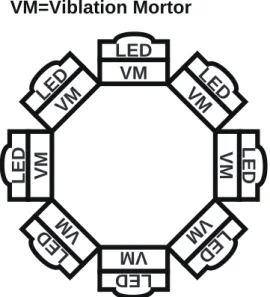
The device is formed as a bracelet so that the user attaches on his or her wrist and consists of display part and wrist posture sensing part. On the display part, eight vibration motors and eight LEDs are attached along ring shape to present vibration and light. Figure 1 describes how the vibration motors and the LEDs are layouted. The wrist posture sensing part detects the user’s wrist posture from tilt, direction and position of the device. The device uses the posture information to calculate and to present relative direction to the target object. Even though the device can present only two-dimensional direction statically, the user can sense three-dimensional direction by that the device keeps presenting relative direction according to the user’s movement. We believe that natural movement on daily life is enough to let user know the three-dimensional direction.
The device can present only two-dimensional direction naturally, but the user can know three- dimensional direction by keeping the vibration and light to relative direction according to the user’s wrist posture. The applications for this device are navigation system in complex buildings such as hospitals and libraries, lost prevention system for children, presenting the direction to people or dangerous objects around robot suite user, etc.
LED VM LED
VM
L ED VM L ED VM
LED VM
VM LED LED VM
VM LED VM=Viblation Mortor
Figure 1: The layout of the vibration motors and the LEDs.
2 Related Work
Several actuators are used as tactile display, foexample, pin-array[5], low frequency speaker [2], etc.
Barralon et al. developed similar tactile display to our work[1]. However, our system senses the posture of user’s wrist and adjust stimuli according to the posture. Lee et al.[4] developed a bracelet type tactile display and interaction method using hand gesture. Our approach uses natural movement of wrist instead of hand gesture.
There are several personal navigation systems that present map or geological information on head mounted display or small screen on personal digital assistance or smart phone. Our device can navigate the user without occluding his or her sight while maneuvering. ActiveBelt [6] by Tsukada et al. is the belt type device that presents two-dimensional direction with vibration. Our system can display three-dimensional direction by user’s movement.
3 3D direction display
We implemented the first protype of the 3D direction display. We employed a band made of elastic cloth as base of the bracelet. The elasticity enable the bracelet to fit user’s wrist tight and to convey biveration from the viberation mortors efficiently.
We employed LilyPad viberation mortors as viberation mortors. LilyPad series are series of sensors, actuators and microcontrollers for prototyping wearables and e-textiles. Figure 2 shows a LilyPad viberation mortor and 100 yen coin for size comparison.
Figure 2: LilyPad viberation mortor. Figure 3: BlinkM MinM.
Figure 4 shows the elastic band with eight viberation mortors attached. The viberation mortors are disigned to be wired with conductive thread though, we used electrical cables from strength and elasticity reasons. The viberation mortors are controled with I2C interface through a multiplexer.
Figure 4: This is the caption.
As LEDs, we employed BlinkM MinM, becase of it’s size and it’s features that are handy for prototype implementation. Figure 2 shows a BlinkM MinM and 100 yen coin for size comparison. BlinkM MinM is small full color LED with I2C interface and micro controller.
4 Presenting Models
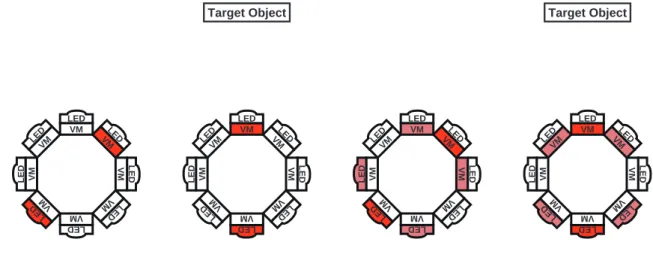
The several presenting models are available with this device. The simplest style is the pointing model which drives the vibration motor and LED that are the directed to the target object. The second style is the diffused reflection model which supposes the target object is a light source, and calculate reflected luminous intensity from the direction of each vibration motors and LEDs. Figure 5 and Figure 6 illustlate the pointing model and the diffused reflection model each. The red color indicate driven actuators and color depth indicate intensity to drive. Also we considered the combinations which apply these models for vibration motors and LEDs, since we employed two stimulus, vibration and light that have different characteristics.
LED VM LED
VM
LED VM LEDVM
LED VM
VMLED LEDVM
VM LED LED
VM LED
VM
LED VM LEDVM
LED VM
VMLED LEDVM
VM LED
Target Object
Figure 5: Pointing Model.
LED VM LED
VM
LED VM LEDVM
LED VM
VMLED LEDVM
VM LED LED
VM LED
VM
LED VM LEDVM
LED VM
VMLED LEDVM
VM LED
Target Object
Figure 6: Diffused Reflection Model.
5 Conclusion and Future Work
We have deveroped a bracelet type information display for displaying three-dimensional direction. The display can present three-dimensional direction by reflecting the posture of user’s wrist.In this paper,
we discussed about presenting models of this device. Imprementation of wrist posture sensing part and formal user study is remaiond as future work.
REFERENCES
[1] Pierre Barralon, Ginna Ng, Guy Dumont, Stephan K. W. Schwarz, and Mark Ansermino. Devel- opment and evaluation of multidimensional tactons for a wearable tactile display. InProceedings of the 9th international conference on Human computer interaction with mobile devices and services, MobileHCI ’07, pages 186–189, New York, NY, USA, 2007. ACM.
[2] Yuki Hashimoto, Satsuki Nakata, and Hiroyuki Kajimoto. Novel tactile display for emotional tactile experience. InProceedings of the International Conference on Advances in Computer Enterntainment Technology, ACE ’09, pages 124–131, New York, NY, USA, 2009. ACM.
[3] Atsutomo Kobayashi, Buntarou Shizuki, and Jiro Tanaka. Evaluation of information presentation styles for wealable computing. InProceedings of the 72nd National Convention of IPSJ, volume 3, pages 71–72, 2010.
[4] Seungyon Claire Lee and Thad Starner. Mobile gesture interaction using wearable tactile displays. In Proceedings of the 27th international conference extended abstracts on Human factors in computing systems, CHI ’09, pages 3437–3442, New York, NY, USA, 2009. ACM.
[5] Heesook Shin, Misook Sohn, and Junseok Park. A design of cell-based pin-array tactile display.
InProceedings of the 2005 international conference on Augmented tele-existence, ICAT ’05, pages 251–252, New York, NY, USA, 2005. ACM.
[6] Koji Tsukada and Michiaki Yasumura. ActiveBelt: Belt-Type Wearable Tactile Display for Di- rectional Navigation. In Nigel Davies, Elizabeth Mynatt, and Itiro Siio, editors, UbiComp 2004:
Ubiquitous Computing, volume 3205 of Lecture Notes in Computer Science, chapter 23, pages 384–
399–399. Springer Berlin / Heidelberg, Berlin, Heidelberg, 2004.