分担研究報告書
The associations between prenatal phthalate exposure and cryptorchidism: The Hokkaido Study in Environment and Children's Health
研究代表者 岸 玲子 北海道大学環境健康科学研究教育センター 特別招へい教授 研究分担者 篠原 信雄 北海道大学大学院医学研究科腎泌尿器外科 教授
研究分担者 松村 徹 いであ株式会社 環境創造研究所 常務取締役
研究要旨
Phthalates are chemicals used as plasticizers for polyvinyl chloride, food packaging, cosmetics, personal care products and known endocrine-disrupting effects in rodents.
epidemiologic studies of male reproductive disorders such as cryptorchidism and hypospadias using measurements of prenatal or postnatal phthalate levels have been reported, however, in regards to the relationship to prenatal exposure to phthalates is very limited and the results are contradictory. The aim of this study is to investigate potential effects of prenatal phthalate metabolite levels on the occurrence of cryptorchidism in the Hokkaido Study on Environment and Children’s Health. This prospective birth cohort study was based on the Hokkaido large-scale cohort, the Hokkaido Study on Environment and Children’s Health. We selected 63 cryptorchidism cases and 126 controls based on the birth records and the questionnaires at aged 1, 2, 4, and 7 years old. Controls were 1 to 2 (1 : 2) matched for delivery year ± 1 year and their delivery hospitals. Seven phthalate metabolites were measured from first trimester maternal blood using ultra-performance liquid chromatography tandem mass spectrometry (UPLC-MS-MS) instrumentation. Cox logistic regression analyses were performed to evaluate associations between prenatal exposure to phthalates and the risk of cryptorchidism. There were no significant associations were observed between cryptorchidism and phthalates metabolite levels, however, a borderline significance was found in the level of MECPP. Prenatal exposure to phthalates did not show adverse effects on cryptorchidism. This was the first study of investigating prenatal phthalates exposure and cryptorchidism in Japanese population. Previous studies also have been reported negative effects of prenatal phthalates exposure on cryptorchidism, continuous investigation is needed as further studies.
研究協力者
アイツバマイ ゆふ(北海道大学環境健 康科学研究教育センター)
A.研究目的
Phthalates are chemicals used as plasticizers for polyvinyl chloride, food packaging, cosmetics, personal care products and known endocrine-disrupting effects in rodents [1, 2]. Animal studies suggest that prenatal exposure to di-butyl
phthalate (DBP) and di-2-ethylhexyl phthalate (DEHP, and di-isononyl phthalate (DiNP) induce anti-androgenic effects on the male fetus. They alter Leydig cell differentiation and function and thus diminish fetal testosterone production and reduced anogenital distance [3-7].
Only three epidemiologic studies of male reproductive disorders such as cryptorchidism and hypospadias using measurements of prenatal or postnatal
分担研究報告書
phthalate levels have been reported, however, in regards to the relationship to prenatal exposure to phthalates is very limited and the results are contradictory; In
Danish study,
mono(2-ethyl-5-carboxypentyl) phthalate
(MECPP) and mono(4-
methyl-7-carboxyheptyl) phthalate (7cx-MMeHP) in maternal amniotic fluid were measured, however, neither di(2-ethylhexyl) phthalate (DEHP) nor di-isononyl phthalate (DiNP) was consistently associated with cryptorchidism and hypospadias [8]. In a prospective Danish–Finnish cohort study, 6 phthalate metabolites from 1–3 months postnatally breast milk sample were measured, however, no association has been reported between phthalate monoester levels and cryptorchidism [9]. In a prospective case – control study of 52 cryptorchidism and 128 control measured monobutyl phthalate (MBP) from breast milk sample 3-5 day after delivery and reported that concentrations were not significantly increased in the cryptorchidism case versus control group although a trend for increased MBP was observed [10].
The aim of this study is to investigate potential effects of prenatal phthalate metabolite levels on the occurrence of cryptorchidism in the Hokkaido Study on Environment and Children’s Health.
B.研究方法 Study population
This prospective birth cohort study was based on the Hokkaido large-scale cohort, the Hokkaido Study on Environment and Children’s Health [11, 12]. Study details regarding the population, data collection, sampling of biological specimens, and
contents of the questionnaire have been described previously [11, 12]. Briefly, native Japanese women living in Hokkaido were recruited in this study at <13 weeks of gestation at 37 hospitals and clinics in Hokkaido between February 2003 and March 2012. From a total of 20,929 pregnant women who were enrolled to The Hokkaido Study of Environment and Children's Health, we selected 19,183 mother-infant pairs who had a baseline questionnaire, birth records, and first trimester maternal blood. From these, we selected 63 cryptorchidism cases and 126 controls based on the birth records and the questionnaires at aged 1, 2, 4, and 7 years old. Controls were 1 to 2 (1 : 2) matched for delivery year
± 1 year and their delivery hospitals.
Assessments of prenatal exposure to phthalates
Seven phthalate metabolites, mono-n-butyl phthalate (MnBP), mono-iso-butyl phthalate (MiBP), mono-benzyl phthalate (MBzP), mono(2-ethylhexyl) phthalate (MEHP), mono(2-carboxymethyl-5-oxohexyl)
phthalate (MEHHP),
mono(2-ethyl-5-carboxypentyl) phthalate (MECPP), Mono (4-methyl-7-carboxyheptyl) phthalate (cx-MiNP) were measured from first trimester maternal blood. Maternal plasma was analyzed using ultra-performance liquid chromatography tandem mass spectrometry (UPLC-MS-MS) instrumentation (Waters, Tokyo, Japan).
Sample preparation
A 40 uL of hydrochloric acid (1M) was added to each maternal plasma sample (0.5 mL). Samples were mixed by vortexing and ultrasonic irradiated for 10 minutes. An internal standard, which consisted of 100
分担研究報告書
ng/mL of MEHP-d4, MiNP-13C4, MEHHP-13C4, MECPP-13C4, OH-MiNP-d4, cx-MiNP-d4 (100 ng/mL of each), 1100 uL of ammonium acetate buffer solution (100 mM, pH 9.0), and 10 uL of β- glucuronidase enzyme were added to each sample to deconjugate glucuronidated phthalate metabolites. The samples were gently mixed and incubated at 37 ℃ for 90 minutes.
After incubation, samples were extracted 300 uL into tube and added 900 uL of acetonitrile. The samples were mixed by vortexing to deproteine. After centrifugation (3,500 rpm for 5 min), 500 uL of supernatants were transferred into new tubes and dried under nitrogen gas. After drying, 250 uL of 20 % methanol was added and ultrasonic irradiated for 5 minutes and transferred to a glass sample vial insert.
Instrumental analysis
The reconstituted extract (10 uL) was injected into an ultra-performance LC (ACQUITY UPLC H-Class) coupled to triple quadrupole tandem MS (Xevo TQ-S) (Waters, Tokyo, Japan). The insoluble particulates were filtered by in-line filters (2.1×5 mm, 1.7 um, Vanguard BEH C8, Waters, Tokyo, Japan) preceding the BEH C8 column (2.1×100 mm, 1.7 μm, Waters, Tokyo, Japan).
The retention gap technique was used by installing retention gap columns Atlantis T3 (2.1×50 mm, 3 u, Waters, Tokyo, Japan), which improved phthalate metabolites sensitivity by trapping mobile-phase phthalate metabolites (contaminants) in the retention gap column. The column temperature was 40℃. The analytes were quantified using ESI-negative SRM mode with product/precursor ion scans unique for each analyte (Table 1). Analytes were eluted from the column with a linear gradient involving solvent A (2 mM ammonium
acetate in water) and solvent B (2 mM ammonium acetate in 95 % acetonitrile) as follows: 2 % B for the initial 1 min, then a gradient of 2 – 98 % B from 1 min to 16 min.
The total UPLC cycle time was 20 min including column re-equilibration. An eluent flowrate of 0.3 mL/min was employed for all analyses.
Data analysis
Because our data did not fall into a normal distribution, phthalate metabolites concentrations were converted to a natural log (Ln) scale. For participants with phthalate metabolites concentrations below the MDL, a value equal to half of the MDL was assigned for statistical analyses. We did not include MBzP, MEHHP, and cx-MiNP in the statistical analysis because these compounds were detected less than 50 %.
For analysis of correlations between the children with and without cryptorchidism and characteristics of mothers and infants, we used the Student’s t-test and the Chi-square test. To assess risk factors or protective factors for cryptorchidism, binominal logistic regression analyses were used. Crude and adjusted Cox logistic regression analyses were performed to evaluate associations between prenatal exposure to phthalates and the risk of cryptorchidism. In logistic models, we evaluated odds ratios (ORs) for the risk of cryptorchidism with Ln- transformed maternal phthalate metabolite levels. Multivariate analyses were adjusted for confounding variables that influenced cryptorchidism in univariate analyses, possible risk factors reported in previous studies. The fully adjusted model used logistic regression analysis of cryptorchidism adjusted for maternal age at
分担研究報告書
delivery, gestational week, parity, maternal education, smoking at early pregnancy, alcohol intake at early pregnancy, maternal BMI before pregnancy, and infant birth weight.
All statistical analyses were performed using the Statistical Package for Social Science (SPSS) for Windows, version 22.0 (SPSS, Inc., Chicago, IL, USA) and JMP Pro 12 Statistical Discovery Software for Windows (S.A.S. Institute Inc., Cary, North Carolina). Differences were considered statistically significant at p <
0.05.
Ethics
For this study, all participating women provided written informed consent, and the study protocol was approved by the institutional ethical board for epidemiological studies at the Hokkaido University Center for Environmental and Health Sciences.
C.研究結果
The characteristics of mother and infant are show in Table 1. There were no statistical significance relationships between cryptorchidism case and control on maternal age at delivery, gestational week, parity, maternal education, smoking at early pregnancy, alcohol intake at early pregnancy, maternal BMI before pregnancy, and infant birth weight, although the trend (p < 0.1) for maternal age at delivery and smoking at early pregnancy; mothers who were older and smokers at early pregnancy had higher prevalence of cryptorchidism.
The distributions of phthalate metabolites were shown in Table 2. MnBP, MiBP, MEHP, and MECPP were detected
more than 70 % of the samples. Most highly detected metabolite was MnBP, followed as MiBP, MEHP, MECPP.
The comparisons of median concentrations of phthalate metabolites were shown in Table 3. The level of MECPP, a second metabolite of DEHP, was lower in cryptorchidism than controls (p = 0.034).
Other metabolites were not obtained significant differences.
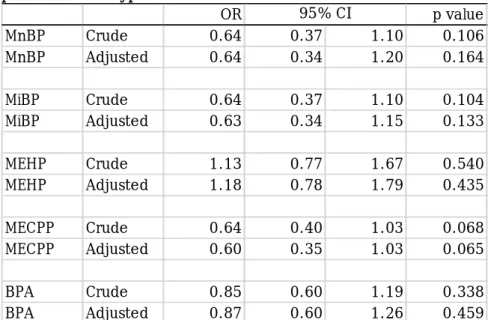
The Cox regression analysis of the associations between prenatal exposure to phthalates on cryptorchidism were shown in Table 4. There were no significant associations were observed between cryptorchidism and phthalates metabolite levels, however, a borderline significance was found in the level of MECPP (OR, 95%
CI: 0.60, 0.35 – 1.03; p = 0.065).
D.考察
This was the first study of investigating prenatal phthalates exposure and cryptorchidism in Japanese population.
We observed no consistent association between prenatal exposure to phthalates and the risk of cryptorchidism in Japanese populations of large scale birth cohort study.
However, a borderline inverse association was found between the level of MECPP and cryptorchidism. Similar findings have been reported from Denmark birth cohort study:
higher amniotic fluid levels of MECPP decreased the corresponding OR for cryptorchidism (p for trend = 0.54) [8]. Other two studies have measured postnatal phthalate levels and related it to the occurrence of cryptorchidism or hypospadias.
分担研究報告書
Main et al. (2006) reported that a study of 68 cryptorchidism cases and 62 controls observed no association between cryptorchidism and metabolites of DMP, DEP, DBP, BBzP, DEHP, and DiNP in breast milk, however, no consistent associations between prenatal phthalates exposure and cryptorchidism or hypospadias [9].
Chevalier et al. (2015) reported that concentrations of MBP from breast milk sample 3-5 day after delivery were not significantly increased in the cryptorchidism case versus control group although a trend for increased MBP was observed in a prospective case – control study of 52 cryptorchidism and 128 control [10].
Moreover, a nested in the EDEN and PELAGIE mother–child cohorts study has been reported inverse associations with maternal urinary phthalate metabolites [13].
Important limitations to these inconsistent interpretations are variations in the case definition, the analytical matrices, and the timing of exposure assessment. Jensen et al.
(2015) measured phthalate levels in amniotic fluid from pregnant women who aged more than 35 years old or having high risk of pregnancy [8]. Therefore, study population in this previous study might differ from our population. Main et al. (2006) and Chevalier et al. (2015) measured phthalate levels from breast milk after their delivery [9, 10]. Considering the important time window of fetal masculinization, exposure assessments should be during the
first half of pregnancy. The findings from previous studies are still unclear, therefore, continuous investigations are needed.
Animal studies supported that prenatal phthalates exposure alter Leydig cell differentiation and function and thus diminish fetal testosterone production and showed cryptorchidism and reduced anogenital distance [3-7]. The exogenous administration of oestrogens during pregnancy results in increased incidence of cryptorchidism were supported by animal studies (Toppari et al., 1996). In this study, we did not investigate the associations between prenatal exposure to phthalates and hormone levels. We could not confirm the inverse relation between prenatal phthalates exposure and cryptorchidism. In contrast, we observed an unexpected decrease in the risk of cryptorchidism with increased concentrations of maternal phthalate metabolites, for which we have no clear explanation. Therefore, for further study, the associations with hormones such as testosterone, androstendione, and insulin- like factor-3 which is produced by fetal Leydig cells and acts on the gubernaculum of the testis which plays a key role in guiding the testis during its phase of transabdominal descent should be investigated in this study.
The limitations of this study need to be considered. In this study, we used serum for measurements of phthalate met abolites instead of urine. The disadvantage of using blood sample instead of urine, such as conversion from diester to monoester after blood sampling, have been considered [14, 15]. To avoid this conversion, we stored blood samples at -80℃ immediately and added acid to inhibit enzyme activity after defrosting samples. The use of a single
分担研究報告書
measure to classify exposure levels of phthalate exposure assessments is also one of our limitations. Since phthalates are known as short half-life compounds, exposure levels of phthalates might be varied during pregnancy. Repeated measurements are much appropriate.
However, we collected blood samples from first trimester of pregnancy, therefore, our time window of exposure assessment is suitable. The definition of cryptorchidism was based on birth records and the self-reported (mother) questionnaires, therefore some misclassifications might be happened. However, we collected most of cryptorchidism cases from birth records, which are diagnosed by medical doctors.
Therefore, we think the misclassifications are held to a minimum. Moreover, cryptorchidism cases appeared in this study might have been not enough to fill the statistical power to analyze the risk of prenatal exposure to phthalates on cryptorchidism, although we selected all cryptorchidism cases from large birth cohort, the Hokkaido Study on Environment and Children’s Health. Small sample size could be a possible reason for not observing association between prenatal phthalates exposure and cryptorchidism.
E.結論
In conclusion, prenatal exposure to phthalates did not show adverse effects on cryptorchidism. This was the first study of investigating prenatal phthalates exposure and cryptorchidism in Japanese population.
Previous studies also have been reported negative effects of prenatal phthalates exposure on cryptorchidism, continuous investigation is needed as further studies.
F.研究発表
1.
論文発表該当なし
2.学会発表
該当なしG.知的財産権の出願・登録状況(予定 を含む。)
該当なし
参考文献
1. Gray, T.J., et al., Species differences in the testicular toxicity of phthalate esters. Toxicol Lett, 1982. 11(1-2): p.
141-7.
2. Martino-Andrade, A.J. and I. Chahoud, Reproductive toxicity of phthalate esters. Molecular Nutrition & Food Research, 2010. 54(1): p. 148-157.
3. Gray, L.E., et al., Administration of potentially antiandrogenic pesticides (procymidone, linuron, iprodione, chlozolinate, p,p '-DDE, and ketoconazole) and toxic substances (dibutyl- and diethylhexyl phthalate, PCB 169, and ethane dimethane sulphonate) during sexual differentiation produces diverse profiles of reproductive malformations in the male rat. Toxicology and Industrial Health, 1999. 15(1-2): p. 94-118.
4. Gray, L.E., et al., Perinatal exposure to the phthalates DEHP, BBP, and DINP, but not DEP, DMP, or DOTP, alters sexual differentiation of the male rat.
Toxicological Sciences, 2000. 58(2): p.
350-365.
5. Mylchreest, E., R.C. Cattley, and P.M.D.
Foster, Male reproductive tract malformations in rats following
分担研究報告書 gestational and lactational exposure to
di(n-butyl) phthalate: An antiandrogenic mechanism?
Toxicological Sciences, 1998. 43(1): p.
47-60.
6. Mylchreest, E., et al., Disruption of androgen-regulated male reproductive development by Di(n-butyl) phthalate during late gestation in rats is different from flutamide. Toxicology and Applied Pharmacology, 1999. 156(2): p. 81-95.
7. Kurahashi, N., et al., The effects of subacute inhalation of Di (2-ethylhexyl) phthalate (DEHP) on the testes of prepubertal Wistar rats. Journal of Occupational Health, 2005. 47(5): p.
437-444.
8. Jensen, M.S., et al., Amniotic fluid phthalate levels and male fetal gonad function. Epidemiology, 2015. 26(1): p.
91-9.
9. Main, K.M., et al., Human breast milk contamination with phthalates and alterations of endogenous reproductive hormones in infants three months of age.
Environmental Health Perspectives, 2006. 114(2): p. 270-6.
10. Chevalier, N., et al., A negative correlation between insulin-like peptide 3 and bisphenol A in human cord blood suggests an effect of endocrine disruptors on testicular descent during fetal development. Hum Reprod, 2015.
30(2): p. 447-53.
11. Kishi, R., et al., Ten years of progress in the Hokkaido birth cohort study on environment and children's health:
cohort profile--updated 2013. Environ Health Prev Med, 2013. 18(6): p. 429-50.
12. Kishi, R., et al., The Association of Prenatal Exposure to Perfluorinated Chemicals with Maternal Essential and
Long-Chain Polyunsaturated Fatty Acids during Pregnancy and the Birth Weight of Their Offspring: The Hokkaido Study. Environ Health Perspect, 2015. 123(10): p. 1038-45.
13. Chevrier, C., et al., Maternal urinary phthalates and phenols and male genital anomalies. Epidemiology, 2012.
23(2): p. 353-6.
14. Kato, K., et al.,
Mono(2-ethyl-5-hydroxyhexyl)
phthalate and
mono-(2-ethyl-5-oxohexyl) phthalate as biomarkers for human exposure assessment to di-(2-ethylhexyl) phthalate. Environmental Health Perspectives, 2004. 112(3): p. 327-30.
15. Silva, M.J., et al., Urinary and serum metabolites of di-n-pentyl phthalate in rats. Chemosphere, 2011. 82(3): p.
431-6.
分担研究報告書
Table 1. Characteristics of mothers and infants
Table 2. Distributions of phthalate metabolites
MDL: method of detection limits
Table 3. Comparisons of phthalate metabolites
Mann-Whitney U-test
p value
n % n % n %
Maternal education =<12 yr 90 44.1 30 44.1 60 44.1 1.000
>12yr 114 55.9 38 55.9 76 55.9
< 4 120 67.0 36 62.1 84 69.4 0.330
>= 5 59 33.0 22 37.9 37 30.6
Alcohol intake during early pregnancy 27 13.0 9 13.0 18 13.0 1.000
Smoking during early pregnancy 22 10.6 10 14.5 12 8.7 0.202
Prity < 1 95 45.9 32 46.4 63 45.7 0.921
>= 2 112 54.1 37 53.6 75 54.3
Maternal age at deliveryMean±SD 30.8 4.9 31.6 4.3 30.5 5.1 0.129
Gestational week Mean±SD 38.6 1.6 38.4 1.8 38.6 1.6 0.277
BMI before pregnancy Mean±SD 21.2 3.6 21.8 4.3 21.2 3.2 0.282
Birth weight (g) Mean±SD 3075 443.4 3006.7 452.5 3108.7 436.5 0.121 X2 test or t-test
total case control
Household income (million yen/year)
MDL <MDL (%) Min 25% Median 75% Max
MnBP 0.57 100 2.7 19.75 41 67.25 150
MiBP 0.44 99 0.22 3.4 5.3 8.13 19
MBzP 0.19 2.9 <LOD <LOD <LOD <LOD 4.7
MEHP 0.23 98.5 <LOD 0.7 1.2 6.75 72
MEHHP 0.23 5.3 <LOD <LOD <LOD <LOD 1.9
MECPP 0.11 86.4 <LOD 0.16 0.26 0.37 1.4
cx-MiNP 0.12 0.97 <LOD <LOD <LOD <LOD 0.13
BPA 0.012 0.14 1.1 4.9 30
median p value
MnBP Case 39.00 (20 - 56.0) 0.363
Control 41.00 (18.5 - 7.00)
MiBP Case 5.30 (3.0 - 8.2) 0.581
Control 5.30 (3.65 - 8.15)
MEHP Case 1.30 (0.68 - 9.1) 0.566
Control 1.20 (0.7 - 6.4)
MECPP Case 0.21 (0.13 - 0.33) 0.011
Control 0.28 (0.19 - 0.42)
BPA Case 0.99 (0.14 - 4.75) 0.637
Control 1.20 (0.14 - 4.9) (25th - 75th)
分担研究報告書
Table 4. The Cox regression analysis of the associations between prenatal exposure to phthalates on cryptorchidism
All phthalate metabolites were Ln-transformed.
Adjusted for birth weight, maternal age at delivery, parity, gestational week, maternal education, smoking during early pregnancy, alcohol intake during early pregnancy, and maternal BMI before pregnancy
OR p value
MnBP Crude 0.64 0.37 1.10 0.106
MnBP Adjusted 0.64 0.34 1.20 0.164
MiBP Crude 0.64 0.37 1.10 0.104
MiBP Adjusted 0.63 0.34 1.15 0.133
MEHP Crude 1.13 0.77 1.67 0.540
MEHP Adjusted 1.18 0.78 1.79 0.435
MECPP Crude 0.64 0.40 1.03 0.068
MECPP Adjusted 0.60 0.35 1.03 0.065
BPA Crude 0.85 0.60 1.19 0.338
BPA Adjusted 0.87 0.60 1.26 0.459
95% CI