Risk factors relating to leaving employment in nursing home 㸫 A comparison of nurses and non licensed care assistants 㸫
Yuka TAMURA
1, 2, Tadahiro KATO
11(The Center for Education and Educational Research, Ehime University)
2(The United Graduate School of Agricultural Sciences, Ehime University)
㸦ᖹᡂ㸰㸳ᖺ㸵᭶㸰㸲᪥ཷ⌮㸧
Abstract
The objective of this study was to shed light on the differences between nurses and non-licensed care assistants (NLCAs) who work in nursing homes in (1) physical and mental stress in the workplace (job stress), (2) satisfaction with work environment and job content (job satisfaction), and (3) Risk factors relating to leaving employment. We surveyed 1404 care workers employed in nursing homes located in Ehime prefecture, Japan. To determine significant differences in job stress and job satisfaction between nurses and NLCAs, the value of each latent factor was compared with Student’s t-test. Further, to determine the ranking of the independent factors we carried out logistic multi-regression analysis of eight independent factors - four latent factors relating to job stress, three latent factors relating to job satisfaction, and age, with reference to the dependent factor of intention to stay in the position for a short time. Results indicated that nurses have greater anger, low energy levels and Job stress (total score) than NLCAs, and further, that nurses have lower satisfaction with job content and job satisfaction (total score) than NLCAs. For nurses, the latent factors associated with leaving employment, in order of greatest to least influence, were satisfaction with job content, pay satisfaction, and being of a young age. For NLCAs, the latent factors associated with leaving employment, in order of greatest to least influence, were satisfaction with job content and being of a young age.
Keywords:Nursing Home, Nurses, Non-Licensed Care Assistants, Job Stress, Job Satisfaction, Leaving Employment
؝.Introduction
Given that in Japan, there has been a recent increase in the number of elderly households and a trend toward nuclear families, it is likely that in the future, we will see growth in the number of nursing home facilities and in the number of elderly people cared for at these facilities.
However, it has been reported that 18.7 percent of full-time nursing home care staff members leave employment during their first year1). This rate is higher
than the average rate for service staff members in other industries (14.6 percent)2). The instability in staffing levels in nursing homes, i.e., the inability to maintain a sufficient number of care staff members because of high turnover, causes the following problems: (1) an inability to provide the high level of care expected, (2) an increase in stress levels of trainee care staff members, and (3) an inability to pass on valuable care techniques to the next generation of staff members.
Recent studies3~6)have been carried out to understand the physical and mental stress of care staff members working in nursing homes and to determine the relationship between stress and leaving employment.
However, these studies have focused on (1) physical and mental stress, (2) the attitude toward the work environment, and (3) the risk factors for leaving employment, irrespective of nurses or NLCAs. The objective of this study was to shed light on the differences between nurses and NLCAs.
؞.Methods 1)Participant
We surveyed 1404 care workers employed in nursing homes located in Ehime prefecture over the period from 2008 to 2010. We analyzed responses from a total of 937 respondents (Nurses– 307, NLCAs - 630)(66.7% response rate).
We informed care workers about the study.
Participants provided written informed consent before starting the study. The questionnaire was located on the reverse side of the survey consent form signed by individual care workers.
2) Contents of the survey
The survey covered four categories:
(1) Questions relating to employee demographics, such as sex, age, and qualifications. (Category 1)
(2) Questions7) relating to job stress in the one-month period immediately preceding the survey. (Category 2) (3) Questions8) relating to job satisfaction. (Category 3) (4) A question as to whether the employee intends to be in his or her current position for only a short period of time. (Category 4)
The 29 statements used in Category 2 were derived from the Brief Job Stress Questionnaire
㸦
BJSQ㸧
created by Shimomitsu et al7). The 33 statements used in Category 3 were derived from a questionnaire on job satisfaction—pay, interpersonal relationships, work environment, job content—(QJS) created by Adachi8). Aswith our previous studies, we created a four-point Likert scale for the questions in Category 2 and Category 3.
Answers on the BJSQ were scored as follows: “Never applies” = 1 point; “Sometimes applies” = 2 points; “Often applies” = 3 points; “Always applies” = 4 points.
Answers on the QJS were scored as follows: “Strongly Disagree” = 1 point; “Disagree” = 2 points; “Agree” = 3 points; “Strongly Agree” = 4 points.
3)Analysis procedures
First, we carried out exploratory factor analysis of the 29 items in Category 2 and the 33 items in Category 3 using maximum likelihood estimation and promax rotation.
For all analyses, the criterion for exclusion of items on a given subscale was 0.40 or greater with loading on only one subscale. We subsequently reanalyzed the remaining items. To ascertain the factor structures derived from the BJSQ and the QJS using exploratory factor analysis, we carried out confirmatory factor analysis using Amos 19.0J for Windows (IBM Inc. Japan) for each group of nurses/NLCAs. The confirmatory factor analysis was performed using our covariance model, in which each factor influenced several statements related to the adjusted factor, and furthermore, each factor hypothesized a covariant relationship among the other factors. Second, we calculated the total score of the latent factors in Category 2 and Category 3. To determine the significance of the difference between nurses and NLCAs in both job stress (Category 2) and job satisfaction (Category 3), we used Student’s t-test. Third, we determined which of the eight independent factors—four latent factors relating to job stress, three latent factors relating to job satisfaction, and age—most strongly influenced the decision to leave employment after only a short period of time (Category 4), with logistic multi-regression analysis (Forced Entry method) for both nurses and NLCAs. Statistical analysis was performed with SPSS 19.0J for Windows (IBM Inc.
Japan) with p values
㸺
0.05 representing a statistically significant difference.؟.Results
1) Demographic characteristics
The participants in this study comprised care workers, of which 307 were nurses, 630 were NLCAs. In the nursing homes covered by this survey, women made up 77.6 percent (n=727) of the employees (nurses and NLCAs). Mean age was as follows: nurses 37.69±9.92 years-old and NLCAs 37.88±12.32 years-old. In comparing mean age, there was no statistically significant difference between nurses and NLCAs. The age distribution of all nurses, male and female, produced a normal distribution curve, with the largest group being the 34-42-year age bracket. The age distribution of all NLCAs, male and female, revealed that the largest group was the 21-32-year age bracket and another
㸫
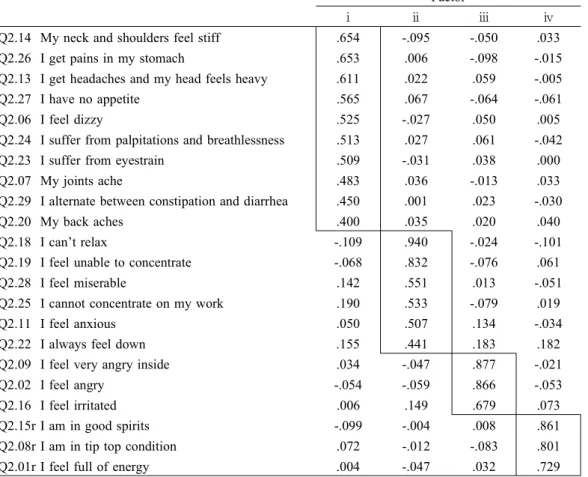
42-58-year age bracket. There were two peak distributions of age.2) Factor analyses of Category 2 and Category 3 Exploratory factor analysis of Category 2 revealed 4 major underlying factors (Table 1). Confirmatory factor
analysis indicated that the Goodness of fit index (GFI)=
0.892; the Akaike Goodness of fit index (AGFI)=0.865;
and the Root Mean Square Error of Approximation (RMSEA)=0.059 for nurses. Confirmatory factor analysis indicated that the GFI=0.900; the AGFI=0.875; and the RMSEA=0.065 for NLCAs. Confirmatory factor analysis showed that the scale has a stable 4-factor structure. We grouped the statements in Category 2 into four new factor divisions, excluding statements with low loading factors:
ϸ
“fatigue”Ϲ
“anxiety/depression”Ϻ
“anger”ϻ
“low energy levels”Exploratory factor analysis of Category 3 revealed 3 major underlying factors (Table 2). Confirmatory factor analysis indicated that the GFI=0.882; the AGFI=0.844;
and the RMSEA=0.083 for nurses. Confirmatory factor analysis indicated that the GFI=0.907; the AGF=0.877; and the RMSEA=0.079 for NLCAs. Confirmatory factor analysis showed that the scale has a stable 3-factor
Table 1 Exploratory factor analysis of Category 2
Factor
ϸ Ϲ Ϻ ϻ
Q2.14 My neck and shoulders feel stiff .654 -.095 -.050 .033
Q2.26 I get pains in my stomach .653 .006 -.098 -.015
Q2.13 I get headaches and my head feels heavy .611 .022 .059 -.005
Q2.27 I have no appetite .565 .067 -.064 -.061
Q2.06 I feel dizzy .525 -.027 .050 .005
Q2.24 I suffer from palpitations and breathlessness .513 .027 .061 -.042
Q2.23 I suffer from eyestrain .509 -.031 .038 .000
Q2.07 My joints ache .483 .036 -.013 .033
Q2.29 I alternate between constipation and diarrhea .450 .001 .023 -.030
Q2.20 My back aches .400 .035 .020 .040
Q2.18 I can’t relax -.109 .940 -.024 -.101
Q2.19 I feel unable to concentrate -.068 .832 -.076 .061
Q2.28 I feel miserable .142 .551 .013 -.051
Q2.25 I cannot concentrate on my work .190 .533 -.079 .019
Q2.11 I feel anxious .050 .507 .134 -.034
Q2.22 I always feel down .155 .441 .183 .182
Q2.09 I feel very angry inside .034 -.047 .877 -.021
Q2.02 I feel angry -.054 -.059 .866 -.053
Q2.16 I feel irritated .006 .149 .679 .073
Q2.15r I am in good spirits -.099 -.004 .008 .861
Q2.08r I am in tip top condition .072 -.012 -.083 .801
Q2.01r I feel full of energy .004 -.047 .032 .729
Table 2 Exploratory factor analysis of Category 3
Factor
Ϩ ϩ Ϫ
Q3.09 My salary is commensurate with the results I achieve at work .866 -.075 -.003
Q3.13 My salary is appropriate for my age and position .845 -.012 -.014
Q3.22 My salary reflects the value of my contribution to the company .781 .005 .029
Q3.17 I have enough money to meet my needs .659 -.016 -.104
Q3.08 Salary and promotions are dealt with fairly at my company .619 .027 .095
Q3.29 My salary is on par with that of my colleagues .618 .014 .037
Q3.05 My salary is enough to live on .488 -.023 -.097
Q3.01 I find my job interesting -.057 .802 -.151
Q3.11 I am well suited to my job -.051 .774 -.041
Q3.19 I feel satisfied that I am doing a worthwhile job .037 .768 -.023
Q3.03 My job has helped me grow as a person -.108 .572 .068
Q3.07 I am proud of working for my company .253 .470 .147
Q3.15 My work is well respected by people outside my company .075 .470 .104
Q3.23 My clients appreciate my work .000 .467 .140
Q3.21 My office has good teamwork -.078 -.064 .948
Q3.14 People get along well with each other at my office -.023 .009 .801
Q3.33 My colleagues are cooperative at work .015 .102 .527
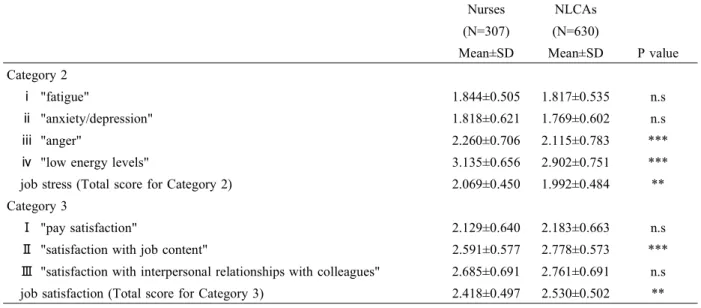
Table 3 Student's t-test's value in Category 2 and Category 3
Nurses NLCAs
(N=307) (N=630)
Mean±SD Mean±SD P value
Category 2
ϸ "fatigue" 1.844±0.505 1.817±0.535 n.s
Ϲ "anxiety/depression" 1.818±0.621 1.769±0.602 n.s
Ϻ "anger" 2.260±0.706 2.115±0.783 ***
ϻ "low energy levels" 3.135±0.656 2.902±0.751 ***
job stress (Total score for Category 2) 2.069±0.450 1.992±0.484 **
Category 3
䊠 "pay satisfaction" 2.129±0.640 2.183±0.663 n.s
䊡 "satisfaction with job content" 2.591±0.577 2.778±0.573 ***
䊢 "satisfaction with interpersonal relationships with colleagues" 2.685±0.691 2.761±0.691 n.s
job satisfaction (Total score for Category 3) 2.418±0.497 2.530±0.502 **
n.s P䍻.05,** P<.01,*** P<.001
structure. We grouped the statements in Category 3 into three new factor divisions, excluding statements with low loading factors:
Ϩ “pay satisfaction”
ϩ “satisfaction with job content”
Ϫ “satisfaction with interpersonal relationships with colleagues”
3)Comparison of Category 2 and Category 3 between nurses and NLCAs
We used Student’s t-test to compare the latent factor scores for each of the four factors in Category 2 and the total score of Category 2 (job stress) for nurses and NLCAs (Table 3). In the comparison of nurses and NLCAs, there were statistically significant differences in the scores for Ϻ“anger”, ϻ “low energy levels” and the
total score for Category 2. We also compared the latent factor scores for each of the three factors in Category 3 and the total score of Category 3 (job satisfaction) for nurses and NLCAs (Table 3). In the comparison of nurses and NLCAs, there was a statistically significant difference in the scores forϩ “satisfaction with job content” and the total score for Category 3. Our results showed that nurses tend to feel anger, lose motivation and complain of dissatisfaction with job content to a greater degree than NLCAs.
4) Factors affecting Category 4 in both nurses and NLCAs
Table 4 shows the results of logistic multi-regression analysis of factors associated with Category 4 in nurses.
For nurses, the intention to leave work was a satistically significant influenced by, from strongest to weakest, (1)ϩ
“satisfaction with job content”, (2)Ϩ“pay satisfaction”, and (3) “age”. Table 5 shows the results of logistic multi-regression analysis of factors associated with Category 4 in NLCAs. A high score for ϩ“satisfaction with job content” and “age” provided an inhibitory effect on the intention to leave work.
ؠ.Discussion
Our results showed that in our study population, levels of job stress were greater for nurses than for NLCAs.
Further, job satisfaction was lower for nurses than for NLCAs. In particular, nurses tended to feel anger, lose motivation and complain of dissatisfaction with job content to a greater degree than NLCAs. Not only do nursing homes cater to the medical treatment of elderly people, but they also serve as their place of residence, and nurses often have to share in the daily care of elderly residents in cooperation with NLCAs. As a result, we consider that nurses will feel a sense of dissatisfaction with such a working environment. In fact, in response to questionnaires seeking the reason nurses leave employment at nursing homes, nurses wrote that they not only had the responsibility of care work in addition to their nursing duties, but they also did not feel motivation or pride in their work. Some reports suggest that there are often conflicting opinions among the members of care staff, such as nurses, NLCAs, and occupational therapists9~11). Nursing home staff members are of the view that when thinking about the care management of elderly patients, consideration should be given to how the person would be
Table 4 Logistic multi regression analysis of factors associated with leaving employment in Nurses
Partial regression coefficient P value Odds ratio 95%confidence interval lower limit upper limit
Age -0.028 0.030 0.973 0.949 0.997
䊠 "pay satisfaction" -0.584 0.009 0.558 0.359 0.867
䊡 "satisfaction with job content" -1.215 0.000 0.297 0.175 0.504
Constant 5.573 0.000
X2test P<.001 Hit ratio 67.1%
Table 5 Logistic multi regression analysis of factors associated with leaving employment in NLCAs
Partial regression coefficient P value Odds ratio 95%confidence interval lower limit upper limit
Age -0.035 0.000 0.966 0.952 0.980
䊡 "satisfaction with job content" -1.179 0.000 0.308 0.221 0.427
Constant 4.348 0.000
X2test P<.001 Hit ratio 67.5%
taken care of at home. Accordingly, for example, in the case of a patient with chronic heart failure, nurses prefer to treat the person with complete bed rest; however, NLCAs consider that total bed rest deprives the patient of quality of life. Both opinions take into account the patient’s needs, but they are at odds with each other. Our survey revealed that because of staff shortages, nurses who work in nursing homes often have to engage in areas of work they did not expect to be involved in, and as a result, nurses tend to lose sight of their identity as nurses. In turn, this leads to low levels of job satisfaction.
Furthermore, our survey revealed that for both nurses and NLCAs, satisfaction with job content is the factor that has impact on leaving employment. In our view, whether nurses and NLCAs each have established specialized roles, and whether they can make use of their specialized skills in the course of their work in nursing homes plays an important part in continuing employment. For nurses, the latent factors associated with leaving employment, in order of greatest to least influence, were satisfaction with job content, pay satisfaction, and being of a young age.
However, in Japan today, the problem of salary is seen in all workplaces12). The national care scheme (Kaigohoken) is faced with the issue of how to provide a fair salary for nurses given a very limited budget. In general, nursing specialty skills are as follows: (1) checking vital signs, (2) managing medication, (3) emergency response, and (4) treating bedsores and other injuries. In our view, the reason younger nurses tend to leave employment is that the lack of nursing experience that results from working in a nursing home prevents the establishment of their identity as specialist elderly care nurses. For NCLAs, the latent factors associated with leaving employment, in order of greatest to least influence, were satisfaction with job content and being of a young age. Our study shows that for NLCAs, most are 32 years of age or younger, i.e., the age distribution of NLCAs has a bipolar shape. As a result, the younger NLCAs probably have opportunities of couching their care skills to the elders. The reason younger NLCAs tend to leave employment is that in
addition to the great amount of physical labor involved in elderly care, the constant training of new NLCAs places a further burden on top of their existing duties.
We must address that our study had several limitations. Given that our study is a cross-sectional survey, it cannot demonstrate causation.
In conclusion, our study showed that nurses have greater anger, low energy levels and Job stress (total score for Category 2) than NLCAs, and further, that nurses have lower satisfaction with job content and job satisfaction (total score for Category 3) than NLCAs. For nurses, dissatisfaction with job content, dissatisfaction with pay and being young were associated with the intention to leave employment. For NLCAs, dissatisfaction with job content and being young were associated with the intention to leave employment.
As a result of its rapidly aging society, Japan will be faced with an increased demand for nursing care services, and care staff members involved in elderly care will face even greater responsibilities. Recommendations to increase the retention rates of care staff members at nursing homes, we demonstrated that the director should (1) accept the individual concrete suggestions regarding the workplace from nursing home care staff members and make an effort to increase job satisfaction with job content and (2) increase the opportunities for training to improve the care skills. In particular, younger care staff members involved in nursing may need psychological support from colleagues, and the nursing home directors should provide opportunities for the care staff to participate in elderly care skill improvement seminars, so that young care staff members are able to acquire a highly professional confidence.
ء.References
1) Care Work Foundation:
http://www.kaigo-center.or.jp/report/pdf/h20_chousa_po int.pdf, 2009. (In Japanese)
2) Ministry of Health, Labour and Welfare:
http://www.mhlw.go.jp/toukei/itiran/koyou/doukou/08-2/
kekka.html, 2009. (In Japanese)
3) Furukawa, A.: A comparison on how visiting nurses and care workers handle work stress, Tokushima Bunri University, 78, 1-6, 2009. (in Japanese)
4) Tanabe, T.: A study about psychological stress to care staff of a nursing home for elderly residents with dementia: How to cope with burnout syndrome, Faculty of Letters, Hokusei Gakuen University, 42(1), 41-56, 2004. (in Japanese)
5) Suzuki, S. and Kano, T.: Nursing home employees' stress structure, faculty of social welfare, Iwate Prefectural University, 5(1), 45-55, 2004. (in Japanese) 6) Sawada, Y.: Care, Gender, Burn out: The relationship between Care stress and Burnout of Care worker in nursing home, Kwansei Gakuin policy studies review, 1, 1-17, 2002. (in Japanese)
7) Shimomitsu, T., Haratani, T., Nakamura, K., et al.: The final development of the Brief Job Stress Questionnaire mainly used for assessment of the individuals. In: Kato M, ed. The Ministry of Labour sponsored grant for the prevention of work related illness: The 1999 report.
Tokyo, Tokyo Medical College, 126–164, 2000. (in Japanese)
8) Adachi, T. : Job satisfaction of sales people -A covariance structure analysis of the motivational process-, Japanese Journal of Psychology, 69(3), 223-228, 1998. (in Japanese)
9) Briles, J.: Zapping conflict builds better teams. Nursing, 35(11), 32, 2005.
10) Hendel, T., Fish, M., and Galon, V.:Leadership style and choice of strategy in conflict management among Israeli nurse managers in general hospitals, Nursing Management, 13(2), 137-146, 2005.
11) Tengilimoglu, D. and Kisa, A.: Conflict management in public university hospitals in Turkey: A pilot study, The Health Care Manager, 24(6), 55, 2005.
12) Mihara, H. and Matsumoto, K.: Conditions of Workers in Institutions for People with Mental Disablilities:
Questionnaire Survey, Japanese Journal of Studies on
Disability and Difficulty, 37(2), 68-75, 2009. (In Japanese)