原 著
献血者の献血に関する意識調査
―特に本人確認と検査結果の通知について―
清水 勝
1)竹中 道子
2)池田 久實
3)中村 榮一
4)神谷 忠
5)井上千加子
6)神前 昌敏
7)1)杏林大学医学部臨床検査医学
2)神奈川県予防医学協会
3)北海道赤十字血液センター
4)東京都赤十字血液センター
5)愛知県豊橋赤十字血液センター
6)愛知県赤十字血液センター
7)大阪府南大阪赤十字血液センター
(平成 15 年 12 月 17 日受付)
(平成 16 年 2 月 13 日受理)
QUESTIONNAIRE SURVEY ON BLOOD DONOR OPINIONS ON PRESENTING IDENTIFICATION CARDS AT INTERVIEWS AND ACCEPTING TESTING RESULTS
FOR INFECTIOUS MARKERS INCLUDING HIV
Masaru Shimizu1), Michiko Takenaka2), Hisami Ikeda3), Eiichi Nakamura4), Tadashi Kamiya5), Chikako Inoue6)and Masatoshi Kohsaki7)
1)Department of Laboratory Medicine, Kyorin University School of Medicine
2)Kanagawa Health Service Association
3)Hokkaido Red Cross Blood Center
4)Tokyo Metropolitan Red Cross Blood Center
5)Aichi Toyohashi Red Cross Blood Center
6)Aichi Red Cross Blood Center
7)Osaka Minamiosaka Red Cross Blood Center
HIV-positive rates among voluntary blood donors in Japan have increased yearly for more than 10 years. This trend has emphasized the need to ensure blood safety, since more donors with in- fected blood in window periods could be undetected by nucleic acid amplifying testing(NAT).
A questionnaire survey on the idea of requesting identification cards(ID)in interviews at the time of donation, and notifying donors of all blood testing results including infectious markers, espe- cially HIV, was performed in 4 Japanese Red Cross Blood Centers(JBC).ID presentation was accept- able to 81% of donors on average, of whom over 90% would continue blood donations with ID pres- entation. Notification of HIV testing results was agreed to by 47%, denied by 21%, undetermined in 30% and not commented on by 2%. The rates of donors who did not want to be notified of any test- ing results(no notification)were 0.4〜5.1% at each JBC, with the JBC which has introduced a photo- card system with the donor s photograph having the lowest rate. The rates of donors, who did not
はじめに
血液を介する既知の病原体である HBV,HCV,
HIV に よ る 輸 血 後 感 染 症 は 核 酸 増 幅 検 査
(NAT)の導入により大幅にウインドウ期間が短 縮されることから,血液の安全性は飛躍的に向上 すると期待されてきた1).わが国の献血血液は,最 近の 50 検体プールでの NAT 導入により,安全性 は格段に向上したと考えられる2)3).しかしなが ら,検体のプール数を少なくすることにより感染 率が低下するとの報告4)があるにせよ,NAT の個 別検査を行っても HBV,HCV に感 染 し た 報 告 例5)6),また感染初期にはウイルス量が変動して陰 性と判定されること7)もあることから,病原体の検 出には限界があり,血液の安全性を検査法のみに 依存し過ぎることには問題がある.
血液の安全性確保は,まず献血者への問診から 始まるが,わが国ではこの問診をくぐり抜ける HIV 検査陽性者が年々増加し続けており,2002 年 に は 過 去 最 高 の 82 人(1.42!10 万 人)に 達 し た8).かつては献血者中に HIV 感染者が高率に見 出されていた西欧諸国では年々低下し,最近では 10 万人あたり 0.5〜2 人で経 過 し て い る9).し か し,わが国の献血者中の感染率を推定国民感染率 と比較すると西欧諸国に比して高いことが報告さ れていることは10),わが国では献血が HIV の検 査目的に利用されていることを示唆し,献血者中 に NAT の検出限界以下のウインドウ期感染者が 増加していることをも推測させる.厚生労働省と 日本赤十字社血液センター(JBC)では検査目的の マグネット効果を防止するために,公には HIV
検査結果を通知しないことにしているが,1999 年 7 月の旧厚生省中央薬事審議会血液事業特別部 会では,HIV 検査結果を通知する方向で検討する ことを決定したものの,その後の進展は殆どない 状況にある.HIV 検査陽性献血者の一部には感染 の事実を知らない場合もあるであろうが,明らか に検査目的と考えられる献血者のいることも事実 であり8),しかも HIV 検査陽性者の中には何故か 住所や氏名を偽っていると思われる例もある11).
これらの問題に対処するために,検査結果への 献血者の対応状況を調査し,さらに問診の実を上 げるために,問診時に身分を確認できるもの(身 分証)の提示と HIV 検査結果の通知を公にはして いないことについての献血者の意識調査を実施し たので報告する.
対象および方法
調査 1.北海道,東京都,愛知県,大阪府の各 JBC の献血者について,献血時に検査サービス(血液 型,生化学検査,400mL と成分採血では血算)と 感染症マーカー陽性時の検査結果の報告を希望し ない(不要)と申告した人数(不要者数)と,希 望する(要)とのことで郵送された検査結果報告 書が本人に届かず返送されて来た人数(不能者数)
とを,感染症マーカー陽性と陰性に区分して調査 した.調査期間は 2002 年内の連続する 3 カ月間と した.
調査 2.上記 4 JBC の各一施設に来所した一連 の献血者 300 名を対象にして,問診時に身分証
(ID)の提示を求めることと,HIV 検査結果を公に 通知していないことに関する意識をアンケート票 get mailed notification of all testing results to be sent back to the JBC(no acceptance)were 0.4〜0.8%
at each JBC. However, the rates of approval for no notification and no acceptance for only infectious markers increased to 0.4〜16.8% and 0〜5.6%, respectively. In particular, the rate of both no notifica- tion and no acceptance for syphilis testing results was 41.7% dramatically higher in the JBC, which is the highest in both the number and rate of HIV infection among donors every year.
These results indicate that ID presentation in interviews has already been accepted by almost all donors, but that HIV notification is approved by only half. However, most donors would agree to notification of HIV infection if they were able to understand its importance to both public and individ- ual health as well as to blood safety by proper education and information on HIV infection.
HIV, blood donors, ID, HIV notification Key words:
Table 1 Items of the questionnaire survey concerning ID presentation in interviews and notification of HIV testing results
1. Concerning yourself:
①Age:16―19, 20―29, 30―39, 40―49, 50―59, ≧ 60
②Gender:Male, Female
③Occupation:Official, Employee, High School Student, Other School Student, Housewife, Self-empolyed, Other( )
④Previous Blood Donations:Yes( times);No
2. Confirmation of donor identity(ID)in interviews of blood donation:
①Do you have anything to identify yourself with now?
②If yes in①, what is it?(Multiple answers:Driver s license, Employee s card, Student card, Cash card, Credit card, Medical insurance card, Passport, Other( )
③What do you think about presenting ID cards at blood donation?
Questionable(your opinion: ) No problem;Undecided
④Would you donate blood even if asked to present an ID card?
Yes;No(your opinion: ) 3. HIV(AIDS)testing:
①What do you think about Blood Centers declining blood donors who want only HIV testing?
Reasonable;Don t decline (your opinion: );Undecided
②What do you think about Blood Centers not notifying blood donors of HIV testing results?
Reasonable;Do notify(your opinion: );Undecided
③Do you know Public Health Centers perform anonymous HIV testing free of charge?
Yes;No
(Table 1)ヘの記入式により調査した.
結 果
1.検査結果の通知状況(調査1)
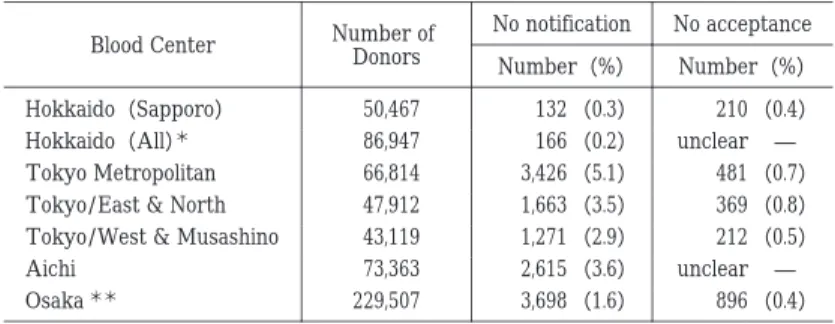
調査対象の 4JBC で実施された成績を,北海道 ブロック JBC(札幌を含む), 北海道 JBC(札幌), 東京都 JBC,東京都東・北 JBC,東京都西・武蔵 野 JBC,愛知県 JBC,大阪府 JBC 別に集計した
(Table 2).大阪府 JBC は 6 カ月間の集計となっ たが,それ以外の JBC は総て 3 カ月間の集計であ る.
全献血者における検査サービスと感染症マー カ ー の 通 知 不 要 率 は 0.2〜5.1%(平 均 2.2%)で
(Table 2),北海道ブロック JBC が最も低かった が,全献血者への配達不能率は 0.4〜0.8% と,JBC 間の差は殆ど認められなかった(Table 2).
感染症マーカー陽性者での通知不要率を見ると
(Table 3),通知対象となる感染症マーカーの陽性 率には 0.3〜0.6% と JBC 間の差は余りないにも かかわらず,通知不要率は北海道ブロック JBC 0.4%,東京都 JBC 16.8%,その他の JBC 5% の 3 群に分かれた.全献血者に対する配達不能率は 0
〜5.6% の幅が認められたが,実数では 10 人未満 であった(Table 3).
なお,献血時には検査サービスと感染症マー カー陽性時の通知の要・不要の希望を別々に申告 できるので,当該期間の検査サービス通知不要者 と感染症マーカー通知不要者を明確に区別して集 計した 2JBC の結果をみると,北海道 JBC(札幌)
では献血者 50,467 人に対して検査サービスの通 知不要者(率)は 27 人(0.05%),感染症マーカー の通知不要者(率)は 132 人(0.3%),大阪府 JBC で は 229,507 人 に 対 し て 各 々 2,936 人(1.3%), 3,698 人(1.6%)と,いずれも感染症マーカーの方 が通知不要の申告率が高く,JBC 間の差も認めら れた.
さらに感染症の各マーカー別に集計すると(Ta- ble 4),通知不要者と配達不能者の合計は,0〜
41.7% と JBC 間の差が大きいが,多くの JBC で は梅毒検査陽性者で高率であることが目立った.
特に東京都 JBC では各マーカーとも 10% 以上と 際立って高率であり,中でも梅毒検査陽性者の 41.7% に通知が届いていなかった.
Table 2 Numbers and rates(%)of blood donors who did not want to be notified of any testing results(no notification)and who did not get mailed notification of all testing results to be sent back to the Blood Centers(no acceptance) .(3 consecutive months in 2003)
No acceptance No notification
Number of Donors Blood Center
Number(%)
Number(%)
(0.4)
210
(0.3)
132 50,467
Hokkaido(Sapporo)
― unclear
(0.2)
166 86,947
Hokkaido(All)*
(0.7)
481
(5.1)
3,426 66,814
Tokyo Metropolitan
(0.8)
369
(3.5)
1,663 47,912
Tokyo/East & North
(0.5)
212
(2.9)
1,271 43,119
Tokyo/West & Musashino
― unclear
(3.6)
2,615 73,363
Aichi
(0.4)
896
(1.6)
3,698 229,507
Osaka* *
*:including Hokkaido Blood Center in Sapporo
**:6 consecutive months
Table 3 Numbers and rates(%)of both no notification and no acceptance for all infectious markers.(3 consecutive months in 2003)
No acceptance No notification
Positive for infectious markers(%)
Number of Donors Blood Center
Number(%)
Number(%)
(1.8)
5
( 0.4)
1
(0.3)
277 86,947
Hokkaido(All)*
(4.3)
8
(16.8)
38
(0.3)
226 66,814
Tokyo Metropolitan
(5.6)
8
( 5.3)
8
(0.3)
150 47,912
Tokyo/East & North
(0.0)
0
( 4.2)
5
(0.3)
119 43,119
Tokyo/West & Musashino
(0.4)
1
( 5.1)
12
(0.3)
236 73,363
Aichi
(2.6)
35
( 4.8)
67
(0.6)
1,402 229,507
Osaka* *
*:including Hokkaido Blood Center in Sapporo
**:6 consecutive months
2.アンケート結果(調査2)
5JBC の献血者へのアンケート(Table 1)の回答 数は 2,063 人であったが,年齢・性別に記入もれ の あ っ た 20 人 を 除 い た 2,043 人 を 対 象 に し た
(Fig. 1).以下に述べる各項目について JBC 別・
男女別さらに年齢別(40 歳未満と以上)に解析し たが,差は認められなかったことから,各 JBC 別に集計した(Table 5,6).
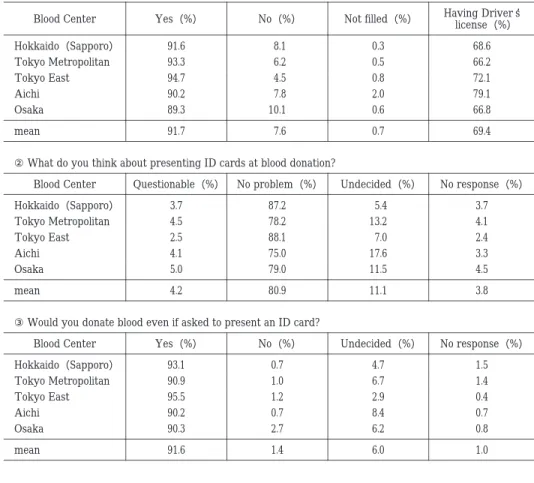
何らかの ID を所持しているとの回答は,89〜
95%(平均 92%)と高率であった.ID としては運 転免許証の所持率が 66〜79%(平均 69%)と最も 多く,次いでキャッシュカード,クレジットカー ドがそれぞれ 30〜35% であり,学生証,健康保険 証が 25〜30% であった.
献血時に ID を提示することには「問題ない」と
の回答が 75〜88%(平均 81%)であり,「問題であ る」との回答は 2〜5%(平均 4%),「分からない」
との回答が 11% であった.しかし,ID の提示を求 められても「献血する」との回答が 90% 以上あり,
「献血しない」との回答は 0.7〜2.7%(平均 1.4%)
であった(Table 5).
エイズ検査に関しては,エイズ検査を目的とし た献血を「断る」のは当然とする回答は,66〜77%
と高率であったが,「断るべきではない」との回答 も 5〜8% あり,その理由として検査を受ける機会 を広げるべきであると書かれたものが多かった.
エイズ検査の結果を知らせていないことについ ては,「当然である」が 17〜24%(平均 21%)であっ たが,「知らせるべきである」が 43〜53%(平均 47%)と最も多く,「分からない」が 25〜31%(平
Table 4 Numbers and rates(%)of both no notification and no acceptance for each infectious marker.(3 consecutive months in 2003)
Syphilis HTLV- Ⅰ
HCV HBV
Blood Center
No Notification
(%)
Positive No Notification
(%)
Positive No Notification
(%)
Positive No Notification
(%)
Positive
No Acceptance
(%)
No Acceptance
(%)
No Acceptance
(%)
No Acceptance
(%)
( 0.0)
( 5.6)
0 18 1
( 0.0)
( 0.0)
0 60 0
( 0.0)
( 3.0)
0 100 0
( 1.0)
( 1.0)
1 100 1
Hokkaido
(Sapporo)
(31.3)
(15.2)
15 48 5
(15.6)
( 5.3)
7 45 2
(15.7)
( 0.0)
8 51 0
(11.1)
( 1.6)
8 72 1
Tokyo Metropolitan
(15.0)
(11.8)
3 20 2
( 2.9)
( 3.0)
1 34 1
( 5.3)
( 0.0)
2 38 0
( 3.9)
(10.2)
2 51 5
Tokyo/
East & North
( 0.0)
( 0.0)
0 7 0
( 2.4)
( 0.0)
1 41 0
( 8.9)
( 0.0)
3 38 0
( 3.7)
( 0.0)
1 27 0
Tokyo/West
& Musashino
( 7.7)
( 0.0)
1 12 0
( 7.3)
( 0.0)
6 82 0
( 3.6)
( 0.0)
2 90 0
( 5.9)
( 2.1)
3 51 1
Aichi
( 4.8)
( 7.5)
6 126 9
( 5.3)
( 1.0)
2 513 5
( 6.3)
( 3.9)
29 462 4
( 1.7)
( 1.4)
5 301 4
Osaka*
*:6 consecutive months
Fig. 1 Distribution of responders to the questionnaire by age, gender and JBC
Table 5 Requesting identification cards(ID)in interviews at the time of blood donation
①Do you have anything to identify yourself with now?
Having Driver s license(%)
Not filled(%)
No(%)
Yes(%)
Blood Center
68.6 0.3
8.1 91.6
Hokkaido(Sapporo)
66.2 0.5
6.2 93.3
Tokyo Metropolitan
72.1 0.8
4.5 94.7
Tokyo East
79.1 2.0
7.8 90.2
Aichi
66.8 0.6
10.1 89.3
Osaka
69.4 0.7
7.6 91.7
mean
②What do you think about presenting ID cards at blood donation?
No response(%)
Undecided(%)
No problem(%)
Questionable(%)
Blood Center
3.7 5.4
87.2 3.7
Hokkaido(Sapporo)
4.1 13.2
78.2 4.5
Tokyo Metropolitan
2.4 7.0
88.1 2.5
Tokyo East
3.3 17.6
75.0 4.1
Aichi
4.5 11.5
79.0 5.0
Osaka
3.8 11.1
80.9 4.2
mean
③Would you donate blood even if asked to present an ID card?
No response(%)
Undecided(%)
No(%)
Yes(%)
Blood Center
1.5 4.7
0.7 93.1
Hokkaido(Sapporo)
1.4 6.7
1.0 90.9
Tokyo Metropolitan
0.4 2.9
1.2 95.5
Tokyo East
0.7 8.4
0.7 90.2
Aichi
0.8 6.2
2.7 90.3
Osaka
1.0 6.0
1.4 91.6
mean
均 30%)であった.
保健所でエイズ検査を無料・匿名で受けられる ことについては,53〜71%(平均 60%)と過半数 が承知していた(Table 6).
考 察
今後の血液の安全性を確保していくための参考 に資するために,献血時の検査サービスと感染症 マーカーの通知不要者数(率)と通知不能者数(率)
とを調査した.
献血時の検査サービスの通知不要率は,JBC 間で差があり,試験的に献血手帳を光カード化し,
顔写真とともに住所・氏名や既存の検査結果を随 時読み取れる体制の導入を試みた北海道 JBC(札 幌)12)では 0.05% と際立って少なかった.献血手帳 の在り方や検査サービスの提供の仕方が,通知要 との申告率の向上に影響していると考えられる.
一方,検査サービスの配達不能率は 0.4〜0.8% と JBC 間に余り差はなかったが,今回は大都市内の JBC 施設での献血者が対象であることから,その 理由が単なる誤配,誤記によるものか,転勤,転 居の問題も含めてさらに検討すべきであろう.
感染症マーカーの陽性率は大阪を除く各 JBC とも 0.3% と殆ど同率であったが,陽性者中の通 知不要率は JBC 間差が大きく,いずれも検査サー ビスの通知不要率よりも 2〜3 倍多かった.しかも 配達不能率は検査サービスのそれよりも 4〜7 倍 も高いことが注目される.さらに各感染症のマー カー別に,通知不要率と配達不能率をみると,各 JBC とも梅毒のそれが高い傾向にあった.特に東 京都 JBC では通知不要率がいずれのマーカーで も 10% 以上もあり,梅毒検査陽性者の配達不能率 も他の感染症マーカーに比して一段と高かった.
Table 6 HIV(AIDS)testing
①What do you think about Blood Centers declining blood donors who want only HIV testing?
No response(%)
Undecided(%)
Don t decline(%)
Reasonable(%)
Blood Center
0.8 24.9
7.9 66.4
Hokkaido(Sapporo)
1.2 22.5
7.7 68.6
Tokyo Metropolitan
0.9 16.4
5.7 77.0
Tokyo East
0.3 20.6
5.1 74.0
Aichi
0.6 20.8
6.0 72.6
Osaka
0.8 21.5
6.7 71.0
mean
②What do you think about Blood Centers not notifying blood donors of HIV testing results?
No response(%)
Undecided(%)
Do notify(%)
Reasonable(%)
Blood Center
1.7 30.1
49.4 18.8
Hokkaido(Sapporo)
3.1 28.8
47.2 20.9
Tokyo Metropolitan
3.7 25.8
53.3 17.2
Tokyo East
1.4 33.4
43.2 22.0
Aichi
0.3 31.5
44.1 24.1
Osaka
1.9 30.1
47.0 21.0
mean
③Do you know that Public Health Centers perform anonymous HIV testing free of charge?
No response(%)
No(%)
Yes(%)
Blood Center
0.5 46.4
53.1 Hokkaido(Sapporo)
1.2 42.9
55.9 Tokyo Metropolitan
0.4 34.0
65.6 Tokyo East
0.0 29.1
70.9 Aichi
0.4 40.0
59.6 Osaka
0.6 39.8
59.6 mean
これは感染症マーカー陽性献血者側の問題(職場 献血などでやむを得ず採血した場合等)と解すべ きであろう.
感染症マーカーの検査が目的であるとすれば,
通知が届かない虚偽の住所や氏名を申告するとは 考え難く,感染症マーカー,特に梅毒検査陽性の 検査結果の通知を受けたくない献血者に対して は,感染症マーカー陽性の血液は廃棄され,陽性 者は全国の JBC のコンピューターに登録されて いることを伝え,さらに患者の安全を守るために は自ら安全を保証できる血液を提供する自己責任 の必要性を強調すべきであろう.それと共に,HIV については保健所で匿名・無料の検査を受けられ ることも知らせるべきであるが,そのことを献血 者の 60% しか知らなかったとの結果は啓発の在 り方について一考を要する.なお,HIV 検査陽性
者は梅毒検査陽性をも伴う率が高いこと(大阪 JBC で 40%,東京都 JBC で 26%)11)13)を考慮する と,HIV 検査陽性者での通知不能状況を明らかに する必要があるであろう.特に HIV 感染者の多く 見いだされる JBC で梅毒検査陽性の検査結果が 多くの本人に届いていない現状は,感染者の健康 管理と二次感染予防上の問題となることから,積 極的な対策を講じる必要があるであろう.献血時 に ID の提示を求めることは(後述),有効な対策 の一つと考える.
一方,献血者に対するアンケート調査では,問 診時に ID の提示を求めることについては 81%
が「問題なし」と回答し,92% が ID となりうるも のを所持していた.「問題あり」の理由としては面 倒,時間が掛る,初回のみにして欲しい,他への 漏えいを防止できるか,などを上げていた.また
「分からない」との回答には ID の提示の必要な理 由が不明としているものが多かった.また,北海 道 JBC(札幌)では,光カード化による照合が可 能であることから12),さらに ID は不要との意見 もあったが,少なくとも初回時には必要であろう.
さらに ID 提示を求められても引き続き献血をす るとの回答は 92% もあったことから,提示の必要 性を説明し,提示方法や守秘義務の徹底等に十分 配慮することにより,ID の提示は献血推進上の障 害にはならないと考える.諸外国の状況としては,
献血時に米国では社会保証番号が登録され,欧州 諸国では ID の提示は当然なこととして受入れら ており,最近の実態調査でも同様な報告14)が行わ れている.
検査結果の通知不要・配達不能の献血者の問題 は,ID の提示により一部は解決されるものと期待 され,さらに検査結果の通知を不要とする献血は 断ること(献血者中の対象者数は最大で 5%)も一 つの対策と考えられるが,いずれも献血者の確保 には殆ど支障にはならないと考える.JBC では現 在の献血手帳をプラスチックカード化し,携行し やすくすることで,献血者の履歴照合を確実に行 うことを考えているが,ID としての機能をも盛り 込むことが期待される.ID の提示により,献血者 が自らの血液の安全性について責任を持つとの自 覚を生むことにもなるであろう.
HIV 関連のアンケート調査では,検査目的の献 血は「断るべき」との回答が 71% と,多くの献血 者が現在の献血時の方針を受け入れていた.一方,
「断るべきではない」が 7% あり,その理由として は検査を広く行うためには不便な保健所や費用の 高い医療機関ではなく,JBC の利用を是としてい たが,ウインドウ期の感染者を除外するためには,
保健所などでの検査体制の充実を優先すべきであ ろう.
HIV 検査結果を「知らせるべき」であるとの見 解は 47% と最も多かったが,「知らせない」のは当 然が 21%,「分からない」が 30% であった.この成 績は以前に行われた調査でエイズ検査結果を「知 らせるべき」が献血者の 73% との報告15)あるいは 日本輸血学会の関係者では「知らせるべき」が
80% 以上との報告16)に比すると低かった.しかし HIV 検査目的の献血を「断るべきでない」,「わか らない」との回答者や,HIV 検査結果を「知らせ ない」,「分からない」との回答者には,感染する機 会のあった者が献血することは他の感染症マー カーと同様に受血者である患者にとって危険なこ と,さらに HIV 感染者に積極的に通知することは 感染者の早期治療と二次感染を予防する上で重要 なことを,教育・啓発して理解を深める必要があ ると考える.
今回の調査結果をも踏まえると,わが国でも献 血時の HIV 検査結果を公に知らせ,感染している 献血者の背景を調査して,対策を講じる時期に来 ているというべきであろう.ちなみに,欧米先進 諸国では総て通知しており,しかも献血者中での HIV 感染者は漸減傾向にあり,マグネット効果を 促進することにはなっていない9).わが国でも,通 知することを前提に,その方策を検討するべきで ある.
結論として,献血時に身分証の提示を求め,HIV 検査結果を通知し,保健所などでの無料・匿名の 検査体制を利便性の高いように充実させ,献血の マグネット効果を抑制していくことが,今後さら に血液の安全性を高めて行くことになると考え る.
本研究は厚生労働科学研究費補助金エイズ対策研究事業 の一環として行われたものである.
文 献
1)Schreiber, G.B., Busch, M.P., Kleinman, S.H., Kore- litz, J.J.:The risk of transfusion-transmitted viral infection . The Retrovirus Epidemiology Donor Study. N. Engl. J. Med., 334:1685―1690, 1996.
2)Mine, H., Emura, H., Miyamoto, M., Tomono, T., Minegishi , K . , Murokawa , H . , Yamanaka , R . , Yoshikawa, R., Nishioka, K.:Japanese Red Cross NAT Research Group. High throughout screen- ing of 16 million serologically negative blood do- nors for hepatitis B virus, hepatitis C virus and human immunodeficiency virus type-1 by nucleic acid amplification testing with specific and sensi- tive multiplex reagent in Japan. J. Virol. Methods., 112:145―151, 2003.
3)Minegishi, K., Yoshikawa, A., Kishimoto, S., Yugi,
H., Yokoya, N., Sakurada, M., Kiyokawa, H., Nishi- oka, K.:Japanese Red Cross NAT Screening Re- search Group. Superiority of minipool nucleic acid amplification technology for hepatitis B virus over chemiluminescence immunology for hepati- tis B surface antigen screening. Vox Sang., 84:
287―291, 2003.
4)Weusten, J.J.A.M., van Drimmelen, H.A.J, Lelie, P.
N . : Mathematic modeling of the risk of HBV , HCV and HIV transmission by window-phase do- nations not detected by NAT. Transfusion, 42:
537―545, 2002.
5)百瀬利也,遠藤正浩,西田一雄,有田準一,吉松 彰,中平誠司,高橋有二,山岸尚仁,藤村佳世子,
松本千恵子,田所憲治,長峰 守:PCR 法でも見 出せないウインドウ期の血液が原因と考えられ る輸血後 B 型肝炎症例.日 輸 血 会 誌,44:152, 1998.
6)Schuttler, C.G., Caspari, G., Jursch, C.A., Willems, W.R., Gerlich, W.H., Schaefers.:Hepatitis C virus transmission by a blood donation negative in nu- cleic acid amplification tests for viral RNA. Lan- cet, 355:41―42, 2000.
7)Fang, C.T., Tobler, L.H., Haesche, C., Busch, M.P., Phelps, B., Leparc, G.:Fluctuation of HCV viral load in a healthy volunteer blood donor. Transfu- sion, 43:541―544, 2003.
8)清水 勝,池田久實,中村栄一,神谷 忠,矢内
純吉,清川 尚,竹中道子:献血者・妊婦等に関
する研究グループ総括.HIV 感染症の動向と予防
介入に関する社会疫学的研究(主任研究者 木原
正博).厚生労働科学研究.平成 14 年度研究報告,
243―257, 2003.
9)EuroHIV(Institute de Veille Sanitaire):HIV!
AIDS Surveillance in Europe . End-year report 2001. 2002(66):35―39, 2002.
10)木原正博,今井光信,清水 勝:献血者における
HIV 感染状況.Infectious Agent Surveillance Re- port(IASR), 21:140―141, 2000.
11)中村栄一,仲田健一,渡部準之助:献血者集団に おける HIV 陽性例と自己申告例から見た現状分 析について.献血者・妊婦に関する研究グループ
(グループ長 清水勝).HIV 感染症の動向と予防
介入に関する社会疫学的研究(主任研究者 木原
正博).厚生労働科学研究.平成 13 年度研究報告,
220―224, 2002.
12)千葉泰之,兼松藤男,田村弘侯,池田久實:光カー ドによる献血カードシステムの開発. 臨床病理,
47(補冊):143, 1999.
13)矢内純吉,神前昌敏:献血者集団における HIV 感染状況.献血者・妊婦に関する研究グループ
(グループ長 清水勝).HIV 感染症の動向と予防
介入に関する社会疫学的研究(主任研究者 木原
正博).厚生労働科学研究.平成 13 年度研究報告,
236―239, 2002.
14)木村和子,杉本和隆,高西優子:海外のドナーセ レクトに関する研究.HIV の検査法と検査体制を 確立するための研究(主任研究者 今井光信).厚 生労働科学研究.平成 13 年度研究報告,122―141, 2002.
15)井上千加子,神谷 忠,小澤和郎:献血者におけ
る HIV についての意識調査.日輸血会誌,47:
22―28, 2001.
16)清水 勝,竹中道子:問診による血液の安全性確
保対策.少子高齢化社会における献血による安全 な血液の国内自給自足対策の在方に関する研究
(主任研究者 清水勝).厚生労働科学研究.平成 14 年度研究報告,94―106, 2003.