Phase-Wave Propagation Phenomena in Two-Dimensional Cellular Neural Networks
Koji Urabe
1Yoshifumi Nishio
2(Niihama National College of Tech.
1, Tokushima Univ.
2)
1. Introduction
Cellular Neural Networks (CNN) are con- structed by many cells connected each other. The cell contains linear and nonlinear current sources controlled by voltage. Investigating the nonlinear phenomena is an important work for clarifying dynamics of CNNs.
One of the nonlinear phenomena observed in CNNs is phase-wave propagation phenomena
(1). The CNN constructed by 2 cells can oscillated by choosing appropriate parameters. Coupling os- cillating CNNs, 1-dimensional 2-layer CNN can be construc ted. Putting initial phase difference to any cells in 1-dimensional 2-layer CNN, phase- wave propagation phenomena that the phase dif- ference is propagate to other cells could be ob- served.
In this work, we report nonlinear phenomena could be observed in 2-dimensional CNNs.
2. 2-Dimensional CNN
In this study, we consider what kind of phe- nomena can be observed in the CNN oscillators coupled in 2-dimension.
We use 2-layer 2-Dimension modified CNN as shown in Fig. 1.
CNN Oscillator constructed by 2 cells
1 2 3
1
2
3
i
j
Fig.1: 2-Dimension Array constructed by CNN Oscillators (3
×3)
The circuit equation governing the CNN in Fig.
1 are written as
˙
x
1,i,j=
−x1,i,j+ a
1y
1,i,j+ c
1x
2,i,j(1)
˙
x
2,i,j=
−x2,i,j+ a
2y
2,i,j+ c
2x
1,i,j(2) +d
2³y
1,i,(j−1)+ y
1,i,(j+1)+ y
1,(i−1),j+ y
1,(i+1),j´(3) y
`,i,j= 0.5 (|x
`,i,j+ 1| − |x
`,i,j−1|) (4) (i = 1, 2,
· · ·, M, j = 1, 2,
· · ·N, ` = 1, 2) where x
`,i,jis the state, y
`,i,jis the output of
CELL
`,i,j. This modified CNN is different from
the original CNN in state feedback from the cell which is at the same position in the other layer.
a
`, c
`and d
`are the feedback parameters form the output its own cell, from
stateof the cell which is at the same position in the other layer, and from the output of the neighborhood cell in the other layer, respectively.
For numerical analysis we use this set of pa- rameters which are same values at 1-Dimension CNN, as shown follows,
a
1= 1, c
1= 1, a
2= 1.2, c
2=
−1.1, d2= 0.05 3. Simulation Result
For numerical simulation, we consider 2- dimensional CNN constructed by 9 cells, M = 3, N = 3. And the initial conditions are given as follows:
Table 1: Initial State x
h,i,j(0)
(a) x
1,i,j(0) (b) x
2,i,j(0) i
1 2 3
1 1.0 -1.0 -1.0 j 2 -1.0 1.0 1.0 3 -1.0 1.0 1.0
i
1 2 3
1 0.0 0.0 0.0 j 2 0.0 0.0 0.0 3 0.0 0.0 0.0
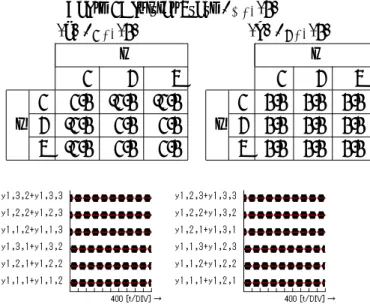
Fig.2: Simulation Result 4. Conclusions
In this works, we could be observed phase-wave propagation phenomena in 2-dimensional CNNs.
We can observe phase-wave propagation phenom- ena to horizontal and vertical directions.
(1) Z. Yang, K. Tsuruta, Y. Nishio and A.
Ushida, “Investigation of phase-wave prop- agation phenomena in second order CNN arrays”, Proc. of ISCAS’04, vol. 3, pp. 49- 52, 2004.
平成19年度電気関係学会四国支部連合大会