
INVITED PAPER
Special Section on Emerging Technologies on Ambient Sensor Networks toward Future GenerationAmbient Sensor Network Technologies for Global Connectivity Support
Masayoshi OHASHI†a),Senior Member andNao KAWANISHI††,Member
SUMMARY This paper discusses the core ambient sensor network (ASN) technologies in view of their support for global connectivity. First, we enumerate ASN services and use cases and then discuss the underlying core technologies, in particular, the importance of the RESTful approach for ensuring global accessibility to sensors and actuators. We also discuss several profile-handling technologies for context-aware services. Finally, we envisage the ASN trends, including our current work for cognitive be- havior therapy (CBT) in mental healthcare. We strongly believe that ASN services will become widely available in the real world and an integral part of daily life and society in the near future.
key words: sensor network, sensor, actuator, RESTful, CBT
1. Introduction
Ambient sensor network (ASN) technology has attracted much attention as a next generation communication infras- tructure. It is sometimes referred to as the internet of things (IoT) and machine to machine communication (M2M). In an ASN, a variety of services are offered via sensors and actu- ators connected to a network. The underlying technologies that support ASN are not recent developments; they have been around for years, with some having originated from ubiquitous networking R&D activities in Japan. In this pa- per, we overview these technologies and look at the future directions of ASN.
2. History of ASN Technologies
ASN has its roots in the concept of ubiquitous computing proposed by Mark Wiser[1], who stated that all comput- ing nodes will eventually fade into the background and un- obtrusively support our daily life. At that time, the con- cept was merely a vision; however, it is now coming to fruition because powerful computer technology has become sufficiently miniaturized to facilitate devices such as smart- phones, sensors, and wearables, which are connected to net- works, and thus are able to communicate with each other.
Consequently, the paradigm is becoming real. Furthermore, sensed data are being collected in the cloud and analyzed to generate new knowledge.
We believe that the objective of ASN should not be to create totally new services but rather to bring ICT close to
Manuscript received February 9, 2015.
Manuscript revised April 27, 2015.
†The author is with Fukuoka University, Fukuoka-shi, 814- 0180 Japan.
††The author is with ATR, Kyoto-fu, 619-0288 Japan.
a) E-mail: [email protected] DOI: 10.1587/transcom.E98.B.1733
the activities of users and society in order to increase the productivity of industries and individuals, and lower the cost of various services; thereby, contributing to the entire soci- ety. For example, typical target ASN services include mit- igating disasters and monitoring children. These activities normally require considerable human resources when they are carried out without ICT.
However, with ASN support for such services, signifi- cant portions of the associated tasks may be conducted with- out human resources, which can then be diverted for use in other endeavors. This can help to facilitate a sustainable society to increase productivity and value creativity per per- son, thereby offsetting the twin problems of declining birth rate and aging population currently facing Japanese society.
Further, ASN can also help in the management and control of energy via smart grids, which is very important for main- taining sustainability.
During the past quarter century, communication tech- nologies — in particular, the Internet and wireless technol- ogy — have shown remarkable progress, resulting in stan- dard and/or de-facto approaches. Many communication technologies have been installed and made widely available to the market in the form of chipsets. This signifies that the communication technology itself has become a tool for achieving an objective and not the objective itself. We are convinced that ASN is an excellent vehicle for the communi- cations industry to offer various ambient services that utilize ICT.
ASN has long been regarded as a future target for re- searchers. Recently, however, ASN has gradually come to be considered as also promising for businesses and indus- tries. For Small and Medium Enterprises (SMEs), this is an opportunity to release unique services and sensor products, as well as opportunities for manufacturers to provide com- munications/sensor chipsets in volume.
There are minor differences between the terms “ASN,”
“M2M,” and “IoT.” However, since they are often used in- terchangeably according to the context, in this paper, we do not make any specific distinction between them.
3. ASN Services and Use Cases
Examples of ASN services can be found in the service sce- narios in the oneM2M use case collection [2], which in- cludes the following services:
- Energy management
Copyright c2015 The Institute of Electronics, Information and Communication Engineers
1734
IEICE TRANS. COMMUN., VOL.E98–B, NO.9 SEPTEMBER 2015
- Smart buildings - Healthcare
- Public transport services - Residential services - Transportation services - Etc.
Similar services are also listed in ITU recommendations[3].
The objectives of these services are to improve the efficiency of social systems (including energy management), to en- hance human health and wellbeing (improve the quality of human life), and to reduce overall cost. The issue that has to be considered is of course whether the services deserve the investment. In recent times, the following factors have served to accelerate the deployment of ASN systems:
1) Advent of low cost sensor devices
In the past, sensor nodes had to be developed from scratch when they were needed. Some sensor nodes were commer- cially available but were not widely used. Recently, how- ever, open sensor nodes such as Arduino[4]and Raspberry Pi[5]have become widely available in the market at such a low cost that it is now relatively easy to acquire sensor data from the environment, send them to a sink node through a wireless connection, and collect and analyze them in cloud storage. Because these sensor nodes have an open archi- tecture, it is possible to connect various sensors/actuators via simple programming. Wireless/Ethernet communication modules for them are also available. Although such modules do not possess much processing capability, they are attrac- tive when applied in a horizontal environment.
(N.B.: We use “horizontal” to refer to a device being applied across various systems. If a device is designed only for a dedicated system, we regard the usage as “vertical”
usage).
2) Cost effective broadband access network
The advent of broadband optical communication systems and 3.9G wireless communication systems such as LTE have significantly reduced public access communication cost per bit. In addition, as several MVNOs (Mobile Virtual Net- work Operator) have entered the wireless market, communi- cations cost is no longer a serious obstacle for ASN. In gen- eral, ASN requires low speed and intermittent communica- tion, as opposed to continuous high speed communication;
thus, communication services satisfying such requirements will be desired. In the area of short range communication with low energy, ZigBee and Bluetooth low energy (BLE) technologies are preferred technologies.
3) Large-scale data collection through cloud storage Storage capacities have increased tremendously. If the total size of the data being dealt with is less than one terabyte, then a locally installed hard disk will suffice. However, in the case of an ASN system in which larger data will be col- lected by widely distributed sensors, a cloud storage system will support data collection in a scalable manner. Collected
data may be visualized in the cloud to intuitively grasp gen- eral trends or a cloud service can send an alert if the data indicate anomalies. One example of such a service is Xively [6]. It is said that Xively now supports over 200 million devices for 17 million users.
4. ASN core Technologies
4.1 ASN Processing Flow
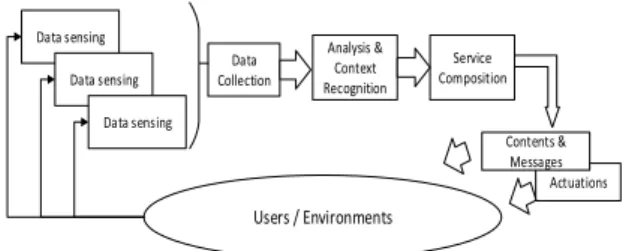
The conceptual processing flow of ASN is shown in Fig. 1.
First, the state of the environment is measured by sensors, and then sensed data are collected in a storage unit via a data sink. The stored data are then analyzed and the “Context”
determined based on the results. Then, if necessary, provi- sion of service or contents is decided and they are provided to users or environments. As a part of services, actuators may also be triggered.
As a high level mechanism, ASN flow is simple and various kinds of sensor devices, sensor nodes, and commu- nication tools are used, depending on the service require- ments and service scenario. In this case, it is advantageous to utilize an open architecture in which components (i.e., various sensors and actuators) are loosely and adaptively connected to each other and allow flexible behaviors based on a service scenario rather than a monolithic closed system.
4.2 RESTful Approach
In view of this principle, when one considers a new ASN service in which systems (proprietary or open) are con- nected in an open manner, then without doubt, use of the internet protocol suite has to be considered, particularly on the network and transport layers, i.e., the use of IPv4/v6 and TCP/UDP.
At the higher layers, utilization of the “RESTful” ap- proach is very important for flexible interconnection of sen- sors/actuators in ASN systems. The term “RESTful” is based on REST (representational state transfer), which is an architectural style for a distributed system like the World Wide Web[7]. Recently, RESTful approach has been de- ployed widely in API designs on the Internet for information exchange. In RESTful approach, an object is treated as a re- source and identified by a uniform resource locator (URL) and is adaptively manipulated by HTTP methods. This con- cept does not confine its application to only resources on the
Fig. 1 Conceptual ASN processing flow.
Fig. 2 Example of ASN based on RESTful approach.
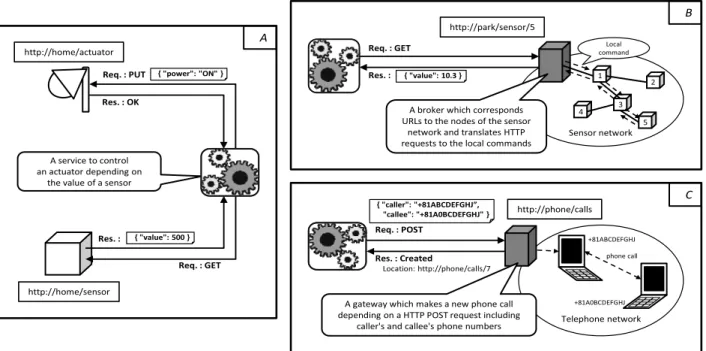
Web but also allows its application to sensors and actuators in the real world[8]. For example, one can get a value from a sensor by sending an HTTP GET method to a correspond- ing URL, or one can control an actuator by sending a next transition state to it with an HTTP PUT method. A service to control the actuator depending on the value of the sensor can be realized by integrating these resources and methods (see A in Fig. 2). Expanding the RESTful approach to real objects has not been dealt with on the Web; however, it gives flexible accessibility that we believe is a best practice for ASN.
In our group, the RESTful approach was firstly applied in the national ubiquitous R&D project Ubila (2003–2008) [9]under the name CASTANET[10], and became one of the core technical concepts of the subsequent national project called CUBIQ (2008–2010)[11]. Those projects dealt with virtually all aspects of ubiquitous networking and ubiqui- tous computing. Because the primary concept phrase at that time was “Connection anytime, anywhere, with anyone and to everything,” there was a strong request by the government to fulfil that concept with sophisticated technical achieve- ments. This requirement was in fact not easy to satisfy be- cause the number of organizations participating in CUBIQ was high and each body already had their own architecture and preferred communication technology. Getting one solid architecture appeared virtually impossible. In order to re- solve these gaps between participating bodies, RESTful ap- proach was selected and field experiments conducted.
Because the sensors and actuators used in ASN often have low computing and communications capabilities, use of HTTP over a TCP connection may be a burden for such devices. Recently, a lightweight protocol called the con- strained application protocol (CoAP) was released by the IETF[12]specifically to support ASN. The protocol itself is
simpler than HTTP and operates over UDP; thus, the com- munication load is expected to be light.
In HTTP and CoAP, a client sends a request to a server first to get or update data. Suppose that a sensor (or the proxy of a sensor) has server capabilities and a client re- quests some sensor data, this model is suitable for a sensor that always provides measured data when requested. In con- trast, if a client requests conditional data, for example, a re- quest with some trigger conditions (like notify if the temper- ature increases above 40 degrees), then the client normally has to wait until such a condition is met and the data is pro- vided from a sensor. In this case, Comet[13],[14]can be utilized to facilitate the long polling required. Alternatively, one may utilize a Publish/Subscribe type protocol. This type of protocol is designed to provide published information to subscribers whenever information is generated from a pub- lisher. It is suitable also for ASN systems in which informa- tion about many sensors (Publishers) is delivered to many subscribers. Message queuing telemetry transport (MQTT) [15] is a representative Publish/Subscribe protocol and is also utilized in oneM2M[16].
4.3 Handling Resources in Multiple Domains
Every sensor and actuator must be clearly identified within a system; hence, a unique identification scheme is manda- tory. A number of identification schemes are currently used to identify objects in ICT systems of multiple domains. For example, IMEI is used for mobile phones, ICCID for SIM, and EPC and several other codes for RFID. In every sys- tem, an entity is uniquely identified within a defined sys- tem. The issue is the question of how to identify an entity outside the system or how to interwork identity schemes be- tween systems., The identification and addressing scheme
1736
IEICE TRANS. COMMUN., VOL.E98–B, NO.9 SEPTEMBER 2015
Fig. 3 A user’s daily activities and related profiles.
being discussed in oneM2M[17]is one in which not only sensor nodes but also service and/or application entities also need identifiers for interworking purposes.
In view of the use of the RESTful approach discussed above, in order to make all identification schemes in mul- tiple domains globally unique and interoperable, identifica- tion schemes should be mapped to URLs or be described as states of resources with URLs. For example, in the case of interworking of a closed local system with the Internet, a broker would take care of the mapping between identifi- cations and URL and HTTP requests received at the broker would be translated into local commands to the target ob- jects. In this way, we can treat sensor nodes in a sensor network as resources, although they are not able to under- stand HTTP by themselves (see B in Fig. 2). On the other hand, in Twilio, phone calls are treated as resources and a new phone call can be made by using HTTP POST method with a state including caller’s and callee’s phone numbers to the corresponding URL[18](see C in Fig. 2). By integrat- ing any resources in multiple domains mapped to URLs, we can create various services.
4.4 Context Information Collection and Dissemination In ASN, measured data are collected and decisions made or some actuation carried out based on analysis of the measure- ment results. If the decision logic is simple, the methodol- ogy is straightforward. For example, in the case of a flood monitoring system, a flood detection sensor constantly mea- sures the water level and, if the level exceeds the limit, the monitoring system sends an alarm. Because this is a closed system, the measurement unit is known in advance, so it is sufficient for the monitoring server to assess the situation by just receiving measured data.
However, the situation becomes very complex in ASN systems; particularly, in systems related to human activities.
Services that use such ASN systems are called “context- aware services.” For example, when a person is coming back home from work, if the temperature in the home exceeds a certain limit (which may vary depending on the season), then a home management system may turn on the air condi- tioning system at an appropriate time prior to his/her return.
In such a case, the system must know the state that he/she is in on his/her way back home. Such information is called
“context.” An agreeable definition of context was given by Day[19]. If context is well recognized and understood by a system, then the system will be able to comprehend the meaning of the user’s behavior or the intention of a target user; thus, better services may be provided. With this sense, the way in which the context is described is crucial, but no standardized format has been specified to date.
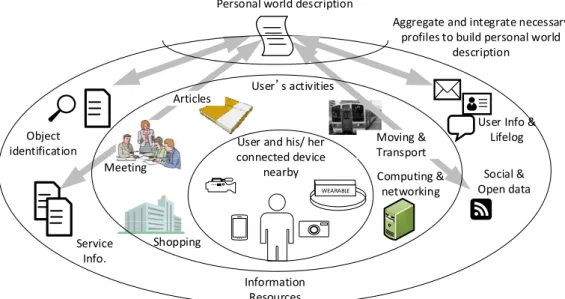
We have been proposing a personal profile aggregator that manages collection and dissemination of personal con- text as a context handling platform[20]. The proposed plat- form manages user generated context information sent from a user. Such information is fundamentally a life log of a user that includes location, visit history, purchase history, and other such information (Fig. 3).
Currently, such information on the activity of a user is typically collected piecemeal by application providers or over the tops (OTTs), depending on the device provided.
For example, activity information may be collected by a wearable healthcare sensor provider, while his/her visit in- formation is collected by a GPS based location based ser- vice (LBS) provider. In contrast, the proposed aggregator is managed by one profile manager — who administers all as- pects of personal profile management. Without passing the personal profile directly to an application provider, the pro- file aggregator delivers the necessary and sufficient profile information to a requested party in accordance with a per- sonal information provisioning policy set forth by the user whenever personal information is requested. Now that var-
Fig. 4 Example RDF expression for a user life log.
ious pieces of personal information is directly sent to a ser- vice provider via smartphones with or without the notice of the user, we believe that this would be beneficial for a user to protect his/her privacy while giving a good opportunity to utilize personal information and enjoy context-aware ser- vices by providing adequate quality and quantity of personal information to service providers[21].
Semantic notation appears to be a reasonable approach for describing personal context, because all the semantics of a personal profile can be globally recognized. R&D imple- mentation of a life log system using a mobile feature phone was achieved in 2005 under the name “Keitai de Lifelog.”
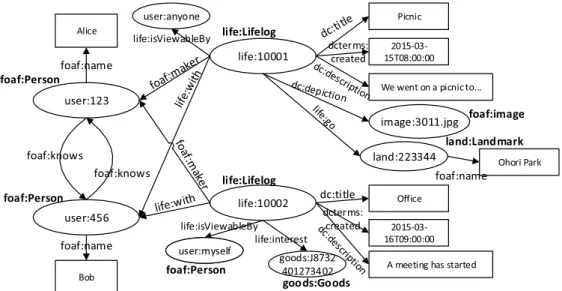
Figure 4 shows an example of the expression of a user life log in which all profile information is described using the re- source description framework (RDF) scheme[22]. In RDF, a sentence comprises triples, specifically, Subject, Predi- cate, and Object. In this figure, the user’s activities are de- scribed using the triplets. Each life log event is identified by a record (life:Lifelog) and the system can recognize the category of the user’s activity by referring a predicate, i.e., who (foaf:maker), when (dcterms:created), where (life:go), interest to what (life:interest), with whom (life:with), etc.
For example, Lifelog type resource life:10001 is linked to a resource user:123 with a predicate foaf:maker. This means that life log record life:10001 is made by user:123, called
“Alice.” This example only shows the life log record of an individual, however, the scheme is not limited to a life log.
It can also be used to describe the context of general situa- tions.
Collected data are stored in a semantic database and re- trieved using RDF query language (SPARQL). The resource description stated above is analyzed by SPARQL and all re- sources can be searched and retrieved with one query.
Recently, linked open data (LOD) entered the scene and is actively being discussed, with use of its semantics be- ing regarded as a promising express method for open data.
The government is now keen to make their own data open. If
a piece of data can be described using RDF, then it is possi- ble to construct a scheme like the proposed life log scheme.
For example, if person’s visit to a place is found in semantic open data with RDF, then this record can be linked to his/her visit record (life:go).
The next challenge is how to make use of such life log records and how to provide better services and applications.
This is discussed in the next subsection.
4.5 Flexible Service Provisioning and Control
As described in Sect. 3, ASN covers a wide variety of ser- vices. Therefore, a flexible service creation and control mechanism is essential for ASN. For this purpose, it is ap- propriate to make use of existing small real or virtual ser- vices and invoke them whenever necessary using service controlling functions. We call such an approach an “hori- zontal approach.”
There are a number of such web services available on the Internet. For example, IFTTT[23]and Zapier[24]pro- vide a comprehensive user interface for defining a trigger condition and its action. Other examples include Pipes[25]
and Plagger. These are called feed aggregators and normally use RSS feeds for input and generate appropriate outputs such as RSS feeds, contents, e-mails, and tweets. Apply- ing such tools to ASN appears to be straightforward if the context information described above can apply to them.
5. Trends in the Evolution of ASN
In this section, we describe several trends in the evolution of ASN.
5.1 Making Use of Big Data
ASN sometimes generates large amounts of “big data” that,
1738
IEICE TRANS. COMMUN., VOL.E98–B, NO.9 SEPTEMBER 2015
when successfully analyzed in the cloud, is said to pro- duce new knowledge. This is a new trend that we are sure will open up a new vista to the ASN world. The key is in how the big data are collected and uploaded to a cloud plat- form, making it feasible for modeling and large-scale anal- ysis with special data handing techniques such as Hadoop.
Processing has become rather easy and relatively low cost thanks to the advent and penetration of commercial cloud services. In the near future, many sensors will be installed in various places, generating a constant stream of sensor data.
Dealing with such big data is expected to be a typical pro- cessing task for ASN. There are many experts in this big data processing field; therefore, we will not go into the details of this topic here.
5.2 Spread of Wearable Sensors
Recently, various types of wearable sensors have come onto the market. In particular, wrist-type motion sensors, such as Watashi Move[26], Jawbone [27], and Microsoft band [28], have become very popular. With these sensors, peo- ple can monitor their everyday activities without taking any specific conscious action. Some devices are even able to monitor heart rate and/or locations with GPS. The data from these devices are then uploaded onto the cloud of a service provider and the results of analyses conducted are viewed via the user’s smartphone. Consequently, healthcare busi- ness is receiving much attention as a result of wearable sen- sors.
Many wearable sensor providers operate their own healthcare portal. Users may constantly check on their health status by periodically consulting a smartphone to see the measured results. In some cases, measured data are only stored on the providers’ site and users do not have a chance
Fig. 5 Snapshot of “Kokoro App.”[30](available at the Apple App Store).
to retrieve them. In order to facilitate mashing up for fur- ther service enhancement, an open data policy, in which the measured data belong to the user in principle and the user has the right to control the data, is essential.
5.3 Expectation of Open Hardware
The important objective for ASN is to penetrate devices and applications widely in order to serve our real world society.
One important facet for achieving this vision is open hard- ware. Open hardware is a computing module in which both software and hardware design are made open, giving users flexible programming opportunities and flexible connectiv- ity with sensor devices. A typical open hardware is Arduino [4]. Even when the design of the hardware is not made pub- lic, it can sometimes be called open hardware if a sufficient software development kit is provided. Android devices may be regarded as this kind of open hardware.
Recently, Intel released a small computing module with integrated communication functions called Edison [29].
Further, Intel also just announced an even smaller module called Curie[30]that is aimed at the wearables market. The advent of such modules will contribute to ASN penetration.
5.4 Application of ASN to Mental Healthcare
As described in Sects. 3 and 5.1, healthcare services with wearable sensors are becoming popular. The main purpose is in essence to maintain good physical health. We believe that maintaining a good mental condition is also important as the next ASN target. For example, the economic loss due to clinical depression is said to be two trillion yen per year in Japan, which amounts to a major damage for the Japanese economy. Even when such a clinical case level is
not reached, there are potentially many workers who are get- ting mentally distressed as a result of stress. Obtaining some form of relief from such stress is for them equally impor- tant. With this as our motivation, we have gotten involved in cognitive behavior therapy (CBT), a kind of counseling technique that is effective for depression.
CBT is, in essence, psychotherapy to monitor and modify one’s own thoughts and behaviors. In CBT, a patient keeps a record of his/her daily life and analyzes himself/herself, followed by rebuilding of his/her cogni- tion from negative thoughts to more realistic and effective thoughts. It is a pragmatic way of improving the condition of one’s mind. Recording the life of a patient using paper is however inefficient. Because it is indeed a life log itself, we have joined the project called Fun to Learn, Act and Think through Technology (FLATT) instituted by Kyoto Univer- sity and are currently involved in the development of a CBT application called “Kokoro App.” (“kokoro” means “mind”
in Japanese)[31]for the iPhone (Fig. 5). The execution of CBTs on PC/smartphones has been experimented abroad. In fact, the results of a trial conducted using volunteer patients confirm that this application may be effective[32]. We are planning to enhance CBT by making use of various types of life log data obtained through wearable sensors[33].
6. Conclusion
In this paper, we discussed the core technologies that will provide support for ASN through the years. In particular, we emphasized the importance of the RESTful approach for ensuring global accessibility to sensors and actuators.
Further, we discussed several profile-handling technologies for context-aware services and their relationship to LOD.
Lastly, we envisaged the trends in ASN, including our cur- rent work toward the development of mental healthcare CBT. ASN services are not provided solely by large ser- vice providers and OTTs, they are also available for small communities and SMEs, and are even customizable to suit individuals.
ASNs have the tremendous potential to support our life and society as technology matures. The key issue is per- haps who will invest in which ASN area and who will make ASN a big business, which we believe is quite feasible as significant changes will take place within the next decade.
In the same manner as many web/network services have be- come very popular through web technologies over the past 15 years, ASN services in the real world are also expected to become very popular in the near future.
Acknowledgments
We wish to thank the committee of this special section for giving us the opportunity to publish this paper. We also wish to express our deep appreciation to all members who were involved in the national ubiquitous projects Ubila and CU- BIQ. Contributions of Prof. T. Furukawa and all members of the FLATT are appreciated for CBT project.
A part of this work is supported by a joint research with KDDI R&D laboratories. A part of the CBT work is sup- ported by “Research and Development on Fundamental and Utilization Technologies for Social Big Data,” the Commis- sioned Research of the National Institute of Information and Communications Technology (NICT), JAPAN.
References
[1] M. Weiser, “The computer for the 21st century,” Sci. Am., vol.265, no.3, pp.94–104, Sept. 1991.
[2] oneM2M: TR0001, “oneM2M use cases collection,” Sept. 2013.
http://www.onem2m.org/images/files/deliverables/oneM2M-TR-00 01-UseCase-V0 0 5.doc
[3] ITU-T:Y.2221, “Requirements for support of ubiquitous sensor net- work (USN) applications and services in the NGN environment,”
2010.
[4] Arduino, http://www.arduino.cc/ [5] Raspberry Pi, http://www.raspberrypi.org/ [6] Xively, http://www.xively.com
[7] R. Fielding, Architectural styles and the design of network-based architectures, Ph.D. Dissertation, University of California, Irvine, 2000.
[8] D. Guinard, V. Trifa, and E. Wilde, “A resource oriented architecture for the Web of Things,” 2010 Internet of Things (IOT), pp.1–8, 2010.
[9] M. Ohashi, “Japanese ubiquitous network project: Ubila,” AISE Handbook (Handbook on Ambient Intelligence and Smart Envi- ronments), eds. by H. Nakashima, H. Aghajan, and J.C. Augusto, pp.1223–1250, Springer, 2009.
[10] Y. Kawahara, N. Kawanishi, M. Ozawa, H. Morikawa, and T. Asami,
“Designing a framework for scalable coordination of wireless sensor networks, context information and Web services,” 27th International Conference on Distributed Computing Systems Workshops (ICD- CSW’07), pp.44–44, 2007.
[11] M. Ohashi, “Introduction of ubiquitous service platform project CU- BIQ,” Proc. 2011 Tenth International Symposium on Autonomous Decentralized Systems, pp.456–461, 2011.
[12] RFC7252, “The constrained application protocol (CoAP),” June 2014.
[13] S. Duquennoy, G. Grimaud, and J.-J. Vandewalle, “Consistency and scalability in event notification for embedded Web applications,”
Proc. 2009 11th IEEE International Symposium on Web Systems Evolution, pp.89–98, 2009.
[14] Comet: Low Latency Data for the Browser, http://infrequently.org/ 2006/03/comet-low-latency-data-for-the-browser/
[15] MQTT Version 3.1.1, A. Banks and R. Gupta, eds., OASIS Standard, 2014.
[16] http://www.etsi.org/news-events/news/749-2014-01-a-new-phase-in- onem2m-standardization
[17] oneM2M: TR0001 “oneM2M Functional Architecture Base- line Draft,” Aug. 2014. http://www.onem2m.org/images/files/ deliverables/TS-0001-oneM2M-Functional-Architecture-V-2014-08.
[18] Twilio Docs — API REST Making Calls, http://www.twilio.com/ docs/api/rest/making-calls
[19] A.K. Dey, “Understanding and using context,” Personal and Ubiqui- tous Computing, vol.5, no.1, pp.4–7, 2001.
[20] D. Morikawa, M. Honjo, N. Kotsuka, A. Yamaguchi, and M. Ohashi,
“Profile aggregation and dissemination: A framework for personal- ized service provisioning,” Ubicomp 2004 Workshop, Nottingham, England, Sept. 2004.
[21] D. Morikawa, M. Honjo, A. Yamaguchi, and M. Ohashi, “A Pro- posal of user profile management framework for context-aware Ser- vice,” Proc. 2005 Symposium on Applications and the Internet Workshops (SAINT 2005 Workshops), pp.184–187, 2005.
[22] N. Kotsuka and D. Morikawa, “Mobile life log distribution and man-
1740
IEICE TRANS. COMMUN., VOL.E98–B, NO.9 SEPTEMBER 2015
agement of profiles in real world,” IPSJ Magazine, vol.50, no.7, pp.603–612, July 2009. (in Japanese)
[23] IFTTT, https://ifttt.com/ [24] Zapier, https://zapier.com/
[25] Pipes: https://pipes.yahoo.com/pipes/
[26] Watashi Move, http://www.watashi-move.jp/pc/wm/index.html (in Japanese).
[27] Jawbone, https://jawbone.com/
[28] Microsoft band, http://www.microsoft.com/microsoft-band/ [29] Edison, http://www.intel.com/content/www/us/en/do-it-yourself/edi
son.html
[30] Curie, http://www.intel.com/content/www/us/en/wearables/wearabl e-soc.html
[31] Kokoro, https://itunes.apple.com/jp/app/kokoroapuri/id567669213 (in Japanese).
[32] H. Imai, T. Furukawa, M. Horikoshi, N. Kawanishi, A. Hasegawa, Y.
Takeuchi, and M. Ohashi, “The efficacy of cognitive-behavior ther- apy application for depression using smartphone,” IEICE Gen. Conf.
’15, IEICE B-18-28, March 2015 (in Japanese).
[33] N. Kawanishi, A. Hasegawa, H. Imai, Y. Takeuchi, and T. Furukawa,
“An implementation of a platform to support cognitive behavioral therapy using smart phones,” 4th International Symposium on Per- vasive Computing Paradigms for Mental Health (MindCare 2014), Tokyo, Japan, 2014. (poster)
Masayoshi Ohashi received B.S., M.S., and Ph.D. degrees in Engineering from Kyoto Uni- versity in 1981, 1983, and 1994, respectively.
He joined KDD in 1983 and has been engaged in the research and development of third gen- eration mobile telecommunications, ubiquitous computing/networking. He was previously a director at Advanced Telecommunications Re- search Institute International (ATR), and is cur- rently a professor at Fukuoka University. He is a member of IEEE, IEICE, and IPSJ.
Nao Kawanishi received B.E., M.E., and Ph.D. degrees from the University of Tokyo in 2002, 2004, and 2009, respectively. He joined Advanced Telecommunications Research Insti- tute International (ATR) in 2008. He has been engaged in the research and development of ubiquitous networking, cognitive radio access networks, cooperative relative positioning, and lifelog applications. He is a member of IEEE, ACM, IPSJ, and IEICE.
![Fig. 5 Snapshot of “Kokoro App.” [30] (available at the Apple App Store).](https://thumb-ap.123doks.com/thumbv2/123deta/10098698.1498991/6.892.90.807.754.1088/fig-snapshot-kokoro-app-available-apple-app-store.webp)
