O
ver s eas expans i on and t ec hnol ogi c al
c apabi l i t i es : t he c as e of Chi nes e el ec t r oni c s
f i r m
s
著者
Ki m
ur a Koi c hi r o
権利
Copyr i ght s 日本貿易振興機構(ジェトロ)アジア
経済研究所 / I ns t i t ut e of D
evel opi ng
Ec onom
i es , J apan Ext er nal Tr ade O
r gani z at i on
( I D
E- J ETRO
) ht t p: / / w
w
w
. i de. go. j p
j our nal or
publ i c at i on t i t l e
I D
E D
i s c us s i on Paper
vol um
e
699
year
2018- 03
INSTITUTE OF DEVELOPING ECONOMIES
IDE Discussion Papers are preliminary materials circulated to stimulate discussions and critical comments
Keywords: technological capabilities, M&A, electronics industry, China
JEL classification: F21, L68, O31
* Associate Senior Research Fellow, IDE.
IDE DISCUSSION PAPER No. 699
Overseas expansion and technological
capabilities: The case of Chinese
electronics firms
Koichiro KIMURA*
March 2018
Abstract: We analyze the formation of technological capabilities of major
Chinese home appliance and consumer electronics manufacturers in
comparison with telecommunication equipment manufacturers and hardware
startups in the electronics industry. To achieve this, we focus on the external
business environment of major home appliance and consumer electronics
manufacturers, including the technological gaps between foreign and Chinese
firms in the same industry, the possibility of cross-border mergers and
acquisitions (M&A) transactions, and the barriers to starting a business and to
developing new products. Results suggest that there are a variety of ways to
increase the technological capabilities of firms in emerging countries and that
The Institute of Developing Economies (IDE) is a semigovernmental, nonpartisan, nonprofit research institute, founded in 1958. The Institute merged with the Japan External Trade Organization (JETRO) on July 1, 1998.
The Institute conducts basic and comprehensive studies on economic and related affairs in all developing countries and regions, including Asia, the Middle East, Africa, Latin America, Oceania, and Eastern Europe.
The views expressed in this publication are those of the author(s). Publication does not imply endorsement by the Institute of Developing Economies of any of the views expressed within.
INSTITUTE OF DEVELOPING ECONOMIES (IDE), JETRO
3-2-2, WAKABA,MIHAMA-KU,CHIBA-SHI
CHIBA 261-8545, JAPAN
©2018 by Institute of Developing Economies, JETRO
No part of this publication may be reproduced without the prior permission of the
1
Introduction
*As the domestic market has saturated, many indigenous Chinese firms have become outward looking to pursue further growth. Numerous Chinese firms now have global operations, such as Huawei Technologies (Huawei) and ZTE in the telecommunication equipment industry, Haier Group (Haier) and Midea Group (Midea) in the home appliance industry, and Lenovo in the PC industry, among others. In addition to these major incumbents, there are an increasing number of hardware startups that are aggressively developing overseas markets immediately after they commence business operations. Examples of such startups include Da-Jiang Innovations Science and Technology (DJI), which was founded in 2006 and sells drones, and Makeblock, which was founded in 2011 and sells a robot production platform, among others.
This paper discusses the overseas expansion of Chinese firms and their technological capabilities vis-à-vis their competitiveness in the global market. We limit the discussion to firms that have own-brand products. Although there are numerous contract manufacturers that are exporting huge product volumes to customer firms, the business strategies of firms with own brands are different from those of contract manufacturers in terms of, for example, product development and marketing. Hence, we concentrate on the rise of global brands from China. Among the many aspects of business internationalization, we are specifically concerned with overseas market expansion through exports and/or outward foreign direct investment (ODI). Therefore, herein, we limit the aims of ODI to the market-seeking objective, though there are other purposes for investment, such as resource-seeking and strategic asset-seeking ODI (Buckley et al., 2007).1
* Associate Senior Research Fellow, Development Studies Center, Institute of Developing
Economies (IDE), Japan. The author thanks the members of the research project “Industrial Organisation in China: Theory Building and Analysis of New Dimensions,” Dr. Mai Fujita (the project leader, IDE), Dr. John Humphrey (University of Sussex), Professor Shiro Hioki (Tohoku University), and Dr. Ke Ding (IDE) for their comments. Also, the author expresses my gratitude to Professor Tomoo Marukawa (The University of Tokyo) as the discussant for my article and all participants at the workshop held at Institute of Development Studies, University of Sussex, and IDE. Certainly, all remaining errors are my own.
1 Cheng and Ma (2010) show China’s “Go Overseas” policy and some patterns of outward FDI
It is known that the productivities of internationalizing firms through exports and/or ODI are higher on average than those of their non-internationalizing counterparts (Antràs, 2016; Antràs and Helpman, 2004; Helpman et al., 2004; Melitz, 2003). Overseas expansion requires additional fixed costs to understand and adapt to foreign trade institutions, markets, rules, and preferences of foreign consumers, among other things, while organizing sales and after-sales service networks in foreign markets; only high-productivity firms can bear the costs of such expansion. In addition, research on ODI determinants has established that having competitive technology/expertise (the ownership advantage) is one of the determinants of ODI as well as a reason to invest in particular places and do so independently (the location and internalization advantages, respectively) ergo the ownership-location-internalization (OLI) paradigm for ODI mechanisms (Dunning and Lundan, 2008).2
ODI offers business opportunities to investors but also requires additional fixed costs associated with international ventures for the same reasons noted above. Therefore, investors must exhibit a certain degree of competitiveness in comparison to their rivals.
As previous studies in international economics predict, Chinese firms with increasing technological capabilities have been accelerating overseas operations. In addition to introducing technology from developed countries, major Chinese firms have gradually increased research and development (R&D) efforts to decrease production costs and to launch high value-added products under the fierce competition and rapid wage growth in China after the mid-2000s. As a result, Chinese firms actively looking abroad are increasing their efforts to adapt to the tougher business conditions in China.
The technological capabilities and configurations of Chinese firms are, however, different among firms. Although home appliance and consumer electronics manufacturers have also increased their technological capabilities by introducing technologies from developed countries, by virtue of learning-by-doing through huge production and by carrying out continuous R&D, some of the major home appliance and consumer electronics manufacturers have exhibited a tendency toward buying time for further growth through large-scale cross-border mergers and acquisitions (M&A) transactions. Moreover, firms that have conducted large-scale cross-border M&A have been more likely to succeed in the internationalization of their businesses in comparison with other home appliance and consumer electronics manufacturers. In contrast, major
2
telecommunication manufacturers have tended to expand their overseas operations with less of an emphasis on large-scale cross-border M&A transactions. On the other hand, startups are different from the incumbents, which conduct M&A transactions and R&D investment. Startups striving to produce new products are increasing in the background of changes in the business environment and are associated with the birth of new markets and the development of startup ecosystems. Consequently, internationalizing firms share a similarity in that they are uniformly increasing their technological capabilities, but they also exhibit differences in terms of process specificities related to their technological capabilities.
In this case study, we analyze the formation of technological capabilities in Chinese firms in the home appliance and consumer electronics industry, comparing it with telecommunication manufacturers and hardware startups in the same industry. We focus on the external business environment of major home appliance and consumer electronics manufacturers, including the technological gaps between foreign and Chinese firms in the same industry, the possibility of cross-border M&A transactions, and the barriers to starting a business and to developing new products. Results suggest that there are a variety of ways through which firms can increase their technological capabilities in emerging countries and that there can be an optimal strategy for firms in emerging countries depending a business condition.
The remainder of this article is organized as follows. In Section 2, we introduce the growth pattern and overseas expansion of Chinese firms. In Section 3, we analyze the formation of technological capabilities in Chinese electronics firms. Finally, Section 4 concludes.
2
Growth of Chinese Firms
In this section, we introduce the growth of Chinese electronics firms as a precursor to the analysis in the next section. First, the growth pattern of Chinese firms in the period up to the mid-2000s is discussed in Section 2.1. Subsequently, the nature and extent of Chinese
2.1 Growth Trends from the 1970s to the Mid-2000s
Chinese electronics firms rapidly grew by being more likely to place greater emphasis on market-oriented stages in product value chains—product development, manufacturing, and sales—in the period up to the mid-2000s (Kimura, 2014; Marukawa, 2007; Ohara, 2000; Watanabe, 2015); they have also endeavored to become increasingly technology-oriented in recent years. Market-technology-oriented stages specifically include downstream operations in value chains, such as building nationwide sales and after-sales networks and providing products catering to the preferences and lifestyles of Chinese consumers in a variety of areas and from a variety of income levels, among other things. In contrast, technology-oriented stages include upstream operations, such as designing and developing new products and developing and manufacturing core components of products. Product assembly and manufacturing locates between the market- and technology-oriented stages just described.
Chinese firms have been rapidly growing since the advent of economic liberalization in the late 1970s. Since there were significant technological gaps between foreign and Chinese firms when this period of liberalization commenced, Chinese firms began to introduce production lines and related technologies from developed countries. Moreover, they accumulated technological capabilities and expertise in terms of assembling and manufacturing products through the rapid expansion of production volumes. Consequently, technological gaps in the product assembly and manufacturing stage have narrowed.
However, it was not rational for Chinese firms facing significant technological gaps to accumulate technological capabilities for product development and core components independently at that time. Therefore, they heavily depended on the product design services and core components provided by outside specialized firms. Chinese firms did not possess advanced technologies, and it was rational to use outside firms because product structures had become modularized through digitalization and because industrial structures had become vertically specialized along with modularization.
Chinese firms have been more likely to internalize the market-oriented stage rather than the technology-oriented stage. They have actively established nationwide sales and after-sales service networks, including markets in local cities and rural areas which foreign firms have not yet penetrated. Moreover, they have differentiated products
indigenous firms in the Chinese market.3 In other words, they have been able to enjoy the
home advantage in the domestic market. Consequently, Chinese firms have realized rapid growth by finding an optimal balance among the following three factors: technological accumulation, utilization of outside firms to fill technological gaps, and the home advantage as indigenous firms.
Although the market-oriented strategy has worked well for Chinese firms in the domestic market, it is not effective in the global market (Kimura, 2014). First, because Chinese firms still face technological gaps in product development, their technological capabilities are insufficient to differentiate products in the context of fierce competition in the global market. Second, because the accessibility of vertical specialization can be an advantage not only for Chinese firms but also for firms in other emerging countries, the advantage can decrease in foreign markets. Third, as they have enjoyed the home advantage in the Chinese market in comparison with foreign firms, they, in turn, face the away disadvantage as foreign firms in other markets. Importantly, they are required to have some form of advantage to offset the cost of instigating foreign operations. Therefore, they have been attempting to increase technological capabilities as the business environment in China has become tougher for Chinese firms.
2.2 Overseas Expansion for Further Growth
Given the increasing technological capabilities of Chinese firms, they are expanding their overseas operations to pursue further growth. Table 1 shows the domestic and foreign market shares of major Chinese home appliance and consumer electronics firms in 20154
;
3
Moreover, protectionist policies significantly helped the domestic market expansion of Chinese firms, especially until China’s World Trade Organization (WTO) accession in 2001. However, we cannot underestimate the effect that fierce competition among indigenous Chinese firms had on enhancing the competitiveness of those firms (Kimura, 2011).
4 Foreign market shares are standardized by the size of every market. “Foreign Market” includes
the firms included are those ranked within the top five in each product market in China, listed in descending order of foreign market share. Foreign market shares might be smaller than the market shares of Chinese firms in each individual product market because the market categories in Table 1 include some related products, though we can find comparative situations in terms of which firms are, and are not, expanding overseas operations.5
Table 1: Domestic and Foreign Market Shares by Firm and Market, 2015
Source: Constructed by the author through Euromonitor’s Passport.
Table 1 shows that some of the major firms in the domestic market are expanding foreign market shares. The revenue of Lenovo, the biggest PC vendor, mainly comes from overseas markets, with just 32% coming from China in 2014. The geographical breakdown of Lenovo’s foreign revenue is as follows: 26% from the Americas, 14% from
5 For example, the category of computers and peripherals includes desktop and portable
computers, monitors, and printers. The category of refrigeration appliances includes refrigerators, freezers, and electric wine coolers, among others.
Firm Brand(s) Market Domestic
Market (%)
Foreign Market (%)
Lenovo Lenovo Computers and peripherals 24.8 5.5
Haier Haier Refrigeration appliances 39.1 4.2
Haier Haier Home laundry appliances 44.8 2.3
Hisense Hisense, Ronshen Refrigeration appliances 11.4 1.0
Haier Haier Microwaves 13.1 0.6
Midea Midea Microwaves 36.8 0.6
Hisense HiSense Televisions 17.5 0.3
Midea Midea Refrigeration appliances 10.5 0.2
TCL TCL Televisions 16.4 0.2
Midea Midea, Little Swan Home laundry appliances 23.9 0.2
Changhong Changhong Televisions 8.0 0.1
Skyworth Skyworth Televisions 17.0 0.0
Konka Konka Televisions 9.6 0.0
Meiling Meiling Refrigeration appliances 8.0 0.0
TCL TCL Home laundry appliances 3.3 0.0
Asia-Pacific, and 28% from Middle East and Africa. Haier is one of the largest home appliance manufacturers in the global refrigerator and washing machine markets. It is ranked first in China, with market shares of 39.1% and 44.8% in the Chinese refrigeration and home laundry appliance markets, respectively. Moreover, it is trying to expand shares in markets both in developed and developing countries. Other home appliance manufacturers are also endeavoring to expand overseas business, although the majority is still captured by Samsung and LG in South Korea and certain Japanese firms in the home appliance market.
Next, in the telecommunications equipment industry, Huawei and ZTE are rapidly growing in the global market. Huawei has already taken its place among the top telecommunications equipment venders with Ericsson (Sweden) and Nokia (Finland).
Huawei’s revenue totaled 395,009 million RMB in 2015, and the revenue by market was as follows: 42% from China; 32% from Europe, the Middle East, and Africa; 13% from the Asia-Pacific; and 10% from the Americas (Huawei Investment & Holding Co., Ltd., 2016).6
Further, although ZTE is not included in the top group in the global telecommunication equipment market, it is a major player in the industry. ZTE’s revenue was 81,471.3 million RMB in 2014 (ZTE’s official website).7 Half of this revenue
emanates from the Chinese market and the other half from overseas markets.
In addition to these major incumbents, an increasing number of hardware startups are also vying to sell newly developed products in the global market (Kimura, 2017, Forthcoming). The rapid expansion of the global commercial drone market was initially led by Parrot in France, 3D Robotics in the U.S., and DJI in China since approximately 2010; according to DJI, it captured circa 70% of the market in 2016. Makeblock, a Shenzhen-based platform provider for making robots, is also expanding overseas sales in more than 140 countries, especially in the Western market. In addition to electronics hobbyists, the robot platform has become popular for those consumers who are interested in science, technology, engineering, and mathematics education and also appeals to children.
As discussed above, an increasing number of Chinese firms are currently trying to increase their technological capabilities and expand foreign operations. However, the
6
Sales by business category were as follows: 59% from the carrier business, 33% from the consumer business, 7% from the enterprise business, and the remainder from other businesses.
7 Sales by business category were as follows: 57% for carriers’ networks; 28% for handset
formation of technological capabilities is different across firms; this is discussed in detail in the next section.
3
Technological Capability Formation and Determinants
Major home appliance and consumer electronics firms have been expanding their global market shares, especially by conducting large-scale cross-border M&A transactions. To decrease production costs and develop high value-added products, major home appliance manufacturers such as Haier and Midea have also been investing in R&D activities. Indeed, Haier has five major R&D centers around the world.
However, in addition to R&D, it has had opportunities to acquire white goods businesses from firms in developed countries in the same industry.8
According to Table 2, Haier bought Fisher & Paykel (New Zealand), the washing machine and refrigeration business of Sanyo (Japan), and the home appliance business of GE (U.S.). Haier’s aim to buy these firms is to acquire technologies and patents for high-end white goods, and sales networks in the global market. In addition to the increase of technological and sales capabilities, Haier can realize an advantage of scale by integrating the capacity of each firm.
8
Table 2: Cross-Border M&A Deals over 100 Million USD
Notes: (1) The author accessed the M&A database on February 3, 2017.
(2) The following names were used to search for M&A deals for each firm: Huawei Technologies Co., Ltd. (registered in China) for Huwaei; ZTE Corporation (in China) for ZTE; Haier Group Corporation (in China) and Qingdao Haier Co., Ltd. (in China) for Haier; Midea Group Co., Ltd. (in China), Midea International Corporation Co., Ltd. (in Hong Kong), and GD Midea Holding Co., Ltd. (in China) for Midea; and
Lenovo Group Ltd. (in Hong Kong), Lenovo Germany Holding GmbH (in Germany), and Lenovo NEC Holdings BV (in the Netherlands) for Lenovo.
(3) “Deal Status” includes “Completed Assumed,” “Completed,” “Announced,” and “Pending,” and it excludes “Withdraw” and “Rumor.”
(4) Asterisks (*) denote deal values estimated from various sources.
Source: Constructed by the author through Bureau van Dijk’s Zephyr.
Acquiror Target Target Country Deal Type Deal Status Announced Date Huawei Sunday Communications Ltd Cayman Islands Minority stake increased
from 7.11% to 8.02% Completed 155.04 * 05/26/2004 Haier Haier Electronics Group Co.,
Ltd Bermuda
Acquisition increased from 19.38% to 51.31%
Completed
Assumed 249.77 12/11/2009 Haier Haier-CCT Holdings Ltd Bermuda Acquisition increased from
29.94% to 84.85% Completed 126.34 03/16/2004 Haier Haier (Hong Kong) Ltd Hong Kong Acquisition increased from
100% to 100% Announced 806.04 05/26/2015 Haier Haier Sanyo Eelectric Co., Ltd Japan Acquisition Completed 121.26 * 10/18/2011 Haier Fisher & Paykel Appliances
Holdings Ltd New Zealand Capital Increase 50%
Completed
Assumed 117.04 * 05/27/2009 Haier Haier Singapore Investment
Holding Pte Ltd Singapore Acquisition 100% Announced 785.68 05/26/2015 Haier GE Appliances US Acquisition 100% Completed 5,400.00 01/15/2016 Midea KUKA AG Germany Minority stake increased
from 5.4% to 10.2% Completed 136.95 * 02/04/2016 Midea Toshiba Lifestyle Products &
Services Corporation Japan Acquisition 80.1% Completed 499.51 * 03/30/2016 Midea Carrier Latin America Holding
Company n.a. Acquisition 51%
Completed
Assumed 223.00 * 08/08/2011 Lenovo Comércio de Componentes Eletr
ônicos (CCE) Ltda Bermuda Acquisition 100% Completed 146.38 * 09/05/2012 Lenovo Medion AG Germany Minority stake 36.656% Completed 330.62 06/01/2011 Lenovo Medion AG Germany Acquisition increased from
36.656% to 73.955%
Completed
Assumed 311.75 06/01/2011 Lenovo Medion AG Germany Acquisition increased from
61.49% to 79.81%
Completed
Assumed 146.33 10/09/2012 Lenovo Lenovo Group Ltd Hong Kong Share buyback 4.7% Announced 152.37 05/04/2005 Lenovo NEC Personal Computer KK Japan Acquisition 100% Completed 224.3 * 01/27/2011
Lenovo Motorola Mobility Holdings
Inc. US Acquisition 100% Completed 2,910.00 * 01/29/2014 Lenovo IBM Corporation's X86 Server
Hardware Business US Acquisition 100% Announced 2,300.00 * 01/23/2014 Lenovo IBM Corporation's PC Business n.a. Acquisition 100% Completed 1,750.00 12/07/2004
Other major manufacturers also have a similar strategy. Midea and Lenovo aim to increase the technological capabilities and related patents and to expand the sales networks with the strong brands of acquired firms. Midea has been trying to expand its reach by acquiring the Latin American business of Carrier (U.S.) and the white goods business of Toshiba (Japan).9
In addition to the home appliance manufacturers, a consumer electronics manufacturer, Lenovo, also has expanded by buying the businesses of firms in developed countries, such as the PC business of IBM (U.S.) in 2004, Medion (Germany) in 2011, and the PC business of NEC (Japan) in 2011.10
Although Lenovo has been conducting R&D in the electronic computer manufacturing industry, but the ratio of R&D to revenue is relatively not so high, 2.6% in 2014. Therefore, Lenovo also has been expanding overseas business by conducting large-scale cross-border M&A transactions. In addition to the firms on Table 2, Hisense, a major Chinese TV manufacture as shown in Table 1, also decided to buy Toshiba’s TV business (Japan) at over 100 million dollars in order to enhance their global business in 2017. Therefore, major manufacturers which are trying to expand sales in the global market are likely to conduct cross-border M&A deals for further growth.
In industries in which related technologies have gradually matured, technological gaps often become smaller, and this “catching up” manifests itself in productivity increases across firms in developing countries. Consequently, major firms in developed countries can lose their competitive edge over firms in developing countries. This dynamic evolution can then proceed such that firms in developing countries end up buying the businesses of the defeated firms and increasing their technological capabilities, brand power, and a variety of assets, such as patents and sales networks in overseas markets.
Therefore, growing firms in developing countries need to consider the balance between possibilities to acquire competitors’ businesses in the same industry and investing in R&D for enhancing competitiveness; excessively large-scale M&A and excessive R&D investments are both risky. For example, when a major Chinese home appliance and consumer electronics manufacturer, TCL, acquired the television business of Thomson (France) and the mobile phone business of Alcatel (France) in 2005 after
9
Moreover, Midea bought a robot manufacturer in Germany, KUKA, and is trying to absorb robotics technologies and expand business.
10
establishing joint ventures with both of these French firms, it could not generate successful results due to inadequate business forecasts and insufficient control over the acquired organizations. These were early major transactions for Chinese manufacturers and illustrate key difficulties with conducting large-scale cross-border M&A for firms that did not have enough experience in it.
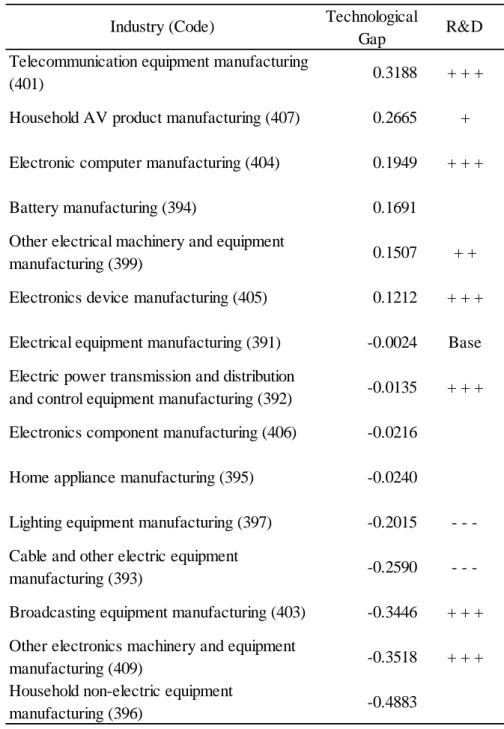
Since we are interested in the formation of technological capabilities in firms in developing countries, we here utilize data from Kimura (2016) to measure the average technological gaps between foreign and indigenous firms vis-à-vis China’s electronics industry (Table 3). The data cover the 2005–2007 period, when the Chinese government began to place emphasis on R&D activities. The electronics industry is here divided into 15 sub-industries on the basis of China’s standard industrial classification (the standard codes are shown in parentheses).11
The technological gaps in the second column show the differences between average productivity levels of foreign and Chinese firms located in China, specifically calculated for each industry as follows: average total factor
productivity (TFP) level of foreign firms − average TFP level of Chinese firms. Therefore, the gaps do not include the business of foreign firms for the global market other than the Chinese market. The 15 industries are ranked in descending order of technological gaps. In the last column—R&D—the signs + + + (− − −), + + (− −), and + (−) pertain to industry dummies for an R&D determinants equation.12
They indicate that firms in each industry are (not) likely to conduct R&D at significance levels of 1%, 5%, and 10%, respectively; blank cells denote statistical insignificance.
11
The industries included at the two-digit level of classification are as follows: the manufacturing of electrical machinery and equipment (39) and the manufacturing of computer, communications, and other electronic equipment (40). Radar and auxiliary equipment manufacturing (402) was omitted because of the small number of firms in the industry.
12
The probit regression equation is as follows:
rdit=α +x’it + industry + εit,
where rd is a binary dependent variable (1: a firm conducts R&D, 0: a firm does not conduct R&D); x is a vector of control variables (output, export value, profit rate, and firm age); industry
Table 3: Technological Gaps and R&D
Source: Kimura (2016).
The results in Table 3 can be described as follows. First, technological gaps are industry-contingent. The average TFP levels of Chinese firms in the lower nine industries are higher than those of foreign firms; however, those of Chinese firms in the upper five industries are not. According to the descriptions of the 15 industries, it would appear that technologies used in upper industries are not only advanced but also have room for further advancement. Therefore, even if Chinese firms in upper industries are increasing their
Telecommunication equipment manufacturing
(401) 0.3188 + + +
Household AV product manufacturing (407) 0.2665 +
Electronic computer manufacturing (404) 0.1949 + + +
Battery manufacturing (394) 0.1691
Other electrical machinery and equipment
manufacturing (399) 0.1507 + +
Electronics device manufacturing (405) 0.1212 + + +
Electrical equipment manufacturing (391) -0.0024 Base
Electric power transmission and distribution
and control equipment manufacturing (392) -0.0135 + + +
Electronics component manufacturing (406) -0.0216
Home appliance manufacturing (395) -0.0240
Lighting equipment manufacturing (397) -0.2015
-Cable and other electric equipment
manufacturing (393) -0.2590
-Broadcasting equipment manufacturing (403) -0.3446 + + +
Other electronics machinery and equipment
manufacturing (409) -0.3518 + + +
Household non-electric equipment
manufacturing (396) -0.4883
Industry (Code) Technological
productivities, technological frontiers therein might still proceed upward. Second, firms are heterogeneous in terms of their likelihood to conduct R&D. In particular, firms in lighting equipment manufacturing and cable and other electric equipment manufacturing are unlikely to conduct R&D as the negative signs show. Third, firms in the industries associated with bigger gaps are likely to conduct R&D. Although firms in broadcasting equipment manufacturing and other electronics machinery and equipment manufacturing are likely to conduct R&D, the technological gaps therein are smaller than in other industries. The numbers of firms in these industries, 552 and 570 firms, respectively, are small relative to the average number of firms (i.e., 2,513 firms), and products in the latter industry are miscellaneous.13
Therefore, we can posit that although firms in industries associated with bigger gaps can learn more from foreign firms, they are also likely to conduct R&D themselves. If firms in high-tech industries do not conduct R&D, it could be difficult for them to realize further growth. Firms for which the technological gap is getting smaller could increase their technological capabilities by buying foreign firms and their businesses. The behavior of Amoi Electronics (Amoi), a major consumer electronics manufacturer in Xiamen, Fujian, is a pertinent example for understanding the optimal choice to increase technological capabilities for firms in emerging countries. Amoi emphasized in-house R&D to differentiate its products, especially mobile handsets, in fierce competition around the mid-2000s. However, sales did not increase enough to justify increasing the R&D investment. As a result, performance was poor. Although local electronics had been getting to need technological capabilities at that time, but firms might need to consider the balance between R&D and M&A if a possibility to buy foreign firms is getting higher under decreasing technological gaps.
On the other hand, as firms in telecommunication equipment manufacturing in Table 3 conduct R&D, Huawei and ZTE had accumulated technological capabilities through R&D before the Chinese government began to place emphasis on innovation in the mid-2000s. In the case of Huawei, the ratio of R&D to revenue has been over 10% (Huawei Investment & Holding Co., Ltd., 2016). Since technological innovation in telecommunications equipment has been rapid, firms in developing countries in this industry have also been required to conduct R&D. As a result, Huawei has continuously
13
filed a large number of patent applications every year and ranked first in the world with 3,898 Patent Cooperation Treaty (PCT) applications in 2015.
Although Huawei has also concluded various M&A deals to expand business, cross-border M&A deals over 100 million USD are less common. It is difficult to buy major competitors in the same industry, and those competitors maintain active roles by sustaining technological advantages. Moreover, some political concerns from governments in developed countries also inhibit Huawei’s and ZTE’s ODI. Consequently, Huawei has tended to accumulate technological capabilities by investing in R&D activities.
Next, ZTE has also accumulated technological capabilities by continuously conducting R&D. According to ZTE’s official website, it allocates 10% of its revenues to R&D. Consequently, ZTE has filed numerous patent applications. It was the third largest applicant in the world with 2,155 PCT applications in 2015, after Huawei and Qualcomm Inc. (U.S.). However, according to Table 2, it has not concluded any cross-border M&A deals over 100 million USD. These major firms have achieved rapid growth by catching up with firms in developed countries in the same industries.
With emerging new markets such as drones, Internet of Things devices, wearable devices, and robots, hardware startups focusing on developing new products are on the rise. In these new markets, gaps are much less substantive; in other words, firms in developed and developing countries are standing at similar starting points, although the former will still benefit from certain advantages over the latter. In addition, reducing barriers to starting businesses also contributes to closing gaps. Specifically, we can observe the rise of new business systems, such as open source software/hardware, 3D printers, cloud computing services (e.g., Amazon Web Services, AWS), and crowdfunding (e.g., Kickstarter). Startup ecosystems are also rapidly developing. The number of shared office and work spaces for entrepreneurs is increasing. Therefore, entrepreneurs can start businesses with small budgets. In addition, according to a service
provider in China’s venture capital and private equity industry, Zero2IPO, the amount of venture investment in 2016 was 130 billion RMB, 3.7 times higher than in 2010.
developing new markets as first-movers, not followers like the Chinese firms of recent history.
As a result, we showed the following differences among Chinese electronics manufacturers in this section. First, major Chinese home appliance and consumer electronics manufacturers expanding global sales tend to conduct large-scale cross-border M&A transactions. They are trying to seize further opportunities for growth by buying foreign firms or their businesses. Second, firms in the industry with smaller technological gaps are likely to have an opportunity to conduct large-scale cross-border M&A transactions in comparison with firms in the industries with bigger technological gaps and significantly changing business environment. Foreign firms in the industry with bigger gaps are still competitive and startups are at the same starting point.
4
Conclusions
As discussed herein, an increasing number of Chinese firms that have been accumulating technological capabilities are trying to expand overseas operations for further growth. However, the formation of technological capabilities differs among firms, and we have analyzed those differences in terms of the external business environment.
Many major Chinese home appliance and consumer electronics manufacturers have been expanding their business in the global market by conducting large-scale cross-border M&A transactions; we have shown that the technological gap between foreign and Chinese firms is related to this. When technological gaps are smaller, firms have possibilities to increase technological capabilities and accelerate growth by acquiring the businesses of firms in developed countries. If technologies do not change rapidly, then there is potential for firms in developing countries to rapidly catch up with and overtake the technological levels of firms in developed countries, thereby securing important competitive advantages.
The case of firms in the telecommunication equipment industry contrasts with that of firms in the home appliance and consumer electronics industry. When bigger gaps exist, it is still difficult to buy major competitors because they retain their competitiveness. As discussed, it is difficult to provide conclusive remarks regarding the case of the
In addition, the case of startups also differs from that of firms in the home appliance and consumer electronics industry. Since business opportunities in new markets are increasing and the barriers to starting businesses are decreasing, even startups from developing countries have opportunities to seize first-mover advantages. The increase in such new business opportunities is also a significant characteristic of the era of globalization and digitalization.
The technological capabilities of firms in developing countries have been prioritized for innovation and further growth in middle-income countries. Examining the case of Chinese firms, this study found that the technological gaps and the opportunity to conduct M&A transactions, etc., influence the formation of technological capabilities in the era of globalization and rapid changes in technology and business environments. Therefore, firms in developing countries which are trying to increase technological capabilities are required to evaluate the external business environment. It is difficult for firms to change a growth strategy, so it is significant to choose an optimal way for increasing technological capabilities. Therefore, it is imperative to explore and understand the patterns of technological capability formation.
References
Antràs, Pol (2016) Global Production: Firms, Contracts, and Trade Structure, Princeton: Princeton University Press.
Antràs, Pol, and Elhanan Helpman (2004) “Global Sourcing,” Journal of Political Economy 112(3): pp. 552–580.
Buckley, Peter J., L. Jeremy Clegg, Adam R. Cross, Xin Liu, Hinrich Voss, and Ping
Zhang (2007) “The Determinants of Chinese Outward Foreign Direct
Investment,” Journal of International Business Studies 38: pp. 499–518.
Cheng, Leonard K. and Zihui Ma (2010) “China’s Outward Foreign Direct Investment,”
in Robert C. Feenstra and Shang-Jin Wei, eds. China’s Growing Role in World Trade, Chicago and London: The University of Chicago Press.
Dunning, John, and Sarianna M. Lundan (2008) Multinational Enterprises and the Global Economy, 2nd ed., Cheltenham: Edward Elgar.
Helpman, Elhanan, Marc J. Melitz, and Stephen R. Yeaple (2004) “Export Versus FDI with Heterogeneous Firms,” American Economic Review 94(1): pp. 300–316. Huawei Investment & Holding Co., Ltd. (2016) 2015 Annual Report, Shenzhen: Huawei
Investment & Holding Co., Ltd.
Kimura, Koichiro (2011) “China and India’s Electrical and Electronics Industries: A Comparison between Market Structures,” in Moriki Ohara, M. Vijayabaskar, and Hong Lin, eds., Industrial Dynamics in China and India: Firms, Clusters, and Different Growth Paths, New York: Palgrave Macmillan.
Kimura, Koichiro (2014) The Growth of Chinese Electronics Firms: Globalization and Organizations, New York: Palgrave Macmillan.
Kimura, Koichiro (2016) “Technological Development Conditions and R&D: The Case of Electrical and Electronics Industry”, Hiroyuki Kato and Kai Kajitani, eds. The Evolving Chinese-model Capitalism beyond Double Trap, Kyoto: Minerva Shobo (in Japanese).
Kimura, Koichiro (2017) “A Change of Chinese Firms: Innovation through Starting Businesses,”Ajiken World Trend No. 258: pp. 38–42 (in Japanese).
Kimura, Koichiro (Forthcoming) “Competition and Innovation,” Toa No. 609 (in Japanese).
Marukawa, Tomoo (2007) Gendai Chugoku no Sangyo: Bokko Suru Chugoku Kigyo no
Tsuyosa to Yowa sa [Modern China’s Industries: Strengths and Fragilities of
Growing Chinese Firms], Tokyo: Chuokoron-Shinsha (in Japanese).
Melitz, Marc J. (2003) “The Impact of Trade on Intra-Industry Reallocations and Aggregate Industry Productivity,”Econometrica 71(6): pp. 1695–1725.
Ohara, Moriki (2000) “Chugoku Kaden Meka no Kyoso Yui [Competitive Advantages of Chinese Home Appliance Manufacturers],” Nicchu Keikyo Journal No. 2: 6– 16 (in Japanese).