43
Problems in Career Services at Japanese Universities:
A Case Study of Initiatives at Kansai University
Tomotsugu Kawasaki
Professor, Faculty of Sociology, Department of Psychology, Kansai University
Introduction
Career services for students at Japanese universities have been undergoing major changes, particularly in the past several years. Universities have different ideas about career services, but there are similarities among the changes that are taking place at many universities, including Kansai University.
Firstly, the main unit for providing career services is now referred to as the
“career section” instead of the “job placement section” at many universities.
Secondly, universities are targeting students in lower grades and are providing career services at an early stage. Thirdly, universities are shifting their focus from the support of student job search activities to assistance in career development. Fourthly, universities are developing career education curriculums, and career-related issues are discussed in class. These changes are summarized in Table 1.
Career assistance primarily used to be provided by job placement sections
that offered information and assistance for job search activities, with the aim of
matching targeted students in the third year or above with jobs. Nowadays,
universities are providing career development assistance to students in their
first year and above mainly through career centers. These centers cooperate
with faculty members to enable students to independently make decisions
about their future career and lifestyle. These changes indicate how Japanese
universities are beginning to emphasize the concept of careers. It is often
pointed out that behind this shift are problems related to school-to-work
transition among youth, such as the increase in freeter and school graduates
who quit their jobs prematurely or fail to find employment altogether
(Kawasaki, 2005a). Recently, the concept of CSR (Corporate Social
Responsibility) is becoming popular and, as pointed out by Hirai (2005), we
are entering an era in which universities are also required to fulfill their social
responsibilities, such as improving career services. Universities are the final
stage of education and thus have an important mission to nurture and create
talented individuals who can contribute to society throughout the entire
educational process (Kawasaki, 2005b).
44
Table 1: Changes in Career Services at Japanese Universities
PAST PRESENT
MAIN BODY FOR
PROVIDING SERVICES Job placement section Career center TARGET GROUP Students in the third year
and above
Students in the first year and above SERVICES Job search assistance Career development
assistance COOPERATION WITH
FACULTY MEMBERS None Yes
The degree of improvement in career services should not be measured solely by an increase in the job placement rate. Some private universities are seeking to improve career services as part of their business strategy. However, it is necessary to foster the ability of individual students to independently develop their career and support their efforts towards realization of their goals.
Even though the concept of careers has started to be emphasized in Japan, it has yet to be fully understood. At some universities, career education consists of courses aimed at providing students with the skills and knowledge necessary for job search activities. Although this type of assistance is necessary, what is really important for universities in providing career services is to consider how they can shape student’s attitudes towards the concepts of work and career, as well as foster a “career consciousness”.
The Ministry of Education, Culture, Sports, and Science and Technology published a report for promoting career education in 2004, and this year is hence referred to as the “First Year of Career Education.” The report defined career education as “education that supports the career development of each student based on the concept of careers, and fosters the determination, attitude and capabilities necessary for individual students to develop their career” (The Ministry of Education, Culture, Sports, and Science and Technology, 2004).
Characterizing career education more directly as “education fostering each
student’s concept of work and career,” the report put forth a policy of
promoting systematic and continuous career education through elementary,
junior and senior high schools. Unfortunately, there are many problems
surrounding career education. Only recently, Japanese schools began to offer
career services and career education based on the concept of careers, and as a
result students currently enter universities without having received any
Problems in Career Services at Japanese Universities:
A Case Study of Initiatives at Kansai University
45
career-based guidance and training in primary and secondary education.
Universities are now offering various types of support under the rubric of career services, and this is creating some confusion.
This essay will address the current status and problems of career services at Japanese universities through a case study of how career education is practiced at Kansai University. The phrase “career services” was created in the Untied States, and it is used in place of the phrase “career guidance.” (Watanabe and Herr, 2001) This essay refers to career guidance systems at universities, including career-based services and education courses offered by career offices.
1. V-Step Procedure for Career Assistance
Kansai University is a private school that was founded in 1886 originally as a law school. It was later granted status as a university in 1926. In November 2006 the university will celebrate the 120
thanniversary since its foundation. Over the years it has evolved into a comprehensive university featuring seven departments (Faculty of Law, Faculty of Letters, Faculty of Economics, Faculty of Commerce, Faculty of Sociology, Faculty of Informatics, and Faculty of Engineering), the Institute of Foreign Language Education and Research, and eight graduate school departments. Two professional schools have been established recently. The School of Law was established in 2004, and the School of Accountancy was established in April 2006. 28,578 students(26,675 undergraduates and 1,903 graduate students) are enrolled in the school as of May 1, 2005.
Kansai University has developed a career education system called the
“V-Step Procedure for Career Support” (Table 2). The scope of the program extends beyond just providing support for finding employment; the program seeks to encourage the all-round personal growth of students throughout their school life.
The program is a system of career services that integrates the regular
school curriculum and extracurricular educational programs offered by the
career center. The program seeks to promote the career development of each
student and create useful members of society.
46
Table 2: V-Step Procedure for Career Assistance STEP I
(spring of the first year)
Promotion of Career Consciousness
STEP II (fall of the first year-the second year)
Career Education
STEP III (spring and
summer of the third year) Pre-internship Orientation &
Summer Internship
STEP IV (fall of the third
year)
Post-internship Program
STEPV (the third- the
fourth year)
Invitation to Job searches
Pre-internship Education Core Program Post-internship Education Career Counseling
STEP I “Promotion of Career Consciousness” involves distribution of the
“Career Development Booklet” during matriculation in order to provide basic guidance on career choice, finding employment and skill development. The purpose of the booklet is to encourage students to contemplate their future career and lifestyle. In April and May, the first step program called “Basic Career Planning Seminar Series” will be held. The series consists of four sessions – “Know Your Vocational Interest and Aptitude,” “Know the World of Work,” “Know Your Personality,” and “Develop Your Career Plan” – which will be held multiple times. In 2005, approximately 4,500 students participated in this seminar. STEP I aims to raise the students’ awareness of future career choices at a very early stage following matriculation.
STEP II “Career Education” is a program that is integrated into the regular curriculum. Three courses have been created in order to foster student awareness about the concept of work and career, and foster the students’
ability to develop plans concerning “working and living.” In 2005, 205 students attended these three courses. .
STEP III and IV consist of internship programs. Various types of
internships are offered; however they can be roughly divided into business
internships and school internships. Most business internships provide third
year students with practical training at companies and various organizations
over a period of two weeks or so during the summer break. In 2004, 721
students participated in internships at 349 organizations. Of these, 406 were
business internships at 226 organizations, and 315 were school internships at
123 elementary, junior and senior high schools. As for 2005, 692 students have
participated in internships (excluding the pre-internship program which is
Problems in Career Services at Japanese Universities:
A Case Study of Initiatives at Kansai University
47
scheduled to be implemented) at 344 organizations so far. STEP III and IV consist of pre- and post-internship orientation and practical training. The pre-internship orientation offers four units of instruction on self-analysis, industry research, business etiquettes and communication. The post-internship orientation includes a presentation on internship experience and a seminar to encourage students to further develop the “new awareness” that they experience about themselves and the concept of work and career through such internships. In order to help students reach this awareness and utilize it in their career planning, the post-internship orientation of STEP III and IV as well as the career education courses and seminar of STEP I and II are important. The key is to develop a systematic program.
Building on the previous steps of promotion of career awareness, practical training and the review of results, STEP V “Invitation to Job Search” offers a variety of job-search assistance programs to help students realize their individual goal. There are nearly 200 various programs for supporting student job search activities offered on a continual basis, including career choice guidance programs, orientations on the civil service examination and teacher examination, and various thematic sessions. On campus job fairs are organized each year by inviting to campus representatives from nearly 1,000 companies.
Career counseling is being offered in conjunction with these steps. At Kansai University, six professional counselors provide career counseling services at the “Career Design Office”, which was established in 2001. During 2004, about 3,156 students visited the office to browse through information, participate in advisory sessions for those wishing to pursue a career in teaching, or participate in small group seminars. Some 273 students received approximately 323 sessions of career counseling.
The V-step Procedure for Career Support has some unique features. First,
the program is systematically designed to progress in accordance with the
school year of students. Internship training is the core program. STEP I and II
serve broadly as pre-internship education, while STEP IV and V provide
post-internship career education. Second, while the career center assumes a
leadership role in running the program, it does so through cooperation with the
faculty members. Third, the program provides individualized support by
linking career counseling with each step of the program to ensure that students
can advance through them independently. Incidentally, the author has been
serving as the director of career development at the university since 2001, and
48
has been involved in the career services and career counseling provided in STEP I–IV of the program. The section below presents a more detailed discussion of career education, internship programs, and career counseling, which are the key elements of career services. The current status and problems of career services at Japanese universities will also be addressed through comparing and contrasting the efforts of other universities with that of Kansai University,
2. Career Education
Today, we are entering an era in which “individuals” matter (Kawasaki, 2004). In the workplace world, individuals have to distinguish themselves by their own abilities, personal interests and values. In order to participate in such a world, it is necessary for students to be able to independently plan their career and personal life. Kansai University is providing career education courses with the goal of helping students acquire “life skills” – the ability to plan their future, collect information, make decisions and develop human relationships – as well as developing their own concept of work and career.
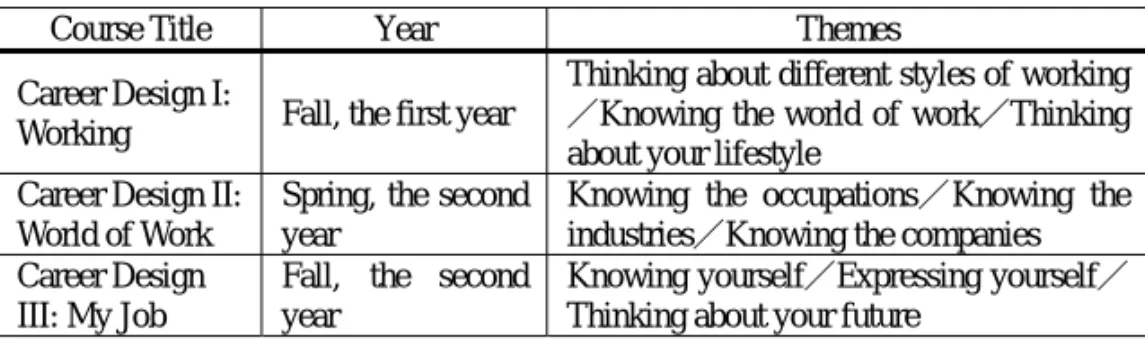
Table 3 provides an overview of the courses on offer.
“Career Design I” seeks to establish a foundation for career planning and providing students with opportunities to examine their approach towards career and life. The goal of “Career Design II” is to improve the ability of students to collect and utilize information, further their understanding of industries, occupations, and companies, and expand their “world of work.” “Career Design III” aims to help students improve their ability to design and plan a career based on an understanding of themselves, as well as improve their self-presentation skills and prepare them for future job search activities.
Faculties and career counselors of the “Career Design Office” serve as instructors for these courses, with three instructors assigned to each course. By engaging in course assignments, including essay writing, presentations, group discussions, self-assessment exercises, communication skills training and various group exercises, students have many opportunities to analyze their relationship with society and contemplate their future as they deepen their understanding of themselves and society.
The issue for career services at Kansai University is how to develop a
mechanism to increase the number of students who enroll in career education
Problems in Career Services at Japanese Universities:
A Case Study of Initiatives at Kansai University
49
Table 3: “Career Education Courses”
Course Title Year Themes
Career Design I:
Working Fall, the first year
Thinking about different styles of working
/Knowing the world of work/Thinking
about your lifestyle
Career Design II:
World of Work
Spring, the second year
Knowing the occupations/Knowing the industries/Knowing the companies Career Design
III: My Job
Fall, the second year
Knowing yourself/Expressing yourself/
Thinking about your future
courses. The number of students who take career education courses is not very significant due to the fact that only one department lists career education courses as a requirement. I do not believe that all students should be required to take career education courses; however, generally students with a high degree of motivation tend to take these courses. It is necessary to provide adequate academic advisory services and to reevaluate how the career education courses should be positioned within the school curriculum, in order to promote the enrollment of students who need career education courses and whose career awareness can be raised by taking such courses.
Looking at other universities, it is noted that the content of career education is diverse although the same phrase “career education” is used (Kawasaki, 2005c). On one hand, there are schools such as Kansai University where career education courses cover the entire process leading up to actual career planning.
In these courses, students are encouraged to think about the meaning of work
and develop their own concept of work and career based on an understanding
of themselves and occupations in general. On the other hand, other schools
offer the same type of job search assistance programs that traditionally have
been provided job placement departments, such as industry seminars hosted by
corporate representatives and workshops on how to complete job applications,
under the rubric of career education. Both types of activities are necessary, and
the problem is not so much whether one type is better than the other. Rather, it
is the fact that different types of support activities are offered under the same
rubric of “career education,” and this is creating some confusion about career
education. While job search-related guidance provides information on how to
proceed when leaving university, career education aims to provide guidance on
the process itself. In career education, it is crucial to promote career awareness
within each student based on a developmental approach. There is no consensus
50
on what constitutes career education, and as the concept of a career is not fully understood, universities must start from building such a consensus. In order to do this, it is important for each school to hold discussions on career education involving all related parties, including both faculty members and administrative staff.
Moreover, universities have different approaches towards the assignment of instructors and operation of career education courses. Only a few schools rely on faculty members; most schools utilize external human resources in some form or another. There are four patterns in which schools use external human resources: 1) adjunct instructors are assigned specifically for career education courses 2) professionals and outside experts serve as instructors on a rotation basis 3) guest speakers are invited occasionally 4) faculty and outside experts instruct as a team (Kawasaki, 2005d). Kansai University follows the fourth pattern. In Kansai University’s case, outside experts are counselors of the “Career Design Office,” and the arrangement has the benefit of facilitating close cooperation among instructors. Some schools completely outsource career education courses to external experts. Even if these courses are based on an excellent curriculum, the course content and teaching methods must be adjusted to meet the needs of students at each school. In light of this, it is perhaps preferable that faculty members and administrative staff serve as coordinators, even in the case of universities that rely on external human resources.
3. Internship Programs
The core portion of the business internship program offered at the Kansai University Career Center takes place during the summer break of the third year.
There are two methods for selecting candidates for these internships: screening by the school and selection by the host organizations themselves. In addition to the ordinary business internship program, there is the long-term internship program, the international internship program, and the pre-internship program.
The long-term internship program targets third-year students and provides them with practical training one day a week over a period of about six months.
The international internship program is maintained through cooperation with
Kansai University’s partner schools. The program offers either one month
internships at corporations in Missouri mediated by Webster University, or
two-week internships at corporations in Hawaii mediated by Kapiolani
Problems in Career Services at Japanese Universities:
A Case Study of Initiatives at Kansai University
51
Community College, the University of Hawaii. The pre-internship program mainly targets second-year students, and it is offered during the spring break right before they become third-year students. In addition, there are internships offered independently or mediated by companies and local government bodies, and these are referred to as external internships.
The challenges thus far for internship programs at Kansai University have been finding host organizations and keeping them throughout the pre/post-internship training. The problem of finding hosts is common among other universities, and it is particularly acute among large universities. At Kansai University, the career center has been working hard to find more hosts;
however, currently only about 50-60% of those students wanting to participate in these internship programs can be matched with suitable host companies and organizations. Therefore, internship applicants are screened by the school through a series of interviews. While the screening process itself gives students a valuable opportunity to experience an interview, there are many students who do not make it to the selection process. At the same time, it would also be problematic for the school to let students become interns too easily. It is important that each student has a clear goal. “The most important thing in an internship program is to participate with a sense of purpose about what you want get out of it. I believe what each person can get out of the program in such a limited amount of time is up to that person.” “Many people might think that I want to be a civil servant when they hear I am interning at a city office, but I decided to do my internship there because I wanted to find out who I am through local government work, not because I wanted to become a civil servant.” These are excerpted comments from a report compiled by students who participated in internship programs, and show that these students had a very clear sense of purpose. The student who made the first comment came out of the internship with a realization of the importance of the three steps of
“planning, doing, and evaluating.” The other student achieved his goal of
knowing himself better by finding out first-hand what he is good and not good
at. These examples indicate that internships have a greater impact when
students participate with a clear goal and sense of purpose. In order to
maximize the effectiveness of practical training, it is important that students
reexamine the “new awareness” that they discover through these internships
and verbalize it in post-internship program, as well as clarify their goals
through pre-internship orientation. Students seek to participate in internships
52
0 50 100 150 200 250 300 350 400 450
96 97 98 99 00 01 02 03 04 0.0 20.0 40.0 60.0 80.0 100.0
Universities with internships Junior colleges with internships Vocational schools with internships Ratio of universities with internships Ratio of junior colleges with internships Ratio of vocational schools with internships
for a variety of reasons. Another important task is to improve pre- and post-internship program so that students with different goals can participate with a clear sense of purpose, find “new awareness” through practical training, and utilize the experience for planning their future career.
Now let us consider the status of internships at universities across Japan.
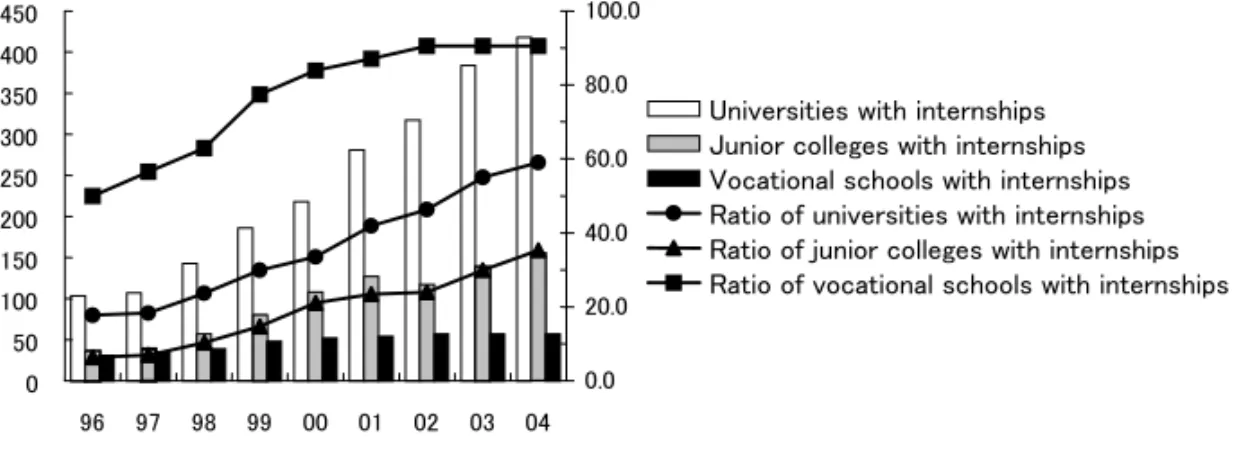
According to a survey by the Ministry of Education, Culture, Sport, Technology and Science, the proportion of universities that maintain internship programs as part of their educational curriculums is increasing each year. In 2004, the proportion reached 59.0% (418 schools) (Figure1.). The most commonly targeted grade for internship programs was the third grade (75.7%), and the most common time for internships was during the summer break (82.7%). The most common duration of internships was between one to two weeks (49.8%). These figures provide us with a portrait of an average university internship program in Japan today. The total number of student interns for 2004 was 39,010. While this is an increase of 4,885 since 2003, it is by no means a large number. The Ministry of Health, Labour and Welfare estimates that about 120,000 students participated in internships, including extracurricular ones, in 2004: however the figure does not amount to 20% of the average total number of students in one grade. There is no estimate of the total number of those students who wanted to participate in internship programs. Securing host organizations for internships is a national problem. A survey by the Ministry of Health, Labour, and Welfare (2005) highlighted that internships bring some degree of benefits to host companies. Specifically, the
Figure 1: Number & Ratio of Schools Offering Internship Programs Source: Ministry of Education, Culture, Sports, Science and Technology, Daigakuto ni Okeru
Heisei 16-nendo Intanshippu Jisshi Jyokyo Chosa Kekka
Problems in Career Services at Japanese Universities:
A Case Study of Initiatives at Kansai University
53
Figure 2: Duties Host Companies Assign to Student Interns
Source: Ministry of Health, Labour and Welfare, Intanshippu Suishin no Tame no Chosa Kenkyu Iinkai Hokokusyo
following benefits have been identified: 1) the growth of young employees who supervise the interns 2) an improvement in the recognition of these organizations among universities and students 3) revitalization of the organization. Therefore, universities should actively advertise these benefits.
According to the survey by the Ministry of Health, Labour, and Welfare (2005), duties for interns are becoming increasingly diverse (Figure 2). Of the surveyed companies, 15.8% have interns involved in “some of the duties assigned to part-time workers.” While the figure is not too high, it still raises some concern. Students often complain about the tasks they are assigned as interns, and therefore universities that provide them with these internships must accurately grasp the real nature of the duties involved.
Some of the unique types of educational internship programs are: 1) the
“problem-solving type”, which requires interns to propose projects 2) the
“long-term type”, which allows students to familiarize themselves with their duties 3) the “international type”, which features a short-term study abroad program 4) the “alternation type”, which requires students to alternate between internship and on campus classes (Kawasaki, 2005e). Kyoto Sangyo University has been operating a Japanese-style co-op program since 2003 in which students repeat the process of alternating between university classes and internships from the first year to the fourth. This is a program based on the
4.5 15.8
29.8 44.7 44.8
50.3 61.1
0.0 10.0 20.0 30.0 40.0 50.0 60.0 70.0 Other
Part of duties for part-time/casual workers Special tasks other than regular duties for employees
Part of main duties for employees Observing operations at the workplace or factory Accompanying employees who are working Part of less important duties for employees
54
“alternation type” of internship. It is also referred to as the “Sandwich Method” and is widely recognized in Japan. The program should be highly regarded for its systematic design that enables students to make progress towards self-development and goal realization as progressively challenging tasks are assigned to them. Universities cannot expect significant effects from developing unique internship programs if these programs are merely isolated, unsystematic efforts. It is therefore necessary to effectively incorporate internships into the entire career services program covering a four-year period.
4. Career Counseling
The “Career Design Office” at Kansai University deals with a wide range of issues related to the planning of students’ futures, such as graduate school applications, studying abroad and school transfers, in addition to job searches.
The office offers career counseling by appointment. One session is 50 minutes per person, but it often goes over this time limit. Students who make an appointment are asked to provide detailed descriptions of any concerns they would like to discuss, along with their school life and occupations they aspire to. This process is extremely important, as verbalizing their concerns can help students to clarify their problems, and this process itself can often lead to the resolution of these problems. Many students participating in the career-based programs at Kansai University experience difficulties and anxiety as they go through the steps designed to raise career consciousness and support job search activities. The purpose of counseling is not to solve their problems and worries; rather it is to foster the independence of students so that they can find their own way and solution. Therefore, counselors in principle do not make decisions for students, although they might provide relevant information and guidance. Counseling is very effective not only in responding to the problems of individuals, but also in encouraging them to utilize their “new awareness”.
Common concerns dealt with during counseling can be divided into the
following groups: 1) “I don’t know what I really want to do” and “I don’t
know which occupation I am suited to” 2) “Which preparatory school is the
best for the qualifying examination that I will be taking?” and “How can I
become a Japanese language teacher?” 3) “I am wavering between going to
graduate school and finding a job” and “I am debating whether I should
become a nursery school teacher or not.” The first type involves the inability to
define a specific goal, while the second concerns the inability to find
Problems in Career Services at Japanese Universities:
A Case Study of Initiatives at Kansai University
55
information independently. Questions in the third group stem from an inability to make decisions independently. When counseling students, I also notice a lack of communication skills, which has been widely pointed out as a major problem. If we add this problem to the above three problems, they correspond with the four skill areas that are considered necessary for students to develop through career education in elementary, middle and high school: 1) ability to make plans for the future 2) ability to utilize information 3) ability to make decisions 4) ability to develop relationships with others. These are also the skills that the career education courses at Kansai University aim to help students acquire. Students who receive counseling constitute only a portion of the entire student population, but the issues cited above probably reflect on the whole the concerns of university students of today.
The challenge for schools offering career counseling is to figure out how to employ counseling in conjunction with other methods of assistance.
Counseling cannot solve every problem. For example, students who lack communication skills need to develop these skills. Kansai University offers small group seminars for improving communication skills, and counselors can recommend to students to attend. However, these seminars are not offered all the time. Moreover, seminars for developing other skills will not necessarily be available. The skills and abilities of students are developed incrementally from the time they are in elementary school. Training at university cannot develop their skills and abilities overnight. Of course, there is discussion as to what degree universities should be responsible for assisting students; however, universities need to consider possible ways to link counseling with other methods, including the use of external support groups.
5. Future Problems
The concluding section will discuss problems concerning the university career services as a whole while touching on the themes discussed in the individual sections of the essay.
5.1. Systematic Program and Learning Process
Kansai University has designed a systematic career services program by
integrating career education into a broad system of career development
assistance. However, systematizing the program does not guarantee that
students will learn in a systematic and continuous fashion. As is illustrated by
56
the number of students who participate in career services programs , students take credit courses on career education or participate in internships voluntarily.
Especially at large universities, the process of making career programs compulsory will no doubt be at most times a challenge. Moreover, given that one of the purposes of career services is to foster the independence and self-help of students, making participation in all career assistance programs compulsory does not necessarily solve all the problems. However, schools still need to explore methods for systematizing the learning process for students, and this is a challenge that is faced by all universities.
Not all students need career services, and even those who need them require different programs according to their level of career development.
Schools should be aware that they could end up presenting too many problems for students to overcome, and as a result raise the bar of entry into the labor market too high for some students by setting up a comprehensive four-year career development program. It would be difficult to achieve this in reality;
however, if possible, universities should provide career assistance programs based not on school year, but on the individual situation of each student. At the very least, they need to offer career services suited for individual students.
5.2. Cooperation with Faculty Members
Finding ways to cooperate with faculty members is a challenge faced by
almost all university career centers. At Kansai University, the career center
cooperates with the faculty members in both designing and operating the
program; however, a more wide-ranging cooperation is needed. In principle,
universities should try to provide career services through all facets of their
educational activities. Primary and secondary schools offer career education
across the boundaries of academic subjects without establishing specific
courses or a time-frame for career education. At the university level, it is
considered effective to establish a career education curriculum that becomes a
base for providing career education. However, there are other opportunities for
providing such education. For example, it is possible to develop communication
skills through academic seminars. Similarly, it is possible to offer career
services through a wide range of academic courses. To this end, all faculty
members should understand the concept and role of career services, and it is
important to construct an environment in which administrative staff can
actively become involved in educational activities. Furthermore, it is important
Problems in Career Services at Japanese Universities:
A Case Study of Initiatives at Kansai University