The
JbPa"ese
Jb"rnat
of
Rsychonomic Science1987,
Vol.
6,No. 1,11-ooA
dynamical
model
of
social
interaction
Masanori
NAKAGAWA
Hbkkaido
Ubeiversitv
and
Naohito
CHiNo
Aichigakuin
l:1)tiversity
The
present
study proposes a mathematical modelfor
thedynamic
change of socialinter
action
between
two
persons.
Even
though
socialinteraction
has
essentially adynamic
aspect which varies through time and acress situations,
the
traditionat
psychology
has
neversucceeded
in
treating
this
dynamic
change.First,
we assume sornehypotheses
onbasic
rulesfor
the
dynamic
change of socialinteraction.
Then
those
hypotheses
areintegrated
into
asimple system of
differential
equations; adynamical
system,Each
coeficient of termsin
the system represents
personalities
of twopersons,
ln
accordance with various combinationsof values of
the
coeMcients, socialintera
¢tion
between
the
two
persons
brings
out a varietyoi
dynarnic
phases
which are representedin
the
phase space ofthe
dynamical
system.thermore, a concept of
dynamic
personalities,
which vary according to situations,is
defined
using a non-linear
dynamical
system.Finally,
the
relationbetween
the
present
model・andthe method which constructs a
dynamical
systern using anMDS,
is
cliscussed.
Key
words: socialinteractions,
dynarnic
rnodels,dynarnical
systems,differential
equations,
dynamic
personalities.
I.
Introduction
andbasic
hypotheses
'
Social
interaction
has
essentiallya
dynamic
aspect which
varies
through
time
and acrossmultifarious situations.
We
often see orhear
that
a
quarrel
arisessuddenly
among
friendly
fellows,
orthat
apair
whohave
been
living
cat-and-dog
life
falls
in
love
with each other unexpectedly.Such
stories
aretoo
trite
to
be
told
in
a
fan-ciful novel
if
notfor
a
suitable'adaptation.
In
the
traditional
psychology,
however,
there
has
been
lacking
a suitable model which cantell
suchdynamic
storiesof
social'
interactionl
The
present
studyproposes
a
model whichdescribe's
these
dynamic
changesof
social
interaction.
Now
let
usformulate
some
hypetheses
below,
in
whichdynamic
changesof
social
interactions
between
two
persons
could
be
explicated,
at
least,
theoretically.
First
wedefine
somebasic
functions
each
of
whichdenotes
an
intensity
ofattitude
of
one
person
toward
the
other;Hypothesis
I
Let
the
symbolsX
andY
denote
two
per-sons,
andlet
the
function
x(t) representthe
intensity
of
attitude
of
X
toward
Y
attime
t.
Thus,
y(t)
standsfor
that
of
Y
toward
X
at,
time
t.
Here,
each ofthe
functions
xand
y
is
continuous,
having
values which arepos-itive
or
negative.
If
the
value of x ory
iS
pes-itive,
the
attitudeof
X
toward
Y
attime
t,
orthat
ofYtoward
Xat
t
is
positive.
Conversely
negative
values ofthese
functions
mean anegative
attitude
ofX
toward
Y,
and
that
of
Y
toward
X
at
time
t.
Furtherrnore,
the
greater
the
absolute
value
of
each
function
becomes,
the
strongerthe
positive
or
negativeattitude
of
one
person
toward
the
other
atthe
time.
Next
weintroduce
anatural
hypothesis
onthe
interaction
between
the
two
persons
in
terms
of
the
change
oftheir
attitudestoward
The Japanese Psychonomic Society
NII-Electronic Library Service
The JapanesePsychonomic Society
12
The
Japanese
Journal
ofPsychonomicScienceVol.
6,
No.
1
Hypothesis
II
The
attitude
of
X
toward
Y
attime
t
in-fluences
the
change of attitudeof
Y
toward
X
at
time
t.
The
attitude
of
Y
toward
X
att
also simultaneouslyinfluences
the
changeof
attitude of
X
toward
Y
atthe
time.
Further
we a$sumethat
the
attitude
of oneperson
attime
t
influences
the
change ofhis
own attitude,
This
leads
to
the
third
hypoth-esis.
Hypothesis
III
The
attitude
of
X
toward
Y
att
infiuences
the
change of attitude ofX
toward
Y
at
time
t.
In
the
same way,the
attitude
ofY
toward
X
att
influences
the
change ef attitudeof
Y
toward
X
att.
Hypothesis
III
mayrequire
further
explana-tions.
Our
emotions aresometimes
accel-erated
by
our
own
behavior.
It
causeslovers
even
morepain
to
saygood-bye
onthe
morn-ing
after.In
the
same
way,our
passions
are
sometimes reduced
by
our affective reactionsas
is
assertedin
the
two
factors
theory
ofthe
emotional systems.
Hypothesis
III
generalizes
those
self-reaction system withinpsychological
functions
usingthe
convenientterm,
`attitude '.
A
further
implication
ofHypothesis
III
will
be
detailed
in
the
following
section.Now
we
cometo
integrate]
the
preceding
three'
hypotheses
into
one
sirnple
system,Hypothesis
IV
Hypotheses
II
and
III
canbe
represented
by
a
system ofdifferential
equations,
i.e.,
adynamical
system as shownbelow,
usingthe
functions
defined
in
Hypothesis
I.
li
'
iil;
'
:,
il.
"
:,
'g.
'
:;}
(1,)
Each
term
in
the
systemhas
apsychological
meaning
as
is
explained
in
the
next
section.II.
The
meaaning ofthe
modelSince
the
left-hand
terms
in
the
system
represent
change ratesof
attitudesat
time
t,
each
differential
equation meansthat
both
one's own attitude and
the
attitude
ofthe
other at
time
t
simultaneouslyinfiuence
the
change rate of one's own attitude.
The
term
aixin
equation(1)
denotes
the
influence
of
X's
attitudetoward
YL
If
the
infiuence
ofthe
term
biy
is
negligible(that
is,
bi==O),
and aiis
positive,
then
the
term
aix
has
certaininfluences
on
the
change rateof
X's
attitude.That
is,
if
xis
positive,
aixbecomes
positive,
andtherefore
dxtdt
becomes
positive.
This
means xhas
atendency
to
increase,
Then,
X's
attitudebecomes
moreand more
positive,
with a snowballing effect.On
the
contrary, a negative xmakes
aix anddx!dt
negative, and as a result, xtends
to
decrease.
In
this
case,a
negative attitude ofX
accelerates
itself.
Summing
up, apositive
aihas
the
effect
of self-acceleration ofX's
attitude.Conversely,
a negative aihas
aneffect
of
self-inhibition of
X's
attitude.
With
a
negativeai, negative x makes
aix
positive
and
aposi-tive
x makesit
negative.Then
a
positive
xyields
negativedxldt
and a negative x apos-itive
dx!dt.
That
is,
with apositive
x,it
is
inhibited
to
decrease,
while
witha
negative
x,
it
is
inhibited
to
increase.
Considering
those
characteristics, we canlnterpret ai
as
a representationof
one aspect ofX's
character,
i.e.,
the
self-oriented
property.
From
this
interpretation,
positive
ai meansX
has
a self-accelerating character.This
could
be
paraphrased
asfollows:
whenhe
behaves
kindly
to
Y
at
the
beginning,
his
favor
for
Y
becomes
greater
andgreater.
On
the
otherhand,
his
initial
malice,to
Y
acceleratesthe
negative
attitude
ofX
to
YL
For
negative ai,X's
characteris
self-inhibitory.If
X
is
self-inhibitory,
X's
extremely negative attitudeis
inhibited,
and
a
too
great
faver
of
X
for
Y
is
likewise
inhibited.
The
parameter
a2in
the
second equationof
the
system
has
the
same characteristics asdiscussed
aboveon
ai.The
a2 standsfor
aself-oriented
trait
of
Y's
personality.
The
pararneter
bi
in
the
first
equation
alsorepresents a
kind
of
X's
character.The
term,
biy
in
the
equation
denotes
the
influence
of
Y's
attitude
onthe
rate ofthe
changeof
X's
M.
Nakagawa
andN.
Chino:
A
dynamical
model of socialinteraction
Table
1.
Four
basic
personalities
constru ¢tedby
the combination ofself-oriented
properties
(self-inhibitory
or self-accelerating), andothers-oriented
properties
(normal
orperverse).
I " t
Mxx. I l t
self- l
I
I
HLx oriented: seLf-inhibitory
l
seLf-aceelerating :others-X's. I (a<O) l (a>O) I
Oriented Ssxl l :
--"--t---)NTx-xl--tttt-te---t---T:--J---f--t--J---1
1 1 1 1 1 1l the one vho
Lnhiblts
l
the
one who is emotiona] lnermal l one's own emotion and
I
and reaets normallyto
l
(b>O) :reacts normaltyto
theIthe
otherI
Iother
:
:1 d b
T---1-"---"---"f-r---"----4m---tT----t---
---
)1 t t
S t 1
l the one vho inhibits I
the
one wheis
emotionat1
perverse l one'$ ovn emotion andt
and reacts adverseLy to : Cb<O) Ireaets adverse]yto
thelthe
ether t
lother
l l 1 1 d-m----m---"-T--tTl
"---"- ---v---1- ----"-L--JtJ-J----J--Tt--ml
13
;.::
:
l
l
1
1
, I :
l
l
: : lI
li,e.,
ai equalsO,
with apositive
b,.
If
y
is
pos-itive,
xincreases
because
dx!dt
gets
positive,
and
negative
y
makes xdecrease.
In
contrast,it
follows
from
a negativebi
that
a negativey
causes an
increase
in
x, andpositive
y
brings
a
decrease
in
x.From
the
aboveinterpretation
ofthe
para-meter
bi,
it
follows
that.
underthe
positive
bi,
X's
attitude
becomes
better
whenY's
attitudetoward
X
is
positive,
andX's
attitudegets
worse
whenY's
attitudetoward
Xis
alsobad.
Positive
br
indicates
that
X
has
an
ordinalcharacter with which
he
reacts straightlyac-cording
to
Y's
attitude.Conversely,
for
the
negative
bi,
X
reactsadversely.
His
attitude
gets
worse whenY's
attitudeis
positive,
andgets
better
when
Y
reacts negatively.He
answersfavor
with malice, and malicewith
favor,
It
sounds rather unnatural,but
might
be
more comprehensibleby
interpreting
that
X
is
a
mean
person
whogets
arrogant
when
the
partner
behaves
gently,
but
becomes
servile
when
his
partner
is
haughty.
Sumrning
upbi's
characteristics,it
couldbe
concluded
that
this
parameter
shows anothers-oriented
part
ofX's
personality.
The
para-meter
b2
in
the
second equationis
also
thought
to
be
the
others-orientedfacet
ofY's
person-ality.
Thus
far,
wehave
interp'reted
two
kinds
of
parameters,
onedenoting
a self-orientedpart
of a
person's
personality
with
respectto
human
relation, andthe
other representing anothers-oriented
character.Combining
those
two
parameters
that
cantake
various
values,
a
varietyof
per$onality
styles canbe
obtained,some of which
are
shown
in
Table
1.
Finally,
the
constants ofthe
system, ci andc2, are
interpreted
asexpressiens
of
one's
basic
attitudes, whichare
independent
of
parameters,
ai, a2,bi
andb2
stated above.The
nextparagraph
willdiscuss
whatchanges of
interaction
are causedby
the
combination of
two
persons
whohave
their
own original
personalities
respectivelydefined
with
parameter
valuesin
the
model.IIL
What
willhappen
between
apair
?
a.
Phase
of adynamical
systemBefore
treating
changes ofinteractions
ac-cording
to
the
model,phases
ofthe
dynamical
system representing
the
model mustbe
dis-cussed.
Let
(x(t),
y(t))
denote
the
coordinates of apoint
on
a
plane
at
time
t,
which
obeythe
dynamical
law
described
by
equation
(1).
The
orbit
which
the
point
draws
along
the
time
formsacurve
on
the
plane
as asolution
ofthe
system.Generally
this
curveis
called a solutlon curve, andthe
plane
is
calledthe
phase
space,
Depending
oninitial
positions
from,
whichthese
curvesstart at
tirne
to,
there
are
infinite
solutien
curves
in
the
phase
space.
The
forms
ofsolution curves of
the
systemare
determined
only
by,parameters
ofthe
system,In
other
words,
phases
of
the
solutions
canbe
classi-fied
by
parameter
values ofthe
system,
The Japanese Psychonomic Society
NII-Electronic Library Service
The JapanesePsychonomicSociety
14
The
JapaneseJournal
ofPsychonomicScienceVol.6,No.
1
dynamical
systemlike
the
present
model,forms
of solution curves canbe
classifiedwithout
diraculty
usingthe
simpleformulas
stated
below,
wheredi,
a2,bi,
andb2
arethe
parameters
in
the
model system:P
=-(ai+aa)
q=aiaa-bib2
'D=P2
-4q
.
When
p,
q>O
andD<O,
the
solution curvesform
a spiral which converges asymptoticallyto
a centralpoint
as shownin
Fig,
1-A.
On
the
otherhand,
whenq>O
andP,
D<O,
the
solution curves
draw
an outgoing spiral whichstarts
from
a centralpoint
andgoes
far
awayas
shownin
Fig.
1-B.
In
each case,the
' '
A
IB
' xD
'Fig.
1,
Various
patterns
of orbitsin
the
phase space ofthe
dependi,ng
upon values ofthe parameters,Fig.
A
corresponds tospirals,
C
stable nodes,D
unstable nodes,E
t972).
F
s
linear
dynamical
system,stable spirals,
B
unstable
M.
Nakagawa
andN.
Chino:
A
central
point
is
calledthe
singurarpoint,
atwhich
both
derivatives
in
the
system vanish.Thus,
classification offorms
of solution curvesis
usually calledthe
classification of singularpoints.
Coordinates
of a singtdarpoint
aregiven
by
the
formulas
below.
(:iCa2,EIi/ab2,Cbr,,
22,Cai,-rabi,Cb2,)
(2)
(For'convenience
all
singular
peints
are
reset
to
the
origin
in
Figs.
1-A,
-B,
-C,
-D,
-E,
and-F.)
If
D>O
anda>O,
the
singularpoint
is
called
the
nodebecause
solution curveslook
tied
together
atthis
point
(see
Fig.
1-C
and-D).
Moreover,
in
this
case, with apositive
P,
solution
curvesare
converging onthe
nodeas
shown
in
Fig.
1-C,
while with a negativeP
these
curves arediverging
from
the
node(see
Fig.
1-D).
For
both
spirals
and
nodes,
singularpoints
are called sinks since solution curves are
verging
thereon.
On
the
otherhand,
singularpoints
of
diverging
curvesare
called sources
because
the
curves are reminiscent ofhot
sprmgs.
For
any sinks, eventhough
the
startingpoint
is
drifting
from
the
singularpoint
by
some
noises,
the
curve comesback
into
the
sink afVer all.
In
this
case,the
singularpoint
Table
2.
The
classification ofsystem
in
accordance withmeters
in
the system.T---"---L""-"-"--L---T
dynamical
rnodel of socialinteraction
15
is
described
asbeing
stable.Conversely,
in
the
case of sources,the
singularpoint
is
scribed as
being
unstablebecause
the
systemis
so unstableas
to
get
down
from
the
sourcepoint
with a small noise.Unstable
cases arenot restricted
to
sources,but
arise alsoin
the
case of negative
q.
Singular
points
of
this
kind
are called saddlepoints,
because
those
solution curves
form
lines
just
aslittle
balls
draw
whenthey
rolldown
the
saddle
of
a
horse
(see
Fig.
1-E).
There
is,
however,
a special casein
whichq
just
equals
O;
then
solution curvesdraw
'
Fig.
2.
The
classification of $lngularpoints
ofthe
11'near
dynarnical
system, according to therelation of
the
parameter$
in
the system,where
P
standsfor
-(ai+a2),
q
denotes
aia2
-bib2・
(From
Simmons,
1972).
'
dynamic
status ofthe
modelthe
relationbetween
para-:::}:::::::::::t::]::::::::
-
x.-
i s.tt-q : p'h"
:sxs.Ml
:
al + a2 <Ol : Sink :i
l
el + a2 =Diu"-u---1
I I : ai + a2 >O!:
Sour:e
I
l
l
ala2 ) blb2 : l SLable 2,
nblb2 > -tal - a2)
:
d Nodeur---H--UJ-urU-UU"L..:tT---TT
: : Stable 2,4blb2 <
-(al
-
a2) , : Spiral :Centers (O > ala2 > blb2) :::l-1::::::::::lt:::::::lll nla2 < blb2 :l Unstable :l Node ::l Unstabte :: Splral ]m---i---Unstable SadtiLe 4blb2 )
-cal
-
a2)2 4blb2 <rcal
-
a2)2 ::::::::It:::::::::::::::::The Japanese Psychonomic Society
NII-Electronic Library Service
The JapanesePsychonomic Society
16
The
Japanese
Journal
ofPsychonomicScienceVoL
6,
No.
1
ellipses,
the
singularpoint
being
a
center, asshown
in
Fig.
1-F.
The
singularpoints
arenaturally
called centers.Generally
both
ofsinks and centers are stable, while
sinks
arespecifically called asymptotically stable.
All
are
summed
upin
Fig.
2.
In
Table2
every case
is
classified usingformulas
consist-lng
ofparameters
in
the
model system,i.e.,
ai, a2,
bi,
and
ba,
according
to
the
signs ofp,
q
and
D.
b.
[IIhe
dynamic
phase
of socialinteraction
Social
interaction
between
two
persons
canbe
classlfiedtheoretically
in
terms
ofthe
para-meters
of
the
system,
usingthe
modelre-presented
by
the
dynamical
systemand
the
classification
of
singularpoints
of
the
system
discussed
sofar.
In
addition, rememberingthat
those
parameters
of
the
system
imply
the
personalities
of
each
person,
social
inter-action
between
the
two
canbe
classifiedlocally
according
to
the
combination oftheir
person-alities.
For
example,suppose
that
X
has
a
self-inhibitery
personality(i.e.,
a,<O), andthat
his
others-oriented
personality
is
ordinal(b,>O).
Suppose
further
that
he
is
moreinfluenced
by
his
own
attitudethan
by
the
attitude of others(lail>bi),
and
iurthermore
that
Y
has
the
same
personality
as
X
(a2<O,
b2>O,
and
la21>
b2).
Then
the
systemhas
the
phase
ofa
stable
node
because
aiae>btb2, at+a2<O, and4bib2>O>-(ai-at)2
(see
Table
2).
This
meansthat
the
interactlon
between
the
two
person
in
question
gradually
stabilizes alongthe
time
axis, whatever relation
they
mayhave
had
atfirst.
This
is
true
especially,if
both
ofthem
have
positive
basic
attitudes(ci,c2>O),
i.e.,
if
both
are
gentle
basicalry,
they
willhave
a
good
relationshipafter
all,
even
if
they
once
opposed
each
other
due
to
somebody'sslander-ous
activities.
If
one, notboth
of
them,
is
eontrary-mincled
(i.e.
bi<e
or
b2<O
andbtb2<O)
withoutchanging
the
other
conditions assumed above,the
changeof
the
interactien
between
them
is
not
so slmplethough
they
finally
reach agood
relation.In
this
case,even
if
they
favored
each other at onetime,
aquarrel
arisesbetween
them
at alater
tirne.
For
the
orbitimplying
the
changeof
the
interaction
draws
a spiral converging
to
a
$ingular
point.
When
they
have
a self-accelerating character(i.e.,
ai>Oand
a2>O),the
interaction
between
them
is
unstable andgets
into
infinite
diver-gences,
whetherfor
good
orfor
evil.This
is
true
even
though
both
of
X
and
Yare
self-dependent
(fail,/a2f>Xbil,/b2D.
Assuming
that
either an extremely negative or extremelypositive
attitude
results
in
the
ruination
of
both
of
them,
those
divergences
of
the
inter-action may
be
interpreted
asthe
fate
of
persons.
In
ourdaily
lives,
the
break-up
efrelationships
is
brought
on
not onlyby
malicebut
alsoby
too
immoderate
kindness.
Under
the
above conditions(that
is,
se!f-dependent
and
self-accelerating),
andit
both
of
their
others-oriented
personalities
are
nega-tive
or
positive
(b,b2>O),
the
interaction
di-verges
diametrically.
That
is
to
say,they
head
straightfor
the
ruin(because
biba>O>
-(at-a2)2).
But,
when only one ofthem
has
a contrary-minded character
(bib2<O)
and
their
self-oriented
personalities
are equalto
eachother
(ai=at),
the
fate
comesafter
sometwists
and
turns
(because
bib2<O=-(a!-a2)Z).
In
the
same way, we canimagine
variety'of
the
fate
and
the
fortune
of
persons
assum-ed
in
the
present
model.Some
ofthem
wouldhave
happyendings
and sometragic,
depending
upon
personalities
ofpersons
representedby
the
parameters
in
the
model system,Typical
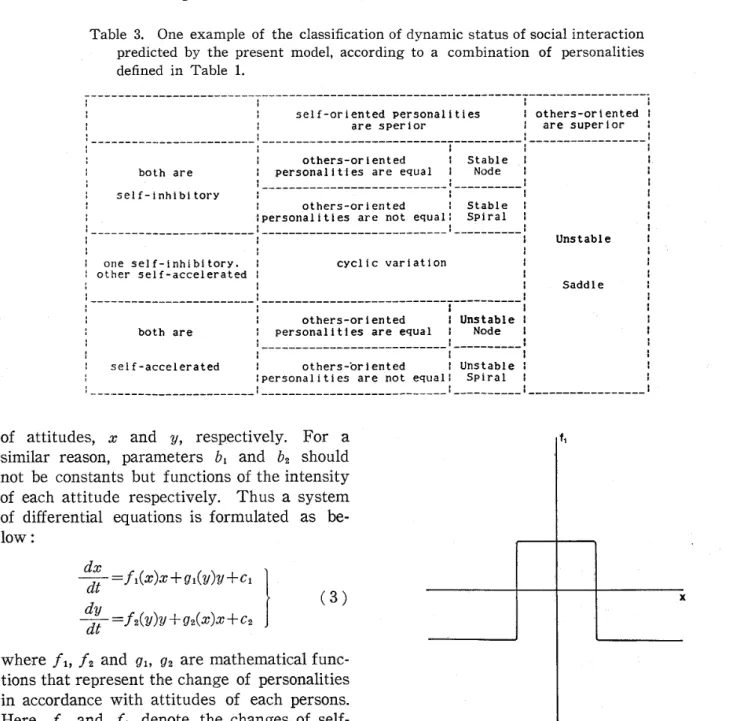
combinations of
personalities
and results aresummarized
in
Table
3.
IV.
Further
development
of
the
model a.Nonlinear
modelAlthough
the
results
discussed
in
the
pre-ceding chapter seem somewhat
interesting,
some
problems
remainto
be
consideredin
the
modelfrom
an experientialpoint
ofview.
For
example,it
is
not
natural
to
suppose,
whether
for
a self-inhibitedpersonality
or aself-accelerating
one,that
those
personalities
are
invariant
alongtime
or
across
situationswithin a
person.
It
shouldbe
notedthat
in-hibition
becomes
strongfor
too
immoderate
kindness
or malice, andthat
acceleration comesup
for
obscure attitudes.In
other words,parameters
arand
a2, which representself-oriented
personalities,
are not constantsbut
M,
Nakagawa
andN.
Chino:
A
dynamical
model of socialinteraction
Table
3.
0ne
example ofthe
classification ofdynamic
status ofsocialinteraction
predicted
by
the present model, accordingto
a combination of per$onalities
definecl
in
Table
1.
1:::I:l:tt:::`::::・::::::r'17
b i
1 t : : self-oriented persenalities r l are sperior
-
/
1 :
1 1 -b L ; l other,s-oriented : Stable l both are : persenatjties are equaa l Nede
1 1 1
t 1 l
: self-inh ±bitory : : : : others-oriented : Stable
: apersenalities are net equat: Spirai
t i
i 1
t d
i t 1
- i
i one self-inhibttery. ± cyclic variation
I other self-accelerated l
1
1 L Lb
1
b : : : : : others-oriented SUnstab!e: both are : persenalittes are equal t Node
I : r
l : t
t self-accelerated : others-briented rUnstable
! :personalities are not equal: Sptral
Itt----J--'t---t--ttt--rT"-tL't--uL-LL---+'tJ-t----+---of attitudes, x and
y,
respectively.For
asimilar
reason,parameters
bi
andb2
shouldnot
be
constantsbut
functions
of
the
intensity
of each attitude respectively.
Thus
a systemof
differential
equations
is
formulated
asbe-low
: :::::::::::t'ts::t'1I::::: others-ertented are superier Unstable Saddledx
:
d
l:ll[Iii;,
g
j,
(
gi.
v
::i
,,,
where
fi,
f2
and
gr,
gz
are mathematicalfunc-tions
that
representthe
change ofpersonalities
'in
accordance
with attitudes of eachpersons.
Here,
fi
andf2
denote
the
changesof
self-briented
personalities
ofXand
Y;
respectively,while
gi
andg2
standfor
changes ofothers-oriented
personalities.
For
example,let
us supposethat
fi
has
the
character shown
in
Fig.
3.
Then,
thefunction
fi
has
a negative valueagainst
a
large
ab-solute
value
ofX's
attitude, and apositive
value against
a
relatively
small value ofthe
X's
attitude.That
is,
Xbecomes
self-inhibitorywhen
his
attitude.gets
eithertoo
negative ortoo
positive.
Such
an
assumption
represented
by
the
function
shownin
Fig.
3
seernscon-vincing when
we
rememberthe
hypothesis
that
too
strongpositive
or negativeattitude
results
in
the
fatal
ruinef
persons.
The
system
described
by
equation(3)
is
general!y
tl
x
Fig.
3.
The
graph
ofthe
iunction
fl
which
.
presentsthe
non-linear relationbetween
the
self-oriented
property
ofX's
personality
and
X's
attitudetoward
Y.
nonlinear.
It
willbe
naturalto
supposea
situationin
which
the
self-orientedpersonalities
arein-fltienced
not
only
by
the
self attitudebut
alsoby
the
partner's
attitude.Such
an
influence
may
have
aninteractive
effecton
the
attitude
of
both
persons
toward
each other.Then
wemust
represent
the
influence
of
the
attitudes
on
the
change of eachpersQn's
a・ttitude
as
general
nonlinear
'functions
with
two
terms
The Japanese Psychonomic Society
NII-Electronic Library Service
The JapanesePsychonomic Society
18
The
Japanese
Journal
of.
/ii:g,:lzl:i1
(4,
where
functions
F
and
G
denote
the
total
in-fluences
ofthe
attitude oftwo
persons
onthe
changes
of
each
person's
attitude,
respectively,while a and
b
indicate
parameter
vectors.Generally
system(4)
has
plural
singular
points,
which
are
given
aspoints
at
whichboth
F
and
G
are
equalto
O.
The
initial
attitudesof
both
persons
will
determine
the
singularpolnt
at whichthe
sy$temwill
converge(where
at
least
someof
singular
points
areassumed
to
be
stable).In
the
neighborhood of each singularpoint,
the
system
canbe
approximatedby
the
for-mula
below:
dx
0F
OF
dt
= .ax(Xo,Yo)x+
oy
(xoTyo)y+hi(x,y)
1
ddyt
=gGx
(x,,y,)x+
ti.Gy
(.,,y,)y+h,(x,y)
J
(5)
where
(xo,yo)
denotes
the
coordinates of asingular
point,
The
matrix consisting ofthe
parameters
ofthe
linear
part
in
the
formula
is
generally
called
the
Jacobian
matrix
as shownbelow:
(;
・
E
・[::::i
Z.i
・
[i:
・i:])
,,,
From
the
aboveformula,
it
follows
that
each
singular
point
is
characterizedlocally
as
if
it
were
the
singularpoint
of
a
linear
systemrepresented
as
follows,
when any realparts
of
eigenvalues
are not equalto
O.
if-
li
F
pt
" .]::i::'
l.;
'
ii:l;:]:
i
(7)
That
is
to
say,each
singular
point
canbe
classified using
the
Jacobian
matrix underthe
above condition.
In
the
neighborhood of each singularpoint,
each value of
Jacobian
terms
in
the
formula
Psvchonomic
Science
Vol,
6,
No.
1
<6)
is
interpreted
asdeneting
each
personality
of each
person
discussed
earlierin
the
linear
model.
However,
the
values ofJacobian
terms
are
determined
individually
by
the
position
ofeach
singularpoint,
Furtherrnore,
eventhough
the
systemis
approximatedby
the
linear
system
whoseparameters
areJacebian
terms
in
the
neighborhood
of anordinal
point,
the
Jacobian
matrix
changesin
accordance withthe
changeof
coordinates ofpoints,
i.e.,
per-sons'
attitudes.
In
other words,in
the
caseof
the
present
model representedby
system(3),
the
tendency
of
each
person's
personality
depends
onhis
own attitude changeand
that
of
the
partner's,
while
the
tendency
in
the
linear
modelis
independent
of changes ofattitudes.
For
the
present
model,at
least,
personalitie$
eachhave
individual
values ateach
individual
position
in
the
phase
space.This
means,again
in
the
present
medel, weassume
a
dynarnic
personality
whichhas
the
possibility
of change accordingto
the
situationin
whichthe
person
is
involved.
It
follows
that
interactions
between
the
・personalities
ofpersons
andthe
situations aroundthem
aremodeled at
Ieast
theoretically
in
the
non-linearsystem.
Generally
those
situationsinvolving
persens
do
not consist only ofpersons'
attitudes,btit
of other
factors
arso,such
as
their
social orphysical
environment andtheir
ownpsycho-logical
state.Taking
account of suchfactors,
we will substitute constant
parameter
vectorsa,
b
in
the
systemby
general
vectorfupctions
of
time,
a(t),b(t)
which represent changesof
situations along
time.
Thissubstitution
gener-ates
the
formula
below:
ll
Xl;g,zx
・,::;::}
(s)
where at
least
a
term
of vectors a(t) orb(t)
can
be
t
itself.
The
system representedby
the
formula
(8)
is
the
mostgeneral
dynamic
model of socialinteractions
in
the
case oftwo
persons.
For
the
system,the
positions
andthe
nurnber ofsingular
points
in
the
phase
space are notconstant,
but
they
changein
accordancewith
M.
Nakagawa
andN.
Chino:
A
Changes
ef a(t) orb(t)
sometimes causedrastic
changes of
the
positions
andthe
number ofsingular
points
(these
drastic
changes arecalled
bifurcations).
This
meansthat
somefactors
causedrastic
changes ofthe
interaction
between
two
persons,
evenif
the
interaction
was
stable
in
the
first
stage.b.
N
persons
caseHere,
wewill
discuss
a
more
general
casein
whichthe
number ofpersons
is
given
by
n(>2).
Construction
ofthe
modelin
this
case
is
not verydithcult,
at
least,
theoretically.
Now,
let
Xi,
Xh,
X3+・・Xh
denote
npersons
and
xiy(t)denote
values ofthe
attitudeof
Xl
toward
.X]
attime
t(i,J'--1,2・・・n).
Then
ageneral
dynamic
model of socialinteractions
among n
persons
is
given
by
the
systembe-low
:
dxie
=fl(V12t X13]
'
'
't
Mn,n-l, al(t))dt,
)
dcXiti3
=f2(xiz, xi3, ''', xn,n-i, a2(t))1
(g)
I
I
T
dxnn-i
J
=fN(X12, Xle,
'
'
',Xn,
n-1, aN(t))dt
where
functions
fte
and vectorfunction
aic(t)(fe=1,2,・・-,M=n(n-1)})
aregenerally
non-linear.
However,
it
is,not
as easyto
analyzethe
present
dynarnical
system asit
is
to
merelyconstruct
the
modeLIt
is
verydithcult
evento
imagine
the
general
variations of solutioncurves and singular
points
in
the
general
p-dimensional
phase
space.'In
the
present
case,if
we candeduce
the
system
into
a more simpleform,
for
examplea
system with a smallerdimension,
withoutmissing
the
mathematicalfeatures
ofthe
orig-inal
system,it
willthen
be
possible
to
do
afairly
strict
analysis ofthe
system.Indeed,
for
the
linear
systern,the
deduction
ofthe
dimension
was reportedin
a
study on ady-namic
model of socialdevelopment,
in
which
the
principal
component
analysis
was
applied
to
social
indices
for
countriesof
the
world(Naka-gawa
&
Ohsawa,
1980).
Ii
another methodcan
be
found
for
the
deduction
ofdimension,
multidimensional scaling could
be
usedeffec-tively.
dynamical
rnodel of socialinteraction
19
V.
Reconstruction
ofthe
modelbased
uponMDS
If
xi,・(t)in
the
system(9)
canbe
measuredby
a
relative and nonnegativescale,
such
asthe
ordinary scalein
sociometric,the
observedvalue of xij(t) on
the
scale canbe
assumedas an asymmetric relation
between
persons
XL
and
XY
attime
t.
Then
these
asymmetricrelations can
be
analyzedby
asymmetricMDS
to
constructthe
spacein
whichevery
person
is
representedas
apoint
in
accordance withthe
relationships atthe
time.
If
xij(t) canbe
measured at any
given
time,
the
points
ing
persons
draw
curves alongtime
in
the
space constructed
by
MDS,
usingtime
seriesobservations
of xid(t),Therefore,
assumingcertain coordinates
in
the
space,it
is
possible
to
construct adynamical
systemin
whichthe
phase
spaceis
the
space constructedby
MDS
and
the
above
mentioned
curvesare
ed
as
solution
curves ofthe
system,Since
the
dimension
of
the
space
constructedby
MDS
using observeddata
is
often
not
asmany as
the
sample number,the
dynamical
system
is
expectedto
have
a smallersion
than
the
numberof
persons,
and
would
be
representedby
the
following
general
form.
dy,
(lt
==
Fi
(yl
ya,
''',Yr,
t)
i
(lo)
dit'
;pi.(yi,y2,
・・・,yr,
t)
J
Here
ris
the
dimension
ofthe
system.yi(t)
are solution
functions
correspondingto
an
arbitrary coordinates, and
FL
(i=1,・`・,r)
arenonlinear
functions
of rterms.
Generally
i;}
have
some
parameters,
which maybe
functions
of
tirne
in
themselves.
If
the
forms
ofthe
functions
areknown
already,it
is
not soficult
to
reduce suchparameters
or
parameter
functions
from
the
given
data
in
such a waythat
the
system satisfiesthe
data.
However,
forms
ofthe
functions
are
usuallynot
known
prior
to
the
analysis.
Even
in
such cases,
if
the
dimension
ofthe
systemis
small enough and suthcient
data
aregiven,
it
is
possible
to
reconstructthe
functions
selves.
Indeed,
usingNewcomb's
sociometricdata
over16
weeks with17
studentsThe Japanese Psychonomic Society
NII-Electronic Library Service
The JapanesePsychonomic Society
20
The
Japanese
Journal
ofPsychonomic
systern
is
nowbeing
researched uponto
ex-plain
changesof
the
relationshipsamong
persons
alongtime
(Chino,
1984;
Chino
&
Nakagawa,
1983).
In
these
researches,drastic
changes
of
singularpoints
were
6bserved
asdiscussed
inthe
last
chapter,
and
the
changesof social
interactions
amongpersons
wereanalyzed
qualitatively
through
the
phase
of
bifurcations.
'
VL
Discussion
There
are somedifi
¢ultiesin
practical
ap-plications
of
the
first
modelwhich
may
be
too
large
to
allow analysis,in
accordance
withthe
nurnber of
persons
as$umed,
eventhough
the
model
can representthe
concrete relationsbetween
the
changesoi
socialinteraction
anddynamic
personalities
of eachperson.
Con-versely
in
the
last
model,it
is
possible
to
re-duce
the
dimension
ofthe
system suchthat
the
functions
assumedin
the
system canbe
reconstructed
through
the
estimation
ofthe
given
data
using some smoothing methodsfor
general
nonlinearfunctions,
However,
it
is
not so clear what
psychological
meaningsthe
iunctions
or
the
parameters
have,
though
the
model
has
a
good
possibility
of applicationto
the
practical
data
for
the
changes
of
social
interaction,
Taking
account
of
th.e
advantages
and
dis-advantages of each model,
it
is
appropriateto
make clear
the
relation
between
two
models,as
wellas
to
deduce
the
psychological
mean-ing
ofinner
mechanismin
the
last
model,
in
terms
of
the
first
model.To
our
regret,it
is
not easyto
realizethe
above
goal
generally,
However,
in
the
last
model,
if
each
solutionfunction
yi(t)
canbe
represented
as
a vectorfunction
ofgiven
re-Iatienships
between
persons,
like
ut(t)==gt(x),
where
yi=(yii,yi2,・・・,yiic,・-i,yir),
i
denotes
ith
person,
k
signifies
'kth
coordinatein
the
last
model, x=(xii,xi2,・.・,xn-i,n),
then
that
model can
be
translated
into
the
systembelow,
which
is
similar
to
the
formula
ofthe
first
moclel.Science
Vol.
6,
No,
1
dxtj
of
dt
=Eig,
(gi(x)7
gj(x))jF<gi(x))
+
QElfg,.
(gi(x),
gs(x))iFKg,・(x))
where
tt'
,
'
Y'
=-'
k
(
,
"
lgY
"
(
',,i=,,...,.,.I
(ii)
.
The
present
translation
provides
a
suthcient
condition
for
the
description
of
the
last
modelby
the
formula
of
the
first
model,but
it
does
not
provide
necessary conditions.Also,
there
is
no absoluteproof
for
the
existence offunc-tions
between
ui(t)
and x(t),that
is
gt(x),
as-sumed
there.
Even
if
the
functions
canbe
supposed,
it
is
notyet
clear what conditionsare necessary
for
functions
ofthe
systemin
the
Iast
modelin
orderto
representit
in
the
form
ofthe
first
medel.The
research onthose
conditionsis
one ofthe
important
prob-lems
left
for
the
future
asis
the
theoretical
development
ofthe
model andthe
methodof
its
applicationto
the
practical
data.
Furthermore,
if
persons
in
the
present
modelare substituted
by
nations,it
is
possible
to
introduce
adynamic
model of socialinteraction
between
nations,like
Richardson's
model ofarms
expenditures
(Richardson,
1939).
Th・en,
we may
be
ableto
discuss
the
variousprob-lems
or
troubles
among
nations
in
the
world
in
terms
of
the
model.
References
Chino,
N.
1984
Toward
a theory ofdynamical
system
in
group
dynamics.
Working
paper
in
education and
psychology
atNagoya
University.
Chino,
N.,
&
Nakagawa,
M.
1983
A
vectorfield
model
for
sociometricdata.
Paper
presented
atthe
11th
annual meeting of theBehaviormetr,ic
Society
ofJapan,
Kyoto,
September.
Nakagawa,
M.,
&
Ohsawa,
S.
1980
Construction
of a system
dynamics
modelby
principal
ponent analysis,
Behattiometriha,
8,
57-73.
Newcomb,
T.M.
1961
The
acquaintanceProcess.
New
York
:Holt,
Rinehart
andWinston.
Richardson,
L.
F.
1939
Generalized
foreign
politics.
The
British
lbesrnat
oj"
Ilsycholqg:vT,
Mbnogrmph
StipPlements
No,
23,
Simmons,
G.F.
1972
Difiizrential
eqttations.New