* 愛知工業大学 基礎教育センター(豊田市)
愛工大生の英語勉強のためのゲートウェイ
A Gateway for English Study for AIT Students
Charles I. Kelly and Lawrence E. Kelly *
チャールズ・ケリー ローレンス・ケリー
Abstract: English Study for AIT Students is a page designed to be a gateway for Aichi Institute of Technology students in their English studies. This paper explains about this page using screen shots.
1. Introduction
English Study for AIT Students is a page designed to
be a gateway for Aichi Institute of Technology students in their English studies. This page introduces them to the university, to the English conversation teachers’ web pages, to the Moodle courses, and to the locations of computers that students can use on campus. It also has a video that explains how to log in to the Moodle courses that are used in the freshmen English conversation classes. This page also has links to various web pages for further study. The class syllabus and the first handout is also linked off this page. This article will explain what can be found on each of these individual pages.
Figure 1: English Study for AIT Students www.manythings.org/ait
2. School Web page
www.ait.ac.jp - aitech.ac.jp/~english
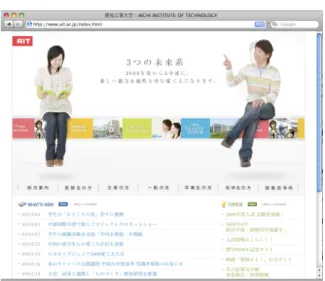
Figure 2: Aichi Institute of Technology’s Homepage in Japanese
Figure 3: Aichi Institute of Technology’s Homepage in English Aichi Institute of Technology is written across the top of the page in both Japanese and English, with the school’s address in English. This gives students an example of how to write an address using English. The school phone number is also here.
3. Links to Teachers’ Homepages
Figure 4: Links to Teacher’s Homepages
There are links to the English conversation teachers’ homepages. Students can immediately learn more about their English teachers. All of the freshman conversation teachers have a homepage. Please visit these homepages. Charles Kelly’s home page is explained below.
Figure 5: Charles Kelly’s homepage http://aitech.ac.jp/~ckelly/
This page will be explained to give students an example of what they can find on their teachers’ homepages. The page has an illustration of the teacher and a brief introduction. There are links to the English
Study for AIT Students (http://www.manythings.org/ait/
and to the support page for the textbook Many Things http://www.manythings.org/mt/), which is the textbook for the Moodle course. There are also links to the teacher’s various hobbies and Web projects. Contact information for the teacher is also included.
Glenn Kelly,
http://aitech.ac.jp/~gkelly/
Figure 6: Glenn Kelly’s Homepage Larry Kelly,
http://aitech.ac.jp/~lkelly/
http://aitech.ac.jp/~offner/
Figure 8: Mark Offner’s Homepage
Bruce Vorland,
http://aitech.ac.jp/~vorland/
Figure 9: Bruce Vorland’s Homepage Paul Rumme,
http://aitech.ac.jp/~rumme/
Figure 10: Paul Rumme’s Homepage
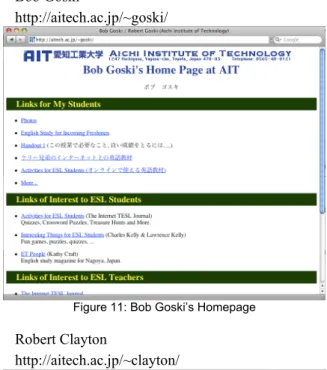
http://aitech.ac.jp/~goski/
Figure 11: Bob Goski’s Homepage Robert Clayton
http://aitech.ac.jp/~clayton/
Figure 12: Robert Clayton’s Homepage
4. Moodle Course Access
Web Homework @ cms.aitech.ac.jp
To make it easy for students to access the freshman Conversation Moodle curriculum there are links to each teacher’s course. These links are direct links to each teacher’s course. This helps students bypass the main Moodle entry. Students will first get the default log in page for the Moodle site, then be forwarded directly to their teacher’s course where they then type in the “course enrollment key.”
5. Moodle Login Video
Figure 14: Moodle Login Video Part of the page at www.manythings.org/ait
This video shows students how to login to their Moodle classes. Step by step, clear and simple instructions are given in English as the cursor is moved to each part of the login. This video, which is approximately one minute in length, gives students their first English listening activity.
6. Upperclassmen Moodle Pages
Figure 15: Upperclassmen Moodle Login Part of the page at www.manythings.org/ait
These courses are for students who have completed their freshman conversation courses. Students who want to continue to study using Moodle can register here and continue their English study while on campus.
There is a link to the English Forums. This allows upperclassmen to contribute to the Forums course and through this to see what the freshman students are writing about. Forum entries by upperclassmen can provide interesting material to freshmen students. Upperclassmen can also comment of entries by freshmen students.
6. Computer Locations on Campus
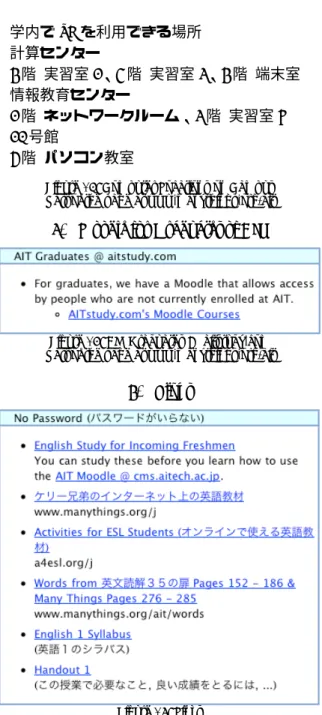
This part of the page lists the location of computers on campus that can be used for study.
学内で PC を利用できる場所 計算センター 3 階 実習室 1、4 階 実習室 2、3 階 端末室 情報教育センター 1 階 ネットワークルーム、2 階 実習室 A 10 号館 5 階 パソコン教室
Figure 16: Computer Locations on Campus Part of the page at www.manythings.org/ait
7. Moodle for Graduates of AIT
Figure 17: AIT Graduates @ aitstudy.com Part of the page at www.manythings.org/ait
8. Links
Figure 18: Links
following pages.
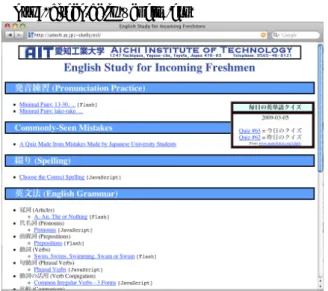
http://aitech.ac.jp/~ckelly/esl/
Figure 19: English Study for Incoming Freshmen You may study these before you learn how to use the AIT Moodle @ cms.aitech.ac.jp.
ケリー兄弟のインターネット上の英語教材
www.manythings.org/j
Figure 20: ケリー兄弟のインターネット上の英語 教材
This page has Japanese navigation and an explanation to help students find study materials on this website.
Activities for ESL Students (オンラインで使える英語教材)
a4esl.org/j
Figure 21: Activities for ESL Students English Words for AIT Freshmen
www.manythings.org/ait/words
Figure 22: English Words for AIT Freshmen
This page links the words used in the English textbooks used by AIT freshmen to an online dictionary where students can see the definition and also listen to pronunciation of words. This helps students to study efficiently, since they can browse the list of words and easily find the definition of words they do not know with a mouse click, rather than needing to type the words.
8. English 1 Syllabus (英語1のシラバス
Figure 23: English 1 Syllabus
The student can access the syllabus for the class from here. The syllabus explains the 15-week course.
9. Handout 1 (この授業で必要なこと, 良い成
績をとるには, ...)
http://www.manythings.org/ait/handout1.htm
Figure 24: First Handout
This handout explains about the conversation class and the requirements for successfully passing the course. We give the students this handout on paper in the classroom. It is also online for students who either lose their copy or cannot locate their copy easily.