INTRODUCTION
The large - scale and long - range transport of sand dust from the deserts of Mongolia, northern China, and Kazakhstan in East Asia is referred to as an Asian dust storm (ADS). ADS can occasionally be large enough to spread around the globe (1). In Japan, the high-est frequency of ADSs occurs from March to May. Recent studies have shown an association of ADS exposure with an increased risk of exacerbation of asthma (2, 3). Our previous telephone surveys also showed that ADS can aggravate respiratory symptoms and pulmonary function in adult patients with asthma (4, 5). In animal models, ADS airborne particles can increase pulmonary inflamma-tion and infiltrainflamma-tion (6, 7), but it remains unclear how exposure to an ADS influences airway inflammation in humans.
Kharitonov et al. first reported that measurement of fractional exhaled nitric oxide (FeNO) was clinically useful for detection and management of cytokine mediated airway inflammation as a non -invasive marker in patients with asthma (8). There is now good evidence for a strong relationship of FeNO value with airway in-flammation in asthma, and FeNO measurement has become a prac-tical tool for diagnosis and management of asthma (9).
In this study, daily peak flow expiratory (PEF) and FeNO were measured before and after ADS in adult patients with asthma. The relationship of exposure to the ADS with airway inflammation was investigated based on the FeNO value, and the association of PEF with FeNO after ADS exposure was examined. As far as we are aware, this is the first study of the effect of ADS on airway inflam-mation in patients with asthma using measurement of FeNO.
MATERIALS AND METHODS
PatientsA longitudinal study was conducted with measurement of FeNO before and after an ADS and monitoring of daily morning PEF in adult patients with asthma from March to May 2012. The subjects were 33 outpatients aged"18 years old with asthma who were recruited into the study from December 2010 to January 2011. At this time the subjects had moderate asthma based on National Heart, Lung, and Blood Institute criteria (10) and a score on the Japanese version of the Asthma Control Test (ACT- J) of!20 (11). The patients were residents in Yonago City, Japan, and outpatients at Tottori University Hospital. Based on Global Initiative for Asthma (GINA) criteria, asthma was defined as positive if a case met (1) and (2) or (3) of the following criteria : (1) a history of intermittent wheezing ; (2) airway hyperresponsiveness to methacholine ; and (3) reversible airflow limitation (12% and 200 ml variability in FEV1) (12). The study was approved by the institutional ethics commit-tee (Ethics Commitcommit-tee of Tottori University, Approval Number 1656) and all patients gave written informed consent.
Definition of the period of ADS exposure and monitoring of air pollutants
The period of ADS exposure was determined using information from the Japan Meteorological Agency based on the criterion of visibility!10 km due to dust arising from the deserts of East Asia, as determined by meteorological satellites. The concentration of suspended particular matter (SPM) was confirmed based on moni-toring at many locations in Japan by the Japanese Ministry of the Environment. In this study, we used data for SPM in Yonago City. LIDAR data for sand dust particles and air pollution aerosols were provided by Matsue observatory, which is located 25 km from Yonago City, because the Yonago observatory does not have a LIDAR system.
Recording of daily morning PEF and FeNO
From February to May 2012, all patients recorded their daily morning PEF using a peak flow meter (Mini - Wright, Harlow,
ORIGINAL
Effect of exposure to an Asian dust storm on fractional exhaled
nitric oxide in adult asthma patients in Western Japan
Masanari Watanabe1, Jun Kurai1, Hiroyuki Sano2, and Eiji Shimizu1
1Department of Respiratory Medicine and Rheumatology, Tottori University Faculty of Medicine, Yonago, Japan,2Department of Respiratory
Medicine and Allergology, Kinki University Faculty of Medicine, Osakasayama, Japan
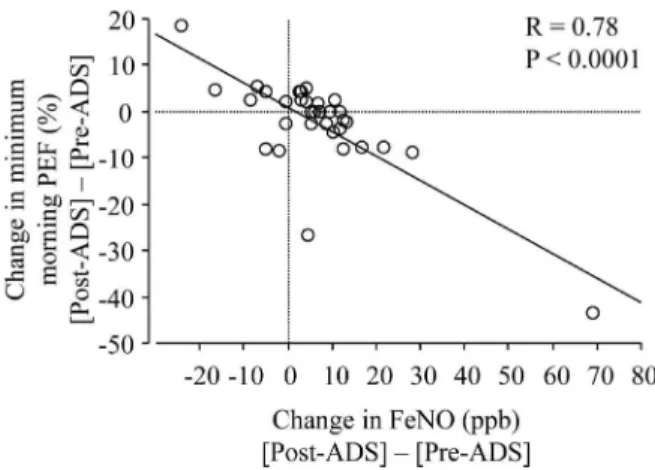
Abstract : Background : Epidemiological investigations indicate that an Asian dust storm (ADS) can aggravate respiratory disorders. However, the effects of ADS on airway inflammation remain unclear. The aim of this study was to investigate the association of exposure to ADS with airway inflammation. Methods : The subjects were 33 adult patients with asthma who measured daily peak flow expiratory (PEF) from March to May 2012. Frac-tional exhaled nitric oxide (FeNO) was measured before and after ADS. Results : The FeNO values were 13.8 13.7 ppb before the ADS and 20.3 19.0 ppb after the ADS, with no significant difference. There was also no sig-nificant association of PEF with ADS exposure. However, the increase of FeNO after ADS exposure was propor-tional to the decrease of PEF (R = -0.78, P 0.0001). Conclusion : These results suggest that airway inflammation aggravated by ADS exposure may induce a decrease in pulmonary function in some adult patients with asthma. J. Med. Invest. 62 : 233-237, August, 2015
Keywords :Asthma, airway inflammation, Asian dust storm, fractional exhaled nitric oxide, peak flow expiratory
Received for publication May 26, 2015 ; accepted July 28, 2015. Address correspondence and reprint requests to Masanari Watanabe, M.D., Ph.D., Department of Respiratory Medicine and Rheumatology, Tottori University Faculty of Medicine, 36 1 Nishichou, Yonago 683 -8504, Japan and Fax : +81 - 859 - 38 - 6539.
England, American Thoracic Society scale). February was used as the practice period. PEF was measured three times within 30 min of getting up in the morning and before inhalation of corticoster-oids orβ2- agonists or taking oral drugs. Patients recorded the best value from three attempts. The minimum morning PEF (% recent best) was determined based on the lowest daily morning prebron-chodilator PEF (13). The recent best value is defined as the best PEF from March to May 2012 in each patient. Lowest PEF values were also determined for the post ADS (April 23 to 29) and pre -ADS (April 15 to 21) periods.
FeNO was measured using NObreath (Bedfont Scientific, Maid-stone, Kent, UK) following American Thoracic Society/European Respiratory Society recommendations (14). ADS days are predict-able based on the LIDAR system. Patients were requested by tele-phone to visit Tottori University Hospital for measuring FeNO be-fore and after an ADS in Yonago City. FeNO was measured once from April 15 to 21 and once from April 24 to April 26, and these val-ues were defined as the pre - ADS and post- ADS valval-ues, respectively. Statistical analysis
Results are shown as the mean!standard deviation (SD). SPSS Statistics software (Japanese ver. 16.0 for Windows ; IBM Japan, Tokyo, Japan) was used for statistical analysis. Differences in PEF and FeNO between the post- ADS and pre - ADS periods were ana-lyzed by t- test. The association between PEF and FeNO was evalu-ated by linear regression analysis. Significance was defined as p! 0.05 in all analyses.
RESULTS
Patient characteristics
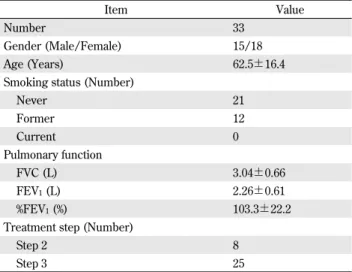
All 33 registered patients recorded daily respiratory symptoms and PEF for"98% of the study period (March to May). Their char-acteristics are shown in Table 1. A treatment step according to the Japanese guidelines for adult asthma of March 2012 was used (15).
Sand dust particles and SPM
Daily levels of sand dust particles and SPM from March 1 to
May 31 2012 are shown in Figure 1. Two ADS days were identified based on information from the Japan Meteorological Agency : April 23, and April 24. Daily levels of sand dust particles were not cal-culated on 16 days of the study period (March 1, 2, 3 to 6, 17, 18, 23, and 24 ; April 3, 4, 11, and 20 ; and May 2, and 3).
PEF and FeNO
The minimum morning PEF values were 93.9!4.5% in the pre -ADS period and 91.5!9.1% in the post- ADS period, with no significant difference between the periods (Fig. 2). The respective FeNO values were 13.8!13.7 parts per billion (ppb) pre - ADS and 20.3!19.0 post- ADS, also without a significant difference (Fig. 3). After exposure to an ADS, there was a significant negative rela-tionship between the change in PEF and the change in FeNO (R= - 0.78, P!0.0001 ; Fig. 4) ; that is, the increase of FeNO was pro-portional to the decrease of PEF.
DISCUSSION
The effect of exposure to ADS on airway inflammation in adult patients with asthma was investigated in this study. Of 33 patients, 25 had increased FeNO value after the ADS compared to before the ADS. There was no significant association of exposure to the ADS with the FeNO value, but the increase in FeNO after ADS ex-posure induced a significant decrease in pulmonary function, which suggests that airway inflammation induced by exposure to ADS can aggravate pulmonary function in some adult patients with asthma. There have been several studies of the association of FeNO with exposure to particulate matter (16), with some showing a signifi-cant association with an increase in FeNO, whereas others have not found a significant relationship between exposure to air pollut-ants and FeNO. Variation in the composition of particulate matter may be a reason for these different results (17). Onishi et al. sug-gested that ADS events can be classified into three types based on LIDAR data : Type 1 events with high counts of air pollution aero-sols ; Type 2 events with high counts of mineral dust particles, com-pared to air pollution aerosols ; and Type 3 events with very low counts of air pollution aerosols (18). Thus, the compositions of ADS particles can also vary. During this study, the only ADS days were April 23 and 24. Therefore, we were only able to measure post-ADS FeNO once, and further investigation of the association of ADS exposure with FeNO will need several more measurements of FeNO before and after an ADS.
Exposure to particulate matter has been widely shown to increase the number of neutrophils and the concentration of pro - inflamma-tory cytokines such as interleukin (IL) - 6, tumor necrosis factor (TNF) -α, and myeloperoxidase in the airway (19, 20). However, an increase in FeNO may more strongly reflect airway eosinophilic inflammation compared to neutrophilic inflammation (21). Neutro-phils migrate to the lungs during acute inflammation induced by exposure to particulate matter in patients with asthma (22). The concentration of IL- 8 in bronchoalveolar lavage fluid (BALF) and IL- 8 mRNA expression in bronchial biopsy tissue from healthy sub-jects are also increased by particulate matter (23), and IL- 8 is a key cytokine in exacerbation of airway inflammation by exposure to particulate matter. In contrast, although many studies have shown that particulate matter, including ADS particles, is able to aggra-vate eosinophilic airway inflammation in animal models (24, 25), as far as we know, there has been few studies to investigate this association in humans using induced sputum, bronchial biopsy, BALF, or urinary leukotriene. In the current study, we only meas-ured FeNO to investigate the effect of ADS on airway inflammation, but ADS particles may augment neutrophilic airway inflammation and other pro - inflammatory cytokines, rather than eosinophilic air-way inflammation.
Table 1. Characteristics of the patients
Item Value
Number 33
Gender (Male/Female) 15/18
Age (Years) 62.5!16.4
Smoking status (Number)
Never 21 Former 12 Current 0 Pulmonary function FVC (L) 3.04!0.66 FEV1(L) 2.26!0.61 %FEV1(%) 103.3!22.2
Treatment step (Number)
Step 2 8
Step 3 25
Data are shown as a number or mean!SD
FVC ; forced vital capacity, FEV1; forced expiratory volume in 1 second,
%FEV1; percentage of predicted FEV1
M. Watanabe, et al. Asian dust and fractional exhaled nitric oxide
234
In this study, an increase in FeNO value after exposure to ADS was significantly associated with a decrease in pulmonary function. This result suggests that ADS exposure can induce an increase of airway inflammation and a decrease of pulmonary function. We have not found a significant association of exposure to an ADS with pulmonary function in previous studies (4, 5). However, 11% to 22% of adult patients with asthma noted worsening lower res-piratory tract symptoms on ADS days, and also had decreased
pulmonary function (4, 5). There are several clinical phenotypes in asthma (26) and the effects of ADS on asthma may differ in each patient, with only a minority of patients experiencing exacerbation due to exposure to ADS. When comparing patients with and with-out an increase of FeNO value after an ADS, no significant differ-ence was seen in age, gender, treatment step, pulmonary function, or ACT score.
Pharmacotherapy to suppress airway inflammation can decrease Figure 1. Daily levels of sand dust particles (closed circles) and SPM (open squares). Arrows indicate the ADS day. Data for sand dust particles are missing from March 2 to 5 and April 2, 3, 11 and 21 due to a LIDAR failure.
Figure 2. Minimum morning PEF (% recent best) in the pre - ADS (April 15 to 21) and post - ADS (April 23 to 29) periods. The recent best value is defined as the best PEF from March to May 2012 in each patient.
Figure 3. FeNO values before and after the ADS. FeNO measured 7 days before the ADS days was defined as the pre - ADS value. FeNO measured from April 24 to April 26 was defined as the post - ADS value.
FeNO value and increase PEF value. In this study, none of the pa-tients had emergency or unscheduled hospital visit, or needed a step up of treatment from pre - ADS period to April 24, which was the first ADS day. Therefore, pharmacotherapy did not affect FeNO value, but might have affected PEF value. On post- ADS measure-ment, two patients, who had more than 20% decrease of PEF value, needed an intravenous drip infusion of steroids. After post- ADS measurement, four patients needed to increase inhaled corticoster-oid and/or long - actingβ2- agonist. We may underestimate the ef-fect of exposure to ADS on PEF value. We may underestimate the effect of exposure to ADS on PEF.
There may be an increased risk of hospitalization caused by an ADS in children with asthma (2, 3) and the influence of an ADS may differ between adult and pediatric asthma in Japan. Addition-ally, in studies of associations of ADS with hospitalization, the state of asthma control has been unclear ; thus, ADS exposure may be a risk for hospitalization for patients with poorly controlled asthma, but not for those with well controlled asthma. The patients in the current study were well controlled by medication and had an ACT-J score!20. The effect of exposure to ADS on asthma may be mild when the asthma is controlled well, and this may explain why we did not find associations of exposure to ADS with pulmonary func-tion and airway inflammafunc-tion in the current study.
There are several limitations in the study. First, we did not evalu-ate the extent of exposure to the ADS in each individual. However, patients recorded their time spent outdoors, and all patients spent more than one hour outdoors on ADS days, although the time out-side varied among individuals. Controlled exposure studies are required to avoid this limitation. Second, the measurement time varied in this study, and recent reports have shown that patients with asthma have diurnal variation in FeNO, and that this is a pre-dictor of the risk of future exacerbation (27). Thus, the measure-ment time may require standardization in a future study. Similarly, the day of measurement of FeNO was not the same in all patients. Our previous study demonstrated that the effects of exposure to ADS on PEF value were delayed by two days (28). The decrease of PEF value was highest on ADS day. Therefore, we may under-estimate the effect of exposure to ADS on FeNO in patients meas-ured on April 25 and 26 compared to those on April 24. Third, in order to investigate the effect of ADS on airway inflammation, we were unable to estimate other biomarkers such as the number of eosinophil in induced sputum and blood, C - reactive protein, and se-rum immunoglobulin E. Further study is needed to investigate these effects. Finally, we were unable to adjust our findings for other air pollutants such as ozone, sulfur dioxide, and nitrogen dioxide, ex-posure to all of which can also affect the FeNO value (16).
CONCLUSION
We were unable to find an association of exposure to ADS with airway inflammation based on measurement of FeNO in adult pa-tients with asthma. However, an increase of FeNO after exposure to ADS induced a significant decrease of pulmonary function. This suggests that exposure to ADS may aggravate airway inflamma-tion in some adult patients with asthma.
COMPETING INTERESTS
The authors declare that there is no conflict of interest regard-ing publication of this paper.
AUTHORS’ CONTRIBUTIONS
MW conceived of the study and ME, JK and HS participated in the design, MW and JK enrolled patients and acquired clinical data, MW and JK performed the statistical analysis. MW and ES drafted the manuscript. All authors read and approved the final manuscript.
ACKNOWLEDGEMENTS
We thank Atsushi Shimizu and Nobuo Sugimoto (National In-stitute for Environmental Studies) for providing LIDAR data. The study was supported by the Environmental Research and Technol-ogy Development Fund (5C - 1154 and 5 - 1453) of the Japanese Ministry of the Environment. The sponsors had no role in the study design ; in the collection, analysis and interpretation of data ; in the writing of the report ; or in the decision to submit the article for publication.
REFERENCES
1. Uno I, Eguchi K, Yumimoto K, Takemura T, Shimizu A, Uematsu M, Liu Z, Wang Z, Hara Y, Sugimoto N : Asian dust transported one full circuit around the globe. Nat Geosci 2 : 557 - 560, 2009
2. Kanatani KT, Ito I, Al - Delaimy WK, Adachi Y, Mathews WC, Ramsdell JW : Toyama Asian Desert Dust and Asthma Study Team : Desert- dust exposure is associated with increased risk of asthma hospitalization in children. Am J Respir Crit Care Med 182 : 1475 - 1481, 2010
3. Ueda K, Nitta H, Odajima H : The effects of weather, air pollut-ants, and Asian dust on hospitalization for asthma in Fukuoka. Environ Health Prev Med 15 : 350 - 357, 2010
4. Watanabe M, Yamasaki A, Burioka N, Kurai J, Yoneda K, Yoshida A, Igishi T, Fukuoka Y, Nakamoto M, Takeuchi H, Suyama H, Tatsukawa T, Chikumi H, Matsumoto S, Sako T, Hasegawa Y, Okazaki R, Horasaki K, Smizu E : Correlation of Asian dust storms with worsening of symptoms for patients with asthma in western Japan. Allergol Int 60 : 267 - 275, 2011 5. Watanabe M, Igishi T, Burioka N, Yamasaki A, Kurai J, Takeuchi H, Sako T, Yoshida A, Yoneda K, Fukuoka Y, Nakamoto M, Hasegawa Y, Chikumi H, Matsumoto S, Minato S, Horasaki K, Shimizu E : Pollen augments the influence of desert dust on symptoms of adult asthma patients. Allergol Int 60 : 517 - 524, 2011
6. Lei YC, Chan CC, Wang PY, Lee CT, Cheng TJ : Effects of Asian dust event particles on inflammation markers in periph-eral blood and bronchoalveolar lavage in pulmonary hyperten-sive rats. Environ Res 95 : 71 - 76, 2004
Figure 4. Relationship between the change in FeNO and the change in minimum morning PEF from before to after exposure to the ADS.
M. Watanabe, et al. Asian dust and fractional exhaled nitric oxide
236
7. Kurai J, Watanabe M, Tomita K, Yamasaki HS, Shimizu E : Influence of Asian dust particles on immune adjuvant effects and airway inflammation in asthma model mice. PLoS One 9 : e111831, 2014
8. Kharitonov SA, Yates D, Robbins RA, Logan - Sinclair R, Shinebourne EA, Barnes PJ : Increased nitric oxide in exhaled air of asthmatic patients. Lancet 343 : 133 - 5, 1994
9. Munakata M : Exhaled nitric oxide (FeNO) as a non - invasive marker of airway inflammation. Allergol Int 61 : 365 - 372, 2012 10. National Heart, Lung, and Blood Institute. Practical guide for the diagnosis and management of asthma. NIH Publication 97 - 4053. Published October 1997
11. Toyama M, Hasegawa T, Sakagami T, Koya T, Hayashi M, Kagamu H, Muramatsu Y, Muramatsu K, Arakawa M, Gejyo F, Narita I, Suzuki E ; Niigata Asthma Treatment Study Group : Depression’s Influence on the Asthma Control Test, Japanese Version. Allergol Int 63 : 587 - 594, 2014
12. Global Initiative for Asthma (GINA) : Global strategy for asthma management and prevention 2012 (revision). NIH Publication issued January, 1995 (update 2012)
13. Reddel HK, Salome CM, Peat PJ, Woolcock AJ : Which index of peak expiratory flow is most useful in the management of stable asthma? Am J Respir Crit Care Med 151 : 1320 - 1325, 1995
14. American Thoracic Society ; European Respiratory Society : ATS/ERS recommendations for standardized procedures for the online and offline measurement of exhaled lower respira-tory nitric oxide and nasal nitric oxide, 2005. Am J Respir Crit Care Med 171 : 912 - 930, 2005
15. Ohta K, Ichinose M, Nagase H, Yamaguchi M, Sugiura H, Tohda Y, Yamauchi K, Adachi M, Akiyama K ; Japanese So-ciety of Allergology. Japanese Guideline for Adult Asthma 2014. Allergol Int 63 : 293 - 333, 2014
16. Scarpa MC, Kulkarni N, Maestrelli P : The role of non - invasive biomarkers in detecting acute respiratory effects of traffic-related air pollution. Clin Exp Allergy 44 : 1100 - 1118, 2014 17. Huang RJ, Zhang Y, Bozzetti C, Ho KF, Cao JJ, Han Y,
Daellenbach KR, Slowik JG, Platt SM, Canonaco F, Zotter P, Wolf R, Pieber SM, Bruns EA, Crippa M, Ciarelli G, Piazzalunga A, Schwikowski M, Abbaszade G, Schnelle - Kreis J, Zimmermann R, An Z, Szidat S, Baltensperger U, El Haddad I, Prévôt AS : High secondary aerosol contribution to particulate pollution during haze events in China. Nature 514 : 218 - 222, 2014
18. Onishi K, Kurosaki Y, Otani S, Yoshida A, Sugimoto N, Kurozawa Y : Atmospheric transport route determines compo-nents of Asian dust and health effects in Japan. Atmos Environ 49 : 94 - 102, 2012
19. Larsson BM, Grunewald J, Sköld CM, Lundin A, Sandström T, Eklund A, Svartengren M : Limited airway effects in mild asthmatics after exposure to air pollution in a road tunnel. Respir Med 104 : 1912 - 1918, 2010
20. Behndig AF, Larsson N, Brown JL, Stenfors N, Helleday R, Duggan ST, Dove RE, Wilson SJ, Sandstrom T, Kelly FJ, Mudway IS, Blomberg A : Proinflammatory doses of diesel ex-haust in healthy subjects fail to elicit equivalent or augmented airway inflammation in subjects with asthma. Thorax 66 : 12 -19, 2011
21. Djukanovi´c R, Lai CK, Wilson JW, Britten KM, Wilson SJ, Roche WR, Howarth PH, Holgate ST : Bronchial mucosal manifestations of atopy : a comparison of markers of inflam-mation between atopic asthmatics, atopic nonasthmatics and healthy controls. Eur Respir J 5 : 538 - 544, 1992
22. Sierra- Vargas MP, Guzman - Grenfell AM, Blanco - Jimenez S, Sepulveda- Sanchez JD, Bernabe - Cabanillas RM, Cardenas-Gonzalez B, Ceballos G, Hicks JJ : Airborne particulate matter PM2.5 from Mexico City affects the generation of reactive oxygen species by blood neutrophils from asthmatics : an in vitro approach. J Occup Med Toxicol 4 : 17, 2009
23. Holgate ST, Sandström T, Frew AJ, Stenfors N, Nördenhall C, Salvi S, Blomberg A, Helleday R, Söderberg M : Health ef-fects of acute exposure to air pollution. Part I : Healthy and asthmatic subjects exposed to diesel exhaust. Res Rep Health Eff Inst 112 : 1 - 30, 2003
24. Ren Y, Ichinose T, He M, Song Y, Yoshida Y, Yoshida S, Nishikawa M, Takano H, Sun G, Shibamoto T : Enhancement of OVA- induced murine lung eosinophilia by co - exposure to contamination levels of LPS in Asian sand dust and heated dust. Allergy Asthma Clin Immunol 10 : 30, 2014
25. Harkema JR, Wagner JG, Kaminski NE, Morishita M, Keeler GJ, McDonald JD, Barrett EG ; HEI Health Review Commit-tee : Effects of concentrated ambient particles and diesel en-gine exhaust on allergic airway disease in Brown Norway rats. Res Rep Health Eff Inst 145 : 5 - 55, 2009
26. Chung KF, Adcock IM : Clinical phenotypes of asthma should link up with disease mechanisms. Curr Opin Allergy Clin Immunol 15 : 56 - 62, 2015
27. Saito J, Gibeon D, Macedo P, Menzies- Gow A, Bhavsar PK, Chung KF : Domiciliary diurnal variation of exhaled nitric oxide fraction for asthma control. Eur Respir J 43 : 474 - 84, 2014
28. Watanabe M, Noma H, Kurai J, Sano H, Saito R, Abe S, Kimura Y, Aiba S, Oshimura M, Yamasaki A, Shimizu E : De-creased Pulmonary Function in School Children in Western Japan after Exposures to Asian Desert Dusts and Its Associa-tion with Interleukin - 8. Biomed Res Int 2015 : 583293, 2015