
Efficient Blind Source Separation Combining Closed-Form Second-Order ICA and Nonclosed-Form Higher-Order ICA
4
0
0
全文
(2) Next, we apply 白e sin酔lar value decomposition (SVD)ωa (1), which is represented as. [3]:. Rt, 2: Rt;(!) = U(I)diag(入川2,...)U(I)H,. supe抑制on of. Jso(W(I)) = 乞IIW(I)Rt;(!)W(I)H - diag[W(I)Rt;(!)W(I)H)112,. (3) where入k are血e eigenvalues,. where superscript H represents a co勾ugate佐anspOS1U叫Rt,(I) (i = 1,2, ..) are白e cross-corre1ation matrices of the input t),. .. x(l, diag[.). ing of the eigenvector百. [ 2: Rt;(!)r. Jso(W. minimization of (1)) yields sim叫t組eous diagonalization (decorrelation) of the∞rrelation m甜ix ofy(l,t) h也e typical higher-order ICA, Kullback-Leibler divergen∞. (η (8). L(I)HRt, (I)L(I). L(I)HRt, (I)L(I) = T(I)diag(σ1 (ti),σ2(む),...)T(I)H,. yz(f, p(ν(1,. where (1,t)) is the mar.伊al PDF of t), t))凶恥 joint PDF ofy(l,t). cost function is hi酔ly relevant to higher order statÌStics of血e so町∞s and non-Gaussianity.. (9). 泊町内(ti) are the eigenvalues for a s抑止time block ti,組d. T(I) denotes the ma凶x consisting of shared eigenvector冨which are. In general, for both 2nd- and higher-order ICAs, the optimiza. indep官ndent of time-block index i. Therefore, for any i, the si・. Rt, (1) can be achieved as follows; T(I)HL(I)HRt, (I)L(I)T(I) = diag(σ1 (ti),σ2(ti),...), (10). multaneo凶diagonalization of. tion procedures c釦be conducted via nonc10sed-form (i.e., iterative ). W(1)岱updated along with the negative必・ Jso(W(1)) or JHO(W(1))百E向島re it has. op回ization in which. rection of gradient of. = L(I)L(I)H,. It can be proved [8]也at if也e cov:叩組ce of也e sourωs s(l,t) in ti凶negligible, every for any i shares the S個e eigenvectors, and幽is given via SVD form as. p(y(l, t)) JHO(W(!))= !P(i宮(1, t))log �T 戸中 -1 /.. 、 、 喝 て よ々、(4) l1î二1 11;=0. P(YI (1,t)). This. Rt, (1) as follows. L(I) = U(I)diag(l/♂�, 1/';>:;,…).. y(l,. between the joint probability density function (PDF) of t)副 t) is used for the∞st function. p(YI. Then we obtain a full・r釦k de∞mposition. for pseudo-inverse of:Li. IS也e operation for setting every off-diagonal e1ement to zero. The. OfYI(l,. diag(入1, ...) denotes the diagona1 ma U(1) is the ma住ix consist・. trix which includes the eigenvalues, and. which are calculated around the m叫tip1e time indiωs t;, and. the product of marginal PDFs to be minimized as. (め. 佃d 血is me組s that也e optimal separation filter matrix in也e 2nd. an inherent disadvantage in白紙there is di血c叫ty wi血 血e . poor紐d. order sense is given by. slow ∞nvergence of non1inear optimization, particularly when we. (1 1) Wso(l) = (L(I)T(J))H. in Eq. it is su血cient for (9), T (1). are con企onted with very complex convolutive mixtures組d unfortu. nately set a bad initial value. Furthermore, ordinæγICA・based BSS. Note 也at,おr也e calculation of. algori也ms require huge computationa1∞mple氾ties. The disadvan・. us to 0凶y apply a single SVD to 組ab r ita r ry single time-block ti because of白e eigenvector-sharing property.. tages reduce 也e applicability of the approach to 也e general audio applications which often need real-time processing. It is worth mentioning也at Molgedey et al. have shown the. closed-form solution on1y for the cぉe that 白e number of correla・. 3. PROPOSED METHOD. tion ma仕ix blocks岱up to 2 [9]. In con位ast,也e algori也m [8] used. 3.1. Mo“va泊。n. in the proposed me白od is the first generalized closed-form solution. which can be applicab1e even to血e . case of i >. In a previous study, closed-form solution of the 2nd-order ICA w鎚. 2.. proposed by one of the au也ors [8], who showed that simple alge. braic calculations enable the separation of mixed si伊als wi血out it. 3.3. Second stage: nonclosed-form higher-order ICA. erative filter updating. This finding has motivated us to combine the. The separation創ter matrix. closed-form 2nd-order ICA and higher-order ICA, where the com. putational ∞st is ∞nsiderably reduced (see Sect. 3.4). Moreover, our 抑制egy provides a good tool for an insight into 也e essential. 午lestion 血at which cost function is better aInong non-stationarity and non-Gaussianity (see Sect. 3.5). Hereinafter we describe也e de. we propose to∞mb町出e nonclosed・form higher-order ICA after. 血e 2nd-order ICA.. tailed algorithm. 取higher-order ICA包conducted by the following manner;. (12) W[OI (J) = Wso(l), WIi+ll(!) = η [1 - ( φ(y(J,t))♂ (1, t)) J Wlil (1) ( 1 3) +Wω(/),. h血e original reference [8],出e principle of血e closed品rm 2nd order ICA w.ωderived, especial1y 企om 血e ma血ematical point of. This. subsection briefly describes the overview of si伊al pro. cessing inthe closed-form ICA. The s凶ct proofs of血etheorem w世. where superscript li)均resents the number of iterations, 1白血E. be omitted due to the limitation of the current manuscripfs space as. First, we obtain血e coπelation matrices with different time points. Rt, (1) = (x(l,t)x(l,t)H)tEtぃ. This s回.tegy regards血e separation filter matrix. Wso (1) as an initial value for higher-order ICA's iterative learni略. 3.2. First stage: c1osed-form 2nd・orderICA. 羽ew.. Wso(l) ob凶ned by 2nd・order ICA. often provides insuflìcient source-separation pe巾>rmance. To pol ish up血e separation filter matrix組d gain也c白rther performan∞,. (5). where (・)出‘denotes the time-averaging ope国or over specific time duration ti, 組d i = 1,2,... represent indices of time-averaging block. 1. identity matrix,. (. - ) t denotes也e time-averaging operator over whole time indic民組d 41 .) is the appropriate non1inear vector functi叫 e.g., [?, 10] (we use [ 10] in出s pap同. (. In genera1, the higher-order ICA suffers from組 prob1em of the. poor and slow convergence of no凶inear optimization. In 血e pro・. posed me血od, however,也e pre∞ding closed-form 2nd-order ICA. can give a better initial state for the higher-order ICA,組d也e pro. posed combination mitigates the drawbacks on the p∞r∞nvergence. - 46. - 72 -.
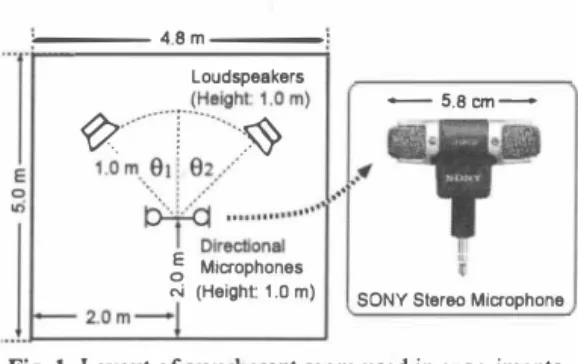
(3) 』一一一一ーー- 4.8. 3.4. Computatiooal-cost ef6cieocy of proposed method. Loudspeakers. 10 the first stage,the closed-form 2nd-order ICA mainly requires the. 令;冷 列 f U〆 叶〈 ;. following computatio凶ー. Calculatioo of correlatioo matrices: The computations for obtain. 1.0m. ing Rt,(1) result in,e.g., more白血hundred m叫tiplications. accumulations to deal with the observed signal of several sec. Calcul凶00 of L(I): To obtain L( I) in Eq. (8), a single SVD sho凶d be performed as in Eq. (6), where the computational load is O(K3) (K∞rresponds to也e dim.ensioo of L(I))ー. 2nd・order ICA approximately depends on也e∞st of obta凶ngRt,(I) because the calculations of L(I) and T (I) are relatively negligible when K岱small,e.g., 2 or 3. In addition, it sho凶d be mentioned. 血at也e whole computatio凶 in the closed-form solution are almost. 也e same as. those for 1 or 2 iterations in the higher-order lCA,組d. 也us almost all the∞mputational resources can be dedicated to the. higher-order ICA part in the secood stage. F町曲ermore,白 compu. tational comple氾ties can be totally reduced because也e good山tial・. ization by the closed-form ICA saves the number of iterations in白c following higher-order ICA's upω出g. Wso(l) given by Eq. (11) can diagonalize each ∞ト. relation matrix when the ∞van組偲of. 8. (1, t). in. t;. is negligible. Consequently under such a condition,也e∞st釦nction defìned by. (3) is minimized to be zero,i.e,the following relatioo holds;. =. O.. (14). This rem創ns us 白紙 the closed-form solutioo Eq. (11) gives. a good estimate of the. matrix. W10J (1) as (A) a matrix which has entries of random com. plex value,and (B) identity 四回x. The step-size p釘阻eterηin the. higher-ord釘ICA is fì.xed to 0.1伽oughout the experime凶.. Noise reduction rate ()恨R). [4], defìned as 也e output si伊al・. to・noise ratio (SNR)血也minus the input SNR in dB, is used as 白州ective indication of separation perform組ce. The SNRs are. calculated under the assumption that血e speech signal of血e unde. sired speaker凶regarded as no回Figures 2-4 show the∞nvergenω. posed method, we plot也e res叫ts only in the higher-order ICA part. with a comp紅ison on oon-statiooarity and noo-Gaussianity. Owing. ゐ。(Wso(l)). ICAs, we prepare two higher-order ICAs wi血 different 凶tial 創ter. These s∞res are也e averages of 6 speaker∞mbinations.. Ano白er contribution 0f the closed-おrm 20d・order ICA is concemed. Eq.. 4.2. Evalua泊00 of computa討onal-cost ef直cieocy. In order to∞mpare the proposed method with several conventional. C町ves ofNRR under di能rent speaker allocations. As for 也e pro. 3.5. As a judgiog tool for ooo-s飽討ooarity vs. ooo-Gaussiaoity. ωEq. (10),. SONY Ster田Microphone. Fig. 1. Layout of reverberant room used in experiments.. Calcul凶00 .of T (1): The ma出x T(I) in Eq. (11) needs one more In summary, overall amount of∞mputations in也.e closed-form. -ーー- 5.8町n-. e. DIredonal Microphones N (Height・1.0m). onds.. SVD in Eq. (9)明白白e compu也tiooal load ofO(K3). m-ーーーーーー:. theoretical upper Iimitation. of 也e separa. From the results,we first confirm白紙白e closed-form 2nd-order. ICA can sωre the NRRS of 8-10 dB (see the point ofNumber. ations = 0) reg釘dless. of iter. of也e speaker directions. This consistent 組d. tolerableμrformanωis very attractive if we take into ac∞unt the. low∞mputational cost. Application of the higher-order ICA in血e. se∞nd stage can remarkably improve the separation pe巾m釦ce, 組d白e proposed BSS ouゆerforms all of the conventional methods,. especially on its convergence time. 4.3. Judge of oon-sta討ooarity vs. ooo-Gaussiaoity io speech. tioo performance among the 2nd-order ICAs based on so町ce oon. h出is釦bsection, we compare the 2nd・order ICA (non-stationarity). and local-m.ini.mum problems which often arise in 白∞nventional. i = 2) or 36 s (max i = 64) long observed signals to∞凶ider白e de. of也e危st stage 組d也e possible perform組∞ increase/decreぉe by. form 2nd・order ICA is conducted as two man且ers; leanlÎng with. stationarity vs. non-Gaussi組ity in ICA, i.e., the increase implies. of time-block aver勾mg.. stationarity. Note血at there are no a島ctions企om poor-convergeoce nonclosed-form (iterative) method. Therefore,by seeing the results. 也e second stage, we c佃put a period to 血e disαlSsion on non 也e superiority of non-Gaussianity.. 3 s (max. penden∞ on the data lengthτne higher-order ICA after the closed. ぬll-Iength. data,. or wi白 1.5 s data, to equalize the data・size effect. As shown in Figures 5-7,血.e performance of也.e 2nd-order ICA. is slightly improved as 也e observed白ta length increases, but it. 4. EXPERIMENTS AND DISCUSSIONS. C組not reach the level of血e higher-order ICA at all. Al也ough the. experimental res叫ts are very limited nu皿ber of evidences, we c岨. 4.1. Experimeotal cooditioos To evaluate the efficacy of 血e proposed me血od, we carried out. sound-separation experiments in a real reverberant room ill凶trated. in Fig. 1,where two sour∞s and伽o directional microphones (stereo・ miαophone)ぽe鈎t. The reverberation time in this room is 200. and higher-order ICA (non-Ga郎1阻ty). Here we prepare. ms. Two speech signals are assumed to arrive 企om different directions,. speculate也at non-Ga凶sianity岱more beneficial也組 non-stationarity in ICA for speech signals inherentlyτñis result is also ∞nsistent. 明白pre-泊ous. all-iteration-type ICAs'. results (see, e.g., [6]; unfor. tunately these me血ods s凶I釦ffer from local-m.ini.ma problem). As. far as we know,our new comparison 組d conclusion are血e world's. 盆st appearan∞s because we derive it via closed-form method, and. Ih and (h,where we prepare血ree kinds of so町民direction pa悦erns. 血is c組 help由Eぬr也er investigations on血is topic.. speakers as也e so町∞ samples, 組d we generated 6 combinations. First, we proposed a new e節cient BSS method combining closed. s01llld sample岱limited to 3 s. The DFT size is 1024,and the企'ame shift leng也 is 256.四e block size for calc山.tion of each Rt,(了) is. 白e preceding closed-form ICA c組 pro羽de a good initial value and. as follows; (01,02) = (-900,_100), (_100,00), or (300,600). We 凶ed也e speech signals spoken by two male and two female of speakers. The sampling企equency is 8 lcHz 組d the leng也 of each. set to 1.5 s in血.e closed-form 2nd・order ICA part. 1-. 5. CONCLUSION form 2nd-order ICA and nonclosed・form highぽ・order ICA, where. the following悩gher-order ICA c組 upぬte白e separa討on創ters企om. 也e advantageous坑a知S. This enables us to redu関白E∞mputational. 47. - 73ー.
(4) l……Random value 鴫- . Identitv matrix一一Prop。伺d method I. EZSEED ちさEBEZ. [6] H. Buchner, R Aichner, 組d W. Kellerma且且,“A generalization. 25,. O. of blind sourω separation algori也ms for convolutive mixtures. IEEE Trans. Speech & Audio Process.,voL 13, pp. 120ー134, 2005. based on second-order staωtics,". [7] H. Saruwatari et al., “Blind so町ce separation based on a fast-convergence algor抽m combining ICA and beamforming,". IEEE Trans. Speech & Audio Process., vo1.l4, pp.66ふ同678, 2006. [8] A T,組aka, H. Imai, 組d M. Miyakoshi,“Theoretical founda・ o. 60. 100. Fig. 2. NRR convergence for. l….. Random v副ue. 160. Number of iterations. tions of second-order-statistics・based blind so町ω sep紅atlon. 200. for non-自由nary sources,". --.Identitv m曲以一一P問問詞d method. [9] 1. Molgedey and H. Schuster,“Separation of a m訣旬re of in dependent signals using time delayed correlations," Phys. Rev. Lett., voL72, no.23, pp .3634ー3 637, 1994 [10] H. Sawada et al.,“Polar c∞出血te based no血ear function for 企equency domain blind source separation," IEICE Trans Fundam.,voLE86・A, no.3, pp.590ー596,2003.. I. 日 2::l // / J .. �ですプτー . • • • � .でJ. r叶. γ / , ?: e q. /. � 4� Z ト,-. 口 2n何回arlCA 回 Higher-order ICA (1.5 s舵leaming) • Higher.唱rder lCA (制Ilengthleaming) 35,. ・. ,,/. ∞ 100. 160. Number of iterations. !"・・. Random v副ue. --.Iden首ty ma肘X.一一Propo曲d method. 唱e. J J / / / / / /. 12. ;' " •. 3. i::: Q) UI. 4. Z E。. 。. 60. 互却. 200. @. e 25. (01,02) = (_100,00). Fig. 3. NRR convergence for. g叫 S. Proc. ICASSP, pp.III・600一回・603,. 2006. (Ih, 02) = (-90ぺ_100). 5却. 31to5. I. t. 皇 S. - ---一- �" 一一一-・ ・ 一 一一. 3.・c. 36・・c. Ob.e同・d・Ign.11・ngth. Fig. S. Res叫臼of NRR for. 口 2n何回er ICA. (01,02) = (-90ぺ-100). ISJ H唱her-order ICA (1.5 sec.leaming). . High町唱団er ICA (full lenゆleaminω. 100. 160. Number of iterations. Fig.4. NRR∞町ergen∞ for. � 25 ,ー. 200. 2m 15. 国 官3. (01,02) = (300,600). !=-. comple氾ties without deteriorating血e separation performanω Sec. �. ondly, using 也e proposed me也.od, we compare two types of ICAs wi也 non-stationarity and non-Gaussianity. Experimental results re veal白紙血eperformanωS ofthe 2nd-order ICA are inferiortothose. 10. 2. 主. of the higher-order ICA. 36・・c. s・・c. Ob.・w・d副gn・11・ngth. 6. REFERENCES. [1] N. Murata and S. Ike仇“'An on-line algori血m for blind source separation on speech si伊als," Proc. NOLTA ,pp.923-926,1998. [2] S. Ikeda組d N. M町ata,“A ' me血od of blind source separation based on temporal s回cture of si伊als," Proc. ICONIP,pp.737742,1998 [3] 1. Parra組d C. Spence,“Convolutive blind separation of non stationary so町∞s," IEEE Trans高'peech & Audio Process., voL8,pp.320ー327,2000. [4] H. Saruwatari et al., “Blind so臨e separation combining in・ dependent component analysis 組d beamforming," EURASIP Joumal on Applied Sig. Process., voL2003, pp.I135-1146, 2003 [5] T. Nishika叫HS削watari, and K. Shikano,“Blind so町ce sep. Fig.6. R,叫ts of NRR for. 口2nd-order ICA. � 25. 2n i情 国 電3. e. �. 0 z. 5. 36.ec. 3.・c. Ob.erv・d副gn・11・ngth. Fig. 7. Res凶包ofNRR for. Fundam.,voLE86・A, no.4, pp.846-858, 2003. -. 10. 。. IEICE Trans.. 1. QHigher-order ICA (1.5 s前回ming). .H唱her-order ICA (fulllen体leaming). aration of acoustic signals based on multistage ICA combining. 企equency-domain ICA and time-domain ICA,". (01, 02) = (_100,00).. 48. 一 74 -. (01,02) = (30ぺ600)..
(5)
図

関連したドキュメント
Abstract The representation theory (idempotents, quivers, Cartan invariants, and Loewy series) of the higher-order unital peak algebras is investigated.. On the way, we obtain
In this paper, we obtain strong oscillation and non-oscillation conditions for a class of higher order differential equations in dependence on an integral behavior of its
Theorem 2.11. Let A and B be two random matrix ensembles which are asymptotically free. In contrast to the first order case, we have now to run over two disjoint cycles in the
Using the results proved in Sections 2 and 3, we will obtain in Sections 4 and 5 the expression of Green’s function and a sufficient condition for the existence and uniqueness
[7] Martin K¨ onenberg, Oliver Matte, and Edgardo Stockmeyer, Existence of ground states of hydrogen-like atoms in relativistic quantum electrodynam- ics I: The
We consider some nonlinear second order scalar ODEs of the form x 00 + f (t, x) = 0, where f is periodic in the t–variable and show the existence of infinitely many periodic
Abstract The classical abelian invariants of a knot are the Alexander module, which is the first homology group of the the unique infinite cyclic covering space of S 3 − K ,
The proof of the main theorem relies on two preliminary results: existence of the solution to mixed problems for linear second-order systems with smooth coe ffi cients, and existence
