Japanese-English code-switching in L1 and L2
monolingual modes
著者(英)
Miyako Takagi
journal or
publication title
Journal of Inquiry and Research
volume
87
page range
1-18
year
2008-03
Japanese-English
code-switching
in L1 and L2 monolingual
modes
Miyako
Takagi
Abstract
This paper concerns language modes and the variability of code-switching (CS). Language mode is the state of activation of a bilingual's languages and language processing mechanisms at a given point of time (Grosjean, 2001). The present study focuses on Japanese-English CS observed
in monolingual language modes. The source of data is the story-telling narratives of Japanese chil-dren living in the UK, and the monolingual language mode was elicited by specifying the base lan-guage in which the child would tell the story. Each child told the researcher the stories of Cinderel-la and Momotaro in English and then Japanese, or vice versa. The questions addressed in this paper are: 1) Does CS occur in a monolingual language mode, in which the non-used language is
deactivated? If yes, what motivates CS in what contexts, and what types of CS can be seen? 2) Can we detect any differences in the frequency and type of CS in each base language? It is noted that a considerable number of switches occurred in the monolingual mode and that the majority of the switches occurred in the 1,1 base language. Clear differences were found between switches accord-ing to the base language. The paper considers the implications of these findaccord-ings. It is argued that CS in the monolingual language mode is largely due to the interference of the embedded language (EL). The findings are related to the notion of language mode and activation. The paper also sug-gests how the language mode affects the type, direction and frequency of CS.
Keywords: language mode, activation, code-switching, bilingual children, Japanese-English
1. Introduction
Language mode refers to the level of activation of a bilingual's two languages at a given point in time. Grosjean (1982; 1985; 1992; 1997; 2001) has developed this concept and discusses bilingual and monolingual language modes: when the speaker is in a more or less monolingual mode, we can assume that the occurrence of elements from the other language will be less fre-quent, as the other language is not activated; however, when the speaker is in a bilingual mode,
he/she will often use elements from both languages, because both languages are activated. Each language mode has a number of quite varied effects on language behaviour, such as the frequency of use of the other language during language production and language perception, the amount and type of mixed language used, the ease of processing of the two languages and the frequency of base language change (Grosjean, 2001).
This study investigates Japanese-English code-switching (CS) observed in the monolingual language mode. The source of data is the story-telling narratives of Japanese children living in the UK1>, and the monolingual context was elicited by specifying the base language in which the child would tell the story. Each child told the researcher about Cinderella and Momotaro in En-glish (second language: L2) and then Japanese (first language: L1), or vice versa, while looking at picture books. That is, the children told the same story twice, once in each language2). Under the assumption that the speakers were in a monolingual language mode, this paper addresses the following questions: 1) Does CS occur in the monolingual language mode, when the non-used language is deactivated? If yes, what motivates CS in what contexts, and what types of CS
can be seen? 2) Can we detect any differences in the frequency and type of CS in each base lan-guage? It was noted that a considerable number of switches occurred in the monolingual mode and that a large portion of the switches occurred in the L1 base language. Clear differences were found between switches according to the base language. What are the implications of these findings? It is argued that CS in the monolingual language mode is largely due to the
inter-ference of the embedded language (EL). The findings are related to the notion of language mode and activation. The paper also suggests how the language mode affects the type, direc-tion and frequency of CS.
2. Language mode and CS
2.1 The bilingual's language modes
In recent psycholinguistic studies on bilingualism, Grosjean has developed a new model of bilingual speech production:
Bilinguals find themselves in their everyday lives at various points along a situational continuum that induce different language modes. At one end of the continuum,
guals are in a totally monolingual mode, in that they are interacting with monolinguals of one — or the other — of the languages they know. At the other end of the
um, bilinguals find themselves in a bilingual language mode, in that they are
municating with bilinguals who share their two languages and with whom they ly mix languages (i.e., code-switch and borrow). These are endpoints, but bilinguals
also find themselves at intermediary points, depending on such factors as who the
terlocutors are, the topic of conversation, the setting, the reasons for the exchange,
and so forth (Grosjean, 1997:227-8).
Nishimura (1997) examined the language choice patterns of Niseis (second generation Japanese) living in Toronto. Her analysis reveals three patterns of language choice according to the inter-locutors: the Niseis choose Japanese (the Japanese monolingual mode) when they talk to a na-tive Japanese; they choose English (the English monolingual mode) when they talk to fellow Niseis; they use both Japanese and English (the bilingual language mode) when they talk to a group of native Japanese and Niseis. We can see this as an example of bilinguals adopting a cer-tain language mode according to the situation they are in.
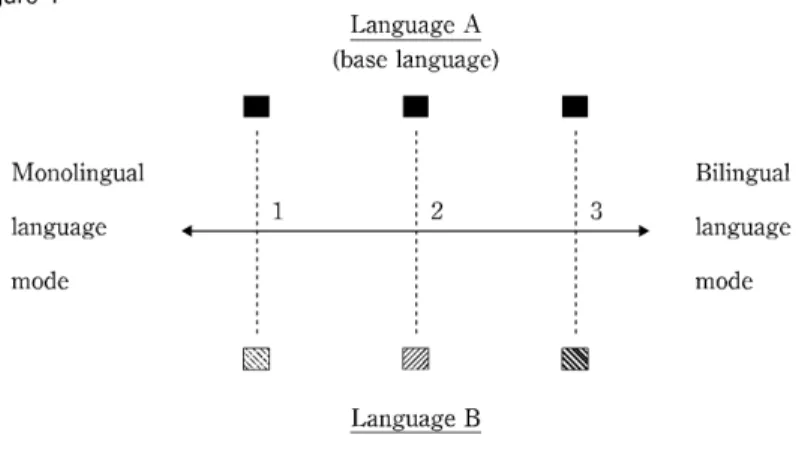
Grosjean (2001) proposes a visual representation of the language mode continuum. In Figure 1, the bilingual's positions on the continuum are represented by the dotted vertical lines, and the level of language activation by the degree of darkness of the squares (black is active and white is inactive). The model is two-dimensional: the horizontal axis is a continuum, the
en-dpoints of which represent a monolingual mode and a bilingual mode. At the same time, the horizontal axis divides the model into two parts: the bilingual's languages (A and B) are located in the upper and lower parts respectively. These two areas are discrete. In other words, there is no continuum between language A and language B. The model assumes that there is a base language to (almost) all conversations3>.
Figure 1 Monolingual language mode 1 Language A (base language) ^ 2 3 Bilingual language mode Language B
At the monolingual end of the continuum, bilinguals adopt the language of the monolingual interlocutor(s) and deactivate the other language as best they can. Thus, in Figure 1, the bilin-gual in position 1 is using language A as the base language and has deactivated language B. This deactivation has led to much theorizing and controversy around the notion of a language switch. What is certain is that bilinguals rarely deactivate the other language totally, which leads to the following question: "In what way is the language processing of bilinguals in monolingual speech mode different from that of monolinguals, given that there is always some residual activation of the other language in bilinguals?" (Grosjean, 1992:59). At the bilingual end of the continuum, bilinguals usually choose a base language to use with their interlocutor, that is, a main language of interaction. Once it has been chosen, bilinguals can bring in the other language (also called the guest language) whenever they need or wish to. Thus, the bilingual in position 3 is using language A as the base language and brings in language B from time to time.
Note that a particular position on the language mode continuum corresponds to various lev-els of activation of the two languages. When the speaker is in a more or less monolingual mode, we can assume that the occurrence of elements from the other language will be less frequent, as the other language is not activated. Green (1986) even proposes that the other language is in-hibited. However, when the speaker is in a bilingual mode, he/she will often use elements from both languages, because both languages are activated (though one — the base language — is more strongly activated than the other). Furthermore, speakers may travel along the horizontal axis when the situation and topic of the conversation require it. Speakers may also switch from one base language to another depending on the requirements of the speech situation. It is also noted that "bilinguals differ among themselves as to the extent they travel along the continuum; some rarely find themselves at the bilingual end (purists, language teachers, etc.) whereas others rarely leave this end (bilinguals who live in tight-knit bilingual communities where a form of mixed language is one of the language norms)" (Grosjean, 1992:58, 1995:262).
2.2 The impact of language mode on CS
Jacobson (1990) compared Spanish-English CS data from people of different ages and so-cial backgrounds in Texas. He concludes that speakers can be categorized by their preferred bilingual mode of speaking. Either Spanish or English may function as the matrix language (ML), or there may be no such asymmetry. This indicates that they are located either in a Span-ish bilingual mode or in an EnglSpan-ish bilingual mode or in an equal bilingual mode. Thus, in `natural' settings
mode continuum.
Treffers-Daller (1998) examined the effect of a speaker's language mode in terms of code-choice and CS. She placed the same speaker, a Turkish-German bilingual, in three different lan-guage modes by changing the context and the interlocutors. The author reports clear differ-ences between the switches found in the three fragments in her data. In the monolingual Ger-man mode, switching was limited to insertions of single words with a particular cultural load, most of which would probably be classified as established borrowings; German was clearly the base language at the discourse level and also the ML at the level of individual sentences;
inter-sentential CS occurred mainly when the topic or a switch of interlocutors necessitated it. In the bilingual German mode, switching was not very frequent either, but of a very different type: there were mainly alternations, both within and between sentences; most alternations took place at the periphery of the sentence, such as the appositions; most of these were separated from the rest of the sentence by pauses; inter-sentential switching was fluent and not triggered by external factors such as participants and topics. Most switches were found in the Turkish bilingual mode, where smooth insertions of central constituents and function words were
fre-quent, and both intra-sentential and inter-sentential switching was fluent and not triggered by external factors.
However, if language mode is not an independent variable in the study, it must be con-trolled. Grosjean (1997) says that it is important to recognize which language mode (monolin-gual or bilin(monolin-gual) the speaker was in when his or her speech was recorded before we analyze the code-switches or other language contact phenomena. Grosjean and Soares (1984, 1986) stress the differences that occur in the processing of language when a bilingual is in the monolingual as opposed to the bilingual mode. As we know very little about the participants' movement along the language mode continuum, it is not always clear which points along the continuum they were in when they were recorded. According to Grosjean (1997), the language mode factor has not been controlled carefully enough in many bilingual studies, and one consequence of not doing so is that a lot of ambiguous data is obtained, as some participants may be in a monolin-gual mode, others in a bilinmonolin-gual mode, and still others somewhere in between the two. For ex-ample, what might be seen as the accidental interference of one language with the other may in fact be a perfectly conscious CS in the bilingual speech mode. If, indeed, participants are in a bilingual mode, then both language systems are active, and no claims can be made about the
au-tomatic influence of one language on the other. It is only when participants are in a truly monolingual mode that such a claim can be made.
It is critical to know which language mode a bilingual is in before making any claims about the individual's language processing or language competence, and the complexity of bilinguals' speech modes should be taken into account by researchers (Grosjean, 1992). In most studies on bilingualism, the data has been collected in natural settings, in which it is difficult to control the speaker's language mode5). Treffers-Daller (1998) suggests that recognizing the base language of a conversation and the language mode that a speaker is in may help to differentiate various language contact phenomena.
3. Analysis and Findings 3.1 Frequency of CS occurrence
The frequency of CS occurrence was examined for each child in each story. A total of 524 switches (tokens) were counted for all subjects, a rate of 0.4 switches per minute in English and 3 switches in Japanese. This rate seems low in comparison with Fotos's (1995) English-Japanese bilingual children, whose rate was 4 per minute. This is probably due to the different
language modes. The children were in a monolingual mode while telling a story, as they were asked to speak one language at a time, while Fotos's children were recorded more or less in bilingual modes, so switching was the normal, unmarked choice in their conversation (Fotos,
1995).
As for the frequency of CS, the following points were evident: 1) A large portion of total switches (84%, N = 439) occurred in the 1.1 Japanese base language. The direction of CS was, therefore, asymmetrical, that is, from Japanese (L1) to English (L2). This contrasts with Fotos's (1990, 1995) finding that the direction of switching was more balanced. 2) The topic af-fected the frequency of occurrence: CS was more likely to occur when Momotaro was being told in English, and when Cinderella was being told in Japanese. 3) The occurrence of CS was more affected by the topic when the base language was English (Cinderella 15% vs. Momotaro 85%, N = 85) than when it was Japanese (Cinderella 66% vs. Momotaro 34%, N = 439).
We see that a considerable number of switches occurred in the monolingual language mode. What, then, actually motivated CS when the child was telling a story in one language?
3.2 Contexts where CS occurred: what motivated CS?
The contexts in which CS occurred were analyzed to examine what motivated CS (Takagi, 2006a). The following categories were identified for switches produced in the English base language.
1. Cultural borrowing: This means that the EL is used for culture-specific words which have no equivalent in the ML. This is a type of switch whose function is to fill a lexical gap between the languages. It appears that the EL words are used intentionally to solve lexical communication problems. The speaker is aware of the lack of a particular item in his/her ML mental lexicon, and often signals their use by pausing. For example, some children switched to Japanese for culture-specific items such as dango and oni, as in the following.
(1) Please can I have one of your dango? [dumpling]
(2) I'm going to oni's island.[demon]
(3) You can come to my oni-taiji.[demon-vanquishing]
2. Flagged borrowing: This refers to lexical borrowing which has some pragmatic function such as emphasis or humour. The speaker appeared to use the EL word consciously and the switch-ed word tendswitch-ed to be utterswitch-ed distinctively or to be flaggswitch-ed by a pause. For example, one child said:
(4) She is Momotaro's baasan. [grandmother]
The speaker knew the English equivalent, which was used in other contexts. It seems that he is fully aware of using the EL word and the effect its use has. Here, a humorous effect is produced by the use of the Japanese baasan instead of the English `grandmother' or `granny'. This type of
lexical borrowing could occur if the speaker did not know the target word in English. In the fol-lowing example, she might not have found the word `coach' in her L2 mental lexicon.
(5) Pumpkin pie is turning to basha. [coach]
The common feature of all the examples in this category is that the use of the Japanese word is intentional and uttered distinctively with a pause.
3. Request for a lexical term: Sometimes a switch is used for an aside which appeals for help in continuing in the original language. The children sometimes asked about a target word they did not know, for which they switched to Japanese, as is shown below.
(6) Kore nan te iu no, eigo de? [What is this called in English?]
4. Quotation of a character's utterances and feelings: CS for quotation is common in bilingual speech. In the following examples, the speaker switched to Japanese for the character's deci-sion and inner utterance respectively.
(7) He decided, "Bukkowasoo! " [(I) will kill (him) !]
(8) And Cinderella thought when you Prince Prince knows my name and where I live, I ... "Watashi wa sugoku komaru wa."
[I would be very embarrassed.]
5. Personal comment and feeling: This refers to switches expressing the speaker's personal comments or feelings. Switched utterances are not relevant to the sequence of the story itself but rather mark an aside. The switch seems to act as a device to demarcate the comment mode
from the narrative mode. The following examples illustrate this. (9) Researcher: Are they pretty?
Subject : Zenzen pretty ja naai ! [(They) are not pretty at all!] (10) Eeeto Cinderella ja nakute nan dakke, eeto....
[Well, not Cinderella, what is it? mm..]
In (9), the speaker switched to Japanese to make a comment on Cinderella's two sisters. Here, the speaker's own feeling about the characters is expressed with emphasis. The switched utter-ance in (10) is addressed to the speaker herself, which is an aside from the story-line. Switching to mark personalization versus objectivization is frequently referred to in the literature (e.g. Romaine, 1995; Fotos, 1990, 1995, 2001). Additionally, I found an interjection such as the fol-lowing.
(11) So moo ya daa![I don't want to continue (it) any more!] Here, the speaker expressed his feeling that he did not want to continue the task any more.
The categories stated above are frequently referred to in the literature as the discourse functions or pragmatic purposes of CS. These types of switch can be categorized as `functional-ly motivated'. The switches are characterized as functional, although the speaker may not necessarily be aware of it. It should be noted that another type of switch was observed, which was categorized as `syntactically triggered' as opposed to functionally motivated.
6. Syntactically triggered: This type of switch is an abrupt EL intrusion at the syntactic level. CS may be unintended when the speaker is in a monolingual mode. Unintended switching can be referred to as `triggering', as it is often activated by a trigger word. It was found that the trigger word tended to be a proper noun, such as "Momotaro", or a culture-specific word, as is shown in the following example.
(12) But he ate a dango o tabeta kara ne, ACC eat-PAST reason-PTL illocutionary-PTL
dakara ne I he was a bit more strong.
so illocutionary-PTLACC: accusative PTL: particle
[But he ate a dango, so he was a bit more strong.]
In Example (12), the switch was triggered by dango, resulting in ML alternation from English to Japanese. Then, however, the speaker reverted to the base language, English. She realized her
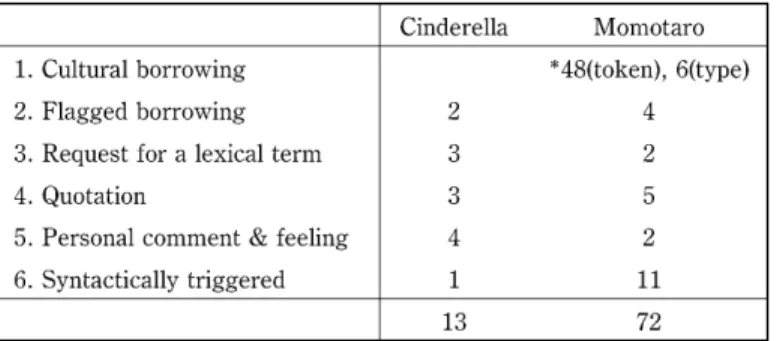
mistake and returned to English. Romaine (1995) describes triggering as more or less uncon-scious switching, which is motivated by internal linguistic factors. Such triggering occurs ac-cidentally because of the impact of topic-associated words. This type of switch needs to be dis-tinguished from functionally motivated switches, because it is not motivated by contextual fac-tors or linguistic need, but rather results from language interference. Table 1 shows the num-bers of CS occurrence in each of the categories stated above.
Table 1 The contexts of English--Japanese CS
Cinderella Momotaro
1. Cultural borrowing *48(token), 6(type)
2. Flagged borrowing 24
3. Request for a lexical term 32
4. Quotation 35
5. Personal comment & feeling 42 6. Syntactically triggered 111
1372
*This ratio means that these are specific items
, being keywords in the story.
The categories numbered 1 to 5 represent functionally motivated CS. The total number of switches was 85, out of which 73 (86%) were functionally motivated and 12 (14%) were syntacti-cally triggered. We can say that CS tended to occur functionally in the L2 mode.
Another type of triggering, i.e. lexical triggering, was observed in the data. Triggering oc-curs both at the lexical and syntactic level. It was found that the contexts in which CS occurred in the L1 base language were different from those in the L2 base language. Switches produced in the L1 base language were identified as lexically triggered.
The point to be observed in the Japanese base language is that switches were largely lexi-cal, involving basic vocabulary rather than culture-specific items. In addition, the switches tended to be smooth. This is in contrast to the lexical switches observed in the L2 base lan-guage, which were often flagged by hesitation or pausing. In most cases, the switches cannot be explained by contextual factors such as discourse functions and linguistic need. This type of CS is also noted by Nishimura (1997) among the Niseis living in Toronto. The Niseis in some cases code-switched for no apparent reasons. Nishimura refers to it as `free variation'; that is, no identifiable function motivates the switch. De Bot and Schreuder (1993) argue that, for various reasons, words of the non-intended language may intrude into a subject's speech.
mental lexicon, or by difficulty in retrieving such an item. In some cases, the child might not know the word in Japanese. In other cases, the English word might be selected, consciously or unconsciously, even though they knew the equivalent in Japanese. Frequent corrections show that the child often knew the word in both languages. Why, then, did he or she use the English word even though he or she knew the Japanese equivalent? A possible explanation could be
psycholinguistic: the EL was more readily available or easily accessible than the ML for the speaker.
To sum up, CS in the L2 base language is triggered by the topic, and switches were largely functionally motivated. CS in the L1 base language, on the other hand, tends to be more moti-vated by psycholinguistic factors, and more attributable to the automatic influence of the L2. The monolingual speech of bilinguals often shows the active interference of the language cur-rently not in use (Grosjean, 1995). Given the fact that the majority (84%) of switches occurred in the L1 base language, CS in monolingual mode is characterized as EL interference.
3.3 Types, i.e. syntactic categories, of CS
This section examines the types of CS produced in each base language. The grammatical categories of switched constituents were broken down and classified. In an attempt to quantify CS, I counted the number of types (different items), not tokens (the total items), because some i-tems associated with the story line were used repeatedly by the same speaker. In total, 42
different switches were identified in the English base language, while the number was 196 in the Japanese base language.
According to Poplack (1980), three types of CS can be identified: tag-switching, inter-sen-tential and intra-seninter-sen-tential. Tag-switching involves the insertion of a tag or tag-like element
from one language into an utterance which is otherwise entirely in the other language. Dis-course markers such as `you know', `I mean', `okay', etc. are English examples of tag-switches. Inter-sentential switching involves a switch from one language to the other for a whole tence. It may also occur between speaker turns. Intra-sentential switching occurs within a sen-tence. This means that switched elements range from the single morpheme level to higher lev-els, namely, phrasal constituents and complement phrases, since a sentence may well include more than one clause. Intra-sentential switching may also include mixing within word bounda-ries.
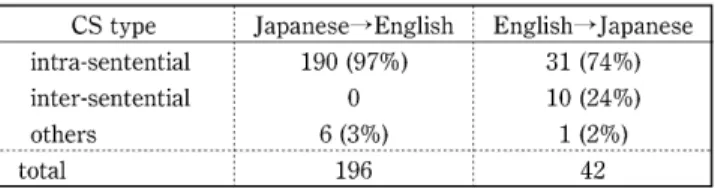
One way of looking at the structural categories of CS is to contrast the frequencies of inter-sentential and intra-inter-sentential CS. Table 2 shows the breakdown of the two types of CS.
Table 2 The distribution of CS type
CS type Japanese-*English English-*Japanese
intra-sentential inter-sentential others 190 (97%) 0 6 (3%) 31 (74%) 10 (24%) 1 (2%) total 196 42
We can see that intra-sentential CS is the most frequent type of CS in both the English and Japanese base languages. It is noteworthy that there is no inter-sentential CS from Japanese to English, while 10 CS (24%) are inter-sentential from English to Japanese. We need to consider what types of switched constituents are most frequent in intra-sentential CS.
Another classification of CS types is necessary to understand the constituents in intra-sen-tential switching. Myers-Scotton introduces the Complement Phrase (CP) as the unit of analysis (Myers-Scotton, 1997; 1998; Myers-Scotton & Jake, 1995; Jake & Myers-Scotton, 1997). A CP, in short, is synonymous with a clause that has a complementizer, although this complementizer is often null. Myers-Scotton (1998) argues that because the CP can be defined more precisely than either the sentence or the clause, it is the best unit for discussing the grammatical structur-ing of CS. Since a sentence may well include more than one CP, the term 'intra-sentential CS' can refer to 'inter-CP CS' as well. Therefore, 'intra-CP switching' would be a more appropriate and precise term. Also, when switching is between monolingual CPs, it should be referred to as `inter -CP switching' , not `inter-sentential CS'.
The distribution of intra-CP and inter-CP CS was examined in each base language. Although intra-sentential CS was the most frequent type of CS in both the Japanese and English base languages, the types of CS constituents are significantly different.
Table 3 The distribution of CS type
CS type Japanese—English English—*Japanese
intra-CP inter-CP others 185 (94%) 5 (3%) 6 (3%) 11 (26°7o) 30 (72%) 1 (2%) total 196 42
A comparison of Tables 2 and 3 reveals a structural difference in intra-sentential CS between the base languages. A change is noticeable in the distribution with the English base language. According to Table 3, the majority (94%) of CS is intra-CP in the Japanese base language, but it
is inter-CP (72%) that is most frequent in the English base language. This is in marked contrast to what we saw earlier in Table 2, i.e. the ratio of inter-sentential CS was only 24% (N=10).
The change of distribution in the CS types indicates that a considerable number of switches oc-cur at the clause boundary in the English base language.
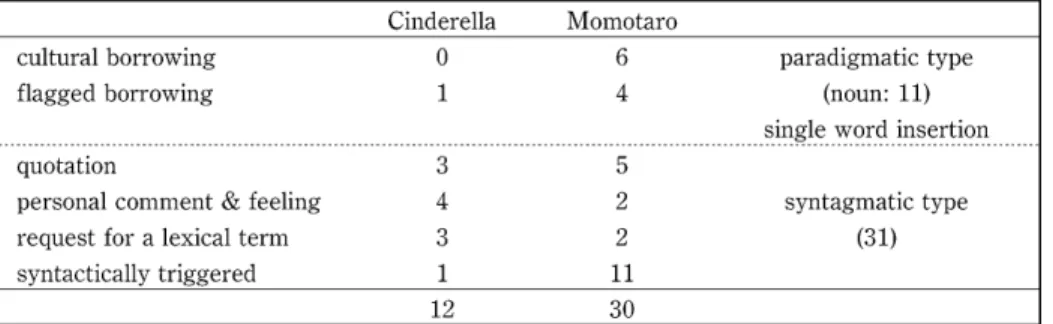
The dichotomy of paradigmatic and syntagmatic dimensions6> was used to classify the CS types (Takagi, 2006a). Paradigmatic CS is defined as the process of producing a `single unit', while syntagmatic CS produces a `string of units' in the other language. As for switches in the
English base language, single nouns were identified as paradigmatic and other categories (clauses, sentences, phrases) were counted as syntagmatic. Out of the total number of English — Japanese switches (N= 42) , 26% were paradigmatic (N= 11) and 74% were syntagmatic (N = 31) (See Table 4). We can see that switches in the English base language tended to be syn-tagmatic.
Table 4 The distribution of CS contexts in each topic Cin derella Momotaro
cultural borrowing flagged borrowing 06 14 paradigmatic type (noun: 11) single word insertion quotation
personal comment & feeling request for a lexical term syntactically triggered 35 42 32 111 syntagmatic type (31) 1230
As for switches in the Japanese base language, single words and isolated phrases (not in a sentence) were classified as paradigmatic, whereas phrasal categories produced in a sentence were classified as syntagmatic. The total number of Japanese— English switches was 196, out
of which 150 (77%) were paradigmatic and 46 (23%) were syntagmatic. Tables 5 and 6 show the distribution of grammatical categories in paradigmatic and syntagmatic CS respectively.
Table 5 The number of paradigmatic CS
grammatical category number
noun verb
adjective
noun phrase in isolation prepositional phrase in isolation
93 33 18 5 1 Total 150
Table 6 The number of syntagmatic CS
grammatical category number noun phrase 21 phrasal verb 10 adjective phrase 7 clause 5 prepositional phrase 1 verbal phrase 1
other ("like some") 1
We see that switches in the Japanese base language tended to be paradigmatic. This result cor-responds to the fact that switches in the L1 mode were largely lexical.
The data was further analyzed in the framework of alternation vs. insertion7 . A clear con-trast depending on the base language was evident in switches that were analyzed as the syntag-matic type: in the Japanese base language, syntagsyntag-matic CS was characterized as the insertion of phrasal constituents, while in the English base language, it was always alternation, and no phrasal insertion was found. The switches in the Japanese base language are all categorized as the insertional type, because whatever EL elements are switched, Japanese is kept as the ML (Takagi, 2006b; 2007a). However, CS involves ML alternation when the base language is En-glish. The ML changes from English to Japanese (Takagi, 2007b).
Some structural differences were noticeable in the switched constituents between the base languages. Although single word switching is most common regardless of the base language, the alternational type only occurs when the base language is English. However, these differ-ences seem to be attributable to the typological characteristics of Japanese and English8), rather than to the effect of language mode, that is, a psycholinguistic factor.
4. Discussion and implications
4.1 Direction of CS
The direction of CS tended to be from L1 to L2, regardless of language dominance or proficiency9). What does this asymmetry indicate? It seems that there is a primary psycholin-guistic factor that determines the direction. Given the fact that deactivation of the language which is not being used is not complete, and that a bilingual's speech is constantly influenced by
the deactivated language (Grosjean, 1997), the possible degree of deactivation might be unequal for the bilingual's L1 and L2. Is it possible that L2 deactivation in speaking Ll is more difficult than L1 deactivation in speaking L2?
It is assumed that the level of activation of one language over another determined which language was more available for the speaker. For children living in an L2 environment, L2 acti-vation will easily reach the level to be selected in language production. As the speaker uses the
L2 more frequently and more proficiently, the more automatically the switch will take place. If there is an `activation threshold' for items to be selected from the mental lexicon, the L2 item may reach this level easily and be spoken even though the selected language is L1. Or it can be considered that such L2 items have already achieved the same status as Ll in the speaker's
mental lexicon.
What is the implication of CS direction for lexical links? The asymmetry of CS direction re-minds us of the remaining question of whether relationships between elements in different lan-guages are equally close in both directions (De Bot, 1992). Knoll and Scholl (1992) have present-ed evidence from translation and semantic priming tasks that shows there is an asymmetry in cross-language performance. They suggest that words in each language (L1 and L2) are inter-connected via lexical-level links and conceptual links, but that the strength of these connections differs for the two languages. The asymmetry of CS occurrence may imply that the links be-tween lexical elements are stronger (or closer) from L2 to Li.
4.2 CS in the Li and L2 monolingual modes
Treffers-Daller (1998) suggests that there are more peripheral switches at the monolingual endpoint of the continuum, while switches of more central constituents tend to be at the bilin-gual endpoint of the continuum. By switches of peripheral elements she means tags, fillers and interjections. It is assumed that at the monolingual endpoint of the continuum we find cultural borrowings, established borrowings and other items that are difficult to translate. These may be flagged, because the speaker is trying to speak either language in its `pure' form. Going to the bilingual side of the continuum, we find other parts of the lexicon, including basic
vocabula-ry.
The findings of the present study corroborate Trffers-Daller's assumption on some points. We have seen that CS was triggered by the topic in the monolingual L2 mode. A large portion of switches were cultural borrowings and some other lexical borrowings, most of which were flagged with a pause or hesitation. (This behaviour has been called flagged switching.) This may imply that the speaker tends to be at the L2 monolingual endpoint most of the time while speaking. In the monolingual Ll mode, on the other hand, switching of basic vocabulary ac-counted for the majority of switches, rather than culture-related words. Furthermore, switch-ing tended to be smooth (this has been called smooth switchswitch-ing), though some corrections were observed. More switching would be predicted when the speaker is on the Ll side of the continu-um than on the L2 side. In other words, the speaker located at the 1,1 endpoint is more likely to travel to the bilingual side of the continuum.
Peripheral switches were identified in the monolingual L2 mode. By `peripheral switches' I mean switches for quotation, comment and interjection, which were categorized as functionally motivated CS. (Such switches are considered to be `peripheral' in terms of the discourse level,
which is not necessarily the same as being peripheral constituents of the sentence.) Peripheral elements of speech slip into what is intended to be monolingual discourse. It was noted that lan-guage dominance can be indicated by the direction of functionally motivated CS (Takagi, 2006a): children switched to their dominant language to make a comment external to the narra-tive or to mark an aside. Bentahila and Davies (1998) regarded this phenomenon as a`leak': if bilinguals speaking their non-dominant language have not only to activate their command of this
language but also in some sense to deactivate their command of the dominant, psycholinguisti-cally prior language, then the momentary lapses into the stronger language could be seen as slight failures of this deactivation process. This idea corroborates the assumption stated earlier that CS in the monolingual mode is caused by EL interference.
5. Conclusion
We have shown that the language mode continuum model can account for the general ten-dencies in the frequency and type of CS found in discourses produced by bilingual children. It is shown that CS in the monolingual mode will tend to be lexical, characterized as single word switching, which I referred to as the paradigmatic type. Switching will be most frequent when the speaker is in the bilingual mode and probably least frequent in the monolingual L2 mode. If we compare the two monolingual language modes, more switching is expected when the
speak-er is on the L1 side of the continuum. Also, switching is likely to consist of pspeak-eriphspeak-eral elements on the monolingual side of the continuum, and central elements on the more bilingual side. Moreover, flagged switches can be expected on the monolingual side, and smooth switching can be expected on the bilingual side of the continuum. Treffers-Daller (1998:197) states, "The
model can explain why in some speech styles flagged switches may dominate, whereas in other speech styles fluent switching is more common". As she argues, the language mode continuum concept may offer a new approach to studying variable CS patterns within and between com-munities (e.g. Poplack, 1988; Bentahila and Davies, 1992; 1995) because it can help account for tendencies in the frequency and type of switching that takes place.
Notes
1) The profiles of the ten sample children are given in Takagi (2006a). 2) For details of the data-collecting procedure, please see Takagi (2006a).
3) Given the high level of activation of both languages in the bilingual mode, not only can code-switches and borrowings be produced but also the base language can be changed frequently, that is, the slightly less ac-tivated language becomes the base language and vice versa. A change of topic, situation, interlocutors, etc. may lead to a change in the base language. When this happens repeatedly within the same interac-tion, it gives the impression that the two languages are equally active.
However, Grosjean (2001) argues that there is evidence in the sociolinguistic and psycholinguistic literature that, at any given point in time, one language is always more active than the other and that it is this language that governs language processing. Myers-Scotton (1993 [1997]) also points out that the matrix language (ML) may change within a single discourse for sociolinguistic reasons, but she claims that it is always possible to determine the ML for any discourse sample. She acknowledges that there may be corpora which show an approximate 50-50 split between languages but maintains that the ML can be identified even in such a case.
Bentahila (1995) argues strongly against the assumption of the overall ML for any discourse by presenting his discourse sample of Moroccan bilinguals, in which frequent switches between whole clauses rather than small constituents were observed and the two languages contributed an almost equal number of words.
4) For example, a Spanish-English bilingual speaking Spanish to a Spanish monolingual is in a `Spanish monolingual mode' (Spanish is the base language and the other language, English, is deactivated as the mode is monolingual). The same bilingual speaking English to an English monolingual is in an `English
monolingual mode'. If this person meets another Spanish-English bilingual and they choose to speak
Spanish together and code-switch into English from time to time, then both are in a 'Spanish bilingual
mode'. If for some reason the base language were to change (because of a change of topic, for example),
then they would be in an 'English bilingual mode'. In Jacobson's (1990) data, the speakers may be
ed either in a Spanish bilingual mode or in an English bilingual mode, or in some other cases, in an equal
bilingual mode, where the two languages contribute almost equally to the discourse and the base
guage cannot be identified.
5) In collecting the data, I was able to control each child's language mode by asking him/her to start narrat-ing either in English or in Japanese.
6) The explanation of 'paradigmatic' vs. `syntagmatic' dimensions is given in Takagi (2006a). 7) The explanation of the 'alternation' vs. 'insertion' distinction is given in Takagi (2007a). 8) I discussed the grammatical constraints of Japanese-English CS in Takagi (2007ab).
9) The sample children had different combinations of abilities in the two languages. The sample included two opposing groups who could be contrasted in the relative dominance of their L1 and L2.
References
Bentahila, A. (1995). Review of "Duelling languages: grammatical structure in codeswitching" by Carol Myers-Scotton. Language 71, 135-140.
Bentahila, A. & Davies, E. (1992). Code-switching and language dominance. In R. J. Harris (Ed.), Cognitive processing in bilinguals (pp. 443-458). Amsterdam: North Holland/ Elsevier.
Bentahila, A. & Davies, E. (1995). Patterns of code-switching and patterns of language contact. Lingua 96, 75-93.
De Bot, K. (1992). A bilingual production model: Levelt's `speaking' model adapted. Applied Linguistics.
Vol. 13, No. 1, 1-24.
De Bot, K. & Schreuder, R. (1993). Word production and the bilingual lexicon. In R. Schreuder & B. Weltens (Eds.), The bilingual lexicon (pp. 191-214). Amsterdam: Benjamins.
Fotos. S. (1990). Japanese-English codeswitching in bilingual children. JALT Journal 12 (1), 75-98. Fotos. S. (1995). Japanese-English conversational codeswitching in balanced and limited proficiency
guals. Japan Journal of Multilingualism and Multiculturalism. 1 (1), 2-15.
Fotos. S. (2001). Code switching by Japan's unrecognized bilinguals: Japanese university students' use of their native language as a learning strategy. In Noguchi, M. G. & Fotos, S. (Eds.), Studies in Japanese
bilingualism (pp. 329-352). Clevedon, UK: Multilingual Matters.
Green, D. W. (1986). Control, activation and resource: a frame and a model for the control of speech in guals. Brain and Language 27, 210-223.
Grosjean, F. (1982). Life with two languages: an introduction to bilingualism. Cambridge, Mass: Harvard University Press.
Grosjean, F. (1985). The bilingual as a competent but specific speaker-hearer. Journal of Multilingual and Multicultural Development 6(6), 467-477.
Grosjean, F. (1992). Another view of bilingualism. In R. J. Harris (Ed.), Cognitive processing in bilinguals (pp. 51-62). Amsterdam: North Holland/Elsevier.
Grosjean, F. (1995). A psycholinguistic approach to code-switching: The recognition of guest words by guals. In Milroy, L. & Muysken, P. (Eds.), One speaker, two languages: cross-disciplinary perspective on
code-switching (pp. 259-275). Cambridge: Cambridge University Press.
Grosjean, F. (1997). Processing mixed languages: issues, findings, and models. In A. M. B. de Groot & J. F. Kroll (Eds.), Tutorials in bilingualism: psycholinguistic perspective (pp. 225-254). Lawrence Erlbaumm
Associates.
Grosjean, F. (2001). The bilingual's language modes. In J. Nichol (Ed.), One mind, two languages: bilingual language processing (pp. 1-22). Oxford: Blackwell.
course. In R. Jacobson (Ed.), Codeswitching as a worldwide phenomenon (pp. 111-139). New York: Peter Lang.
Jake, J. & Myers-Scotton, C. (1997). Codeswitching and compromise strategies: implications for lexical structure. International Journal of Bilingualism. Vol. 1, No. 1, April, 25-40.
Knoll, J. F. & Scholl, A. (1992). Lexical and conceptual memory in fluent and nonfluent bilinguals. In R. J. Harris (Ed.), Cognitive processing in bilinguals (pp.191-204). Amsterdam: North Holland/Elsevier. Myers-Scotton, C. (1993)[19971. Duelling languages: Grammatical structure in code-switching. (2nd edition
with Afterword). Oxford: Oxford University Press.
Myers-Scotton, C. (1997). Code-switching. In F. Coulmas (Ed.), The Handbook of Sociolinguistics (pp. 217-237). Oxford: Blackwell.
Myers-Scotton, C. (1998). Structural uniformities vs. community differences in code-switching. In R. Jacobson (Ed.), Codeswitching worldwide (pp. 91-108). Berlin; New York: Mouton de Gruyter. Myers-Scotton, C. & Jake, J. (1995). Matching lemmas in a bilingual language competence and production
model: Evidence from intrasentential code switching. Linguistics 33, 981-1024.
Nishimura, M. (1997). Japanese/English code-switching: syntax and pragmatics. Peter Lang Publishing, Inc., New York.
Poplack, S. (1980). Sometimes I'll start a sentence in Spanish Y TERMINO EN ESPANOL: toward a ogy of code-switching. Linguistics 18, 581-618.
Poplack, S. (1988). Contrasting patterns of codeswitching in two communities. In Monica Heller (Ed.), switching: anthropological and sociolinguistic perspectives. (pp. 215-44). Berlin: Mouton de Gruyter. Romaine, S. (1995). Bilingualism (Second Edition). Oxford: Blackwell.
Takagi, M. (2006a). Code-switching and language dominance in Japanese-English bilingual children. In Journal of Inquiry and Research (PP. 17-35). No. 83, March, 2006. Kansai Gaidai University. Osaka,
Japan.
Takagi, M. (2006b). Code-switching and L1 development in Japanese-speaking children living in an dominant environment. In Journal of Inquiry and Research (PP. 19-37). No. 84, September, 2006. Kansai
Gaidai University. Osaka, Japan.
Takagi, M. (2007a). Grammatical congruence in Japanese-English insertional code-switching. In Journal of Inquiry and Research (PP. 19-35). No. 85, March, 2007. Kansai Gaidai University. Osaka, Japan. Takagi, M. (2007b). Alternational code-switching in the story-telling narratives of English-Japanese
gual children. In Journal of Inquiry and Research (PP. 1-18). No. 86, September, 2007. Kansai Gaidai
University. Osaka, Japan.
Treffers-Daller, J. (1998). Variability in code-switching styles: Turkish-German code-switching patterns. In R. Jacobson (Ed.), Codeswitching worldwide (pp. 177-197) Berlin; New York: Mouton de Gruyter.