西 南 交 通 大 学 学 报
第 55 卷第 4 期
2020
年 8 月
JOURNAL OF SOUTHWEST JIAOTONG UNIVERSITY
Vol. 55 No. 4
Aug. 2020
ISSN: 0258-2724 DOI:10.35741/issn.0258-2724.55.4.17
Research article Education
T
HE
P
RACTICE OF
D
IGITAL
L
EARNING
(D-L
EARNING
)
IN THE
S
TUDY
FROM
H
OME
(SFH)
P
OLICY
:
T
EACHERS
'
P
ERCEPTIONS
在家學習(SFH)策略中的數字學習(D-學習)實踐:教師的認知
Widya Rizky PratiwiaSTMIK Bina Adinata, Bulukumba, Indonesia
Srikaya Street, Bulukumba, Indonesia, [email protected]
Received: April 21, 2020 ▪ Review: June 29, 2020 ▪ Accepted: July 15, 2020
This article is an open access article distributed under the terms and conditions of the Creative Commons Attribution License (http://creativecommons.org/licenses/by/4.0)
Abstract
This article investigates the efficacy of Digital Learning implementation in SFH policy from teachers' viewpoints. The outbreak of the COVID-19 pandemic in Indonesia in mid-March 2020 required the Government to take a decisive step in the form of Study from Home (SFH). The policy was aimed at preserving the quality of students' mental and psychological learning while socially and physically distancing. In this descriptive qualitative study, the interviews were conducted online with four teachers in various high schools in Bulukumba Regency, Indonesia. It was also supported by documents. This research found that teachers prefer to use WhatsApp and Google Classroom as the platforms to organize D-Learning. These applications are more comfortable to use, easy to access, and more familiar in their environment. Teachers perceive that D-Learning modifies the learning process so that it becomes more flexible. It also results in more autonomous learners. However, teachers are aware they are not yet ready to provide good technology-based material. They face difficulties in assessing students' progress from home. Students were also found to lack enthusiasm in responding to the learning content. Besides, inadequate facilities and infrastructure limit the students' access to D-Learning. As a result, D-Learning in SFH policy has not been effective for the students' cognitive and affective development and learning goals cannot be maximally achieved. Thus, it is suggested that the government support all efforts to adjust quickly to the D-Learning system's practice, such as by broadcasting more educational content through electronic media and publishing materials of pedagogical specialists for working in D-Learning environments.
Keywords:Digital Learning, Study from Home, COVID 19, Teachers, WhatsApp
摘要 本文從教師的角度研究了數字學習在 SFH 政策中的實施效果。 2020 年 3 月中旬印度尼西亞
爆發新冠肺炎大流行,要求政府採取“在家學習”形式的決定性步驟。該政策旨在在保持社會和 身體距離的同時保持學生的心理和心理學習質量。在這項描述性的定性研究中,訪談是在印度尼
Pratiwi / Journal of Southwest Jiaotong University/ Vol.55 No.4 Aug 2020 2 2 西亞 布昆巴摄政 的各所高中對四名老師進行的在線採訪。它也得到文件的支持。這項研究發 現,教師更喜歡使用 WhatsApp 和谷歌課堂作為組織 D 學習 的平台。這些應用程序使用起來更舒 適,易於訪問,並且對它們的環境更加熟悉。教師認為,D 學習 可以改變學習過程,從而使其變 得更加靈活。這也導致更多的自主學習者。但是,教師知道他們尚未準備好提供基於技術的好的 材料。他們在評估學生在家中的學習進度時面臨困難。還發現學生對學習內容的反應缺乏熱情。 此外,設施和基礎設施不足限制了學生獲得 D 學習 的機會。結果,SFH 策略中的 D 學習 對學生 的認知和情感發展並沒有有效的作用,並且無法最大程度地實現學習目標。因此,建議政府支持 所有為快速適應 D 學習 系統的實踐而做出的努力,例如通過電子媒體廣播更多的教育內容以及出 版在 D 學習 環境中工作的教學專家的材料。 关键词: 數字學習,在家學習,新冠肺炎,教師,WhatsApp.
I. I
NTRODUCTIONThe world of education cannot be separated from the strategic role played by teachers. They are the main character behind students successfully achieving their academic goals. Equipped with several competencies, such as pedagogy, personality, social skills, and professionalism, teachers can be the ideal intermediary between students and parents, stakeholders, and the learning environment to create the synergy in line with community life. As a professional, the teacher is responsible for educating, teaching, guiding, directing, training, and evaluating students' learning progress. This responsibility is to develop their knowledge in the fields of study, teaching techniques, and learning processes [1].
In the 21st century, teachers are now equipped with many digital competencies, such as data literacy, the ability to communicate through the media, the ability to create learning content, and the ability to solve problems [2]. Data literacy is related to the ability of educators to process information that is useful for learning. Communication through the media is closely related to the interaction and cooperation among educators. Teachers must utilize different forms of media to create a learning process that can be accessed by students. The creation of learning content is related to educators' creativity in managing and presenting learning information through various available technological sources. In dealing with problems, educators are expected to be capability of producing solutions based on student learning needs so that the effectiveness of learning objectives can be maximized. In the 21st century, a teacher’s digital competence was triggered by the development of information and communication technology (ICT) that was so rapid. The emergence of computer-based learning concepts, such as electronic learning (E-Learning), mobile learning (M-(E-Learning), and
digital learning (D-Learning), as a whole, is the impact of the integration of ICT in the world of education.
E-Learning and M-Learning are part of D-Learning, although some learning tools can be specifically categorized as E-Learning and M-Learning [3]. D-M-Learning occurs when the learning process takes place digitally. Interactions between educators, students, and learning environments (teaching materials, learning resources, learning media) are mediated by commonly-used communication devices, whether specifically designed or not. The term refers to learning practices that utilize technology effectively to strengthen students’ learning experiences by providing interactive learning resources, learning content, learning evaluations, and means of communication [4]. Three fundamental perspectives are inherent in D-Learning as a learning concept that is a combination of several technologies, digital content, and learning itself [5]. Technology refers to applications or information and communication platforms that can be used to carry out learning activities, such as Google Classrooms, Zoom, Google Meet, and Whatapps Groups. Digital content refers to the discussion material related to knowledge and skills that will be taught to students that are packaged in digital form, either created explicitly by educators or only content already available that is utilized in learning resources such as websites, Youtube, and e-books. Nevertheless, learning is related to the teacher's role as a guide who directs students' learning activities in accessing learning content.
The effectiveness of D-Learning has been tested in various countries and shows satisfactory results on several aspects of learning. D-Learning has a positive impact on student motivation and learning outcomes compared to conventional learning (face to face), primarily related to the flexibility of personalized learning, time, and
3 3 3 access to learning content [6]. In terms of output,
students are more actively involved in accessing learning resources that automatically improve their social skills. In terms of outcomes, students have full control of learning activities, so they feel motivated and confident [7]. D-Learning, combined with programmed learning, can also improve student learning outcomes and learning motivation [8].
In Indonesia, the term D-Learning is still less popular than its predecessor, "E-Learning", which is identical to the learning management system (LMS). However, lately, D-Learning began to be discussed after the COVID-19 pandemic hit Indonesia and affected several aspects of life throughout the country, including education. The death rate due to COVID-19 continued to increase until the beginning of May, and it claimed the lives of about 1,114 Indonesian populations [9]. This condition has had a profound impact on government structural policies from upstream (central) to downstream (village), aiming to reduce the spread of COVID-19 by socializing terms, such as social distancing, physical distancing, and working from home. The work from home policy for teachers and workers in government circles led the minister of education and culture to dismiss schools in the affected areas of COVID-19 which automatically encourages the jargon of "study from home" for students. Studying from home has impacted of a series of Indonesian government policies since it was established as a country exposed to the COVID-19 pandemic on March 2, 2020. Studying from home requires students to learn from home during the COVID-19 emergency so that learning cannot be carried out conventionally (face to face). These conditions make D-Learning the best choice as a means of learning by teachers.
Teachers in Bulukumba Regency, South Sulawesi, Indonesia began conducting Digital Learning on March 17, 2020, since students were encouraged to learn from home [10]. Various online platforms are used to carry out learning, such as Google Classroom, Whatsapp groups, Zoom, etc. The transformation of learning is quite surprising to teachers because creativity and innovation in the 21st century means that teacher competencies are truly tested so that the learning process remains meaningful to students. Finally, the implementation of D-Learning has led to a variety of perceptions among teachers in Bulukumba Regency. There is no particular platform available as a learning tool, as is the case with universities. Therefore, the researcher is encouraged to examine the implementation of D-Learning in SFH policy more rootedly, in
order to assess whether D-Learning in SFH policy is effective for students' cognitive and affective development, and understand the benefits and challenges of D-Learning practice in SFH policies from teachers' viewpoints.
II.
L
ITERATURER
EVIEW A. Teachers’ PerceptionsEveryone can understand a reality that has already happened. The accumulation of understanding produces information that plays an essential role in shaping perception. Perception results from simplifying various information that can be used as a principle or belief in acting. Perception is a thought and action towards a reality influenced by the knowledge and experience. It is an idea, picture, or belief resulting from an effort to understand something [11]. The perception is manifested in the form of opinions, beliefs, attitudes, and judgments about something in the environment [12]. Perception efforts involve people in organizing and interpreting impressions by giving meaning to a phenomenon [13]. Teachers' perceptions reflect the attitudes and actions that will be taken in the learning process. Therefore, what is done inside and outside the classroom is influenced by their perception [14]. As an underlying assumption in making decisions, teacher perceptions have a significant influence on learning because they affect attitudes and actions and display views on many aspects of the education [15].
Teacher's perception can be viewed from two approaches, namely bottom-up theory, and up-bottom theory. The up-bottom-up theory explains how perception is formed from data received by the five senses and then processed cognitively to produce a perception. The characteristic of the theory is that the final perception is mostly determined by the content and quality of what is captured by the five senses. In other words, perception is driven more by a stimulus [12]. Perception will be shaped by information captured from the five human senses. The information can be in the form, size, and color of the object being observed.
In contrast to the above theory, the up-bottom theory departs from knowledge, expectations, or thoughts possessed by someone to produce a perception. It can be said that knowledge, expectations, and initial thoughts are still in the form of a hypothesis to judge the object being observed. There are several reasons why perception functions as a hypothesis, namely 1) perception allows behavior that is following the characteristics of objects that do not make sense,
Pratiwi / Journal of Southwest Jiaotong University/ Vol.55 No.4 Aug. 2020 4
2) the ambiguity of the object being observed, and 3) the tendency towards the possibilities that occur [12].In the constructivist view, perception is formed by extracting knowledge arranged to become information separately or in cognitivist "synthesis." The final product of perception is the knowledge, motivation, and emotions of the observer.
In this context, teacher perceptions are associated with implementing D-Learning during the Covid-19 emergency period in Bulukumba Regency, Indonesia. This perception of each teacher is diverse because many factors influence them, especially related to digital competence, which is closely related to the creativity of a teacher to bring meaningful learning. Teacher perceptions include thoughts, assumptions, beliefs, and actions taken while implementing digital learning as a cutting edge step in the middle of a study from home policy.
B. D-Learning Implementation in Bulukumba Regency, Indonesia.
The fast development of information and communication technology has penetrated the world of education, changing the paradigm of teaching and learning. Today's learning activities encourage students to experience what is being learned or "learning by doing" so that the role of technology and information is needed to help students understand and apply their knowledge. Learning has been presented virtually through various learning concepts such as electronic learning, mobile learning, and digital learning as a perfect manifestation of the integration of learning theory with educational technology. The idea of D-Learning is becoming increasingly popular because it effectively strengthens student learning experiences if it uses appropriate technology. D-Learning can include components of a comprehensive learning system such as assessment, learning strategies, learning content, learning platforms, access to learning resources, and interactive learning media. The D-Learning environment can be educational software, digital learning tools, online learning programs, or learning resources. The environment consists of several components such as organizational learning, submission and the assessment of assignments, management and use of student information, timetabling, internships and final projects, developing, managing and sharing the learning materials, education process support, learning analytics, communication, collaboration, multimedia, and freely available applications. These components can be selected according to the learning needs and their relevance to the
effectiveness and efficiency of the learning process. The teacher can do it independently by holding on to the principle of benefit.
The implementation of digital learning in schools in Bulumkumba Regency during the Covid-19 emergency did not occur institutionally, as did universities with massive online learning platforms. The local government also did not instruct the particular platform as a D-Learning environment. The movement of D-Learning implementation was initiated by teachers structurally in an educational institution through an internal agreement. The implementation is a spontaneous response to several policies related to the spread of Covid-19. The application is carried out online by utilizing several communication platforms commonly used by most people such as Whatsapp, E-mail, google classrooms, google meet, and Zoom in. The platform is used as the primary medium to deliver learning content, direct learning activities, access learning resources, provide assignments, and evaluate the learning process. The teacher is free to choose the platform to use, but the schedule and duration of learning remain following the curriculum. The hardware used consists of laptops and mobile phones connected to the internet. The teacher prepares learning content by collecting digital information in cyberspace or creating it themselves through learning content developer software.
C. The Policy of Study from Home (SFH) in the Emergency of COVID-19
The entry of the Covid-19 pandemic outbreak into Indonesia in mid-March 2020 made the central government take conclusive steps to prevent the spread of the virus to various regions. Some of the born policies include social distancing, physical distancing, work from home, and regional quarantine. Therefore the government prohibits activities that involve large amounts of time. The government also closes all places and activities that can potentially cause mass crowds such as seminars, study sessions, markets, schools, government agencies, and tourist and entertainment places. The impact of learning activities in the school environment is nullified in an indefinite period. The government and every society element then campaigned for "study from home" to care for students' mental and psychological learning to stay awake during the Covid-19 pandemic emergency until conditions improved. Students are instructed to learn from home through online tutoring. Parents of students are also involved to ensure that children continue to study at home by providing
5 5 5 assistance and supervision of online learning
activities. In supporting the learning activities at home, the ministry of education and culture launches a "learning from home" program for all levels of education. It is broadcast live through national TV broadcast TVRI at 08.00 - 23.00 WIB. Moreover, through the ministry of education and culture, the government has collaborated with a private platform to provide free online learning such as home learning, Meja Kita, Icardo, Kelas Pintar, Ruangguru, Sekolahmu, etc. All of which are accessible to students at any time while connected to the internet.
Policy study from home directly involves the teacher's role to provide instruction and guidance on the class like face to face. The teacher's creativity in delivering the material is tested. If it does not, it will give rise to impressions and meanings that are not good for students so that students' motivation and learning interest are low and ultimately decreases learning outcomes. Teachers who have mastered digital competence in the 21st century are challenged to conduct various experiments and find a unique D-Learning formulation so that students are motivated to learn. Teachers who have not mastered digital competence in the 21st century are encouraged to learn while applying little by little, the knowledge they have gained through training programs provided by local governments or autodidact learning. In other words, this policyis a challenge and opportunity for every teacher to bring the best education in Indonesia.
III.
M
ETHODS/M
ATERIALSThe study was conducted in Bulukumba Regency, one of the red zone areas impacted by the COVID 19 pandemic. To preserve the quality of education during Social and Physical Distancing, the best solution is to follow safety protocols in implementing the the Study from Home (SFH) policy. Therefore, the learning process should be continued through the implementation of Digital Learning (D-Learning). Consequently, it is crucial to report on the efficacy of the implementation of Digital Learning in the SFH policy from the perspective of teachers.
Three core points were investigated in this study, namely, to examine the implementation of D-Learning in the SFH policy more rootedly, whether D- Learning in SFH policy was effective for students' cognitive and affective development, and the benefits and challenges of D-Learning practicing in SFH policies from the viewpoints of teachers.
The current research study is designed as a descriptive qualitative study. The purpose was to explain the comprehensive summarization of specific events experienced by individuals or groups of people in everyday life [16]. The researcher selected four teachers as participants in this study through purposive sampling. They were teachers in several Vocational High Schools in Bulukumba Regency, South Sulawesi, Indonesia. The participants were teachers at SMK Negeri 2, SMK DH Pepabri, SMK Negeri 9, and SMK Negeri 11. They taught different subjects: Mathematics, English, ICT, and Religion. There was only one male participant, while others were female. To protect participants' identities, the researcher coded them with abbreviations followed by a numerical, such as T1.
Table 1. Participants Participants Items Schools Subjects of teaching Gender
T1 SMK Negeri 2 ICT Male
T2 SMK DH
Pepabri
Maths Female
T3 SMK Negeri 9 English Female
T4 SMK Negeri 11 Religion Female
The data was gained from interviews and is supported by documents, such as the screenshot of teachers' WhatsApp group and Google classroom which were sent to the author because the author was not the participant-observer who was involved in the group. The researcher communicated with participants online. The researcher interviewed them by using a handphone and recording the conversation. The data were then transferred from spoken to written form to be organized and analyzed [17]. The participants sent the data by WhatsApp. The data sent, such as the screenshots of teachers' instructions in giving material, students' responses to the materials or tasks given, and the number of participants in those class groups. The data were analyzed utilizing an interactive model of analysis. It was a series of collecting, reducing, presenting the data, and drawing some conclusions.
IV.
R
ESULTS ANDD
ISCUSSIONThe occurrence of the global COVID-19 pandemic requires all educational institutions to implement digital learning (D-Learning) systems to maintain the quality of their nation's education. The Study from Home (SFH) policy instructed by
Pratiwi, W.R. / Journal of Southwest Jiaotong University/ Vol.55 No.4 Dec. 2020 6
Figure 1. D Learning Implementation in WFH Policy
the government to all educational institutions, especially in Indonesia, forces both teachers and students to adapt to this change. This situation certainly caused a variety of reactions and perceptions in its implementation. Some teachers feel that they are ready to conduct the online classes, while others are not prepared yet.
Therefore, in responding to this situation, it is crucial to report the teachers’ point of view about the efficacy of digital learning (D-Learning) implementation in the Study from Home (SFH) policy in Indonesia, especially in Bulukumba Regency.
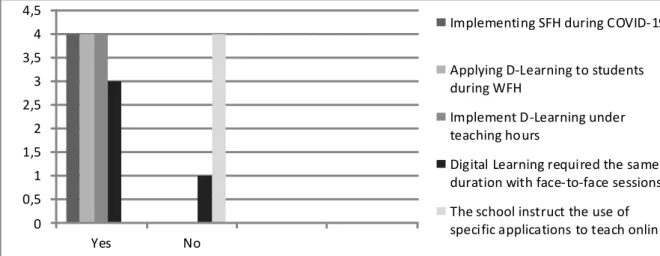
A. D-Learning Implementation in SFH Policy Nine questions were distributed to investigate the implementation of digital learning (D-Learning) in the Study from Home (SFH) policy. To open the discussion of this study, the researcher wanted to know whether or not teachers in Indonesian High Schools, especially in Bulukumba Regency, South Sulawesi apply digital learning to teach their students. If so, what kinds of online applications do they use in the learning process, and what are the reasons for choosing those applications? Figure 1 demonstrates that all participants were instructed in the Study from Home (SFH) policy during the COVID-19 pandemic, and they applied digital learning to students during the SFH policy. All participants also reported implementing digital learning by following teaching time in their face-to-face schedule. Before SFH being instructed by the government, teachers conducted the teaching and learning process as usual via face-to-face interaction in school. They taught the students according to their schedule. However, COVID-19 suddenly changed everything. Face-to-face interaction activities should be continued through digital learning to help everyone stay safe and healthy.
According to T3, it was challenging to set the schedule of digital learning the same as for face-to-face teaching sessions. She stated that the teacher and students agreed to start the lesson at 7.30 a.m. on Monday and Tuesday, the same as usual when they were studying face-to-face at school. However, the current situation was very different. Not all students could attend this online class on time. Many factors affected it, such as difficulty in accessing the internet.
In implementing this digital learning, all teachers stated that they were free to choose the kinds of online applications they would like to use. However, from many different types of applications, they only used WhatsApp and Google Classroom. They stated that these applications are more familiar in their environment, especially WhatsApp. It is considered as a potential medium to support the teaching and learning process [18]. Besides, these applications are more comfortable to use and easy to access. All of them used these applications through the media of a cell phone more often because it was more flexible than using a laptop or computer. T1, who has a similar voice to T3, revealed that:
"Initially, we agreed to use three types of applications, namely WhatsApp group, Google Classroom, and Zoom. However, in its implementation, Zoom was not effective because many students had unstable internet networks, especially for those who lived in remote areas. So, we decided to focus on Google classroom in providing material, but students were more comfortable in submitting their tasks by sending it through my WhatsApp number. These applications were also familiar and easy to operate". (Interview/ Teacher 1).
0 0,5 1 1,5 2 2,5 3 3,5 4 4,5 Yes No
Implementing SFH during COVID-19
Applying D-Learning to students during WFH
Implement D-Learning under teaching hours
Digital Learning required the same duration with face-to-face sessions The school instruct the use of specific applications to teach online
Figure 2. Google Classroom and WhatsApp Group
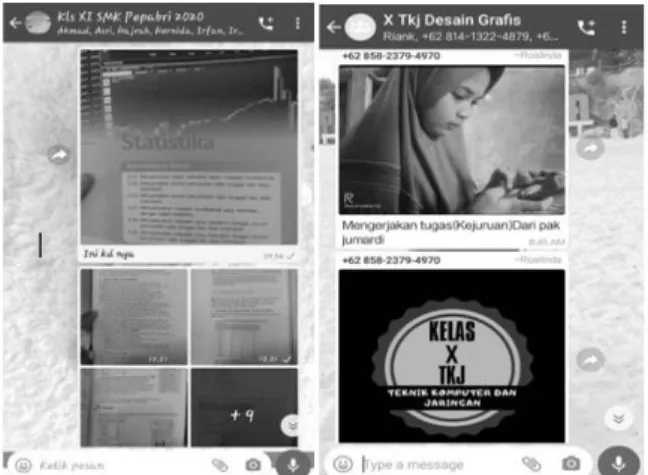
Figure 2 presents the display of the Google Classroom and WhatsApp Group application created by the teachers. In teaching via Digital Learning, T1 and T3 informed that they create Google classroom to make them quickly distribute the materials. These participants taught more than one class, so in Google Classroom, they could deliver materials once for those classes. They thought it was more effective. It could also efficiency their time. Teachers used Google classroom to distribute and explain content. It was also used to give instructions about the task that students must complete. For students, Google Classroom was a medium to facilitate the students to ask something they did not understand yet. However, students were more comfortable to submit their tasks through WhatsApp. They preferred to send the assignments directly to teachers’ WhatsApp numbers rather than the Google Classroom or WhatsApp group.
In contrast to T1 and T3, T2 and T4 have consistently used the WhatsApp group since the first SFH policy was instructed. They used this application to deliver the material, give instruction, and receive the students' tasks. They explained the materials by recording their voices. They also sent some pictures related to contents.
The students could respond to the lesson by typing or recording their voices. Thus, this application facilitated teachers and students to discuss everything about the lesson. Creating a user group on WhatsApp provides a platform for teachers to share materials, other digital information, and alert service related to academics [19]. Figure 3 shows the screenshot of how the teacher delivered materials and students' responses to the material given.
B. The Efficacy of D-Learning for Students' Development
Nine questions were distributed to investigate
Figure 3. WhatsApp Group Activities
whether Digital Learning in SFH policy effective for students' cognitive and affective development. Initially, Study from Home is the best way to deal with COVID 19 pandemic. By this policy, teachers and students can involve themselves in the teaching and learning process within social and physical distancing. Thus, they can stay healthy and safe. However, this shocking situation happened quickly without the proper preparation of all elements of society, including education practitioners.
In implementing Digital learning, students were expected to attend online classes as in conventional courses. This participation is one of the teacher's assessment rubrics to measure how much enthusiasm and discipline a student has. However, most teachers found that there were still students who had never accessed this online class. When investigated more deeply, one of the reasons was some students were at a low economic level, so they did not have mobile phones or laptops. Some students had mobile phones, but they did not have enough money to buy internet quota.
All participants perceived D-Learning was not as efficient as face to face class. Students were not too active in asking, answering questions, and expressing opinions. Besides, face to face learning process was felt more practical to force the students to submit the tasks on time. T1 reported that all his students had been involved in attending online classes. He admitted that all students always submitted the tasks. However, they were not as disciplined as face-to-face courses. The extract is presented below.
“When I give a task, all students submit it.
But when I instruct them to complete the task and send it tomorrow, some of them did not do it. They will submit the assignment the day after tomorrow or maybe in the next week. Then they send their job to me, followed by apologies for
Pratiwi / Journal of Southwest Jiaotong University/ Vol.55 No.4 Aug. 2020 8
just having an internet quota”. (Interview/ Teacher 1).
The information from T1 was supported T2. She revealed that some students submitted the task. However, they submitted it late. The students then sent their job, followed by giving confirmation and, apologized to the teacher that they were late submitting the assignment because they did not have internet quota. Most of the students had similar reasons.
Unlike others, T4 seems more ready to respond to the rapid changes that occur in learning systems from conventional to this digital learningmethods. She argued that students could quickly understand the instructions and material explained in online classes. She also said that most of her students were more enthusiastic about participating in digital learning, even though there were still two students who had never accessed her online class.
To know participants’ perceptions of whether students' development of material comprehension and affective (attitude) can be assessed through digital learning, all participants agreed that students' development of material comprehension could be evaluated through digital learning. It can be showed by the result of their competence in finishing the task. However, 2 participants said "yes," while 2 participants responded "no" when they were asked about whether students' development of affective (attitude) can be assessed through digital learning. These contradictory answered increasingly made the researcher wanted to deeply explore the reasons. T4 that is in line with T3 said
“Their delay in submitting the assignment is one of the assessments of a student's behavior. Students who are late in submitting the duties can be judged that these students lack discipline and responsibility. If internet quota issues constrain them, there are other ways to solve the problem. They can borrow relatives' handphones who have internet quota. When in their home, the internet network is unstable, they can confirm to me by making regular calls that do not require the internet network”. (Interview/ Teacher 4)
Whereas T2 believed that students' development of affective (attitude) could not be assessed through digital learning stated
“In face-to-face classes, students' affective development is easier to assess. They do not dress neatly, often disturbing their friends, behaving disrespectfully to others can be seen clearly. They arrive at school late for various reasons, and it can be seen if the student is lying or not by looking at his body movements.
However, they cannot be assessed through Digital learning.” (Interview/ Teacher 2).
The barriers perceived by T2 may not be experienced when they engage in face to face or blended learning [20]. What teachers experience and feel during performing D-Learning raises perceptions, both positive and negative. This perception of each teacher is diverse because many factors influence them. T4 and T3 stated that the delay in submitting the assignment is one of the assessments of a student's behavior. They perceived that this kind of student was lack of discipline and responsibility. While T2 said that the students’ behavior could be easily assessed by looking at their body movements. Concerning the teacher is what a teacher believes [21], perception can be a tool to determine teacher assessment and meaning of the learning process [22].
From the series of investigations, it was found that Digital Learning in SFH policy has not been efficient on the students' cognitive and affective development.
C. The Benefits and Weaknesses of D-Learning from Teachers' Viewpoints In this session, the researcher reports the benefits and challenges of D-Learning practicing in SFH policies revealed by the EFL teacher explicitly. This investigation is crucial to know whether Digital Learning has matched the teachers’ capacity and competence, as well as the readiness of all High School Students.
From the results, it was found that D-Learning has four benefits. First, it is more flexible than a traditional classroom. It can be conducted anytime and anywhere because it is not limited by time and space. Despite having a schedule and rules from the school, teachers and students can agree on an appropriate time to meet. Second, D-Learning lightens the teachers' job of delivering the material because students are encouraged to be more creative. In this case, teachers only act as facilitators. Teachers provide opportunities for students to work independently and in a structured manner. Even though it seems relaxed, students can be more innovative because they can utilize all the media and facilities in their home to complete the assignments. Third, D-Learning makes the relationship between parents and children closer. In completing assignments, students sometimes feel more comfortable asking their parents to help them rather than their teachers. Thus, parents are involved in their children's learning activities. Fourth, it indirectly encourages students and teachers to master technology, quickly. It contributes to improving
the quality of education in the 4.0 era. The lessons learned from the pandemic of COVID 19 will result in the generation of new laws, regulations, platforms, and solutions for future cases, when countries, governments, and the general population will be more prepared than they are today [23].
Even though D-Learning has many benefits, all the study participants agreed that its abrupt implementation shocked educational practitioners, primarily teachers and students. In practice, they found it to be very challenging. The most common problem is inadequate D-Learning facilities and infrastructure. These involve the uneven spread of internet networks, the unavailability of internet quotas, and the lack of media to access the D-Learning platforms. Furthermore, teachers are not quite ready to use technological tools in learning. Many teachers can manage their classes well in a conventional context, but some are still unable to utilize technology to distribute their teaching materials. Supposedly, in the 21st century, teachers are equipped with several digital competencies, such as data literacy, the ability to communicate through the media, the ability to create learning content, and the ability to solve problems [2]. Another challenge is that it is difficult to measure the students' progress, especially their affective development. Some students do not submit the assignments, and they do not attend the online class on time for various reasons. In an in-person classroom, teachers have the unique capability to assess the students' character through their body movements. However, through physical distancing, it is difficult to determine the students' attitudes without seeing their facial expressions or body movements. However, through physical distancing, it is difficult to determine the students' attitudes without seeing their facial expressions or body movements. Finally, students are less active in responding to the learning material conveyed by the teacher. This impacts the ability to have an interactive discussion and a question and answer session during the learning process, so learning tends to be one-way. In conclusion, Indonesia, especially Bulukumba Regency, is not ready to fully implement D-Learning in this SFH policy. In addition to Indonesia, many countries are still far from being ready to conduct D-Learning with optimal efficiency, and much effort is needed to be able to achieve the high-quality standards that are expected of the educational system [24].
V.
C
ONCLUSIONA. Summary
Indonesian EFL teachers, especially in Bulukumba Regency, South Sulawesi, Indonesia, utilize D-Learning in the Study from Home (SFH) policy. To implement D-Learning, they prefer to use WhatsApp and Google Classroom to deliver the material, provide instruction, and collect the students' assignments. These applications are more familiar in their environment, more comfortable to use, and easier to access. D-Learning offers many benefits. It is perceived to be more flexible because it can be conducted anytime, and anywhere. D-Learning also encourages students to become autonomous learners. Students are motivated to be more creative and independent in completing the assignments. Moreover, through the implementation of D-Learning, the SFH policy forces students and teachers to adapt quickly to technological developments, and this is beneficial for improving a nation’s ability to face the challenges of the 4.0 era. Another benefit of D- Learning is that it enables the relationship between students and parents to become closer. However, the rapid change from a conventional classroom to an online learning system causes some problems. Teachers are aware that they are not yet ready to provide good technology-based materials. They have difficulties assessing their students' progress when the students learn from home. Students have also been found to lack enthusiasm in responding to the learning content. Furthermore, inadequate D-Learning facilities and infrastructure limit the students’ ability to access D-learning sessions. Consequently, the practice of D-learning in the SFH policy has not been efficient in terms of facilitating the students' cognitive and affective development. Thus, it is not possible for them to achieve optimal learning goals.
B. Suggestions
To respond to the problems that arise from D-Learning in the SFH policy, it is suggested that the Ministry of Education should collaborate with electronic media platforms to broadcast more educational content every day. This will enable students to access as much learning material as possible. The government is expected to support all virtual workshops and seminars related to D-Learning. This support can be realized by providing funding for the organizing institution. Therefore, teachers can upgrade their knowledge of technological development in the field of education for free. Through the Ministry of Education, the government is also expected to publish pedagogical specialists' materials for
Pratiwi / Journal of Southwest Jiaotong University/ Vol.55 No.4 Aug. 2020 10
working in D-Learning environments, including video lessons, innovative methodologies, entertaining pedagogy, and presentations, as well as exercises, projects, and tests. The government can also collaborate with internet providers to ensure that students can easily access D-Learning platforms, such as giving discounts for internet quota purchases for students based on their ability to show their students' ID cards. Parents and teachers are always expected to motivate students to have enthusiasm for the material they are learning and to get used to participating in D-Learning. In the next few years, they must accept that technological development will shift the way humans learn and think from conventional classrooms to the D-Learning environment.
A
CKNOWLEDGMENTMany people contributed to the completion of this research. They supported every step the researcher did from beginning to end of the investigation. For that, the researcher delivered thanks to the family, friends, and colleagues for praying, guiding, and suggestions to complete this study. Special thanks were addressed to LPDP Scholarship as sponsorship for funding this study. Many thanks were also given to the participants for the time and willingness to share the information.
R
EFERENCES[1] NATIONS, J. E. (1962) The teacher as a
Person. Association of Supervision and
Curriculum
Development.
Los-Angeles,
California.
[2] BLYZNYUK, T. (2018) Formation of
Teachers’ Digital Competence: Domestic
Challenges and Foreign Experience. Journal
of Vasyl Stefanyk Precarpathian National
University,
5(1),
pp.40-46.
DOI:https://doi.org/ 10.15330/jpnu.5.1.40-46
[3] BASAK, S. K., WOTTO, M., and
BELANGER, P. (2018) E-learning,
M-learning
and
D-learning:
Conceptual
definition and comparative analysis.
E-Learning and Digital Media, 15(4),
pp.191-216. DOI:
10.1177/ 2042753018785180[4] RENTON SCHOOL DISTRICT (n.d.)
What is digital learning? [Online] Available
from:
https://www.rentonschools.us/learning-and-teaching/digital-learning
[5] FISHER L.B. (2020) Connecting With
Reluctant
Remote
Learners.
[Online]
Available
from:
https://www.edutopia.org/article/connecting-reluctant-remote-learners
[6] LIN, M. H., and CHEN, H. G. (2017) A
study of the effects of digital learning on
learning
motivation
and
learning
outcome. Eurasia Journal of Mathematics,
Science and Technology Education, 13(7),
pp.3553-3564.
[7] RAPORU, İ. H. (2015) Literature review
on the impact of digital technology on
learning
and
teaching.Social
research.
Raighaltas-na
h-Alba:
ICF
Consulting
Services Ltdю Available from:
https://dera.ioe.ac.uk/24843/1/00489224.pdf
[8] LIN, H. M. et al. (2007) The effect of
digital learning in situated instruction on
learning achievement of vocational high
school special class students. In: The 18th
Asia Conference on Mental Retardation in
Taipei, Taiwan, November, 2007, pp. 18-23.
[9] WORLD HEALTH ORGANIZATION.
(2020) Coronavirus Disease (COVID-19)
situation
Dasbord.
Available
from:
https://covid19.who.int/region/searo/country/
id [Accessed 20/04/20].
[10] BUGISPOS. (2020) Dampak Corona,
Masa
Libur
Sekolah
di
Bulukumba
Diperpanjang
ki.
Available
from:
https://bugispos.com/ [Accessed 28/03/20]
[11]
HORNBY,
A.S.
(2005)
Oxford
Advanced Learners’ Dictionary of Current
English. Oxford: Oxford University Press.
[12]
JANNAH,
R.
(2019)
Teachers'
Perception on the Use of English Textbook in
Teaching English. Doctoral dissertation.
Banda Aceh: Universitas Islam Negeri
Ar-Raniry.
[13] ROBBINS, J. (2005) Between “Hello”
and “See you later”. Development of
strategies for interpersonal communication in
English by Japanese EFL students. Published
Dissertation.
Ann
Arbor:
Michigan
University Press.
[14]
JIA,
Y.
(2004)
ESL teacher’s
perceptions andfactors influencing their use
of classroom-based readng assessment.
Bilingual Research Journal, 29(2),
pp.459-482.
[15] NURHAYATI, F. K., TARJANA, S. S.,
and HERSULASTUTI, H. (2018) Teachers'
Perceptions toward the Implementation of
2013 Curriculum. In: Proceedings of the 2
ndEnglish
Language
and
Literature
International Conference (ELLiC), Semarang,
May 5, 2018, pp. 76-87.
[16] LAMBERT, V. A., and LAMBERT, C.
E. (2012) Qualitative descriptive research:
An
acceptable
design. Pacific
Rim
International
Journal
of
Nursing
Research, 16(4),
pp. 255-256.[17] CRESWELL, J. W. (2012) Educational
Research:
Planning,
Conducting,
and
Evaluating Quantitative and Qualitative
Research
(4
thed.).
Boston:
Pearson
Education.
[18] MAULINA, N. N., and BASRI, M.
(2019) WhatsApp Audio and Video
Chat-Based in Stimulating Students’
Self-Confidence and Motivation to Speak English.
Asian EFL Journal, 23 (6.3),
pp. 181-203[19] AFFUL, B. and AKRONG, R. (2019)
WhatsApp and academic performance among
undergraduate students in Ghana: Evidence
from the University of Cape Coast. Journal
of
Education
for
Business.
DOI:10.1080/08832323.2019.1644276
[20] GILLETT-SWAN, J. (2017) The
challenges of online learning: Supporting and
engaging the isolated learner. Journal of
Learning Design, 10(1),
pp.20-30.
DOI:https://doi.org/10.5204/jld.v9i3.293
[21] PAJARES, M. F. (1992) Teachers’
Beliefs and Educational Research: Cleaning
up
a
Messy
Construct.
Review
of
Pedagogical Research, 70,
pp. 509-517.[22] KURNIAWATI, N. (2006). Teachers’
use of textbooks in Teaching and Learning
process.
Unpublished
Master’s
Thesis,
Pendidikan:
Universitas
Pendidikan,
Indonesia.
[23] BASILAIA, G., and KVAVADZE, D.
(2020). Transition to online education in
schools during a SARS-CoV-2 coronavirus
(COVID-19)
pandemic
in
Georgia.
Pedagogical Research, 5(4),
pp. 1-9.[24] DOGHONADZE, N. et al. (2020). The
Degree of Readiness to Total Distance
Learning in the Face of
COVID-19-Teachers’ View (Case of Azerbaijan,
Georgia, Iraq, Nigeria, UK and Ukraine).
DOI: 10.31578/jebs.v5i2.197
参考文:
[1] NATIONS, J. E.(1962)作為人的老
師。監督與課程開發協會。加利福尼亞洛
杉磯。
[2] BLYZNYUK,T.(2018)教師數字能
力的形成:國內挑戰和國外經驗。 Vasyl
Stefanyk 喀爾巴阡民族大學學報,5
(1),
第
40-46
页
。DOI:10.15330 /
jpnu.5.1.40-46
[3] BASAK,S. K.,WOTTO,M. 和
BELANGER,P.(2018)電子學習,M 學
習和 D 學習:概念定義和比較分析。電子
學習和數字媒體,15(4),
第
191-216
页.
DOI:10.1177 / 2042753018785180
[4] RENTON 學校區(無註明)什麼是數
字學習? [在線]可從以下網站獲得:
https://www.rentonschools.us/learning-and-teaching/digital-learning
[5] FISHER L. B. (2020)與不情願的遠
程學習者聯繫。 [在線]可從以下網站獲得
https://www.edutopia.org/article/connecting-reluctant-remote-learners
[6] LIN M. H. 和 CHEN H. G.(2017)研
究數字學習對學習動機和學習成果的影
響。歐亞數學與科學教育雜誌,13
(7),
第
3553-3564
页
.
[7] RAPORU,İ。 H.(2015)關於數字技
術對學與教的影響的文獻綜述。社會研究
苏格兰里亚尔塔斯:ICF 諮詢服務有限公司
https://dera.ioe.ac.uk/24843/1/00489224.pdf
[8] LIN,H. M. 等。(2007)情景教學中的
數字學習對職業高中特殊班學生學習成績
的影響。 於:2007 年 11 月在台灣台北舉
行的第 18 屆亞洲智障會議上,第 18-23
页.
[9] 世界衛生組織(2020)冠狀病毒病
(COVID-19)情況達斯伯德。可從以下網
址獲得:https://covid19.who.int/region/
searo/country/id [訪問時間 20/04/20]。
[10] BUGISPOS (2020)電暈的影響,
Bulukumba 的學校假期延長了. 可從以下
網址獲得:https://bugispos.com/ [訪問時間
28/03/20]
[11]
HORNBY, A.S. (
2005)牛津高級學習
者當前英語詞典。牛津:牛津大學出版社
[12] JANNAH,R.(2019)教師對英語課
本在英語教學中的使用的看法。 博士論
Pratiwi / Journal of Southwest Jiaotong University/ Vol.55 No.4 Aug. 2020 12