第 54 卷 第 6 期
2019 年 12 月
JOURNAL OF SOUTHWEST JIAOTONG UNIVERSITY
Vol. 54 No. 6
Dec. 2019
ISSN 0258-2724 DOI:10.35741/issn.0258-2724.54.6.53
Research Article Economics
L
OCAL
P
UBLIC
L
EADERSHIP
D
EVELOPMENT THROUGH
S
OCIAL
L
EARNING TO
F
ACE THE
F
OURTH
I
NDUSTRIAL
R
EVOLUTION
通过社会学习面对第四次工业革命发展地方领导力
Wildan Taufik Raharja a, Suryanto b, Jusuf Irianto c, Falih Suaedi c, Dian Yulie Reindrawati d
a Postgraduate School, University of Airlangga
Surabaya, Indonesia, [email protected]
b Department of Psychology, University of Airlangga
Surabaya, Indonesia, [email protected]
c Department of Public Administration, University of Airlangga
Surabaya, Indonesia, [email protected], [email protected]
d Faculty of Vocational Studies, University of Airlangga
Surabaya, Indonesia, [email protected]
Abstract
This research aims to give an alternative solution for leadership development in the public sector to face the Fourth Industrial Revolution (Industry 4.0). The development of global information technology has demanded public services to adjust to today’s technologies. The problem of this study isthe public sector leaders, who are in the majority consisting of baby boomers generation up to generation X. These generations are not too familiar with technology. Traditional training models cannot improve the competencies of leaders who are predominantly old; adult learning must be developed. They do not need competency development classes, but they need mentoring to learn directly. This is a challenge to the development of local leadership in the public sector against Industry 4.0, which is implicated in the increase of public services based on technology and network. This research uses a qualitative research approach with a case study perspective. The focus of this research is local leadership competencies in the public sector. The data aretaken from primary data by interview and secondary data from literatureanddocuments that are related to the research aims.The results of this study recommend the concept of leader-member exchange, where possible in the process of social learning, to develop public leadership in the era of Industry 4.0. Here, the challenge is the desire and ego of leaders to study with their subordinates.
Keywords: Leadership Development, Social Learning Theory, Industry 4.0, Public Sector
摘要
这项研究旨在为面对第四次工业革命(工业4.0)的公共部门领导力发展提供替代解决方案。全球 信息技术的发展要求公共服务适应当今的技术。这项研究的问题是公共部门的领导人,他们中的
大多数是X世代之前的婴儿潮一代。这些世代对技术不太熟悉。传统的培训模式不能提高主要是 老领导的能力。成人学习必须得到发展。他们不需要能力发展课程,但需要指导才能直接学习。 对于工业4.0,这是对公共部门地方领导力发展的挑战,工业4.0与基于技术和网络的公共服务的增 加有关。本研究采用定性研究方法,并具有案例研究的角度。这项研究的重点是公共部门的地方 领导能力。这些数据是通过访谈获得的主要数据以及与研究目的相关的文献和文献的次要数据。 本研究的结果建议了在社会学习过程中可能的领导者-成员交换的概念,以在社区中发展公共领导力。工业4.0时代。在这里,挑战在于领导者与下属一 起学习的愿望和自我。 关键词: 领导力发展,社会学习理论,工业4.0,公共部门
I. I
NTRODUCTIONIndonesia is still experiencing a leadership dilemma by looking at political pressure and state instability over the past 10 years. There is an impression that there is a lack of leadership capability in this multicultural country [1]. Leadership is an important factor in achieving policy objectives. In this regard, the success of a policy is often associated with local leadership [2]. Public sector leadership and reform are two interrelated and inseparable concepts, because leadership is largely seen as an internal force and is a significant impetus for reform [3]. Leaders can determine the progress of a nation, especially policies in the economic field [4].
Effective leaders create a positive organizational culture, strengthen motivation, clarify the goals and missions of the organization, and direct the organization to more productive and high-performance outcomes [5], [6]. Each leader has its own challenges, such as in the public sector, where organizations are often driven by a sense of social mission [7]. The government must still play an important role in encouraging the growth and development of the country. That is why, in many cases, the development of leadership in the public sector is associated with welfare and social justice [8]. The social side of leadership is more important in the public sector. In this regard, the trust and power of the leaders can create effective leadership [9].
In the public sector,which faces a number of enormous challenges, leaders areforced to be more innovative. They must provide services to people and communities, which are characterized by increasing levels of diversity in terms of culture, language, religion, and education. Leaders will be asked to develop into "gifted generalists" with various leadership abilities [10]. Public services must ensure that leaders are skilled in carrying out increasingly complex tasks in society [11]. In this research, the main problem, in leadership development, is that
leaders are old and do not have technological competence. They cannot be trained with old models, such as seminars. They need direct mentoring. Hence, the research question remains, that is, how to develop effective public leadership to face the Fourth Industrial Revolution (Industry 4.0)?
II. L
ITERATURER
EVIEW A. Public Leadership DevelopmentLeadership researchers, in the Western context, tend to define leadership by identifying the functions of leaders in organizations. They group leadership into several leadership styles [1]. In this study, we will discuss how to develop an effective leader. Dominant leadership development can be seen from how organizations develop their leaders and what types of methods they use [12].
In this fast-changing and dynamic world of the public sector, leadership development is more important than ever. Leadership development is not a new concept but an ongoing challenge in the public sector [13]. The development of leadership has influenced organizational effectiveness and the results of activities. The main obstacle to the development of public sector leadership is the lack of professional trainers [8].
B. Leadership for Revolution of Industry 4.0
Public leaders are required to learn quickly to respond to the problems of society, especially in facing the challenges of the Industrial Revolution 4.0. Public services for the business environment must improve their quality, as an impact of the Industrial Revolution 4.0 [14]. Future leaders need to be prepared to solve complex, interdependent, and unpredictable problems.
Before further discussion of Leadership 4.0, here, we will explain the development of the leadership model associated with the Fourth Industrial Revolution from 1.0 to 4.0. Accordingly, Kelly explained the fourphases of
leadership that are associated with the development of Industry 4.0 [15]. Leadership 1.0 is a charismatic leadership that exists in "The Theory of Social and Economic Organizations," which put forward by Max Weber. Leadership 2.0 is the scientific management era. Leadership 3.0, known as a leader, has a moral dimension. Here, leaders, who are transformed, look for potential motives where the result is a relationship of stimulation and mutual improvement that can turn followers into leaders and turn leaders into moral agents.
Then, Leadership 4.0 is a future leadership approach, which does not emphasize the status,
power of position, control, and rank. The leader will not make decisions or become a sole executive decision-maker or idea maker. Leadership 4.0 can be defined leadership in the Industry 4.0 era. This kind of leadership is a leadership modelthat isfast, team-oriented, cross-hierarchical, and cooperative, which is called digitalleadership; it has a strong focus on innovation [16]. In this regard, initiatives are effective catalysts to enhance collaborative leadership [17]. Ideas, innovations, and good decisions will come through collaborative networks and open collaboration.
Figure 1. The four phases of leadership
The development of leadership style changes from year to year. The development of science and technology, which is still essential, requires leaders to change their leadership style. Leadership must be adjusted not only in the private sector but also in the public sector. Digital technology has an influence not only on information technology but also on how organizations are managed and leadership styles being applied [16].
The development of information technology in society demands public services to also develop in accordance with the current technological era. Nowadays, the problem with leaders in the public sector is that leaders are predominantly a baby boomer generation to generation X, where the generation lacks technology skills. This is a challenge for leadership development in the public sector in encountering Industry 4.0 revolution, which has implications for increasing public service based on network technology. Leadership skills are really important in improving the performance of public sector organizations, and it is very likely
that the optimal leadership style is integrated [18]. In addition, Leadership 4.0, which emphasizes responsiveness, also emphasizes openness and flexibility in the leadership structure. Decision making does not have to be centralistic, but more decentralized, which emphasizes freedom of innovation. In this leadership model, leaders are required to be more open-minded.
III. R
ESEARCHM
ETHODOLOGYThis study uses a qualitative approach with a case study research view, specifically about the observation of behavior [19]. The researchers seek to find the meaning of phenomena from the viewpoints of participants and learn how to develop shared behavior patterns over time. The researchers carefully observe the activities, individuals, and groups. The focus of this research is the technological competence of leaders, which isthe most important component in the era of the Fourth Industrial Revolution. In the discussion section, researchers try to develop effective leadership development methods.
Charismatic Directive
Relational
Data consist of primary data and secondary data. In this research, the primary data were taken from in-depth interviews. The study begins with research questions and collects primary data from focus groups to answer these research questions [20]. Also, the researchers chose a purposive sampling technique. The selected informants were those considered to be the most knowledgeable in understanding the problems in this study. Informants were chosen, because they possessed the information needed by the researchers, namely employees with higher positions and employees with lower positions. All interview guides are read by the interviewer to make a good interpretation and same perception [21].
Then, secondary data were obtained by the researchers from existing sources or reused for other research questions [22]. They were government documents, journals, and literature reviews. Moreover, interactive analysis models were used in the data analysis [23]. These models consist of four main components, namely data collection activities, data condensation, data display (data presentation), and conclusion drawing (conclusion verification).
IV. R
ESULTFrom the results of interviews and observations in the field, the data showed that the village secretary, who was the highest leader in the bureaucracy, did not have skills in using technology.
Mr. Isroi, as the Blimbing Village Government Development Staff, revealed that the skills of the Secretary of Blimbing Village were still low in technology:
He's old. If it's a computer, we're talking about. I don't think he's able to do it. Back then, there were no computer lessons. We just have to understand his lacking. (Interview with Mr. Isroi, October 21, 2018)
The opinion was also conveyed by the next informant, namely Mr. Suisno, who was a government staff and also treasurer in 2015:
The village secretary is not able to use Excel; we couldn't cooperate to do things related to Excel stuff if it was only typing in words; it is still possible, but excel is out of the question, and there's no motivation to learn. (Interview with Mr. Suisno, October 21, 2018)
Then, Ms. Chos'yah, who served as PKK, explained that the Village Secretary (commonly called Carik) lacks educational background; he only obtained senior high school skills.
The Carik (village secretary) used to be a gardener in an office, only a regular senior high
school graduate. But his luck was good, he was finally appointed as a civil servant and was moved to this village until now. You can decide yourself whether he is able to use a computer. In the past, there were no computer lessons. If he was to study again, I think that would be hard because he's old. (Interview with Ms. Chos’yah, October22, 2018)
This condition certainly affects the skills and knowledge, especially how aperson thinks. There are also other alternatives to improve competence by developing the competency of the village secretary. However, it is also very difficult because of his age. From some of the informants, in terms of skills in using computer technology (such as MS Office), it can be concluded that the village secretary is still not sufficiently competent. The age of retirement is difficult to develop. Then, Mr. Thonsom, as the Sub-district Head of Gudo, evaluated the development of less effective leaders:
But more than that, there is assistance, so there is hands-on training. Village companions are present. Then, accompanying and teaching until the finish, it's better. But if it's just a seminar like what has already been done, it's not effective. Because there are too many participants, not all participants can grasp the material. The most effective method for assistance is to be directly taught andtrained, where the tool is brought until the finish. Certainly, there can be. For example, this is a financial reporting program or application; this is how you use it ... . (Interview with Mr. Thonsom, October 22, 2018)
He emphasized thatalthough the Regional Government of East Java Province organized training courses, they were less effective and efficient, because some participants could not attend, and village leadersare old. Thus, what is needed is a village companion, who is at all times in the village to guide the leaders.
V. D
ISCUSSIONA. Public Leadership Development through Social Learning
This article tries to develop leadership in the perspective of social learning theory. It explains human behavior because of the ongoing mutual interaction between behavioral, cognitive, and environmental influences. Social learning theory views the formation of individual personalities in response to social stimuli. This theory emphasizes that an individual's identity is not only a product of subconscious but also because of the individual's response to the expectations of
others [24]. A person's behavior and attitudes grow because of encouragement or affirmation from those around him. Social learning theory specifically understands that a large part of human behavior is studied in observation through modeling [25].
Leaders can develop their competencies by themselves and others. They can improve their capabilities and develop the staff based on their experiences and knowledge [3]. The learning models’ concept explains a learning process based on observing the environment, especially about the behavior of others [26]. Social learning theory(also known as observational learning)suggests that people can learn new behaviors by observing others [27]. It also points to the mutual relationship between the characteristics of social-environmental; that is, how individuals perceive them and how they are interested and motivated to reproduce the behavior of what they have seen. According to Hanna et al., social learning theory suggests that individuals can learn a lot by observing and imitating the behavior of others. The focus of the social learning theory, regarding leadership, is to teach leadership in all formal and informal activities [28]. The social learning theory sees leaders and subordinates as having interactive relationships, which can be negotiated [25]. In an ethical context, the therapeutic social learning framework offers guidance on how leaders in the future actually learn to make decisions.
B. Leader-Member Exchange Approach and the Public Leadership Development
The social learning theory of leadership ignores power structures and politics [26]. In this case, the leader is developed by the organizational environment. The ability of leaders in the public sector is limited and slowed in the following global developments very quickly. In this regard, leaders must learn in the surrounding environment (including subordinates). Knowledge transferring between subordinates and leaders can be seen in the leader-member exchange (LMX) theory. LMX theory first appeared in the 1970s [29]. This theory conceptualizes leadership as a process of interaction between leaders and followers on the relationship of knowledge exchange between the two [30]. Leader-follower exchange is also described by Messick and Kramer, which illustrates more with the dimension, where leaders and their followers provide support and satisfaction with one another and deal less with exchanging concrete behaviors [31].
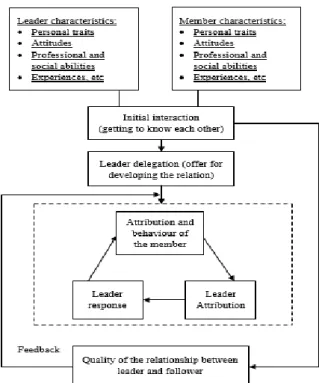
Several studieson social learning theory and leadership only discuss how subordinates or followers learn from their leadership, not how leaders develop themselves from the subordinates, such as in the decision making considering opinions of the subordinates and newly updated technology development. Figure 2 describes the relationship between leaders and subordinates with their own attitudes, characteristics, social abilities and professional, and previous experiences. These aspects significantly affect the interaction between leaders and followers. Leaders and subordinates can complement each other's strengths and weaknesses. Action-learning is themain component in leadership development programs,which focuses on solving complex and real-world problems [32]. Direct social learning is able to adapt and reflect the usefulness of learning that occurs during the learning process [33]. The leader will learn first-hand with his staff and exchange ideas to solve complex problems.
Figure 2. Qualities and development of leader-member relations by Winkler
This method of leadership development is very effective and does notcost very much. Industry 4.0 requires leaders who are digital literate. The concept of digital leadership is indeed suitable to be a model of a leader in the Industrial Revolution 4.0 era. Kelly explained that Industry 4.0 era could be led to the consumers who are highly connected to biotechnology, machine intelligence (AI), high-speed transportation networks, and alternative
energy sources, which are able to change the consumer behavior of organizations [15]. The current leadership model (influence based, relational, direction, and processing) will not have a place in future organizations. The leadership will be led to networking, collaboration, collectiveness, and responsiveness.The development of traditional leadership (based on an evaluation of organizational needs and determined skills, knowledge, and competencies) is no longer sufficient for the challenges that will be faced by leaders in the world today.
In essence, public sector organizations must change into open institutions to build collaborative networks and encourage innovation in public services. Leaders must have high creativity to face the challenges of the Industrial Revolution 4.0. Creative and futuristic leadership is seen as a style of effective leadership, which supports a collaborative culture andencourages innovation [34].
VI. C
ONCLUSIONPublic leaders of the Industrial Revolution 4.0 era must be able to develop themselves by using the social learning theory method. Leadership development interventions were carried out by a combination of experiential learning and self and group analysis [12]. Leaders in the public sector, the majority of whom are from baby boomers to generation X, must be able to adapt to global developments with effective learning, namely the transfer of knowledge with the surrounding environment. Most leaders increase their ability from experience; they learn by themselves andobserving their environment [32].
The concept of LMX is possible in the process of social learning theory for leadership development. Increasingly important as a theoretical foundation for the field of psychology and overall organizational behavior, social learning theory (regarding leadership) has good potential in the future [25]. The limitation of this research is that researchers can find out the competencies of leadership if they are not embroiled contextually and situationally in a case. Moreover, how researchers can understand the capabilities of leadership only through in-depth interviews based on people's perceptions [35]. In addition, the ego of public leaders, who do not want to learn from their subordinates,was a challenge for this method.
A
CKNOWLEDGMENTThe research was supported by the University of Airlangga. We thank our colleagues from
postgraduate school, the University of Airlangga, who shared their insights and knowledge. We would also like to show our gratitude to the Government of Indonesia, who gave us an opportunity to do this research.