Effects of neuroactive peptides, vasopressin,
vasopressin fragments, and its analog
(NC-1900) on learning and memory
著者
佐藤 友昭, 西川 殷維
雑誌名
鹿児島大学歯学部紀要
巻
28
ページ
19-25
発行年
2008
URL
http://hdl.handle.net/10232/4859
Introduction
An increasing population of patients with geria tric dis-ease would cause an important social problem for Japan. In particular, dementia would decrease the qua lity of life (Q OL) not only for the patients themselves but also near relatives who nurse them. Naturally, an anti-dementia drug is need for these patients and the near relatives to inhibit the progress of dementia and to maintain their QOL. In recent years, it is reported that Donepezil, which is a cholinesterase inhibitor and only authorized as an
anti-dementia drug in Japan, is not cost effective, and it is sug-gested that more effective treatments than cholinesterase inhibitors are ne eded for A lzheimer’s disease w hich is one of a form of dementia1)
. Therefore, we believe that it is nec-essary to study drugs, except cholinestera se inhibitors, which have bee n suggested as having an anti-dementia effect.
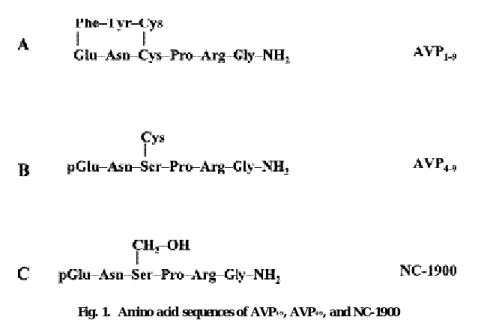
AVP1-9has been suggested to play an important role in memory formation (Fig. 1-A). For example, it has been re-ported that in Alzheimer’s disease or Down’s syndrome,
Effects of neuroactive peptides, vasopressin, vasopressin
fragments, and its analog (NC-1900) on learning and memory
Tomoaki Sato*and Takashige Nishikawa
Department of Applied Pharmacology, Field of Functional Biology and Pharmacology, Advanced Therapeutics Course,
Kagoshima University Graduate School of Medical and Dental Sciences, 8-35-1 Sakuragaoka, Kagoshima 890-8544, Japan
Abstract
Here we describe effects of neuroactive peptides, vasopressin, vasopressin fragment, and its analog, NC-1900, on cognitive functions and CO2-induced amnesia. Vasopressin (AVP1-9) and its fragments are
synthesized in the central nervous, and it is well known to regulate diuretic action. However, vasopressin receptors are distributed not only in the supraoptic nucleus and the paraventricular nucleus but also throughout the central nervous system. This fact shows that an action of AVP1-9is not restricted to the
anti-diuretic action, and it is suggested that AVP1-9and its metabolites regulate cognitive function such as
learn-ing and memory.
In order to determine the mechanism of action of a new AVP4-9analog, NC-1900, on memory process,
we investigated the facilitative effect of NC-1900 on memory performance in eight-arm radial maze and in passive avoidance (PA) tasks in nonamnesic and amnesic mice. The improved effect of NC-1900 on the CO2-induced amnesia was caused by V1A receptor but not V2, and the effect of NC-1900 on memory
retention test performance appeared to be due to activation of the protein kinase C (PKC) signaling pathway via V1A receptors.
Key words: AVP1-9; AVP4-9; NC-1900; memory; passive avoidance; radial maze; vasopressin receptor; PKC
*
Corresponding author: Tomoaki Sato, DDS, PhD Tel.: 099-275-6160 Fax: 099-275-6168 E-mail: [email protected]
which are accompanied by the hypofunction of memory, AVP1-9-mRN A is overexpressed in the temporal lobe2). In addition, it has been confirmed that AVP1-9facilita tes learn-ing and memory processes in several animal models3), 4). How ever, these studies have often been criticized on the basis that AVP1-9-induced me mory facilitation may not actua lly involve an improvement of memory itself but rather a change in performance as a result of some periph-eral fac tor, such as attention, motivation, or arousal5). Thereafter, a carboxy-terminal 4-9 sequence that was gen-erated by aminopeptidase was discovered (Fig.1-B). AVP4-9 reportedly has a more potent facilitative effect on performance in PA6)and other memory tasks7), 8), 9)and does not have peripheral effects, such as antidiuretic or pressor effects6), 7), 9).
NC-1900 (Fig.1-C) is a newly synthesized AVP4-9 ana-log in which the cysteine residue of AVP4-9is replaced w ith a serine residue10), 11)
. This peptide was found to be more se-lective and more potent than AV P4-9 on scopolamine-induced impairment of spatial memory12). In addition, Hirate et al.13) reported that NC-1900 ameliorate cyclohexamide-induced me mory impairment of PA behav-ior, and H ori et al.10)show ed an ameliorating effect of NC-1900 on spatial memory impairment induced by tra nsient forebrain ischemia in rats. We also revealed that the new peptide improved learning, memory impairment and cell damage to cultured cerebro-cortical neurocytes induced by
glutamic acid14)
. In addition, it has been reported that NC-1900 inhibits glycine -induced Cl−currents in the CA1 re-gion of an isolated rat hippocampus and that the inhibition is due to activation of protein kinase A15). Most recently, Mishima et al.11)show ed that the new derivative improves scopolamine-induc ed amnesia in a radial maze a spatial memory task, and concluded that the improvement was not caused by a n increase in the release of acetylcholine, but rather through the activation of V 1A receptors at postsynaptic cholinergic nerves and by interaction with postsynaptic M1receptors.
In this mini-review, w e summarize several lines of vidence implicating the mnemonic effect of AVP1-9, AV P4-9, and NC-1900, and attempt to conjecture the action mechanism of NC-1900 on cognitive functions.
Neurohypopysis hormones and vasopressin
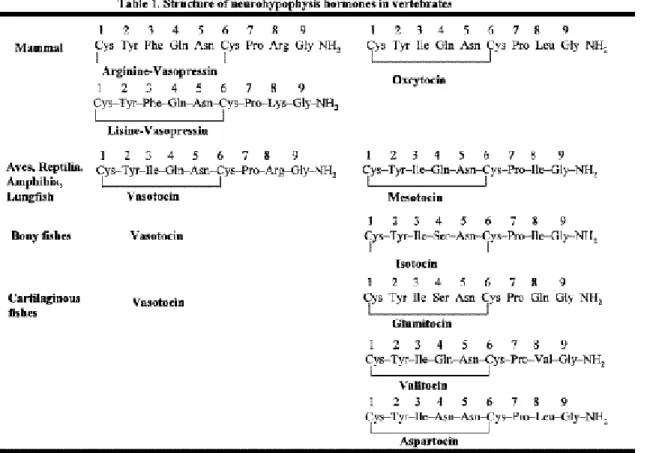
Neurohypopysis hormones are classified into 9 kinds of hormones, and various kinds of mammalian have vasopre ssin a nd oxytocin (Table 1), and vasopressin is known as a multifunctional peptide16). Most of vasopressin has arginine residue in position eight, and it is so called, an arginine vasopressin (AV P1-9). Lysine vasopressin (LVP) are recognized in limited mammalians such as porcine or hippopotami17). A s a hormone that shows an anti-diuretic effect, there is a no difference between the tw o vasopre ssins mentioned above. How ever, vasopressin re-Tomoaki Sato and Takashige Nishikawa
20
ceptors are known to exist in not only supraoptic nucle us and paraventricular nucleus but also in subfornical organa, suprachiasmatic nucleus, hippocampus19) and cerebral cortex16). These reports suggest that AVP1-9has some effect, which is due to a centrally-acting but not an anti-diuretic, for a living body.
Vasopressin fragments
Burbach e t al.6)first reported that the metabolites of argine8
-vasopressin (AV P1-9) can enhance learning and memory, and that the main active metabolite of A VP1-9 pro-duced by aminopeptidase w as a carboxy-terminal 4-9 se-quence [pGlu4, Cyt6] vasopressin (Fig. 2). Since then, AVP4-9 has been studied behaviorally7), 8), 9), 13) and biochemically15), 18), and it w as shown that the metabolite fragment of AVP1-9has a more potent effect than AVP1-9 it-self on learning and memory pe rformance13), 20). It has also been reported that A VP4-9ca uses a more marked reduction of the ischemic decrease of CA1 presynaptic fiber spikes
than treatment with AV P1-9itself21). As me ntioned above, NC-1900 is a novel synthetic AVP4-9analog, and this pep-tide w as found to be more selective a nd more potent than AV P4-9or A VP1-9.
Assessment of learning and memory
In assessment of learning and memory, we have used step-through type pa ssive avoidance (PA) test using meth-ods modified from Matuoka et al.22)or an eight-arms radial maze task23)
.
1) Step-through type PA task
A tw o-compartment step-through type PA apparatus was used. The box w as divided into bright (9 cm × 9 cm × 36 cm) and dark compartments (26 cm × 26 cm × 36 cm) by a guillotine door. In ea ch trial, a mouse was placed in the illuminate d compartment for a 30s habituation pe-riod, and then the guillotine door w as raised to allow entry into the dark chamber. On the pre-exposure session, the step-through latency (the length of time spent in the bright
compartment after a habituation period) was measured, and mice that stepped through to the grids of the dark compart-ment were allowed to remain there for 30 s without electri-cal stimulation and w ere then returned to their home cage. The acquisition trial (Acq.) was conducted over 24 h for the measurement of pre-exposure latency. When the hind le gs of the mice entered into the dark chamber, the guillotine door was closed and electrical foot shock was delivered through the grid floor for a total of 3 s. The time that elapsed prior to entry into the dark c ompartment (latency) was recorded. The latency was measured for up to 300 s.
2) Eight-arm radial maze task
Method of Olton and Samuelson24) modified version was used23). In short, the maze used in present study con-sisted of eight arms extending radially from a central area (22 cm diameter). Each arm was 50 cm long, 10 cm wide, and 5 cm high w ith gray vinyl chloride board walls. Food cups for the reinforcers were placed near the end of each arm. The maze was located in a room containing many extramaze visual cues. Prior to pre-training, the mice were kept on a restricted diet and their body weight was reduced to 90% of normal w eight over a 1-week period; water was freely available. Be fore the pre-training period, each mouse was handled for at least 5 min daily for 5 days. Before the radial ma ze trial began, mice underwent the pre-training
session for 5 days, during which the mice were given 10 min daily to adapt to the apparatus. After the pre-training period, the learning and memory abilities of the mice were evaluated over ten trials (one tria l per day for 2 w eeks). In each trial, a maximum of 10 min was allowed to visit all eight arms a nd eat the food re inforcements. To begin each trial, the mouse was placed on the central platform in a ran-dom orientation and then allow ed to enter any of the a rms. A visit to an arm w as scored if all four limbs of the mouse were within an arm. Re-entry into an already visited arm was regarded as an error. Accuracy of choice was scored by the number of correct choices until the first mistake. In ad-dition, the total number of incorrect choices in a trial was also scored.
Experimental results and their out-line on learning and memory
(1) Effect of N C-1900, AVP4-9, AVP1-9, and vasopre ssin re-ceptor antagonists on memory re tention in the passive avoidance (PA) task25)
Previous studies showed that NC-1900 and AVP4-9 fa-cilitated memory retention in the PA task after an interval of 21 days. The latency in the test was significantly in-creased by NC-1900 (100 ng/kg) or AVP4-9 (0.1 and 1 ng/kg) as compared with the control group. In addition, low doses of AVP4-9(0.1 and 1 ng/kg) did not show a facilitative Tomoaki Sato and Takashige Nishikawa
22
effect on the task. Latency was shorter in mice injected with 1mg/kg Pmp, Tyr-AVP, a V1A antagonist11)as com-pared with mice in the control group. Administration of 100 ng/kg or 1mg/kg AVP1-9did not affect the memory reten-tion of mice. In addireten-tion, the applicareten-tion of the V1A (10 ng/kg) or V2 (10 ng/kg and 10mg/kg) antagonist did not in-fluence the latency in the test. Furthermore we examined the e ffect of co-injection with NC-1900 and V1A or V2 an-tagonist on the latency. The co-inje ction with V1A antago-nist blocked the facilitative effect of 1 ng/kg NC-1900 on the te st latency (the latency was lower in mice that were co-administered 1 ng/kg NC-1900 with 1mg/kg of Pmp, Tyr-AVP than in those that received NC-1900 alone. However, the co-administration w ith OPC-31260, a V2 antagonist, did not prevent the prolongation of latenc y by NC-1900.
(2) Effect of NC-1900, AVP4-9, and AVP1-9on eight-arm ra-dial maze performance21)
The number of correct choices until the first mistake during 10 consecutive trials is compared among control, NC-1900, AVP4-9, and AVP1-9 groups. A between-groups comparison of the four treatment groups showe d that mice receiving 1 ng/kg NC-1900 or 10 mg/kg AVP4-9 made a greater number of correct choices until their first mistake. How ever, there w as no significant differe nce betw een the AVP1-9 treated and control, and the NC-1900 and A VP4-9 groups.
(3) Effect of PMA and 4aPDD and NPC-15437 on memory retention in the PA task
Since V 1A receptors are linked to the phospholipase C (PLC)-PKC signaling pathway, we studied whether the ap-plication of PM A, an activator PKC, facilitates memory re-tention. The group of mice that received intracisternal administration (i.cist.) of PMA (200 ng) had a higher la-tency than the control group. However, the same dose of 4aPDD, an inactive phorbol ester, did not facilitate mem-ory retention at the test.
NPC-15437 is a one of PKC inhibitors, and we exam-ined the effect of NPC-15437 on the facilitation of memory retention in the PA task by NC-1900. The administration of 0.1mg/kg of NPC-15437 did not affect the latency on the test after 21 days; however it did prevent the incre ase in the latency by 1 ng/kg N C-1900. These results suggest that the effect of NC-1900 on memory retention is due to the
activation of the PKC signaling pathway.
(4) Comparison of the effects of N C-1900 and AVP-related drugs on CO2-induced amnesia in the step-through PA task The effects of NC-1900 (1 ng/kg), AVP4-9 (1mg/kg), AV P1-9 (10mg/kg), Pmp,Tyr-AVP (10 ng/kg), and OPC-31260 (10 mg/kg) on CO2-induced amnesia in the step-through PA task are compared. CO2exposure significantly decreased latency compared to the control group, and the administration of NC-1900 (1 ng/kg) ameliorated the CO2 -induced amnesia. A similar effect was observed in AV P4-9, although the effective dose (1mg/kg) was 1000-fold more than that of N C-1900. The administration of AVP1-9 (10 mg/kg), Pmp,Tyr-AVP (1 mg/kg), or OPC-31260 (10 mg/kg) had no effect on CO2-induced a mnesia. In addition, coinjection with V 1 anta gonist (Pmp,Tyr-AVP: 1 mg/kg) and NC-1900 (1 ng/kg) inhibited the ameliorative effect of NC-1900 (1 ng/kg) on CO2-induced amnesia in the step-through PA task. How ever, coadministration of OPC-31260 did not influence the ameliorative effe ct of NC-1900 on CO2-induced reduc tion latency. These results suggested that NC-1900 has a more potent effect on facilitation of mem-ory via the V1A receptor than AVP4-9in CO2-amnesic con-ditions.
Conclusive remarks
The e ffect of NC-1900 on memory retention and CO2-induced a mnesia appeared to be mediated by activa-tion of V1A but not V2 receptors (Fig. 3). One of the key findings in the present experiment was that the effective dose of NC-1900 w as 1000-fold lower than that of AV P4-9. It is claimed that the V 1A receptor is coupled with Gq/11protein26), w hich modulate s the PLC (phospholipase C)
/PKC/ ca lcium-calmodulin (CaM)-dependent protein kinase II signaling pathway25). It suggests a possibility that the fa -cilitation of memory retention by NC-1900 via activation of V1A receptors ma y be due to the modulation of PKC sig-naling pathway activation. Mishima et al.11) revealed that NC-1900 improves KN-62 (a CaM-dependent protein kinase II inhibitor) -induced impairment of spatial me mory. Bourtchuladze et al.28) reported that PKC levels are in-creased in chicks after inhibitory avoidance training. Therefore, we speculate tha t the following sequence of events take plac e: the activation of V1 receptors by NC-1900 would induce the production of IP3, thereby causing
the release of Ca2+from IP3-sensitive Ca2+storage sites, and the Ca2+would subsequently bind to CaM, resulting in the activation of Ca2+/CaM-sensitive adenylate cyclase and the production of cA MP. Together, these facts suggest that fa-cilitation of memory retention by NC-1900 may be primar-ily caused by an increase in the activity of PLC/PKC/CaM-dependent protein kinase II signaling pathway.
References
1) Courtney, C., Farrell D ., Gray, R., Hills, R., Lynch, L., Sellwood, E., Edwards, S., Hardyman, W., Raftery, J., Crome, P., Lendon, C., Shaw, H., Bentham, P. & AD 2000 Collaborative Group.: Long-term donepezil treatment in 565 patients with Alzheimer’s disease (AD2000): randomized double-blind trial. Lancet, 363, 2105-2115, 2004.
2) Labud ova, O., Fang-Kircher, S., Cairns, N., Mo enkenmann, H., Yeghiazaryan, K., Lubec, G.: Brain vasopressin levels in Down sydrome and A lzhe ime r’s disease. Brain Res, 806, 55-59, 1998.
3) De Wied, D.: Long term effect of vasopressin on the maintenanc e of conditioned avoida nce response in rats. Nature, 232, 58-60, 1971.
4) Paban, V., Soumireu-Mourat, B., Alescio-Lautier, B.:
Be haviora l effects of arginine8-vasopressin in the Hebb-Williams maze. Behav. Brain Res., 141, 1-9, 2003.
5) Ettenberg, A., van der K ooy, D., Le Moal, M., K oob, G.F. & Bloom, F.E.: Can aversive properties of (pe-ripherally-injected) vasopressin account for its puta-tive role in memory? Behav. Brain Re s., 7, 310-350, 1983.
6) Burbach, J.P.H., Kovacs, G.L., De Wied, D., V an Nispen, J.W. & Greven, H .M.: A major metabolite of arginine vasopressin in the brain is a highly potent neuropeptide. Science, 221, 1310-1312, 1983. 7) Dietrich, A. & Allen, J.D.: Vasopressin and memory I.
The vasopressin ana logue A VP4-9 enhances w orking memory as w ell as reference memory in the radial maze. Behav. Brain Res., 87, 195-200, 1997. 8) Dietrich, A. & Allen, J.D .: Vasopressin and memory
II. Lesion to the hippocampus block the memory en-hancing effects of AV P4-9in the radial maze. Behav. Brain Res., 87, 201-208, 1999.
9) Mishima, K ., Tsukikawa, H ., Inada, K., Fujii, M., Iwasaki, K., M atsumoto, Y., A be, K., Egawa, T., & Fujiwara M.: Ameliorative effect of vasopressin-(4-9) through vasopressin V1A receptor on scopolamine-Tomoaki Sato and Takashige Nishikawa
24
induced impairments of ra t spatial memory in the eight-arm radial maze. Eur. J. Pharmacol., 427, 43-52, 2001.
10) Hori, E., Uwano, T., Tamura, R., Miya ke, N ., N ishijo, H. & Ono, T.: Effects of a novel arginine-vasopressin derivative, N C-1900, on the spatial memory impair-ment of rats with transient forebrain ischemia. Cognitive Brain Res., 13, 1-15, 2002.
11) Mishima, K., Tsukikaw a, H., Miura, I., Inada, K., Abe, K ., Matumoto, Y., Egashira, N ., Iwasaki, K . & Fujiwara, M.: Ameliorative e ffect of NC-1900, a new AV P4-9 analog, through vasopressin V1A receptor on scopolamine-induc ed impairments of spatial memory in the eight-arm radial maze. Neuropharmac ology, 44, 541-552, 2003.
12) Fujiwara, M., O hgami, Y ., Inada, K. & Iw asaki, K .: Effect of active fragments of arginine-vasopressin on the disturbance of spatial cognition in rats. Behav. Brain Res., 87, 201-208, 1997.
13) Hirate, K., Hirano, M., Nakajima, Y ., Hiyama, A., Maeda, O . & Asakura, W.: No.302, a newly synthe-sized [pGlu4, Cyt6] AVP4-9ana logue, prevents the dis-tribution of avoidance behavior. Behav. Brain Re s., 83, 205-208, 1997.
14) Sato, T., Tanaka, K., O hnishi, Y., Teramoto, T., Hirate, K. & Nishikawa, T.: The ameliorating effects of a novel NC-1900 on impairments of learning/mem-ory caused by glutamic acid. Folia Pharmacol. Jpn., 114 (Suppl1), 198P-203P, 1999.
15) Omura, T., Nabekura, J. & Akaike, N.: Intracellular pathways of V 1 and V2 receptors activated by arginine vasopressin in rat hippocampal neurons. J. Biol. Chem., 274, 32762-32770, 1999.
16) Möller, C. & Marí, F.: A vasopressin/oxytocin-related conopeptide with gamma-carboxyglutamate at posi-tion 8. Biochem. J., 404, 413-419, 2007.
17) Abraham, F.J. & Minton, J.E.: Effects of corticotropin-releasing hormone, lysine vasopressin, oxytocin, and angiotensin II on adrenocorticotropin secretion from porcine anterior pituitary cells. Domest. Anim. Endocrinol., 13, 259-268, 1996.
18) Brinton, R.D., Gonzalez, T.M. & Cheung, W.S.: Vasopressin-induced calcium signaling in cultured hippocampal neurons. Brain Res., 661, 274-282, 1994. 19) Huston, J.P. & Jakobartl, L.: Circling and
consumatory be havior induced by striatal and neocortical spreading depression. Physiol. Behav., 19, 673-677, 1977.
20) Sato, T., Tanaka, K., O hnishi, Y., Teramoto, T. & Nishikawa, N.: The improvemant of memory retention and retrieval of a novel vasopressin fragment analog NC-1900. Folia Pharamacol. Jpn., 120 (Suppl 1), 57P-60P, 2002.
21) Tanaka, T., Shishido, Y., Shibata, S. & Watanabe, S.: Facilitatory effect of vasopressin on the ischemic de-crease of the CA1 presynaptic fiber spikes in rat hippocampal slices. Brain Bes., 644, 343-346, 1994. 22) Matuoka, Y., Hasegaw a, H ., O kuda, S., M uraki, T.,
Uruno, T. & Kubota, K .: Ameliorative effects of tea catechins on active oxygen-related nerve cell injuries. J. Pharmacol. Exp. Ther., 274, 602-608., 1995. 23) Sato, T., Tanaka, K., Teramoto, T., Ohnishi, Y .,
Hirate, K., Irifune, M . & Nishikaw a, T.: Effect of pretraining administration of NC-1900, a vasopressin fra gment analog, on memory performance in non- or CO2-amnesic mice. Pharmacol. Biochem. Behav. 78, 309-317, 2004.
24) Olton, D.S. & Samuelson, R.J.: Remembrance of places passed: spatial me mory in rats. J. Exp. Psychol. Anim. Behav. Process, 2, 97-116, 1976.
25) Sato, T., Tanaka, K., Teramoto, T., Ohnishi, Y ., Hirate, K., Irifune, M. & N ishikawa, T.: Facilitative effect of a novel AVP fragment analog, NC-1900, on memory retention and rec all in mice. Peptide, 25, 1139-1146, 2004.
26) Alexander, S.P.H ., Mathie, A. & Peters, J.A.: Chap Vasopressin and oxytocin receptors In; TiPS nomen-clature supplement. 12thed. Alexander, S.P.H., Mathie, A. & Peters, J.A Eds., 101-102, Elsevier, London, 2001.
27) Ba rberis, C. & Tribollet, E.: Vasopressin and oxytocin receptors in the central nervous system. Crit. Rev. Neurobiol., 10, 119-154, 1996.
28) Bourtchuladze, R., Potte r, J. & Rose, S.P.R.: Memory formation in the chick depends on membrane-bound protein kinase C. Brain Res., 535, 131-138, 1990.