Thermalstability of the Glutamate
Dehydrogenase of Eel Liver
著者
HAYASHI Seiichi, ISE Kunihiro, OOSHIRO Zentaro
journal or
publication title
鹿児島大学水産学部紀要=Memoirs of Faculty of
Fisheries Kagoshima University
volume
28
page range
57-63
別言語のタイトル
ウナギ肝グルタミン酸脱水素酵素の熱安定性
Thermalstability of the Glutamate Dehydrogenase
of Eel Liver
Seiichi Hayashi*, Kunihiro Ise* and Zentaro Ooshiro*
Abstract
Glutamate dehydrogenase purified from the eel liver was not inactivated at 55°
C for 5min.in the presence of the crude extract of the eel liver, but inactivated in the absence of the crude extract. Protective material in the crude extract was not removed by dialysis and was most found in the supernatant after (NH4)2S04 precipitation (0-40^) of the crude extract treated with heating process, in this supernatant the enzyme activity was absent.
After the heating process in the purification procedure, the specific activity of the enzyme increased 2-to 4-fold higher than that of the enzyme before the
heat treatment and the recoveries of the activity were usually from 100 to 250 %.
However the enzyme extracted from the eel liver obtained at September or Octo
ber could not be purified by heating process.
Thermalstabilities of glutamate dehydrogenase (EC 1.4.1.2-4, GDH) purified from mammals to microorganisms vary greatly. Bovine liver GDH, which is most
extensively investigated, is stable for an hour at 41°C in 0. 2 M phosphate buffer (pH 7.6), but loses activity rapidly and irreversibly at SCTC" unless sodium sul fate (0. 5M) is added to the buffer2). It is known that NADP+-speciflc GDH from
Neurospora retains activity for several days at 50°C and pH 7. 23). However NAD+-specific GDH from Neurospora is inactivated rapidly at raised temperatures and low ionic strengths and is more stable in the presence of NAD+ and the competi tive inhibitor of isophthalate4). NAD+-specific GDH's from lower fungi are also reported to be unstable", but those isolated from Clostridium SB46> and Peptococcus
aerogenesn are stable at 50°C, and so are the NADP+-dependent enzymes of Sal
monella** and E. coli9\
Heat treatment at 55°C for about lOmin. was performed to purify GDH from the eel liver. This treatment increased the specific activity of the enzyme by
2- to 4-fold, comparing with that of the enzyme before the treatment. This report describes the thermalstability of GDH purified from the liver of the eel
(Anguilla japonica) and the presence of some material in the crude extract which
has protective effect on the heat denaturation of the enzyme.
58 Mem. Fac. Fish., Kagoshima Univ. Vol. 28 (1979)
Experimental procedure
Enzyme assay The enzyme activity was measured at 30°C in 4 ml of 0.1M
Tris-Cl buffer (pH 8. 0) containing 2. 5 x 10"4M EDTA, 0.1M ammonium chloride, 5x
10"3M a-ketoglutarate and 1. 5xlO~4M NADH. The oxidation of NADH was fol
lowed by the decrease in absorbance at 340 nm with a Hitachi EPU-2 spectro photometer. One unit is defined as the amount of the enzyme catalyzing a de crease of one micromole of NADH per minute under the assay condition describ ed above.
In the reverse reaction the assay mixture (4 ml) was 0.1M glutamate and 5x 10"3M NAD+ in 0.16 M Tris-Cl buffer (pH 8. 5).
Protein concentration was determined by the method of Lowry et al.u\
Enzyme source Cultured eels weighing about 150 g were used and the eel livers
were pooled from 100 to 150 eels to prepar the acetone powder.
Purification procedure The acetone powder was prepared according to the me thod described previouslyn). Crude extract was obtained by extracting the ace tone powder with 10 volumes of 0. 01M Tris-Cl buffer (pH 8. 0) containing 10"3M EDTA at room temperature for one hour. After the enzyme precipitated in a
25 to 60^ (NH4)2S04 cut was dialyzed, the dialyzed solution was heated at 55°C
for approximately lOmin. Precipitated protein was removed by centrifugation and the enzyme in the supernatant was precipitated in a 30 to 40^ (NH4)2S04 cut. Then the enzyme was purified with GTP-Sepharose, of which preparation
was described previouslyn).
The homogeneity of the enzyme was recognized as described in another pa
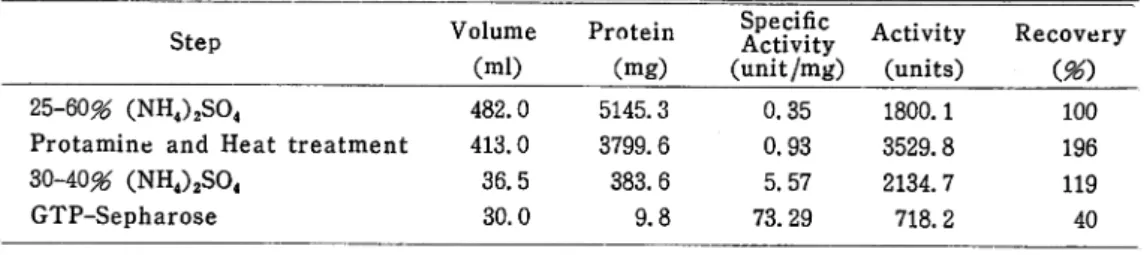
per1". The purification procedure is summerized in Table 1.
Table 1. Summary of the purification of the eel liver glutamate dehydrogenase
Step
25-60^ (NH4)2S04
Protamine and Heat treatment
30-40^ (NH4)2S04
GTP-Sepharose
Volume
Protein
Activfty Activity
Recovery
(ml) (mg) (unit/mg) (units) (96)
482.0 5145.3 0.35 1800.1 100
413.0 3799.6 0.93 3529.8 196
36.5 383.6 5.57 2134.7 119
30.0 9.8 73.29 718.2 40
Wet weight of eel livers, 435. 7 g
Materials Co-enzymes, NAD+ and NADH were obtained from Oriental Yeast Co. CNBr-activated Sepharose was perchased from Pharmacia Fine Chemicals and
Results
Effect of substrates on the thermalstability of purified GDH The enzyme in 0.1M Tris-Cl buffer (pH 8. 0) containing 10~3M EDTA was incubated in the presence or absence of substrates at 30, 35, 40, 50 and 60°C for 15min. After the incuba
tion the enzyme was immediately transfered to an icebath and the activity was assayed at 30°C. In the absence of substrates, the enzyme was inactivated at raised temperature (Fig. 1). In the presence of 0.1M ammonium chloride and 5xlO"3M a-ketoglutarate, the enzyme was stable at 40°C but inactivated at 55°C almost completely. Glutamate (0.1M) as one of substrates had not protective
effect on the heat denaturation of the enzyme.
3.0
P 2.0
-1.0 •
30 40 50 60
Temperature (°C)
Fig. 1 Effect of substrates on the thermalstability of the purified glutamate dehydrogenase.
I, II: After the enzyme was incubated in the absence (I) or the presence (II) of a-ketoglutarate and NH4C1, its ac tivity was assayed in Tris-Cl buffer (pH 8.0) contanining EDTA, a-ketoglutarate, NH4C1 and NADH.
Ill, IV: After the enzyme was incubated in the absence (III) or the presence (IV) of glutamate, its activity was assayed in Tris-Cl buffer (ph 8.5) containing glutamate and
NAD+.
Effect of crude extract on thermalstability of the purified GDH As shown in Fig. 1., the purified enzyme was inactivated at 55°C for 15min. However the enzyme
was stable in the crude extract at 55°C. The recovery of the enzyme activity after
the heat treatment was approximately 200^ (Table 1). Then the effect of the crude extract on the thermalstability of the purified GDH was investigated. After the heating process the crude extract was centrifuged, and the supernatant was
60 Mem. Fac. Fish., Kagoshima Univ. Vol. 28 (1979)
then fractionated with ammonium sulfate, 0-30^ (Fraction I), 30-40^ (Fraction II) (NH4)2S04 fraction and the leaving fraction (Fraction III) unprecipitated with 40^ saturated ammonium sulfate. Each fraction was adequately dialyzed aga inst 0.1M Tris-Cl buffer (pH 7.5) containing 10"3M EDTA.
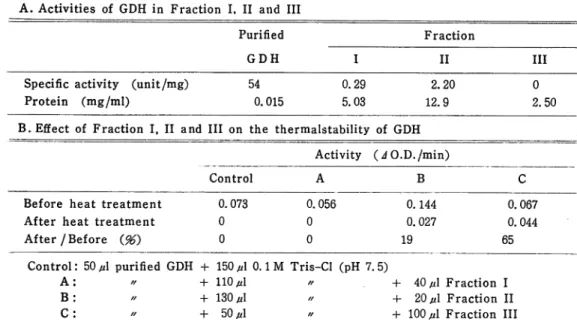
The protein concentration and activity of the enzyme in each fraction were shown in Table 2-A. The purified GDH (50^1) was added to each fraction, of
which concentration of protein was adjusted to equal amount of protein (250 ug)f and incubated at 55°C for 5min. After the incubation the incubation mixture
was immediately transfered to an icebath and the enzyme activity was assayed at 30°C.
Table 2. Effect of crude extract on the thermalstability of the purified
glutamate dehydrogenase A. Activities of GDH in Fraction I, II and III
Purified Fraction
GDH I II III
Specific activity (unit/mg) 54
Protein (mg/ml) 0.015
0.29 2.20
5.03 12.9
0
2.50
B. Effect of Fraction I, II and III on the thermalstability of GDH
Activity (JO.D./min)
Control A B C
Before heat treatment 0.073 After heat treatment 0
After/Before (96) 0 0.056 0.144 0 0.027 0 19 0.067 0. 044 65
Control: 50 iA purified GDH + 150 //10.1M Tris-Cl (pH 7. 5)
A: // + 110 jA // + 40 p\ Fraction I
B: // + 130 fA // + 20 jA Fraction II
C: // -f- 50^1 // + 100 /A Fraction III
As shown in Table 2-B Fraction III had most protective effect on the heat de-naturation of the enzyme, the enzyme activity was retained 65 % of the initial
activity. However the purified enzyme was inactivated completely at 55°C for 5 min. Fraction I had no effect and Fraction II had a little effect on protection.
Seasonal changes of the thermalstability of the crude enzyme Crude enzyme was extracted from the acetone powder which was prepared from 100 to 150 eel
livers. Eels used were almost same size and same weight (about 150 g) at any
season. However crude enzyme prepared at September and October was inacti vated by heat treatment. Then seasonal changes of the effect of heat treat ment on the purification were investigated.
Recovery after heat treatment (%) 200 100 • 1 2 3 4 5 6 7 8 9 10 11 12 Month
Fig. 2 Seasonal changes of the thermostability of the crude enzme.
slightly throughout the year (Fig. 2). After the heat treatment the specific activities of the enzyme prepared at any month except September and October were raised 2 to 4 times higher than those of crude enzyme before the heat treatment. The recoveries of these enzyme activities after the heat treatment
were 100 to 250 % but those at September and October were below 10 %.
Discussion
Purified GDH in 0.1M Tris-Cl (pH 7. 5)containing 10"3M EDTA was inactivated
comletely by heat treatment, at 55°C for 5min. In the presence of a-ketogl-utarate and ammonium chloride the enzyme increased its thermalstability and tolerated at 40°C for 15 min. However in the presence of glutamate the enzyme
did not increase its thermalstability. It is assumed that relative high concen tration of ammonium chloride (0.1M) and a-ketoglutarate made the enzyme increase its thermalstability. In bovine liver GDH high concentration of sodium
62 Mem. Fac. Fish., Kagoshima Univ. Vol. 28 (1979)
sulfate (0. 5M) makes the enzyme increase its thermalstability". Phosphate buffer
(pH 7.6, 0. 2M) also had same effect on thermalstability of bovine liver GDH1}.
As shown in Table 2, it was found that in the crude extract of the eel liver there was some protective compound to make the eel liver GDH increase itsthermalstability. This compound seems to be a material having high molecular
weight like protein, since it was not removed by dialysis. Because of the pre
sence of this protective compound, the heat treatment during the purification
procedure was very useful to remove other proteins except GDH as shown inTable 1.
NADP+-specific GDH's of Salmonella", Neurospora2* and E. coli" are purified by
heating process, at 55°C for 5min„ 53°C for 30min. and 60°C for lOmin., respec
tively.
NAD+-specific GDH of Clostridium SB<2) is also purified by heat tratment
at 65°C for 15min.
However these enzymes purified from microorganisms desc
ribed above are stable at 55 to 60°C without addition of some materials to pro
tect against the denaturation of the enzyme.It is reported by Rogers120 that the loss of the activity of bovine liver GDH during the heating process did not occur from successive partial denaturation
of all the enzyme molecules which were present and soluble at the beginning
of the heating process, and that the heat treatment had not altered the affinity
of the substrate binding site for isophthalic acid, as competitive inhibitor, in
the remaining "active" enzyme molecules. If these results reported by Rogers
are true for other thermostable GDH's, these enzymes maintain to have their original properties after the heating process.Seasonal changes of the thermalstability of the crude enzyme were obserbed.
Crude enzyme prepared at September and October was inactivated by heat treatment.
After the heat treatment the specific activities of the enzyme prepared
at any month except September and October were raised 2 to 4 times higherthan those of crude enzyme before the heat treatment. It is assumed that the
protective compound to make the eel liver GDH increase its thermalstability was
absent in the extract of the eel liver obtained at September and October. Theabsence of the protective compound seems due to the change of the components
in the eel liver by the changes of feeding or the preparation for migration, eels
in Kagoshima migrate from river to the sea at October or November. Lewanderet al.u) reported the difference of liver protein content between the yellow and
silver phases of the European eel, the yellow eel is successively changed to wards the silver eel phase during the summer and autumn of the year of spa wning migration.References
1) Olson, J. A. and Anfinsen, C. R. (1953) : Kinetic and equilibrium studies on crystalline
L-glutamic acid dehydrogenase. /. Biol. Chem., 202, 841-856.
et la forme moleculaire de la glutamico-deshydrogenase. /. Biochem., 46, 1171-1185. 3) Barrett, R. W. and Strickland, W. N. (1963) : Purification and characterization of
a TPN-specific glutamic acid dehydrogenase from Neurospora cra^sa. Arch. Biochem. Bio-phys., 102, 66-76.
4) Veronese, F. M., Nyc, J. F., Degani, Y., Brown, D. M. and Smith, E. L. (1974) : Nicotinamide adenine dinucleotide-specific glutamate dehydrogenase of Neurospora I. /. Biol. Chem., 249, 7922-7928.
5) Lejohn, H. B. and Sterenson, R. M. (1970) : Multiple regulatory processes in nicotina mide adenine dinuleotide-specific glutamate dehydrogenases. /. Biol. Chem., 245, 3890-3900.
6) Winnacker, E. L. and Barker, H. A. (1970) : Purification and properties of a NAD-dependent glutamate dehydrogenase from Closridium SB4. Biochim. Biophys. Acta. 212,
225-242.
7) Johanson, W. M. and Westlake, D. W. S. (1972) : Purification and characterization of glutamic acid dehydrogenase and or-ketoglutaric acid reductase from Peptococcus
aerogenes. Can. J. Microbiol., 18, 881-892.
8) Coulton, J. W. and Kapoor, M. (1973): Purification and some properties of the glutamate dehydrogenase of Salmonella typhimurium. Can. J. Microbiol., 19: 427-438. 9) Veronese, F. M., Boccu, E. and Conventi, L. (1975) : Glutamate dehydrogenase from
Escherichia coli: Induction, purification and properties of the enzyme. Biochim. Biophys.
Acta. 377, 217-228.
10) Lowry, O. H., Rosebrough, N. J., Farr, A. L. and Rafall, R. J. (1951) : Protein measurement with the Folin phenol reagent. /. Biol. Chem.. 193, 265-275.
11) Hayashi, S. and Ooshiro, Z. (1977) : Availability of GTP-Sepharose for the purifica tion of glutamate dehydrogenase from eel liver. Bull. Japan. Soc. Sci. Fish., 43, 107-113.
12) Hayashi, S. and Ooshiro, Z. in preparation
13) Rogers, K. S. (1975) : Heat denaturation of bovine liver glutamate dehydrogenase. Proc. Soc. Exper. Biol. Med., 149, 1023-1025.
14) Lewander, K., Dave, G., Johansson, M.-L., Larsson, A. and Lidman, U. (1974) : Metabolic and hematological studies on the yellow and silver phases of the European eel, Anguilla anguilla L. I. Comp. Biochem. Physiol., 47 B, 571-581.