Yokota
type
invariants derived from
Costantino-Murakami’s
Invariants
Atsuhiko
Mizusawa
Waseda
University
This is
a
survey of [4]. In this note,we define
invariants for coloredoriented
spa-tial graphs
from
Costantino-Murakami’s
invariants
([2]) following themethod
definingYokota’s invariants ([7]). We call these invariants Yokota type invariants. Then
we
pro-pose a volume conjecture between the Yokota type invariants and volumes of hyperbolic
polyhedra.
1
Knots and spatial graphs
In this section, we quickly review knots, spatial graphs, the Reidemeister
moves
forthem, the volume conjecture and Yokota’s invariants.
Definition
1.1. $A$ knot isan
embeddingofa
circle into the three-sphere. $A$ spatial graph(a knotted graph) is
an
embedding ofa
graph $(V, E)$ into the three-sphere. Where $V$ isa set of vertices and $E$ is a set of edges. $A$ plane graph is
a
spatial graph whichcan
beembedded to the two-sphere.
We treat them through diagrams derived by regular projections to the two-sphere.
Figure 1: Diagrams ofa knot, aspatial graph and a plane graph.
There
are
5localmoves
called Reidemeistermoves
for knot and spatial graph diagrams (Figure 2). Here RIV and $RV$moves
appear only for spatial graph diagrams.Theorem 1.2. Two diagrams represent the same knot or spatial graph
if
and onlyif
the$-\}_{1}^{)}($
RI RII RIII
RIV RV
Figure 2: Reidemeister moves.
Fkom Theorem 1.2, values or properties derived from diagrams of knots (resp. spatial
graphs) that do not change under the Reidemeister moves are invariants of knots (resp.
spatial graphs).
The $N$-th colored
Jones
polynomial $J_{N}$(. ;q) isan
invariant for knotsdefined
throughan
$N$-dimensional
representation ofquantumgroup
$\mathcal{U}_{q}(sl_{2})$
.
When $N=2$, it correspondsto the Jones polynomial.
Conjecture 1.3 (Volume conjecture [3] [5]). Let $K$ be a hyperbolic knot in $S^{3}(i.e$
.
thecomplement
of
$K$ has a complete hyperbolic structure). Then the valueof
the coloredJones polynomial
of
$K$ at $N$-th rootof
unity $\exp(2\pi\sqrt{-1}/N)$ in the nextform
convergesto the hyperbolic volume
of
complementof
$K.$$2 \pi\lim_{Narrow\infty}\frac{\log|J_{N}(K;\exp(2\pi\sqrt{-1}/N))|}{N}=Vol(S^{3}\backslash K)$,
where $Vol(\cdot)$ is the hyperbolic volume.
The volume conjecture is generalized for any knots by using the simplicial volume
(Gromov norm) instead ofthe hyperbolic volume ([5]).
In [7], Y.
Yokota defined
invariants for coloredspatial graphs. $A$ color isa
non-negativeinteger added to the graph edges. The colors correspond to the dimension of the
repre-sentation of$\mathcal{U}_{q}(sl_{2})$
.
$A$ triple $(i, j, k)$ of colors is called admissible (for this representation)if they satisfy $|i-j|\leq k\leq i+j$ and $i+j+k\in 2\mathbb{Z}$. Yokota’s invariants
are
first definedfor trivalent graphs then generalized for any graphs.
Definition 1.4 (Yokota’s invariants). Let $\Gamma$ be a trivalent spatial graph. We add colors
to edges of $\Gamma$ such that
diagram $D$of admissibly
colored
$\Gamma$can
be estimated
by theKauffman
bmcket
$\langle\cdot\rangle$ (see[7]
for details). We put $\Delta_{a}=$
$(i,j, k)$
.
Yokota’s invariants $\langle\cdot\rangle_{Y}$ for colored trivalent graph $\Gamma$are
definedas
$\langle\Gamma\rangle_{Y}=\langle D\rangle\langle\overline{D}\rangle/\prod_{Trip1es}$of
$\theta(i, j, k)$, colors at vertices
wher$e^{}$
means
the
mirror imageof
a
diagram.Yokota’s invariants
are
generalizedfor
spatial graphs which have 1, 2, $n$-valent $(4\leq n)$ verticeswith the next relations at vertices.for
an
$n$-valent vertex $(4\leq n)$ where color $i$moves
all admissible colors for the right-handside diagram. This relation is independent of the ways extending the edge.
$\langle\frac{i\wedge j}{\vee}\rangle_{Y}=\frac{\delta_{ij}}{\triangle_{i}}\langle\underline{i}\rangle_{Y}$
for
a
2-valent vertex, andfor
an
1-valent vertex.2
Costantino-Murakami’s invariants
In this section
we
review the invariants for colored oriented framed trivalent spatialgraphs
defined
by F.Costantino and J.
Murakami in [2].Here
trivalent graphsmay
havecircle components. These invariants have properties of the volume conjecture between
tetrahedron graphs and hyperbolic volumes oftetrahedra.
2.1 Definition of CostantinoMurakami‘s invariants
Costantino-Murakami’s invariants
are
defined through the non-integral representationsof the quantum group $\mathcal{U}_{q}(sl_{2})$ where $q$ is at a root of unity. $\mathcal{U}_{q}(sl_{2})$ is the Hopf algebra
Generators:
$E,$ $F,$ $K,$ $K^{-1}.$Relations: $[E, F]= \frac{K^{2}-K^{-2}}{q-q^{-1}},$ $KE=qEK,$ $KF=q^{-1}FK,$ $KK^{-1}=K^{-1}K=1.$
Structure
of the Hopf algebra:$\triangle(E)=E\otimes K+K^{-1}\otimes E,$ $\triangle(F)=F\otimes K+K^{-1}\otimes F,$ $\triangle(K^{\pm 1})=K^{\pm 1}\otimes K^{\pm 1},$
$S(E)=-qE, S(F)=-q^{-1}F, S(K)=K^{-1},$
$\epsilon(E)=\epsilon(F)=0, \epsilon(K)=1,$
where $\Delta$ is the coproduct, $S$
is the antipode and $\epsilon$ is the counit.
Let $n\in \mathbb{N}$ and $\xi_{n}$ be
a
$2n$-th primitive root of unity $\exp(\pi\sqrt{-1}/n)$.
We prepare notations:$\{a\}=\xi_{n}^{a}-\xi_{n}^{-a}(a\in \mathbb{C}) , [a]=\frac{\{a\}}{\{1\}}, \{k\}!=\prod_{j=1}^{k}\{j\}(k\in \mathbb{N})$,
$\{\begin{array}{l}ab\end{array}\}=\prod_{j=0}^{a-b-1}\frac{\{a-j\}}{\{a-b-j\}} (a, b\in \mathbb{C} s.t. a-b\in\{0,1, \ldots, n-1\})$.
For each non-half-integer complex number $a \in \mathbb{C}\backslash \frac{1}{2}\mathbb{Z}$, there is a simple $n$-dimensional
representation of$\mathcal{U}_{\xi_{n}}(sl_{2})$
on
a
representation space $V^{a}$ which isan
$n$-dimensional vector
space whose basis is $\{e_{0}^{a}, \ldots, e_{n-1}^{a}\}$
.
The actions of this representation are given by$E(e_{j}^{a})=[j]e_{j-1}^{a}, F(e_{j}^{a})=[2a-j]e_{j+1}^{a}, K(e_{j}^{a})=\xi_{n}^{a-j}e_{j}^{a} (e_{-1}^{a}=e_{n}^{a}=0)$.
For two complex numbers $a,$ $b \in \mathbb{C}\backslash \frac{1}{2}\mathbb{Z}$, the two representations related to them
are
isomorphic if and only if $a-b\in 2n\mathbb{Z}$. The dualrepresentation on $(V^{a})^{*}$ is isomorphic to
the representation
on
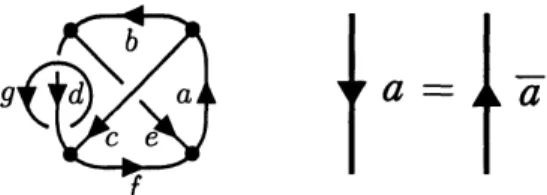
$V^{n-1-a}.$Let $\Gamma$ be
an
orientedframed trivalent graph. We add non-half-integercomplex numbers
to each oriented edge of $\Gamma$ (Figure $31eft$
). The numbers are called colors. In the
cal-culations of
Costantino-Murakami’s
invariants (see below), an $a$ colored downward edgecorresponds to the representation space $V^{a}$ and
an
$a$ colored upward edge corresponds tothe dual space $(V^{a})^{*}$. From the isomorphism between the representations on $(V^{a})^{*}$ and $V^{n-1-a}$, we can identify an $a$ colored edge and
$n-1-a$
colored opposite direction edge(Figure 3 right). We put $\overline{a}=n-1-a$
.
We define admissible condition for the colors of$\}a=\}\overline{a}$
Figure 3: $A$ colored oriented trivalent graph (left) and identification of colored edges (right).
Definition 2.1 (Admissible condition). If three colors $a,$$b,$$c$ ofedges at
a
vertex satisfythe next condition, the triple $(a, b, c)$ of the colors is called admissible.
$a+b+c\in\{n-1, n, \ldots, 2n-2\},$
here the orientations of the three edges
are
all toward the vertex.If three colors of
a
vertexare
admissible,we
can
givea
representation canonically atthe vertex.
From
now
on, unless otherwise noted, variable colors in summations $\sum$move
all admissible colors.
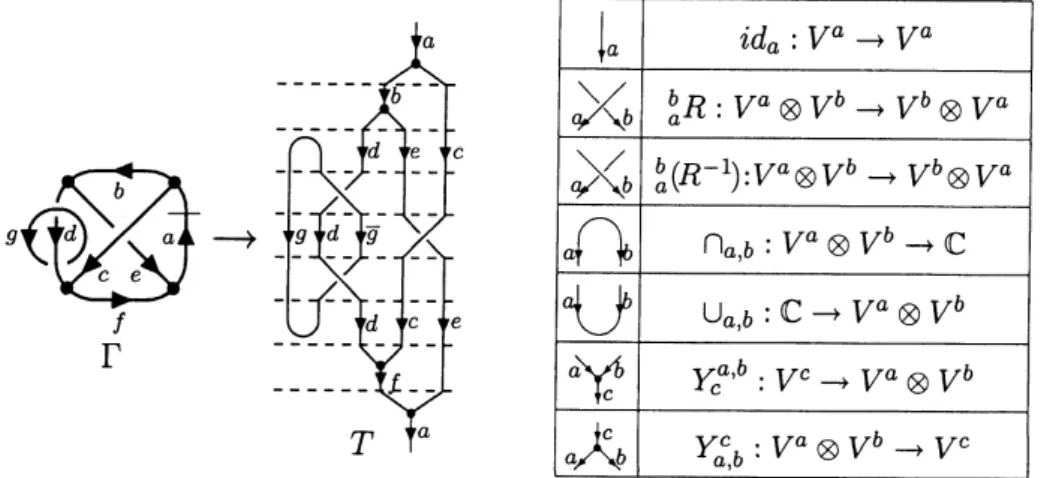
To calculate Costantino-Murakami’s invariants for admissibly colored oriented framed trivalent spatial graph $\Gamma$,
we
cutan
edge of $\Gamma$ and make an (1, 1)-tangle diagram $T$so
that the boundary edges of$T$
are
oriented downward. Thenwe
cut $T$ to slicesso
thatin each slice there is just
one
singular point, which isa
maximal, minimal, crossing orvertex point (Figure 4 left). $A$ boundary of
an
$a$ colored strand ina
slice is related tothe representation space $V^{a}$ if the strand isoriented downward and to $(V^{a})^{*}$
or
$V^{n-1-a}$ ifthe strand is oriented upward. From the representation of$\mathcal{U}_{\xi_{n}}(sl_{2})$, each slice is regarded
as a
map from the tensor product ofrepresentation spaces corresponding to the bottomboundary
of
strands in theslice
to theone
corresponding to theupper
boundary (Figure4 right). Here the maps
are
definedas
follows.$baR(e_{i}^{a} \otimes e_{j}^{b})=\sum_{m}\{m\}!\xi_{n}^{2(a-i)(b-j)-m(a-b-i+j)-\frac{m(m+1)}{2}}\{\begin{array}{ll}i i- m\end{array}\} \{\begin{array}{l}2b-j2b-j-m\end{array}\}e_{j+m}^{b}\otimes e_{i-m}^{a},$
where $m \in[0, \min(i, n-j-1)]\cap \mathbb{N}.$
$\bigcap_{a,b}(e_{i}^{a}\otimes e_{j}^{b})=\delta_{b,n-1-a}\delta_{i,n-1-j}\xi_{n}^{-(a-i)(n-1)},$ $\bigcup_{a,b}=\delta_{b,n-1-a}\sum_{i=0}^{n-1}\xi_{n}^{-(a-i)(n-1)}e_{i}^{a}\otimes e_{n-1-i}^{b}.$
Figure 4: $\Gamma$ and $T$ (left),
the maps related to the singular points (right).
where
$C_{i,j,k}=\sqrt{-1}^{c-a-b}(-1)^{j-k}\xi\{\begin{array}{l}2c2c-k\end{array}\}\{\begin{array}{l}2c-(n-1)a+b+c\end{array}\}$
$\sum_{z+w=k}(-1)^{z}\xi\frac{(2z-k)(2c-k+1)}{n2}\{\begin{array}{l}a+b-ci-z\end{array}\}\{\begin{array}{lll}2a -i+ z2a -i \end{array}\} \{\begin{array}{l}2b-j+w2b-j\end{array}\}$
Then
we
have a map $op(T)$ from the representation space related to the color, say $a,$of the cutting edge of $\Gamma$ to itself by composing the maps related to the slices of
$T$;
$op(T)$ : $V^{a}arrow V^{a}$. By Schur’s lemma, $op(T)$ is equal to a scalar $\lambda(T)(\in \mathbb{C})$ multiplied
identity $\lambda(T)id_{a}$
. Costantino-Murakami’s
invariants $\langle\cdot\rangle_{CM}$ of $\Gamma$are
defined by$\langle\Gamma\rangle_{CM}=\lambda(T)\{\begin{array}{l}2a+n2a+1\end{array}\}$
Theorem 2.2 ([2]). For colored oriented
framed
trivalent spatialgraph$\Gamma$, the value $\langle\Gamma\rangle_{CM}$does not depend
on
the choiceof
the cutting edge and (1,1)-tangle diagram T.Therefore
$\langle\cdot\rangle_{CM}$ is
an
invariantsfor
colored orientedframed
trivalent spatial graph.Remark 2.3. 1. For
a
half-integer $a \in\frac{1}{2}\mathbb{Z},$$\{\begin{array}{l}2a+n2a+1\end{array}\}=0.$
Hence for half-integer colors,
Costantino-Murakami’s
invariants may become infinity.2. If graphs
are
restricted to links,Costantino-Murakami’s
invariants correspond tothe Akutsu-Deguchi-Ohtsuki (colored Alexander) invariants. For the
Akutsu-Deguchi-Ohtsuki invariants, the properties of the volume conjecture between links and cone
2.2 Relations of Costantino-Murakami’s
invariants
In this subsection,
we
review relations ofCostantino-Murakami’s invariants.
Using therelations,
Costantino-Murakami’s
invariantsare
calculated axiomatically.The $6j$-symbols $\{\cdot\}$
are
thevalues determined by 6 colors. The $6j$-symbolsare
definedas coefficients of the relation (3) below. For $a,$$b,$ $c,$$d,$ $e,$$f \in \mathbb{C}\backslash \frac{1}{2}\mathbb{Z}$ and $a+b-c,$$a+f-$
$e,$$b+d-f,$$d+c-e\in \mathbb{Z}$, the $6j$-symbols
are
calculated by the next formula.$\{\begin{array}{lll}a b cd e f\end{array}\}=(-1)^{n-1+B_{afe}}\{\begin{array}{l}2f+n2f+1\end{array}\}\frac{\{B_{dce}\}!\{B_{abc}\}!}{\{B_{bdf}\}!\{B_{afe}\}!}\{\begin{array}{lll} 2c A_{abc} +1- n\end{array}\} \{\begin{array}{l}2cB_{{\oe} d}\end{array}\}$
$\cross\sum_{z=s}^{S}(-1)^{z}\{\begin{array}{ll}A_{afe} +12e+z +1\end{array}\} \{\begin{array}{l}B_{aef}+zB_{aef}\end{array}\}\{\begin{array}{l}B_{bfd}+B_{dce}-zB_{bfd}\end{array}\}\{\begin{array}{l}B_{dec}+zB_{dfb}\end{array}\},$
where $s= \max(0, -B_{bdf}+B_{dce}),$ $S= \min(B_{doe}, B_{afe}),$ $A_{xyz}=x+y+z,$ $B_{xyz}=x+y-z.$
Costantino-Murakami’s invariants of tetrahedron graphs
are
described by using the6j-symbols and
we
denote them by $\{\cdot\}_{tet}.$$\{\begin{array}{lll}a b cd e f\end{array}\}.$
It
was
proved that $\{\cdot\}_{tet}$ is well-defined for half-integer colors. The next local relationshold for Costantino-Murakami’s invariants.
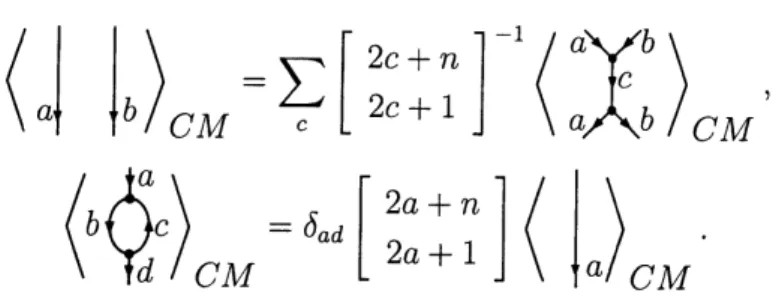
$\langle\rho^{1_{a}}\rangle_{CM^{=\xi_{n}^{-2a\overline{a}}}}\langle 1_{a}\rangle_{CM} \langle\}ab\rangle_{CM}=\xi_{n}^{2a\overline{a}}\langle 1_{a}\rangle_{CM}$ (1)
(2)
$b$
(3)
$d$
$\langle_{a}\downarrow$ $\downarrow b\rangle_{CM}=\sum_{c}$
$l_{a}\rangle_{CM}$
2.3 Properties of the volume conjecture
Costantino-Murakami’s
invariants
have properties of the volume conjecturebetween
tetrahedron graphs and hyperbolic volumes of ideal and truncated tetrahedra (Figure 5
left). Shapes of tetrahedra in the hyperbolic space are determined by their 6 dihedral
angles of edges. The ideal tetrahedra are the hyperbolic tetrahedra whose vertices are
all at infinity points of hyperbolic space. The two dihedral angles of opposite edges of
ideal tetrahedra
are
equal. Therefore the shapes of ideal tetrahedraare
determined by3 dihedral angles $\alpha,$$\beta,$
$\gamma$
.
It is known that they satisfy $\alpha+\beta+\gamma=\pi$.
In the Klein model of hyperbolic space,we
can consider the tetrahedron whose verticesare
“outside”the hyperbolic space (Figure 5 right). For each vertex of this tetrahedron, there is just
one
geodesic surface which intersects perpendicularly to each of three adjacent faces ofthe vertex. Cutting the tetrahedron by the surfaces at every vertex,
we
havea
finitepolyhedron in the hyperbolic space. This polyhedron is called truncated tetrahedron.
Three dihedral angles $\alpha,$$\beta,$
$\gamma$of edges adjacent toan “outside” vertex satisfy $\alpha+\beta+\gamma<\pi.$
Klein Model Poincar\’e Model
Figure 5: Images of ideal and truncated tetrahedra(left), a vertex outside the hyperbolic space and a cutting surface (gray) (right).
Theorem 2.4 ([2]). Let $S$ be a hyperbolic tetmhedron, $\theta_{a},$
$\cdots,$$\theta_{f}$ be dihedml angles
of
$S$ and $a_{n},$$\cdots,$$f_{n}$ be sequences
of
integer colors such that $\lim_{narrow\infty}\frac{2\pi a}{n}=\pi-\theta_{a},$$\cdots$ $\lim_{narrow\infty}\frac{2\pi f_{n}}{n}=\pi-\theta_{f}$.
Costantino-Murakami’s
invariantsof
tetmhedron graphs $\{\cdot\}_{tet}$($i.e$
.
dihedml
anglesof
opposite edgesare
equal),$Vol(S) =\lim_{narrow\infty}\frac{\pi}{n}\log((-1)^{n-1}\{\begin{array}{lll}a_{n} b_{n} c_{n}a_{n} b_{n} c_{n}\end{array}\})$
$= \lim_{narrow\infty}\frac{\pi}{n}\log((-1)^{n-1}\{\begin{array}{l}\overline{a_{n}}\overline{b_{n}}\overline{c_{n}}\overline{a_{n}}\overline{b_{n}}\overline{c_{n}}\end{array}\})$
If
$S$ isa
truncated tetmhedmn,$Vol(S)=\lim_{narrow\infty}\frac{\pi}{2n}\log(\{\begin{array}{lll}a_{n} b_{n} c_{n}d_{n} e_{n} f_{n}\end{array}\} \{\overline{\frac{a_{n}}{d_{n}}}\overline{\frac{b}{e_{n}}n}\overline{\frac{c_{n}}{f_{n}}}\}_{tet})$
.
(5)3
Yokota
type
invariants
and numerical calculations
In this section,
we
define Yokota type invariantsfor coloredoriented spatial graphs withmore
thanor
equal to 3-valent vertices from Costantino-Murakami’s invariants. We alsopropose
a
volume conjecture for the Yokota type invariants between plane graphs andhyperbolic
convex
tetrahedra. By numerical calculations,we
observe regularities of theYokota type invariants for integer colors and asymptotic behaviors ofthem.
3.1 Definition of Yokota type
invariants
Using the similar way to define Yokota’s invariants, Costantino-Murakami’s invariants
are generalized to invariants for non-framed colored oriented spatial graphs with
more
than or equal to 3-valent vertices. Like the Yokota$\rangle s$ invariants, these invariants are first
defined for trivalent graphs thengeneralized for graphswith
more
than 3-valrent vertices.Definition
3.1 (Yokota type invariants). Let $\Gamma$ be admissibly colored oriented trivalent graph and $D$ be its diagram. Yokota type invariants $\langle\cdot\rangle_{Y}$,are
defined fromCostantino-Murakami’s invariants by the next relation.
$\langle\Gamma\rangle_{Y’}=\langle D\rangle_{CM}\langle\overline{D}^{r}\rangle_{CM},$
wher$e^{}$ means the mirror image, $\cdot$
$r$
means
reversing orientations ofall edges. Using thenext relation, we define the Yokota type invariants for graphs with more than 3-valent
vertices.
where the surrounding edges have the
same
colors and orientations on the both sides andTheorem 3.2. The values
of
the Yokota type invariantsare
independentof
the choiceof
the diagrams to calculate andof
the ways to extend edges atmore
than 3-valent vertices.Pmof.
This isa
sketch ofproof. Theinvariance ofthe Yokota type invariantsfor RII, RIIIand$RV$
moves
come
from that ofCostantino-Murakami’s
invariants. The invariance for$RI$and RIV
moves come
from direct calculations using the relations (1) and (2) respectively. The next equation holds for the Yokota type invariants.By extending edges at a
more
than 3-valent vertex recursively, it changes to a trivalenttree. The shape ofthe tree depends on the ways to extend the edges. The values of the
result graphs are, however, the
same
because the treesare
transformed to each other bya
sequence of themoves
in the equation. $\square$In Theorem 2.4, the value inside log$(.$ $)$ of Equation (5) is the value ofthe Yokota type
invariants for tetrahedron graphs. Using the Yokota type invariants, we conjecture the
extension of Theorem 2.4.
Conjecture
3.3.
Let$\Gamma$ bea
plane graphand
$S_{\Gamma}$ bea
hyperbolicconvex
polyhedmn whichis bounded by $\Gamma$.
If
sequencesof
integer colorsof
$\Gamma$ are taken as in Theorem2.4 for
corresponding dihedral anglesof
$S_{\Gamma}$, then$Vo1(S_{\Gamma})=\lim_{narrow\infty}\frac{\pi}{2n}\log(\langle\Gamma\rangle_{Y’})$ .
3.2 Numerical calculations
We show the numerical calculations of the Yokota type invariants for square pyramid
graphs andobserveregularities of the Yokota type invariantsfor integer colors and
$= \sum_{i}\{\begin{array}{ll}2i+ n2i+1 \end{array}\} \{\begin{array}{lll}a e di c b\end{array}\}\{\begin{array}{lll}d g hf c i\end{array}\} \{\begin{array}{l}\overline{a}\overline{e}\overline{d}\overline{i}\overline{c}\overline{b}\end{array}\}\{\begin{array}{l}\overline{d}\overline{g}\overline{h}\overline{f}\overline{c}\overline{i}\end{array}\}$
where the thirdequation
uses
therelation (4). Weconsidercolored squarepyramidgraphs$\Gamma_{1,n}$ and $\Gamma_{2,n}$ corresponding to the followingsquare pyramids.
where all vertices of the squarepyramid of$\Gamma_{1,n}$
are
truncated and the4 bottomverticesofthe square pyramid of$\Gamma_{2,n}$
are
ideal vertices. The sequences of colors become integers bytaking appropriate integer $n$. For the integral colors, the
formula of
thesquare
pyramidgraph looks diverging to infinity because of the coefficient $\{\begin{array}{ll}2i+ n2i+1 \end{array}\}$ and
even
theregularity at the integer colors of the square pyramid formula is not proved yet. When
we
do numerical calculations,we
slightly differ the integer colors using small real number $\epsilon$ preserving admissible conditions.Before the numerical calculations,
we
show algebraic computation ofthe formula ofthesquarepyramids. Wecalculated the formula
as a
rationalfunction of$q$by not substituting$\xi_{n}$ to $q$ (i.e. defining $\{a\}=q^{a}-q^{-a}$) and reduced the numerator and the denominator by
common
factors then substituted $q=\xi_{n}$.
The resultsare as
follows.$\Gamma_{1,n}:n=24,$ $\{a, b, c, d, e, f, g, h\}=$
{9,8,9,9,8,8,8,9},
$\frac{2702553921462776104873773262573943868288}{4144454025633775}.$
$\Gamma_{2,n}:n=12,$ $\{a, b, c, d, e, f, g, h\}=$
{4,4,4,4,4,4,4,4},
$\Gamma_{2,n}:n=24,$ $\{a, b, c, d, e, f, g, h\}=$
{8,8,8,8,8,8,8,8},
$\frac{1841727671678193906056765234366258287027200}{19743796020815679008287}.$
The values are finite and the regularities for these $n$’s
are
shown. However, the abovecomputation for large $n$ takes too long time.
We
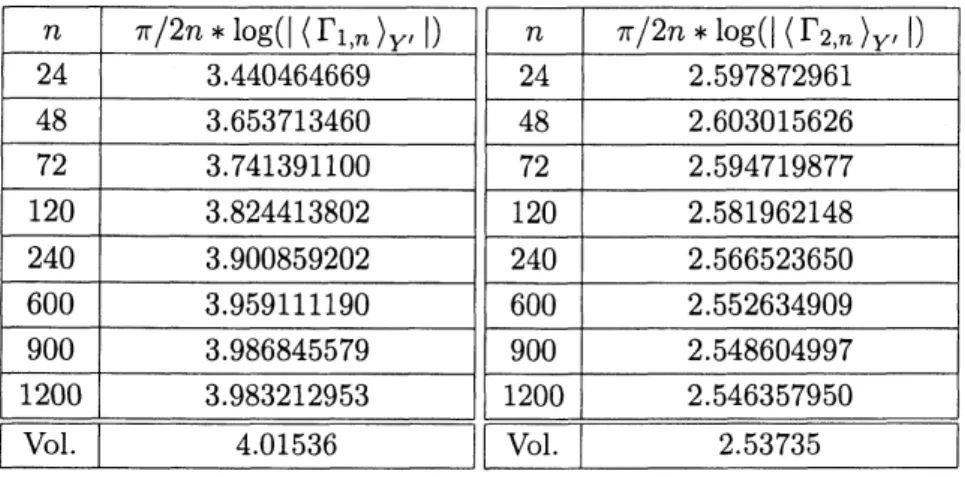
did numerical calculations at $\epsilon=$0.0000001
and observed asymptotic behavior ofthe formulafor $\Gamma_{1,n}$ and $\Gamma_{2,n}$. The resultsare
in Table 1, wherewe
calculated to 9th decimal places. We took the absolute valuesof the Yokota type invariants to kill the multivalency of $\log$ because in the result of the
calculations the value of Yokota type invariant for each $n$
was
a negative real number.We need
more
discussions here. The resultsseem
to tend to the volume of each squareTable 1: Numerical calculations at $\epsilon=0.0000001$
pyramid. These near-integer colors calculations also show that the formula may have
regularities at integer colors. The results are not so strong supporting evidences for Conjecture 3.3. We propose the next problem.
Problem 3.4. Pmve Conjecture 3.3
for
some
polyhedm which havemore
than 3-valentvertices. References
[1] J. Cho and J. Murakami Some limits
of
the coloredAlexander invariantof
the figure-eight knot and the volumeof
hyperbolic orbifolds, J. Knot Theory Ramifications 18no.
9 (2009), 1271-1286.[2] F. Costantino and J. Murakami On $SL(2,$C) quantum $6j$-symbol and its relation to
[3]
R.
Kashaev The
hyperbolicvolume
of
knots
from
the quantum dilogarithm,
Lett,Math. Phys. 39 (1997),
269-275.
[4] A. Mizusawa and J. Murakami Yokota Type Invariants Derived
from
Non-integmlRepresentation
of
$\mathcal{U}_{q}(sl2)$, in preparation.[5] H. Murakami and J.
Murakami
The coloredJones
polynomials and the simplicialvolume
of
a
knot,Acta
Math. 186no.
1 (2001),85-104.
[6] J. Murakami Colored Alexander invariant
for
framed
links, Osaka J. Math. 45no.
2(2008), 541-564.
[7] Y. Yokota Topological invariants
of
graphs in 3-space, Topology 35 (1996), 77-87.Department of Mathematics
Waseda University Tokyo
169-8050
JAPAN
$E$-mail address: a-mizusawa @aoni.waseda.jp