Filtering volatility from
data
observed at
random
time
intervals
Jaksa
Cvitanie
*Robert
Liptser
\daggerBoris
Rozovskii
\ddaggerIlya Zaliapin
\SOctober 10,
2005
$AMS$ (2000) Subject
Classifications:
Primaxy $60\mathrm{G}35,91\mathrm{B}28$; secondary $62\mathrm{M}20,93\mathrm{E}11$.Key Words and Phrases: nonlinear filtering, discrete observations, volatility estimation.
Abstract
Weconsideracontinuous-time model forastockprice,whichis, however, observed at discrete time intervals. The time between observations is random. Wereportonthe formula for the optimal filter for the current value of the volatility of the stock price and we illustrate the theoretical results with a numerical example. The filter gives
stable and efficient estimates of thevolatility As apreliminary step, we estimate the possible values of volatilityusinga variation of the Multiscale Trend Analysis (MTA) method.
*Caltech, $\mathrm{M}/\mathrm{C}$ 228-77, 1200 E. California Blvd. Pasadena, CA 91125. Ph: (626) 395-1784. $\mathrm{E}$mail:
[email protected]. Researchsupported inpart by NSF grant DMS 04-03575.
$\uparrow \mathrm{D}\mathrm{e}\mathrm{p}\mathrm{a}\mathrm{r}\mathrm{t}\mathrm{m}\mathrm{e}\mathrm{n}\mathrm{t}$ of Electrical Engineering-Systems, Tel Aviv University, 69978 Tel Aviv, Israel.
E-mail:[email protected]
tDepaxtment ofMathematics , USC, 3620 $\mathrm{S}$Verm ont Ave, MC 2532, Los Angeles, CA90089-1113, Ph:
(213) 740-6117, $\mathrm{E}$-mail: [email protected]. Researchsupported in part bythe ArmyResearch Officeand
the Office ofNavalResearchunderthe grants DAAD19-02-1-0374 and N0014-03-0027.
InstituteofGeophysics and PlanetaryPhysics,UCLA, 3845SlichterHall, Los Angeles, CA90095-1567,
2
1
INTRODUCTION
Inthispaper
we
reporton
theoretical results fromCvitanic, Liptserand Rozovskii [3] andon theirnumericalimplementation inCvitanic’, Rozovskii andZaliapin [4]. Theproblemwe
con-sider is the one of estimating the current volatility value from stock priceobservations. The observations
are
discrete, possiblyobserved at random times. The mainapplicationwe
have in mind is high-frequency stock data (”tick-by-tick” data).We
work ina
continuous-time, Brownian motiondriven model for the stock price, with stochastic volatility, independent of the driving Brownian motionprocess.
Related literature includes, among others, Prey and Runggaldier [7], Runggaldier [25], Elliott et al [5], Gallant and
Tauchen
[8], Malliavin and Mancino [20], Fouque et al. [6], Rogers and Zane [23], and Kallianpur and Xiong [13], Ait Sahaliaand Mykland [1], Platania and Rogers [22], andJohannes andPoison [11]. Thereis also arich econometrics, time-series literature on ARCH-GARCH mod els of stochastic volatility, presentingan
alternative way to model and estimate volatility;see Gourieroux
[9] fora
survey.Our work
was motivated
primarily by Prey and Runggaldier [7]. That paper derivesa
Kallianpur-Striebel type formula (see e.g. [12]) for the optimal mean-square filter of the volatility process, and investigates Markov Chain approximations for this formula. We extend this result in thatwe
derive the exact filtering equations, whichcan
easily be imple-mented-The Prey and Runggaldier model is anatural model for stochastic volatility, but it does not quite fall in the “standard” category of diffusion
or
simple point processes models for which filtering results have been developed (cf. [18], [15], [24]). Thus, therewas
a need to develop further technical tools to deal with our problem. However, it turns out that the resulting filtering equationsare
simplerthan in thecase
ofcontinuousobservations.
In the latter case, the nonlinear filters are described by infinite dimensional stochastic differential equations, for example, by stochastic partialdifferential
equations (seee.g.
[24]). Incon-trast, in
our
setting, the filtering equationcan
be reduced toa
recursive system of linked deterministic equations of Kolmogorov type. Moreover, at the observation times the filter is given by a simple Bayesian recursion.In
our
numerical examplewe assume
th at the volatilityisa
Markov chainprocess. Beforewe can
dothe filtering,we
have to decide whatpossiblevalues thevolatilitychaincan
attain,and
what the transition probabilitiesare.
This preliminary stage is related to the power variationestimates of volatility,as
surveyed in Barndorff-Neielsen,Graversen
and Shephard [2], for example. We adapt the so-called MultiscaleTrend
Analysis of Zaliapin et $al$ $[27]$,where
we use
a
variation process to estimate possible volatility values. However, while in thepower variations literature suchan
estimate isthe final
estimate ofvolatility, inour
case
using filtering. Also, let
us
emphasize again that, unlike most of the existing work, the time intervals between observations maybe random inour
framework.We show that the complete algorithm, consisting ofthe preliminary estimation and the filtering estimation, performs very well in
a
variety of circumstances,on
simulated andon
real data. It quickly recognizes when there $1S\lrcorner$
a
jump in volatility value. It is also robustwith respect to the given drift value, which is important,
as
the drift is hard to estimate in practice,Wedescribethe modelin section 2,state themain filtering results andexamplesinsection 3, discuss the preliminary estimation of the model parameters in section 4, the numerical implementation of the filtering formula in section 5, and the complete algorithm in section
6.
We
present two examples with real datain section7.
2
THE
MODEL
2.1
Observation
values and
observation
times
We fix a probability space $(\Omega, \mathcal{F}, \mathrm{P})$ equipped with a filtration $\mathrm{F}$
$=(\mathcal{F}_{t})_{t\geq 0}$ satisfying the
“usual” conditions (see, e.g. [19]). All random
processes
consideredin thepaper are assumed to be definedon
$(\Omega, \mathcal{F}, \mathrm{P})$ and adapted to F.We consider astock price process $S=(S_{t})_{t\geq 0}$ given bythe It6 equation
$fS_{t}=r(\theta_{t})\mathit{3}_{t}dt+v(\theta_{t})S_{t}fB_{t}$ (2.1)
where $B=(B_{t})_{t\geq 0}$ is
a
standard Brownian motion and $\theta=(\theta_{t})_{t\geq 0}$ isa
cadlag Markovjump-diffusion processin IR withthe generator $\mathcal{L}$
.
For thesake of simplicity,we
assume
that$r(x)$ and $v(x)$ are measurable bounded functions
on
$\mathbb{R}$, the initial condition $S_{0}$ is constant,and $v(x)$ and $S_{0}$ are positive.
The process $(\theta_{t})_{t\geq 0}$ isreferred to
as
the volatilityprocess. It is unobservable,and
theonly observable quantitiesare
the values of the $\log$-price process $X_{t}=\log S_{t}$taken
at stoppingtimes $(T_{k})_{k\geq 0}$,
so
that $T_{0}=0$,$T_{k}<T_{k+1}$ if$T_{k}<\infty$, and $T_{k}\uparrow$oo as
$j_{\acute{v}}\uparrow\infty$.
According to (2.1), the $\log$-price process is given by
$X_{t}= \int_{0}^{t}(r(\theta_{s})-\frac{1}{2}v^{2}(\theta_{s}))ds+\oint_{0}^{t}v(\theta_{s})dB_{s}$ .
We
use
the abbreviated notation$X_{k}:=X_{T_{k}}$.Thus, the observationsare
given by the sequence{Tkl$X_{k})_{k\geq 0}$. The observation process $(T_{k}, X_{k})_{k\geq 0}$ is
a
multivariate (marked) point process(see,
e.g.
[10], [16]) with the countingmeasure
4
where $\delta_{\{T_{k},X_{k}\}}$ is the Dirac delta-function
on
$\mathbb{R}_{+}\mathrm{x}$ R.We introduce two filtrations relatedto $(T_{k}, X_{k})_{k\geq 0}:(\mathcal{G}(n))_{n\geq 0}$ and $(\mathcal{G}_{t})_{t\geq 0}$, where
- $\mathcal{G}(n):=\sigma\{(T_{k}, X_{k})_{k\leq n}\}$,
- $\mathcal{G}_{t}:=\sigma(r([0, s]\mathrm{x} \Gamma)$ : $s\leq t,$$\Gamma\in \mathrm{B}(\mathrm{R})$, where $B(\mathbb{R})$ is the Borel a-algebra
on
R.It is
a
standard fact (see IIL3.31 in [10])$\mathcal{G}_{T_{k-}}=\mathcal{G}(k)$, $k=0,1\ldots$ , (2.2)
and $\{T_{k}\}$ is a system ofstopping times with respect to $(\mathcal{G}_{t})_{t\geq 0}$.
Remark 2.1 The filtration $(\mathcal{G}_{t})_{t\geq 0}$ provides
more
information thanthefiltration$\mathcal{G}_{T_{k}}$, namelyit provides additional information about the duration between the observation times,
The paper Cvitanic, Liptser and Rozovskii [3] works out thefiltering
formula for
general observation times, but here, for the simplicity ofpresentation, we willassume
the following: Assumption 2.1 The observation times $(T_{k})_{k\geq 0}$are
either:(i) the jumptimes of a doubly stochasticPoissonprocess (Cox process) with theintensity
$n(\theta_{t})$,
or
(ii) $T_{k}=\mathrm{k}\mathrm{S}$, that is, the observation times
are
deterministic, with constant lengtha
ofinterarrival intervals.
2.2
Volatility
Process
We
now
specify more preciselythe volatility process. Let $(\mathbb{R}, B(\mathbb{R}))$ and $(\mathbb{R}_{+}\mathrm{x} \mathbb{R},B(\mathbb{R}_{+})\otimes$$B(\mathbb{R}))$ be measurable spaces with Borel $\mathrm{c}\mathrm{r}$-algebras. The volatility
process
$\theta=(\theta_{t})_{t\geq 0}$ isdefined by the It6 equation
$d \theta_{t}=b(t, \theta_{t})ft+\sigma(t, \theta_{t})dW_{t}+\oint_{\mathrm{R}}u(\theta_{t-\}}x)(\mu^{\theta}-\nu^{\theta})(dt, dx)$, (2.3)
where $W_{t}$ is
a
standard Wiener process and $\mu^{\theta}=\mu^{\theta}(dt, dx)$ isa
Poissonmeasure
on$(\mathbb{R}_{+}\mathrm{x} \mathbb{R}_{1}B(\mathbb{R}_{+})\otimes B(\mathbb{R}))$ with the compensator $\nu^{\theta}(dt, fx)=K(dx)dt$
, where
$K(dx)$ is aa-finite non-negative
measure on
$(\mathbb{R}, B(\mathbb{R}))$. Weassume
that $E\theta_{0}^{2}<\infty$,
thefunctions
$b(t, z)_{\gamma}\sigma(t, z)$, and $u(z,x)$
are
Lipschitz continuous in $z$ uniformly with respect to othervariables,
and
$|b(t, z)|+| \sigma(t, z)|^{2}+\int_{\mathrm{J}\mathrm{R}}|u(z, x)|^{2}K(dx)\leq C(1+|z|^{2})$.
It is well known that under these assumptions (2.3) possesses a unique strong solution adapted to $\mathrm{F}$, and $E\theta_{t}^{2}<\infty$
for any
$t\geq 0$.The generator of the volatility process is given by
$\mathcal{L}f(x):=b(t, x)f’(x)+\frac{1}{2}\sigma^{2}(t, x)f’(x)$
$+ \oint_{\mathbb{R}}(f(x+u(x, y))-f(x)-f’(x)u(x,y))K(fy)$.
Before proceeding with the assumptions and main
results
we shall introduceadditional
notation. Set$m(s, t)=f_{s}^{t}(r( \theta_{u})-\frac{1}{2}v^{2}(\theta_{u}))$du, (2.4)
and
$\sigma^{2}(s, t)=\int_{s}^{t}v^{2}(\theta_{u})du$ (2.5)
For simplicity, it is assumedthat$v^{2}(s, t)$ isbounded away from zero. Let
us
denote by$\rho_{s,t}(y)$the density function of the normal distribution with
mean
$m(s, t)$ and thevariance $\sigma^{2}(s, t)|$.
$\rho_{s,t}(y):=\frac{1}{\sqrt{2\pi}\sigma(s,t)}e^{-\frac{(y-m(s,t)\mathrm{J}^{2}}{2\sigma^{\Xi}(s,t)}}$ (2.6)Clearly, $\rho$ is the conditional density of the stock’s $\log$-increments $X_{t}-X_{s}$ given $\theta$.
Let $\mathcal{F}^{\theta}=(\mathcal{F}_{t}^{\theta})_{t\geq 0}$ be the right-continuous filtrationgenerated by $(\theta_{t})_{t\geq 0}$ and augmented
by $\mathrm{P}$
-zero
sets bomF.
Denote by $G_{k}^{\theta}$ a regular version of the conditional distribution of $T_{k+1}$with respect to” $\mathcal{F}^{\theta}\vee \mathcal{G}(k)$. That is, $G_{k}^{\theta}$ is the distribution of the time of the nextobservation, given previous history, and given ?.
Let $N=(N_{t})_{t\geq 0}$ be the countingprocess with interarrival times $(T_{k}-T_{k-1})_{k\geq 1}$ , that is
$N_{t}= \sum_{k\geq 1}I(T_{k}\leq t)$ (2.7)
We also
assume
Assumption 2.2 The Brownian motion B is independent of $(\theta,$
N).
3
FILTERING RESULTS
3,1
The main result
For
a
measurablefunction$f$on
$\mathbb{R}$such that $E|f(\theta_{t})|<\infty_{?}$define the conditional expectationestimator $\pi_{t}(f)$ by
$\pi_{t}(f):=E(f(\theta_{t})|\mathcal{G}_{t})=f_{\mathbb{R}}f(z)\pi_{t}(dz)$, (3.1) Here and below$\mathcal{F}^{1}\vee F^{2}$ stands for the$\sigma$-algebra generatedby thea-algebras$F^{1}$ and$\mathcal{F}^{2}$
.
$\mathrm{e}$
where $\pi_{t}(dz):=dP(\theta_{t}\leq z|\mathcal{G}_{t})$ is thefilteringdistribution, (Notethat
we
omitthe argument $\theta_{t}$ of$f$ inthe estimator $\pi_{t}(f))$. As in the Bayesian framework, we suppose that thea
prioridistribution $\pi_{0}(dx)=P(\theta_{0}\in fx)$ is given.
Let $\sigma\{\theta_{T_{k}}\}$ be the $\mathrm{c}\mathrm{r}$-algebra generated by $\theta_{T_{k}}$. For $t>T_{k}$, let
us
define the followingstruc
rure
functions:
$\psi_{k}(f;t_{7}y, \theta_{T_{k}}):=B(f(\theta_{t})\rho_{T_{k)}t}(y-X_{k})\phi(T_{k}, t)|\sigma\{\theta_{T_{k}}\}\vee \mathcal{G}\tau_{k})$ (3.2)
and its integral with respect to $y$
$\overline{\psi}_{k}(f).t$,$\theta_{T_{k}}):=\int_{\mathbb{R}}\psi_{k}(f;t, y, \theta_{T_{k}})dy=E(f(\theta_{t})\phi(T_{k}, t)|\sigma\{\theta_{T_{k}}\}\vee \mathcal{G}_{T_{k}})$ (3.3)
where $\rho$ is given by $(2,6)$ and
$\phi(t)$ $=$ $\mathrm{n}(9\mathrm{t})\exp(-\int_{T_{k}}^{s}n(\theta_{\mathrm{u}})du)$ if Assumption 2.1 (i) holds (3.4) $\phi(t)$ $=$ 1 if Assumption 2.1 (ii) holds, (3.5)
If $f\equiv 1$, the argument $f$ in $\psi$ and $\overline{\psi}$ is replaced by 1.
For $t\geq T_{k}$ and a bounded function $f$ , define
$\mathcal{M}_{k}(f;t, \pi_{t}):=\cdot\frac{\pi_{T_{k}}(\overline{\psi}_{k}(f,t))-\pi_{t-}(f)\pi_{T_{k}}(\overline{\psi}_{k}(1\cdot t))}{\int_{t}^{\infty}\pi_{T_{k}}(\overline{\psi}_{k}(1\cdot s))ds}.,’$.
The main filtering result from Cvitanic, Liptser and Rozovskii [3] is (specialized to
As-sum
ption 2.1):Theorem 3.1 Under
our
assumptions,for
every measurable boundedfunction
$f$ in thedo-main
of
the generator $\mathcal{L}$ such that $\int_{0}^{t}E|\mathcal{L}f(\theta_{s})|ds<$oo
for
any $t\geq 0$, thefollowing systemof
equations holds:1) For every $k=0$,1 $\ldots$ , at the observation times vie have
$\pi_{T_{k+1}}(f)=\frac{\pi_{T_{k}}(\psi_{k}(f,t,y))}{\pi_{T_{k}}(\psi_{k}(1\cdot t,y)\rangle},\cdot|$
$\{\begin{array}{l}t=T_{k+1}y=X_{k+1}\end{array}\}$
(3.6)
Under Assumption 2.1 (i);
we
have between observation times: 2) Forevery
$k=0,1$.
,.
and $t\in \mathrm{Q}T_{k},T_{k+1}[$,$f\pi_{t}(f)=\pi_{t}(\mathcal{L}f)dt$ -$\mathcal{M}_{k}$$(f;t_{\}\pi_{t})$
it.
(3.7)Under Assumption 2.1 (ii), the second $tem$ is zero, that is,
we
have:2) For every $k=0$, 1$\ldots$ and$t\in \mathrm{I}T_{k}$,$T_{k+1}[$
,
Remark 3,1 Note that for high-frequency observations, it maybe satisfactory to compute
the volatilityestimate only at price observationtimes. In that
case
we only need touse
the relatively simple Bayes-type recursion formula (3.6), and not the differential equation (3.7)or
(3.8).Remark 3.2 Clearly, the “structure functions” $\psi$ and $\overline{\psi}$
are
of paramount importancefor
computingthe posterior distribution ofthe volatility process. We would like to stress that these do not involve the observations and could be pre-computed “$\mathrm{o}\mathrm{f}\mathrm{f}- 1\mathrm{i}\mathrm{n}\mathrm{e}^{1}$’ using only the
a
prioridistribution. Then, “on-line”} when the observations becomeavailable,
one
needsonlyto plug in the
obtained
measurements $(T_{k}, X_{k})$.
This is important for developingefficient
numerical algorithms.
Remark 3.3 Note that for almost
every
$\omega$ $\in\Omega$, filtering equation (3.7) is a deterministicequationofKolmogorov’s type, rather then
a
stochasticpartialdifferentialequationarising in nonlinearfilteringof diffusionprocesses.
Thewell-posedness andregularityofsuchequations iswellresearched
in theliteratureon
second orderparabolicdeterministic integro-differential equations (see e.g. [17]i, [21], [14] and the references th erein),3.2
The
case
of
the Markov
chain
volatility
process
In this section we specialize
our
formulas to thecase
wherethe volatilityprocess is modeled by a continuous time Markov chain.We
assume
that the counting process isa
Coxprocess
with in tensity $n(\theta_{t})$, and that$\theta=(\theta_{t})_{t\leq T}$ is a homogeneous Markovjump process taking values in the finite alphabet $A=$
$\{a_{1}, \ldots, a_{M}\}$ with the intensity matrix $\mathrm{A}=(\lambda(a_{\dot{\mathrm{z}}}, a_{j}))=(\lambda_{ij})$ and the initial distribution
$p_{q}=P(\theta_{0}=a_{q})_{:}$ $q=1$, $\ldots$ $\mathrm{J}$M. (Thisis
one
of thetwomodels of the state process discussedin [7].) In this case,
$\mathcal{L}f(\theta_{s})=\sum_{J}\lambda(\theta_{s}, a_{j})f(a_{j})$
Denote by $\theta_{t}^{j}$ the process $\theta_{t}$ starting from
$a_{j}$, and
$p_{ji}(t):=P(\theta_{t}=a_{i}|\theta_{0}=a_{j})$ , $\pi_{j}(t)=P(\theta_{L}=a_{j}|\mathcal{G}_{t})$ ,
$r_{ji}(t, z):=E(e^{-\int_{0}^{\mathrm{t}}n(\theta_{u}^{j})du}\rho_{0,t}^{?}(z)|\theta_{t}^{j}=a_{i})\}$
where $\rho_{0,\mathrm{r}}^{J}(z)$ is
obtained
by substituting$\theta_{s}^{j}$ for $\theta_{s}$ in $\rho_{0_{\}}t}(z)$. It follows from Theorem
3.1
(for details
see
Cvitanic, Liptser and Rozovskii [3]), with $f(\theta_{t}):=I_{\{\theta_{\mathrm{t}}=a_{i}\}}$, that$\pi_{i}(T_{k})=\frac{n(a_{i})\sum_{j}r_{ji}(T_{k}-T_{k-1},X_{k}-X_{k-1})p_{j\dot{\tau}}(T_{k}-T_{k-1})\pi_{j}(T_{k-1})}{\sum_{i_{1}j}n(a_{i})r_{ji}(T_{k}-T_{k-1},X_{k}-X_{k-1})p_{ji}(T_{k}-T_{k-1})\pi_{\mathrm{i}}(T_{\mathrm{k}-1})}$ . (3.9)
8
4
Numerical implementation
In this section
we
consider numericalimplementation of the Markov chain examplefrom the previoussection. Wewill estimate the aprioriparametersof the chain, and thenwe use
the filtering formulas. For simplicity, we set$v_{t}=v(\theta_{t})=\theta_{l}$.
4.1
Discrete approximation
of
$v_{t}$We
now
constructa
natural discrete time Markov process approximation $d_{n}$ of the volatilityprocess $v_{t}$, with values from the alphabet $\{a_{i}\}_{i=1,\ldots,M}$.
We
fixa
small discrete step A and define the transition probability matrix $Q=(Q_{ij})_{i,j=1,\ldots,M}$ for theprocess
$d_{n}$as
$Q_{ij}=\{$
$\lambda_{i\mathrm{j}}\Delta$, $i\neq j$
$1- \sum_{i\neq k}\lambda_{ik}\Delta$, $i=j$
.
(4.1)
Here the step A is chosen such that
a
$\sum_{ij}$ A$fj$ $<1$.
Thefinite-dimensional
distributions ofthe
process
$d_{n}$ converge to that of $v_{t}$as
$\Deltaarrow 0$.The probabilities$p_{ji}(t)=P(v_{t}^{j}=a_{i})$ are estimated using the corresponding probabilities
for the discrete process $d_{n}$:
$\hat{p}_{ji}(t)=P(f_{m_{1}}=a_{i}|d_{0}=a_{j})=[e_{j}\mathrm{x} Q^{mt}](\mathrm{i})$
,
(4.2)where $m_{t}= \lfloor\frac{t}{\Delta}\rfloor$ ,
$e_{j}$ denotes a row-vector of length $M$ with all
zeros
except for the valueone at the j-th position, $[v](i)$ is the i-th element of vector $v$, and $\lfloor x\rfloor$ is an integer closest
to $x$ from below.
The process $(v_{s}^{j}|v_{t}^{j}=a_{i})$
on
$[0, t)$ is approximated by its discrete counterpart$(d_{n}|d_{0}=a_{j}, d_{mt}=a_{i})$ on $[0, m_{t})$. Theone-step
conditional
transitional probabilities for thelatter process
are
given by$P(d_{n}=a_{k}|d_{n-1}=a_{k’}, d_{m_{\mathrm{t}}}=a_{i})=$
$=$ $\frac{P(f_{n}--a_{k}|d_{n-1}=a_{k’})P(f_{m_{t}}=a_{i}|d_{n}--a_{k})}{\sum_{m=1}^{M}P(d_{n}=a_{m}|f_{\tau\iota-1}=a_{k’})P(d_{m_{t}}=a_{i}|d_{n}=a_{m})}$ . (4.3)
Here
$P(d_{n}=a_{k}|d_{n-1}=a_{k’})=[e_{k’}\mathrm{x} Q](k)$; (4.4)
Theonly arbitrary choice in
our
constructionis the discrete time step$\Delta$.
To approxim ate$v_{t}$ on $[0, t)$
we
set$\Delta=\mathrm{m}\ln|\{\frac{1}{100\max(\lambda_{ij})}$, $\frac{t}{100}\}$
which
ensures
thatwe
haveon
average no less than100
steps of$d_{n}$ within each interval ofconstant volatility $v_{t}$, yet no less than
100
steps within $[0, t)$.4.2
Monte Carlo
estimation
of
$r_{ji}$A Monte Carlo procedure used to estimate the conditional expectation $r_{ji}$ is based
on
thesimulations ofthe discrete-time process $d_{n}$ defined in the previous section. Introducing the
notation
$\delta_{k}:=(T_{k}-T_{k-1})$ , $\Delta_{k}:=(X_{T_{k}}-X_{T_{k-1}})$, (4.6)
and
$A_{k}^{j}:= \int_{0}^{\delta_{k}}(v_{u}^{j})^{2}$du
we see
that in estimating$r_{ji}$,we can
use
$\rho_{0,\delta_{k}}^{j}(\Delta_{k})=\frac{1}{\sqrt{2\pi A_{k}^{j}}}\exp\{-\frac{(\Delta_{k}-r\delta_{k}+\frac{1}{2}A_{k}^{j})^{2}}{2A_{k}^{j}}\}$. (4.7}
The onlyrandom element here is$A_{k}^{j}$, which
can
be found given arealization of$v_{t}$on
$[0, \delta_{k})$:$A_{k}^{\mathrm{i}}:= \sum_{i=1}^{N_{k}}a_{(i)}^{2}(u_{i}-u_{i-1})$, (4.8)
where $u_{i}$
are
the times of the volatility jumps, $N_{k}$ is the number of volatility jumps in the interval $[0, \delta_{k})_{7}v_{t}^{j}=a(i)$are
the volatility values for $t$ $\in[u_{i-1}, u_{\mathrm{i}})$ (from the alphabet $\{a_{1\}}\ldots, a_{\Lambda \mathrm{f}}\})$, $u_{0}=0$,$u_{N_{k}}=\delta_{k}$, $a_{(1)}=a_{j}$. The condition $\theta_{t}^{J}=v_{\delta_{k}}^{j}=a_{i}$ in the definition of $r_{ji}$ implies that $a(N_{k})=a_{i}$.
Similarly,
$\int_{0}^{\delta_{k}}n(v_{u}^{j})du$ $= \sum_{i=1}^{N_{k}}n(a_{(i)})(u_{i}-u_{i-1})$
.
(4.9)We estimate$r_{ij}$by simulating independentrealizations of$f_{n}$
on
$[0, \delta_{k})$ andusing equations10
5
Estimating
a
priori
values of the filter parameters
We now consider the problem of estimating a priori values of the filter parameters –
volatility alphabet $A$, jumpintensities $\Lambda$, initial probabilities pit and observation intensities
$N$$=n(a_{i})$, ($\mathrm{i}_{2}j=1$, . . . ,M) from observations $X_{T_{k}}$,
The idea is to find
a process
$P_{t}$ such that$\Delta P_{t}\approx av_{t}$At, (5.1)
forsmall At. Theestimationof piece-wise constant volatility$v_{t}$ is then equivalent tofinding
the optimal piece-wise linear approximation $L(t)$ to the
process
$P_{t}$.
Distinct slopes of$L(t)$will correspond to distinct volatility values; and the rest of the parameters
can
also be estimated using $L(t)$.
Such a problemcan
be effectively solved by the Multiscale ’bendAnalysis (MTA) of [27].
5.1
Volatility alphabet
Consider the process $P_{t}$ defined as the
sum
of the absolute returns betweenthe times $T_{k}$:$P_{t}:= \sum_{k.T_{k}<t}|\Delta_{k}|$, (5.2)
where $\Delta_{k}:=X_{T_{k}}-X_{T_{karrow-1}}$
.
The alphabet estimation procedure is basedon
the followingresult (see Cvitanic, Rozovskii and Zaliapin [4]):
Proposition 5.1 Suppose that the volatility$v$ and the intensity $n$
of
observationsare
con-stant within the interval $[0, t]$.
(i)
if
Assumption 2.1 (i) holds, then$\frac{P_{t}}{t\sqrt{n}}-\frac{v}{\sqrt{2}}\mathrm{a}.arrow 0\mathrm{s}$,
as
$narrow\infty$. (5.1)(i)
If
Assumption2.1
(ii) holds, then$\frac{\sqrt{\delta}P_{t}}{t}-v\sqrt{\frac{2}{\pi}}\mathrm{a}arrow 0\mathrm{s}.$,
as
a
$arrow 0$.
(5.4)Remark 5.1 Theproposition is alsotrueforintervals of the
form
$[t_{1}, t_{2}]$. Thus; ifvolatility$v_{t}$ is piece-wise constantwithvalues from the alphabet $A$, andtheobservational intensity$N$
is
a
function ofvolatility, then $P_{t}$ is asymptoticallya
piece-wise linearfunction
with slopes,in case (i),
within the respective intervals, and with slopes, in
case
(ii),$s_{i}=s_{i}(a_{i})=a_{i}\sqrt{\frac{2}{\pi\delta}}$. (5.6)
Remark 5.2 Barndorff-Neielsen, Graversen and Shephard [2] showed that if$X_{t}$ is a
Brow-nia1l seminartingale with $v_{t}$ being a cadlagprocess, and observations
are
madeon
aregulargrid with
a
fixed step3
then undersome
mild conditionson
$v_{t}$$\sqrt{\mathit{5}}P_{t}arrow\sqrt{\frac{2}{\pi}}P\oint_{0}^{t}v8ds$ ,
as
&\rightarrow 0 (5.7)If
we
considera
piece-wise linear process $L(t)$ with slopesdefined as
in (5.5), (5.6), thenthe distinct volatilityvalues $a_{i}$
are
uniquely determined by $M$ distinct slopes of$L(t)$. Belowwe
willuse
observations to approximate the asymptotic piece-wise linear structure of $P_{t}$.Ifthis approximation has $N_{L}$ distinct linear segments and the observations form
a
Poissonprocess, then according to (5.5) the distinct volatility values
can
be estimatedas
$\tilde{a_{i^{\mathrm{P}\mathrm{o}\mathrm{i}\mathrm{s}\mathrm{s}\mathrm{o}\mathrm{n}}}}=s_{\iota}\sqrt{\frac{2}{n_{i}}}$, $\mathrm{i}=1$,
’
..
,$N_{L}$. (5.8)In
case
of regular observational grid with step $\delta$we
similarly obtain using (5.6) $\tilde{a_{i^{\mathrm{R}\mathrm{e}\mathrm{g}\mathrm{u}1\mathrm{a}x}}}=s_{i}\sqrt{\frac{\pi\delta}{2}}$, $\mathrm{i}=1$,.
. .’$N_{L}$
.
(5.9)Prom (5.8),(5.9) one obtains
a
piece-wise constant volatility estimate $\overline{v_{t}}$ with $N_{L}$ distinctvalues $\overline{a}_{i}$
.
Ifthe piece-wiselinear approximation $L(t)$ is close tothe piece-wise linearlimit of$P_{t}$, the estimators $\overline{a_{i}}$ shouldhave a multi-modal distribution with each mode corresponding
to a single value of the true alphabet $A$
.
To estimate the size $M$ of the alphabetas
wellas
its elements, the estimated volatility values $\overline{a_{2}}$, $\mathrm{i}=1$,.
..
,$N_{L}$, should be appropriatelybinned into $\overline{M}\leq N_{L}$
groups
$\{\hat{a_{i}}\}_{i=1,\ldots,\overline{M}}$
.
We denote this grouped volatility estimate by $\hat{v_{t}}$.(Our binningprocedure is somewhat ad-hoc.) Note that parametersni;$\mathrm{i}=1$,
$\ldots$ ,$N_{L}$, in (5.8),
should
also be estimated fromthe data,Suppose that i-th segment of$L(t)$ has duration$T_{i}$ and includes$m_{i}$ observations. A natural estimate of$n_{(i)},$ $\mathrm{i}=1$, $\ldots$,$N_{L}$, withinthe i-tn segment of $L(t)$ is
$\hat{n}_{(i)}=\frac{m_{i}}{T_{i}}$
.
(5.10) Belowwe use
this expression to obtain initial estimates $\tilde{a_{i}}$, $\mathrm{i}=1$,.
.. ,$N_{L}$, of the alphabetvalues.
The main problem in constructing $L(t)$ is that
we
do not knowa
priori the intensity of12
(while the problem ofconstructing
an
optimal piece-wise linear approximation with given number of segments is well-studied). Thus, wehave to resolve the tradeoff betweenthedetail and the quality of the piece-wise linear approximation $L(t)$.
In general,we
want the alphabet$\{a_{l}\}$ (the
number
of distinct slopes) to beas
smallas
possible while the approximation $L(t)$be
as
close to $P_{t}$as
possible; and thesetwo goals contradict each other. This tradeoff canbe effectively resolved
and
the approximation $L(t)$constructed
by the Multiscale Trend Analysis of [27],5.2
Initial probabilities,
observation
intensities,
and
jump
inten-sities
Let $m_{ij}$ $(\mathrm{i}, j=1, \ldots ,\overline{M})$ denote the number of observation epochs
$T_{k}$ such that $\hat{v}_{T_{k}}=a_{j}$
and $\hat{v}_{T_{k-1}}=a_{i}$:
$m_{ij}= \sum_{k=2}^{N}\delta(\hat{v}\tau_{k}-a_{j},\hat{v}_{T_{k-1}}-a_{i}))$
where $\delta(\cdot, \cdot)$ is a discrete
delta-function.
Similarlywe
define$T_{ij}= \sum_{k=2}^{N}(T_{k}-T_{k-1})\delta(\hat{v}_{T_{k}}-a_{j},\hat{v}_{T_{k-1}}-a_{i})$
.
The initial probabilities$p_{i}=P(v_{0}=\hat{a_{i}})$, off-diagonal jump intensities $\{\lambda_{\dot{0}j}\}$, $\mathrm{i}\neq j$, and
observation intensities $n_{l}=n(a_{i})$
are
estimatedas
$\hat{p_{i}}=\frac{\sum_{k}T_{\tau k}}{\sum_{j}\sum_{k}T_{jk}}$, $\mathrm{i}=1$,$\ldots,\overline{M}$, (5.11)
$\hat{\lambda}_{ij}=\frac{T_{ii}+T_{ij}}{m_{ij}}$
,
$\mathrm{i},$$j=1$, . . ’ , $\overline{M}$ , $\mathrm{i}\neq j$, (5.12) $\hat{n_{i}}=\frac{\sum_{k}m_{ik}}{\sum_{k}T_{ik}}$, $\mathrm{i}=1$, $\ldots$, $\overline{M}$.
(5.13)After that, the diagonal jump intensities
are
estimated as $\hat{\lambda}_{i\mathrm{i}}=-\sum_{k\neq i}\hat{\lambda}_{ik}$,$\mathrm{i}=1$,$\ldots,\overline{M}$
.
Remark 5,3
We
introduced two different estimators for observation intensity $n_{\dot{\mathrm{t}}}$ given byEqs. $(5r10)$ and $(5,13)$. The estimate (5.10) is preliminary, it gives $N_{L}$ estimated values of
intensity, each corresponding to
one
segment of the piece-wise linear approximation $L(t)$.This is necessary to obtain
a
preliminary alphabet estimate $\{\overline{a_{i}}\},$$\mathrm{i}=1_{\}}\ldots$,$N_{L}$.
On theother hand, the final expression (5.13) produces $\overline{M}$
estimated values using the posterior
5.3
MTA method
Multiscale Trend Analysis (MTA) is
a
set of applied statistical techniques for time series analysis that operate with trends – local linear approximations – of the series $X(t)$ atdifferent scales [27]. Formally, the time series $X(t)$ observed at finite (regular
or
irregular)time grid $\{t_{i}\}_{i=1}^{N}$isrepresentedby
a
tree$Mx$,
whosenodescorrespondto linear trendswithin
$X(t)$.On
average, the longerthe trend, the higher the corresponding node in thetree, Theroot corresponds to the global linear approximation$L_{0}(t)$, the leaves totheelementary linear
segments within $[t_{i}, t_{i+1}]$,
and
each internal node tosome
appropriately chosentrend onan
intermediatescale.
One
can use MTA
tree toconstruct a
set of piece-wise linear approximations $L_{k}(t)$,
&=1,
...
’$d$, of $X(t)$ with increasing detail Itwas shown
in [27] that fora self-affine
random walk with Hurst exponent $H$ the fitting
error
$E_{k}$ (in $L^{2}$) of such approximations isrelated to the number $N_{k}$ oftheir linear segments as $E_{k}=E_{0}N_{k}^{-2H}$. In general, the
MTA
spectrum – a graph showing $E_{k}$
as
a
function of $N_{k}$ – is a very useful tool for studyingscaling properties of $X(t)$
.
In particular, itcan
be used to detect the change ofself-affinescaling (for example, change of $H$ with time or with analysis resolution). Here,
we
willapply MTA to the process $P_{t}$ of (5.2). Noticeably, a typical $P_{t}$ trajectory that corresponds
to a Markov volatility model is not a pure self-affine series, The volatility jumps create a
characteristic scale. Accordignly, the MTA spectrum is governed by the volatility structure while
we
consider approximations with long trends (longer than the average duration of intervals ofconstant volatility); and by pure Brownian motion at short trends. Asa
result,a
typical MTAspectrum forthe observed trajectories is characterized bya corner
point $k_{0}$,at which the spectrum slope breaks from
some
$|s|>1$ to $|s|=1$; the latter correspondingto a pure Brownian walk $(H=1/2)$.
Here we illustrate the alphabet estimation procedure using an example with $r=0.05$, two-valued volatility alphabet $\{\sqrt{2r}, 2\sqrt{2r}\}\approx$
{0.316,
0.632},
transition intensities $\lambda_{12}=$$\lambda_{21}=1$, observational intensities $n_{i}=10^{3}$, and initial probabilities$p_{i}=1/2$
.
A realizationof the process $X_{t}$ is shown in Fig. la; the shaded
areas
depict intervals with $v_{t}=a_{1}$.Fig-ure
lb shows the process $P_{t)}$ which indeed capturesthe time-dependent volatility structure.For visual convenience,
we
show
herethe detrended
process $\hat{P}_{t}$, since the monotonicity of
$P_{t}$ makes it difficult to distinguish between its global upward trend and piece-wise linear
segments
we are
interested in. The piece-wise linear structureof
$P_{t}$ prominentlyovercomes
the stochastic noise unavoidably present in $P_{t}$.Next
we
applytheMTA to constructtheset ofpiece-wiselinear approximations$L_{k}(t)$ for$P_{t}$. The corresponding
MTA
spectrumisshown in Fig. 2. Therelation $E_{k}=E_{0}/N_{k}$ isclearlyobserved for $N_{k}>40$. For $N_{k}\leq 20$the spectrum deviatesfrom thisline depicting presence
14
within the interval between$N_{k}=22$and$N_{k^{\wedge}}=42$, whichwedenoteinthhefigure
as
the cornerpoint 1 and 2 respectively. The first
corner
point corresponds to the MTA level $k=13_{7}$the second to $k=25$. To depict the piece-wise linear structure of $P_{\mathrm{t}}$
we
first consider itspiece-wise linear approximation $L_{13}(t)$ at the level $k=13$ of
the
MTA decom position; thatis at the
corner
point 1 of the MTA spectrum (see Fig. 2). The approximation $L_{13}(t)$ isshown in Fig. lb together with the original process $P_{t}$; recall that
we
extracted the globaltrend of$P_{t}$ from boththe functions. One
can see
thatMTA
correctly depicted allthe majorlinear segments that correspondto the intervals ofconstant volatility,
Next
we
estimate the volatility alphabet using the formula (5.8); theraw
estimate $\tilde{\uparrow J_{t}}$is shown in Fig. $1\mathrm{c}$; the true volatility values
are
depicted by dashed horizontal lines. Thedistribution of distinct values of$\tilde{v_{\mathrm{f}}}$ is shown
on
the right in Fig. $1\mathrm{c}$: the bimodal structureof the distribution is obvious. The estimates $\hat{a_{i}}$ of the alphabet values are obtained
as
theaverages of$\tilde{a_{i}}$ within the distinct modes. Theresulting alphabet is
{0.323,
0,647},
which iswithin 3% relative
error
of the true values. Next, we distributetheraw
estimates $\tilde{a_{i}}$ into thetwo bins to obtain the resulting estimate $\hat{v_{t}}$ shown in panel $\mathrm{d}$;
indeed
it is almost perfect,missing only
one
very short volatility interval at $t$ ; 15.The initial probabilities
are
estimatedas
$\hat{p_{1}}=0.56$ and $\hat{p_{2}}=0.44$. The jumP intensitiesas
$\hat{\lambda}_{12}=0.97$ (2% relative error),$\hat{\lambda}_{21}=1.03$ (3%), The observation intensitiesas
$\hat{n}_{1}=$985.2
(1%), $\hat{n}_{2}=$ 1012.1 (1%). These estimations
are
very stable with respect to choosinga
particular
corner
point; for example, they remain within 3% relativeerror
ifwe
chooseany
point between $k=13$ and $k=25$
.
6
The
combined
algorithm
Here is a description of the complete algorithm:
Input: Asset’s $\log$-prices $X(T_{k})$, $T_{k}\leq T$
.
Step 1. Estimate volatility alphabet. 1.1
Construct
theprocess
$P_{t}$ ofEq. (5.2).1.2 Construct the MTAdecomposition $M_{P}$ of theprocess $P_{t}$ and findMTA spec-true $(N_{k}, E_{k})$, $k=1$, ,
. .
’$f$
.
1.3
Select acorner
point $k_{0}$ of MTA spectrum (a point where the slopeof
thespectrum changes from a higher to
a
lower value); and consider thecorre-sponding piece-wise linear approximation $L_{k_{0}}(t)$
of
$P_{t}$ with $N_{k_{0}}$ segments.1.4
Calculate preliminary alphabetvalues
$\{\overline{a_{i}}\}$ applying either (5.8) and (5.10)or (5.9) to the slopes $si7$ $\mathrm{i}=1$,
1.5 Obtain the alphabet estimate , $\{\hat{a_{i}}\}_{i=1,.,.,\overline{M}}$ by binning the values $\{\tilde{a_{i}}\}$
accordingto their multi-modal distribution.
Step 2. Estimate
a
priori initial probabilities using Eq. (5.11). Step 3. Estimatea
priori transitional intensities using Eq. $(5,12)$,Step 4. Estim atetime-dependentvolatilityusing the filterEq. $(3,9)$ with
a
prioriparameters from Steps 1,2,3,
Output: Time dependent distribution $p_{i}(T_{k})$ of volatility, $\mathrm{i}=1$,. .
.
’ $M-$
) $T_{k}\leq T$.
7
Examples
Here
we
aPPlyour
combined algorithm to two price series. First,we
analyze the daily dynamics ofGeneral Electric shares traded at NYSE during1962-2004.
Then, we estimate the volatility ofintraday trades for IBM duringNov. 1,1990
– Jan. 11,1991.
7.1
Daily data:
General Electric
Here we estimate thevolatilityforGeneral Electric company. Specifically, we consider daily closing prices provided by
Wharton
Research Data Services [26]. We thusassume
that the observational grid is uniform with step of $\delta=1$ day (ignoring the fact that longerintervals do exist between Fridays and Mondays as well
as
during holidays). The dynamics of the original prices $S_{t}$ ($/share) is shown in Fig. $4\mathrm{a}$. Below we work with the log-prices$X_{t}:=\log_{10}S_{t}$. To estimate the volatility alphabet
we use
only the data during1962-1998
(seeFig. $4\mathrm{a}$). MTAspectrum for the process $P_{t}$ of (5.2) is shown inFig. $4\mathrm{b}$
.
One sees clearlythe transition from ahigher absolute slope $(|s|\approx 2)$ to a lower one $(|s|\approx 1)$ as the number
$N_{k}$ of segments in
our
peace-wise linear decompositions increases. ’bansitionoccures
withina
broad interval$25<N<150$
, which corresponds to decomposition levels $17\leq k\leq 90$.
The results of
our
estimationare
stable with respect to particular choice of the level for analysis. Figure $4\mathrm{c}$ shows the histograms of initial volatility estimates $\tilde{a}_{i}$ obtained at level $k=$ i7. The three-m odal structurewith
modes at about{0.06,
0.1,0.15}
is prominent; asimilar three-modal stucture is observed at level $k=90$ (panel $\mathrm{d}$). The same results
are
obtained at all intermediate levels
$16<k<90$
(not shown). Thus,our
analysis suggests$\overline{M}=3$, $\{\hat{a_{i}}\}=\{0.06,0.1, 0.15\}$, which
we
use
to estimate initial probabilities and jumpintensities:
1
$\mathrm{G}$Theabove estimates
are
usedas
inputs for the filteringformula. The posterior probabilities$p_{i}(t)$, $\mathrm{i}=2,3$, during
1998-1999
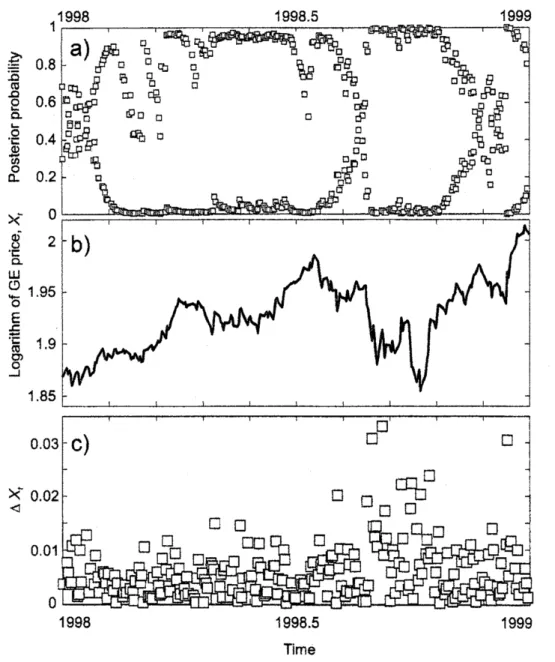
are shown in Fig. $5\mathrm{a}$, We also show for comparison the $\log$ price $X_{k}$ (panel b) and absolute returns $|\Delta_{k}|=|X_{k}-X_{k-1}|$ (panel $\mathrm{c}$). During thesecond half of
1998
the market witnesseda
significant price drop of theGE
shares (panelb) associated with increased volatility nicely reflected in the dynamics of $|\Delta_{t}|$ (panel $\mathrm{c}$).
This volatility increase is captured by the posterior probabilities shown in panel $\mathrm{a}$
.
We
found (not shown) that
our
resultsare
very stable with respect to the particular choice of thethree-valued
alphabet corresponding to the distribution of Fig. 4 $\mathrm{c},\mathrm{d}$ (say, choosing $\{\hat{a_{\overline{l}}}\}=\{0.05, 0.08, 0.15\}$, etc.).Remark 7,1 The reader could ask why
we
needthefilteringestimate, ifwecan
simplyuse
estim ation based only
on
price variations. We do a comparison of that type in Cvitanic, Rozovskii and Zaliapin [4], showing that, in general, the filtering procedure ismore
stable and efficient.7.2
Intraday data:
IBM
In this section
we
estimate intraday volatility using the data for the IBM company during Nov. 1, 1990 – Jan. 11, 1991. Weuse
the dataprior to January 11 to estimate the filterinput parameters, and then apply the filter during January 11 to estimate the volatility. The data set includes 60,328 transactions; almost all of them
occur
between 9:30 AM and 16:30 $\mathrm{P}\mathrm{M}$.
The transaction time is reported up toa
second; theaverage
time between two consecutive transations (we call this interevent time) is 29 $\mathrm{s}\mathrm{e}\mathrm{c}$. In order to construct the
process $P_{t}$
we
preprocessed the data in the following way. First, all interevent times $T_{i}$larger than 2 hours
were
replaced with random times $\tilde{T}_{i}$ from the empirical distribution ofinterevent times shorter than 2 hours. This way
we
removed the long gaps associated with nights, holidays, and long intraday breaks, and concentratedon
the price dynamics during the businesshours.
Second, ifseveral
transactions with different pricewere
reported withinone
second (so they1ave
thesame
time tag),we
separate themby 0.5 seconds; therewere
6,548 suchcases
(10% of the dataset).The histogram of the initial alphabet estimates $\tilde{a_{i}}$ (Eqs. (5.8) and (5.10)) is shown in
Fig. 6. While there is no striking multimodal structure, the choice of
$\hat{a_{i}}=\{0.19, 0.33, 0.53, 0.75\}$
seems
reasonable ifone
wants to represent the volatilityas
a
Markov jumpprocess.
The corresponding estimates of the filter parametersare:
$\mathrm{A}=\{$
-2.75
0.61 0.881.26
$1.32$ -6.082.37
2.392.91
2.87
-8.55
2.765.65
8.86 5.61 -20.12, $[1/\mathrm{h}\mathrm{o}\mathrm{u}\mathrm{r}]$.
The filtering results
are
illustrated in Fig.7
wherewe
show the estimated volatility and price of IBM shares during the morning hours on January 11, 1991, Thea
posteriori volatility $\hat{v_{t}}$ is obtained in the following way: first,we find
the expected values$E(v_{T_{k}}):= \sum_{i=1}^{\overline{M}}p_{t}(T_{k})\hat{a_{i}}$. (7.1)
Then,
we group
the posterior expectations (7.1) into $\overline{M}$separate values
$\hat{v_{t}}:=\{\hat{a_{\mathrm{i}}}$, $\mathrm{i}=\arg\min_{k=1,\ldots,\overline{M}}|E(v_{1})-\hat{a_{k}}|\}$. (7.2)
The filter detected four volatility bursts. Two of them ($9:35\mathrm{A}\mathrm{M}$ and $11:40\mathrm{A}\mathrm{M}$)
corre-spondto
a
high trading intensity;one
$(9:50\mathrm{A}\mathrm{M})$ to arapid priceincrease; andone $(10:40\mathrm{A}\mathrm{M})$to intensive price oscillations (without the net change). We
see
that when price changesare
mild (in
our
example the price only changes byfixed
increments of 0.125), the filter effec-tively uses the information on the trading intensity to make a decision about the current volatility.References
[1] Ait Sahalia, Y. and P. Mykland (2004), Estimating Diffusions with Discretely and Possibly Randomly Spaced Data: A General Theory. Annals
of
Statistics, 32,2186-2222.
[2] Barndorff-Nielsen, O.E.)
Graversen
S.E. and
N. Shephard (2003), Power variation&
stochastic volatility:a
review andsome
new
results. Journalof
Applied Probability 41A,133-143.
[3] Cvitanic, J., R. Liptser, and B. Rozovskii (2004), A Filtering Approach to Tracking Volatility from Prices Observed at
Random
Times. Submitted.[4] Cvitanic, J., Rozovskii, B., Zaliapin, I. (2005), Numerical estimation of volatility values from discretely observed
diffusion
data. Subm itted.[5] Elliott, R J., Hunter,
W.C.
and Jamieson, B.M.Drift
and volatility estimation in dis-crete time. Jour,of
Economic Dynamics&
Control, 22 (1998),209-218
18
[6] Fouque, J.-P., Papanicolaou, G. and Sircar, R., Derivatives in Financial Markets with Stochastic Volatility, Cambridge University Press, (2000).
[7] Prey, R. and Runggaldier, W. A Nonlinear Filtering Approach to Volatility Estimation with a View Towards High Frequency Data.
International Journal
of
Theoretical
and Applied Finance 4 (2001),199-210.
[8] Gallant,
A.
R. , andTauchen, G. Reprojecting PartiallyObserved
Systems with Appli-cation to Interest Rate Diffusions. Jourmalof
the American StatisticalAssociation
93 (1998), 10-24.[9] Gourieroux, $\mathrm{C}_{)}$.ARCHModels and Finaicial Applications, Springer (1997).
[10] Jacod, J. and Shiryaev,A. N. Limit Theorems
for
Stochastic
Processes. Springer-Verlag, NewYork, Heidelberg, Berlin, (1987).[11] Johannes, M. and N. Poison (2003), MCMC methods for Financial Econometrics,
Preprint.
[12] Kallianpur, G. and Striebel,C, Stochastic
differential
equations occurring inthe estima-tion of continuous parameter stochasticprocesses, Teor. Veroyatn. Primen., 14 (1969), 597-622.[13] Kallianpur, G. and Xiong, J. Assetpricingwith stochasticvolatility. AppL Math. Optim,
43
(2001), pp.47-62.
[14] Krein, S.G. Linear Equations in Banach Spaces. Birkhauser, Boston, (1982).
[15] Krylov, N.V. and Zatezalo, A. Filtering offinite-state time-non homogeneous Markov
processes,
a
direct approach. Applied Mathematicsa
Optimization 42 (2000), 229-258. [i6] Last, G., Brandt, A. Marked Point Processes on the Real Line: A Dynamic Approach,Springer-Verlag, NewYork, 1995.
[17] Lions, J.-L. and Magenes, E. Problemes
aux
Limites Non Homogenes et Applications, Dunod, Paris, (1968).[18] Liptser, $\mathrm{R}.\mathrm{S}$
.
and Shiryaev, $\mathrm{A}.\mathrm{N}.$. Statistics
of
Random
Processes
$II$.
Applications,Springer-Verlag, NewYork, (2000). [19] Liptser, $\mathrm{R}.\mathrm{S}$
.
and Shiryayev, $\mathrm{A}.\mathrm{N}$.
Theoryof
Martingales. Kluwer Acad. Publ, (1989). [20] Malliavin, P. andMancino, $\mathrm{M}.\mathrm{E}$.
FourierSeries
method formeasurementof multivariate[21] Mikulevicius, R. and Pragarauskas, H. On the Cauchy problem for certain
integro-differential
operators in sobolev and Holder spaces. Lithuanian Mathematical Journal,32 (1992),
238-263.
[22] Platania, A. and L.C.G. Rogers, Particle Filtering in High Frequency Data, Preprint,
(2004).
[23] Rogers,
L.C.G.
and Zane,0.
Designing and estimating models of high-frequency data. Preprint, (1998).[24] Rozovskii, $\mathrm{B}.\mathrm{L}$. Stochastic Evolution Systems, Linear Theory and Applications to
Non-linear Filtering, Kluwer Acad, Publ., Dordrecht-Boston, (1990).
[25] Runggaldier, $\mathrm{W}.\mathrm{J}$. Estimation via stochastic filtering in financial market models. In :
Mathematics ofFinance (G.Yin and Q.Zhang $\mathrm{e}\mathrm{d}\mathrm{s}.$). Contemporary Mathematics, Vol.
351, pp.309-318, American
Mathematical
Society,Providence
R.I., (2004) . [26] Wharton Research Data Services available at http:$//\mathrm{w}\mathrm{r}\mathrm{d}\mathrm{s}.\mathrm{w}\mathrm{h}\mathrm{a}\mathrm{r}\mathrm{t}\mathrm{o}\mathrm{n}.\mathrm{u}\mathrm{p}\mathrm{e}\mathrm{n}\mathrm{n}.\mathrm{e}\mathrm{d}\mathrm{u}$[27] Zaliapin, I., A. Gabrielov, and
V. Keilis-Borok
(2004),Multiscale
Trend
Analysis.20
Figure 1; Exampleofestimating apriorivalues of filter inputparameters, a)
Asset
log-price$X_{t}$ (solid line,
left
axis) and its two-valued volatility $v_{t}$ (dashed line, right axis). Param eters of the process are $\{a_{i}\}\approx${0.316,
0.632},
$r=0.05$, $\lambda_{12}=\lambda_{21}=1$, $n(a_{1})=n(a_{2})=10^{3}$,
$p_{i}=1/2$. b)
Process
$P_{t}$ (solid) and its piece-wise linear approximation $L_{13}(t)$ (dashed)corresponding to the
corner
point 1 ofMTA decomposition (see Fig. 2). The approximation is offset by 1 upward for comparison. The global lineartrend of$P_{t}$ isextractedfromboth the processesfor
visual convenience, c) Raw volatility estimate $\tilde{v_{t}}$ (left part) anddistribution
of its distinct values (right part). bue alphabet values
are
depicted by horizontal dashed lines. d) Finalvolatilityestimate $\hat{v_{t}}$.
hue alphabet valuesare
depicted byhorizontal
dashedFigure 2: MTA spectrum for the
process
illustrated in Fig. la. Shaded lines depict two scaling regions with the transition zone between twocorner
points marked in the figure. The right scaling region has the slope -1,which
corresponds to a self-affine random walk withno
persistence. Theleft
region deviates from this scaling depictinga
non-random structure within theprocess
$P_{t\}}$. this structure isdue
to the characteristic scales of constant22
Time,hours $.\sim\underline{u)\simeq\circ}$ $\Xi\varpi$ $.\# y’)0[mathring]_{\circ}$0.11
0.3
0,5Estimated volatility Estimatedalphabet
Figure
3:
Filtering synthetic asset price, a) Asset $\log$-price $X_{t}$ (right axis) and trueun-observed volatility $v_{t}$ (left axis). Distinct volatility values
are
depicted by shadows: darkfor $v_{t}=0.5$, light for $v_{t}=0.3$,
none
for $v_{t}=0.1$. b) Aposteriori probabilities $p_{3}(t)$ (darksquares) and $p_{1}(t)$ (white squares) within the interval shown in a). c) Alphabet estimation.
Histogram of initial volatility estimates $\tilde{a}_{i}$ clearly has
a
three-modal structure. Dashed linesFigure 4: Estimating volatility for General Electric company during 1962-1998, a) Asset price $S_{t}$ during 1962-2004; market splits
are
depicted by solidarrows.
The shaded interval1962-1998
is used for alphabet estimation, b) MTA spectrum for theprocess
$P_{t}$ thatcorre-sponds to GE $\log$-price dynamics. The transition from a higher slope $(s\approx-2)$ to a lower
one
$(s\simeq-1)$as
$N$ increases is obvious; itoccu
$\mathrm{r}$ between levels $k=17$ and $k=90$. $\mathrm{c}$),$\mathrm{d}$)
Histogram ofinitial volatility estimates $\tilde{a}_{i}$ at level
$\mathrm{k}$ $=17$ (panel c) and $k=90$ (panel $\mathrm{d}$).
Th$\mathrm{r}\mathrm{e}\mathrm{e}$-modal structure is prominent within this broad range of levels. Similar results
are
24
$\cross\triangleleft$
1998 1998.5 1999
Time
Figure 5: Estimatingvolatility forGeneral Electriccompany during 1998-1999. a) Posterior probabilities$p_{i}(t)$, $\mathrm{i}=2$ (light squares) and $\mathrm{i}=3$ (dark squares) thatcorrespondtovolatility
values $v_{2}=0.1$
and
$v_{3}=0,15$. b) Dynamics ofthe
$\log$-price $X_{t}$. c)Absolute
returns $|\Delta_{t}|$ of$U\mathrm{J}\mathrm{C}$ $.\underline{\mathrm{o}}$
co
$Dq\}\Phi \mathrm{O}$ \={o} $\mathrm{D}\mathrm{z}\mathrm{E}\supset\Phi\llcorner$Figure 6: Bstim ating volatility for IBM
company
during November 1,1990
– January 10,1991. Histogram of initial estimates ofvolatility alphabet values $\hat{a_{i}}$, $\mathrm{i}=1$,
$\ldots$ ,$N_{k_{0}}=493$, $k_{0}=300$. $=\mathrm{g}$
.
$\sim$ $\frac{\varpi}{\mathit{0},>}$ $\mathrm{B}\Phi$ $\in\varpi$ $.\overline{\overline{\mathrm{u}^{u_{1}})}}$ $\tilde{\mathrm{f}\mathrm{f}\mathrm{i}}L4\}\dot{q\}‘ \mathfrak{g}}$ $.0^{=}\tilde{\mathrm{S}}$.
TimeFigure 7: Filtering volatility forIBM company duringJanuary 11,