A
study
on the
linear complementarity representation
of
piecewise
linear
functions
櫻井智章,室伏俊明
東京工業大学大学院総合理工学研究科知能システム科学専攻
Tomoaki
Sakurai, ToshiakiMurofushi
Departnent of
Computationanl Intelligenceand
SystemsScience,
Tokyo
Institute of
TechnologyAbstract: This paper describes investigations on a representation of piecewise linear functions, called
the linear complementarity representation (the LCR for short). Especially, the paper focuses on the
P-representationandthe ULT-representation, whicharespecialtypesof the LCR, andexplainstheir
proper-ties. Moreover, the paper discusses the minimizationproblem of the LCR, and explains investigationson
this issue.
1
Introduction
Piecewise linear function plays
an
$imp_{ortar1}t$ roleas an
approxirnation function in many fieldssuch
as
nonlinear circuit [3, 6], nonlinear controll [5], mathematical programming [1], and manyotherengineering applications, for the
reason
ofpossessingan
ability of uniformly approximatingacontinuous function definedon acompact domainarldapropertyoflinearityon aneighborhood
ofalmosteverypoint in the domain. However, it alsopresents
some
problems in practicaluse:
im-proving
an
approximation inaccuracycauses
theexponentialincreaseof the numberofparameters;itisnotso easy to treat theexpressionofpiecewiselinearfunction based on its definition(e.g., [3]).
Therefore, much research has been done in
an
effort to develop new efficient representation [6].This paperreport
our
prese1lt research findingson
thelinear comple1nentarity representation.In Section 2, we explain thedefinition of piecewiselinear furiction. In Section 3, we introduce
the linear complementarity representation and its special types, called the $P$-representation and
the ULT-representation, and describe their properties
as
wellas
the construction method of aULT-representation for a given piecewise linear function. In Sections 4 and 5,
we
formulate theminimization problem
on
the linear complementarity representation, and explainour
researchfindings on this issue [8].
Throughout this paper, $m$ and $n$ indicate positive integers. For a positive integer $l$, the set
ofintegers from 1 to$l$ is denoted by $[l]$, i.e., $[l]=\{1, 2, . . . , l\}$
.
The inner product of two vectorsset $R\subset \mathbb{R}^{n}$ is called a polyhedron if it can be represented as the intersection of finitely many
closed half-spacesin $\mathbb{R}^{n}$. By definition, $\emptyset$ and $\mathbb{R}^{n}$
are
polyhedra.2
Piecewise linear function
Definition 2.1. [9] A finite farmly $\mathcal{R}$of polyhedra in $\mathbb{R}^{n}$ is called
a
polyhderalpartitionof$\mathbb{R}^{n}$ ifitsatisfies the following conditions:
$(i)\cup \mathcal{R}=\mathbb{R}^{n}$;
(ii) int$P\neq\emptyset$ for all $P\in \mathcal{R}$;
(iii) For each $P,$$Q\in \mathcal{R},$ $P\neq Q$ implies int$P\cap intQ=\emptyset,$
where “int” denotes the topological interior of aset.
Definition 2.2. [7, 9] A function$f$ : $\mathbb{R}^{n}arrow \mathbb{R}^{m}$ is said to be piecewise linear if it is continuouson
$\mathbb{R}^{n}$ and there exists
a
polyhedral partition $\mathcal{R}$ of$\mathbb{R}^{n}$ such that $f$ is linear on each region $R\in \mathcal{R}.$A linear function $g$ : $\mathbb{R}^{n}arrow \mathbb{R}^{m}$ which coincides with $f$
on
some
$R\in \mathcal{R}$ is said to bea
hnearcomponent of$f$
.
We denote by PWL the family of all piecewise linear functions.3
The linear complementarity
representation
3.1 Definition
Definition 3.1. [6] A correspondence$f$ from$x\in \mathbb{R}^{n}$to$y\in \mathbb{R}^{m}$ iscalled
a
linear complementaritycorrespondence, an LCC for short, if there exist
a
nonnegative integer $k$, matrices $A\in \mathbb{R}^{m\cross n},$$B\in \mathbb{R}^{m\cross k},$ $C\in \mathbb{R}^{k\cross n}$, and $D\in \mathbb{R}^{k\cross k}$, and vectors $g\in \mathbb{R}^{m}$ and $h\in \mathbb{R}^{k}$ such that
$y=Ax+Bu+g$ , (1)
$j=Cx+Du+h$
, (2)$u,j\geq 0, \langle u,j\rangle=0$
.
(3)Thevectors$u$ and$j$ satisfying the equation (3) arecalled complementarityvectors, and the
equa-tions (1)$-(3)$
are
collectively calleda
linear complementarity representation. By convention,we
abbreviate therepresentation (1)$-(3)$ as $(A, B, g;C, D, h)$
.
Remark 3.1. Every linear function$Ax+g$hasarepresentation$(A, O, g;0,1,0)$, where$A\in \mathbb{R}^{m\cross n}$
and $g\in \mathbb{R}^{m}$
.
Byconvention for the discussion of this paper,we assume
thateach linear functionhas
a
zero-dimensional representation $(A;g)$ instead of the above one-dimensional representation$(A, O, g;0,1,0)$. See Definition 4.1 in Subsection 4.2, for the definition of the dirnension of a representation.
Remark 3.2. Calculationofacorrespondence value $y$ for each $x$is reduced to solvingthe hnear
complementarity problem (LCP for short) of the form $(D, q(x))$, where $q(x)=Cx+h$
.
Thisproblem is called the derived LCP from the triplet $(C, D, h)$
.
See Definition A.l in Appendix $A,$for the definition of the LCP.
3.2
$P$-representation and ULT-representation
Definition3.2. [2, 6] (a) $P$-representation is a linear complementarity representation whose
coeffi-cient$D$ in (2) isa$P$-matrix(seeDefinition$A.2.(i)$). The farnily ofLCCs havinga$P$-representation
is called Class $P$, and denoted by P.
(b) $ULT$-representation is a linear complementarity representation whose coefficient $D$ in (2) is
a
ULT-matrix (see Definition A.2.(ii)). The family ofLCCs having a ULT-representation is called
Class $ULT$, and denoted by ULT.
Remark 3.3. By the definitions of$P$-matrix and ULT-matrix that $P\supset$ ULT holds. Though an
LCCis, in general,
a
multi-valuedfunction, PropositionA. 1 in AppendixA statesthat everyLCC
in $P$ becomes a single-valued function. As mentioned in Remark 3.1 that every linear function
has a representation $(A, O, g;O, 1,0)$
.
This is, in fact,a
ULT-representation. Thus, every linearfunction belongs to both $P$ and ULT.
The next theorem, Theorem 3.1, indicates that ULT is closedunder the operationsof$\max$and
$\min$compositions, and direct
sum.
Inadditionto this, the closedness isalsotrueforthe operationsofcompositionand hnear combination [9]. Thistheoremyieldsanoperationformulae between two
representations,and moreover, plays
an
importantrolein theconstruction ofaULT-representationfor agiven piecewise linear function. This theorem is also true for P.
Theorem 3.1. [9] (i) If
a
function $f$ : $\mathbb{R}^{n}arrow \mathbb{R}$ hasa
ULT-representation, say $(A, B,g;C, D, h)$,and
a
function $f’$ : $\mathbb{R}^{n}arrow \mathbb{R}$ has a ULT-representation, say $(A’,$ $B’,$$g’;C’,$$D’,$$h$ then their $\max$$f\vee f’$ and$\min f\wedge f’$ have the ULT-representations:
$f\vee f’$ : $(A’, (O B’ 1)$ ,$g’;(\begin{array}{l}CC’A’-A\end{array}),$ $(\begin{array}{lll}D O OO D’ O-B B 1\end{array}),$ $(\begin{array}{l}hh’g’-g\end{array}))$ ,
$f\wedge f’$ :
$(A, (B 0 -1),$
$g;(\begin{array}{l}CC’A’-A\end{array}),$ $(\begin{array}{lll}D O OO D’ 0-B B 1\end{array}),$ $(\begin{array}{l}hh’g’-g\end{array}))$.
(ii) Ifa function $f$ : $\mathbb{R}^{n}arrow \mathbb{R}^{m}$ has a ULT-representation, say $(A, B,g;C, D, h)$, and a function
$f’$ : $\mathbb{R}^{n}arrow \mathbb{R}^{m’}$
has a ULT-representation, say $(A’,$ $B’,$$g’;C’,$$D’,$$h$ then their direct
sum
$f”=$ $f\oplus f’$ : $\mathbb{R}^{n}arrow \mathbb{R}^{m+m’}$has the ULT-representation:
The next theorem states that $P$-representation and ULT-representation, individually,
charac-terize all piecewise linear functions.
Theorem 3.2. [9] The familyof all piecewise hnearfunctions coinsides with Classes$P$ and ULT,
that is, ULT $=P=PWL.$
3.3
Construction
ofa
ULT-representationBy the following procedure,
a
ULT-representation ofeach scalar-valued piecewise linear functioncan
be obtained bymeans
of Theorem 3.1 and the below mentionedTheorem 3.3:(i) Construct a max-min polynomial for a given piecewise linear function;
(ii) Transformeach $\max$and$\min$operators toaULT-representation bymeans of Theorem3.1.(i),
in recursively.
Theorem 3.3. [7] Every piecewise linear function $f$ : $\mathbb{R}^{n}arrow \mathbb{R}$ has a formula
$f= \fbox{Error::0x0000}\bigwedge_{i\in S_{j}}g_{i},$
where $\{g_{i}\}_{i\in I}$is the finite family of all linear components of$f,$ $S_{j}$ is asubset of$I$, and $J$isafinite
index set. Thisformular is called amax-min polynomial in the variables$g_{i}.$
Remark 3.4. Theorem 3.3is also valid for the vector-valued piecewise linear function [7].
There-fore, by using also Theorem 3.1.(ii),
we
canconstructa
ULT-representationforeveryvector-valuedpiecewiselinear function.
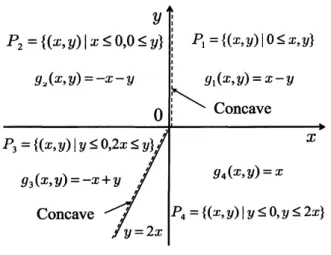
Example 3.1. Considerthe function$f:\mathbb{R}^{2}arrow \mathbb{R}$ asdefined in Figure 1.
Figure 1: Two-variablepiecewise linear function $f$
(i) Thefirst step isthe constructionofa $\max$-r1lin polynomial of$f$
.
The procedureconsists ofthe identifications of $J$ and $\{S_{j}\}_{j\in J}$ in Theorem 3.3. The identification of $J$ corresponds to the
becomes
concave
(seeFigure 1). In this case,$P_{1}\cup P_{4}$corresponds to$j=1$, and$P_{2}\cup P_{3}$correspondsto $j=2$
.
Next,we
determine $S_{j}.$ $S_{j}$ is the index set of linear component whose value is greaterthan
or
equal to$f$ on acorrespondingregion. On$P_{1}\cup P_{4},$ $g_{1}$ and$g_{4}$are
satisfied, and on $P_{2}\cup P_{3},$$g_{2}$ and$g_{3}$
are
satisfied. Thus, we have$S_{1}=\{1$, 4$\},$ $S_{2}=\{2$,3
$\}$, andhence,we
obtain the formula$f=(g_{1}\wedge g_{4})\vee(g_{2}\wedge g_{3})$
.
(ii) The second step is the transformation to
a
ULT-representation. We begin withzero-dimensional ULT-representations of linear components of $f$, and transform each $\max$ and $\min$
operations to ULT-representations. Since $g_{1}$ and $g_{4}$ have ULT-representations $((1 -1);0)$ and
((1 O);O), respectively (seeRemark 3.1),
a
ULT-representationof$g_{1}\wedge g_{4}$ isobtainedas
follows:$((1 -1), -1,0;(0 1), 1,0)$
.
Similarly,
we
havea
ULT-representationof$g_{2}\wedge g_{3}$as:
$((-1 -1), -1,0;(0 2), 1,0)$ .
Therefore, we obtain a ULT-representation $S=(A, B,g;C, D, h)$ of$f=(g_{1}\wedge g_{4})\vee(g_{2}\wedge g_{3})$
as
follows:
$A= (-1 -1) , B=(0 -1 1) , g=0,$
$C=(\begin{array}{ll}0 10 2-2 0\end{array}), D=(\begin{array}{lll}1 0 00 1 01 -1 1\end{array}), h=(\begin{array}{l}000\end{array})$
4
Minimization of the linear complementarity representation
4.1
Problem institution
Consider again the ULT-representation $S$ obtained in Example 3.1. Then, we
can
easily verifythe existence of the relation $u_{2}(x, y)=2u_{1}(x, y)(\forall(x, y)\in \mathbb{R}^{2})$ between $u_{1}$ and $u_{2}$ with
a
simplecalculation. Thus, by eliminating the component $u_{2}$, the representation$S$ results in the following
representation $(A,$ $B’,$$g;C’,$$D’,$$h$
$A= (-1 -1) , B’=(-2 1) , 9=0,$
$C’=(\begin{array}{ll}0 1-2 0\end{array}), D’=(\begin{array}{ll}1 0-1 1\end{array}), h’=(\begin{array}{l}00\end{array}).$
As in this case, the resulting representation, in generally, involves
some
redundancies. Inpracti-cally, it is desirable that the obtained representation does not contain any redundancies. Then,
how
can
we verifya given representation to beaminimum representation? In Subsection 4.2, we4.2
Problem
formulation
Let $m$ and $n$ be arbitrary positive integers. For
a
positive integer $k$, we define the families oftriplets$A^{k}$ and$\mathbb{C}^{k}$
as
follows:$\mathbb{A}^{k}=\{(A, B,g)|A\in \mathbb{R}^{m\cross n}, B\in \mathbb{R}^{m\crossk}, g\in \mathbb{R}^{m}\},$
$\mathbb{C}^{k}=\{(C, D, h)|C\in \mathbb{R}^{k\cross n}, D\in \mathbb{R}^{k\cross k}, h\in \mathbb{R}^{k}\}.$
The family of all linearcomplementarityrepresentationswith $k$-dimensional complementarity
vec-tors is denoted by $\mathbb{S}^{k}=\Delta \mathbb{A}^{k}\cross \mathbb{C}^{k}$
.
Byconvention, wedenote by $\mathbb{S}^{0}=\{(A, g)|A\in \mathbb{R}^{m\cross n}, g\in \mathbb{R}^{rn}\}$the familyofall representationsoflinear functions. Then, $\mathbb{S}=\Delta\bigcup_{k\geq 0}\mathbb{S}^{k}$ expresses thefamily of all
linear complementarity representations. Similarly, when
we
denote by$\mathbb{S}_{ULT}^{k}$the family of allULT-representations with the $k$-dimensionalcomplementarity vectors, $\mathbb{S}_{ULT}=\bigcup_{k\geq 0}\mathbb{S}_{ULT}^{k}$expresses the
family of all ULT-representations. Note that $\mathbb{S}_{ULT}^{0}=\mathbb{S}^{0}$
.
The “dimension” ofa representation isdefined as follows.
Definition 4.1. Let$S\in \mathbb{S}$be given, and let $k$be
a
nonnegative integer. Wesay$S$is$k$-dimensionalif$\mathcal{S}\in \mathbb{S}^{k}$
, denoted by$\dim(\mathcal{S})$
.
Let $f$ be an LCC. Then we denote by$\mathbb{S}(f)$ the family of all representations that characterize
$f$
.
Similarly, wedenote by $\mathbb{S}_{ULT}(f)$ the family of all ULT-representations of$f$.
The minimizationproblem is formulated in the following.
Definition 4.2. Let $S\in \mathbb{S}(f)$
.
Then$S$ is called a minimum dimensional representation (amini-mum representationfor short) of$f$ if$\dim(S)\leq\dim(\mathcal{T})$ for all $\mathcal{T}\in \mathbb{S}(f)$
.
Problem 4.1. The minimization problem with respect to $f$consists of the followingtwo
require-ments: For agiven representation $S\in \mathbb{S}(f)$,
(a) verify whether or not $S$ is aminimum representation of$f$;
(b) find a minimum representationof$f$, when$S$is not minimum.
In thesame manner, we can definethe concept of minimum dimensional ULT-representation,
and formulatetheULT-minimizationproblem: similarly,
we can
also formulate the$P$-minimizationproblem.
Definition 4.3. Let $S\in \mathbb{S}_{ULT}(f)$
.
Then $\mathcal{S}$is called
a
minimum dimensional $ULT$-representation(a minimum ULT-representation for short) of$f$ if$\dim(S)\leq\dim(\mathcal{T})$ for all $\mathcal{T}\in \mathbb{S}_{ULT}(f)$
.
Problem 4.2. The $ULT$-minimization problem with respect to $f$ consists of the following two
(a) verify whether
or
not $S$ isa
minimum ULT-representation of$f$;(b) find a minimum ULT-representation of$f$, when $S$is not minimum.
5
Considerations
on
the
minimum
dimensionality
Inthissection,
we
willdiscusshowwe
verifytheminimaldimensionalityfora
given representation.Thekey toour approachisthat finding aminimumrepresentationwill be achieved by eliminating
all redundancies ofagiven representation. Inour present research, wehave considered the ULT-representation only.
5.1
Redundancies of the complementatity
vectors
Webegin withthe following threeexamples todiscuss thereducibility. Eachexamplesdemonstrate
different type ofredundancies fromone another.
Example 5.1. Let$S_{1}=(A_{1}, B_{1}, g_{1};C_{1}, D_{1}, h_{1})$ be the ULT-representation given by the following:
$A_{1}=(1$ 1$)$ , $B_{1}=$
(0101),
$g_{1}=0,$ $C_{1}=(\begin{array}{l}-3-6-4-848612\end{array}),$ $D_{1}=(\begin{array}{llll}1 0 0 01 1 0 00 0 1 00 0 1 1\end{array}),$ $h_{1}=(\begin{array}{l}0000\end{array}).$Then, we can easily verify that there exist the following relations among the components of the
complementarityvectors $u_{i}(x)(i=1,2,3,4)$:
$u_{1}(x)=3u_{2}(x) , u_{3}(x)=2u_{4}(x) , u_{4}(x)=-2x_{1}-4x_{2}+2u_{2}(x)$
.
This would imply that the valiables $u_{1}(x)$, $u_{3}(x)$, and $u_{4}(x)$ are omitted from $S_{1}$
.
Indeed, wecan
omit them from $\mathcal{S}_{1}$, and hence we find that $S_{1}$ reduces to the following ULT-representationS\’i
$=$$(A_{1}’, B_{1}’,g_{1}’; C\’{i}, D_{1}’, h_{1}’)$:$A_{1}’= (-1 -3) , B_{1}’=3, g_{1}’=0, C_{1}’=(1 2 ) , Di=1, h_{1}’=0.$
Example 5.2. Let$S_{2}=(A_{2}, B_{2}, g_{2};C_{2}, D_{2}, h_{2})$ be the ULT-representation given by the following:
$A_{2}=(1 1 ) , B_{2}=(0 1 ) , 92=0, C_{2}=(\begin{array}{ll}1 22 1\end{array}) , D_{2}=(\begin{array}{ll}1 00 1\end{array}) , h_{2}=(\begin{array}{l}00\end{array}).$
Then,in this case, there is norelation between$u_{1}(x)$ and$u_{2}(x)$ as inExample5.1. However,since
the variable $u_{2}(x)$ is independently obtained from$u_{1}(x)$ and the variable$u_{1}(x)$ is vanished from
the first formula of the original representation, we can
onnt
$u_{1}(x)$ from $S_{2}$.
Thus $S_{2}$ reduces tothe followingone-dimensional ULT-representation $S_{2}’=$ $(A_{2}’, B_{2}’,g_{2}’; C_{2}’, D_{2}’, h_{2}’)$:
Example 5.3. Let $\mathcal{S}_{3}=(\mathcal{A}_{3},C_{3})\in \mathbb{S}_{ULT}^{k}$ be given. Supposethere exist
a
positive integer $k’<k,$a
triplet $C_{3}’\in \mathbb{C}_{ULT}^{k’}$, anda matrix$E\in \mathbb{R}^{k\cross k’}$such that the solution $u(x)$ tothederived LCP from
$C_{3}$ can be expressed
as
$u(x)=Eu’(x)$, where $u’(x)$is the solution to the derived LCP from $C$‘.
Then $S_{3}$ reduces to the ULT-representation $S_{3}’=(\mathcal{A}_{3}’,C_{3}’)\in \mathbb{S}_{ULT}^{k’}$, where $\mathcal{A}_{3}’=(A_{3}, B_{3}E, g_{3})$ for
$\mathcal{A}_{3}=(A_{3}, B_{3},g_{3})$
.
Asdemonstratedabove, thereexist at least three types of redundancies of the complementarity
vectors: (i) dependency
among
the components of thecomplementarity vectors (Ex.5.1), (ii) theerasability of the components of the complementarity vectors from the first formula caused bysome
columnsof$B$ being
zero
(Ex.5.2), (iii) representability of the original complementarityvectors bymeans of
some
lower-dimensional representation (Ex.5.3). Clearly, the minimum dimensionalityrequires the absenceof redundancies ofthe complementarity vectors. We therefore conclude that
theproblemoffinding a minimum dimensional representationresults in theproblemofeliminating
redundantcomponentsof the complementarity vectors. We conjecture that the redundancies would
be covered by the above mentionedthree types. However, it has not been proven yet. This is a
future work. So far,
we
have investigated the redundancies of (i) and (iii), and found that theredundancy of (i) is equivalent to the generalization of (iii), called the ULT-reducibility. In the
next subsection, wewill explainabout thisinvestigation.
5.2
ULT-reducibility
Firstly, we define the ULT-reducibility that isa generalization of the redundancy (iii).
Definition 5.1. Tworepresentations$S,$$\mathcal{T}\in \mathbb{S}$
are
said to be equivalentto each other, denotedby$S\cong \mathcal{T}$, if there exists an LCC $f$such that $S,$$\mathcal{T}\in \mathbb{S}(f)$
.
Definition 5.2. Let $\mathcal{C}\in \mathbb{C}_{ULT}^{k}$
.
Then $C$ is said to be $ULT$-reducible if there exist a nonnegativeinteger$k’<k$, and
a
triplet$C’\in \mathbb{C}_{ULT}^{k’}$suchthat everyrepresentationthat contains$C$is equivarlentto
a
ULT-representation that contains $C’$ [i.e., for every $\mathcal{A}\in \mathbb{A}^{k}$, there exists $\mathcal{A}’\in \mathbb{A}^{k’}$
such that
$(\mathcal{A},C)\cong(\mathcal{A}’, C’)]$
.
Ifnot, it is said tobe $ULT$-irreducible.$C_{3}$ in Example 5.3 is ULT-reducible. Moreover, by Theorem 5.1 below, $C_{1}$ in Example 5.1 is
also ULT-reducible. Onthe other hand, $C_{2}$ in Example 5.2 is ULT-irreducible.
Proposition 5.1 is anirnmediate concequence of Definition4.3 and Definition 5.2. This implies
that ULT-irreducibility of$C$ is necessary for agiven
representation to be minimum dimensional.
Exarnple 5.2 is a counterexarnpleforthe sufficiency.
Proposition 5.1.
If
$S=(\mathcal{A}, C)\in \mathbb{S}_{ULT}(f)$ is a minimum dimensionalrepresentationof
$f$, thenThe following Theorem
5.1
shows that the redundancy of (i) and ULT-reducibility of $C$ isequivalent. The condition (S) in Theorem 5.1 expresses
a
dependency among the components ofthe complementarity vectors.
Theorem 5.1. Let $k$ be a positive integer. Then $C\in \mathbb{C}_{ULT}^{k}$ is $ULT$-reducible
if
and onlyif
thesolution $u(x)$ to the derived$LCP$
from
$C$satisfies
the following condition:(S) Forsome$p=1$,2,
.
.
.
,$k$, there esist $\{\lambda_{i}\}_{i<p}\subset \mathbb{R}$ anda linearfunction
$l_{r}:\mathbb{R}^{n}arrow \mathbb{R}$ such that$u_{p}(x)= \sum_{i<p}\lambda_{i}u_{i}(x)+l_{p}(x) (\forall x\in \mathbb{R}^{n})$
.
6
Conclusion
Inthis paper,weintroduced the linear complementarity representationofpiecewisehnear function
andits specialtypes, called the$P$-representation and the ULT-representation, and explained their
fundamental properties
as
wellas
the construction method ofa
ULT-representation for a givenpiecewise linear function. Moreover,
we
formulated the minimization problem concerning to thelinear complementarity representation, and mentioned
our
investigation obtainedso
far on thisissue. It is
a
future work to clarify the relation between the minimum dimensionality and the redundancies discussed in Subsection 5.1.A
The linear complementarity problem
Let $k$ be apositive integer, and let a matrix $D\in \mathbb{R}^{k\cross k}$ and avector$q\in \mathbb{R}^{k}$ be given.
Definition A. 1. [4] The linear complementarity problem,LCPforshort, is to findapairofvectors
$u,j\in \mathbb{R}^{k}$ such that
$j=Du+q$, (4)
$u,j\geq 0, \langle u,j\rangle=0$ (5)
orto show thatnosuch pair exists. We denote the above problem by the pair $(D, q)$
.
A pair $(u,j)$satisfying (5) is said tobe complementary, and the one satisfying (4) and (5) is calleda solution
tothe LCP $(D, q)$
.
Definition A.2. (i) [4] $P$-matrix is
a
square matrix whose principal minorsare
allpositive.(ii) [6] Unit lower triangular matrix, ULT-matrix for short, is a lower triangular matrix whose
A principal minor is the determinant of
a
principal sub-matrix of $D$.
A principal sub-matrixis defined as $(d_{ij})_{i,j\in I}$, where $\emptyset\neq I\subset[k]$, for the original matrix $D=(d_{ij})_{i,j\in[k]}$
.
By definition,every ULT-matrix is a $P$-matrix.
Ingeneral, the LCP doesnot necessarily have
a
solution. Even if it hasa
solution, generally itis not necessarily unique. However, Proposition A.1 below claims that
a
$P$-matrixguarantees theuniqueness of solution.
Proposition A. 1. [4] A matrix$D\in \mathbb{R}^{k\cross k}$
isa$P$-matrix if and only if the LCP $(D, q)$ hasaunique
solutionfor every $q\in \mathbb{R}^{k}.$
References
[1] E. L. Allgowerand K. Georg, Piecewiselinearmethods for nonlinear equationsand
optimiza-tion, J. Comput. Appl. Math., 124 (2000)
245-261.
[2] W. M. G.
van
Bokhoven and D. M. W. Leenaerts, Explicit formulas for the solutions ofpiecewise linear networks, IEEE $\mathcal{I}Vans$
.
Circuits Systems I Fund. Theory Appl., 46 (1999)1110-1117.
[3] L. O. ChuaandS. M. Kang, Section-wisepiecewise-linearfunctions: canonicalrepresentation,
properties, and applications, Proc.
of
The IEEE, 65 (1977).[4] R. W. Cottle, J.-S. Pang, R. E. Stone, The linear complementarity problem, Academicpress,
(1992).
[5] M. Johansson, Piecewise Linear Control Systems: A computational approach, Lecture Notes
in Control and Information Sciences 284, Springer, (2003).
[6] D. M. W. Leenaerts and W. M. G.
van
Bokhoven, Piecewise Linear Modeling and Analysis,Kluwer, Boston (1998).
[7] S. Ovchinnikov, Max-minrepresentationofpiecewise linear functions, Contributions to
Alge-bra and Geometry, 43 (2002) 297-302.
[8] T. Sakurai and T. Murofushi, ULT-minimal realization ofpiecewise linear functions, RIMS
Kokyuroku 1452 (2005) 22-29.
[9] T. Sakuraiand T. Murofushi,Linearcomplementarityrepresentationof piecewise linear