I
MASTER’S REPORT
IMPLICATION OF JAPAN BANKING
RESTRUCTURING TO CHINA
By
GUAN Tingting
(ID: 51211614)
SUPERVISOR: YAMAMOTO Susumu
GRADUATE SCHOOL OF ASIA PACIFIC STUDIES
RITSUMEIKAN ASIA PACIFIC UNIVERSITY
Fall 2012
II
Acknowledgement
First of all, I want to express my heartfelt gratitude to my mentor, Professor YAMAMOTO Susumu, who gave me a lot of help, guidance and encouragement in this study. The profound knowledge, rigorous study, indefatigable demeanor and sincerity of my mentor has set an good example for my studying and working.
In addition, I want to express my grateful thanks to Professor YAMAGAMI Susumu, the vice president of APU, interviewing me and giving me the chance to study in APU.
Also, I want express my thanks to Japan International Cooperation Agency and Japan International Cooperation Centre. Without their support and help, my study in Japan could not be possible.
Thanks for all of my Chinese and foreign friends in APU. Without their helping and accompany, my study and life would be very hard. I've had a memorable and meaningful time in APU with their accompany.
Finally, I would like to deeply thank my parents. Without their love and supporting, my oversea study could not be possible.
The reason why I chose this topic as my Master Report is that I have worked in the Central Bank of China sub-branch for 5 years. My main work responsibility is about banking supervision and regulation, and learning the experiences of Japan banking restructuring and related regulation will be meaningful and helpful for my future working and researching.
III
TABLE OF CONTENTS
CHAPTER TITLE PAGE
Title Page………i
Acknowledgement……….………ii
Table of Contents……….……….iii
Abstract……….vi
CHAPTER 1 INTRODUCTION
1.1 Background of the stud………1
1.2 Objective of the study………...2
1.3 Significance of the study………...3
1.3 Methods of the study……….4
1.4 Structure of the study………4
1.5 Literature Review………..5
CHAPER 2 The Basic Theories and Models of Banking Restructuring 2.1 Basic theories of banking restructuring………6
2.1.1 Market Power Theory………..6
2.1.2 Efficiency Theory……….7
2.1.3 The transaction cost theory...………8
2.1.4 The Financial Game Theory...………..9
2.2 The models of banking restructuring………9
2.2.1 The model of Mergers………..9
2.2.2 Joint Model…...10
2.2.3 M & A Model………..10
IV
CHAPTER 3 The Background of Japanese Banking Restructuring
3.1 International Environment……….12
3.1.1 Unprecedented wave of mergers………..12
3.1.2 Backward in the international financial competition………...13
3.1.3 Financial risk of economic globalization and financial liberalization……..13
3.2 Domestic Environment………..14
3.2.1 Stagnant economic and huge non-performing assets………..14
3.2.2Separate operation system under attack………...14
3.2.3 The requiring of financial reform………14
3.2.4Remove restrictions on financial holding company……….15
3.2.5 The rapid development of information technology……….15
3.3 The historical background 3.3.1 The end of 19th century to the early of 20th century………...15
3.3.2 World War II to the mid-1990s………16
CHAPTER 4 The Development and Characteristics of Japan Banking restructuring after the mid-1990s 4.1 The development of banking sector restructuring after the mid-1990s……18
4.2 The characteristics analyzing of banking restructuring after the mid-1990s 4.2.1 Follow the market principle………21
4.2.2 Carry out mixed operation………..22
4.2.3 Merges among big banks……….23
4.2.4 Establish financial holding company………..23
4.2.5 Foreign capital participation………23
4.2.6 Promoted policy of government………..24
CHAPTER 5 The measures and effect analysis of the Japanese banking restructuring 5.1 The main measures of the Japanese banking restructuring………..25
V
5.1.2 Implement financial reform………26
5.1.3 Dispose of bad assets………..26
5.1.4 Improve the profitability of the bank's core business……….26
5.2. The effects of Japanese banking sector restructuring………..27
5.2.1 Increase the market share………27
5.2.2 Improve people's confidence for the financial industry………..27
5.2.3Banks receives the benefits from scale of operation………...28
5.2.4 Achieve economies of scope in banking business………...28
5.2.5 Achieve the diversification of the banking business………...28
5.2.6 Promote financial innovation………..29
5.2.7 Promote the reform of the financial system………29
5.2.8 Promote Japan's economic recovery………...29
5.3. The problems of Japan banking sector restructuring...30
5.3.1 Bring a certain amount of risk……….30
5.3.2 Increases the pressure of employment……….30
5.3.3 Improve the bank's monopoly degree result in the detriment of the interests of consumers………31
5.3.4 Lagging laws and regulations hinder the process of banking sector restructuring……….32
5.4. The experience of the Japanese banking sector restructuring……….32
5.4.1 Sound legal and financial regulatory system is an important protection……32
5.4.2Conducted in the guidance of market principle………33
5.4.3 Financial deregulation and diversified operation………33
5.4.4 Investment in financial innovation and IT………..33
5.4.5 Foreign capital participation………34
CHAPTER 6 The situation and problems of China banking restructuring 6.1. The situation of China banking restructuring……….35
6.1.1 The administrative dominated mergers and acquisitions………...37
VI
6.1.3 Less cross-border mergers and acquisitions……….38
6.1.4 Incomplete laws and regulations………..38
6.2 The analysis of problems of China banking restructuring………..38
6.2.1 The inadequate laws and regulations………....39
6.2.2 The restructuring process led by the government……….39
6.2.3. Single and simple ways of banking restructuring………39
6.2.4 Unclear property rights of the state-owned commercial banks………40
6.2.5 The management integration problem………..40
6.2.6 Staff surplus and the burden of non-performing assets……….40
CHAPTER 7 Implications of Japan to further promote the banking sector restructuring 7.1 Perfect financial legal system………...42
7.2 Moderate government intervention………...43
7.3 Promote the property rights reform………...44
7.4 Handle the problem of non-performing assets………..45
7.5 Promote the mixed operation of the financial industry……….45
7.6 Establish financial holding company………46
7.7 Promote foreign capital participation in restructuring………..47
7.8 Promote the construction of information technology of bank………..47
7.9 Improve the social security system………...48
VII
ABSTRACT
With the tide of financial globalization and liberalization sweeping the whole world, the degree of the financial innovation and liberalization are strengthened increasingly. If the bank wants to have more competitive advantages among the fierce international competition, the recombination and merger of banks is undoubtedly the effective way of setting up big banks in a short time, which can achieve economies of scale, reducing competitors, increasing market share. Thereby, western developed countries experienced the unprecedented wave of M&A universally in 1990s.
Since the burst of the bubble economy in the early of 1990s, the Japanese economy had experienced recession for a long time, which caused many financial institutions bankrupted. Facing a sluggish domestic economy and the wave of M&A in the international banking industry, Japan began a new round of consolidation so as to improve the international competitiveness, adapt to meet the requirements of the financial globalization, get rid of the financial predicament, and deepen finance system reform. The Japanese government took the measures of formulating and revising relevant laws, improving the finance supervision system, disposing of the bad assets and promoting the bank operation capability. The significance of Japan banking restructuring was far-reaching. Firstly, it expanded the market share and achieved the financial diversification. Secondly, it promoted the Japanese financial innovation and reform. Third, it drove the recovery of economy and accelerated the process of financial internationalization and liberalization of Japan. However, Japan also faced some problems, such as increased employment pressure, some potential strategy and management risks and the reduction of consumer’s benefits due to increasing banking monopolization, etc.
At present, China banking restructuring developed at an early and exploratory stage. China and Japan have many similarities in banking restructuring because of similar background of financial industry. Carefully studying Japan banking restructuring will bring some important referential experiences to the reformation of
VIII
the Chinese financial system. This study starts with the theories of the banking restructuring, analyzes the characteristics, measures, effects and problems of Japanese banking recombination based on the general review of its background and development condition. At last, the thesis proposes some targeted policies and recommendations on China banking restructuring from the actual situation by comparing Japanese experience and enlightenment.
1
CHAPTER I INTRODUCTION
1.1 Background of the study
Mergers and acquisitions of banking sector have become familiar in the majority of the developed countries in the world. A large number of international and domestic banks all over the world are engaged in merger and acquisition activities. One of the principal objectives behind the mergers and acquisitions in the banking sector is to obtain the benefits of economies of scale. With the help of mergers and acquisitions in the banking sector, the banks can achieve significant growth in their operations and minimize their size to a considerable extent. Another important advantage behind this kind of merger is that in this process, competition can be reduced because merger eliminates the competitors from the banking industry. Through mergers and acquisitions in the banking sector, the banks look for strategic benefits in the banking sector. They also try to enhance their customer base.
In the context of mergers and acquisitions of the banking sector, it can be reckoned that the size does matter and growth in size can be achieved through mergers and acquisitions quite easily. Growth achieved by taking assistance of the mergers and acquisitions in the banking sector may be described as inorganic growth.
The government, banks and private banks are adopting policies for mergers and acquisitions.
In many countries, global or multinational banks are extending their operations through mergers and acquisitions with the regional banks in those countries. These mergers and acquisitions are named as cross-border mergers and acquisitions in the banking sector or international mergers and acquisitions in the banking sector. By doing this, global banking corporations are able to place themselves into a dominant position in the banking sector, achieve economies of scale, as well as increase market share. Mergers and acquisitions in the banking sector have the capacity to ensure efficiency, profitability and synergy. They also help to form and grow shareholder
2
value. (Wu, 2003)
But In some cases, banks with financial trouble are also subject to takeover or mergers in the banking sector and this kind of merger may result in monopoly of acquire, job cuts and layoff. Although financial market liberalization, economic reforms, banking regulations and a number of other factors have played an important function behind the growth of mergers and acquisitions in the banking sector, there are still many challenges and problems to overcome through appropriate measures.
In Japan, since the collapse of the bubble economy in the early 1990s, the banking industry also launched a large scale restructuring activities in order to restore the competitiveness of financial industry and adapt to the trend of the global banking sector restructuring. In September 2000, Dai-Ichi Kangyo Bank, Fuji Bank and Industrial Bank of Japan merged and formed Mizuho Financial holding company; In April 2001, Sumitomo Bank and Sakura Bank merged into Mitsui Sumitomo Financial Group; In April 2000, Bank of Tokyo-Mitsubishi, Mitsubishi Trust Bank and the Japan Trust Bank of Mitsubishi agreed to set up Tokyo Financial Group; In April 2001, the Japanese Joint Financial Holdings Group were set up by composition of Sanwa Bank, Tokai Bank and Toyo Trust Bank ; In March 2002, Daiwa Bank and the Rising Sun Bank composed of the Resona Financial Holding Company. These five financial groups together constructed a new financial structure for banking sector of Japan in the 21st century. In October 2005, Mitsubishi Tokyo Financial Group and Japan's United Financial Holding Company jointly set up the Mitsubishi United Financial Group. Since then, Mitsubishi United Financial Group, Mizuho Financial Holdings Corporation and Sumitomo Mitsui Financial Group are the most important three merger groups in Japan banking sectors. The restructuring of the Japanese banking industry were not only rebuilt Japan's financial system which has undergone profound changes, and restore and enhance the international competitiveness of the Japanese banking sector, greatly promote the development of the Japanese financial sector and the Japanese economy.(Zhang, 2000)
3
With the influx of foreign financial institutions, the extended scale of commercial banks and the nee of state-owned commercial banks to adjust the organizational system, bank mergers and acquisitions are carrying on in China but still in the exploration and development stage. China and Japan have big similarities in financial reformation and development of financial systems. Based on carefully studying Japanese banking restructuring, this paper aims to bring some important experiences and implications from Japan to give suggestions on how to improve China banking restructuring effectively and provide some recommendations for the reformation and development of the Chinese financial system.
1.3 Significance of the study
The implication of banking restructuring from Japan will provide a direction to consider how to effectively implemented banking restructuring and reform according to the practical situation of China.
1.4 Methods of the study
The methods of this study mainly include comparison analysis, documentary data collection and cases studying. Based on restructuring laws and regulations, the study will make a comparative analysis to find the differences of two countries in banking restructuring and implications from Japan. The banking operation information will be collected from official documents, annual banking operation reports of two countries and official supervisory website to support the analysis. By studying some restructuring cases in Japan, analyzing and evaluating how restructuring were implemented and the effects of restructuring.
1.5 Structure of the study
This study starts with the theories of the banking restructuring, and analyzes the characteristics, measures, effects and problems of Japanese banking recombination based on the review of its background and development condition. Then, examine the implications from Japan and evaluate the current situation of the Chinese banking
4
restructuring and potential problems. At last, the study proposes some targeted policy recommendations on China banking restructuring from the actual situation by comparing Japanese experiences and implications, and analyze the remaining obstacles and future issues faced by the Chinese banking restructuring.
1.6 Literature Review
In the U.S., a large number of commercial and savings banks were taken over by other depository institutions during the 1980s and especially after restrictions were removed by the Riegle-Neal Interstate Banking and Branching Efficiency Act of 1994. In Europe, the emergence of the European Union in 1999 promoted the consolidation of the financial services industry. In the crisis-hit Asian countries, foreign capital entry into the banking industry and government recapitalization promoted bank restructuring and consolidation. These merger waves generated a vast literature on bank M&As, especially for U.S. and European banks.
Berger, Demsetz and Strahan (1999) review the existing research concerning the causes and consequences of the restructuring of the financial industry. They point out that the evidence is consistent with increases in market power and competiveness especially in the case of consolidation within the same market. It can achieve improvements in profit efficiency, diversification in operation. But little cost efficiency improvement on average, and potential costs to the financial system from increases in systemic risk or expansion of protection of the financial safety.
The restructuring program will be effective if we can identify accurately the sources of the crisis. Work by Long (1987) and Hinds (1988) argued that macroeconomic imbalance such as large fiscal and balance of payments deficits, sharp changes in relative prices, external shocks, and policy errors can lead to weak financial structures, large portfolio losses. Finally, this condition causes distressed borrowing, bank runs, capital flight, monetary and price instability. The restructuring program is the best way to optimize and reallocate the financial resources and reduce the risks from financial crises.
5
credit corporative banks during the period of 1984-20025. Their major findings are as follows. First, less profitable and cost efficient banks were more likely to be an acquirer and a target. Second, acquiring banks improved cost efficiency but still deteriorated their capital-to-asset ratio after consolidation. Finally, the consolidation of banks tended to improve profitability when the difference in the ex-ante profitability between acquiring banks and target banks were large.
Liu,Y.(2002) argued that bank mergers and acquisitions can achieve the diversification effect and reduce the risk. Though mergers and acquisitions, the banks can purchase assets at lower price comparing with the replacement cost to achieve the expansion of low-cost assets. Especially in multinational operations, the acquisition of foreign banks provides a good approach to open the foreign local market. As the financial industry is a highly similar industry, acquiring banks are able to allocate resources in a similar field. Therefore, the bank can effectively reduce and avoid the risk, so that accelerate the accumulation of capital.
Yamori, Harimaya and Kondo (2005) studied financial holding companies of regional banks and found that profit efficiency tended to increase when the market share in the region increased. My study will extend to find more causes and effects of banking restructuring in Japan.
6
CHAPER 2
The Basic Theories and Models of Banking Restructuring
2.1 Basic theories of banking restructuring
2.1.1 Market Power Theory
The market power theory originated from the economics of imperfect competition and monopoly theory. The theory promotes that competition can be reduced because merger eliminates competitors, expand market share, and increase opportunities for gain long-term bank profits. In the case of financial globalization and liberalization, influenced by the impact of strong foreign banks, the banks often reorganized and merged to a large banking group so that improve and strengthen competitiveness.
The key point of the theory is that expanding the size of banks will enhance bank strength. Bank restructuring is not just to achieve economies of scale, more importantly, by increasing market share, eventually lead to some form of plan and monopoly, bring a huge competitive advantage, increase long-term profit opportunities.
Generally speaking, financial institutions can increase market power by restructuring in the following three cases: (1) the financial demand decline, financial service supply surplus; (2) foreign banks enter the domestic market, the international competition became more intense; (3) the law has become particularly strict to financial institutions, multiple links among financial institutions including conspiracy is illegal.
On the one hand, bank mergers to achieve economies of scale are likely to increase social welfare; On the other hand, bank mergers lead to a certain degree of monopoly will result in the loss of social welfare. Therefore, economists Williamson propose that determining the merger have good or bad impact on the community, we must examine the change in net social welfare after the merge. However, under the prevailing tide of bank mergers in western countries today, new theoretical view is
7
that the merger will not cause monopoly prices, the transaction costs savings can reduce the price, and thus increase the number of consumer and the net social welfare. Therefore, countries are encouraged banks to restructure.
2.1.2 Efficiency Theory
Eugene (1970) pointed out that the bank restructuring activities are not only to make participation of both sides in the reorganization to improve their operational efficiency and business performance, but also bring potential benefits for society. The improvement of the efficiency and the profitability mainly result from improving operations and implementing some form of business cooperation by restructuring . The specific benefits of bank restructuring reflect in two aspects: First one is the effectiveness of cooperation. By combining the strengths and advantages, eliminating overlapping business to reduce operating costs and achieve the 1 +1> 2 effect. The second one is economies of scale. Operating costs decreased by the scale of operation (the scale of banking business, the number of personnel and the expansion of the agency network) to gain more profits. The main goal of efficiency theory is to encourage the restructuring of banks, specifically including the scale of economic theory, the efficiency differentiation theory and undervalued theory.
Bank economies of scale refers to the reducing of unit operating costs with the expending of business size, number of personnel and institutional outlets, reflecting changes in the relationship between banks operating scale and cost-benefit. Compared with the general industrial and commercial enterprises, the bank's economies of scale are easier to forge. Bank of economies of scale formation are away from social restrictions on the volume of aggregate demand, but also from social constraints on product specifications, styles and different preferences. At the same time, as the bank's main business object, money and capital has homogeneity, which determines that the bank has an infinite expansion of space. In general, the larger the bank size, the more extensive coverage, the lower the possibility of the simultaneous withdrawal of all creditors. Therefore, the bank reserve requirement ratio may be reduced by the greater effectiveness of bank deposits derived, thereby enhancing the ability of withstand risks. In addition, the bank expansion can also improve their credit rating,
8
and promote the bank profit efficiency.
The efficiency differentiation theory thought that reason of bank restructuring is the inconsistent of the management efficiency of the two sides involved in the reorganization. If the management efficiency of Bank A is better than Bank B, and its funds owned more than the daily demand for loans, and its economies of scale is to the permitted extent, by mergers and acquisitions with Bank B, Bank A can make the remaining funds to get fully utilized. At the same time, the management level of B Bank can be improved. Therefore, A and B banks are able to increase the effective combination of the capital gains.
The undervalued theory advocates that the main reason for the mergers and acquisitions is that the market value of the target bank for some reason fails to reflect the true value or potential value, and then mergers and acquisitions activities take place. Economist Tobin use the ratio of Q to indicate the likelihood of bank restructuring, where Q = stock market value / replacement cost of assets. When Q> 1, the possibility of the formation of mergers and acquisitions is less, when Q <1, there are more possibility of the formation of the M & A. In mergers and acquisitions of the banking sector, only the listed banks can achieve this acquisition. The theory is further concluded that the merger and acquisition activity will increase in the case of the technical conditions and frequent changes in stock prices.
2.1.3 The transaction cost theory
The Transaction Cost, also known as internalization theory, which reveals the reason of existence of the business, is internal transaction costs less than market transaction costs. Transaction costs is the cost of using the price mechanism, including information fees paid for get information of trading partner , signing fees paid for the negotiation, signing, and overseeing the execution of the contract. The complexity of the market will lead the completion of the transaction to pay high transaction costs, while the reorganization can achieve transaction internalization, thereby reducing the transaction costs of the bank.
Williamson (1975) pointed out that opportunistic behavior, asset specificity, transaction uncertainty and trading frequency have an impact on transaction costs, and
9
their interaction causes the operation of the market with the complexity and uncertainty, leading to pay high transaction costs. To reduce the transaction costs, the new form of trading which market transactions can be changed into the internal resource allocation process through the reorganization of the enterprise, thereby lowering transaction costs.
2.1.4 The Financial Game Theory
Game theory focuses on the research of mutual restraint, mutual influence of decision-making participants and includes decision equilibrium theory. The purpose of Game Analysis is that predict the game equilibrium by using the rules of the game.
Mergers and acquisitions between banks belonging to the dynamic equilibrium of the non-cooperative game in the state of Incomplete Information (Cao, 2005) Monopoly of a few banks in the U.S., Japan, Europe and other world financial pattern, the oligopolistic banks always stay in a long period of competition - coordination – competition, the short-term cooperative game was always break by a long-term competition. Financial game theory believe that pioneer have the first advantage in the fierce competition, the profits the first-mover obtained are much larger than the followers; and first-mover can keep the advantage of pioneer in a new round of negotiation, coordination, strength and status, to further improve efficiency and increase competitiveness. In reality, the adjustment of financial structure since the 1990s, mergers and acquisitions of banks are always more than the inter-bank cooperation, its purpose is to gain an advantage in the financial competition game and lead the market.
2.2 The models of banking restructuring
2.2.1 The model of Mergers
The model of Mergers refers to two or more banks merged into a new bank, the dissolution of the existing banking institutions will be dissolved after merger and the credit and debt will inherited by the newly established bank.
Merger usually conducted between relevant and complementary banking. The purpose of combining the strengths, expanding the operation scale, enhancing the
10
operational strength, reducing administrative costs, and improve the competitiveness can be achieved. In addition, the monopoly of the bank will be greatly enhanced because of merger, which may also lead to a decline in financial efficiency and have a negative impact on economic development.
2.2.2 Joint Model
The joint model is the form of contracts between banks, as well as insurance, securities, trust and other non-financial institutions, which achieve joint and resource sharing about some business. Bank jointly in most cases have no capital association, the two sides remain separate entities identity, and its internal management framework remains unchanged after the implementation of the joint and develop strategic and cooperative relations on the basis of equal status.
Joint mode has the characters of high efficiency, low-risk and low transaction costs of cooperation, and flexible forms. A possible risk may lead to the loose form of cooperation, so that difficult to form a full-scale, competitive banking groups and ability to withstand risks are easily prone to the "domino effect".
2.2.3 M & A Model
Bank mergers and acquisitions means the market competition mechanism, one or more banks are acquired by another core bank or "brand" bank to form a M & A Bank Group. Core banks obtain the control of the operation, financial and personnel management. However, the acquired bank can still maintain an independent legal person status.
Mergers and acquisitions between banks can take full advantage of economies of scale in the post-merger to enhance market competitiveness, expand space for development and strengthen the brand benefit. Bank mergers and acquisitions, however, need to go through the complex adjustments of ownership and post-merger integration. It is not only costly, and prone to the risk of property rights, strategy and management.
2.2.4 Financial holding company model
The model is based on core banking and establishing operating financial holding company, which engaged in both the bank's actual business operations, but also
11
engaged in the management of equity and earnings. Under the core bank holding,the subsidiaries can engage in securities, insurance, trust business. Financial holding company itself does not directly intervene in controlling the operation of financial institutions, just engage in their equity investment and earning activities.
Financial holding company can control the right of bank management, save cost, and achieve agency expansion. In addition, the financial holding company mainly based on equity swap and share transfer, which does not require physical collateral, do not need to hold huge amounts of money and can also be a reasonable set of the internal management structure to effectively control risk.
12
CHAPTER 3
The Background of Japanese Banking Restructuring
3.1 International Environment
3.1.1 The unprecedented wave of mergers and acquisitions in developed countries With the development of financial globalization, the developed countries appeared an unprecedented wave of mergers and acquisitions. In 1995, Chase Manhattan Bank and Chemical Bank merged, Bank of Morgan Stanley and Dean Witt bank merged in 1997. In 1998, the U.S. Citibank and Travelers Group merged into the world largest banks – Citigroup at that time, National Bank merged with Bank of America, Northwest Bank and Wells Fargo merged. In 2000, the United States Chase Manhattan Bank and Morgan Bank merged into in the nation's third-largest banking group -JP Morgan Chase Bank. Banking M & A wave of European and American developed countries not only make super and global expansion, but also expand the purpose of operating the border, which had a great influence and impact on the world, especially Japanese banks.
3.1.2 Backward in the international financial competition
Over the few years, Japan's domestic financial markets are relatively closed, the financial industry implemented a separate operation strictly, and operating efficiency has been low. After the collapse of the bubble economy esp. the early 1990s, the huge non-performing assets and financial institution failures continue to occur, the international competitiveness and the position in the international financial industry has showed in sharp decline. Especially in the 1997 Asian financial crisis, Japan's financial industry experienced a further decline in competitive strength. The ranking of Japan's major banks in the world has shown the tendency of declining, Moody's international credit rating agencies also lowered the credit ratings of Japan's major banks. Facing the Europe and the United States accelerated the pace of banking sector restructuring situation, Japan began to recognized that only restructuring the banking sector can hold the domestic financial market in order to obtain the status in the
13
international market
3.1.3 The financial risk of economic globalization and financial liberalization After the economic globalization and financial liberalization, the vulnerability of the banking business increased although banks can enlarge business scope. At the same time, the development trend of economic globalization and financial liberalization result in the fierce international competition. American and European countries have promoted the restructuring of the banking sector by financial deregulation. In this case, the Japanese banking industry must carry out the restructurings to restore and enhance international competitiveness.
3.2 Domestic Environment
3.2.1 Stagnant economic and huge non-performing assets
With the economic bubble burst, Japan experienced the most serious economic crisis since the war in 1997 and 1998, which GDP were in negative growth in continued two years. In this case, the reducing income and increasing bankruptcies led to the large number of bank loans cannot be recover, more and more non-performing assets are formed. Huge non-performing assets make the Japanese banking industry suffered an unprecedented hit, a long history and huge scale of Hokkaido Takushoku Bank, the Japan Bond Bank, the Japan Long Term Credit Bank and one of the four major securities companies, Yamaichi Securities Company all failed to bankruptcy. As a result, there was sharp decline both in the credibility of Japan financial institutions and credit rating, which led to the rising funding cost of Japanese financial institutions in international financial markets. At the same time, the increase of non-performing assets caused, the formation of credit crunch situation, further impact on the corporate financing and investment. Therefore, Japan's major banks hope to regain the people's trust through the restructuring, so that reduce agencies, update the services and facilities, improve the quality of service. At the same time, the Japanese government and corporations hope to rebuild Japan's financial system through the banking sector restructuring in order to promote economic recovery.
14
Facing the globalization, large-scale, information technology development trend of financial industry, American and European countries were actively promoting the development of the mixed operation of financial institutions. At the same time, with the economic and social development, market demand for diversified business have great impact on the bank's traditional business, the business scope of banks in developed countries has changed from the traditional deposit and loan business to the insurance, securities, trust, investment and financial management. In contrast, Japan has inherited the concept of the “Douglas Act” which implemented the separate operation of the business of banking.
3.2.3 The requiring of financial reform
In 1998, the Japanese government implemented financial system reformation called "the Big Bang” and tried to push forward financial reform according to the three principles of" freedom, justice, international”. The purpose of this reformation was to gradually give up the over-protection and control of the government on the financial sector and establish a competitive financial system through the removal of fences between banking, securities, insurance and other industries to expand their business scope and promote the competition. To achieve this, the banking sector restructuring is imperative. Therefore, the financial reform in 1998 can be seen as the beginning of the financial sector restructuring.
3.2.4 Remove restrictions on the establishment of financial holding company After World War II, for encouraging the competition and breaking the monopoly, the Japanese government prohibits the establishment of a monopoly in the financial holding company. In December 1997, the Japanese government modified the "Antimonopoly Act" to repeal the ban on the establishment of financial holding companies, allowing banks to set up a financial holding company in the form of subsidiary though capital markets to operating the business of banking, insurance, securities at the same time. As a result, it broke the restricted area of the establishment of a holding company and introduced financial holding company system. In addition, the Japanese government revised the Commercial Code in October 1999 to establish the equity swap and equity transfer system. These two modifications of the law
15
provided basic legal conditions for the restructuring of the Japanese banking sector.
3.2.5 The rapid development of information technology
Since the 1990s, Japan's rapid development of computer and communication technology were widely used in the financial industry and constantly open up new areas in financial services, such as electronic currency, internet banking and remote trading and payment. These new technologies not only updated the trading systems, clearing systems and service network of financial sector, but also changed the mode of operation and development strategies of the bank. Internet banking has changed the traditional banking business model, and customers can carry out business with bank through the internet and phone. Because of the low cost of online banking transactions, the bank is easy to get the best profits, thus promoting the vigorous development of the banking sector. Banks can save large amount of money in terms of investment in online banking by reorganization. For example, in terms of developing new financial instruments, bank mergers only need to establish one system which can reduce the equipment investment spending and the cost of research and personnel matters. Therefore, the rapid development and applications of information technology not only promote the era of financial information, but also provide the technical support for the restructuring of the financial industry.
3.3 The historical background
Since the Japanese government promulgated the “Bank Merger Act” in 1896, the footsteps of the Japanese banking sector restructuring have never stopped. Before the banking sector restructuring in 1990s, the restructuring of Japan's banking sector has experienced two stages.
3.3.1 The end of 19th century to the early of 20th century,
In 1896, the Japanese government enacted the Bank Merger Act, which encouraged the restructuring of the banking sector. During 1901 and 1903, the total number of Japanese commercial banks reduced from 1867 down to 374 through bankruptcy, dissolution or merger,
16
In 1911, the Ministry of Finance order to merge small banks in order to avoid competition with each other. After the 1927 financial crisis, the Japanese government promulgated new "Bank Act" at the same time modified the “Bank Merger Act”, and actively encouraged banks to merge and simplify the procedures of the bank mergers. It accelerate the pace of big bank mergers small and medium banks. During this stage, the Japanese banking sector restructuring mainly provided service for the war and promote the formation and development of the wartime economy. An important symbol was that bank capital and industrial capital penetrated with each other. These bank's internal mergers which mainly promote the practice of large banks merge small and medium banks rapidly expanded the bank's scale of operation and the formation of a monopoly business. Minority financial oligarchy could improve the international competitiveness on the basis of obtaining high profits.
3.3.2 World War II to the mid-1990s
In 1964, First Bank of Japan and the Rising Sun Bank merged into First Bank; In 1971, First Bank and Kangyo Bank merged into the Dai-Ichi Kangyo Bank; In 1973, Kobe Bank and Titan bank mergers for the Suns Kobe Bank. The banking sector restructuring has greatly improved the financial strength and international status. In the late 80s, not only the 17 Japanese banks were in the world's 25 largest banks, and the top 10 were all Japanese banks. Among them, the asset size of the Dai-Ichi Kangyo Bank in 1987 was $ 275.3 billion which were equal to 2.7 times of the largest U.S. banks - Citigroup. However, as mentioned earlier, due to the bursting of the bubble economy of the early 1990s, the international competitiveness of Japan's financial industry quickly dropped. For this reason, the Japanese government increased the readjustment of the banking sector and modified the Securities Exchange Act, the Securities Investment Trust Law and, the Banking Law and other regulations. As a result, the Japanese banking sector restructuring entered a new phase: In April 1, 1990, the Mitsui Bank and the sun Kobe Bank merged into the sun Kobe Mitsui Bank (renamed Sakura Bank in 1992); In April 1, 1991, Concord Bank and Saitama Bank merged to form the Concord Saitama Bank (renamed the Rising Sun Bank in 1992).
17
In this period, the main bodies of the banking sector restructuring were the banks belong to enterprise groups. Due to restructuring, the financial resources of the group were reintegrated to further strengthen the dominant position of banks and improve the competitiveness of the six enterprise groups.
But direct merger is difficult to obtain satisfactory results. Because Antimonopoly Act which the Japanese government introduced in the early postwar period prohibited the establishment of the monopoly of the financial holding company, the restructuring of the Japanese financial institutions can only conduct direct merger. However, due to differences in corporate culture, historical background, and operating structure, it often took a very long-run period, and even difficult to obtain satisfactory results. For example, after First Bank and Kangyo Bank merged to the Dai-Ichi Kangyo Bank, the internal human relation has not get rid of the trouble from the two sides for a long time. (Yoshino, 1987)
Still, the reintegration of interbank resources did not bring about revolutionary changes in the financial industry. Bank Act, the Securities Exchange Act provides for financial institutions prohibited cross-industry business of financial institutions, and although these regulations were modified in 1980, the mutual penetration among banking, insurance, and were very limited. Therefore, the banking sector restructuring only conducted in the same business within the re-integration of poor bank merger by more advantage bank. This re-integration to achieve complementary advantages, to some extent, improve the bank's domestic and international competitiveness, but did not break the basic pattern of the banking sector, and bring a revolutionary change in Japan's financial industry.
18
CHAPTER 4
The Development and Characteristics of Japan Banking
restructuring after the mid-1990s
4.1 The development of banking sector restructuring after the mid-1990s
Although Japan's major banks ranked among the world's largest banks in the 1980s, but the time of dominating the global banking industry is not long. In 1995, Japan accounted for six of the world's top 10 banks was the final swan song. Subsequent to the beginning of the new century, the Japanese banking continuous fallen in the ranking of the global banking year after year, most banks were caught in a situation of loss. Of course, the Japanese banks responded quickly, from the beginning of 1996, Japan's major banks have carried out large-scale self-help movement by the way of restructuring. (Zhang, 2000)
In March 1995, Mitsubishi Bank and Bank of Tokyo merged into Tokyo-Mitsubishi Bank which opened the prelude of the new era of banking sector restructuring. Bank of Tokyo-Mitsubishi owned assets of 77 trillion yen, is the world's largest banks with a total of 388 domestic institutions and 200 foreign institutions.
In order to accelerate the pace of banking sector restructuring, the Japanese government amended the Antimonopoly Act in December 1997 for the lifting of the restrictions of a pure holding company and modified the relevant law that allows banks and securities firms to establish a financial holding company for promoting cross-sector restructuring of financial institutions. These measures provided legal support and protection for the restructuring of Japan's banking sector. Thus, the Japanese banking industry rapidly start a new upsurge of reorganization.
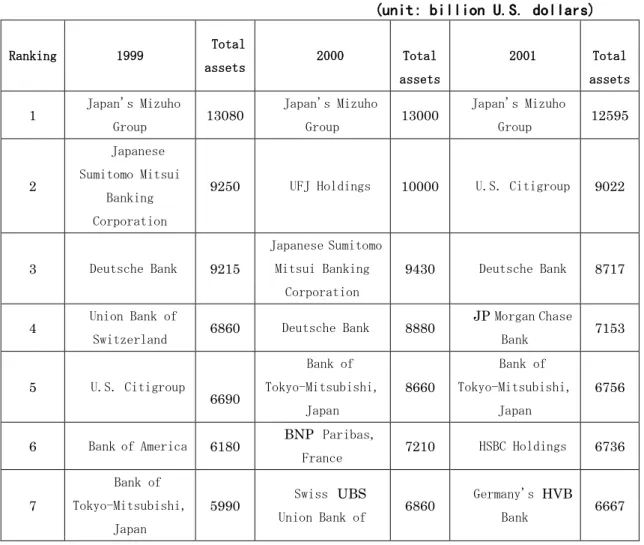
In August 1999, Dai-Ichi Kangyo Bank, Fuji Bank and Industrial Bank of Japan announced a reorganization of the first financial holding company in Japan - Mizuho Financial holding company. The total assets of Mizuho Financial holding company was 141 trillion yen, becoming the largest banking group on assets in the world at that
19
time (see Table 1).
In October 1999, Sumitomo Bank and Sakura Bank announced a merger and established Mitsui Sumitomo Financial Group on April 1, 2001, which the total assets were 99 trillion yen, was the Japan's second and the world's third largest banking group at that time.
In April 2000, the Bank of Tokyo-Mitsubishi, Mitsubishi Trust Bank and the Japan Trust Bank announced the formation of the Mitsubishi Tokyo Financial Group by cross-shareholding, which were the Japan's third and the world's fifth largest banking group at that time.
In March 2000, Japan's Sanwa Bank, Tokai Bank and Toyo Trust Bank announced a merger by stock swap. Then, Japan's United Financial Holdings Group was formed on April 1, 2001, becoming the fourth largest financial group in the Japanese banking sector.
Table 1: 1999 - 2001, the world's top ten banks ranked (by total assets)
(unit: billion U.S. dollars) Ranking 1999 Total assets 2000 Total assets 2001 Total assets 1 Japan's Mizuho Group 13080 Japan's Mizuho Group 13000 Japan's Mizuho Group 12595 2 Japanese Sumitomo Mitsui Banking Corporation
9250 UFJ Holdings 10000 U.S. Citigroup 9022
3 Deutsche Bank 9215 Japanese Sumitomo Mitsui Banking Corporation 9430 Deutsche Bank 8717 4 Union Bank of
Switzerland 6860 Deutsche Bank 8880
JPMorgan Chase Bank 7153 5 U.S. Citigroup 6690 Bank of Tokyo-Mitsubishi, Japan 8660 Bank of Tokyo-Mitsubishi, Japan 6756
6 Bank of America 6180 BNP Paribas,
France 7210 HSBC Holdings 6736 7 Bank of Tokyo-Mitsubishi, Japan 5990 Swiss UBS Union Bank of 6860 Germany's HVB Bank 6667
20
8 ABN AMRO Bank 5040 Citicorp Group 6670 Swiss UBS
Union Bank of 6646 9 HSBC Holdings 4850 Bank of America 6560 BNP Paribas,
France 6458 10 Credit Suisse 4740 HSBC Holdings 5690 Bank of America 6422
Source: "The Banker" 2000, 2001, 7.
Though the restructuring of the banking sector which have shown above, Japan has formed a banking pattern which based on the four Financial Group, Mizuho Financial Holdings, Sumitomo Mitsui Financial Group, Mitsubishi Tokyo Financial Group and Japan's United Financial Holdings, their respective members as shown in Table 2.
Table 2: Japan's four major financial groups diagram
Mizuho Group Sumitomo Mitsui Group Tokyo-Mitsubishi Group UFJ Holdings Group Bank Industrial Bank of Japan Dai-Ichi Kangyo Bank
Fuji Bank Sumitomo Bank Sakura Bank The Bank of Tokyo-Mitsubishi Sanwa Bank Tokai Bank Rising Sun Bank
Trust
Dai-Ichi Kangyo Fuji Trust Yasuda Trust
Sumitomo Trust Chuo Mitsui Trust
and Mitsubishi Trust and Japanese Trust Tokyo Trust Toyo Trust Life Insurance First life Asahi Life Yasuda Life The rich life
Sumitomo Life
Mitsui Life Meiji Life
Daido Life Sun life Chiyoda life
Loss Insurance
Yasuda Fire & Nichido Fire
Nissan Fire Dacheng fire
Sumitomo
Mitsui sea Tokyo Marine
Japanese fire Koa fire Great Tokyo fire
Chiyoda fire Securities Advised angle securities Shinko Securities Japanese securities Sakura securities Tokyo-Mitsubishi Securities International Organization of Securities Tokyo Stock Wing Securities East Sea Securities
Source: Zhang, D.R.(2000) Japan's banking sector restructuring pattern has basically taken shape. International Finance 6.126-131.
21
In 2002, Japan's banking industry was once again set off an upsurge of reorganization, some banks did not enter the four major financial groups also began to actively seek partners. On March 1, 2002, Japanese bank and the Rising Sun Bank merged to form Resona Financial Holding Company, after ranking in the holding company of the Mizuho Financial and Mitsui Sumitomo Financial Group, Japan United Financial Holdings, and the Mitsubishi Tokyo Financial Group, became the Japan's fifth-largest financial group.
In July 2004, Japan's fourth largest financial group UFJ Holdings prepared to merge with Mitsubishi Tokyo Financial Group because the expansion of the bad debt problem. On October 1, 2005, the two companies officially announced the successful merger. With the reorganization of UFJ and MTFG, the trust and bond departments of the respective subsidiary merged to form the Mitsubishi UFJ Trust & Banking Corporation and Mitsubishi UFJ Securities Co., Ltd. Mitsubishi UFJ Trust Bank has huge overseas assets, also are one of the world's largest investment institutions at present. On January 1, 2006, the independently operated MTFG and UFJ's commercial banking sector merger was announced, a new Tokyo-Mitsubishi UFJ Bank (The Bank of Tokyo-Mitsubishi UFJ) are established which are the biggest financial group of Japan with the largest assets and size. The Bank of Tokyo-Mitsubishi UFJ is also one of the most comprehensive financial institutions in the world until now.
4.2 The characteristics analyzing of banking restructuring after the mid-1990s By reviewing the development of banking restructuring after the mid-1990s, and compared with restructuring in the past, it can be seen the reorganization of the Japanese banking sector after the mid-1990s are not only involve an unprecedented scale and wide range, but also has new feature in new era.
4.2.1 Follow the market principle
During a long term, Japan's big banks generally belong to an enterprise group by cross-shareholdings and became the core members of the enterprise group. The past banking sector restructuring only aimed to re-adjust and re-configuration of the
22
group's internal financial resources, in order to strengthen the dominant position and competitiveness of the banks within the group. But now the restructuring of the banking industry break through the enterprise group boundaries and the core banking is no longer rigidly adhere to the restrictions of the group. The restructuring are conducted in accordance with market principles in order to achieve the rational allocation of financial resources. For example, Dai-Ichi Kangyo Bank, Fuji Bank, Industrial Bank of Japan which originally belonged to the Dai-Ichi Kangyo Bank Group and the Hibiscus Group established the Mizuho Financial Group by reorganization. Originally belonging to the Sumitomo Group and Mitsui Group, Sumitomo Bank and Sakura Bank merged to establish Mitsui Sumitomo Financial Group, has broken through the limitations of the group to achieve the optimal allocation of the financial resources among the different enterprise groups.
4.2.2 Carry out mixed operation
From World War II to the mid-1990s, Japan has inherited the concept of Douglass Act with long-term implementation of the separate operation of the banking, insurance, securities and trust. In 1999, the United States enacted the Gramm - Leach - Buli Lei Act to ensure the legal status of the mixed operation, so that the international status of American financial institutions has greatly improved. In order to adapt to the trend of the global financial mixed operation, the Japanese government implemented the new banking law in April 1998, abolished the limitations of the banking separate operation to allow the cross- business of banking, insurance and securities. As a result, Japanese financial institutions can not only merging by integration and cross-shareholding, but also can carry out other financial business. For example, the securities business of the Industrial Bank of Japan is more developed, but there is no retail business. Dai-Ichi Kangyo Bank and Fuji Bank which belongs to the City Bank have a large retail business outlets, the three bank restructuring can be achieved advantages complementary. The reorganization indicates that the era of banking, insurance and securities co-operative is not far off.
4.2.3 Merges among big banks
23
banks mergers small and medium banks. However, “powerful consolidation” between the big banks has become the main features in the new era. Restructuring between the big banks can achieve the advantages complementary, resource sharing, but also attaches great importance on cooperation to reduce transaction costs, improve competitiveness, rapidly increase the share in international financial markets.
4.2.4 Establish financial holding company
Since the Japanese government amended the Antimonopoly Act in December 1997, banks are allowed to set up a financial holding subsidiary company in the form of capital markets operation. Establishing a financial holding company has become the main way of banking sector restructuring. Financial holding company model can not only avoid the traditional merger with the problems of personnel management and organizational adjustment, but also can use the equity swap and equity transfer without the need for physical collateral and the use of huge sums of money. After the establishment of financial holding company, the owned banks still maintain their own way of doing business and corporate culture, this is not only easier to coordinate operations, reduce costs, but also effectively control risk by a reasonable set of the internal management structure in order to overcome the inadequate of merger and tender offer. From the practices of recent Japanese banking restructuring, we can see major banks all have taken the way of the establishment of financial holding companies to achieve enhancing the competitiveness of the financial group.
4.2.5 Foreign capital participation
Different from banking sector restructuring in the past, a significant characteristic during this period is foreign capital to participate in the restructuring of the banking sector. According to foreign participation process in the Japanese banking sector restructuring, in addition to direct entry into the Japanese financial market to open business outlets, foreign capital mainly in equity, acquisitions and other ways to participate in the restructuring of the Japanese banking sector. For example, in 1998, the U.S. national Streeter Trust Bank and Japan's Mitsui Trust Bank announced a joint business; In August 1999, Sanwa Bank of Japan announced to carry out joint venture cooperation with the United States Morgan Stanley Dean Witt Securities ; In February
24
2000, the United States Investment Fund's made acquisition of the Long Term Credit Bank of Japan. The foreign capital entry to some extent take up part of Japan's domestic market, but it optimize the capital structure of Japanese financial institutions, introduce the competition mechanism to the Japanese financial market and improve the transparency of financial markets. Practice has proved that it is conducive to the opening up financial markets and the formation competitive environment.
4.2.6 Promoted policy of government
Under the financial protection administration, the general practice of the Japanese government dealt with the bank has problem were injection of public funds to nationalization firstly, and then set up a transition bank. Its purpose is to prevent the bankrupt of the banks and keep the stability of financial system and financial markets. Financial protection administration can strengthen the government control of financial institutions so that financial institutions cannot neglect the efficiency of the business. The impact of the wave of international banking restructuring urge the Japanese government to promote the financial reform with ending the financial protection administration, relaxation of financial controls, the abolition of the barriers of the financial sub-operators and the implementation of deposit insurance system, so that Japanese financial institutions generally enhance the sense of competition and have carried out structural adjustment and operation reform. Also, Japan's major banks realize that restructuring was the only way of remaining invincible in the fierce competition in domestic and international financial markets and achieving the target of financial internationalization and globalization.
25
CHAPTER 5
The measures and effect analysis of the Japanese banking
restructuring
5.1 The main measures of the Japanese banking restructuring 5.1.1 Improve the banking supervision system
In the process of the Japanese financial reform, in order to meet the needs of the banking sector restructuring, the government developed and modified the relevant laws and regulations firstly to perfecting the banking supervision system. One of the important measures was the establishment of specialized financial regulators - the Financial Recycling Committee on December 15, 1998.The Financial Supervisory Authority under The Financial Reconstruction Commission, primarily responsible for implementation of the inspection, supervision and re-capitalized bank failures. The main measures of The Financial Supervisory Authority take are: strengthen financial supervision, increasing the autonomy of the Financial Supervisory Authority; formulating the development of accounting and reserves of the loan classification standards. At the same time, the Japanese Government conducted the merger of residential and financial management company and the Resolution and Collection Bank merged and established the Debt Collection finishing Agency (RCC), this processing operations of the new body responsible for the bad assets of banks, including the purchase of the failed bank, and have settled The force of the bad assets of financial institutions. These measures strengthen the financial regulatory functions to ensure the smooth operation of the banking sector restructuring and financial reforms.
5.1.2 Implement financial reform
Financial reform started in 1998 mainly include: allow banks to sell investment trust funds, set up guarantee mechanism of life insurance, non-life insurance and the securities for investors, abolition of the securities transaction tax, the introduction of market pricing of short-term government financing, and allow financial companies to
26
issue bonds for loan financing. Since October 1999, the government allows commercial banks to issue ordinary bonds, stop the restrictions on stock brokerage business of banking and securities institutions, and allow banks and securities firms to conduct cross-competition. These reform measures integrated the domestic financial system and played an important role in restoring the international status of the Japanese financial industry and adapting the development of financial globalization.
5.1.3 Dispose of bad assets
The Japanese government deals with the non-performing assets of banks by injecting the public funds. The public funds that the Japanese Government invested mainly used to inject to the bank in financial crisis but still has the ability to repay, the banking sector's restructuring activities, sterilization costs, and additional protection of depositors funds. The Japanese government injected public funds to promote the sale of the collateral of non-performing assets and the restructuring of the banking sector, revitalizing the majority of non-performing assets, increase the own capital ratios of major banks. In addition, the Japanese government solves the non-performing assets of major banks through privatization and joint merger. This series of measures has received a significant effect, the number of city banks in financial difficulties in 1998 quickly reduced from 10 to 5. (Zhang, 2005)Therefore, these reformations not only improve the vitality of Japan's major banks, but also regain the international competitiveness.
5.1.4 Improve the profitability of the bank's core business
The major Japanese bank loans are mostly concentrated in low-yielding business loans. In order to increase the profit, many low-profit banks will turn to the stock market. Banks through loans packaged sold to institutional investors and other non-bank financial institutions, major banks also adopted to expand the retail business, increase the consumer credit, housing loans and capital market services business, effectively increase revenues. For reducing costs, many Japanese financial institutions reduce the bank branches, especially the significant reduction of overseas branches, and the implementation of the layoff system. In addition, banks reduce costs through strategic alliances. These measures greatly reduce the bank's operating costs and
27
improve the profitability of banks.
5.2. The effects of Japanese banking sector restructuring 5.2.1 Increase the market share
Under normal circumstances, a bank is bigger in size, the greater competitiveness and higher public credit. The Japanese banking sector restructuring enable the combined bank improve the financial strength and market share, also win the trust of more customers. Mizuho Financial Group holds approximately 30% of the domestic market share, coupled with the subsequent establishment of the Sumitomo Mitsui Financial Group and Mitsubishi UFJ Group, there are more than 60% domestic market share for the three financial groups. Also taking the Bank of Tokyo Mitsubishi Bank for example, the former is the only professional foreign exchange bank in Japan, with a focus on overseas operations, the latter's business focuses on the domestic market, after the merger, the newly established Bank of Tokyo-Mitsubishi not only maintain the two banks originally own advantages, but also make up for their shortcomings, which have achieved rapid development and expansion in overseas and domestic business.
5.2.2 Improve people's confidence for the financial industry
The massive restructuring of the Japanese banking sector is considered to be the economic regeneration. It was believed that the new Financial Group will be able to compete with the international financial giant and keep the competitiveness and stabilization of the financial sector. The restructuring can provide adequate funding for industry and pay a huge role to promote Japan's economic recovery. Bank mergers also make a positive reflection in the capital market, its stock price significantly rose after the reorganization of several major banks, led the Tokyo stock market continued to rise, Which shares of Mizuho Financial Group and Japan's United Financial Holdings already low in 2003 rose more than 4 times, and Sumitomo Mitsui Financial Group rose 2 times, Mitsubishi Tokyo Financial Group rose more than doubled. The improvement of the banking situation has led investors to invest in the Japanese stock market in general. Starting from the half of 2003, the Japanese stock market finally
28
get rid of the depressed state of more than 10 years, the Nikkei index strongly reacted to climb the high point.
5.2.3Banks receives the benefits from scale of operation
After the restructuring, the Japan's major banks quickly expanded its asset size and achieved the scale operation to fully enjoy the following benefits: First, the management fees can be apportioned in more business, management cost was greatly reduced; Second, the different financial products and financial services make full use of existing sales channels, greatly reduced the marketing costs; Third, by improving the business processes and using new technology, saving the research and development expenses. The six major banking groups achieved the highest level of profitability in September 2006, the total profits of Mizuho Financial Group, Mitsubishi UFJ Financial Group and Sumitomo Mitsui Banking Group excess more than 1 trillion yen at that time.
5.2.4 Achieve economies of scope in banking business
The restructuring of the banking industry broke the limitations of separate operation, banking, insurance, trust and securities and other financial services can be jointly operated, not only enhanced the image and competitiveness of the bank, but also scattered and digestive the internal financial risk. More importantly, the reorganization optimized and integrated the financial resources, enable banks to achieve complementary advantages and resource sharing, reduce the bank's operating costs, and achieve economies of scope.
5.2.5 Achieve the diversification of the banking business
The Japanese banking industry has been operating under strict separate operation for a long time. After financial reform, financial regulation gradually relaxed and the limitations of the separate operation was completely abolished, the financial institutions can carry out the business of banking, insurance, securities and trust to achieve the complementary operations. After the reorganization, Bank Group could carry out the diversification of the banking, securities, trust and insurance business, and toward the path of development of the integrated bank.
29
In the process of restructuring in the banking sector, on the one hand, because the Japanese government relaxed financial regulation, the integration between the different industries became possible. On the other hand, due to the rapid development of information technology, thus creating favorable conditions for a variety of new financial business carried out. On this basis, the newly established Financial Group through the inter-bank cooperation, the establishment of new banks and the development of new business are pushing the financial innovation.
5.2.7 Promote the reform of the financial system
After World War II, the Japanese government set up restrictions of financial system on interest rates, business constraints, and separation of domestic and international financial markets based on indirect financing, this system once played an active role in the stable development of the financial industry and Japan's economic recovery and rapid growth. However, with the changes in domestic and international financial environment, this system is no longer adapt to the needs of Japan's economic development. In the 1980s, the Japanese economy lasted for a long-term stagnation resulted from the drawbacks of the financial system. Though the banking sector restructuring, the Japanese government changed the original financing structure which was irrational, unsound banking system and incomplete financial regulatory system, thus promoted the comprehensive reform of the financial organization system and established a financial system for the 21st century financial globalization.
5.2.8 Promote Japan's economic recovery
After the economic bubble burst in the early 1990s, the Japanese economy has been in a recession. Lack of demand and declined production has made enterprises in trouble. Many of them cannot repay the bank loans, thus more and more banks' bad assets formulated. At the same time, the increase of non-performing assets caused banks be afraid of provide loans for enterprises, a credit crunch situation has formed, further exacerbated the economic downturn. Restructuring of the banking sector not only enhanced the financial strength of financial institutions and risk-resisting ability which changed the situation of the "credit crunch", but also broaden the financing channels for enterprises. As a result, the economic recovery that began in early 2002
30
to October 2007, lasted 68 months, more than 57 months of the Izanagi Boom, was the longest boom since the war. (Wang, 2009)
5.3. The problems of Japan banking sector restructuring 5.3.1 Bring a certain amount of risk
Although the banking sector restructuring promoted the reform of the financial system and maintained the stability of the banking system, the property rights risks, the strategy risks, management risks and potential risks has not been eliminated. The big banking group are in the strength of the high-risk investments, but their own problems are easily be concealed. Once the investment fails, even if it is big enough could not escape. The Daiwa Bank incident is the best proof. Moreover, once the largest banks are in trouble, rescues are more difficult, the impact is more powerful. The survival of the banking industry relies heavily on public trust. Once public confidence lost can lead to bank losses, and then brought widespread panic, threatening the security of the entire banking system. Also, if the bank size is more than the best profit-making points, the size and efficiency are inversely proportional. In addition, the bank size is too large to make banking business development lose some flexibility, not easy to adjust business direction in order to adapt to market changes.
5.3.2 Increases the pressure of employment
The restructuring of the banking sector is not a simple combination, but the re-adjustment of the internal sector and business networks in order to expand the size of funds save operating costs and improve efficiency. In the process of restructuring, many duplicate agencies and departments will be revoked. In addition, high-technology investment in a corresponding the increase application of information technology, online banking business to carry out and cost reduction requirements will result in a large number of bank staffs unemployed. For example, in 2006, the Mizuho Financial Group cut about 7000 employees, Sumitomo Mitsui Financial Group laid off 5,000 people, Mitsubishi Tokyo Financial Group laid off 4,000 people. The financial holding group, formed by the Mitsubishi Tokyo Financial