* Correspondence to : PING GAO
Graduate School of Economics, Ritsumeikan University 1-1-1 Nojihigashi Kusatsu, Shiga 525-0052, Japan E-mail: [email protected]
査読論文
Housing Supply Elasticity in China:
Differences by Housing Type
PING GAO
*Abstract
This paper employs an improved urban growth model to estimate the housing supply elasticity in China. New construction of housing is modeled as a function of changes in housing prices, construction costs, bank loans as well as land-use controls. Using annual data from a panel of 31 Chinese provinces over the period of 1999-2010, we find that there are obvious differences in the price elasticity of supply among housing types. Also, the effect of changes in independent variables on new construction differs by housing type. The result well explains the trend of housing prices during the observed period.
Keywords
Elasticity of Housing Supply, Variation, Housing Types
1. Introduction
There has been a large body of literature which focuses on the estimation of housing supply elasticities. Earlier work by Muth (1960), Follain (1979) and Stover (1986) support a perfectly elastic housing supply. On the other hand, Topel and Rosen (1988), DisPasquale and Wheaton (1990), and Blackley (1999) found that price elasticities vary from -0.9 to 3.0. Afterwards, the imperfect elasticity of housing supply attracts a growing number of literatures that tries to explain why housing supply elasticities might vary over regions or countries. Recent attempts include Mayo and Sheppard (1996), Malpezzi and Maclennan (2001), Green, Malpezzi and Mayo (2005), who provide strong evidence that the housing
supply varies from place to place. With a focus on the variation in housing supply elasticity between multi-family units and single-family homes in Australia, McLaughlin (2012) stresses that, ‘… there are no reasons to assume the supply elasticity of housing to be homogenous between housing types.’ He argues that it will be biased and not precise to estimate housing supply elasticity without accounting for the difference of housing types. However, few empirical researches have been carried out to examine whether housing supply elasticity differs from type to type.
Our previous work has examined the variation of housing supply elasticity across cities1.This paper further investigates whether housing supply elasticity differs by type
based on the evidence comes from 31 Chinese provinces. In China, the housing supply can be divided into three categories: common residential houses, villas and high-grade apartments, and economically affordable housing.Due to the land for construction use being monopolized by the government, housing of various types has very different modes of access. For example, in the case of “economically affordable housing” the land for its construction is directly supplied by government allotment2. Nevertheless, there is no
empirical research that examines the elasticity of this housing. Even the latest literatures such as Chow and Niu (2010), Fu, Zheng and Liu (2011), and Wang, Su and Xu (2012) ignore the difference among housing types.
Estimation of housing supply elasticity for each housing type is also important to policy-makers. To prompt new construction of housing, the Chinese government has implemented a series of policies including interest rates adjustment and land-use control. However, the initial policies are typically one-size-fits-all, and ignore the obvious difference among housing types. Recently, the government has realized that the effect of housing policies on supply differs from type to type. As a result, policies target to regulate housing of one specific type. For example:
The land policy on July 19th, 2012 in Guangzhou aims to control the high price of office housing and report that, ‘… the rate of levy taxes on land appreciation in advance has been increased from 2% to 3% for office buildings, while the rate is only 2% for residential houses ….’ In particular, the government encourages land supply for common residential and economically affordable housing, while they strictly control land supply for luxury housing. This paper attempts to examine whether such targetable regulations are effective.
We investigate the variation of housing supply elasticities by type of use and the likely causes of this variation. Based on the theoretical framework suggested by the previous
studies, we employ an improved urban growth model to investigate housing supply elasticity for each housing type. It is the first paper to estimate housing supply elasticity by type in China. We distinguish the common residential housing from the luxury housing (villas and high-grade apartments) and economically affordable housing. In particular, we provide an empirical evidence of housing supply elasticity of economically affordable housing which is barely mentioned in the previous studies.
Our paper proceeds as follows. The following section overviews the nature of the housing market in China. Section 3 presents a theoretical background and describes data as well as the estimation procedure. Section 4 shows the estimated results and gives the corresponding interpretations. Section 5 gives concluding remarks which include some suggestions on how to extend the knowledge of the topic.
2. Housing market in China
2.1. Basics of demand and supplyThe modern private housing market in China started in 1998 when the State Council issued the 23rd decree which is regarded as a milestone in the Chinese housing reform. The
real estate market in China has been gradually developing with the reform of the urban housing system. Although there has been an obvious increase in new construction, there is a huge gap between housing supply and housing demand. Several reasons may account for its occurrence. First, the household size decreased from 3.7 persons in 1996 to 3.1 persons in 2010. Meanwhile, the number of single-person household and two-person household has been growing rapidly. Second, rapid urbanization has attracted more and more people to immigrate into urban areas, and generated a huge demand for housing to accommodate the additional person.
Table 1 below shows the structure of various buildings newly started in 2010. Total commercialized buildings consist of commercialized residential housing, office buildings, and buildings for business use. Furthermore, as a component of aggregate commercialized buildings, residential housing including villas and high-grade apartments, and economically affordable housing, which is the main focus of our analysis, takes up more than 80% of the total. According to the definition of the Statistical Bureau of Economics of China, economically affordable housing is a kind of public housing subsidized by the government in terms of a land transfer fees remission and tax reduction. The land used for economically affordable housing is provided in term of administrative transfer or
bidding by the government. Thus, its costs and sales prices are lower than that of common residential buildings.
Table 1 Demand and supply: a comparison by the building type
Buildings type New starts (Ratio) Sales space (Ratio) 1998 2010 1998 2010 Residential buildings:
(10 000 sq.m)
1. Villas and high-grade apartments 2. Economically affordable housing
16,638 (81.6%) 639 3,466 129,359 (79.1%) 5,080 4,910 10,827 (88.9%) 345 1,667 93,377 (89.1%) 4,219 2,749 Office buildings (10 000 sq.m) (4.3%)872 (2.2%)3,668 (3.3%)401 (1.8%)1,890 Houses for business use
(10 000 sq.m) (9.5%)1,939 (10.7%)17,473 (6.7%)811 (6.7%)6,995
Others (%) 4.6% 8.0% 1.2% 2.4%
Note. Data sources from the Table 6-35 (New starts) and Table 6-38 (Sales space), the China Statistic
Yearbook, 2011.
There has been plenty of evidence to suggest that the supply elasticities differ from place to place3. Rather, housing prices in areas with lower supply elasticity are usually
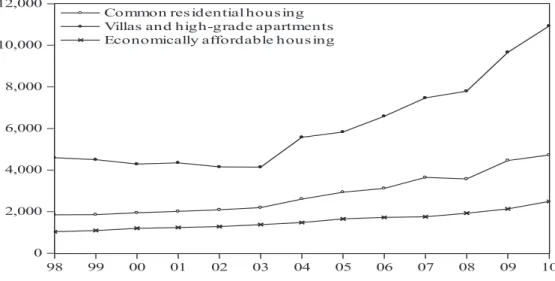
higher and more vulnerable than the areas which have higher supply elasticity. However, so far, there is no evidence of variation in the supply elasticity among housing of various types in China. Figure 1 represents the trend of housing price by type during 1998-2010. It should be noted that prices of common residential houses and economically affordable
Figure 1. The average sales price of housing by type (unit: RMB/sq.m) Source: the China Statistical Yearbook, 2011.
housing have barely increased in contrast to the rapid increase in price of villas and high-grade apartments during the observed period. We in particular raise a question whether such difference in the trend of various housing prices can be explained by variation in the elasticity of supply. We assume that villas and high-grade apartments have a lower price elasticity of supply, while common residential housing has a higher price elasticity of supply. Furthermore, as a kind of public housing, economically affordable housing is assumed insensitive to changes in prices4. These assumptions will be examined in our
following analysis.
2.2. Housing policies: interest rates adjustment and land-use control
Two main instruments, interest rate adjustment and land-use control are widespread to control high home price for the Chinese government. In 2004, the Central Bank of China raised interest rates after remaining unchanged for 9 years. One-year loans and deposit rates were regulated by 0.27%. In 2007, the Central Bank increased the benchmark deposit and loan interest rates to 4.14% and 7.47% respectively. This adjustment may have impacted on the housing market in the short term as well as medium term.
Land use control is another important instrument to regulate the housing market. A constant stream of land policies has been implemented since 1998. Recently, the regulation issued by the Ministry of Land and Resources and the Department of Housing and Urban Construction stressed that the supply of land for common residential buildings use should be increased in the future. The Chinese government strictly regulates the supply of land for villas and high-grade apartment, while the government encourages the supply of the land for common residential use. As a result, there is a huge gap between the prices of different housing type mainly due to the various costs to get the land. We have reason to believe that such inclination of the government may actually lead to diverse housing supply elasticity among housing types.
Does an increase in land supply correspondingly bring about an increase in housing supply? Using the data provided by the Hong Kong housing market from 1973 to 1997, Lai and Wang (1999) explore the common belief that an increase in land supply can be a remedy for the shortage of housing supply. If the government land supply is positively related to housing supply, then increasing land supply will bring about an increase in housing supply. However, the results show that developers’ housing supply is independent of the amount of land provided by the government. What concerns the developer is the economic conditions rather than the land supply in making their decisions. However,
unlike the Lai and Wang (1999), Saiz (2010) finds a strong and positive relationship between restrictive land-use regulations and natural geographic constraints on land supply and suggests these two factors help explain soaring housing prices in areas with stringent regulations. In the United States, both stringent land-use regulations and natural geography affect the supply of elasticity of new housing. In particular, we would want to know whether the land supply has a homogenous effect on housing of different types.
3. Empirical model and data
Following Mayer and Somerville (2000a), and McLaughlin (2012), the new construction is measured as a function of the change in construction costs (costs include all construction-related expenses, such as materials, financial inputs) as well as prices. Meanwhile, it is also affected by the government regulations on land-use (Mayer and Somerville, 2000b). For each type, new construction is modeled as follows:
(1) where newconstr is the new construction of housing, which can be treated as the changes in housing stocks. Δp is the change in housing prices, Δc denotes material costs changes. Δr is the change in interest rate, which measures the cost of financial inputs to developers. Δland is land supply that government released, which is used to characterize the effect of land-use regulations. loans is added to capture the effect of the capacity of developers to obtain the capital.
The data used consists of 31 provinces in China over the period 1999 to 2010 with sample size 372. The provincial data avoid the problem that may cause by using national data since there are obvious variations in both the size of the housing stock and in housing prices. Residential housing consists of common residential housing, villas and high-grade apartments, and economically affordable housing. In order to realize a reasonably robust test on the variation, our paper employs two measures of new construction, (1) the new completion of housing investment, and (2) new starts of housing construction5.
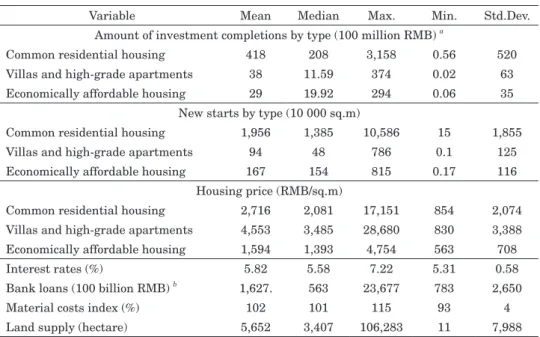
Table 2 reports the summary statistics for all variables used in our analysis. The description of data on economically affordable housing once again demonstrates that, as a commercialized housing, economically affordable housing is totally different from housing of other types. Aggregate estimations of the national housing market without
Table 2 Descriptive statistics
Variable Mean Median Max. Min. Std.Dev. Amount of investment completions by type (100 million RMB) a
Common residential housing 418 208 3,158 0.56 520 Villas and high-grade apartments 38 11.59 374 0.02 63 Economically affordable housing 29 19.92 294 0.06 35
New starts by type (10 000 sq.m)
Common residential housing 1,956 1,385 10,586 15 1,855 Villas and high-grade apartments 94 48 786 0.1 125 Economically affordable housing 167 154 815 0.17 116
Housing price (RMB/sq.m)
Common residential housing 2,716 2,081 17,151 854 2,074 Villas and high-grade apartments 4,553 3,485 28,680 830 3,388 Economically affordable housing 1,594 1,393 4,754 563 708 Interest rates (%) 5.82 5.58 7.22 5.31 0.58 Bank loans (100 billion RMB) b 1,627. 563 23,677 783 2,650
Material costs index (%) 102 101 115 93 4 Land supply (hectare) 5,652 3,407 106,283 11 7,988
Note. a Two measures of the quantity of new housing construction are used in this paper: (1) the new
completions of the investment, and (2) the space of new starts.
b Domestic loans be obtained by Enterprises for Real Estate Development.
Table 3 Unit root test results
LLC (Assumes common unit
root process) ADF (Assumes individual unit root process) Variable Statistic Prob. ** Statistic Prob. ** Obs New starts
1. Common residential -7.215 0.000 114.62 0.001 331 2. Villas and high-grade -11.180 0.000 119.704 0.000 321 3. Economically affordable -4.420 0.000 90.593 0.007 318 Completions of investment
1. Residential -6.293 0.000 73.212 0.156 334 2. Villas and high-grade -7.952 0.000 97.491 0.018 331 3. Economically affordable -9.421 0.000 95.142 0.004 334 The change in prices
1. Common residential -9.996 0.000 151.385 0.000 307 2. Villas and high-grade -7.952 0.000 87.491 0.018 331 3. Economically affordable -7.112 0.000 104.665 0.000 335 The change in bank loans -18.241 0.000 240.438 0.000 300 The change in interest rates -17.230 0.000 192.081 0.000 310 The change in construction costs -18.942 0.000 296.978 0.000 294 The change in land costs -21.250 0.000 282.184 0.000 301
Note. LLC tests are designed to take care of the problem of heteroscedasticity and autocorrelation. ** denotes
distinguishing by type will be seriously biased.
Before regression analysis, we conduct Levin-Lin-Chu (LLC)6 tests and augmented
Dickey-Fuller (ADF) tests for unit roots in the data series. The results are reported in Table 3. The LLC tests confirm that all data series of variables are stationary. But, the ADF tests show that only the data series of common residential housing completions is not stationary. Although, the level data of prices and costs variables are not stationary, changes in these variables (first differences) become stationary, which is consistent with specifications of our model.
Before estimating the equation, first and foremost, two issues are very necessary to address. One is the potential endogeneity problem, and the other is the appropriate number of lags. We use land space released by the government of all levels as a good proxy of land regulation, which is expected to have a positive effect on new construction of housing. Since it is the decision of the local governments, we treat it as an exogenous variable. However, there is still one explanatory variable in Equation (1), changes in housing prices which is suspected to be endogenous. Because that the current changes in housing prices are determined simultaneously along with new construction, Δp is thus generally correlated with the error term. In this case, OLS estimates of a structural equation are not consistent.
Considering the unit root of each variable, our empirical model for each housing type is as follow:
(2) Where i is an index of provinces (Beijing, Tianjin, Heibei …), while t is an index of years from 1999 to 2010. Definitions of other parameters are the same as above. All variables are in their forms of logarithm. The estimated coefficient of housing price changes can be interpreted as price elasticity of housing supply.
To deal with the potential endogeneity problem, we estimate equation (2) using an instrumental variable technique (IV)7. In addition, considering the different duration of
lagged effect, we employ different lagged structure for variables of price and costs changes. However, the appropriate number of lags is difficult to determined, which depends on the length of time required to obtain developed land, acquire housing permits, and builders’ expectations about changes in future house prices. In China, the processes of obtaining land or acquiring permits are unobservable and differ from case to case. Thus, we run
OLS regressions for new construction of housing with different lags for housing prices. A comparison among the indicators of AIC and Schwarz criterion being reported by different models shows that OLS regression with a lag of three years performs better than models with other lagged structure. Similar to the work by Mayer and Somerville (2000a, 2000b) and McLaughlin (2012), this paper uses a length of lags with a period of three years to grasp the short-and-medium effect of the change in price, while considers a lag of one for costs variables.
Our empirical model is based upon Mayer and Somerville (2000), in which new construction of housing is specified as a function of changes in house prices and costs rather than function of the levels of those variables. New construction depends on the change in housing price, changes in construction costs, and changes in the cost of capital. From an econometric perspective, this specification of housing supply will avoid spurious correlations problem. Mayer and Somerville (2000a) reports that “Treating starts as a function of house price changes is also consistent with the time series properties of housing stock and prices8”. Afterwards, Mayer and Somerville (2000b) incorporate land
use regulations into their original framework. Their model has been widely used in recent studies such as Wadu and Lau (2008) and Maclaughlin (2012). Specifically, McLaughlin (2012) firstly applied it to estimate new housing supply elasticity among dwelling types9.
In the next section, we discern whether changes in land-use control, interest rates, and bank loans have an effect on housing completions or housing new starts. In addition, we make a comparison of housing supply elasticities among housing by type.
4. Estimated results and discussions
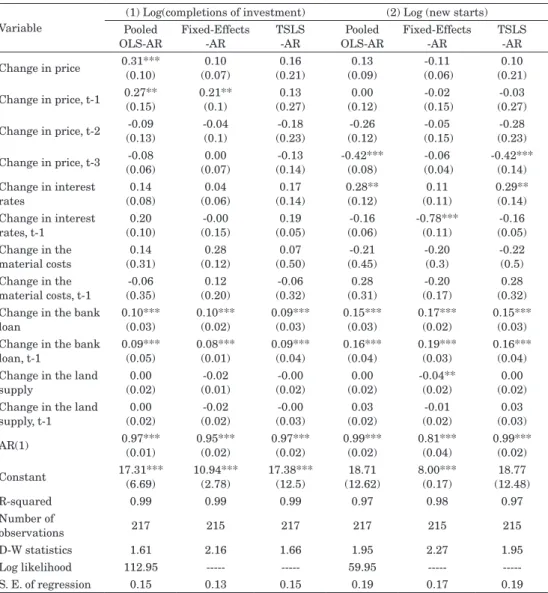
4.1. Estimated resultsTables 4, 5, and 6 presents the estimated results using equation (2) for common residential housing, villas and high-grade apartments, and economically affordable housing respectively. Dependent variables are logged completions and new starts. Multi-techniques are used for estimation. And, we use an AR (1) process to correct for autocorrelation. In addition, we pooled the province data from 1999 to 2010, which may bring about the heteroskedasticity problem. In that case, despite the OLS estimator is still unbiased and consistent, the estimated standard errors are not unreliable. Thus, we adjust our estimated standard errors using the White’s standard errors to correct for this bias.
(1) Results: common residential housing
As reported in the first three columns of Table 4, the coefficients of price changes are significantly positive in the change of the current year and the subsequent one year when we used a method of pooled OLS for estimation. Summing up the magnitude of these significant price changes, we obtain elasticities of 0.58 for completions of common
Table 4 Regression results: common residential housing Variable
(1) Log(completions of investment) (2) Log (new starts) Pooled
OLS-AR Fixed-Effects-AR TSLS-AR OLS-ARPooled Fixed-Effects-AR TSLS-AR Change in price 0.31***(0.10) (0.07)0.10 (0.21)0.16 (0.09)0.13 (0.06)-0.11 (0.21)0.10 Change in price, t-1 0.27**(0.15) 0.21**(0.1) (0.27)0.13 (0.12)0.00 (0.15)-0.02 (0.27)-0.03 Change in price, t-2 (0.13)-0.09 -0.04(0.1) (0.23)-0.18 (0.12)-0.26 (0.15)-0.05 (0.23)-0.28 Change in price, t-3 -0.08 (0.06) 0.00 (0.07) -0.13 (0.14) -0.42*** (0.08) -0.06 (0.04) -0.42*** (0.14) Change in interest rates (0.08)0.14 (0.06)0.04 (0.14)0.17 0.28**(0.12) (0.11)0.11 0.29**(0.14) Change in interest rates, t-1 0.20 (0.10) -0.00 (0.15) 0.19 (0.05) -0.16 (0.06) -0.78*** (0.11) -0.16 (0.05) Change in the material costs (0.31)0.14 (0.12)0.28 (0.50)0.07 (0.45)-0.21 -0.20(0.3) -0.22(0.5) Change in the material costs, t-1 -0.06 (0.35) 0.12 (0.20) -0.06 (0.32) 0.28 (0.31) -0.20 (0.17) 0.28 (0.32) Change in the bank
loan 0.10***(0.03) 0.10***(0.02) 0.09***(0.03) 0.15***(0.03) 0.17***(0.02) 0.15***(0.03) Change in the bank
loan, t-1 0.09*** (0.05) 0.08*** (0.01) 0.09*** (0.04) 0.16*** (0.04) 0.19*** (0.03) 0.16*** (0.04) Change in the land
supply (0.02)0.00 (0.01)-0.02 (0.02)-0.00 (0.02)0.00 -0.04**(0.02) (0.02)0.00 Change in the land
supply, t-1 0.00 (0.02) -0.02 (0.02) -0.00 (0.03) 0.03 (0.02) -0.01 (0.02) 0.03 (0.03) AR(1) 0.97***(0.01) 0.95***(0.02) 0.97***(0.02) 0.99***(0.02) 0.81***(0.04) 0.99***(0.02) Constant 17.31*** (6.69) 10.94*** (2.78) 17.38*** (12.5) 18.71 (12.62) 8.00*** (0.17) 18.77 (12.48) R-squared 0.99 0.99 0.99 0.97 0.98 0.97 Number of observations 217 215 217 217 215 215 D-W statistics 1.61 2.16 1.66 1.95 2.27 1.95 Log likelihood 112.95 --- --- 59.95 --- ---S. E. of regression 0.15 0.13 0.15 0.19 0.17 0.19
Note. Dependent variables: log (completions of investment) and log (new starts). Instruments for the current
change in housing price are annual expense of a household, household size, and prices of fuels. AR (1) process is used to correct for autocorrelation. White’s standard errors are in parenthesis. *** denotes significance at 1% level, ** denotes significance at 5% level.
residential houses. This suggests that a 1% increase in housing prices leads to 0.58% increase in completions of common residential housing spread over the current and the subsequent one year. Considering the specific effects of cross sections, Fixed-effects estimates show that the coefficient of price changes is only significantly positive with a lag of one year. An IV approach is used to resolve the endogeneity problem. TSLS estimates show that the coefficients of price changes are not significant. Employing different methods for estimation generate little difference in the estimated results. The coefficients of changes in the bank loans are significantly positive. In contrast, the coefficients of changes in interest rates, material costs, or land supply are not significant. The estimated result shows that completions of common residential housing rely on price changes and bank loan more than other factors.
The second three columns of Table 4 report the estimated results with dependent variable of housing new starts. The coefficients of changes in housing price are insignificant not only in the current year of the change, but also in the subsequent two years. However, pooled OLS estimates and TSLS estimates show that the changes in housing price are significantly negative with a lag of one year. Furthermore, the coefficients of changes in interest rates are significantly positive in the current year of the change using the estimation method of pooled OLS and TSLS. In contrast, Fixed-effects estimates show that the coefficients of changes in interest rates are significantly negative with a lag of one year. In addition, the coefficients of material costs and land supply are not significantly different from zero, while the coefficients of bank loans are significantly positive both in the current year of the change and the first subsequent year. New starts of common residential housing are sensitive to changes in interest rate and bank loans. However, the lagged effect of these variables is different.
(2) Results: Villas and high-grade apartments
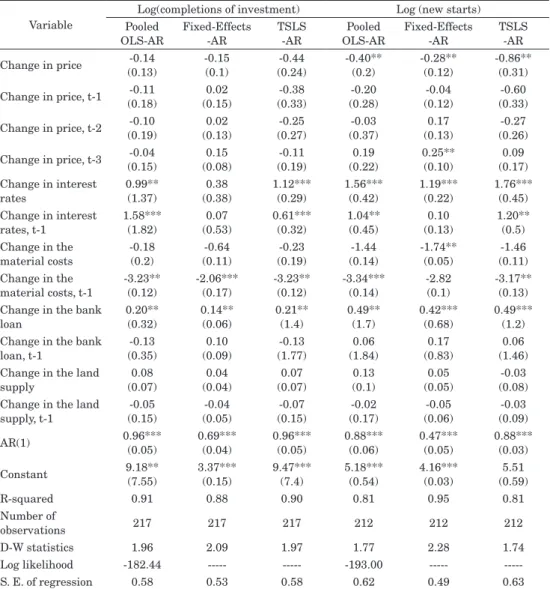
The first three columns of Table 5 show the estimated results with the dependent variable of completions. Using pooled OLS, Fixed-effects and TSLS method, we obtained similar estimated results. Coefficients of changes in housing prices are insignificant in all regressions, which suggest that changes in housing prices have little effect on completions of villas and high-grade apartments. In contrast, pooled OLS and TSLS estimates show that coefficients of interest rates are significantly positive not only in the current year of the change but also in the first subsequent year, which suggests that changes in interest rates have a significantly continuous effect on housing completions. Moreover,
the estimated results also show that changes in bank loans have a significant positive effect, while changes in material costs have a significantly negative effect on completions with a lag of one year. The result suggests that as interest rates and bank loans increase, completions of villas and high-grade apartments increase. Unlikely, as material costs increase, completions of villas and high-grade decrease sharply after one year of the change in material costs. More specifically, the speed of suppliers’ response to changes in
Table 5 Regression results: villas and high-grade apartments Variable
Log(completions of investment) Log (new starts) Pooled OLS-AR Fixed-Effects -AR TSLS -AR Pooled OLS-AR Fixed-Effects -AR TSLS -AR Change in price (0.13)-0.14 -0.15(0.1) (0.24)-0.44 -0.40**(0.2) -0.28**(0.12) -0.86**(0.31) Change in price, t-1 (0.18)-0.11 (0.15)0.02 (0.33)-0.38 (0.28)-0.20 (0.12)-0.04 (0.33)-0.60 Change in price, t-2 (0.19)-0.10 (0.13)0.02 (0.27)-0.25 (0.37)-0.03 (0.13)0.17 (0.26)-0.27 Change in price, t-3 (0.15)-0.04 (0.08)0.15 (0.19)-0.11 (0.22)0.19 0.25**(0.10) (0.17)0.09 Change in interest rates 0.99**(1.37) (0.38)0.38 1.12***(0.29) 1.56***(0.42) 1.19***(0.22) 1.76***(0.45) Change in interest rates, t-1 1.58*** (1.82) 0.07 (0.53) 0.61*** (0.32) 1.04** (0.45) 0.10 (0.13) 1.20** (0.5) Change in the material costs -0.18(0.2) (0.11)-0.64 (0.19)-0.23 (0.14)-1.44 -1.74**(0.05) (0.11)-1.46 Change in the material costs, t-1 -3.23** (0.12) -2.06*** (0.17) -3.23** (0.12) -3.34*** (0.14) -2.82 (0.1) -3.17** (0.13) Change in the bank
loan 0.20**(0.32) 0.14**(0.06) 0.21**(1.4) 0.49**(1.7) 0.42***(0.68) 0.49***(1.2) Change in the bank
loan, t-1 -0.13 (0.35) 0.10 (0.09) -0.13 (1.77) 0.06 (1.84) 0.17 (0.83) 0.06 (1.46) Change in the land
supply (0.07)0.08 (0.04)0.04 (0.07)0.07 (0.1)0.13 (0.05)0.05 (0.08)-0.03 Change in the land
supply, t-1 -0.05 (0.15) -0.04 (0.05) -0.07 (0.15) -0.02 (0.17) -0.05 (0.06) -0.03 (0.09) AR(1) 0.96***(0.05) 0.69***(0.04) 0.96***(0.05) 0.88***(0.06) 0.47***(0.05) 0.88***(0.03) Constant 9.18**(7.55) 3.37***(0.15) 9.47***(7.4) 5.18***(0.54) 4.16***(0.03) (0.59)5.51 R-squared 0.91 0.88 0.90 0.81 0.95 0.81 Number of observations 217 217 217 212 212 212 D-W statistics 1.96 2.09 1.97 1.77 2.28 1.74 Log likelihood -182.44 --- --- -193.00 --- ---S. E. of regression 0.58 0.53 0.58 0.62 0.49 0.63
Note. Dependent variables: log (completions of investment) and log (new starts). Instruments for the current
change in housing price are annual expense of a household, household size, and prices of fuels. AR (1) process is used to correct for autocorrelation. White’s standard errors are in parenthesis. *** denotes significance at 1% level, ** denotes significance at 5% level.
prices and costs is different. An increase in housing price, interest rates, and bank loans generate an immediate increase in housing completions or new starts in the change of the year. In contrast, an increase in material costs only work on new construction of villas and high-grade apartments after one year of the change. The second three columns of Table 5 report the estimated results with the dependent variable of housing new starts. There is
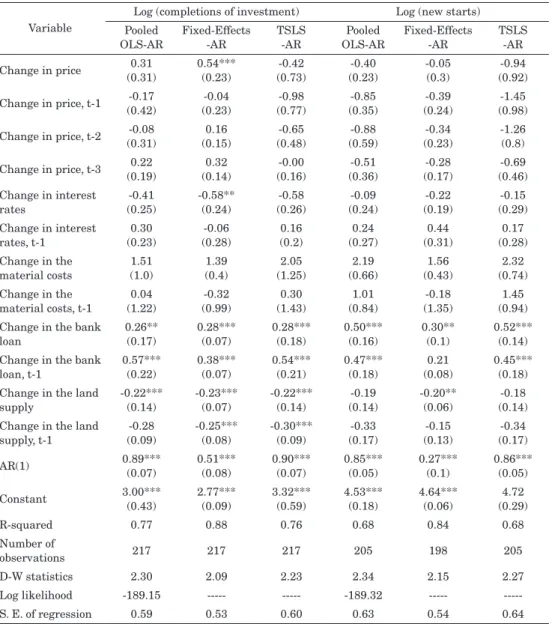
Table 6 Regression results: economically affordable housing Variable
Log (completions of investment) Log (new starts) Pooled
OLS-AR Fixed-Effects-AR TSLS-AR OLS-ARPooled Fixed-Effects-AR TSLS-AR Change in price (0.31)0.31 0.54***(0.23) (0.73)-0.42 (0.23)-0.40 -0.05(0.3) (0.92)-0.94 Change in price, t-1 (0.42)-0.17 (0.23)-0.04 (0.77)-0.98 (0.35)-0.85 (0.24)-0.39 (0.98)-1.45 Change in price, t-2 (0.31)-0.08 (0.15)0.16 (0.48)-0.65 (0.59)-0.88 (0.23)-0.34 -1.26(0.8) Change in price, t-3 (0.19)0.22 (0.14)0.32 (0.16)-0.00 (0.36)-0.51 (0.17)-0.28 (0.46)-0.69 Change in interest rates (0.25)-0.41 -0.58**(0.24) (0.26)-0.58 (0.24)-0.09 (0.19)-0.22 (0.29)-0.15 Change in interest rates, t-1 0.30 (0.23) -0.06 (0.28) 0.16 (0.2) 0.24 (0.27) 0.44 (0.31) 0.17 (0.28) Change in the material costs 1.51 (1.0) 1.39 (0.4) 2.05 (1.25) 2.19 (0.66) 1.56 (0.43) 2.32 (0.74) Change in the material costs, t-1 0.04 (1.22) -0.32 (0.99) 0.30 (1.43) 1.01 (0.84) -0.18 (1.35) 1.45 (0.94) Change in the bank
loan 0.26** (0.17) 0.28*** (0.07) 0.28*** (0.18) 0.50*** (0.16) 0.30** (0.1) 0.52*** (0.14) Change in the bank
loan, t-1 0.57*** (0.22) 0.38*** (0.07) 0.54*** (0.21) 0.47*** (0.18) 0.21 (0.08) 0.45*** (0.18) Change in the land
supply -0.22*** (0.14) -0.23*** (0.07) -0.22*** (0.14) -0.19 (0.14) -0.20** (0.06) -0.18 (0.14) Change in the land
supply, t-1 -0.28 (0.09) -0.25*** (0.08) -0.30*** (0.09) -0.33 (0.17) -0.15 (0.13) -0.34 (0.17) AR(1) 0.89*** (0.07) 0.51*** (0.08) 0.90*** (0.07) 0.85*** (0.05) 0.27*** (0.1) 0.86*** (0.05) Constant 3.00*** (0.43) 2.77*** (0.09) 3.32*** (0.59) 4.53*** (0.18) 4.64*** (0.06) 4.72 (0.29) R-squared 0.77 0.88 0.76 0.68 0.84 0.68 Number of observations 217 217 217 205 198 205 D-W statistics 2.30 2.09 2.23 2.34 2.15 2.27 Log likelihood -189.15 --- --- -189.32 --- ---S. E. of regression 0.59 0.53 0.60 0.63 0.54 0.64
Note. Dependent variables: log (completions of investment) and log (new starts). Instruments for the current
change in housing price are annual expense of a household, household size, and prices of fuels. AR (1) process is used to correct for autocorrelation. White’s standard errors are in parenthesis. *** denotes significance at 1% level, ** denotes significance at 5% level.
little difference in the estimated results compared to completions if we omit the negative effects of changes in housing price on housing new starts.
(3) Results: Economically affordable housing
Described in Table 6, changes in housing prices have little effect on both housing completions and housing new starts using estimation methods of pooled OLS and TSLS. Housing completions and new starts are insensitive to changes in housing prices. Only the Fixed-effects estimates show that changes in housing price have a significant positive effect on housing completions. Furthermore, Fixed-effects estimates also show that changes in interest rates have a negative effect on housing completions. With a 1% increase in interest rates, housing completions decrease by 0.58% after one year of the change. More importantly, economically affordable housing is sensitive to land supply, which is different to common residential housing and villas and high-grade apartments.
Although the coefficients of land supply were not what we expected in advance, to some degree it reminds us that houses of various types cannot be treated in the same way, especially for economically affordable housing which presents a feature of public housing but is sold as common commercialized housing. The result suggests that this type of housing relies on funds and the land supply much than the housing price.
4.2. Discussions
(1) Magnitude in price elasticity of housing supply
Summing up the magnitude of these significant price changes, we obtain the price elasticities of housing supply for each type. The estimated cumulative price elasticities of housing supply are reported in Table 7.
As described in the first row of Table 7, the cumulative price elasticity of residential Table 7 Cumulative price elasticities of housing supply
Housing type Pooled OLS estimates Fixed-Effects estimates TSLS estimates Common residential housing (1). 0.58(2). -0.42 (1). 0.21(2). Insignificant (1). Insignificant(2).- 0.42 Villas and high-grade apartments (1). Insignificant(2). -0.4 (1). Insignificant(2). -0.03 (1). Insignificant (2). -0.86 Economically affordable housing (1). Insignificant(2). Insignificant (1). 0.54(2). Insignificant (1). Insignificant (2). Insignificant
housing completions is 0.58 and 0.21 using the pooled OLS and Fixed-effects method. In contrast, the cumulative elasticity of new starts is only -0.42 using the estimation method of pooled OLS and TSLS. The second row of Table 7 presents the estimated cumulative price elasticities of completions and new starts of villas and high-grade housing. Using different methods brings about little difference in the estimated results. Completions of villas and high-grade apartments seem to be unaffected by changes in prices, while the new starts of it are negatively related to changes in prices. A negative price elasticity of new starts reveals that an increase in prices may bring about a sharp decrease in housing demand which extends the increase of housing being supplied. This type of housing is widely seen to be luxury housing, which only can be afforded by high-income groups. The third row of Table 7 shows the estimated cumulative price elasticity of completions of economically affordable to be 0.54 when we used a method of Fixed-effects for estimation. However, when the other two methods are used we find not only the completions but also the new starts are insensitive to changes in prices.
In general, the result suggests that the common residential housing and villas and high-grade apartments are more sensitive to changes in housing prices. In contrast, economically affordable housing in most cases is not sensitive to price changes. The result once again reminds us that housing supply of various types cannot be treated in the same way, especially for economically affordable housing which presents a feature of public housing but is sold as common commercialized housing. The pricing of economically affordable housing is not determined according to the market condition of supply and demand.
Comparable estimates by Mayer and Somerville (2000) present an 15% increase in new construction over five quarters, while estimates by McLaughlin (2012) present an 5.4% increase in new construction of single-family units over the subsequent five quarters, and 17.3% for multi-family homes between 9 and 44 months later, after an initial delay of 6 months. Similar to McLaughlin (2012), our estimated results reveal that the effect of price changes on both housing completions and new starts varies by housing type.
(2) The effect of land-use control
Since there is no single definite form of land policy, Mayer and Somerville (2000b) instead observes multiple government interventions in land and real estate markets. Zhang (2008) defines the land supply policy by the local government which changes the quota of land supply and land supply modes to regulate the relationship between housing
suppliers and buyers. In this study, we observe the space of land released by governments of all levels to examine whether land-use control has the same effect on housing supply of all housing types.
The estimated results relating to land supply reported in Tables 4, 5, and 6 shows that only the supply of economically affordable housing is sensitive to changes in land supply. In contrast, common residential housing and villas and high-grade apartments are not affected by changes in land supply10.
Since the economically affordable housing, a kind of publicly provided housing is built on the land allocated being exempted from various fees and taxes by the government11. The
supply of economically affordable housing is thus mainly affected by government decisions. In the real world, as argued by the Lincoln Institute of Land Policy (January, 2011) that ‘… the local government prefers offering land to the highest bidder among developers through the auction process to maximize their revenue, and they have little incentive to provide land for the construction of economically affordable housing…’ As a result, the more land released by the government, the less land is available for construction use of economically affordable housing. This issue is even exacerbated by the limited scale of land reserving.
Our result is similar to Lai and Wang (1999) that developer’s housing supply is independent of the amount of land provided by the government. They will examine economic conditions in making their housing supply decisions. This is true for at least common residential housing and villas and high-grade apartments.
(3) Interest rates and bank loans
Two variables, interest rates and bank loans are used to measure the effect of the changes in financing costs and capacity of obtaining capital on housing supply. Given the estimated results reported in Tables 4, 5, and 6 regarding interest rates, we find that the effect of interest rate changes on housing of various types to be obviously different. As described in Table 4, new starts rather than completions of common residential housing are sensitive to changes in interest rates. A 1% increase in interest rates brings about a 0.28% increase in new starts of common residential housing using the method of pooled OLS and TSLS. However, using the method of Fixed-effects yields different results which suggest that new starts of common residential housing decrease by 0.78% when there is an increase of 1% in interest rates. For villas and high-grade apartments, changes in interest rates have a larger effect on both completions and new starts compared to common residential housing (as described in Table 5). In contrast, the effect of interest
rates on completions and new starts of economically affordable housing is insignificant. Only the Fixed-effects estimates suggest that a 1% increase in interest rates will decrease completions of economically affordable housing by 0.58%, which is smaller in magnitude than common residential housing (as shown in Table 6).
Generally, an increase in interest rates will increase the construction costs of developers. Some caution, however, should be exercised in interpreting the estimated results presented here since the change in interest rates can affect both demand and supply of housing. On the one hand, the cost of conducting new housing construction soars as interest rates increase for developers. On the other hand, the increase in interest rates drives up interest payment and thus decreases the needs of new homes for buyers. The reality is more complicated taking account of inflation. Investment in housing is treated as an effective way to head off inflation especially in a country like China, where people lack alternative investment channels. Limited availability of land and rising population growth will increase housing demand and hence housing in general has the potential to beat inflation easily (the Economic Times, 2012). In this case, an increase in interest rates has little effect on housing demand which is predicted to keep growing in long-term.
Most strikingly, the coefficients on bank loans which are used to measure the capacity of obtaining additional capital for developers are significantly positive as we expected. More specifically, the effect of changes in bank loans on new construction differs by housing type in magnitude. According to the results reported in Tables 4, 5, and 6, changes in bank loans affect new construction of economically affordable housing more than common residential housing and villas and high-grade apartments. A 1% increase in bank loans will bring about 0.83% increase in completions and new starts of economically affordable housing in the current year of the change and the subsequent year.
The result shows that the effect of changes in bank loans is larger in magnitude for economically affordable housing than other housing. This is consistent with the fact that in China the financing of economically affordable housing depends upon funds from the housing provident fund which mainly sources from fees from land transfers.
(4) Construction costs
As represented in Table 4, the change in construction costs has little effect on completions and new starts of common residential housing. In contrast, it significantly affects completions and new starts of villas and high-grade apartments (as described in Table 5). More specifically, a 1% increase in material costs causes a 3.23% decrease in
completions and 3.34% decrease in new starts of villas and high-grade apartments one year after the change. For economically affordable housing, changes in material costs have no significant effect on completions and new starts of this type of housing (as described in Table 6).
Alternative empirical housing supply studies of Mayer and Somerville (2000), and McLaughlin (2012) find the coefficient on material costs is not statistically different from zero. Our study extends the previous study by showing that the effect of an increase in material costs on new construction is different by housing type. An increase in material costs only leads to a significant decline in new construction of villas and high-grade apartments. For common residential housing and economically affordable housing, the effect is not significant.
Although changes in prices have a significant effect on new construction of all types, this paper finds that the effect of it in magnitude varies by housing type. In addition, the effect of the change in bank loans is significantly positive for all types of housing, revealing that new construction of housing in China heavily relies on the amount of capital that developers can obtain. Unlikely, the effect of the change in material costs is only significantly affect new construction of villas and high-grade apartments. An increase in material costs leads to a significant decline in supply of villas and high-grade apartments with a lag of one year. Furthermore, the effect of the change in land supply differs by housing type. It has little effect on common residential housing and villas and high-grade apartments, while it significantly affects new construction of economically affordable housing.
As discussed above, the effect of changes in independent variables on new construction differs by housing type. Furthermore, even to the same housing type, the speeds of suppliers respond to changes in prices, costs, and land supply are also different. For example, an increase in bank loans brings about an immediate increase in new starts of villas and high-grade apartments, while an increase in material costs only affects the new starts after one year of the change.
5. Concluding remarks
This paper extends the model firstly proposed by Mayer and Somerville (2000). New construction of housing by type is modeled as a function of changes in housing price, capital costs, construction material costs, land supply, and bank loans. Two measures
of new construction-housing completions and new starts are used to generate more convincible results. Common residential housing is distinguished from villas and high-grade apartments and economically affordable housing.
This paper investigated the variation of the elasticity of housing supply among housing of various types using annual data on a panel of 31 provinces from 1999 to 2010. The result shows a significant variation in the magnitude of housing supply elasticity among various types. Residential housing has a higher elasticity of supply, while the elasticity of villas and high-grade apartments is somewhat lower. Moreover, the effect of changes in independent variables on new construction differs by housing type. More specifically, new construction of common residential housing is mainly affected by changes in price and bank loans. In contrast, new construction of villas and high-grade mainly depends on changes in interest rates, material costs, and bank loans. However, new construction of economically affordable housing is mainly influenced by changes in bank loans and land supply. Based on the empirical evidence presented in this paper, it is implied that housing policy should be more specific with a full consideration of variation in supply elasticity among various housing types. The housing supply structure can be optimized through appropriate use of multi-regulations, such as interest rates adjustment, land-use controls, and controls on bank loans scale aim to provide more affordable housing for common Chinese households.
Finally, it should be noted as argued by Wu, Gyourko, and Deng (2012) that data limitations make the issue on housing supply in China even harder to study and interpret because it is only since 1998 when there has been a true private market with competitive bidding and pricing of property. Quarterly data will be helpful to observe the short-term behavior of the developers. In future research, we hope further study on how to prompt effective housing supply in China based on experiences drawn from several countries with a focus on the effect of public housing increases on the whole housing stock.
Notes
1 Gao. P., K. Inaba, and J. Qin. (2012), pp. 33-48.
2 Economically affordable housing refers to houses constructed by real estate development enterprises or housing units under the instruction of local government. As a kind of public housing, it is targeted to low-income household and be sold at below-market prices.
3 Studies such as Green, Malpezzi and Mayo. (2005), Goodman (1998).
demand and supply.
5 Malpezzi and Maclennan (2001) report two residential output measures: (1) the real value of residential construction and (2) either starts or completions.
6 According to Levin, Lin and Chu (2002) the LLC statistic performs well when i lies between 10 and 250 and when t lies between 5 and 250 for panel data (i, t).
7 Instruments for current change in house prices are current and lagged values of changes real energy prices, long-term interest rate, aggregate consumption expenditure, and the size of households.
8 Mayer and Somerville (2000), p.89.
9 McLaughlin (2012) includes two types of new housing in Australia, multifamily units and single-family homes.
10 In our previous study, both the variables of land costs and land supply are introduced into the model. The estimated result shows that new construction of housing are only sensitive to changes in land costs rather than the land supply in China.
11 In China, the government is the only owner of urban land. The governments at all levels have monopolies on urban land allocation.
References
Blackley D. M. (1999) The Long-Run Elasticity of New Housing Supply in the United States: Empirical Evidence for 1950 to 1994. Journal of Real Estate Financial Econimics 18(1): 25-42.
Chow G.C., and L.L. Niu (2010) Demand and Supply for Residential Housing in Urban China. Research of Finance 355(1): 1-11.
DiPasquale D., and W.C. Wheaton (1994) Housing Market Dynamics and the Future of Housing Prices. Journal of Urban Economics 35 (1): 1-27.
Follain J.R. (1979) The Price Elasticity of the Long-Run Supply of New Housing Construction. Land Economics 55(2): 190-199.
Fu Y.M., S.Q. Zheng, and H.Y. Liu (2011). Examining Housing Supply Elasticity across Chinese Cities: A Structural Approach. Draft version of August 2011.
Gao P., K. Inaba, and J. Qin (2012) An Empirical Study on Housing Supply in Chinese Cities: Using the Urban Growth Model. The Ritsumeikan Economic Review 62(4): 33-48.
Green R.K., S. Malpezzi, and S.K. Mayo (2005) Metropolitan-Specific Estimates of the Price Elasticity of Supply of Housing, and Their Sources. The American Economic Review 95(2):
334-339.
Goodman A.C. (2005) Central Cities and Housing Supply: Growth and Decline in US Cities. Journal of Housing Economics 14(2005): 315-335.
Lai N., and K. Wang (1999) Land-supply Restrictions, Developer Strategies and Housing Policies: The Case of Hong Kong. International Real Estate Review 2(1): 143-159.
Levin A., C.F. Lin, and C.S.J. Chu (2002) Unit root tests in panel data: Asymptotic and finite-sample properties. Journal of Econometrics 108(1): 1–24.
Liu S.J., and J.L. Yang (2005) The 2005 China Report on Industry Development. Issued by the State Council of China, Beijing: Huaxia Press.
Lincoln Institute of Land Policy (2011) Affordable Housing in China. January 2011.
Malpezzi S., and D. Maclennan (2001) The Long-run Price Elasticity of Supply of New Residential Construction in the United States and the United Kingdom. Journal of Housing Economics 10(3): 278-306.
Muth R. (1960) The Demand for Non-Farm Housing. In A.C. Harberger, ed., The Demand for Durable Goods. Chicago: University of Chicago Press.
Mayo S., and S. Sheppard (1996) Housing Supply under Rapid Economic Growth and Varying Regulatory Stringency: An International Comparison. Journal of Housing Economics 5(1996): 274-289.
Mayer C.J., and C. T. Somerville (2000) Residential Construction: Using the Urban Growth Model to Estimate Housing Supply. Journal of Urban Economics 48(1): 85-109.
— Land Use Regulation and New Construction. Regional Science and Urban Economics 30(6): 639-662.
McLaughlin R.B. (2012) New Housing Supply Elasticity in Australia: A Comparison of Dwelling Types. The Annals of Regional Science 48(2012): 595-618.
Topel R., and S. Rosen (1988) Housing Investment in the United States. Journal of Political Economy 96(4): 718-740.
Stover M. E. (1986) The Price Elasticity of the Supply of Single-Family Detached Urban Housing. Journal of Urban Economics 20(3): 331-340.
Saiz A. (2010) The Geography Determinants of Housing Supply. Quarterly Journal of Economics, 125(3): 1253-1269.
Wadu M.J., and S.S.Y. Lau (2008) Floor Space per Person and Housing Development: An Urban Growth Approach to Estimate Housing Supply in Hong Kong. Urban Policy and Research 26(2): 177-195.
Market. Regional Science and Urban Economics 42(3): 531-543.
Wang S.T., H.C. Sun, and B.H. Xu (2012) Estimates of Price Elasticity of New Housing Supply and Their Determinants: Evidence from China. Journal of Real Estate Research 34(3): 311-344.
Zhang H. (2008) Effects of Urban Land Supply Policy on Real Estate in China: An Econometric Analysis. Journal of Real Estate Literature 16(1): 55-72.