Japan Advanced Institute of Science and Technology
https://dspace.jaist.ac.jp/
Title
Linguistic Multi-Expert Decision Making Involving
Semantic Overlapping
Author(s)
Yan, Hong-Bin; Huynh, Van-Nam; Nakamori,
Yoshiteru
Citation
Issue Date
2010-03-26
Type
Book
Text version
author
URL
http://hdl.handle.net/10119/9568
Rights
This is the author-created version of Springer,
Hong-Bin Yan, Van-Nam Huynh and Yoshiteru
Nakamori, Integrated Uncertainty Management and
Applications, Advances in Soft Computing,
68/2010, 2010, 281-292. The original publication
is available at www.springerlink.com,
http://dx.doi.org/10.1007/978-3-642-11960-6_26
Description
Involving Semantic Overlapping
Hong-Bin Yan, Van-Nam Huynh and Yoshiteru NakamoriAbstract This paper presents a probabilistic model for linguistic multi-expert de-cision making (MEDM), which is able to deal with vague concepts in linguistic aggregation and decision-makers’ preference information in choice function. In lin-guistic aggregation phase, the vagueness of each linlin-guistic judgement is captured by a possibility distribution on a set of linguistic labels. A confidence parameter is also incorporated into the basic model to model experts’ confidence degree. The basic idea of this linguistic aggregation is to transform a possibility distribution into its associated probability distribution. The proposed linguistic aggregation results in a set of labels having a probability distribution. As a choice function, a target-oriented ranking method is proposed, which implies that the decision-maker is satisfactory to choose an alternative as the best if its performance is as at least “good” as his requirements.
1 Introduction
Multi-expert decision making (MEDM) is a common and important human activity. In practice, the uncertainty, constraints, and even the vague knowledge of the ex-perts imply that the information cannot be assessed precisely in quantitative form, but may be in a qualitative one [7]. A possible way to solve such situation is the use of the fuzzy linguistic approach [19]. Also, the process of activities or decisions usually creates the need for computing with words. One linguistic computational approach is making use of the associated membership function for each label based on the extension principle [4]. Another approach is the symbolic one [5] by means of the convex combination of linguistic labels. In these two approaches, however, the results usually do not match any of the initial linguistic labels, hence an ap-proximation process must be developed to express the result in the initial expression School of Knowledge Science, Japan Advanced Institute of Science and Technology
e-mail: [email protected]; {huynh,nakamori}@jaist.ac.jp
domain. This produces the consequent loss of information and lack of precision. To overcome this limitation, a 2-tuple fuzzy linguistic representation model is proposed in [7]. Although such an approach has no loss of information, it does not directly take into account the underlying vagueness of the linguistic labels, i.e., it assumes that any neighboring linguistic labels have no semantic overlapping.
Two approaches have been proposed in an attempt to involve the underlying vagueness of the words in linguistic MEDM problems. Ben-Arieh & Chen [1] have proposed a fuzzy linguistic OWA (FLOWA) operator, which assigns fuzzy mem-bership functions to all linguistic labels by linearly spreading the weights from the labels to be aggregated. The aggregating result changes from a single label to a fuzzy set with membership levels of each label. Tang [17] has introduced a collec-tive linguistic MEDM model to capture the underlying vagueness of linguistic labels based on the semantic similarity relation [18], in which the similarities among lin-guistic labels are derived from fuzzy relation of linlin-guistic labels. However, such an approach violates the bounded property of the linguistic aggregation. For more de-tail of the properties of linguistic aggregation, see [5]. Moreover, it assumes that the same label assessed by different experts has the same label overlapping.
According to the epistemic stance interpretation in linguistic modeling by Lawry [12], when an expert assesses some alternatives (options) with a linguistic label, it is assumed that he will probably choose other linguistic labels to describe the option. Possibility theory [6] provides a convenient tool to represent experts’ uncer-tain assessments. Furthermore, even if two different experts have assessed an option with the same linguistic label, the appropriateness degree of other linguistic labels may be different according to experts’ confidence degree, i.e., to what extent the experts are sure that other linguistic labels are appropriate to describe the option. Finally, our another motivation comes from the fact that experts are not necessarily the decision-makers, but only provide an advice [15]. The decision-makers’ prefer-ence information plays an important role in choice of alternatives, which is missed in most research.
In light of the above observations, we summarize our main contributions as fol-lows. First, we assume that the appropriate labels are linearly distributed around the linguistic label provided by the expert with a possibility distribution. The label provided by the expert will be called prototype label. And then based on the basic mass function, we can obtain the probability distribution on the linguistic labels as the aggregation result. Fuzzy modifiers [19] are also used to model some expert’ confidence quantifying how he is sure of the appropriateness of other linguistic la-bels. Second, we propose a target-oriented ranking method incorporating decision-makers’ preferences. It is well-known that human behavior should be modeled as satisficing instead of optimizing [16]. Intuitively, the satisficing approach has some appealing features because thinking of targets is quite natural in many situations.
The rest of this paper is organized as follows. Section 2 proposes a probabilis-tic approach to linguisprobabilis-tic aggregation involving vague concepts. Section 3 proposes a ranking procedure based on target-oriented decision model, in which decision-makers’ preferences are considered. Section 4 provides an illustrative example.
Sec-tion 5 discusses the relaSec-tionships between our approach and three prior approaches. Finally, Section 6 presents some concluding remarks.
2 A Probabilistic Approach to Linguistic Aggregation Involving
Semantic Overlapping
In fuzzy environment, a common characteristic of the MEDM problems, is a finite set of experts, denoted by E = {E1, · · · , Ek, · · · , EK}, who are asked to assess
an-other finite set of alternatives A = {A1, · · · , Am, · · · , AM}. The linguistic assessment
provided by expert Ekregarding alternative Amis presented as xmk ∈ L , where L is
a finite, but totally ordered label set of linguistic variables with an odd cardinality, i.e., L = {L0, · · · , Ln, · · · , LN} with Ln> Llfor n > l. Also, each expert is assigned
a degree of importance or weight wk, denoted as W = [w1, · · · , wk, · · · , wK].
2.1 Linguistic Aggregation Involving Vague Concepts
With the linguistic judgements for alternative Am provided by a set of experts E ,
we can obtain a linguistic judgement vector as Xm= (xm
1, · · · , xmk, · · · , xmK), where
xm
k ∈ L , k = 1, · · · , K. When there is no possibility of confusion, we shall drop the
subscript m to simplify the notations. Our main objective is to aggregate the linguis-tic judgement vector X for each alternative A.
The linguistic judgement provided by one expert implies that the expert makes an assertion. It seems undeniable that humans posses some kind of mechanism for deciding whether or not to make certain assertions. Furthermore, although the un-derlying concepts are often vague the decision about the assertions are, at a certain level, bivalent. That is to say for an alternative A and a linguistic label L, you are willing to assert ‘A is L’ or not. Nonetheless, there seems to be an underlying as-sumption that some things can be correctly asserted while others cannot. Exactly where the dividing line between those labels are and those that are not appropri-ate to use may be uncertain. This is the main idea of epistemic stance proposed by Lawry [12].
Motivated by the epistemic stance, we assume that any neighboring basic lin-guistic labels have partial semantic overlapping in linlin-guistic MEDM. Thus, when one expert Ekevaluates alternative A using linguistic label xk∈ L , other linguistic
labels besides xkin L may also be appropriate for describing A, but which of these
linguistic labels is uncertain. Here, similar with [13], the linguistic label xkwill be
called prototype label. If experts can directly assign the appropriateness degrees of all linguistic labels, then we can obtain a possibility distribution. However, the need of experts’ involvement creates the burden of decision process. Without additional information, we assume that the appropriate labels are distributed around the pro-totype label xkwith a linear possibility distribution. Possibility theory is convenient
to represent consonant imprecise knowledge [6]. The basic notion is the possibility distribution, denotedπ.
It is very rare that when all individuals in a group share the same opinion about the alternatives (options), since a diversity of opinions commonly exists [1]. With the linguistic judgement vector X for alternative A, we can define
Lmin= mink=1,··· ,K{xk}, Lmax= maxk=1,··· ,K{xk} (1)
where xk∈ L , Lmin< Lmax, and Lmin, Lmax are the smallest and largest
linguis-tic labels in X, respectively. The label indices of the smallest and largest labels in judgement vector X are expressed as indmin and indmax, respectively. Also, the
label index of the prototype label xkprovided by expert Ekis denoted as pIndk.
Note that, the result of linguistic aggregation should lie between Lmin and
Lmax(including Lminand Lmax). In addition, if two label indices have the same
dis-tance to the index of the prototype label xk, we assume that they have the same
appropriateness (possibility) degree. Furthermore, as Lawry [12] pointed out, “an assertability judgement between a ‘speaker’ and a ‘hearer’ concerns an assessment on the part of the speaker as to whether a particular utterance could (or is like to) mislead the hearer regarding a proposition about which it is intended to inform him.” Thus if one expert is viewed as a ‘speaker’, then other experts will act as ‘hearer’. Accordingly, we first define a parameter as
∆k= max{pIndk− indmin, indmax− pIndk}. (2)
We then define a possibility distribution of around the prototype label xk∈ L on
linguistic labels Lnas follows
π(Ln|xk) = 1 −pIndk−n
∆k+1 , if indmin≤ n < pIndk;
1, if n = pIndk; 1 −n−pIndk
∆k+1 , if pIndk< n ≤ indmax;
0, if n < indminor n > indmax.
(3)
where n = 0, · · · , N. Assume that there is a set of seven linguistic labels L = {L0, · · · , L6}. Also, we have Lmin= L1and Lmax= L5. Then for a possible prototype
label x, according to Eq. (3), we obtain the possibility distribution of appropriate labels as shown in Fig. 1.
Note π(Ln|xk) is a possibility distribution of around prototype label xk on the
linguistic label set L , then the possibility degrees are reordered as {π1(xk), · · · ,πi(xk), · · · ,πm(xk)}
such that 1 =π1(xk) >π2(xk) > · · · >πm(xk) ≥ 0. Then similar with [10, 11], we
can derive a consonant mass assignment function mxkfor the possibility distribution
L_{0}0 L_{1} L_{2} L_{3} L_{4} L_{5} L_{6} 0.1 0.2 0.3 0.4 0.5 0.6 0.7 0.8 0.9 1 Linguistic labels Possibility distribution
Fig. 1 Possible prototype label and its appropriate labels under [L1, L5]
mxk(φ) = 1−π1(xk), mxk(Fi) =πi(xk)−πi+1(xk), i = 1, · · · , m−1, mxk(Fm) =πm(xk)
(4) where Fi= {π(Ln|xk) ≥πi(xk)}, i = 1, · · · , m and {Fi}mi=1are referred to as the focal
elements of mxk.
The notion of mass assignment suggests a means of defining probability distri-bution for any prototype label. Then we can obtain the least prejudiced distribu-tion [10] of around the prototype label xkon the linguistic label set L as follows:
p(Ln|xk) =
∑
Fi:Ln∈Fimxk(Fi)
|Fi| (5)
where Ln∈ L , mxkis the mass assignment ofπ(xk) and {Fi}iis the corresponding
set of focal elements.
With the weighting vector W = [w1, · · · , wk, · · · , wK], we can obtain the collective
probability distribution on the linguistic label set L as follows: pn= p(Ln) =
K
∑
k=1
p(Ln|xk) · wk (6)
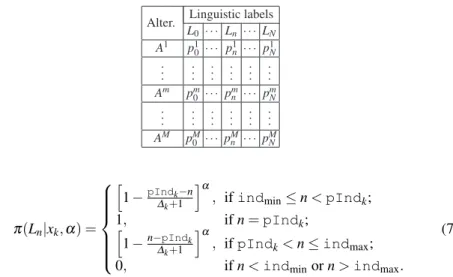
where n = 0, · · · , N. We then obtain a N + 1-tuple probability distribution on the linguistic label set L as follows (p0, · · · , pn, · · · , pN) for each alternative A. The
probability distributions of all alternatives on the label set L are shown in Table 1.
2.2 Involving Expert’s Attitudinal Character in Vague Concepts
Now we introduce a parameterα to model the confidence/certain degree of an ex-pert. It quantifies to what extent the expert is sure that other linguistic labels around the prototype label are appropriate to describe an alterative. With the confidence characterα, we define the possibility distribution of around prototype label xk∈ LTable 1 Probability distribution on the N + 1 labels regarding each alternative Alter. Linguistic labels
L0 · · · Ln· · · LN A1 p1 0 · · · p1n· · · p1N .. . ... ... ... ... ... Am pm 0 · · · pmn · · · pmN .. . ... ... ... ... ... AM pM 0 · · · pMn · · · pMN π(Ln|xk,α) = h 1 −pIndk−n ∆k+1 iα
, if indmin≤ n < pIndk;
1, if n = pIndk;
h
1 −n−pIndk
∆k+1
iα
, if pIndk< n ≤ indmax;
0, if n < indminor n > indmax.
(7)
whereα is a linguistic modifier andα > 0. Whenα> 1 it means that the expert has an optimistic attitude (he is more sure that the prototype label is appropriate to describe an alternative); whenα= 1 it means that the expert has a neutral atti-tude (it is equivalent to the basic model); whenα< 1 it means that the expert has a pessimistic attitude (he is less sure that the prototype label is appropriate to describe an alternative). Without possibility of confusion, the confidence factor will be also called attitude character.
Note that each expert can assign different confidence values according to his preferences or belief. In order to better represent expert’s attitude factor, we in-troduce another parameterβ, whereα = 2β. Although α andβ have continuous forms, for purposes of simplicity, we assign β integer values distributed around 0. For example,β = {−∞, · · · , −3, −2, −1, 0, 1, 2, 3, · · · , +∞}, consequently we get
α = {2−∞· · · , 1/8, 1/4, 1/2, 1, 2, 4, 8, · · · , 2+∞}. In order to help experts conve-niently express their confidence degree, we construct a totally ordered linguistic label set with an odd cardinality. We can define the following set of linguistic labels to represent experts’ confidence degrees.
V = {V0= absolutely unsure,V1= very unsure,V2= unsure,V3= neutral,
V4= sure,V5= very sure,V6= absolutely sure}
α={2−M, 1/4, 1/2, 1, 2, 4, 2M},β= {−M, −2, −1, 0, 1, 2, M}
(8)
where M is big enough positive integer to make sure that [π(Ln|xk)]2
M
→ 0 if indmin≤ n < pIndkor pIndk< n ≤ indmax.
And then according to the procedure mentioned in the basic model, Eqs. (4)-(6), we can infer a collective probability distribution for each alternative.
3 Ranking Based on Target-Oriented Decision Model
After linguistic aggregation, the next step of linguistic MEDM is to exploit the best option(s) using a choice function. Most MEDM process is basically aimed at reach-ing a “consensus”, e.g. [3, 8]. Consensus is traditionally meant as a strict and unan-imous agreement of all the experts regarding all possible alternatives. The decision model presented below assumes that experts do not have to agree in order to reach a consensus. There are several explanations that allow for experts not to converge to a uniform opinion. It is well accepted that experts are not necessarily the decision-makers, but provide an advice [15]. Due to this observation, the linguistic judge-ments provided by the experts does not represent the decision-makers’ preferences. The inferred probability distribution on a set of linguistic labels for each alter-native, as shown in Table 1, could be viewed as a general framework of decision making under uncertainty [14], in which there are N + 1 states of nature, whereas the probability distributions are different. Now let us consider the ranking procedure for the probability distribution on N + 1 linguistic labels in L , as shown in Table 1. We assume that the decision-maker has a target in his mind, denoted as T . We also assume that the target is independent on the set of M alternatives and the linguistic judgements provided by the experts. Based on target-oriented decision model [2], we define the following function
V (Am) = Pr(Amº T ) =
∑
L∈L pm(Am= L) · Pr(L º T ) =∑
N n=0 pm n· Pr(Lnº T ) (9)We assume there exists a probability distribution on the uncertain target regarding each linguistic label Ln, denoted as pT(Ln), where n = 0, · · · , N. Then we define the
following function Pr(Amº T ) =
∑
N n=0 pmn· " N∑
l=0 u(Ln, Ll)pT(Ll) # (10) Recall that the target-oriented model has only two achievement levels, thus we can define u(Ln, Ll) = 1, if Ln≥ Ll; 0, otherwise. Then we can induce the followingvalue function Pr(Amº T ) =
∑
N n=0 pmn· " n∑
l=0 pT(Ll) # (11) Now let us consider two special cases. Without additional information (if the decision-maker does not assign any target), we can assume that the decision-maker has a uniform probability distribution on the uncertain target T , such thatpT(Ln) = 1
N + 1, n = 0, · · · , N. (12) Then we can obtain the value of meeting the uniformly linguistic target as follows:
Pr(Amº T ) = N
∑
n=0 pmn· " n∑
l=0 pLl(T ) # = N∑
n=0 pmn·n + 1 N + 1 (13)If the decision-maker assigns a specific linguistic label Llas his target, the
prob-ability distribution on uncertain target is expressed as pT(Ln) =
½
1, if Ln= Ll;
0, if Ln6= Ll.
where n = 0, · · · , N. Then the probability of meeting target is as follows: Pr(Amº Ll) = N
∑
n=0 pmn· Pr(Lnº Ll) = N∑
n=l pmn (14)Having obtained the utility (probability of meeting target), the choice function for linguistic MEDM model is defined by
A∗= arg max
Am∈A{V (A
m)} (15)
4 Illustrative Example
In this section, we demonstrate the entire process of the probabilistic model via an example borrowed from [7].
A distribution company needs to renew/upgrade its computing system, so it con-tracts a consulting company to carry out a survey of the different possibilities ex-isting on the market, to decide which is the best option for its needs. The op-tions (alternatives) are {A1: UNIX, A2: WINDOWS-NT, A3: AS/400, A4: VMS}.
The consulting company has a group of four consultancy departments as {E1:
Cost anal., E2: Syst. anal., E3: Risk anal., E4: Tech. anal.}.
Each department in the consulting company provides an evaluation vector ex-pressing its opinions for each alternative. These evaluations are assessed in the set L of seven linguistic labels as L = {L0= none, L1= very low, L2= low, L3=
medium, L4= high, L5= very high, L6= perfect}. The evaluation matrix and
weight-ing vector are shown in Table 2.
Table 2 Linguistic MEDM problem in upgrading computing resources Alter. E Experts 1: 0.25 E2: 0.25 E3: 0.25 E4: 0.25 A1 L 1 L3 L4 L4 A2 L 3 L2 L1 L4 A3 L 3 L1 L3 L2 A4 L 2 L4 L3 L2
Now let us apply our proposed model to solve the above problem. The first step is to aggregate linguistic assessments involving vague concepts. With the linguistic evaluation matrix (Table 2), we obtain the minimum and maximum linguistic labels for each alternative according to Eq. (1) as follows:
A1 A2 A3 A4
[L1, L4] [L1, L4] [L1, L3] [L2, L4]
A set of seven linguistic labels, as shown in Eq. (8), is used to represent the con-sultant departments’s confidence degrees. Each concon-sultant department can assign different confidence degrees according to his preference/belief. In this example, we consider two cases:
Case 1: the four departments assign absolutely sure as their confidence degrees.
Case 2: the four departments assign neutral as their confidence degrees.
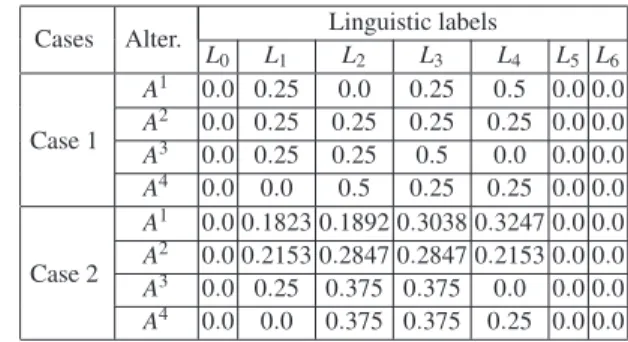
According to linguistic aggregation with vague concepts, proposed in Section 2, we obtain different probability distributions for the four alternatives with respect to different cases, as shown in Table 3.
Table 3 Probability distributions on linguistic labels with respect to different cases Cases Alter. Linguistic labels
L0 L1 L2 L3 L4 L5 L6 Case 1 A1 0.0 0.25 0.0 0.25 0.5 0.0 0.0 A2 0.0 0.25 0.25 0.25 0.25 0.0 0.0 A3 0.0 0.25 0.25 0.5 0.0 0.0 0.0 A4 0.0 0.0 0.5 0.25 0.25 0.0 0.0 Case 2 A1 0.0 0.1823 0.1892 0.3038 0.3247 0.0 0.0 A2 0.0 0.2153 0.2847 0.2847 0.2153 0.0 0.0 A3 0.0 0.25 0.375 0.375 0.0 0.0 0.0 A4 0.0 0.0 0.375 0.375 0.25 0.0 0.0
From Table 3, it is easily seen that when the four departments assign a abso-lutely sure attitude, it means that they are absoabso-lutely sure that a label L is appro-priate for describing an alternative. In this case, the group probability distribution will depend only on the weight information. For instance, for alternative A2under
case 1, the four departments provide their judgements as {L3, L2, L1, L4} and they
have equal weight information, thus the probability distribution on the 7 labels is (0, 0.25, 0.25, 0.25, 0.25, 0, 0).
Now let us rank the four alternatives according to the target-oriented ranking procedure proposed in Section 3. In this example, the four consultant departments provide their advice, but do not make decisions. The true decision-maker is the distribution company. To renew a computer system, the distribution company may simply looks for the first “satisfactory” option that meets some target. Having this in mind, we first assume that the distribution company does not assign his target, i.e., the distribution company has a uniform target T1, which can be represented as
(L0: 1/7, L1: 1/7, L2: 1/7, L3: 1/7, L4: 1/7, L5: 1/7, L6: 1/7) . If the distribution
company can provide a specific label as his target, for example, the company assigns his target as T2= L4= high, it means that the distribution company is satisfactory
to choose an alternative as the best if its performance is at least “good” as high. Table 4 shows the probability of meeting those two targets assigned by the distribu-tion company with respect to four cases of confidence degrees provided by the four consultant departments. From Table 4, option A4(VMS) or A1(UNIX) is the best
choice according to the confidence degrees provided by the four departments and the targets provided by the distribution company.
Table 4 Probability of meeting targets
Cases Targets Alternatives
A1 A2 A3 A4 Case 1 T1 0.5714 0.5 0.4643 0.5357 T2 0.5 0.25 0.0 0.25 Case 2 TT1 0.5387 0.5 0.4464 0.5536 2 0.3247 0.2153 0.0 0.25
5 Discussions
In this section, we shall discuss the relationships between our research and three prior related approaches.
Huynh & Nakamori [9] have proposed a satisfactory-oriented approach to lin-guistic MEDM. In their framework, the linlin-guistic MEDM is viewed as a decision making under uncertainty problem, where the set of experts plays the role of states of the world and the weights of experts play the role of subjective probabilities as-signed to the experts. They then proposed a probabilistic choice function based on the philosophy of satisfactory-oriented principle, i.e., it is perfectly satisfactory to select an alternative as the best if its performance is as least “good” as all the oth-ers. In the aggregation step, such an approach does not directly take into account the underlying vagueness of the labels. The proposed linguistic aggregation some-what generalizes the work provided in [9]. In particular, when all the experts have absolutely sure confidence degree, our linguistic aggregation is equivalent to that given in [9]. For example, under Case 1 of Table 3, the linguistic aggregation results with a probability distribution on the set of linguistic labels, which is dependent on the weights of experts. In the choice function step, although both our approach and that given in [9] are based on the satisfactory-oriented philosophy, we incorporate decision maker’s target preference into the linguistic MEDM problems.
Ben-Arieh & Chen [1] have proposed a so-called FLOWA aggregation operation, which assigns fuzzy membership functions to all linguistic labels by linearly spread-ing the weights from the labels to be aggregated. The aggregatspread-ing result changes
from a single label to a fuzzy set with membership levels of each label. And then the fuzzy mean and standard deviation are used as two criteria to rank the aggre-gation results. Compared with [1], in the aggreaggre-gation step, our approach provides a probabilistic formulation for the linguistic aggregation involving underlying vague-ness of linguistic labels. In addition, our approach can model experts’ confidence degree to quantify the appropriateness of linguistic labels. In the choice function step, our approach considers decision-maker’s requirements.
Tang [17] has proposed a collective decision model based on the semantic sim-ilarities of linguistic labels [18] to deal with vague concepts and compound lin-guistic expressions1. In this approach, a similarity relation matrix < R, L > for a
set of basic linguistic labels is defined beforehand. And then by viewing similarity distribution as possibility distribution, the collective probability distribution on the linguistic label set L is obtained by Eqs. (4)-(6). Finally, two methods are suggested to rank the alternatives: an expected value function and a probabilistic pairwise com-parison method. The expected value function is similar to the ranking function in [1] and the pairwise comparison method is quite similar with the satisfactory-oriented principle proposed in [9]. Compared with our approach, the linguistic aggregation by [17] violates the bounded property of aggregation operation. In addition, the ap-proach in [17] does not consider experts’ confidence degrees. In the choice function step, it does not take into account decision-makers’ requirements.
6 Conclusions
In this paper, we have proposed a probabilistic model for MEDM problem un-der linguistic assessments, which is able to deal with linguistic labels having par-tial semantic overlapping as well as incorporate experts’s confidence degrees and decision-makers’ preference information. It is well known that linguistic MEDM problems follow a common schema composed of two phases: an aggregation phase that combines the individual evaluations to a collective evaluations; and an exploita-tion phase that orders the collective evaluaexploita-tions according to a given criterion, to select the best options. For our model, our linguistic aggregation does not generate a specific linguistic label for each alternative, but a set of labels with a probabil-ity distribution, which incorporates experts’ vague judgements. Moreover, experts’ confidence degree is also incorporated to quantify the appropriateness of linguistic labels other than the prototype label. Having obtained the probability distributions on linguistic labels, we have proposed a target-oriented choice function to establish a ranking ordering among the alternatives. According to this choice function, the decision-maker is satisfactory to select an alternative as the best if its performance is as at least “good” as his requirements.
1The compound linguistic expressions is beyond the scope of our research, thus we only consider
References
1. Ben-Arieh, D., Chen, Z. (2006). On linguistic labels aggregation and consensus measure for autocratic decision-making using group recommendations. IEEE T SYST MAN CY A, 36 (2):558–568.
2. Bordley, R., LiCalzi, M. (2000). Decision analysis using targets instead of utility functions.
DECIS ECON FINAN, 23 (1): 53–74.
3. Bordogna, G., Fedrizzi, M., Passi, G. (1997). A linguistic modeling of consensus in group decision making based on OWA operator. IEEE T SYST MAN CY A, 27 (1): 126–132.
4. Degani, R., Bortolan, G. (1988). The problem of linguistic approximation in clinical decision making. INT J APPROX REASON, 2 (2): 143–162.
5. Delgado, M., Verdegay, J. L., Vila, M. A. (1993). On aggregation operations of linguistic labels. INT J INTELL SYST, 8 (3): 351–370.
6. Dubois, D., Nguyen, H. T., Prade, H. (2000). Possibility theory, probability and fuzzy sets: Misunderstandings, bridges and gaps. In: Dubois, D., Prade, H. (Eds.), Fundamentals of Fuzzy Sets. Mass: Kluwer, Boston, pp. 343–438.
7. Herrera, F., Mart´ınez, L. (2000). A 2-tuple fuzzy linguistic representation model for comput-ing with words. IEEE T FUZZY SYST, 8 (6): 746–752.
8. Herrera-Viedma, E., Herrera, F., Chiclana, F. (2002). A consensus model for multiperson decision making with different preference structures. IEEE T SYST MAN CY A, 32 (3): 394– 402.
9. Huynh, V.-N., Nakamori, Y. (2005). A satisfactory-oriented approach to multi-expert decision-making with linguistic assessments. IEEE T SYST MAN CY B 35 (2): 184–196.
10. Lawry, J. (2001). A methodology for computing with words. INT J APPROX REASON, 28 (2– 3): 51–89.
11. Lawry, J. (2004). A framework for linguistic modelling. ARTIF INTELL, 155 (1–2): 1–39.
12. Lawry, J. (2008). Appropriateness measures: An uncertainty model for vague concepts.
SYN-THESE, 161 (2): 255–269.
13. Lawry, J., Tang, Y. (2009). Uncertainty modelling for vague concepts: A prototype theory approach. ARTIF INTELL, 173 (18): 1539–1558.
14. Savage, L. J. (1954). The Foundations of Statistics. Wiley, New York.
15. Shanteau, J. (2001). What does it mean when experts disagree? In: Salas, E., Klein, G. A. (Eds.), Linking Expertise and Naturalistic Decision Making. Psychology Press, USA, pp. 229–244.
16. Simon, H. A. (1955). A behavioral model of rational choice. QUAL J ECON, 69 (1): 99–118.
17. Tang, Y. (2008). A collective decision model involving vague concepts and linguistic expres-sions. IEEE T SYST MAN CY B, 38 (2): 421–428.
18. Tang, Y., Zheng, J. (2006). Linguistic modelling based on semantic similarity relation among linguistic labels. FUZZY SET SYST, 157 (12): 1662–1673.
19. Zadeh, L. A. (1975). The concept of a linguistic variable and its application to approximate reasoning. INFORM SCIENCES, Part I 8 (3): 199–249, Part II, 8 (4): 301–357, Part III 9 (1): 43–80.
![Fig. 1 Possible prototype label and its appropriate labels under [L 1 ,L 5 ]](https://thumb-ap.123doks.com/thumbv2/123deta/6096518.1075877/6.892.310.588.141.321/fig-possible-prototype-label-and-appropriate-labels-under.webp)