周期的領域に対する数値等角写像
Numerical
Conformal Mapping of Periodic
Structure
Domains
愛媛大学工学部情報工学科 緒方秀教(Hidenori Ogata)
岡野大(Dai Okano)
天野要 (Kaname Amano)
De,
partment of Computer Science, FacuIty ofEngineeringEhime
UniversityAbstract
$l\mathrm{n}$ this paper, we propose anumerical conformal mappingof periodic structure domainsonto periodicparallel$\mathrm{s}\mathrm{l}_{1}^{arrow}\mathrm{t}$ domains- The methodpresentedhereis obtained
byextendingAmano’s methodof numericalconformaI mapping basedonthe charge
simulationmethod. Some numericalexamplesshow that the methodpresentedhere
isefficient. We also applyourmethodtotheanalysisof$\mathrm{p}\mathrm{o}\mathrm{t}\mathrm{e}\mathrm{n}\mathrm{t}\tilde{\iota}\mathrm{a}\mathrm{I}$flowpast obstacles
in a periodic array.
1
Introduction
Conformalmappingis
a
basicproblemincomplexanalysisand is importantinapplicationsto science and engineering, for example, the $\mathrm{a}\mathrm{n}\mathrm{a}\mathrm{I}\mathrm{y}\mathrm{s}i\mathrm{s}$ of two-dimensional potential flow,
electromagnetic fieId, and
so on.
But the exact solution ofcomformal mapping is knownfor few
oases.
Therefore computational method of conformalmappings, that is numericalconformal mapping, has been an attractive problem in numerical analysis. See Henr$i\mathrm{c}\mathrm{i}[5\}$,
$\mathrm{K}\mathrm{y}\mathrm{t}\mathrm{h}\mathrm{e}\mathrm{t}6\iota,$ $\mathrm{N}\mathrm{e}\mathrm{h}\mathrm{a}\mathrm{r}i_{\mathrm{L}}\mathrm{r}7\mathrm{I}$ and $r_{\mathrm{R}\mathrm{e}\mathrm{f}\mathrm{e}\mathrm{t}\mathrm{h}\mathrm{n}[81}\mathrm{e}$ for surveys of numerical conformal mappings.
Amano et al. $\mathfrak{t}^{\iota,2,3}1$ proposed
a
numerical $\mathrm{c}\mathrm{o}\mathrm{n}\mathrm{f}_{\mathrm{o}\mathrm{r}}\mathrm{m}\mathrm{a}1$ mapping basedon
the chargesimulation method, which is
a
fast solver for potential problems. In the method, theproblem of numerical conformal mapping is reduced to the one of approximating the
mapping function, which is expressed by using the charge simulation method, $\tilde{1}.\mathrm{e}.$, the
approximate mapping function is expressed by using a linear combination of complex
logarithmic potentiaIs
$\sum_{j=1}^{N}Q_{j}l\mathrm{o}\mathrm{g}(Z-\zeta j)$, $Q_{j}\in \mathbb{R},$ $\zeta_{j}\in \mathbb{C}(j--\}, 2, \ldots, N)$. (1)
The method
was
applied to the conformal mappings ofmultiplycornected domains ontovarious slit domains and shown to be very efficient from
some
numerical experiments. An$\mathrm{a}\mathrm{p}\mathrm{p}\mathrm{I}_{1\mathrm{C}}^{arrow}\mathrm{a}\mathrm{t}\mathrm{i}\mathrm{o}\mathrm{n}$ to the analysis of potential flows
was
also $\mathrm{p}\mathrm{r}\mathrm{e}\mathrm{s}\mathrm{e}\mathrm{n}\mathrm{t}\mathrm{e}\mathrm{d}[4]$.
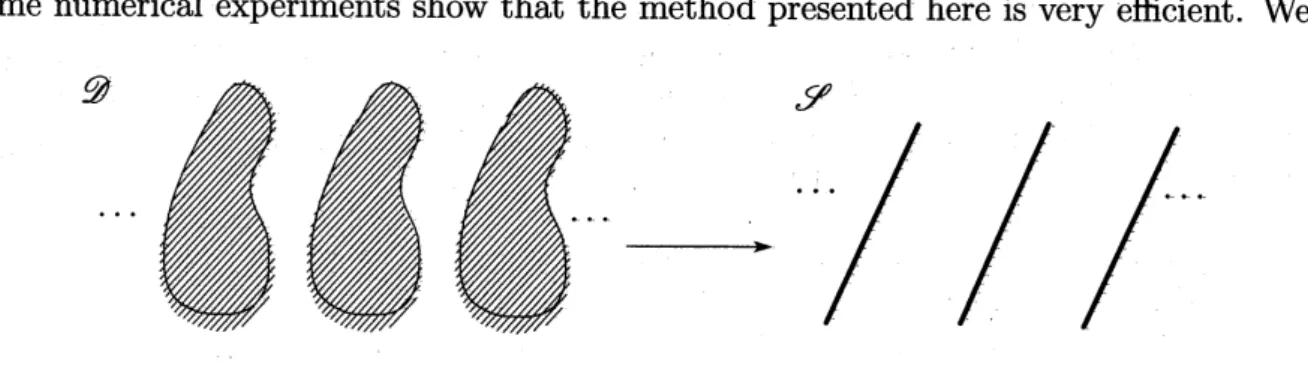
$l\mathrm{n}$ this paper, by extending the above method, we propose a numericai conformal
mapping of periodic structure domains onto periodic parallel slit domains (See Figure
1). In the method presented here, the problem is reduced to the
one
of approximatinga periodic analytic function, which is approximated by a linear combination of periodic
logarithmic potentials
Some numerical experiments show that the method presented here is very efficient. We
Figure 1: ConformaI mapping of the periodic structure domain $\mathscr{D}$ onto the periodic
$\mathrm{p}\mathrm{a}\mathrm{r}\mathrm{a}\mathrm{I}\mathrm{l}\mathrm{e}\mathrm{I}_{\mathrm{S}}\mathrm{I}\mathrm{i}\mathrm{t}$domain $\ovalbox{\tt\small REJECT}$.
also apply
our
methodto the analysis ofpotentialflows past obstaclesin aperiodic array.In section 2, we prepare
some
mathematical notations. In section 3, we propose ourmethod for the numerical conformal mapping ofperiodicstructure domains. In section 4,
we
showsome
numerical examples and applications to the analysis ofpotential flow. Insection 5,
we
conclude this paper and refer to future problems.2
Notations
First
we
defineexactlytheperiodicstructure domain and theperiodic parallelslit domain.Let $a$ be apositive constant.
Let $D_{0}$ be a domain surrounded by a closed Jordan
curve
in $z(=x+iy)$-plane and$D_{m}(m\in \mathbb{Z})$ the domain defined by
$D_{m}=\{Z+ma|z\in D_{0}\}$ (3) which $\mathrm{s}\mathrm{a}\mathrm{t}\mathrm{i}\mathrm{s}\Psi$
$\overline{D_{m}}\cap\overline{D_{\iota-}}-\emptyset$ $(m\neq l)$
.
(4)The periodic structure domain $\mathscr{D}$ is defined
as
the exterior to the domains $D_{m}(m\in \mathbb{Z})$.
$\mathscr{D}=\mathbb{C}\backslash \{_{m\in}\mathrm{U}_{\mathbb{Z}}\overline{Dm}\}-$ (5)
Let $\varphi$ be
an
angle such that $-\pi/2<\varphi\leq\pi/2,$ $w_{0}$ a point in $w(=u+\mathrm{i}v)$-plane, $d$ apositive constant and $S_{m}(m\in \mathbb{Z})$ the rectilinear slit defined by
$S_{m}--\{w_{0}+ma+td\mathrm{e}^{\mathrm{i}\varphi}\}0\leq t\underline{<}1\}$
.
(6)The periodic parallel slit domain $\ovalbox{\tt\small REJECT}$
is defined
as
the exterior to the slits $S_{m}(m\in \mathbb{Z})$.Our problem is tofind numerically
a
conformal mapping $f$ : $\mathscr{D}arrow\ovalbox{\tt\small REJECT}$.
Rom theperi-odic structure of the domains, the mapping functionis expected to satisfy the periodicity
$f(z+a)=f(z)+a$
$(z\in \mathscr{D})$. $l\mathrm{n}$ fact, for a given periodic structure domain$\mathscr{D}$ and
an
angle $\varphi(-\pi/2<\varphi\leq\pi/2)$, there exist
a
periodic parallel slit domain$\ovalbox{\tt\small REJECT}$and
a
conformalmapping $f$ : $\mathscr{D}arrow \mathcal{J}$which satisfies the following properties.
(C1) (boundary condition) $f(\partial D_{m})--S_{m}$ $(m\in \mathbb{Z})$
(C2) (periodicity)
$f(z+a)=f(z)+a$
$(z\in \mathscr{D})$(C3) (asymptotic condition) $f(z)=z+\mathrm{O}(1)$ (${\rm Re} z$ fixed, ${\rm Im} zarrow\pm\infty$ )
We
are
concerned witha
conformal mapping $f$ : $\mathscr{D}arrow\ovalbox{\tt\small REJECT}$ satisfying the properties (C1),(C2) and (C3).
3
Numerical
Conformal
Mapping
In this section, we propose
a
numerical conformal mapping of the periodic structure domain $\mathscr{D}$onto theperiodic parallelslitdomain$\ovalbox{\tt\small REJECT}$
by using the chargesimulationmethod.
The mapping function $f(z)$ of the conformal mapping $\mathscr{D}arrow\ovalbox{\tt\small REJECT}$ is
an
analytic functionin the domain $\mathscr{D}$. Thusthe problem of the numerical
conformal mapping is equivalent to
the
one
of approximating the function $f(z)$ analytic in $\mathscr{D}$.Wewrite the mapping function
as
$f(z)=Z+\mathrm{e}^{(\varphi}\mathrm{i}\pi/2)(z)$, (8)
where $(z)$ is
a function
analytic in $\mathscr{D}$ and periodicwith the period $a$. We approximate
$(z)$ by the charge simulation method.
Rom
the viewpoint offunction
approximation,we
can
say that thecharge simulationmethod is the method of approximating an analytic function by $a$ linear combination of
complex logarithmic potentials
$\sum_{j=1}^{N}Q_{j}\log(z-\zeta j)$, $Q_{j}\in \mathbb{R}_{I}\zeta_{j}\in \mathbb{C}(j=\iota,2, \ldots, N)$. (9)
In
our
case, $(z)$ is a periodic function ofthe period $a$ from the property (C1).$(z+a)=$ $(z)$ $(z\in \mathscr{D})$.
The ordinary formula of the charge simulation method (9), however, is not suitable for
approximatingperiodicfunctions. Weapproximate thefunction$\varphi(z)$ in the following way
by modiPing the formula (9).
where$Q_{j}$ $(j=1,2, \ldots , N)$
are
realcoefficients called the chargesand$\zeta_{j}(j=1,2, \ldots , N)$fixed points in $D_{0}$ called the
char.g
$e$ points. Thus we have the approximate mappingfunction
$f(z) \approx F(z)=Z+\mathrm{e}^{(\varphi}\mathrm{i}\pi/2)\sum_{j=1}^{N}Q_{j}\log\sin[\frac{\pi}{a}(z-\zeta_{j})]$
.
(11)The right hand side of (11) includes complex logarithmic functions. In order to make
$F(z)$ single-valued, we pose on $Q_{j}(j=1,2, \ldots, N)$ the following constraint.
$\sum_{j=1}^{N}Q_{j}=0$. (12)
We can show that the function $F(z)$ is single-valued under the constraint (12) because,
for
an
arbitrary closedcurve
$\overline{C}$surrounding the domain $D_{m}(m\in \mathbb{Z})$,
we
have$\int_{\tilde{C}}\mathrm{d}F(_{Z})$ $=$ $\mathrm{e}^{\mathrm{i}(\varphi}\pi/2)\sum_{1j=}^{N}Q_{j}\int_{\tilde{c}}\mathrm{d}(\log\sin[\frac{\pi}{a}(z-\zeta_{j}-ma)])$
$=$ $2 \pi \mathrm{i}\mathrm{e}^{\mathrm{i}(\varphi}\pi/2)\sum_{j=1}NQ_{j}$
$=$ $0$,
which implies that $F(z)$ is single-valued in $\mathscr{D}$.
We
can
show easily that the approximate mapping function$F(z)$, which is defined by(11) and is subject to (12), satisfies the following properties.
(C2)
(periodicity) $F(z+a)=F(z)+a$ $(z\in \mathscr{D})$(C3)
(asymptotic condition) $F(z)=z+\mathrm{O}(1)$ (${\rm Re} z$ fixed, ${\rm Im} zarrow\pm\infty$)which respectively correspond to the properties (C2) and (C3) of the exact mapping
function $f(z)$.
We treat the boundary condition (C1) in the following way. The condition (C1) is
rewritten as
${\rm Re}\{\mathrm{e}^{\mathrm{i}(\pi/2}\varphi)f(z)\}=u0$ $(z\in\partial D_{0})$, (13)
where $u_{0}$ is areal constant. Instead of (13), we impose on $F(z)$ the followingcondition.
${\rm Re}\{\mathrm{e}^{\mathrm{i}(\pi/2}\varphi)F(z_{i})\}=U_{0}$ $(i=1,2, \ldots, N)$, (14)
where $z_{i}(i=1,2, \ldots, N)$
are
fixed pointson
$\partial D_{0}$ called the collocation points and $U_{0}$approximates the value $u_{0}$. We call (14) the collocation condition.
The condition (14) is rewritten
as
The equalities (12) and (15) form $(N+1)$ simultaneous linear equations with respect
to $Q_{j}$ $(j=1,2, \ldots , N)$ and $U_{0}$. By solving (12) and (15), we determine the charges
$Q_{j}(j=1,2, ..2 , N)$ and obtain the approximate mapping function $F(z)$.
We must modify the expression of the approximate mapping function $F(z)$ (11)
because the function $\log[(\pi/a)(z-\zeta_{j})]$ has its discontinuity
on
the half-infinite line $(-\infty+\mathrm{i}({\rm Im}\zeta j), \zeta j]$ parallel to the real axis, which makes the computation difficult.In
case
thatthe boundary$\partial D_{0}$is starlike with respect to the point $\zeta_{0}$in $D_{0}$, subtracting$0= \sum_{jj}^{N}=1Q\log\sin[(\pi/a)(z-\zeta 0)]$ from the both sides of (11), we have the expression of
the approximate mapping function.
$F(z)=Z+ \mathrm{e}^{(\varphi}\mathrm{i}\pi/2)\sum_{=j1}Qj\log N(\frac{\sin[(\pi/a)(_{Z}-\zeta_{j})]}{\sin[(\pi/a)(_{Z}-\zeta 0)]})$
.
(16)The function $\log(\sin[(\pi/a)(z-\zeta_{j})]/\sin[(\pi/a)(z-\zeta_{0})])$ is continuous in the domain $\mathscr{D}$.
In fact, the function $\sin[(\pi/a)(z-\zeta_{j})]/\sin[(\pi/a)(z-\zeta 0)]$ has only
one zero
at the point $z=\zeta_{j}+ma$ and onlyone
pole ofthe orderone
at the point $z=\zeta_{0}+ma$ in each domain$D_{m}(m\in \mathbb{Z})$. Rom the argument principle, we have
$\int_{\overline{C}}$dlog $( \frac{\sin[(\pi/a)(_{Z}-\zeta_{j})]}{\sin[(\pi/a)(_{Z}-\zeta 0)]})\mathrm{d}z=2\pi \mathrm{i}(1-1)=0$
for
an
arbitraryclosedpath$\overline{C}$surrounding thedomain$D_{m}$, which implies that thefunction
$\log(\sin[(\pi/a)(z-\zeta_{j})]/\sin[(\pi/a)(z-\zeta_{0)}])$ has
no
discontinuityon
the path $\overline{C}$, i.e., the
function $\log(\sin[(\pi/a)(z-\zeta_{j})]/\sin[(\pi/a)(z-\zeta 0)])$ is continuous in the domain $\mathscr{D}$
.
‘,. In $\mathrm{c}a\mathrm{s}\mathrm{e}$ that the boundary $\partial D_{0}$ is not starlike, we
can use
the expression$F(z)=Z+ \mathrm{e}^{(\varphi}\mathrm{i}\pi/2)\sum_{j=1}^{N}\overline{Q}_{j}1\log(\frac{\sin[(\pi/a)(_{Z}-\zeta_{j})]}{\sin[(\pi/a)(z-\zeta_{j+1})]})$, (17)
where $\overline{Q}_{j}=Q_{1}+Q_{2}+\cdots+Q_{j}$ $(j=1,2, \ldots, N-1)$. We can prove that the right
hand side of (17) is continuous in the domain $\mathscr{D}$ in a
similar way to the case that the
boundary $\partial D_{0}$ is starlike. The expression (17) is obtained from (11) inthe following way.
Modifying the right hand side of (11), we have
$F(z)$ $=z+ \mathrm{e}^{\mathrm{i}(\varphi}\pi/2)\{Q_{1}\log\sin[\frac{\pi}{a}(z-\zeta 1)]+\sum_{j=2}^{N}(\overline{Q}j-\overline{Q}j1)\log\sin[\frac{\pi}{a}(z-\zeta_{j})]\}$
$=z+ \mathrm{e}^{\mathrm{i}(\varphi}\pi/2)\{^{N1}\sum_{j=1}\overline{Q}j\log\sin(\frac{\sin[(\pi/a)(_{Z}-\zeta_{j})]}{\sin[(\pi/a)(z-\zeta_{j1}+]})+\overline{Q}_{N}\log\sin[\frac{\pi}{a}(Z-\zeta N)]\}$
4
Numerical Examples
4.1
Examples
of Numerical
Conformal Mappings
We show the examples of the numerical conformal mappings for
some
typical domains.Computations were carried out
on a
SONY PCV-L330A/BP personal computer usingprograms coded in $\mathrm{C}$ with double precision working.
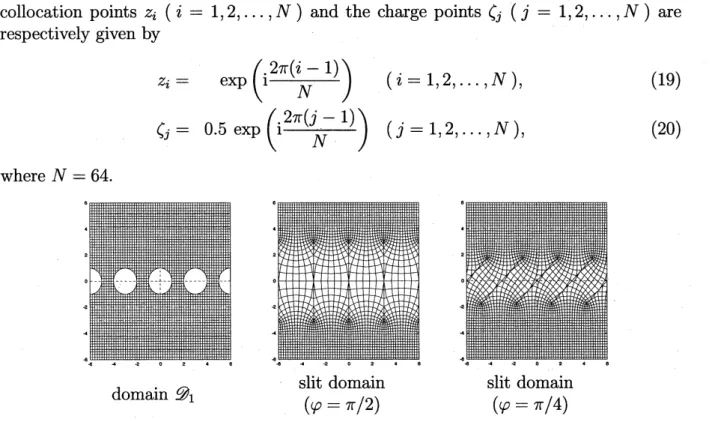
The first example is for the domain exterior to circles in
a
periodic array.$\mathscr{D}_{1}=\{z\in \mathbb{C}||z-3m|>1 (m\in \mathbb{Z})\}$
.
(18)Figure 2 shows the result of the numerical conformal mapping of the domain $\mathscr{D}_{1}$. The
collocation points $z_{i}(i=1,2, \ldots, N)$ and the charge points $\zeta_{j}(j=1,2, \ldots, N)$ are
respectively given by
$z_{i}=$ $\exp(\mathrm{i}\frac{2\pi(i-1)}{N})$ $(i=1,2, \ldots, N)$, (19)
$\zeta_{j}=$ $0.5 \exp(\mathrm{i}\frac{2\pi(j-1)}{N})$ $(j=1,2, \ldots, N)$, (20)
where $N=64$.
slit domain slit domain
domain $\mathscr{D}_{1}$
$(\varphi=\pi/2)$ $(\varphi=\pi/4)$
Figure 2: Numerical conformal mapping of the domain exterior to periodic disks $\mathscr{D}_{1}$.
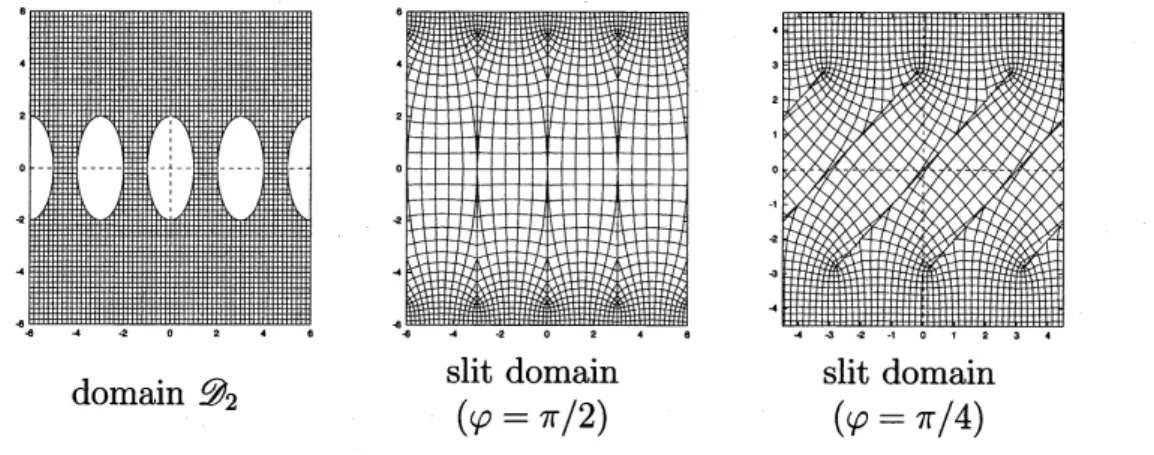
The second example is the domain exterior to ellipses ina periodic array.
$\mathscr{D}_{2}=\{z=x+\mathrm{i}y\in \mathbb{C}|x^{2}+\frac{(y-3m)^{2}}{2^{2}}>1$ $(m\in \mathbb{Z})\}$
.
(21)Figure
3
shows the result of the numerical conformal mapping of the domain $\mathscr{D}_{2}$. Thecollocation points $z_{i}(i=1,2, \ldots, N)$ and the charge points $\zeta_{j}(j=1,2, \ldots, N)$
are
respectively given by ’
$z_{i}=r_{i}\mathrm{e}^{\mathrm{i}\theta_{i}}$
$\theta_{i}=\frac{2\pi(i-1)}{N}$,
$\zeta_{j}=z_{j}+0.5|z_{j+1}-z_{j}1|\exp(\mathrm{i}\arg(z_{j}+1-zj1)+\mathrm{i}\frac{\pi}{2})$ $(j–1,2, \ldots , N)$, (23)
where $z_{0}=z_{N},$ $z_{N+1}=z_{1}$ and $N=64$ (The choise of the points (22) and (23)
was
originally proposed by Amano). We observe from the figure that the boundary of each
ellipse is mapped onto a rectilinear slit.
$\mathrm{s}\iota \mathrm{l}\mathrm{t}$ (lomam
slIt tlomam
domain $\mathscr{D}_{2}$
$(\varphi=\pi/2)$ $(\varphi=\pi/4)$
Figure 3: Numerical conformal mapping of the domain exterior to periodic ellipses $\mathscr{D}_{2}$.
In order to estimate the
error
ofthe numerical conformal mapping, we computed the value$\epsilon=\max_{z\in\partial D_{0}}|{\rm Re}\{\mathrm{e}^{\mathrm{i}(\varphi}\pi/2)F(z)\}-U_{0}|$
,
(24)whichis thedistance between the image of the boundary$\partial D_{0}$ by thenumerical conformal
mapping and the slit $S_{0}$. The value $\epsilon$ does not give the upper bound of the
error
but isexpected to give
a
rough estimate of theerror.
Table 1 shows theerror
estimates $\epsilon$ forthe numerical conformal mappings of the domains $\mathscr{D}_{1}$ and $\mathscr{D}_{2}$. Romthe table, we can say
that the numerical conformal mapping presented here achieves high accuracy, especially
the accuracyof double precision for the domain exterior to circles $\mathscr{D}_{1}$.
Table 1: Error estimate of the numerical conformal mapping.
4.2
Applications
to
Potential Flow Analysis
Our method
can
be applied to the analysis ofpotential flows past obstacles in a periodicarray.
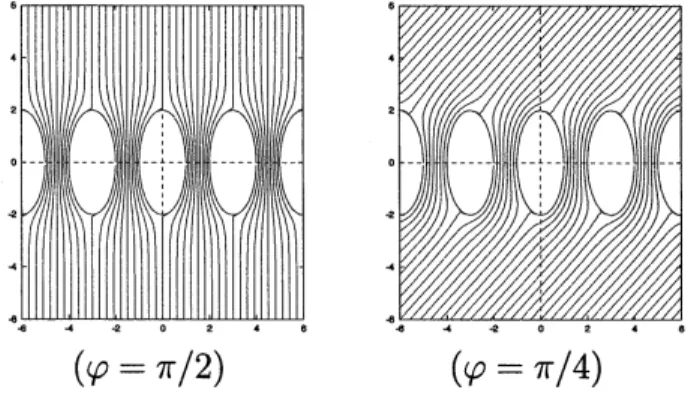
Figure 4 shows the contourlines of the function ${\rm Im}\{\mathrm{e}\mathrm{i}\varphi F(z)\}$, where $F(z)$ is the
approximate mapping function of the domain $\mathscr{D}_{1}$ defined by (18). The figure illustrates
$(\varphi=\pi/\angle)$ $(\varphi=\pi/4)$
Figure 4: Potential flows past cylinders in
a
periodic array.Figure 5 shows the contourlines of the function ${\rm Im}\{\mathrm{e}\mathrm{i}\varphi F(z)\}$, where $F(z)$ is the
approximate mapping function of the domain $\mathscr{D}_{2}$ defined by (21). The figure illustrates
the streamlines of potential flows past ellipses in aperiodic array.
$(\varphi=\pi/\cdot\Delta)$ $(\varphi=\pi/4)$
Figure 5: Potential flows past ellipses in
a
periodic array.5
Conclusions
We presentedin this paper a numerical conformal mapping of periodic structure domains
onto periodic parallel slit domains using the charge simulation method. Numerical
exam-ples in
some
typicalcases
show that the method presented here isveryefficient, especiallyit achieves the accuracy ofdouble precision for the
case
of the domain exterior to circles.As future works,
we are
interested in the following problems.1. Can
we
analyse the dynamicsofmore
practical fluid, for example, Stokesflow, Oseenflow and
so
on, past obstacles in a periodic array?2. Can
we
compute conformal mappings of two-dimensional periodic structure do-mains?References
[1] Amano, K.: A charge simulation method for the numerical conformal mapping of
interior, exterior and doubly-connected domains, J. Comput. Appl. Math., 53(3)
(1994),
353-370.
[2] Amano, K.: A charge simulation method for numerical conformal mapping onto
circular and radial slit domains,
SIAM
J. Sci. Comput., 19(4) (1998),1169-1187.
[3] Amano, K. and Okano, D.: On the numerical conformal mapping of
multiply-connected domains, Information, 2(1) (1999),
17-25.
[4] Amano, K., Okano, D., Shimohira, H., Okamoto, T. and Igaue, Y.: Potential flow
analysis by the numerical conformal mapping, Information, 3(1) (2000),
73-88.
[5] Henrici, P.: Applied and Computational Complex Analysis 3, Wiley, New York, 1986.
[6] Kythe, P. K.: Computational Conformal Mapping, Birkh\"auser, Boston,
1998.
[7] Nehari, Z.: Comformal Mapping, $\mathrm{M}\mathrm{c}\mathrm{G}_{\Gamma}\mathrm{a}\mathrm{w}$-Hill, New York, 1952; Dover, New York,
1975.
[8] $r_{\mathrm{b}\mathrm{e}\mathrm{f}\mathrm{e}\mathrm{t}\mathrm{h}\mathrm{e}\mathrm{n}}$, L. N. (ed.): Numerical Conformal Mapping, North-Holland, Amsterdam,