BRAID INVARIANTS AND INSTABILITY OF PERIODIC
SOLUTIONS OF
TIME-PERIODIC
2-DIMENSIONAL ODE’STakashi MATSUOKA (松岡 隆)
Department of Mathematics, Naruto University ofEducation
e-mail:[email protected]
ABSTRACT. Wepresentatopologicalapproachtothe problemoftheexistence of
unsta-ble periodic solutions for 2-dimensional, timeperiodic ordinary differential equations.
This approach makes useof thebraidinvariant, which isoneof the topological
invari-antsfor periodicsolutions exploitingaconcept in thelow-dimensional topology. Using
the braid invariant, an equivalence relation on the set ofperiodic solutions isdefined.
We prove that any equivalence class consisting of at least two solutions must contain
an unstable one, except one particular equivalenceclass. Also, it is shown that more
than halfofthe equivalenceclassescontain unstablesolutions.
1. INTRODUCTION
Consider a2-dimensional ordinary differential equation of the form:
$\frac{dx}{dt}=f(x, t)$, (1)
where $f$ : $\mathrm{R}^{2}\cross \mathrm{R}arrow \mathrm{R}^{2}$ is aCarath\’eodorymap (i.e.,
$f$ is continuous in$x$for almost aU $t$
and is measurable in $t$ for each$x$) which is periodic with respect to$t$ with period$\omega$ $>0$.
Assume that thereexists auniquesolution $x(t)$ of the initial-valueproblem$x(0)=x_{0}$ for
each point $x_{0}\in \mathrm{R}^{2}$ and this solution is definedon an interval containing $[0, \omega]$. We shall
study the problem of the existence of unstable periodic solutions of (1). The traditional
approachtothisproblemis to make the linear analysis of the related variationalequation,
and it is known that in
some
sense, the linear analysis in the instabilitycase
is easier than that in the stability case (see e.g. [1], [2]). In this paper, we present apurely topological approach to the problem. This approach makesuse
of the braid invariant, which is one of the topological invariants for periodic solutions exploiting aconcept in the low-dimensional topology (see [4], [9] for asurvey). We shall only treat periodicsolutions having period$\omega$ in order to make the argument simpler.
The detailed version of this paper will appear in Topological Methods in Nonlinear Analysis Vol. 14
数理解析研究所講究録 1220 巻 2001 年 123-127
2. BRAIDS OF pERIODIC SOLUTIONS
Here
we
shall define abraid for agiven set of$\omega$-periodic solutions. For generalrefer-ences on
braid theory, see, e.g., [3], [6]. Let $n$ be apositive integer. We call asubset $B$of the product $\mathrm{R}^{2}\cross[0, \omega]$
an
$n$-braidif the following conditions hold:(i) $B$ is aunion of mutually disjoint $n$ simple arcs,
(ii) Each
arc
joins apoint $(x, \mathrm{O})\in S\cross\{0\}$ to $(\tau(x), \omega)\in S\cross\{\omega\}$, where $S$ is aset of $n$ distinct pointson
the plane $\mathrm{R}^{2}$ and $\tau$ is apermutation defined on $S$.(iii) Each
arc
intersects every plane $\mathrm{R}^{2}\cross\{t\}$, $0\leq t\leq\omega$, exactlyonce.
These
axes are
called the strings in $B$.
For
an
$\omega$-periodic solution4of
(1), let$\mathrm{s}\mathrm{t}\mathrm{r}(\xi)$ denote the simple arc in $\mathrm{R}^{2}\cross[0, \omega]$
defined by
$\mathrm{s}\mathrm{t}\mathrm{r}(\xi)=\{(\xi(t),t)|0\leq t\leq\omega\}$.
We call this
arc
the string corresponding to4.
In this paper,
we
shall alwaysassume
that the equation (1) has only finitely many$\omega$-periodic solutions.
Definition 1. Let $P$ be aset of$\omega$-periodic solutions of (1), and $n$ the cardinality of$P$.
Since the strings corresponding to the solutions in $P$
are
mutually disjoint, the union$\bigcup_{\xi\in \mathcal{P}}\mathrm{s}\mathrm{t}\mathrm{r}(\xi)$ of these strings forms
an
$n$-braid denoted by $b(P)$.
We call it the braid of$P$.
3. AN EQUIVALENCE RELATION ON PERIODIC SOLUTIONS
Definition 2. Let $B$ be abraid. Aunion $B_{0}$ of strings in $B$ is called ablock in $B$ if
there is asubset $T$ of$\mathrm{R}^{2}\cross[0, \omega]$ such that
(i) $T$ is theimage of
some
embedding $\mathrm{A}:D\cross[0,\omega]arrow \mathrm{R}^{2}\cross[0,\omega]$, where $D$ is acloseddisk, with $\Lambda(D\cross\{t\})\subset \mathrm{R}^{2}\cross\{t\}$ foreach $t$
.
(ii) If
we
denote by $T_{t}$ the $t$-slice of$T$, i.e. the set $\{x\in \mathrm{R}^{2}|(x,t)\in T\}$, then we have$T_{0}=T_{\omega}$
.
(iii) $B_{0}=B\cap T$
.
We call $T$
an
isolating tube for $B_{0}$ with respect to $B$.
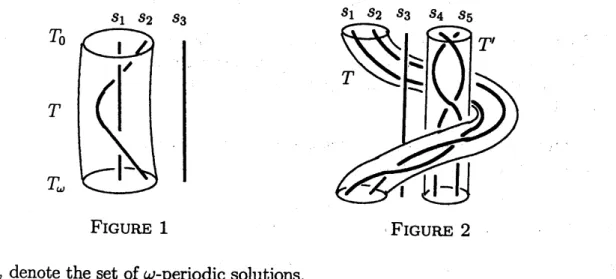
Example 1. It is clearthat $B$ is ablock in itself, and any string in $B$ is also ablock in $B$. We give non-trivialexamples in Figure 1and Figure 2. Let $B$ be the braid consisting
ofthree strings $s_{1}$,$s_{2}$,$s_{3}$
as
in Figure 1. Then the union $B_{0}=s_{1}\cup s_{2}$ is ablock in$B$,
and the set $T$ drawn here gives
an
isolating tube for $B\circ\cdot$ On the other hand, $s_{1}\cup s_{3}$ isnot ablock, Indeed, if it
were
ablock, then the string $s_{2}$ winds around $s_{1}$ and $s_{3}$ in thesame
number of times. However, these winding numbersare
1and 0respectively, and hencewe
get acontradiction. Considernext the braid $B$as
inFigure 2. Then $s_{1}\cup s_{2}$ and $s_{4}\cup s_{5}$axe
blocks in $B$ with isolating tubes$T$,$T’$ respectively. Also, $s_{3}\cup s_{4}\cup s_{5}$ is clearlyablock. Furthermore,
we
can
findan
isolating block for the union $s_{2}\cup s_{3}\cup s_{4}\cup s_{5}$, andso
this union is ablock.$s_{3}$
$T_{0}$
$T$ $|$
$T_{\omega}$
FIGURE 1 FIGURE 2
Let $P_{\omega}$ denotethe set of
$\omega$-periodic solutions.
Definition 3. Two $\omega$-periodic solutions $\xi_{1}$ and $\xi_{2}$
are
said to be equivalentif the braid$b(\{\xi_{1}, \xi_{2}\})=\mathrm{s}\mathrm{t}\mathrm{r}(\xi_{1})\cup \mathrm{s}\mathrm{t}\mathrm{r}(\xi_{2})$forms ablock in
$\mathrm{b}(\mathrm{V}\mathrm{J})$
.
The choice of the term “equivalent”in this definition is reasonable
as
the followingproposition shows:
Proposition 1. The relation on $P_{\omega}$
defined
above is an equivalencerelation.
Example 2. (a) Suppose the equation (1) has three $\omega$-periodic solutions $\xi_{\dot{1}}$, $i=1,2,3$
and the braid $b(P_{\omega})$ is
as
in Figure 1, where $s_{i}=\mathrm{s}\mathrm{t}\mathrm{r}(\xi_{\dot{1}})$. Then $\xi_{1}$ and $\xi_{2}$are
equivalent,since $b(\{\xi_{1}, \xi_{2}\})=s_{1}\cup s_{2}$ is a block in $B=b(P_{aJ})$. However, $\xi_{3}$ is not equivalent to
$\xi_{1}$,
since $s_{1}\cup s_{3}$ is not ablock. Thus, there
are
two equivalence classes$\{\xi_{1},\xi_{2}\}$, $\{\xi_{3}\}$
.
(b) Secondly, suppose (1) has five $\omega$-periodic solutions $\xi_{i}$, $i=1$,
$\ldots$ , 5, with the braid
$b(P_{\omega})=s_{1}\cup\cdots\cup s_{5}$
as
in Figure 2, where$s:=\mathrm{s}\mathrm{t}\mathrm{r}(\xi_{i})$. Then, considering winding
numbers also in this case, we
see
easily that there are three equivalence classes $\{\xi_{1},\xi_{2}\}$, $\{\xi_{3}\}$, and $\{\xi_{4}, \xi_{5}\}$.It should be noted that there is
one
exceptional equivalence class for whichour
mainresults, which will be stated in the next section,
are
not valid. This is the equivalenceclass consisting of the $” \mathrm{p}\mathrm{e}\mathrm{r}\mathrm{i}\mathrm{p}\mathrm{h}\mathrm{e}\mathrm{r}\mathrm{a}\mathrm{l}" \mathrm{s}\mathrm{o}\mathrm{l}\mathrm{u}\mathrm{t}\mathrm{i}\mathrm{o}\mathrm{n}\mathrm{s}$defined below:
Definition 4. An $\omega$-periodic solution $\xi$ is said to be
peripheral if
one
of the following conditions holds:(i) $P_{\omega}=\{\xi\}$, i.e., there
are no
other$\omega$-periodic solutions.(ii) There
are
at least two$\omega$-periodic solutions and $b(P_{\omega}-\{\xi\})$ is ablockin $b(P_{v}‘)$
.
Proposition 2. The set
of
peripheral solutionsfor
$ms$ an equivalence class.We call this class consisting of all the peripheral solutions the peripheral equivalence class, and any other equivalence class anon-peripheral equivalence class. The equation (1) may not have any peripheral solution. In this case, the peripheral equivalence class is an empty set.
Example 3. If $P_{\omega}$ is
as
in Example 2(a), then$\xi_{3}$ is peripheral, since $b(P_{\omega}-\{\xi_{3}\})=$
$s_{1}\cup s_{2}$ is ablock. Therefore, $\{\xi_{3}\}$ is the peripheral equivalence class. Also, if $P_{\omega}$ is
as
in Example 2(b), then $\{\xi_{1}, \xi_{2}\}$ is the peripheral equivalence
class,
since$b(P_{\omega}-\{\xi_{1}\})=$
$s_{2}\cup s_{3}\cup s_{4}\cup s_{5}$is ablock and this
means
that $\xi_{1}$ is peripheral,4. EXISTENCE OF UNSTABLE SOLUTIONS
Definition 5. (cf. [7]) Asolution$x_{0}$ of(1) defined for $0\leq t<\infty$ is stable(or Ljapunov
stable) iffor any $\epsilon>0$, thereis
a
$\delta$ $>0$suchthatevery solution$x(t)$ with $|x(0)-x_{0}(0)|<$ $\delta$ is defined for all $0\leq t<\infty$ and satisfies $|x(t)-x_{0}(t)|<\epsilon$ for any $t$.
Otherwise, $x_{0}$ issaid to be unstable.
Theorem 1. Any non-peripheral equivalence class consisting
of
at least two u-periodic solutions containsan
unstableone.
In the
case
ofan
equivalence class with onlyone
element, the following propositionprovides asufficient condition for its instability:
Proposition 3. Suppose
an
$\omega$-periodic solution $\xi_{0}$ is not peripheral and is a uniqueelement in its equivalence class. Assume that there is a subset $P$
of
$P_{\omega}$ containing40
such that $b(P)$ and $b(P-\{\xi_{0}\})$
are
blocks in$b(P_{\omega})$.
Then40
is unstable.Theorem 1and Poroposition 3would suggest that not afew equivalence classes have
an
unstable solution. In fact, the following theoremholds:
Theorem 2. More than
half of
the non-peripheral equivalence classes containan
unsta-ble $\omega$-periodic solution.
Example 4. (a) Suppose $P_{\omega}$ has the braid
as
in Figure 3. Then $\{\xi_{4}\}$ is the peripheralequivalenceclass, and the non-peripheral equivalence classes
are
$E_{1}=\{\xi_{1}, \xi_{2}\}$ and $E_{2}=$$\{\xi_{3}\}$
.
Since $E_{1}$ has two solutions, by Theorem 1, at leastone
of these solutions isunstable. Also, $\xi_{3}$ satisfies the assumption ofProposition 3with$P$ $=\{\xi_{1},\xi_{2},\xi_{3}\}$
.
Hence$\xi_{3}$ is unstable. Thus,
both
$E_{1}$ and $B\infty \mathrm{n}\mathrm{t}\mathrm{a}\mathrm{i}\mathrm{n}$an
unstable solution.(b) We show that the estimate of the number of equivalence classes with unstable solutions given in Theorem 2is the best possible one, by constructing
an
example.Consider the quotient space $X$ obtained from the torus $T^{2}=\mathrm{R}^{2}/\mathrm{Z}^{2}$ by identifying each
point $x\in T^{2}$ with $-x$
.
Apoint of $X$ represented by $x\mathrm{w}\mathrm{i}\mathrm{U}$ be denoted by thesame
symbol $x$
.
It is easy tosee
that $X$ is homeomorphic to asphere$S^{2}$
.
Let $A$ be thematrix $(\begin{array}{ll}5 22 1\end{array})$
.
Then $A$ induces ahomeomorphismon
$X$ denoted by $g_{A}$.
$g_{A}$ has sixfixed points, $s_{0}$ $=(0,0)$, $s_{1}=(1/4, -1/4)$, $s_{2}=(1/2,0)$, $s_{3}=(1/2,1/2)$, $s_{4}=(0,1/2)$,
and $s_{5}=(1/4,1/4)$
.
Since $s_{2}$,$s_{3}$,$s_{4}$are
degenerate fixedpoints, theyare
unstable. Since$s_{1}$ and $s_{5}$
are
twisted saddles,one can
alter these fixed points to stableones
by alocalmodification of$g_{A}$
near
these points without addingnew
fixed points. Identify $X-s_{0}$with the plane $\mathrm{R}^{2}$
.
Thenthe restriction of$g_{A}$ to $X-s_{0}$ gives
an
orientation-preservinghomeomorphism $g$ :
$\mathrm{R}^{2}arrow \mathrm{R}^{2}$
.
Wecan
choosean
isotopy from id to$g$, and
so we
get avector fieldon
$\mathrm{R}^{2}\cross[0,\omega]$ which induces atime-periodic equation (1). This equationhas five $\omega$-periodic solutions $\xi_{1}$,
$\ldots$ ,$\xi_{5}$ which correspond to $s_{1}$,$\ldots$ ,$s_{5}$ respectively. We
see
that the braid $b(P_{\omega})$ isas
in Figure 4. Therefore each$\omega$-solution is non-peripheraland is the unique element in its equivalence class. Thus, there
are
five non-peripheral equivalence classes.Since
$\xi_{1}$,$\xi_{5}$are
stable and the other threeare
unstable, exactly threeof them consist of unstable solutions
$\mathrm{F}_{\mathrm{I}\mathrm{G}\mathrm{U}\mathrm{R}\mathrm{E}}3$
$\mathrm{F}^{\backslash }\mathrm{I}\mathrm{G}\mathrm{U}\mathrm{R}\mathrm{E}3$ FIGURE 4
The results of this paper
are
proved by using acombination ofthe Nielsen fixed pointtheory and the
Nielsen-Thurston
classification theory ofsurface maps up to isotopy. Remark.
The content of this paper is closelyrelated to that ofaprevious paper [8] of the author. It considersan
orientation-preserving embeddingof the 2-dimensional closed disk into itself, and includessome
results on the existence ofunstable fixed points for such embeddings. Consider thecase
where the initial-values of the$\omega$-periodic solutionsof (1)
are
contained in adisk$D$ which is mapped into itself under the Poincare operator$U$ : $\mathrm{R}^{2}arrow \mathrm{R}^{2}$
associated with (1). Then
we can
apply the results in [8] to theembedding$U$ : $Darrow D$, and
we
obtain several resultson
the existenceof unstable $\omega$-periodic
solutions of(1). These results
are
slightly stronger than those given here, since theyare
valid for all equivalence classes including the peripheral
one.
In this sense, the presentpaper can be regarded as a generalization of [8] to the general
case
where $U$ may nothave an invariant disk.
REFERENCES
[1] J. Andres, Existence, uniqueness, andinstability oflarge-period harmonics tothe third-Order
non-linearordinary differential equations, J. Math.Anal. Appl. 199 (1996), 445-457.
[2] J. Andres, Concluding remarks to problem of Moser and conjecture ofMawhin, Annal. Math. Silesianae 10 (1996),57-65.
[3] J. S. Birman, Braids, Links, and Mapping Class Groups, Ann. Math. Studies, vol. 82, Princeton
Univ. Press, Princeton, 1974.
[4] P. Boyland, Topological methods in surface dynamics, Topology andits Appl. 58 (1994), 223-298.
[5] A. Fathi, F.Laudenbach, mdV.Po\’enaru, 2}uvaux de Thurstonsurles surfaces,Asterisque66-67
(1979).
[6] V. L. Hansen, Braids and Coverings: Selected Topics, London Math.Soc. Student Texts 18,
Cam-bridge Univ. Press, Cambridge, 1989.
[7] M.A. KrasnoseFskii, The OperatorofRanslation Along the Trajectories of
Differential
Equations,Translations ofMath. Monographs, vol. 19,Amer. Math. Soc. 1968.
[8] T. Matsuoka, Fixedpoint index and braid invariantfor fixedpoints
of
embeddings on the disk, toappearin Top. Appl.
[9] F. A. McRobieandJ. M. T. Thompson, Braids andknots in driven oscillators, InternationalJ. of
Bifurcation and Chaos 3(1993), 1343-1361.
[10] W.P. Thurston, On thegeometry anddynamicsofdiffeomorphisms ofsurfaces, Bull. Amer. Math.
Soc. 19 (1988), 417-431