Japan Advanced Institute of Science and Technology
https://dspace.jaist.ac.jp/
Title A New Approach to Graph Recognition and Applications to Distance-Hereditary Graphs Author(s) Nakano, Shin-ichi; Uehara, Ryuhei; Uno, Takeaki Citation Journal of Computer Science and Technology,
24(3): 517-533 Issue Date 2009
Type Journal Article
Text version author
URL http://hdl.handle.net/10119/9179
Rights
This is the author-created version of Springer, Shin-ichi Nakano, Ryuhei Uehara and Takeaki Uno, Journal of Computer Science and Technology, 24(3), 2009, 517-533. The original publication is available at www.springerlink.com,
http://dx.doi.org/10.1007/s11390-009-9242-3 Description
A New Approach to Graph Recognition and Applications
to Distance-Hereditary Graphs
Shin-ichi Nakano1, Ryuhei Uehara2, and Takeaki Uno3
1Department of Computer Science, Faculty of Engineering, Gunma University, Gunma 376-8515, Japan. 2School of Information Science, Japan Advanced Institute of Science and Technology, Ishikawa 923-1292,
Japan.
3National Institute of Informatics, Tokyo 101-8430, Japan.
E-mail: [email protected], [email protected], [email protected] Received MONTH DATE, YEAR.
Abstract
Algorithms used in data mining and bioinformatics have to deal with huge amount of data efficiently. In many applications, the data are supposed to have explicit or implicit structures. To develop efficient algorithms for such data, we have to propose possible structure models and test if the models are feasi-ble. Hence, it is important to make a compact model for structured data, and enumerate all instances efficiently. There are few graph classes besides trees that can be used for a model. In this paper, we in-vestigate distance-hereditary graphs. This class of graphs consists of isometric graphs and hence contains trees and cographs. First, a canonical and compact tree representation of the class is proposed. The tree representation can be constructed in linear time by using prefix trees. Usually, prefix trees are used to maintain a set of strings. In our algorithm, the prefix trees are used to maintain the neighborhood of vertices, which is a new approach unlike the lexicographically breadth-first search used in other studies. Based on the canonical tree representation, efficient algorithms for the distance-hereditary graphs are proposed, including linear time algorithms for graph recognition and graph isomorphism and an effi-cient enumeration algorithm. An effieffi-cient coding for the tree representation is also presented; it requires d3.59ne bits for a distance-hereditary graph of n vertices and 3n bits for a cograph. The results of coding improve previously known upper bounds (both are 2O(n log n)) of the number of distance-hereditary graphs and cographs to 2d3.59ne and 23n, respectively.
Keywords algorithmic graph theory, cograph, distance-hereditary graph, prefix tree, tree
representa-∗ The extended abstract was presented at the 4th Annual Conference on Theory and Applications of Models
of Computation (TAMC07). This work was partially done while the second and third authors were visiting ETH Z¨urich, Switzerland.
tion.
1
Introduction
Data-driven computations are of interest for
data mining, bioinformatics, etc. Such
com-putations process huge amounts of data; they find and classify knowledge automatically. For these purposes, we sometimes assume that the data is structured, and such structures can be observed implicitly or explicitly. More precisely, we assume a possible structure for the data, and then enumerate them and test if the assump-tion is feasible. The frequent pattern discovery problem in data mining is a typical example, and it has been widely investigated (see, e.g., [1, 2, 3, 4]). Once a feasible model is found, we solve the problem at hand for the structured data. However, these structures are relatively primitive from the graph algorithmic point of view, and there are many unsolved problems for more complex structures.
We have to attain three efficiencies to deal with the complex structures: the structure has to be represented efficiently; essentially differ-ent instances have to be enumerated efficidiffer-ently; and the properties of the structure have to be checked efficiently. Except for studies on trees [5, 6, 7, 8, 9], there have been few studies from the viewpoint of efficiency.
A variety of graph classes have been
pro-posed and studied [10, 11]. Since the early
work by Rose, Tarjan, and Lueker [12], the lex-icographic breadth first search (LexBFS) has
played an important role as a basic tool to recognize several graph classes. The LexBFS gives us a simple ordering of vertices based on the neighborhood-preferred manner (see [13] for further details).
We use prefix trees instead of LexBFS. A prefix tree, which is also known as a trie [14], represents a set of strings and enable one to check whether a given string is included in the set or not. We regard a string as a set of neigh-bors of a vertex and maintain the strings of all vertices with a prefix tree. By using two prefix trees corresponding to two different neighbor-hoods, we can efficiently find a pair of vertices having identical (or similar) neighbors. This is a different approach from the previously known algorithms based on LexBFS [15, 16].
We apply the above idea to distance-hereditary graphs. Distance in graphs is one of the most important topics in algorithmic graph theory, and there are many applications that have geometric properties that can be repre-sented by graphs. Distance-hereditary graphs were characterized by Howorka [17] as a means of dealing with the geometric distance property called isometric, which means that all induced paths between pairs of vertices have the same length. More precisely, a distance-hereditary graph is a graph in which the distance between any pair of vertices u and v will be the same on any vertex induced connected subgraph con-taining u and v. Intuitively, any longer path
between them has a shortcut on any vertex in-duced subgraph. (Without loss of generality, we will assume that the distance-hereditary graph is connected.)
There has been some research on charac-terizing distance-hereditary graphs [18, 19, 20]. In particular, Bandelt and Mulder [18] showed that any distance-hereditary graph can be
ob-tained from K2 by a sequence of extensions
called “adding a pendant vertex” and
“split-ting a vertex.” Many efficient algorithms on
distance-hereditary graphs are based on this characterization [21, 22, 23, 24, 25, 26]. We will show that the extensions can be efficiently found on prefix trees that represent two differ-ent neighborhoods of vertices.
The class of distance-hereditary graphs con-tains two well known graph classes: trees and cographs. Cographs can be obtained by a se-quence of “splitting a vertex” extensions from K2 and an efficient tree representation, called a cotree, is known (see, e.g., [16] for further details). Recently, distance-hereditary graphs attract attention again; Oum showed that a graph is distance-hereditary if and only if it has rank-width at most 1 in his thesis [27]; Chan-dler et al. investigate probe versions of distance-hereditary graphs and cographs [28], and Gioan and Paul give a characterization by using split decomposition with a simple recognition algo-rithm [29].
Our study presented here makes two key contributions to the topic of distance-hereditary
graphs. First, we propose a compact and canon-ical tree representation. This is a natural gener-alization of a cotree, which is the tree represen-tation of cographs. Secondly, we show a linear time and space algorithm that constructs the tree representation for any distance-hereditary graph. The linear time and space algorithm in-volves two key ideas. The first idea is using two prefix trees, one for open and another for closed neighborhoods. This idea allows us to efficiently find “twins,” which are obtained by splitting a vertex. The second idea is introduc-ing a vertex orderintroduc-ing named “levelwise laminar ordering,” which allows us to remove pendant vertices efficiently. The levelwise laminar order-ing is weaker than the LexBFS orderorder-ing. These results have the following applications.
(1) The graph isomorphism problem can be solved in linear time and space. This was con-jectured by Spinrad in [30, p.309], but it was not explicitly shown.
(2) The recognition problem can be solved in linear time and space. Our algorithm is much simpler than the previously known recognition algorithm for the class (see [15, Chapter 4]); the original Hammer and Maffray’s algorithm [20] fails in some cases, and Damiand, Habib, and Paul show a correct algorithm in [15]. However, the correct algorithm requires one to build the cotree of a cograph in linear time as a subrou-tine. The subroutine can be implemented by using a classic algorithm due to Corneil, Perl,
and Stewart [31], or a recent algorithm based on the multisweep LexBFS approach by Bretscher, Corneil, Habib, and Paul [16]. (Note that the recent result by Gioan and Paul also gives an-other linear time recognition algorithm for the class [29].)
(3) For given n, all distance-hereditary graphs with at most n vertices can be enumerated in O(n) time per graph with O(n2) space.
(4) We propose an efficient encoding of a
distance-hereditary graph. Any
distance-hereditary graph with n vertices can be rep-resented in at most d3.59ne bits. This encod-ing gives us an upper bound on the number of distance-hereditary graphs of n vertices: there are at most 2d3.59ne non-isomorphic distance-hereditary graphs with n vertices. Applying the technique to cographs, each cograph of n ver-tices can be represented in at most 3n bits, and hence the number of cographs of n vertices is at most 23n. These upper bounds are improve-ments on the previously known upper bounds of 2O(n log n) [30, p.20,p.98].
2
Preliminaries
The neighborhood of a vertex v in a graph G = (V, E) is the set N (v) = {u ∈ V | {u, v} ∈ E}. We denote the closed neighborhood N (v)∪ {v} by N [v]. For a vertex subset U of V , we
de-note the set {v ∈ V | v ∈ N(u) for some u ∈
U} by N(U), and the set {v ∈ V | v ∈
N [u] for some u∈ U} by N[U]. A vertex set C is a clique iff all pairs of vertices in C are joined by an edge in G. If a graph G = (V, E) itself is a clique, it is said to be complete and is denoted by Kn, where n = |V |. Given a graph G = (V, E)
and a subset U of V , the induced subgraph by U , denoted by G[U ], is the graph (U, E0), where E0 = {{u, v} ∈ E | u, v ∈ U}. For a vertex w, we sometimes denote the graph G[V \ {w}] by G− w for short. Two vertices u and v are said to be twins iff N (u)\ {v} = N(v) \ {u}. For twins u and v, we say that u is a strong sibling of v iff {u, v} ∈ E, and a weak sibling iff {u, v} 6∈ E. We also say strong (weak) twins iff they are strong (weak) siblings. If a vertex v is a strong or weak twin of another vertex u, we simply say that they are twins and v has a sib-ling u. Since twins are transitive, we say that a vertex set S with |S| > 2 comprises strong (weak) twins iff each pair in S consists of strong (weak) twins. In this paper, we will order the vertices. For an ordered vertex set, let S be a set of twins. Then, we call v ∈ S a larger sibling of S if v > v0 for some other v0 ∈ S with respect to the ordering. That is, every sibling in S is a larger sibling, except the smallest one, which will be called the smallest sibling of S. Note that it is easy to find a larger sibling for given S; take arbitrary two twins, and pick the larger one.
For two vertices u and v, the distance be-tween the vertices, denoted by d(u, v), is the minimum length of the paths joining u and
v. We extend the neighborhood recursively
as follows: For a vertex v in G, we define
N0(v) := {v} and N1(v) := N (v). For k > 1, Nk(v) := N (Nk−1(v))\ (∪ki=0−1Ni(v)). That is,
Nk(v) is the set of vertices of distance k from v.
In this paper, the following graph operations play an important role; (α) pick a vertex x in G and add a new vertex x0 with an edge {x, x0}, (β) pick a vertex x in G and add x0 with edges {x, x0} and {x0, y} for all y ∈ N(x), and (γ) pick
a vertex x in G and add x0 with edges{x0, y} for all y ∈ N(x). For operation (α), we say that the new graph is obtained by attaching a pendant vertex x0 to the neck vertex x. In (β) and (γ), it is easy to see that x and x0 are strong and weak twins, respectively. In this case, we say that the new graph is obtained by splitting the ver-tex x into strong and weak twins, respectively. It is known that the class of cographs is charac-terized by the above operations as follows (see, e.g., [31] for characterizations of cographs): Theorem 1 A connected graph G with at least two vertices is a cograph iff G can be obtained from K2 by a sequence of operations (β) and (γ).
These operations are also used by Bandelt and Mulder to characterize the class of distance-hereditary graphs [18]:
Theorem 2 A connected graph G with at least two vertices is distance-hereditary iff G can be obtained from K2 by a sequence of operations (α), (β), and (γ).
We add one pendant vertex in (α), and split a vertex into two siblings in (β) and (γ). In this paper, we also use the following generalized op-erations for k > 1; (α0) pick a neck x in G and add k pendants to x; (β0) pick a vertex x in G and split it into k + 1 strong siblings; and (γ0) pick a vertex x in G and split it into k + 1 weak siblings.
For a vertex set S ⊆ V of G = (V, E), the contraction of S into s ∈ S is obtained as fol-lows: (1) for each edge {v, u} with v ∈ S \ {s}
and u ∈ V \ S, add an edge {u, s} to E; (2)
replace multiple edges by a single edge; and (3) remove all vertices in S\ {s} from V and their associated edges from E.
Let v1, v2, . . . , vn be an ordering of a
ver-tex set V of a connected distance-hereditary
graph G = (V, E). Let Gi denote the graph
G[{vi, vi+1, . . . , vn}] for each i. The ordering is
a pruning sequence iff Gn−1 is K2 and Gi can be
obtained from Gi+1 by either attaching a
pen-dant vertex vi or splitting some vertex v ∈ Gi+1
into twins v and vi for each i < n − 1. (In
other words, Gi+1 is obtained from Gi by
ei-ther pruning a pendant vertex vi or
contract-ing some twins vi and v ∈ Gi+1 into v for each
i < n− 1.) For a connected cograph G, the pruning sequence of G is defined similarly only by splitting vertices.
Two graphs G = (V, E) and G0 = (V0, E0) are isomorphic iff there is a one-to-one
{φ(u), φ(v)} ∈ E0 for every pair of vertices
u, v ∈ V . We say that G ∼ G0 if they are iso-morphic.
2.1
Open and closed prefix trees
and basic operations
Here, we introduce the prefix trees of open and closed neighbors. These are used for detecting strong twins, weak twins, pendants, and necks efficiently. The details of the notion of a prefix tree, which is also called a trie, can be found in standard textbooks; see, e.g., [14].
Let V be an ordered set of vertices (here-after, we assume that the vertices are numbered from 1 to |V | in some way). A prefix tree for a family of subsets of V is a rooted tree T sat-isfying the following conditions (the vertices of prefix trees are called nodes to distinguish them from the vertices in V ). Except the root, each node in T is labeled by a vertex in V , and some nodes are (doubly) pointed to by vertices in V . The labels of a prefix tree satisfy the following two conditions; (1) if a node with label v is the parent of a node of label v0, then v0 > v, and (2) no two children of a node have the same label. Note that two or more nodes in T can have the same label (the name of a vertex of V ), but each vertex in V has exactly one pointer to a node in T .
We will maintain N (v) and N [v] = N (v)∪ {v} for all vertices in G by using two prefix trees as follows. The path of a prefix tree from a node
x to the root gives a set of labels (or vertex set in G), denoted by set(x). If x is pointed to by a vertex v, we consider that set(x) is associated with v. In this manner, we can use the two pre-fix trees to represent two families of open neigh-borhoods and closed neighneigh-borhoods by consid-ering the neighbor set as the associated set. We call these prefix trees the open and closed pre-fix trees, and denote them by T (G) and T [G], respectively. Intuitively, sorting N (v) and N [v] defines a unique sequence L(v) of vertices v for
each v ∈ V (G), and merging common prefixes
of those sequences{L(v) | v ∈ V (G)} generates the open prefix tree T (G) and the closed prefix tree T [G], respectively.
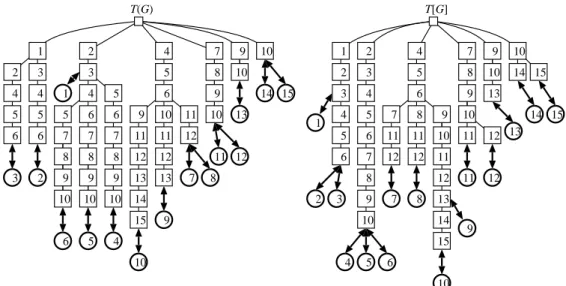
The prefix trees T (G) and T [G] for the distance-hereditary graph G in Figure 2(1) are depicted in Figure 1. Each square is a node la-beled by a vertex in G except the root. Each circle indicates a vertex in G, and the thick ar-rows are (double) pointers to the corresponding node. That is, a vertex in a circle has a neighbor set that appears on the path from the pointed node to the root, and they are incrementally ordered from the root to the node.
We can make it so that every leaf of the pre-fix tree is pointed to by at least one vertex (since leaves pointed to by no vertices are redundant). Thus, the size of the prefix tree is O(n + m). Here, we clarify the data structure for the pre-fix tree. A prepre-fix tree is represented by the set of its nodes, and each node has the pointer to its parent. The children of a node x is maintained
by a doubly linked list of pointers to the chil-dren, and the list is in x. Thus, we can get the parent of a node in constant time, but finding a specified child (by a label) takes linear time in the number of children. We assume that the pointers between a parent and its children are doubly linked. Hence, when an algorithm deals with a child v, the algorithm can remove the pointer to v in O(1) time in the doubly linked list to the children located in its parent.
Lemma 3 For any given graph G = (V, E), T [G] and T (G) are constructed in O(n + m) time and space.
Proof. In general, a prefix tree of a given fam-ily can be constructed in linear time. To make the paper self-contained, we describe the con-struction algorithm for the open prefix tree in Algorithm 1. Note that while every vertex in G points to exactly one node in T , some nodes x in T have a list of vertices in G pointing to x.
Algorithm 1: Construction of the open prefix tree
Input : Graph G = (V, E) with V ={1, 2, . . . , n}; Output: T (G);
// In 1-4, sort neighbors of all vertices by bucket sort
P (v) :=∅ for each v ∈ V ;
1
foreach v = 1, 2, . . . , n do
2
insert v to P (u) for each u∈ N(v);
3
end
4
// Hereafter, construct prefix tree level-by-level
initialize T as a tree with one root node
5
(initially) pointed to by every vertex of G; foreach k = 0, 1, 2, . . . , maxv∈V |P (v)| do
6
foreach node x on the kth depth of T
7
(in increasing order) do
foreach vertex v pointing to x (in
8
increasing order) do
if |P (v)| > k then let u be
9
the (k + 1)th vertex in P (v); if x has no child with label u
10
yet then create the child y of x with label u;
update so that v points to y;
11 end 12 end 13 end 14 return T as T (G). 15
The computation time of Algorithm 1 is O(n + m). The first loop sorts the
neighbor-hood of each vertex by bucket sort. The second loop constructs the prefix tree level-by-level. In the kth loop, we create all the children of the nodes on the (k− 1)th depth. This is done by making a child each kth neighbor in P (v) for each v ∈ V .
Note that step 10 can be done in O(1) time; we put a “mark” y on vertex u in V when node y is made. All marks of vertices in V for x are cleared after step 12.
The closed prefix tree can be constructed in
a similar way. 2
From the definitions, we can immediately have the following observations.
Observation 4 Let u and v be any vertices in G. Then, (1) u is the pendant of the neck v iff a child of the root of T (G) has label v and is pointed to by u; (2) u and v are strong twins iff u and v point to the same node in T [G]; and (3) u and v are weak twins iff u and v point to the same node in T (G).
We have to update the prefix trees effi-ciently. Hence, Algorithm 2 for removing a node from a prefix tree is a key procedure:
Algorithm 2: Delete a vertex from a pre-fix tree
Input : Open (or closed) prefix tree T (G) (or T [G]), vertex w in V to be deleted;
Output: Open (or closed) prefix tree T (G− w) (or T [G − w]);
let x be the unique node pointed to by w;
1
while x is a leaf node and pointed to by
2
no vertex except w do delete x and set x to be its own parent;
foreach node x with label w do
3
let y be the parent of node x;
4
foreach vertex v pointing to node x
5
do update so that v points y;
remove x from the list of children in y;
6
let Lx and Ly be the lists of children
7
nodes of x and y, respectively;
merge Lx and Ly to obtain the list of
8 children of y ; delete x from T ; 9 end 10 return T . 11
For a graph G = (V, E) and a vertex w,
Algorithm 2 correctly obtains T (G − w) and
T [G − w] from T (G) and T [G], respectively. We now analyze the complexity of Algorithm
2. The node x pointed to by the vertex w
has an ancestor with label v iff w ∈ N(v) or
w ∈ N[v]. Thus, the number of ancestors of the node pointed to by w is at most|N[w]|, and hence steps 1 and 2 can be done in O(|N[w]|)
time. Moreover, the number of nodes with label w is bounded by |N[w]|. Hence, the loop from steps 3 to 10 will be repeated at most |N[w]| times. Steps 4, 6, 7, 9, and 10 can be done in O(1) time, and step 5 can be done in O(|N[w]|) time. Therefore, our main task is to evaluate step 8, which merges two lists of nodes x and y. Generally, lists Lx and Ly may contain nodes
having the same label. In such cases, we have to unify the nodes by merging the two lists Lx
and Ly. We here call this operation unification.
However, we will show in Lemmas 22 and 24 that in our algorithm Lx and Ly never have a
common node; thus, no unification occurs. This is the key to our linear time algorithm.
3
Canonical trees
In this section, we introduce the notion of the DH-tree, which is a canonical tree represen-tation of a distance-hereditary graph. First, we define the DH-tree derived from a distance-hereditary graph G. Although it is canonical, it is still redundant. Hence, we next introduce the normalized DH-tree, which will be used as the canonical and compact representation of a distance-hereditary graph.
Any cograph is a distance-hereditary graph. The normalized DH-tree for a cograph G co-incides with the cotree, which is a known tree representation of a cograph. That is, the nor-malized DH-tree is a natural generalization of the cotree.
3.1
DH-tree
derived
from
a
distance-hereditary graph
We will deal with K1 (single vertex) and K2
(two vertices joined by an edge) as special distance-hereditary graphs. Hence, hereafter, we assume that G = (V, E) is a connected distance-hereditary graph that contains at least three vertices. For given distance-hereditary graph G = (V, E), we define three families of vertex sets as follows;
S :={S | x, y ∈ S if N[x] = N[y] and |S| > 2}, W :={W | x, y ∈ W if N(x) = N(y), |W | > 2,
and |N(x)| = |N(y)| > 1},
P :={P | x, y ∈ P if x is a pendant vertex and y is its neck}.
Note that when y is the neck of two pendant vertices x1 and x2, P contains the set P with {x1, x2, y} ⊆ P . Moreover, we have the follow-ing observation.
Lemma 5 For each P inP, P contains exactly one neck with associated pendants.
Proof. Since each pendant has degree 1, if P contains two necks y and y0, y is a pendant of the neck y0, and vice versa. This implies that G is K2, which contradicts to the assumption. 2 Now we show that the families give disjoint sets. More precisely, for any pair of sets S1 and S2 in S ∪ W ∪ P, S1∩ S2 = ∅. (Note that we haveS ∪ W ∪ P ⊆ V , or some vertices may not belong to any vertex set.)
Lemma 6 Let v be any vertex in a distance-hereditary graph G. Then v belongs to either (1) exactly one set in S ∪ W ∪ P, or (2) no set in the families.
Proof. If v belongs to no set, we have nothing to do. Hence, we assume that v belongs at least one set. We now have three cases.
(1) v is in a set P in P. Then we have two
subcases. First, we assume that v is a pendant. Then there is a unique neck u in P , and by Lemma 5, it is easy to see that v 6∈ P0 in P with P 6= P0. Here, |N(v)| = |{u}| = 1; hence v 6∈ W for any W ∈ W. On the other hand, N [v] = {u, v}; hence there is no other vertex v0 with N [v0] = N [v] except v0 = u. However, N [u] = N [v] implies that G ∼ K2, which is a contradiction. Thus v6∈ S for any S ∈ S.
Next, we assume that v is a neck in some P in P. Then there is a pendant u of v. Ac-cording to a similar argument to the one above, there is no other set P0 ∈ P that contains v. Moreover, the only neighbor of u is v. Hence there is no other vertex v0 with N (v) = N (v0) and N [v] = N [v0] (except v0 = u, which implies G ∼ K2, a contradiction). Thus, P is the only set containing v.
(2) v is in S for some set S inS. By (1), there is
no set P ∈ P that contains v. We first assume
that there is another set S0 ∈ S with v ∈ S0. Then it is easy to see that for any u ∈ S and u0 ∈ S0, N [u] = N [u0](= N [v]). Hence we have S = S0, which is a contradiction. Now we
as-sume that there is another set W ∈ W with
v ∈ W . By assumption, N[v] = N[u] for some u in S, and N (v) = N (w) for some w in W . Since u, v ∈ S, {u, v} ∈ E. Therefore, we have N (w) = N (v) ∪ {u} and hence {u, w} ∈ E. This contradicts the fact that N [v] = N [u] and {v, w} 6∈ E.
(3) v is in W for some set W inW. By (1) and (2), there is no set P ∈ P and S ∈ S that con-tains v. To derive a contradiction, we assume
that another W0 in W contains v. Then it is
easy to see that W = W0, which is a contradic-tion.
Therefore, the family S ∪ W ∪ P define
dis-joint sets of V . 2
Lemma 7 For any distance-hereditary graph G, S ∪ W ∪ P 6= ∅.
Proof. By Theorem 2, G can be generated by a sequence of operations. For the last operation
of the sequence, we have a non-empty set. 2
Here, we introduce the notion of the DH-tree derived from a distance-hereditary graph G, which is a rooted ordered tree where each in-ner node has a label (we again use the notation “node” for a DH-tree (and prefix tree) to dis-tinguish from a “vertex” in G). The label of an inner node is one of{s, w, p}, which indicate strong twin, weak twin, and pendant with neck, respectively.
For given distance-hereditary graph G = (V, E), the DH-tree derived from G is defined
recursively from leaves to the root. We have three basic cases:
(1) G = K1: The DH-tree derived from K1 is defined by a single root with no label.
(2) G = Kn: When G ∼ Kn with n > 2, the
DH-tree of G is defined by a single root with la-bel s and n leaves with no lala-bels. The tree rep-resents that Kn can be obtained from a single
vertex K1 by splitting it into n strong siblings. (3) G = Sn, where Sn is a star with n > 2
ver-tices that consist of a center vertex with n− 1 pendant vertices. In this case, we define the DH-tree derived from G as a DH-tree with a single root with label p and n leaves with no labels. Note that the tree is ordered. The leftmost child of a node with label p indicates the neck. That is, the leftmost leaf corresponds to the center of the star, and the n− 1 leaves correspond to the n− 1 pendants.
Note that the cases are disjoint. In particu-lar, K2 is a clique, and not a star. Hence, the root with label p of a DH-tree has at least three children. Note also that the number of leaves of the tree is the number of vertices in G. This fact is an invariant for the DH-tree.
We now define the DH-tree T derived from
G = (V, E) with |V | = n > 2 in the general
case. We assume that G is neither Kn nor a
star of n vertices. We start with n leaves of T ; they are initially independent. Since each leaf inT corresponds to a vertex v in G, we identify the leaf with v hereafter. Then, by Lemmas 6
and 7, we can group the leaves into three kinds
of families S, W, and P with S ∪ W ∪ P 6= ∅.
Let S be any set inS. We make a common
par-ent with label s of the leaves. We repeat this process for each S in S. For each set W in W, we similarly make a common parent with label w. Let P be any set inP. Then, by Lemma 5, P contains exactly one neck v and some pendants u. We make a common parent with label p for them, and make the neck v the leftmost child of the parent. The pendants are placed to the right of the neck in arbitrary ordering.
Next, we contract each vertex set U inS∪W
into any vertex u ∈ U on G. Each vertex u
corresponds to a parent in the resultant T and
we identify these correspondences. For each
P ∈ P, we also prune all pendant vertices
ex-cept the unique neck in P . The neck
corre-sponds to the parent of the nodes in P .
We repeat the process until the resultant graph becomes one of the basic cases, and we obtain the DH-tree T derived from G = (V, E). An example of a distance-hereditary graph G and the DH-tree derived from G are depicted
in Figure 2 and Figure 3, respectively. The
twins are contracted by removing all siblings except the smallest one. Each node in the DH-tree corresponds to a vertex in the distance-hereditary graph and is depicted in Figure 3. Note that the DH-tree itself does not store in-formation.
Theorem 8 We can construct the DH-tree T derived from G iff G is a distance-hereditary graph.
Proof. Due to Bandelt and Mulder in [18], G is distance-hereditary iff G has a pruning se-quence. Hence, we can prove the theorem by using simple induction for the number of the
vertices of G with Lemmas 6 and 7. 2
Corollary 9 (1) For any distance-hereditary graph G, the DH-tree derived from G is uniquely determined.
(2) The DH-tree T derived from a distance-hereditary graph G = (V, E) requires O(|V |) space.
Proof. (1) The corollary is true from the fact that the families S, W and P are uniquely de-termined.
(2) By definition, the number of leaves of T is equal to |V |. Moreover, every inner node of T has at least two children. Thus, the number of inner nodes is at most |V |, which implies the
corollary. 2
The following characterization will be used later.
Lemma 10 Let G be a distance-hereditary graph that contains at least two vertices, and T be the DH-tree derived from G. Let d be the diameter of T . Then we have the following; (a) d> 2,
(b) each inner node has at least two children, (c) each inner node has a label, either p, s or
w, and each leaf has no label,
(d) the label of the root is p or s, and
(e) any non-leftmost child of a node with label p is not w.
Proof. The above statements except the last one immediately come from the definition. State-ment (e) is true since a weak neighbor of a
pen-dant is always a penpen-dant. 2
3.2
Normalized
DH-tree
of
a
distance-hereditary graph
Section 3.1 introduced the notion of the DH-tree derived from a distance-hereditary graph G = (V, E). However, such a graph can be re-dundant.
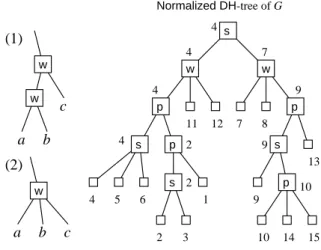
As a rule (β) can be replaced by (β0), if a node x with the label “w” is the parent of the other nodes y with the label “w,” x and y can be weak siblings in the same level (in Figure 4, the case (1) can be replaced by (2)). The same reduction can be applied to the nodes with the label “s.”
Hence, we introduce the notion of the nor-malized DH-tree of a distance-hereditary graph G, which is obtained from the DH-tree derived from G by applying the reduction repeatedly as possible as we can (see the right tree in Figure 4 which is the normalized DH-tree obtained from the DH-tree in Figure 3). Lemma 10 also holds for the normalized DH-tree. Below, we prove two lemmas for a normalized DH-tree.
Lemma 11 From a given DH-tree derived from a distance-hereditary graph G = (V, E), the normalized DH-tree of G can be constructed in O(|V |) time and space.
Proof. The reduction can be done by using the
standard depth first search. Hence, the
nor-malized DH-tree T of G can be obtained from
the DH-tree T0 derived from G in O(|T |) =
O(|T0|) = O(n) time and space. 2 The height of a node on a rooted tree is the distance from it to the farthest node in its de-scendants. (Hence the height of a leaf is 0.) Lemma 12 For any distance-hereditary graph G = (V, E), let T be the DH-tree derived from G. Let x be any node in T and y be its parent. Assume that x and y have the same label and are reduced in the normalized tree. Then, the height of y does not change in the normalized DH-tree of G.
Proof. Without loss of generality, we assume that x and y have the same label w. If all chil-dren of y have the same label w, they form a set of weak twins, which is a contradiction. Hence y has at least one child z that has a different label. Among them, we assume that z has the largest height. We show that the height of y is given by z, not by x. To derive a contradiction, we assume that z is lower than x. Recall that the DH-tree is derived from leaves to root. Hence, when z is lower than x, z and other lower nodes are merged by the algorithm and we obtain y with label w. Then y cannot be the parent of
x, which contradicts the assumption that y is the parent of x. Hence, the height of y does not
change in the normalized tree. 2
Lemma 12 immediately leads to the following lemma:
Lemma 13 For any distance-hereditary graph G, let T and T0 be the DH-tree derived from G and the normalized DH-tree of G, respectively. Then, the roots of T and T0 have the same height.
Proof. To prove this lemma, all we need to do is use Lemma 12 and simple induction on the
height of the roots of trees. 2
In order to characterize the normalized DH-tree, we begin with some definitions. Let x be a node of a normalized DH-tree having label p. The leftmost child of p is called a neck child, and the other children are called pendant chil-dren. For any node x in a (normalized) DH-tree T , let C(x) denote the set of children of x and L(x) denote the leaves in C(x). Then, a peel operation at a node x in T is defined as fol-lows; (1) if L(x) = C(x), remove all children of x; (2) if L(x) ⊂ C(x) and L(x) ∈ W ∪ S, re-move all children of x except one leaf; and (3) if L(x)⊂ C(x) and L(x) ∈ P, remove all children of x. The peel operation forT is defined by the union of peel operations at all inner nodes in T . Intuitively, a peel operation corresponds to a contraction of twins in a set U of W ∪ S or
pruning pendants in a set P of P. Hence, we
Observation 14 Let G = (V, E) be a distance-hereditary graph, T be the normalized DH-tree of G, and S, W, and P be the families of ver-tex sets defined by twins and pendants on G. Let G0 be the distance-hereditary graph which is obtained from G by contracting all twin sets in S ∪ W and pruning pendants in P. Then, the normalized DH-tree of G0 is coincides with the DH-tree obtained fromT by performing the peel operation on T .
Lemma 15 Let G be a distance-hereditary graph that contains at least two vertices, and T be a normalized DH-tree. Let d be the diameter of T . Then the following statements are true. (a) a parent and its children do not have the same label if the parent has label s or w,
(b) the root is a center of the tree,
(c) if the root has two children, the label of the root is s, the labels of the children are both w or both p, and d is even, and
(d) if the label of the root is p, at least two non-leftmost children of the root have the maximum height among the children of the root.
Proof. Statement (a) is immediately by defi-nition of a normalized DH-tree. With careful analysis of the construction of the DH-tree de-rived from G, we can see that any inner node x has at least two children of the same height that gives the height of x. Hence the root of the DH-tree derived from G is a center of the tree. Thus, we can use Lemmas 12 and 13 to prove (b).
To prove (c), we suppose that the root has two children. Then by the same argument for (a), the two children have the same height that gives the height of the root. Hence, d is even. By definition, the root has label s, and the la-bels of its children are p or w. If the root has label s and two children have different labels p and w, this implies that in the last step of the construction of DH-tree, the last graph would be a star, which is a contradiction.
The last statement (d) can be obtained from a similar argument to the one for (a); the height of the root is given by at least two non-leftmost
children. 2
Now we can state the compact and canonical representation of a distance-hereditary graph: Theorem 16 The normalized DH-tree of a connected distance-hereditary graph is canoni-cal. That is, the normalized DH-tree T for any given connected distance-hereditary graph G is uniquely determined, and the original distance-hereditary graph G is uniquely constructed from the normalized DH-tree T up to isomorphism. Proof. By Corollary 9(1), the DH-tree T0 de-rived from a given distance-hereditary graph G is uniquely determined. Moreover, the normal-ized DH-tree T does not change with the order of the normalization process. Hence, the nor-malized DH-treeT for G is uniquely determined from G.
Let T be the normalized DH-tree which is constructed from a distance-hereditary graph
G. We show that the original G can be recon-structed fromT by induction on the diameter d of T . Note that when T contains just the root, we have d = 0. Hereafter, we assume d> 2 from Lemma 10(a). Next we assume that d = 2. If G is Kn or a star with n > 1 vertices, it is easy to
see that G can be uniquely reconstructed from T . Suppose that G is neither Kn nor a star
with n vertices. Then, T has diameter 2 if and only if V produces exactly one set in S, W, or P. However, V ∈ S implies G is Kn, V ∈ W
implies G is an independent set of n vertices, and V ∈ P implies G is a star with n vertices, which are contradictions. Thus, G is one of the basic cases when d6 2.
Let T have diameter d > 2, and assume that any DH-treeT0 of diameter less than d can uniquely generate the corresponding distance-hereditary graph G0. Let L0 be the set of leaves in T . Among them, let L be the set of leaves that give the diameter d of G; that is, for each v ∈ L, there is another vertex u (in L) with d(u, v) = d. The set L can be partitioned into distinct sets L1, L2, . . . , Lksuch that Licontains
the leaves with a common parent. Then, each common parent of a set Li is labeled by w, s, or
p. Recall that, at first, each leaf corresponds to a vertex in G.
Let T00 be the DH-tree obtained by peeling T . Then, form Observation 14, we have two cases: either the diameter d00 < d or d00 = d. In either case, as similar discussion to the one in the proof of Lemma 15 shows that G is uniquely
reconstructed fromT . 2
Corollary 17 The normalized DH-tree T for a distance-hereditary graph G = (V, E) requires O(|V |) space.
3.3
Cotree for a cograph
By the characterizations in Theorems 1 and 2, the normalized DH-tree for a cograph only con-sists of the nodes of labels s and w. This notion of the tree representation for a cograph is known as the cotree, and appears in many studies, e.g., [16, 31, 15]. We note that only the nodes of label p require the ordering of children in the normal-ized DH-tree. Hence the cotree of a cograph is a labeled rooted non-ordered tree.
4
Levelwise laminar
order-ing
For maintenance of a pendant vertex in a distance-hereditary graph, we introduce a tech-nical vertex ordering, called levelwise laminar ordering. Note that for any distance-hereditary graph G and r in G, Nk(r) induces a (not
nec-essarily connected) cograph, and this fact plays an important role in previous papers [18, 15]. The levelwise laminar ordering is weaker than the fact.
We first define the notations N+
v (u), Nv−(u),
and Nv0(u) as follows. We fix any vertex v in G = (V, E). Then, for each u ∈ V , N+
v (u)
the set Nd(u,v)−1(v)∩ N(u), and Nv0(u) denotes
the set Nd(u,v)(v)∩N(u). We define Nv−(v) :=∅
for any v ∈ V .
Let V be a set of n vertices. Two sets X and Y are said to be overlapping iff X∩ Y 6= ∅, X\ Y 6= ∅, and Y \ X 6= ∅. A family F ⊆ 2V is
said to be laminar iffF contains no overlapping sets; that is, any pair of two distinct sets X and Y in F satisfies either X ∩ Y = ∅, X ⊆ Y , or Y ⊆ X. Then any distance-hereditary graph has the following laminar structure:
Lemma 18 ([18, Theorem 3(4)]) Let G = (V, E) be a distance-hereditary graph. Let r be any vertex in V . Then the family {Nr−(v)| v ∈ Nk(r)} is laminar for any k > 1.
Lemma 18 is proven in [18, Theorem 3(4)]; this lemma is one of five properties that characterize the class of distance-hereditary graphs. In other words, Lemma 18 is necessary, but not suffi-cient condition for distance-hereditary graphs. For example, C6 also has the laminar property although it is not distance-hereditary.
Let G = (V, E) be a distance-hereditary graph, and r be any vertex in V . Hereafter, we fix r and call it the root of the ordering. Now, we introduce a new notion of an ordering (v1 = r, v2, . . . , vn) of vertices in V . We write
vi < vj for two vertices vi and vj if i < j. If
a vertex ordering satisfies the following condi-tions, we call it a levelwise laminar ordering: (L1) For any vi ∈ Nk(r) and vj ∈ Nk0(r),
i < j holds if 06 k < k0.
(L2) For any vi, vj ∈ Nk(r), k> 1, i < j holds
if Nr−(vj)⊂ Nr−(vi).
(L3) Let vi, vj be any vertices in Nk(r), k> 1,
i < j such that Nr−(vi) = Nr−(vj).
Then we have Nr−(vi) = Nr−(vj) = Nr−(v)
for all vertices vi < v < vj.
By Lemma 18, any distance hereditary graph has a levelwise laminar ordering.
Lemma 19 Let u be a pendant of a neck v. When u is not the root of the levelwise order-ing, v < u.
Proof. The only neighbor of u is v. Hence u will not be numbered before v when u is not
the root. 2
Lemma 20 The levelwise laminar ordering of a distance-hereditary graph G = (V, E) can be computed in O(|V | + |E|) time and space.
Proof. First, we fix the root r. Then we or-der the vertices by the standard breadth first search from r by using a queue as follows; first, the queue Q is initialized by r, and while Q is not empty, we pick up the first element v from Q and number it, and put the unnum-bered vertices in N (v)\ Q into the last part of Q. This proves (L1). Next, for (L2), we com-pute the ordering of the vertices in Nk(r) for
each k = 1, 2, . . .. For each k, we have to solve the following subproblem for X = Nk−1(r) and
Input: Bipartite graph G0 = (X∪Y, E0) with X = {x1, x2, . . . , xn}, Y = {y1, y2, . . . , ym},
and E0 ⊆ X × Y .
Output: If there are yi, yj in Y such that
N (yi) and N (yj) overlap, output “No,” else
output the ordering over Y such that yi < yj
if N (yj)⊂ N(yi).
If the problem can be solved in O(|X|+|Y |+ |E0|) time and space, we have (L2) in linear
time. The vertices in X and Y are maintained in the usual arrays. To simplify the algorithm,
we add a universal vertex y0 to Y such that
N (y0) = X. We first sort Y0 :={y0, y1, . . . , ym}
such that |N(y0)| > |N(y1)| > |N(y2)| > · · · > |N(yn)| by bucket sort. (Ties are broken by the
original ordering.) Then, if Y can be sorted
in a levelwise laminar ordering, the ordering already satisfies (L2) since N (y) ⊆ N(y0) im-plies |N(y)| 6 |N(y0)|. Hence, it is sufficient to check if they do not overlap. To check that, we define the last(x) for each vertex x in X; last(x) = yj indicates that the last vertex set
containing x is N (yj). Hence, we can determine
if some N (yj0) overlaps N (yj) with yj < yj0,
since N (yj0) contains two vertices x and x0 with
last(x)6= last(x0). The algorithm is as follows:
Algorithm 3: Laminar ordering in a level Input : A bipartite graph
G00 = (X∪ Y0, E00) with X ={x1, x2, . . . , xn},
Y0 ={y0, y1, y2, . . . , ym}, and
E00 = E0∪{{y0, xi} | 1 6 i 6 n};
Output: Y0\ {y0};
sort Y0 such that |N(y0)| > |N(y1)| >
1
|N(y2)| > · · · > |N(yn)| by bucket sort;
foreach i = 1, 2, . . . , n do set
2
last(xi) := y0;
foreach j = 1, 2, . . . , m do
3
check if all vertices x in N (yj) have
4
the same last(x), and output “No” if not;
update last(x) := yj for all vertices x
5 in N (yj); end 6 return Y0\ {y0}. 7
Showing the correctness of Algorithm 3 is
easy. It is not difficult to see that
Algo-rithm 3 runs in O(|X| + |Y0| + |E00|) time and
space. Moreover, the algorithm is stable for
the breadth first search; ties are broken in the breadth first search manner, which implies (L3). Hence, we can compute a levelwise laminar ordering of a distance-hereditary graph G =
(V, E) in O(|V | + |E|) time and space. 2
Note that the levelwise laminar ordering is a partial order, and it is weaker than the LexBFS order.
im-portant role for the deletion of pendants. To use the ordering in the deletion algorithm, we have to show that contraction of twins and deletion of pendants do not spoil the ordering.
Lemma 21 Let (v1, v2, . . . , vn) be a levelwise
laminar ordering of a distance-hereditary graph G = (V, E). Then G−viis a distance-hereditary
graph and (v1, v2, . . . , vi−1, vi+1, . . . , vn) is a
lev-elwise laminar ordering of G− vi if vi is either
(1) a pendant in G, or (2) a larger sibling in G.
Proof. By Theorem 2, G − vi is a
distance-hereditary graph. Hence we show that
(v1, v2, . . . , vi−1, vi+1, . . . , vn) is a levelwise
lam-inar ordering of G− vi in each case. We first
observe that the deletion of vi has some effect
on the vertices only in N (vi).
(1) When vi is a pendant with i > 1, Nr−(v)
does not change for all vertices v in V \ {vi}.
If vi = v1, (v2, v3, . . . , vn) is a levelwise laminar
ordering of G− vi since N (v1) ={v2}.
(2) Let w be a smaller sibling of vi. We have two
cases. First, we assume that w 6= r = v1. Since w and vi are twins, d(r, w) = d(r, vi). Thus
w and vi are in Nk(r) for some k. Hence, for
any vertex x, Nr−(x) contains both w and vi or
none of them. Therefore, removing vi has no
effect on the inclusion relation between Nr−(x) and Nr−(x0) for any x and x0. The other case
is that w = r = v1. Then vi ∈ N1(r) and
N [w] = N0(r)∪ N1(r) if S ∈ S, or vi ∈ N2(r)
and N (vi) = N1(r) if S ∈ W. In any case, re-moving vi does not violate the properties (L1),
(L2), and (L3). 2
5
Linear time construction
of canonical trees
In this section, we give linear time algorithms for constructing the cotree of a cograph and the DH-tree of a distance-hereditary graph. From
Lemma 6 and Observation 4, a set W ∈ W
(resp., S ∈ S) corresponds to a set of vertices pointing to the same node in T (G) (resp., T [G]).
From Lemma 5, a set P ∈ P contains one neck
v. Then, by Lemmas 5 and 6, and Observation 4, the set P corresponds to a node x of depth 1 in T (G) such that (1) x has label v, (2) at least one vertex in G points to x, and (3) all vertices in P \ {v} point to x. The outline of the con-struction of the canonical tree for a cograph or a distance-hereditary graph is;
(0. sort the vertices in the levelwise laminar ordering,)
1. construct the open and closed prefix trees, 2. if G∼ Kn or G is a star, complete T and
halt,
3. produce nodes ofT for vertices in P ∪ S ∪ W,
4. for each set S ∈ S ∪ W, contract larger siblings in S to the unique smallest sibling with the update of prefix trees T (G) and T [G], (5. for each set P ∈ P, prune all pendants with
the update of prefix trees T (G) and T [G],) 6. go to step 2.
Steps 0 and 5 are required only for a distance-hereditary graph to remove pendant vertices ef-ficiently. Our algorithm contracts all twins in S ∪ W and prunes all pendants in P, and then returns to step 2. That is, if contraction of twins produces a pendant, its pruning is postponed to the next execution of the loop. Now we fix the families P, S, and W. Let w be a vertex which will be removed from G since it is one of twins or a pendant.
5.1
Cotree for a cograph
Here, we consider the case of a cograph. We have to consider the case in which w is a larger sibling. We have another sibling w0 with w0 < w.
Lemma 22 Let x be any node of a prefix tree with label w, and y the parent of x. Then x has the largest label (vertex) among the children of y.
Proof. To derive a contradiction, suppose that there is a child x0 of y having a label larger than w. Then, from the definition of prefix tree, no descendant of x0 has label w. On the other hand, any vertex in G is adjacent to both w and w0, or to neither w nor w0. Thus, there is a vertex v in G such that there is a descendant of x pointed to by v, and N (v) contains both of w and w0. Hence, there is an ancestor z of x with label w0 since w > w0. Now let x00 be any descendant of x0 (including x0) pointed to
by v0. Since x0 is in the prefix tree with no re-dundancy, such a vertex v0 should exist. Thus we have w0 ∈ N[v0] and w 6∈ N[v0], which
con-tradicts that w and w0 are twins. 2
By Lemma 22, we can see that no unification occurs in this case. Thus we have the following theorem.
Theorem 23 When w is a larger sibling of a twin, the prefix trees T (G−w) and T [G−w] can be obtained from T (G) and T [G] in O(|N(w)|) time.
5.2
DH-tree
for
a
distance-hereditary graph
Next we consider the case of a distance-hereditary graph. We employ two tricks to re-move a pendant w. The first trick is using the levelwise laminar ordering obtained in step 0. The second trick is to deal with two special sets N [r] and N (r) outside the two prefix trees T [G] and T (G); that is, we remove N [r] and N (r) from T [G] and T (G), respectively, and main-tain them in another way. More precisely, the algorithm performs the following steps:
1. In step 0, sort the vertices in a levelwise laminar ordering.
2. In step 1, construct the prefix trees T [G] and T (G) not including N [r] and N (r). 3. In step 5, maintain all neighbor sets N [v]
T (G) except the root r. Maintain two spe-cial sets N [r] and N (r) separately.
That is, the prefix trees T [G] and T (G) consist of all vertices (including r) as a label, but the root r points to none of their nodes. Two special sets N [r] and N (r) are maintained by standard doubly linked lists; they are initialized in step 0 in O(N [r]) time and space, and each element is pointed to by the neighbor of r.
Now we are going to remove w from G since it is a twin or pendant. When w is a larger sibling, we have already done so in the previous section. We note that we never have w = r since w is a larger sibling and r has the first index. Thus Lemma 22 also holds in this case, and we have nothing to maintain N [r] and N (r).
5.2.1 Pruning a pendant
We assume that w is a pendant vertex with
neck u such that w 6∈ N[r] (or equivalently,
w ∈ Ni(r) with i > 2). Since w 6∈ N[r], we
have u 6= r. We assume that vertices are lev-elwise laminar ordered (r = v1, v2, . . . , vn) from
the root r in V . Since w 6= r, we have u < w by Lemma 19.
Lemma 24 Let w be a pendant in Ni(r) with
i > 2, and u the neck of w. Algorithm 2 can delete w from T (G) and T [G] with no unifica-tion.
Proof. Let x be any node of label w in T (G) or T [G]. We first observe that u is the only
neighbor of w. Hence there are three paths con-taining x of label w in T [G] and T (G), which correspond to N [w], N [u], and N (u). We con-sider three cases.
(1) In T [G], x is produced by N [w]. Since
N [w] = {u, w}, u is the only neighbor of w, and u < w, it is easy to see that x is the leaf of the path of length 2. Thus, no unification occurs.
(2) In T [G], x is produced by N [u]. Since the only neighbor of w is u, each node under x has exactly one child, and the leaf of the path is pointed to by u.
If w is the maximum vertex in N [u], x is a leaf and can be removed in O(1) time. Thus we assume that N [u] contains w0 > w. Let y be the unique child of x, and z the parent of x. Without loss of generality, we assume that w0 is the label of the unique child y. When w0 is also a pendant, u is the only neighbor of w0. Then z has no child that has the same label w0 of y. Hence no unification occurs. Thus, we
assume that w0 is not a pendant. Combining
that w is a pendant in Ni(r) and Lemma 18,
we have w0 ∈ Ni(r) and Nr−(w0) = {u}. We
now observe that u 6= v1 since w 6∈ N[r]. Thus Nr−(u) 6= ∅. Therefore, there is no other ver-tex (except u) that is adjacent to all vertices in Nr−(u)∪ {w0}. This implies that z has no child of label w; hence, no unification occurs.
(3) In T (G), x is produced by N (u). Taking care that u∈ Ni(r) with i > 1, we can see that
Thus, in all cases, Algorithm 2 deletes w
from T (G) and T [G] with no unification. 2
5.2.2 Removing Pendant in N [r]
Now we turn to the operations needed in the case that w is in Ni(r) for i = 0, 1. In other
words, we consider the case that the pendant w to be removed is in N (r) or w = r. We first assume that i = 1, or consequently, a pendant w is in N (r).
Lemma 25 When w is a pendant in N (r), Al-gorithm 2 deletes w from G in O(1) time.
Proof. We can remove w from N (r) and N [r] (which are independent from T (G) and T [G]) in O(1) time since w has two pointers to the corresponding data in the linked lists N (r) and N [r]. Removing w does not change the root of the levelwise laminar ordering. Hence we do not
need to update T (G) and T [G]. 2
Note that Lemma 25 is quite simple since N [r] and N (r) are not in T [G] and T (G). If N (r) is in T (G) and N [r] is in T [G], a
consider-able case occurs. When the pendant w ∈ N(r)
to be removed is not maximum in N (r), several unifications will occur. In that case, it is very hard to make the algorithm run in linear time. Now we turn to the last case i = 0; w is the root and it is a pendant.
Lemma 26 Algorithm 2 deletes a pendant w from G in O(|N[u]|) time when w = r.
Proof. When w is removed, u becomes the next root of the levelwise laminar ordering. Hence, the algorithm has two major maintenance costs; the update of N (r) and N [r] and update of T (G) and T [G]. The N (r) and N [r] can be easily updated in O(|N[u]|) time; just replace them by N (u) and N [u], which can be found in T [G] and T (G) in O(|N[u]|) time. Regarding the update of T (G) and T [G], we do not have to remove the sets N (w) and N [w] from T (G) and T [G], since the sets are not represented in the trees. Instead, we have to remove the sets N (u) and N [u] from T (G) and T [G], respec-tively. This can be done by removing the leaves x in T [G] and T (G) which are pointed to by u, and then removing redundant nodes. The
computation time is O(|N[u]|). 2
5.3
Linear construction
Now we are ready to prove the main theorem of this section.
Theorem 27 Let G = (V, E) be a graph with n = |V | and m = |E|. (1) If G = (V, E) is a cograph, the cotree T derived from G can be constructed in O(n + m) time and space. (2) If G is a distance-hereditary graph, the DH-tree T derived from G can be constructed in O(n + m) time and space.
Proof. (1) For the cograph, we can straightfor-wardly use steps 1, 2, 3, 4, and 6 of the outline given at the beginning of Section 5. We do not need the levelwise laminar ordering, and from
Observation 4, Lemma 22, and Theorem 23, two prefix trees can be maintained in O(|N(w)|) time for each removal of w in G.
To get the sets S and W, we maintain the
set of nodes in T [G] and T (G) pointed to by more than one vertex. The vertices pointing
to the same node correspond to a set in S or
W. This does not increase either time or space complexity.
(2) Now we turn to the distance-hereditary
graph. The correctness of the algorithm
fol-lows from the results in this section. Hence, we analyze its complexity. The computation of a levelwise laminar ordering takes O(n + m) time and space by Lemma 20. The construction of the prefix trees T (G) and T [G] without N (r) and N [r] requires O(n + m) time and space by
Lemma 3. From Lemma 24, Lemma 25 and
Lemma 26, the total time to maintain the pre-fix trees is bounded by O(m + n).
To complete the proof, we need to show that we can get the sets S, W, and P in linear time of their sizes, i.e., O(|S|), O(|W|), and O(|P|), respectively. The computation of P is straight-forward. We just maintain the set of vertices of degree one in G, and update it when we remove a vertex. The vertices of degree one are classi-fied by their unique neighbors, and each group classified corresponds to a set P in P.
The computation of S and W can be done
in the same way as (1) in O(|S|) and O(|W|)
time, respectively, except for S∗ ∈ S satisfying
r ∈ S∗, and W∗ ∈ W satisfying r ∈ W∗. To compute them efficiently, we classify the
ver-tices v by |N(v) \ N(r)| − |N(r) ∩ N(v)| and
maintain the value. Only the vertices v satis-fying |N(v) \ N(r)| − |N(r) ∩ N(v)| = −|N(r)| are included in W0 or S0. Such a vertex v is in S0 if v is adjacent to r, and in W0 otherwise.
When we remove a vertex w from G, the value changes only for vertices v satisfying w ∈ N(v), unless w = r. The number of
such vertices v is |N(w)|; thus, the
mainte-nance can be done in O(|N(w)|) time. When
r is removed as a pendant and another ver-tex becomes the new root, we have to com-pute |N(v) \ N(r)| − |N(r) ∩ N(v)| for vertices in N1(r) and N2(r). This takes O(|N[v]|) time
for each vertex v in N1(r)∪ N2(r). Although
there will be several root vertex removals, a ver-tex v is in N1(r)∪ N2(r) at most twice. Thus, the total computation time for this operation is bounded by O(m + n).
Therefore, the construction algorithm of
the DH-tree T derived from a given
distance-hereditary graph G runs in O(n + m) time and
space. 2
Corollary 28 Let G = (V, E) be a graph with n = |V | and m = |E|. (1) If G = (V, E) is a cograph, the normalized cotree T can be con-structed in O(n+m) time and space. (2) If G is a distance-hereditary graph, the normalized DH-treeT can be constructed in O(n+m) time and space.
Proof. By Theorem 27, we can construct the canonical tree derived from G in linear time. We can contract the redundant nodes from the
tree in linear time by Lemma 11. 2
6
Applications
In this section, we show the applications of
the previous sections. Hereafter, we assume
that the given graph G = (V, E) is a distance-hereditary graph with n vertices and m edges.
6.1
Recognition and graph
iso-morphism
Theorem 29 (1) The recognition problem for distance-hereditary graphs can be solved in O(n+m) time and space. (2) The graph isomor-phism problem for distance-hereditary graphs can be solved in O(n + m) time and space.
Proof. (1) The modification of the algorithm in Section 5 to determine if the input graph is a distance-hereditary graph is straightforward. First, the algorithm checks if the graph has lev-elwise laminar ordering. If the vertex sets on some level are not laminar, we reject the graph. Next, the algorithm constructs the open and closed prefix trees T (G) and T [G], and finds
the families S, W and P. Then the algorithm
constructs the DH-tree of G step by step. After removing all pendants in P and contracting all
twins in S ∪ W, the algorithm again finds the
families S, W and P. Then, if S ∪ W ∪ P = ∅
while V 6= ∅, the algorithm rejects the graph since it is not distance-hereditary graph. It is not difficult to see that this is enough to rec-ognize distance-hereditary graphs by Theorem 2.
(2) By Theorem 8 and Corollary 9(1), G1 ∼ G2 iff their corresponding DH-trees are isomorphic as labeled trees. The isomorphism of labeled trees can be checked in linear time (see, e.g.,
[32, 33]). This together with Corollary 9(2)
completes the proof. 2
The characterizations in [18] leads to the fol-lowing:
Corollary 30 For cographs and bipartite distance-hereditary graphs, we get the same re-sults as in Theorem 29.
A cograph is obtained from K2 by using split-ting. In other words, we have no pendant ver-tices, and hence the levelwise laminar ordering is not required. Hence, our modified algorithm for a cotree is quite simple.
6.2
Enumeration
Let us consider the enumeration problem of distance-hereditary graphs with at most n ver-tices. More precisely, for given n, we efficiently enumerate every distance-hereditary graph with at most n vertices exactly once up to isomor-phism. By Lemmas 10 and 15, we have the nec-essary conditions that a labeled rooted ordered
tree is a normalized DH-tree for a distance-hereditary graph. First we show that the con-ditions are sufficient.
Lemma 31 Let T be a labeled rooted ordered tree of diameter d which satisfies all statements from (a) to (e) in Lemma 10 and statements from (a) to (e) in Lemma 15. Then T is the normalized DH-tree of a distance-hereditary G = (V, E) with |V | > 2.
Proof. We prove the statement for the diame-ter d by induction. We can see the correctness
of the lemma for d 6 2. Now let us assume
that d > 2, and the lemma holds for diameters less than d. Let T0 be the tree obtained from T by peeling, and L be the set of all ordered pairs (x, y) such that x is a leaf removed by the peeling and y is the parent of x which remains in T0. The peeling for T does not violate the statements in the lemmas. Hence, by the induc-tion hypothesis,T0 is the normalized DH-tree of a distance-hereditary graph G0.
Let G be the graph obtained from G0 by
the following operations. To each ordered pair (x, y) in L, we apply the operation (α), (β) or (γ) according to the label of y. Then G is a distance-hereditary graph, by definition. If a vertex v in G is generated by one of the above operations, v is in a set in S ∪ W ∪ P. Thus, by Observation 14, T is the normalized DH-tree of
G. 2
Recall that the normalized DH-tree is a canonical form of a distance-hereditary graph
G up to isomorphism. That is, for a normal-ized DH-tree T , there exists a unique
distance-hereditary graph and vice versa. Hence, by
Lemma 31, it is sufficient to enumerate all la-beled rooted ordered tree satisfying the state-ments in Lemmas 10 and 15 in order to enu-merate all distance-hereditary graphs.
Theorem 32 Distance-hereditary graphs with at most n vertices can be enumerated in O(n) time for each, with O(n2) space.
Proof. The enumeration can be done in three steps: (1) enumerate all trees of n leaves such that each inner node has at least two children, with computing center and all isomorphic sib-lings, (2) for each tree obtained in (1), enumer-ate all possible assignments of labels to all inner nodes so that the conditions in the characteri-zation are satisfied, and (3) for each label as-signment in (2), enumerate all possible choices of one child as a neck for each node with label p.
Note that in (3) we do not distinguish two isomorphic siblings to avoid duplicating same normalized DH-trees. By a slight modification of the tree enumeration algorithm in [34], (1) can be done so that the computation time for each output tree is constant with O(n) space. In a top down depth first manner, both (2) and (3) can be also done in constant time for each with O(n) space. Thus, all normalized DH-trees of distance-hereditary graphs with n vertices can be enumerated in constant time for each. By