
JAIST Repository: 大学におけるロードマッピングを支援するためのデータ分析法に関する研究
146
0
0
全文
(2) Study on Data Analysis Methods for Supporting Road Mapping Approach in Academia. By. Jie Yan. Submitted to Japan Advanced Institute of Science and Technology in partial fulfillment of the requirements for the degree of Doctor of Philosophy. Supervisor: Professor Nakamori Yoshiteru School of Knowledge Science Japan Advanced Institute of Science and Technology September 2007 Copyright © 2007 by JieYan.
(3) Contents Abstract in English Abstract in Japanese Acknowledgment 1. Introduction. 1. 1.1 What is Road Mapping Approach (RMA)………………………………………………..2 1.2 What is Triple Helix………………………………………………………………………...3 1.3 What is ontology……………………………………………………………………….........3 1.4 Contribution………………………………………………………………………...............4 1.5 Outline………………………………………………………………………........................5 2. RMA in industry and government and its application in academia. 7. 2.1 Introduction………………………………………………………………………................7 2.1.1 Cooperation of Academia-Industry-Government for technology development …………………………………………………………………………………………………...7 2.1.2 Roadmap and Road Mapping…………………………………………………..…...10 2.2 RMA in Industry-Government and its application in academia……………………13 2.2.1 RMA in industry……………………………………………………………………....13 2.2.2 RMA in government…………………………………………………………………..16 2.2.3 Applications of RMA in academia…………………………………………………..18 3. Design a framework of RMA support for scientific researchers in academia. 28.
(4) 3.1 Definition of RMA support in academia for scientific researchers…………………28 3.1.1 Why support scientific researchers in academia…………………………………28 3.1.2 When support scientific researchers in academia………………………………..30 3.1.3 What kinds of support for scientific researchers in academia will be provided ………………………………………………………………………………………………….31 3.1.4 How to support scientific researchers in academia………………………………32 3.2 Functions of RMA support in academia for supporting scientific researchers ……………………………………………………………………………...………………….....35 3.2.1 Function 1---data collecting support………………………………………...……..35 3.2.2 Function 2---data analysis support………………………………………...…..…..36 3.2.3 Function 3---searching, networking and mapping support…………………….39 3.3 Framework of RMA in academia for supporting scientific researchers……………40 4. Case-study: Support transportation suing Fuel-cell RMA. 45. 4.1 Domain definition………………………………………………………………………....45 4.1.1 Definition of fuel-cells……………………………....………………………..……...46 4.1.2 Types of fuel-cells……………………………....………………………………….....48 4.1.3 Market of fuel-cells……………………………....……………………………..........52 4.1.4 Seeds-Needs of fuel-cells……………………………....……………………...……..54 4.1.5 Domain definition……………………………....………………………………….....57 4.2 Data collection……………………………....………………………...…………………...60 4.2.1 Data collection in industry……………………………....………………………..…60 4.2.2 Data collection in government………………………………………………………61 4.2.3 Data collection in academia……………………………....…………………………62 4.3 Data analysis……………………………....……………………….……………………...64.
(5) 4.3.1 First-cut roadmap………………………..…………....……………………………...64 4.3.2 Ontology extraction……………………………....…………………………...……...67 4.3.3 Triple helix cooperation……………………………....……………………………...75 4.3.4 Similarity calculation……………………………....………...……………………...81 4.4 Applications of RMA……………………………....……………………………….……...87 4.4.1 Network……………………………....………………………………………...……...87 4.4.2 Map……………………………....……………………………………………...……...92 4.4.3 Search……………………………………....……………………………....................93 5. RMA support system. 95. 5.1 RMA support system introduction……………………………....………………………95 5.2 RMA support system functions……………………………....……………………….…97 5.3 RMA support system evaluation……………………………....…………………….…103 6. Conclusion. 106. 6.1 Summary and limitation……………………………....…………………………..…....106 6.1.1 Summary……………………………....……………………………………………..106 6.1.2 Limitation……………………………....…………………………………….……...107 6.2 Further study……………………………....………………………………………….....107 Reference. 109. Appendix. 116. Appendix 1 –Interview with fuel-cells researchers for first-cut roadmap (questions) ……………………………....……………………………....………………………………..... 116 Appendix 2 –Questionnaire for evaluation of RMA support system……………….…118 Appendix 3 –Technologies……………………………………………………………..........121 Appendix 4 – 25 Main-topics……………………………....…………………………….....122.
(6) Appendix 5 – 106 Sub-topics……………………………....……………………………......123 Appendix 6 – 144 Keywords……………………………... ………………………………...127 Acknowledgments. 132. Publications and conference papers. 133.
(7) List of Figures 1 An example of a triple helix of Academia-Industry-Government………………………8 2 Cooperation among academia, industry and government……………………………....9 3 Roadmap of robot development from TOYOTA…………………………………….…....15 4 Roadmap of robot development from OLYMPUS…………………………….………....16 5 Example of roadmap from government……………………………....……..……………18 6 Scientific research process……………………………....………………………………....30 7 Framework of computer-based RMA support…………………………………………....41 8 Four-level ontology……………………………....…………………………………….…....44 9 Triple helix with ontology…………………………….....………………………….……....44 10 Fuel-cells Principle……………………………...………………………...…………….....47 11 Applications of fuel-cells products…………………………….....………………………58 12 Fuel-cells products classified by types…………………………….....…………………58 13 Fuel-cells classified by different applications of products……………………………59 14 Functions classified by different applications of fuel cell products…………….…...59 15 First-cut roadmap…………………………….....…………………………………………65 16 Example of ontology…………………………….....……………………………….………71 17 Four-level ontology………………………………………………………………………... 71 18 Relation between technology and main-topic…………………………….....…………74 19 Relation between Main-topic and Sub-topic…………………………………….……...74.
(8) 20 Relations between Keyword and Sub-topic…………………………….....……………75 21 Triple helix on technology level…………………………….....…………………….……76 22 Triple helix on main-topic level…………………………….....……………………….…76 23 Triple helix on sub-topic level…………………………….....……………………………77 24 Triple helix on keyword level…………………………….....………………………….…78 25 Triple helix between technology and keyword level……………………….……….....80 26 Net-draw software……………………………………………….....………………………89 27 Network of researcher-technology…………………………….....………………………91 28 Network of researcher-maintopic…………………………….....……………….………91 29 Network of researcher-subtopic…………………………….....…………………………91 30 Network of researcher-keyword…………………………….....…………………………91 31 Network of researchers by affiliation…………………………….....…………..………92 32 Interface of support system…………………………….....………………………………96 33 Interface for setting search criteria…………………………….....………………….…98 34 Interface for the search results…………………………….....…………………….……98 35 Detailed information searching…………………………….....…………………………99 36 Network interface…………………………….....………………………………………..100 37 Interface of mapping and result…………………………….....……………….………101 38 Evaluation of system uses…………………………….....………………………………103.
(9) List of Tables 1. Industry dataset………………………………………....................................................61 2. Government dataset………………………………………………………………………...62 3. Academia dataset……………………………………………………………………………63 4. Attributes and data types……………………………………………………………….....83 5. Example of data for similarity calculation………………………………………………85 6. Research situation distance between keywords………………………………………...86 7. Roadmap from K1 to K2……………………………………………………………………93.
(10) Abstract. This dissertation is a report on data analysis methods for supporting Road Mapping Approach (RMA) in academia. Recently Road Mapping sees its application as a strategic planning tool for research and as a methodology for knowledge management and supporting knowledge creation in academia. This study first focused on relation among scientific research of technology creation in academia, technology development in industry and policy making in government to make clear applications of RMA in academia for research of technology creation, in industry for technology development and in government for policy making, then we addressed ontology and triple helix analysis for supporting Road Mapping Approach (RMA) to help researchers (in scientific research fields such as materials science, physics science and chemistry science) find new interests, new research topics by answering three questions: where are you, where do you want to go and how to get there, and also promote cooperation on technology development among industry, government and academia. After carrying a case-study (support RMA in a specific research field of fuel-cells technology development) out for making sure what kinds of support researchers need and how to support them for RMA in a specific research field based on a framework designed, a computer-based support system was proposed on this study. (This study was a project under the JAIST 21st COE program) Keywords Road Mapping Approach (RMA), scientific research, triple helix of academia-industry-government, ontology extraction, network, similarity measure and support system.
(11) 研究概要 本学位論文は大学におけるロードマッピングを支援するためのデータ分析法に 関する研究のレポートである。ロードマッピングは技術経営(MOT)の重要なマネ ジメントツールとして認識され、最近急速に関心を呼んでいる。近年のロードマッ ピングは戦略的な計画を立てるツールとしてだけではなく知識マネジメントと知 識クリエションの支援ツールとしてもよく使われている。多層構造を有し、市場、 製品、技術開発、コア・コンビタンスなどの相互関係と発展のシナリオ化に特徴 があり、方法論的にも進歩している。本研究では、まず、産・学・官におけるロー ドマッピングの相違を取り上げ、技術開発に関する産・学・官連携の現状を明ら かにした。次に、産・官におけるロードマッピングと異なり、大学の技術系研究者 (特に材料研究科、物理研究科、化学研究科など)が新しい研究課題また新し い方向を決める時のロードマッピングを支援するため、コンピュータベースのデ ータ分析とその結果の応用のフレームワークをデザインした。その後に、大学に おける輸送用燃料電池技術開発研究ロードマッピングを支援する事例研究を行 った。最後に、事例研究から判明した大学におけるロードマッピングを支援する ためのデータ分析とその結果の応用などを参考にし、支援システムを構築した。 (本研究は JAIST における COE プログラムの下で行った). ケーワード ロードマッピングの支援、技術開発に関する科学研究、産・学・官連携、オントロ ジの抽出、ネットワーク、相似性判断、支援システム.
(12) Acknowledgments This work would not have been possible without the support and encouragement of many people. I would like to express my gratitude to all of them even if I can’t mention everyone here. Under the guidance of my supervisor, Professor Nakamori Yoshiteru (JAIST) I have learned a lot, not only about scientific knowledge and scientific approach, but how to become a brilliant research. I was so fortune, I wish would be his student longer more. I would like to express my sincere thanks to Professor Miyake Mikio (JAIST), supervisor of my sub-theme, taught me a lot about fuel-cells; Professor Kobayashi Toshiya (JAIST) kindly guidance; and Professor Marek Makowski (International Institute for Applied System Analysis IIASA), supervisor when I was in IIASA for YSSP (Young Scientists Summer Program) in Vienna. I sincerely thank all my friends and colleagues who always supported me in times of need, and also appreciate to stuffs from COE center (JAIST) in making a wonderful environment and giving so many chances of workshops and conferences. Finally I am indebted to my family for their forever affection, patience and encouragement when all the time I needed through all my years school..
(13) Chapter 1. Introduction This dissertation is a report on a study of data analysis methods for supporting Road Mapping Approach (RMA) in academia. This study first focused on relation among scientific research of technology creation in academia, technology development in industry and policy making. in. government. and. the. triple. helix. of. Academia-Industry-Government. Then addressed ontology and triple helix analysis to support scientific researchers in academia who are doing scientific research in a research fields such as material science, information science, etc., help researchers find new interests, new research topics by answering there questions: where are you, where do you want to go and how to get there, and also promote cooperation on technology development among industry, government and academia. After doing a case-study out for making sure what kinds of support researchers need and how to support them in a specific research field, a computer-based RMA was proposed in this study. (This study was a project under the JAIST 21st COE program). 1.
(14) 1.1 What is Road Mapping Approach (RMA). Motorola Inc. first introduced the concept of a ‘roadmap’ in the 1970s as a kind of strategic planning tool. Today the term roadmap is used liberally by planners in many different types of communities. It appears to have a multiplicity of meanings, and is used in a wide variety of contexts:. by. commercial. organizations,. industry. associations,. governments, and academia, (see Kostoff and Schaller 2001). Perhaps the most widely accepted definition of a roadmap was given by Robert Galvin, former CEO of Motorola (see Galvin 1998): “A roadmap is an extended look at the future of a chosen field of inquiry composed from the collective knowledge and imagination of the brightest drivers of change in that field”. Road Mapping, the process of making roadmaps, is also characterized as follow (see Bennett 2005): “a disciplined process for identifying the activities and schedules necessary to manage technical (and other) risks and uncertainties associated with solving complex problems”.. This study addresses some data analysis methods for supporting Road Mapping for scientific researchers in academia when they want to find new interests, new research topics of technology creation which are related what they are doing now.. 2.
(15) 1.2 What is Triple Helix. The "triple helix" is a spiral model of innovation that captures multiple reciprocal relationships at different points in the process of knowledge capitalization. Etzkowitz & Leydesdorff use the notion of the triple helix of the nation state, academia and industry to explain innovation, the development of new technology and knowledge transfer. (see. Etzkowitz and Leydesdorff 2000). They argue that: “The Triple Helix overlay provides a model at the level of social structure as a historically emerging structure for the production of scientific knowledge”. This study put forward the idea of triple helix for data collecting and network constructing to help researchers make a crystal picture for their assignments in a specific research field.. 1.3 What is ontology. In both computer science and information science, an ontology is a data model that represents a set of concepts within a domain, and the relationships between those concepts. It is used to reason about the objects within that domain. In philosophy, ontology is the study of being or existence. It seeks to describe or posit the basic categories and relationships of being or existence to define entities and types of. 3.
(16) entities within its framework. Ontology can be said to study conceptions of reality (see Quine 1969, Kriple 1963 1980, and Guarino 1995,1998).. This study introduces four-level ontology extraction as the first step of data analysis of data collected from industry, government and academia.. 1.4 Contribution. RMA sees its application in academia for research and as a methodology for knowledge management and supporting knowledge creation. Also recently more and more technology development projects are done successfully by triple helix of Academia-Industry-Government both in industry and government. The basic idea of this study is to introduce the idea of ontology and triple helix analysis to support RMA for scientific researchers’ work on technology creation in academia, especially when they are considering about new research topics and new interests which are related to what they are doing. The major contributions presented in this dissertation are summarized as follows: z. Reviewing resemblance and distinction of application between RMA in industry (government) and academia.. z. Introduce a new idea for design RMA support for scientific researchers in academia.. z. Development of a computer-based RMA support and a real case for. 4.
(17) evaluation. 1.5 Outline. The rest of this dissertation is organized as follows: In Chapter 2, we show RMA in industry and government for technology development and some real cases. Then we introduce applications of RMA in academia.. In Chapter 3, we mention applications of RMA support with the idea of triple helix and ontology for scientific researchers in academia based on the interview with scientific researchers from 3 universities. Then framework of a computer-based RMA support will be presented at the end of this chapter.. In Chapter 4, we report on a case-study for answering why, when, what and how to support RMA for scientific researchers designed in chapter 3. And also present some data analysis methods which are addressed in this approach in detailed.. In Chapter 5, we present the lessons learned from a case-study and functions design for a Road Mapping Support System including its evaluation.. 5.
(18) In Chapter 6, the last chapter, the contributions and achievements of this dissertation are summarized. Conclusions and opportunities for further search are also presented.. 6.
(19) Chapter 2 RMA in industry and government and its applications in academia In this chapter we first explain the problem addressed in this study from the present conditions of cooperation among Academia, Industry and Government. Then we present RMA in industry and government for technology development and some real cases. At the end of the chapter we introduce RMA applications and supports in academia.. 2.1 Introduction. 2.1.1 Cooperation. among. Academia-Industry-Government. for. technology development Recently, more and more technology development projects have been done successfully by cooperation among academia, industry and government especially in information science, environmental science and aeronautical science. For example, in recent years, increasing concerns about energy security and environmental issues encourage the society to look for new technologies and fuel option. But what will the. 7.
(20) future energy system really like? Will it be a hydrogen-based system? If it will, how long will it take for the transition from current energy systems to the future energy system? The answers to those questions depend on the triple helix of academia-industry-government relations, which is thought to be a key component of any national or regional innovation strategy (see Etzkowitz & Leydesdorff 1997).. If we look at. those international programs of the UN (United Nations), the OECD (Organization for Economic Co-operation and Development), the World Bank and the EU (European Union), most of them rely on academia-industry-government relations to achieve their goals (see Gibbons et al. 1994). Figure 2.1 gives an example of a triple helix of academia-industry-government,. describing. the. Nordic. Hydrogen. Energy Foresight- a research project involving 16 partner organizations, including R&D institutes, energy companies and industry, from the five Nordic countries- Denmark, Finland, Iceland, Norway and Sweden (see Nordic H2 Energy Foresight 2005). Society Research. Nordic Industrial Fund. RisØ (DK). Nordic Energy Research. Swedish Defense Research(s) UTNU/SINIEF (N) University of Iceland (IS). H2-Forums Nordic Hydrogen Energy Foresight. DA (DK). Industry. Norsk Hydro (N) Vattenfall (S) Dansk Gasteknisk Center (DK). Source: Nordic H2 Energy Foresight, summary report 2005. Fig 2.1 An example of a triple helix of academia-industry-government. 8.
(21) After exploring these cases, we found some problems in this cooperation as shown in Figure 2.2: In government, policy makers consider about how to support technology development based on the reports from industry and academia, then they well give support such as subsidy to the projects which they let academia and industry do. In industry, support from the technology development and marketing sections will help technology developers’ work to obtain patents. Accomplishment in books and papers published by researchers in academia can also help technology developers. But after patents granted, it will be protected as business secrets.. Government (policy maker) Report. Support. Industry. Academia. Products developer. Technology development Marketing strategy …. Report. Support. Technology creator. Patent. Book. Business secrets. Professor Assistant Student …. Fig 2.2 Cooperation among Academia-Industry-Government. 9.
(22) The problem we addressed in this study is for researchers in academia who are doing scientific research about technology creation, how they can get and analyze the data and information they want and where they can get such support from.. 2.1.2 Roadmap and Road Mapping The roots of applying the concept of a roadmap as a strategic planning tool can be tracked back to the late 1970s and early 1980s, when Motorola and Corning developed systematic Road Mapping Approach (see Probert and Radnor 2003). The Motorola approach has been more widely recognized (see Phaal et al. 2004), leading the spread of road mapping practice in Philips (see Groenveld 1997), Lucent Technologies (see Albright and Kappel 2003), etc. Therefore, it is widely believed that Motorola was the original creator and user of roadmaps (see Probert and Radnor 2003; Willyard and McClees 1987). So the most widely accepted definition of a roadmap was given by Robert Galvin, former CEO of Motorola (see Galvin 1998):. A roadmap is an extended look at the future of a chosen field of inquiry composed from the collective knowledge and imagination of the brightest drivers of change in that field. The definition of road mapping was given by Bennett R. Idaho National Engineering and Environmental Laboratory, INEEL in 2005:. 10.
(23) Road mapping is a disciplined process for identifying the activities and schedules necessary to manage technical (and other) risks and uncertainties associated with solving a complex problem. Thus, a roadmap is not only a plan, but also a vision of future research or action. But this, in a sense, is self-evident: Every plan is a vision, only some might have not enough vision. Thus, we might as well understand road mapping as vision-enhanced planning.. Because the use of the roadmap concept has spread today far beyond its original field of strategic planning for technology and development, we often use the term technology road mapping in the field of management of technology (MOT); those roadmaps are commonly called technology roadmaps. Galvin (1998) pointed out that “roadmaps are working now in industry and they are beginning to gain a stronghold in science.” Indeed, in recent years road mapping has been increasingly used by governments and diverse consortia to support sector-level research collaboration and decision making as well as to plan technological and scientific development, in both national and international contexts. The U.S. Department of Energy initiated a National Hydrogen Vision and Roadmap process, and published a National Hydrogen Energy Roadmap in 2002 which explored the wide range of activities, including. 11.
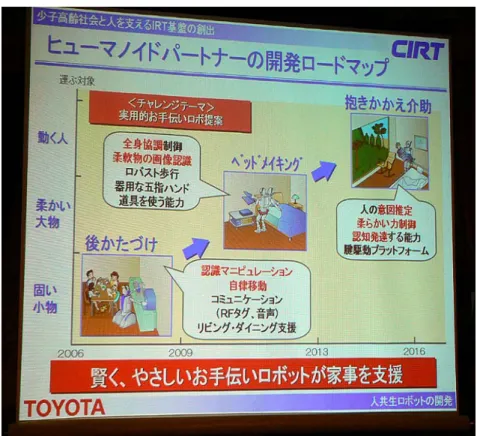
(24) scientific development, required to realize the potential of hydrogen technologies in solving issues of energy security, diversity, and environmental needs in the USA (see United States Department of Energy 2002). NASA also utilized road mapping to develop a technological and scientific development plan (see NASA 1998). An example of the efforts in an international context is the International Technology Roadmap for Semiconductors, developed and updated jointly by the European Semiconductor Industry Association, Japan Advanced Electrics, and Information Technology Industries Association, Korea Semiconductor Industry Association, Taiwan Semiconductor Industry Association, and the Semiconductor Industry Association (see ITRS 2004). The European Union routinely uses road mapping as one of its. tools. for. preparing. subsequent. Framework. Programs. for. international research and development.. Today the term “roadmap” is used liberally by planners in many different types of communities. It appears to have a multiplicity of meanings, and is used in a wide variety of contexts: by commercial organizations, industry associations, governments, and academia. Therefore, the basic idea in this study is to introduce RMA into academia to support scientific researchers’ technology creation. The first step, we will make clear what are the similar and dissimilar points between RMA in industry (government) and academia.. 12.
(25) 2.2 RMA in Industry-Government and its applications and supports in academia. 2.2.1 RMA in industry RMA in industry is a way to identify future product or service needs, map them onto technology alternatives, and develop plans to ensure the required technologies will be available when needed (see Kenichi 2003). In this context, companies must use effective tools to plan their future. This is considered a part of technology management (MOT) in industry; in short,. RMA is a way to do forecasting and planning when. supporting technology development in industry (see Galvin 1998 and Toshiya 1996). A road mapping process has three general steps in industry. (see. Robert. 1988. and. Report. of. symposium. for. industry-government-university cooperation 2003): z. Decide topics of technology development.. z. Share opinions and discuss to get initial conclusions. z. Feedback and discuss further to get final conclusions.. The roadmap document in industry, resulting from a technology road mapping process, is the first step toward consensus on a number of topics (see Salo 2003 and Saritas 2004): z. a vision at a set time in the future;. z. what new types of products (or services) will be required;. z. the enabling technologies to create those products. z. the feasibility of creating the needed technologies. 13.
(26) z. the technological alternatives for achieving the needed technologies;. z. how to address these technology needs through R&D. The. principal. representation,. functions. of. roadmaps. in. industry. communication, planning, coordination,. have. been. forecasting. and selection (see Henderson 1998 and Robert 1988). The roadmap document addresses (see Martin 2003): z. the role of an industry’s suppliers in creating the desired future. z. human resources needs. z. governmental and non-governmental barriers. z. other topics. We collected data and information from 20 companies and we found that they use RMA with the purpose of creating more benefit and service from technology development. Four aspects of road mapping can be distinguished (see Martin 2003): z. To present a concept of the needs of technology and market;. z. To forecast the trend of technology;. z. To provide the data and information about technology and marketing strategy;. z. To support decision makers do technology development.. Technology development in industry is a group activity. Usually, there are several groups for one topic of technology development. First, in each group they will decide their own sub-topic of technology development. Then every member will recount their opinions and. 14.
(27) grounds, every member will change his or her own opinion. At last they will get a consensus conclusion (with which every member agrees). They also invite specialists from different fields to make discussion and workshop getting their opinions. Figure 2.3 and 2.4 shows technology roadmap of robots development from TOYOTA and OLYMPUS in a conference held in Tokyo university on 4thAugust 2006 (see report of project “IRT in the future 10 years”). Fig 2.3 Roadmap of Robot Development from TOYOTA (from:http://robot.watch.impress.co.jp/cda/news/2006/08/07/115.html). 15.
(28) Fig 2.4 Roadmap of Robot Development from OLYMPUS (from:http://robot.watch.impress.co.jp/cda/news/2006/08/07/115.html). We can get a conclusion that in industry, RMA is used for technology development and product innovation as a strategic planning tool.. 2.2.2 RMA in government RMA is also used in government, with slightly different goals than in industry: that of deciding on what topics governmental support of research should be concentrated and how to coordinate governmental supported scientific research and technology creation. Industry and academia give government report for what have been done, what is the next plan, and what is the problem every year. Then government will decide that which kind of technology they will support in which kind of ways (See Australian department of industry, science and resources. 16.
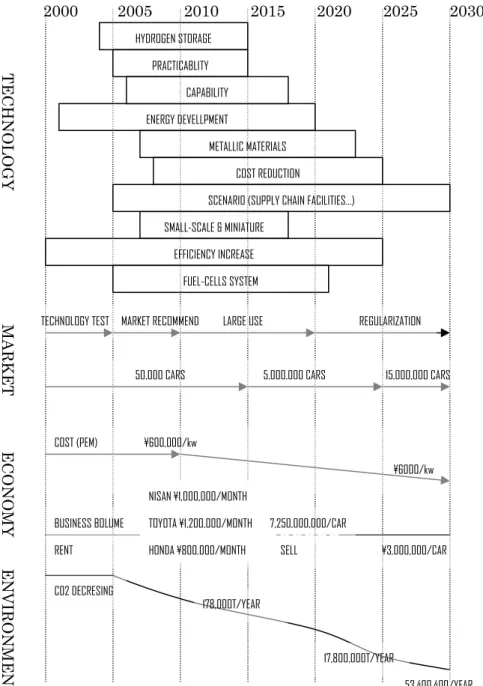
(29) 2001). The roadmap document in industry, resulting from a technology road mapping process, consensus on a number of topics (see Salo 2003 and Saritas 2004): z. To keep the balance between new needs and seeds. z. To present the roles of technology development and social change. z. To get and analyze data and information of projects about technology development and creation. z. To address human resources in a specific research field. z. To decide how to support technology development and creation. The principal functions of roadmaps in government have been representation, coordination, and planning (see Henderson 1998 and Robert 1988). A road mapping process has three general steps in government. (see. Robert. 1988. and. Report. of. symposium. for. industry-government-university cooperation 2003): z. Discuss about the report and research plan from industry and academia.. z. Find cooperative projects of technology development and creation.. z. Decide how to support such projects to get valuable results.. Figure 2.5 shows a technology roadmap for CO2 decreasing projects. You can find other roadmaps in different research field for different technology development (see report of NEDO 2006). 17.
(30) We can get a conclusion that in government, RMA is used for pull and push technology development and creation projects as a planning tool.. Fig 2.5 Example of Roadmap from Government (http://www.nedo.go.jp/roadmap/2006/all.pdf). 2.2.3 Applications and supports of RMA in academia Road mapping has been also adopted in academia. Some academic institutions developed roadmaps as strategic research plans; for example, the Berkeley Laboratory at the University of California prepared and published a research roadmap for its High-Performance. 18.
(31) Data Centers (see Tschudi et al. 2002). Ma et al. have argued that developing personal academic research roadmaps can be very helpful for individual researchers (see Ma and Nakamori 2004). Usually, there are many linkages between development of industrial technologies and scientific research (see Narin et al. 1997). Moreover, the causation between science and technology runs both ways; the causation from technology to science is much more powerful than is generally perceived (see Rosenberg 2004 and Wierzbicki 2005). For those reasons, we will use the term science and technology roadmaps or S&T roadmaps in short, introduced by Kostoff and Schaller (see Kostoff and Schaller 2001).. Roadmaps can mean different things to different people. They are developed for diverse purposes. Phaal et al. identified eight types of technology roadmaps in terms of the intended purpose(see Phaal 2004); Kostoff and Schaller summarized dozens of different applications of roadmaps presented in a technology road mapping workshop in 1998 and found that those applications covered a wide spectrum of uses including (see Kostoff and Schaller 2001): z. Science/research roadmap. z. Cross-industry roadmap. z. Industry roadmaps. z. Technology roadmaps. z. Product roadmaps. 19.
(32) z. Product–technology roadmaps. z. Project or issue roadmaps. Roadmaps can have also different formats. Phaal et al. identified the following eight types of roadmap according to their graphical formats (see Phaal 2004): z. Multiple layers. This is the most common technology roadmap format, comprised of a number of layers (and sub layers), such as technology, product, and market. A Philips-type roadmap could be an example of this format (see Groenveld 1997). z. Bars. Many roadmaps are expressed in the form of a set of bars, for each layer or sub layer. A Motorola-type roadmap is the classic example of this format (see Willyard and McClees 1987). z. Tables. In some cases, entire roadmaps, or layers within the roadmap, are expressed as tables (time vs. performance or requirements). For example, the personal academic research roadmaps introduced in Ma and Nakamori are in this format (see Ma and Nakamori 2004). z. Graphs and plots. A roadmap can be expressed as a simple graph or a plot, typically one for each sub layer. Often, the plots employed are called experience curves, related to technology S-curves (see Grübler 1996).. 20.
(33) z. Pictorial representations. Some roadmaps use more creative pictorial representations to communicate technology integration and plans. Sometimes metaphors are used to support the objective (e.g., a picture of a tree can symbolically represent an environmental commitment). A Sharp-type roadmap could be an example of this format, (see ITRI 1998). z. Flow charts. A particular type of pictorial representation is the flow chart, which is typically used to relate objectives, actions, and outcomes. A NASA-type roadmap could be an example of this format, (see NASA 1998). z. Single layer. This form is a subset of the first type, focusing on a single layer of the multiple layer roadmap. The Motorola roadmap is an example of a single layer roadmap, focusing on the technological evolution associated with a product and its features (see Willyard and McClees 1987). z. Text. Some roadmaps are entirely or mostly text-based, describing the same issues that are included in more conventional graphical roadmaps which often have text-based reports associated with them. The National Hydrogen Energy Roadmap (see United States Department of Energy 2002) and the International Technology Roadmap for Semiconductors (see ITRS 2004) are examples of this format.. According to Australian Department of Industry, Science and Resources. 21.
(34) (see Australian department 2001), there are generally three approaches for making technology roadmaps z. Expert-based approach. A team of experts comes together to identify the structural relationships within the field and specify the quantitative and qualitative attributes of the roadmap. z. Workshop-based approach. This technique is used to engage a wider group of industry, research, academic, government, and other stakeholders, to draw on their knowledge and experiences. z. Computer-based approach. Large databases are scanned to identify relevant research, technology, engineering, and product areas. High-speed computers, intelligent algorithms, and other modeling tools can assist in estimating and quantifying the relative importance of these areas and in exploring their relationships to other fields. This approach is still in its infancy, as large textual databases and efficient information extracting computational approaches have only begun to emerge. Of course, these three approaches are not mutually exclusive and not independent. For example, when the expert-based approach is applied to making roadmaps, it is usual to organize some workshops (through local or remote meetings), while computer, intelligent algorithms, etc. can be used to provide supplemental information and knowledge to experts. Thus, during the road mapping process, it is most likely that. 22.
(35) all three of these approaches are used, though one approach might be dominant. For example, Kostoff et al. developed a road mapping process which starts from identifying major contributory technical and managerial disciplines by text mining (literature-based discovery), followed by workshops in which experts participate (see Kostoff 2004). In practice, the road mapping process should be customized according to its objectives, the organizational culture, and other contextual aspects.. RMA support in academia A new approach of RMA support for making personal academic research roadmaps by applying ideas of Interactive Planning (IP) was suggested by Ma (Ma 2006). The approach suggests the use of a process composed of. six. phases:. forming. groups;. explanations. from. knowledge. coordinators; descriptions of present situation; analysis of current status of every member and idealized design; research schedule and study schedule; and implementation and control. Another approach was suggested by Okutsu (Okutsu 2005), based upon the idea that students from science and engineering laboratories should be asked to manage their research, since they will have to do it in the future, whether in a academia or in industries. Therefore, ATRM (Academy Technology Road Map) was proposed to help researchers, including students, with their research planning in academic science and engineering laboratories. Both these two ideas aim to support students from scientific and. 23.
(36) engineering laboratories to develop their research proposals and research plans. In this study, however, we support RMA in a slightly different way, because we concentrate the step before researchers make their roadmaps. When, what and how to support researchers (professors and students) in academia to make their research roadmaps? To help answer such questions we did an interview with scientific researchers and students from three different schools. Almost researchers have the same opinion such as: z. It is necessary to help researchers make research plans. But it is. hard to say what future research topics will be, so it will be more useful to obtain some support helping researchers to find more valuable research topics and interests. z. Researchers can easily obtain a great quantity of data and. information, but sorting through that data and information to get ideas, is not a trivial problem. z. General roadmap can give researchers a different perspective and. an overview of the whole research field in a time dimension, but for researchers who are doing scientific research, time dimension is not sufficient. We need more detailed information about technologies, research topics, patents and other information such as subsidy from government and industry, etc. it will be an overview of whole research field in this time. z. General roadmap can not help us to know information about what. 24.
(37) researchers in academia, industry and government doing now, about relationships among research topics, researchers, technology, scenarios. Such information would be useful for us to find potential cooperators. They also had some good suggestions like: z. Researchers A (Knowledge Science, a project leader) who is majoring. in model structuring said that we need support to help us manage a lab including student and their research. z. Researcher B (Information Science) whose major is related to. network said RMA should be a computer-based approach, searching data and information what researchers want to know, networking researchers’ relation and getting roadmap automatically. z. Researcher C (Material Science) who is working on fuel-cell. technology said if RMA can give some support when we want to get subsidy such as what kind of research are getting subsidy now, how many researchers are doing such research, who will be the cooperator and who will be the competitors and so on. So, in this study, we would like to support scientific researchers (professors and students) for finding new interests and research topics, the first step in RMA, as well as to push or promote cooperation among university, industry and government on technology creation. z. Why. There are so many works for supporting students’ research plan but only little for supporting decision making of new research topics. We will support all students and professors when they want to start new. 25.
(38) research topic in this study. z. When. It is necessary that support researchers to make their scientific research roadmap. Not only for plan, support in the step before making plan is also necessary. Therefore we will support them when they want to start some new projects or research topics. z. What. What kind of support Data collecting: help researchers collect data what they want in an easy way in a specific research field. Data analyzing: help researchers analyze data to get good results in a specific research field. Searching: help researchers get information in an easy way based on results of data analysis. Networking: help researchers get information of researchers’ relation in a specific research field to find potential cooperators and competitors. Mapping: help researchers know position of their research in the whole research field find cooperative projects. There are lots of related work have been done, but in this study, we will use such data analysis methods for a new application. z. How. How to support researchers RMA support in academia should help researchers answer following questions:. 26.
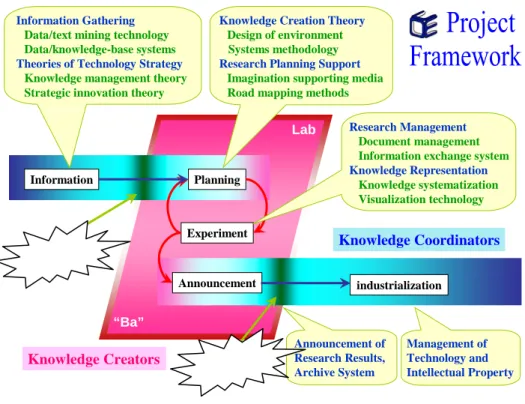
(39) z. Where are you?. z. Where do you want to go?. z. How to get there?. For researchers that means: z. What is the position of research topic related what researcher is dong.. z. What is the position of research topic related what researcher wants to do.. z. What is the relation between research topics related what they are doing and what they want to do.. 27.
(40) Chapter 3 Design a framework of RMA support for scientific researchers in academia In this chapter, a framework of RMA support for researchers in academia will be designed after the introduction of detailed definition and functions of RMA support.. 3.1 Definition of RMA support in academia for scientific researchers. In this study, we give RMA support a different definition explained from what, why, when and how to support scientific researchers in academia.. 3.1.1 Why support scientific researchers in academia In academia, the smallest unit is a laboratory, and researchers in this study mean all members of a laboratory. For a laboratory, usually there is one professor, one or two assistants and many students. RMA. 28.
(41) designed in this study is to help professors, assistants and students. However so many works have been done for supporting students’ research plans such as we explained in chapter 2.. A new RMA support approach for making personal academic research roadmaps by applying ideas of Interactive Planning (IP) was suggested by Ma (see Ma 2006). The approach suggests the use of a process composed of six phases: forming groups; explanations from knowledge coordinators; descriptions of present situation; analysis of current status of every member and idealized design; research schedule and study schedule; and implementation and control. Another approach was suggested by Okutsu (see Okutsu 2005), based upon the idea that students from science and engineering laboratories should be asked to manage their research, since they will have to do it in the future, whether in a academia or in industries. Therefore, ATRM (Academy Technology Road Map) was proposed to help researchers, including students, with their research planning in academic science and engineering laboratories. Both these two ideas aim to support students from scientific and engineering laboratories to develop their research proposals and research plans. However, we also mentioned that researchers (not only for students), said RMA support as a planning tool maybe not enough. Therefore we addressed this study for supporting scientific researchers (professors, assistants and students). It is the same with RMA support in industry and government, a decision. 29.
(42) making approach.. 3.1.2 When support scientific researchers in academia Scientific research process as Figure 3.1 shown, in a laboratory of scientific research, there are two types of difficulties that are mutually related. “Deep-woods” means that it is very difficult to determine the research direction because of the information flood. “Death-valley” means that there are a huge number of ideas which are not used in industry (see Nakamori report 2004).. Information Gathering Data/text mining technology Data/knowledge-base systems Theories of Technology Strategy Knowledge management theory Strategic innovation theory. Knowledge Creation Theory Design of environment Systems methodology Research Planning Support Imagination supporting media Road mapping methods. Lab. Information. Planning. Experiment. Research Management Document management Information exchange system Knowledge Representation Knowledge systematization Visualization technology. Knowledge Coordinators. Deep Woods Announcement. industrialization. “Ba”. Knowledge Creators. Death Valley. Announcement of Research Results, Archive System. Management of Technology and Intellectual Property. Fig 3.1 Scientific Research Process. RMA support we design in this study is to solve the problem of “deep. 30.
(43) woods”: when researchers want to start a new project or new research topic RMA support will help researchers get a clear picture for their position to answer where you are, where you want to go and how to get there; and “death valley”: when researchers want to start a new project or new research topic RMA support will help researchers have a clear understand for seeds and needs in a specific research field.. 3.1.3 What kinds of support for scientific researchers in academia will be provided What kinds of support for scientific researchers in academia depend on what kinds of support they need. Based on interview (mentioned in Chapter 2), we found that the problems are: z. Researchers can easily obtain a great quantity of data and information, but sorting through that data and information to get ideas, is not a trivial problem. On the other hand, researchers are very busy for scientific research and lab management. Therefore researchers need an easy way to collect and analyze data.. z. Researchers don’t really know their position in the research field they are (especially students). Researchers usually only concern about detailed information of technology but unconcern with information of marketing, economy and policy. That means they have a local overview for their position in a specific research field. Therefore. researchers. need. networking. support. technology, human resource, social influence etc.. 31. including.
(44) z. Researchers have their own ways to do their scientific works, also they are very busy. That is why it is not so many chances for researchers to discuss with others researchers from different universities and industries. Therefore researchers need cooperators for doing their scientific research. One the other hand, they also need to know who is competitor for getting subsidy or involving in projects.. Now we have a clear picture that what kinds of support researcher need, the next problem is what kinds of support we can provide. RMA support for scientific researchers will be the tools: z. Support for information searching. z. Support for networking. z. Support for mapping. 3.1.4 How to support scientific researchers in academia We mentioned in Chapter2 roadmaps can mean different things to different people. They are developed for diverse purposes. Phaal et al. identified eight types of technology roadmaps in terms of the intended purpose (see Phaal 2004); Kostoff and Schaller summarized dozens of different applications of roadmaps presented in a technology road mapping workshop in 1998 and found that those applications covered a wide spectrum of uses including (see Kostoff and Schaller 2001): z. Science/research roadmap. 32.
(45) z. Cross-industry roadmap. z. Industry roadmaps. z. Technology roadmaps. z. Product roadmaps. z. Product–technology roadmaps. z. Project or issue roadmaps. For scientific researchers in academia, roadmap means: z. Technology maps. z. Research maps. For RMA support, we will provide: z. Research topic maps. z. Researcher maps. z. Network maps. We also mentioned that according to Australian Department of Industry, Science and Resources (2001), there are generally three approaches for making technology roadmaps z. Expert-based approach. A team of experts comes together to identify the structural relationships within the field and specify the quantitative and qualitative attributes of the roadmap. z. Workshop-based approach. 33.
(46) This technique is used to engage a wider group of industry, research, academic, government, and other stakeholders, to draw on their knowledge and experiences. z. Computer-based approach. Large databases are scanned to identify relevant research, technology, engineering, and product areas. High-speed computers, intelligent algorithms, and other modeling tools can assist in estimating and quantifying the relative importance of these areas and in exploring their relationships to other fields. This approach is still in its infancy, as large textual databases and efficient information extracting computational approaches have only begun to emerge.. In this study, RAM support for scientific researchers in academia will be a computer-based approach. Expert-based and workshop-based approaches are widely used in industry and government. Technology development in industry and government is a group work but scientific research in academia is an individual work. RMA support in academia should be a way for supporting individually motivated work. Also researchers in academia have some dedicated funds for research operation, but they use almost all these funds for experiment equipment, tools and materials, it is thus difficult to invite outside specialists to make a discussion group whenever they want. Therefore we design a computer-based RMA support for scientific researchers in academia.. 34.
(47) In Chapter 2, different formats of roadmap are also mentioned (see Phaal 2004) z. Multiple layers. z. Bars. z. Tables. z. Graphs and plots. z. Pictorial representations. z. Flow charts. z. Single layer. z. Text. In this study computer-based RMA support designed for scientific researchers will use all formats.. 3.2 Functions of RMA support in academia for scientific researchers. 3.2.1 Function 1---data collecting support If researchers want to find new interests or research topic, the first step should be data and information collecting for a domain to make clear that which topic was, is and will be hot topic. Almost all researchers did have such experience, when use “google” or other searching tool, it is very often that after inputting keywords more than 10 thousand records of information will be provided. Thus, researchers will have no time for. 35.
(48) doing their scientific research. Therefore, the first function of RMA designed will be support for data collecting. It means to help researchers decide a domain which they are interested in, and provide some easy ways for data collecting such as online databases or soft wares. Also, for solving the problem of “death valley” and “deep woods” mentioned in chapter 3.1.1. Data and information should be collected from industry, government and academia to help researchers piece out the situation of the domain they chose. It means that when researchers want to find new interests and research topics, they should know a lot about situation of the domain not only what other researchers doing but also the seeds and needs in a specific research field.. 3.2.2 Function 2 ---data analyzing support There are too many data analysis methods, first we should make clear the level of data analysis. Ackoff classified the content of the human mind into five categories (see Ackoff 1989): z. Data: symbols. z. Information: data that are processed to be useful; provides answer to “who”, “what”, “where”, and “when” questions. z. Knowledge: appreciation of data and information; answers “how” questions. z. Understanding: appreciation of “why”. z. Wisdom: evaluated understanding. 36.
(49) Ackoff indicates that the first four categories relate to the past; they deal with what has been or what is known. Only the fifth category, wisdom, deals with the future because it incorporates vision and design. With wisdom, people can create the future rather than just grasp the present and past. But achieving wisdom isn't easy; people must move successively through the other categories. A further elaboration of Ackoff's definitions follows (see Ackoff 1989): z. Data. Data is raw. It simply exists and has no significance beyond its existence (in and of itself). It can exist in any form, usable or not. It does not have meaning of itself. In computer parlance, a spreadsheet generally starts out by holding data. z. Information. Information is data that has been given meaning by way of relational connection. This "meaning" can be useful, but does not have to be. In computer parlance, a relational database makes information from the data stored within it. z. Knowledge. Knowledge is the appropriate collection of information, such that it’s intent is to be useful. Knowledge is a deterministic process. When someone "memorizes" information (as less-aspiring test-bound students often do), then they have amassed knowledge. This knowledge has useful meaning to them, but it does not provide for, in and of itself, integration such as would infer further knowledge. For example,. 37.
(50) elementary school children memorize, or amass knowledge of, the "times table". They can tell you that "2 x 2 = 4" because they have amassed that knowledge (it being included in the times table). But when asked what is "1267 x 300", they can not respond correctly because that entry is not in their times table. To correctly answer such a question requires a true cognitive and analytical ability that is only encompassed in the next level “understanding”. In computer parlance, most of the applications we use (modeling, simulation, etc.) exercise some type of stored knowledge z. Understanding. Understanding is an interpolative and probabilistic process. It is cognitive and analytical. It is the process by which I can take knowledge and synthesize new knowledge from the previously held knowledge. The difference between understanding and knowledge is the difference between "learning" and "memorizing". People who have understanding can undertake useful actions because they can synthesize new knowledge, or in some cases, at least new information, from what is previously known (and understood). That is, understanding can build upon currently held information, knowledge and understanding itself. In computer parlance, AI systems possess understanding in the sense that they are able to synthesize new knowledge from previously stored information and knowledge. z. Wisdom. Wisdom is an extrapolative and non-deterministic, non-probabilistic. 38.
(51) process. It calls upon all the previous levels of consciousness, and specifically upon special types of human programming (moral, ethical codes, etc.). It beckons to give us understanding about which there has previously been no understanding, and in doing so, goes far beyond understanding itself. It is the essence of philosophical probing. Unlike the previous four levels, it asks questions to which there is no (easily-achievable) answer, and in some cases, to which there can be no humanly-known answer’s period. Wisdom is therefore, the process by what we also discern, or judge, between right and wrong, good and bad. I personally believe that computers do not have, and will never have the ability to possess wisdom. Wisdom is a uniquely human state, or as I see it, wisdom requires one to have a soul, for it resides as much in the heart as in the mind. And a soul is something machines will never possess (or perhaps I should reword that to say, a soul is something that, in general, will never possess a machine). Data analysis is to support the process from data to information. We use qualitative analysis to analyze seeds and needs in a specific research field, and quantitative analysis to analyze situation of scientific research in academia, industry and government.. 3.2.3 Function 3 ---searching, networking and mapping support Searching, networking and mapping will support the process from information to knowledge and understanding help researchers possess wisdom.. 39.
(52) z. Searching will give an interface to researchers helping them find data and information they need by an easy way to answer where they are and where they want to go.. z. Networking will help researchers to understand where they are in a specific research field.. z. Mapping will help researchers integrate the results of searching and networking to give an answer about how to get there. 3.3 Framework of RMA support in academia for scientific researchers z. Domain definition. For academic researchers, when they want to star new research topics or new interests, they commonly consider a specific research field, for example, biotechnology, or nanotechnology. Here we use the term. domain to denote the field that researchers are interested in.. A. domain can be simply defined by one or several keywords, for example, a domain can be defined by fuel cell and vehicle as (fuel cell, vehicle). Researchers can specify a domain according to their preferences. They can specify a quite wide domain, for example, nanotechnology; or specify. a. relatively. narrow. domain,. for. example,. compound. semiconductor crystal devices. z. Data for a domain. After a domain is specified, three kinds of data sets corresponding to each dimension of the triple helix in the domain will be collected.. 40.
(53) z. Data set in the academia dimension. This data set contains mainly the information about academic publications in the domain. Such data is available in scientific databases, both online and off line.. Scientific. Patent. Agencies. databases. databases. databases. Data collecting module. Academia. Industry. Governme. data set. data set. nt data set. Domain-defining module. Input Academic Researchers. Data analyzing module. Ontology extraction. Searching. Triple Helix cooperation. Networking. Mappimg. Output Academic Researchers. Fig 3.2 Framework of Computer-based RMA support. 41.
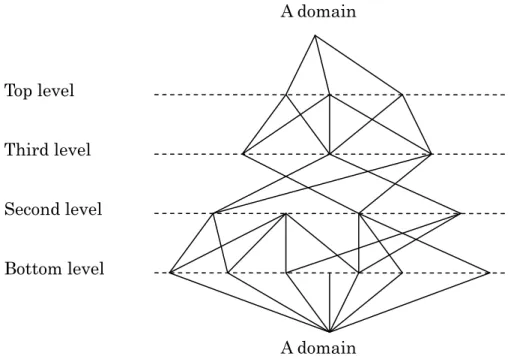
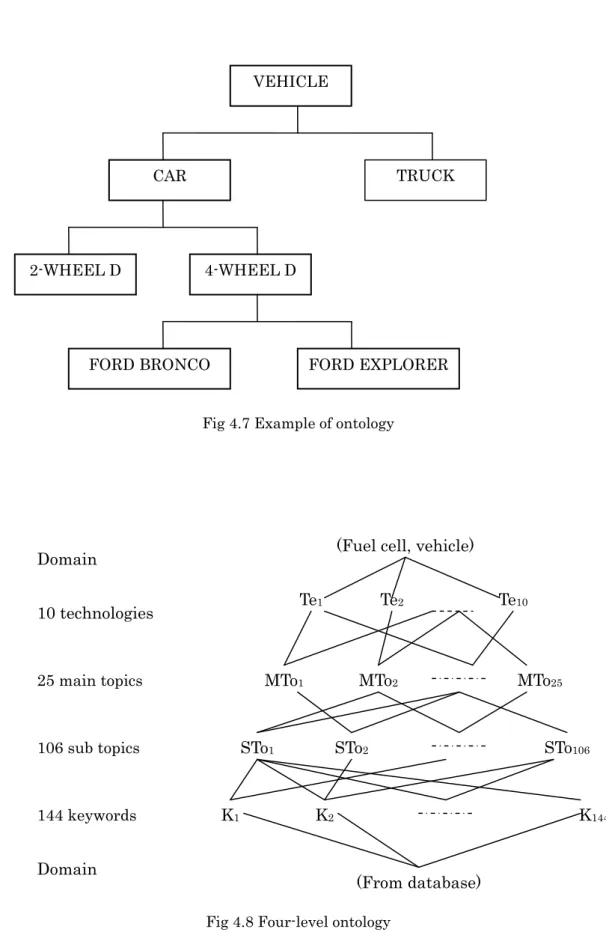
(54) z. Data set in the industry dimension. This data set contains the information about the patents held or being applied for by industry in the domain. Of course, some academic researchers also apply for patents. For making a fuller story, when collecting this data set, the information about the patents held or being applied by academic researchers is also included. This data commonly is available in some patent databases. z. Data set in the government dimension. This data set contains the information about the projects supported by government in the domain, which is commonly available in some government agencies’ websites.. z. Data analysis for a domain (detailed explanation in Chapter 4) z. Ontology extraction. After getting these three data sets, we need to build relations among them for further analysis, and ontology is used for this purpose. After discussion with some academic researchers, we found a four-level ontology is appropriate. As shown in Figure 3.3, the bottom level of the ontology will be the most detailed information. Many system methodologies, such as KJ (see Kawakita J 1975), AHP (see Saaty 1980), and so on, can be applied to identify elements in other three levels by integrating researchers’ expertise. From the bottom level of ontology to the top level of ontology, information. 42.
図


+7


関連したドキュメント
Neatly Trimmed Inlay — Typical examples of this type of turquoise inlay are the bronze animal plaques with inlay and the mosaic turquoise dragon from the Erlitou site
Research Institute for Mathematical Sciences, Kyoto University...
製造業種における Operational Technology(OT)領域の Digital
支援活動を行った学生に対し何らかの支援を行ったか(問 2-2)を尋ねた(図 8 参照)ところ, 「ボランティア保険への加入」が 42.3 % と最も多く,
児童生徒の長期的な体力低下が指摘されてから 久しい。 文部科学省の調査結果からも 1985 年前 後の体力ピーク時から
• パフォーマンス向上コーディネーター( PICO )を発電所各部に 配置した。 PICO は、⽇々の不適合/改善に関するデータのスク
3 学位の授与に関する事項 4 教育及び研究に関する事項 5 学部学科課程に関する事項 6 学生の入学及び卒業に関する事項 7
(1) 研究課題に関して、 資料を収集し、 実験、 測定、 調査、 実践を行い、 分析する能力を身につけて いる.
