How Does Culture Appear in Interviews?
―Focus on “Treating” in Korea and “Going Dutch” in Japan―
Seon-Ah OH, Toshiya YAMAMOTO, Noboru TAKAHASHI,
Kazuko TAKEO, Tatsuya SATO, Chengnan PIAN
1)Introduction
We have researched through interviews in Japan, Korea, China, and Vietnam since 2002. Based on this research, we compared the phenomenon of ‘treating’ in Korea and Japan for what we perceived as common aspects, then picked out the cultural differences.
Among children in Korea, practically speaking, they treat each other many times. Moreover, their parents also tend to consider treating as positive, as apparent from Tables 1 and 2.
Table 1. The responses to the questions “Is it good or bad that children treat their friends to food?” - To not treat is bad. It’s selfish. (Elementary school, 4th grade, M)
- I don’t know. But I don’t think it’s bad. (Elementary school, 5th grade, F) - Treating is good because we can get to know each other.
( Junior high school, 1st year, F) - To treat too often is not good, but usually it’s OK. (Junior high school, 2nd year, F) - I don’t think it’s bad. I treat when it’s necessary. (High school, 2nd year, F)
- It’s not bad. There is no loss because if I treat a friend, then the next time the friend will treat me. (High school, 3rd year, F)
- If I only pay for my own, then I think I’m too selfish. (Mother)
- It’s not good if it’s done too often, but if the parents know about it, it’s okay.
(Mother) - It’s the human feeling of the Korean people. (Mother)
Table 2. The responses to the question “Some people think that ‘treating’ is bad because if you treat your friends to food then they feel burdened to repay you. How do you feel about this opinion?”
- I don’t know. (Elementary school 2nd grade, F)
- If it’s too expensive, then I feel burdened. If it’s a small thing, then I’m OK with it. (Junior high school, 2nd year, F)
- If it’s too expensive for the ages of the children, it’s not good. (Mother)
- If I treat my friend, then when I don’t have any money the friend will treat me. It’s a good thing
(Elementary school, 4th grade, M)
- If I receive some food from my friend then the next time we are out, I will buy my friend some food.
It’s OK. (Elementary school 5th grade, F)
On the other hand, children in Japan tend to prefer paying their share – namely going Dutch. As you can see from Table 3, they and their parents feel that going Dutch is better than treating.
Table 3. The realization of going Dutch among Japanese people.
・ There are some children who are not given an allowance, and a gap opens up between them and others. If they go to a cheap candy store, basically, they don’t treat each other. When we find them treating, we will tell them not to do so. (Mother)
・ I think it doesn’t matter whether treating is good or not. In any case, I feel that equality is better, isn’t it? (High school 2nd, F)
・ I don't feel good about treating my friends to a meal, or at least, I don't want to do so, even though there may be a special reason; in other words, I think it is not good to treat. (High school 3rd, F)
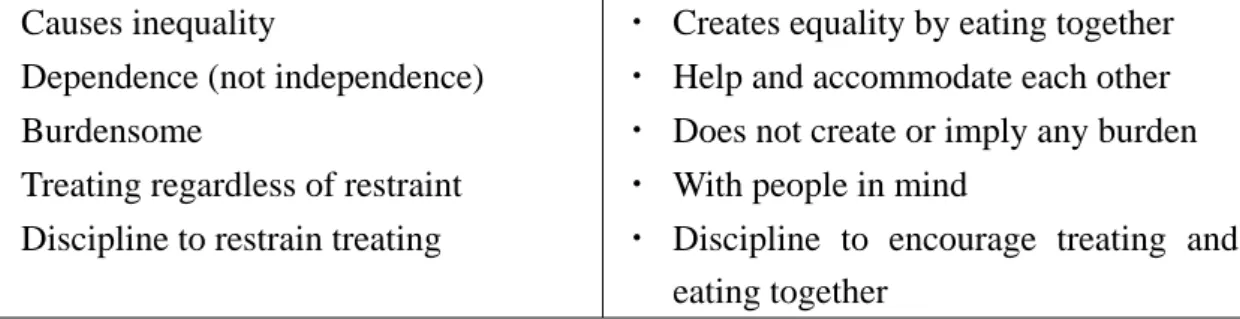
Treating in Korea and going Dutch in Japan, these phenomena are adopted as topics for development and culture repeatedly. With this in mind, at the association, we made a presentation of the results of our research and wrote about the culture of treating in Korea or that of going Dutch in Japan. In addition, as shown in Tables 4 and 5, there are opposing views concerning treating and going Dutch among Japanese and Korean people, which also emphasize the cultural differences when children use their allowances with friends. Based on Table 4, we can observe the opposing mindsets between Japan and Korea.
Table 4. Impression about treating in Japan and Korea
Japanese viewpoint Korean viewpoint ・ Creates dominance among friends
・ Danger of blackmail
・ A feel–good activity
・ Causes inequality
・ Dependence (not independence) ・ Burdensome
・ Treating regardless of restraint ・ Discipline to restrain treating
・ Creates equality by eating together ・ Help and accommodate each other ・ Does not create or imply any burden ・ With people in mind
・ Discipline to encourage treating and eating together
Also, from Table 5, we can find different mindsets concerning going Dutch between Japan and Korea.
Table 5. Impression about going Dutch in Japan and Korea.
Japanese viewpoint Korean viewpoint ・ It can show independence
(responsibility for yourself)
・ Result of regard for people (not creating any burden)
・ Retaining equality
・ Discipline to encourage going Dutch
・ It is egotistical
・ It implies no regard for people
・ It seems to imply a superficial relationship and kindness
・ Discipline to restrain the practice of going Dutch
However, we mentioned the existence of a common mindset which governed the estimation of these phenomena - namely the judgment of right or wrong, and the logic having meaning - between Japan and Korea, which is the regard for people, and also that to retain a good relationship (Oh, Yamamoto, Pian, Takahashi, Sato & Takeo,2006).
In other words, Korean people consider the relationship of treating each other with friends to be one of sharing food, and also maintaining good relationships with them. Besides, it is also possible to understand treating as one of the small skills in a friendship. Conversely however, in Japan, we believe going Dutch can help avoid problems, and we can then also consider that we have an equal relationship. Mothers in Japan consider it the logic of discipline.
However, having thoroughly researched these phenomena and presented the same, we realized that they tend to emphasize only extreme arguments among Japan and Korea; namely that treating always predominates in Korea or going Dutch also predominates in Japan.
Usually, we simply think of it as ‘treating’ but various patterns of treating have emerged, the perception of which is either right or wrong according to children’s age or the situation in which people are treating. We can see 6 patterns in Korea, namely 1)The pattern of sharing and eating one unit of confectionery/candy, 2)The pattern involving
the mutual sharing of food with many friends, 3)The pattern of give and take between one or two close friends, 4) The pattern of turn-taking to treat, 5) The pattern of one-way treating, 6) The pattern of all members paying for and sharing their food (OH, Pian, Yamamoto, Takahashi, Sato, Takeo, Choi & Kim,2005). When viewed in these patterns, we can find some patterns which are also reflected in daily life in Japan.
Moreover, if we see a daily aspect which we study naturally, we realize that there is obviously no universal agreement governing the practice of treating in Korea, nor any agreement to go Dutch in Japan. In both countries, we also hear examples of Korean people feeling the negative effects of treating and Japanese people knowing the benefits of the same.
Although we observe various phenomena or estimations of significance, why are people likely to hide the truth about treating and going Dutch when we interview them?
OH et al. (2006) state that they have already requested details of estimating right or wrong when we interview people about setting standards for what we often see in Japanese society, and they also explain the propensity for unintentionally opposing structures between Japan and Korea based on situations involving interviews and/or discussions between researchers with different backgrounds. The same is also said to apply, not only in research situations but also in discussion among researchers with different cultural backgrounds. Specifically, we agree on the identification of these phenomena (for example, people tend to treat in Korea), however, as for their significance and estimating whether they are right or wrong, researchers have different opinions, which seems to be linked to the opposing structures mentioned previously. Based on the results obtained in this research note, we consider the details of “a treating culture which is formed, and shown dynamically through likely dialogue”; addressing how the occasion of interviews concerning allowances promote answers on the opposite structure or not. We describe the treating culture as related by Koreans, making them recognize and build through interviews. Moreover, when informants are asked about their behavior and its meaning, how did they respond to the questions? We consider it to be adopting words of the "multi-voiced" and “dialogue” concept of Bakhtin, and examine how we consider “culture”.
The question items related to treating and going Dutch
Following in Table 6, you see topics concerning the question of treating or going Dutch.
Table 6 Main questions concerning treating and going Dutch
Dutch? Which is better and why do you think it is good or bad?
B) In Japan (other countries), there is a view that it is not good to treat others because some people think allowances should be used for oneself. What do you think?
C) In Japan (other countries), there is a view that treating is not good because people who are treated by others feel burdened. What is your opinion?
A summary of responses on treating
All the children surveyed living in Korea (Jeju and Seoul) have experienced buying food for their friend/s. It is also reported that children of upper grade age in an elementary school had experienced a system whereby each member of a group would buy food in turn. However, the responses of Korean junior high and high school students indicate that some are basically likely to go Dutch. The responses say that they tend to go Dutch though they do not think that it is good, when responding to question A). And they did not insist treating is preferable, neither. In the steps of questions B) and C), meanwhile, almost all elementary students answered that they didn’t know, while junior high and high school students and their parents said that they didn’t feel any difference in terms of individual personalities. It seems that they did not, at least, consider aspects of treating negatively, and sometimes consider it positively.
Interview responses - what is involved in narrating
The interview situation is specific: It must be completely unprecedented for children to talk with foreigners whom they are meeting for the first time and be questioned by them. We guess that when children are asked questions relating to what they normally do, they realize that they have never consciously thought about it, and are subsequently reminded of their own behavior, whereupon they respond by considering the reasons. Moreover, we ask questions where the content involves international comparisons and which we have already judged right or wrong – for example, there are people who consider it is not good to treat. In other words, like questions B) and C), we state that it ** is not considered good practice, but what do you think about it? When participants in this study are asked questions B) and C) concerning comparisons with Japan by researchers from Japan, they realize the negative perception towards their usual behavior when with friends. From this, we gather that they explain the logic of their behavior, considering it to be based on culture which transcends the level of each individual.
the occasion of an interview with a 2nd grade student in elementary school. An investigator tries to request answers to questions B) and C). However, the child answered only "I don’t know", leaving the investigator at a loss. Elementary schoolchildren tend to answer that there is a lot of treating. Even if they are capable of revealing their personal feelings in answers concerning treating and being treated by friend in daily life, they never consider whether treating is good or bad as a norm. The idea of the standard might have been newly suddenly thrown out by the scene of the interview. Anyway, the situation whereby schoolchildren in Korea are not actually answering "Is treating good or bad?" might be important.
Table 7 Lower class elementary school children answer "I don’t know" when asked the question whether treating is good or bad.
The investigator: “Some people think that treating is bad because your parents give you some allowance, and they want you to use it for yourself, how do you feel about this opinion?”
The child: I don’t understand.
The investigator: You don’t understand. It’s difficult isn’t it, slightly difficult to consider for a moment. But I would like to ask you one more thing. “Some people think that treating is bad because if you treat your friends to food then your friends feel burdened to repay you. How do you feel about this opinion?” The child: I don’t understand.
The investigator: Right. You don’t understand. Well OK, that’s alright.
(Elementary school, 2nd grade, F)
Fluctuation and stability in the opposite structure with others: In an interview situation, especially when questions relating to treating were asked, opposing structures seem to emerge, such as Japan versus Korea. This is not simply concerned with the content of the question item, but also involves the correspondence of the Japanese investigator and South Korean informants.Based on Table 8, this is apparent while there is expectation that the answers are likely to relate to treating a lot, as the Japanese investigator interviews Korean students.
Table 8 Fluctuation and surprise at the answer "Going Dutch is more common".
The investigator: Which is more common, going Dutch or treating and being treated by friends at times?
The child: There is a lot of going Dutch, and we don’t usually have one person treating. Investigator: Oh? Has that been the case for a long time?
The child: We don’t have much money because we are students, so we collect money to make sure it is enough.
Interpreter: For what kind of place? Places you go with friends?
The child: Snack stores or fast food stores, and I don’t go to coffee shops and so on. The investigator: In Japan, the term ‘going Dutch’ means paying for what you eat or
drink yourself. In Korea, does it mean the same? Or, is everything calculated based on an equally split payment of the total?
The child: It is not the first one, as you said, everything is calculated based on the total, with payments equally split.
The investigator: Oh so after all, it involves dividing up and equally split payments. The meaning of ‘go Dutch’ is thus slightly different.
The interpreter: Yes, it is different.
The investigator: Going Dutch is more than a little different. The interpreter: It’s different. (High-school, 3rd,F)
The child states that going Dutch is quite common, and the investigator finds it hard to express a casual reaction such as "Oh yes, really?" Through the reaction “Oh? Has that been the case for a long time?”, we can read the atmosphere whereby an unpredictable quality is perceived and the investigator feels fluctuant in this scene.
However, the difference with Japan resurfaces in the fact that rather than "Only my amount being paid", the exchange reverts to a steady structure again with confirmation, such as by saying "After all, differ", and "differ" many times. I think that they can find “the difference", meaning the narrative in terms of the "Culture of South Korea" can become steady.
According to the situation in Table 8, the researcher was unable to give the example of Japan as an opposing position because the informant, who was a high school student, responded that she usually went Dutch, but the researcher then questioned her on an another opposite structure, which applied to China. Subsequently, the researcher asked her the question as to whether treating was right or wrong in judging the worth of treating. For children who usually go Dutch but who also treat each other, this becomes an occasion to judge their behavior (Tables 9, 10).
Table 9 Wavering or defending the rights and wrongs of treating
The investigator: It is best to go Dutch in Japan. However, there may be many occasions to treat more than go Dutch in China.
(omission) The investigator: Well, so, do you disapprove of treating?
The child: I don’t think like that but I sometimes treat when I need to do so.
Investigator: Ah, You think it’s an obligation. I see. So this is why you disapprove of it. Interpreter: There is no such thing as “treating which is not good”.
The investigator: Yes, that’s right.
(High-school, 2nd,F)
Table 10 Wavering or defending the burden of treating
The investigator: Well, children in Japan have this opinion. They think it is better not to treat friends because the friend/s may feel burdened. Do you understand this? Child (girl): Well, next is my friend’s turn after I treat the friend… So I don’t think it is
a burden.
The investigator: You think like that, don’t you?
The interpreter: Yes, well, there is a rotation of treating among the friends.
The investigator: After all, it is not related to whether treating is right or wrong, is it? The interpreter: No, there is no real relation, well.
The investigator: I see, there is no relation.
The interpreter: I think so. ( high-school 2nd , F)
Surely, it is the occasion of explaining customs of “treating in Korea and going Dutch in Japan.” In this case, most children answer that they don’t know, they don’t feel it is not good, or think of it as a burden. Almost children did not say “treating is bad” at least and explained the reason. The researcher also repeats “It is unrelated”. Based on these processes, the situation reverts stably to that of opposing responses.
On the other hand, initially, a mother were worried about the potential for danger, with reference to the problem of juvenile delinquents, but agreed with treating, provided it involved small amounts or treating of good friends. Finally, after explaining her treating experience, and hearing the opinions of whether it was right or wrong, she also commented that it was egotistical to go Dutch all the time. We obtained results whereby she understood the value of treating, even if she wavered between going Dutch and treating, between Japan and Korea. We can say that this is a stable portrayal of the opposing view.
Discussion
Based on the above, I showed brief details of the treating phenomenon in interviews and mentioned that in interview situations, the visit of Japanese researchers to homes in Korea became an ‘opposing structure’ in terms of meeting with another person. Here,
with ‘treating culture in Korea’ the key term, I want to consider ‘culture’.
Where is culture? : Almost children in Korea report on the experience of treating, although this differed on a case-by-case basis. In some cases involving elementary schoolchildren, they divided some candy with their friends. Alternatively, when the friend comes around to play at home, the parents give some money to the children and dictate that they should buy some candy and eat together. Moreover, junior high and high school students receive slightly more money, and can treat in places where parents do not intervene. However, although many students reported treating, they also reported much more going Dutch. Can such data represent grounds for stating that there is, actually, a treating culture in Korea?
To date, in our research announcements, we have never exposed a clear culture of ‘going Dutch’ in Korea. The issue of treating is not presumed to be a rare and minor occurrence in South Korea, and is discussed as a major cultural aspect. It might be related to the definition of treating in the eyes of junior high school students, high school students, and parents who answered ‘treating is not bed’ and ‘going Dutch is too selfish’ respectively, whereby they are referring to positive treating, despite junior high school and high school students reporting that they go Dutch more then treat.
Why is everyone answering that it is invariable, and that treating is not bad? Are they all lying? No, of course we don’t believe so.
They surely answered based on their experiences in daily life and experiences of going Dutch. They engage in encounters with others (unselfishly), facing each other. Moreover, as they draw comparisons between good and bad and right and wrong, their behavior is brought into relief in terms of the differences between Japanese and Korean, hence they may have selected between the meaning of treating and going Dutch.
This interview situation differs from actual state, whereby a child opts to treat or go Dutch considering the relationship with his/her friend, and the amount of money he/she has. In this interview situation, the researcher, who is from Japan, said “in Japan, some children think treating is bad”.
At that time, “otherness” emerged in front of the Korean children and their parents, which transcends individual dimensions. In an interview situation, answering people’s voices includes not only individual voices based on personal experiences but also those that transcend individual dimensions (otherness) and which appeal to justice. In the interview situation, there are voices relating stories of actual situations, and certain other voices expressing ideologies, norm and culture which are otherwise opposite. In other words, the opinions of children and those of their parents are also becoming multi-voiced.
The above-mentioned contents are linked to the "multi-voiced" and “dialogue” concept of Bakhtin (1979). While more than 2 different values and viewpoints coexist, the various statuses of the participants, and what each participant brings in terms of the background of different history is incorporated, and it is possible to position "the culture" itself as "a difference". We think, a future problem would involve examining the "multi-voiced” and “dialogue" aspects of Bakhtin’s concept.
Note
1) The authors’ belonging is as follows in order. Maebashi Kyoai Gakuen College, Waseda University, Osaka Kyoiku University, Tokyo University of Science, Ritsumeikan University, China University of Political Sciences and Law.
Reference
Oh, S., Pian, C., Yamamoto, T., Takahashi, N., Sato, T., Takeo, K., Choi, S., and Kim, S.(2005) Money and Life Worlds of Children in Korea: Examining the phenomenon of Ogori(treating) from Cultural Psychological Perspectives. Maebashi Kyoai Gakuen college Ronshu. Vol 5,73-88.
Oh, S., Yamamoto, T., Pian, C., Takahashi, N., Sato, T., Takeo, K. (2006) Multi Voice Method for Understanding Cultural Differences: Focusing on the Ogori (treating) among Childern. Maebashi Kyoai Gakuen college Ronshu. Vol 6, 91-102.
Oh, S., Sato, T., Takahashi, N., Yamamoto, T., Takeo, K., and Pian, C.(2008) Cultural Difference and Different Voices Appearing in Interviews: Peer Realtionship Based on “Ogori”(Treating) in Korea. Maebashi Kyoai Gakuen college Ronshu. Vol8,235-245.
バフチン,M.(1979) 小説の言葉(伊藤一郎訳)、バフチン著作集5)新時代社
Appendix
This research was supported by research grants from the Japan Society for the Promotion of Science ( Head Investigator: YAMAMOTO Toshiya).
This research was orally presented in “ISCAR (International Society for cultural and Activity Research) which was held at the University of California San Diego, from September8 to September13 in 2008.
In this research note, the research of OH et la (2005, 2006, 2008) was used, edited again, and translated into English.
要旨 インタビュー場面で文化はどのように現れるのか ― 韓国と日本におけるおごり現象と割り勘現象を中心に― 呉宣児・山本登志哉・高橋登・竹尾和子・サトウタツヤ・片成男 われわれ共同研究チームは、2002 年から日本、韓国、中国、ベトナムの子どもとその親 を対象に、お小遣いを巡る生活について調査を行い、子ども達のお金のもらい方や使い方 から見えてくる親子関係や友達関係と関連する文化・発達を述べてきた。その中で 4 カ国 の研究者の間で常に議論の題材になっていたテーマの一つが、インタビュー場面で目立っ て認識されるおごり現象(韓国)と割り勘現象(日本)であった。 子どもたちが友達と一緒におやつを食べたり、食事をしたりするときの様子として、韓 国のおごり文化と日本の割り勘文化が主張され、データを根拠にそれを正当化する論理が 主張され、いつの間にかそのような文化は常に固定的に存在しているかのうように示され てきた。 しかし、日常生活のなかで自然に観察される場面を省察してみると、韓国のおごり、日 本の割り勘というふうに単純に片付けられない点も多いことに気づく。どうしてインタビ ュー場面では一貫して、韓国のおごり日本の割り勘が主張されやすいのか。本研究ノート では、「インタビュー場面」での子どもや親たちが置かれた状況にはある独特な構造がある ことに焦点を当て、インタビュー場面での「対の構造」と「多声性」という概念と関連さ せながら、インタビュー場面で語りとして現れる「文化」について検討をおこなった。 日本人研究者と対面している韓国の子どもと親、韓国人研究者と体面している日本の子 どもと親というインタビュー場面そのものから、個々人の体験や考えを語る際に個人を超 える代表者になっていること、質問にも答えにも「多声」からなっていることを示し、文 化とはどこにあるのか、どのように現れるのについて考察した。