C14
Numerical simulation of cohesive sediment transport in estuary
O Fitri Riandini, Takao Yamashita, Tomotsuka Takayama
1. Introduction
Three-dimensional simulations of cohesive sediment transport in an estuary have been carried out, using mainly the ECOMSED software (HydroQual, 2002). In addition to hydrodynamics and sediment transport model, flocculation processes and consolidation of mud beds have been implemented into the code to improve sediment transport simulation. The aim of this research is to improve the knowledge regarding the behaviour of cohesive sediment transport and to better understand the specific processes which are involved. In this study, the model is used to predict tidal flow velocity and suspended sediment concentration in estuary of Mahakam delta, East Kalimantan, Indonesia.
2. Model Outline
In the present study the ECOMSED (HydroQual, 2002) model for modeling flow and sediment transport was improved by introducing some methodology adapted from COSINUS works (Berlamont and Toorman, 2000). A new flocculation model (Winterwerp, 1999) that includes the effects of turbulence induced aggregation and floc breakup is implemented to improve the calculation of settling velocity of cohesive sediment. The sediment mass conservation equation was extended to consolidation process by evolving Gibson equation (Gibson et al,, 1967) to advection-diffusion equation for the sediment concentration. The sediment module is configures to run in conjunction with the hydrodynamic model by using the same numerical grid structure and grid computational framework. To model sediment transport, three specific modules were developed: 2.1. Suspended sediment module
2.2. Flocculation module 2.3. Consolidation module
3. Application to real estuary
Estuary of Mahakam delta has potential resources, which can provide a valuable income for the
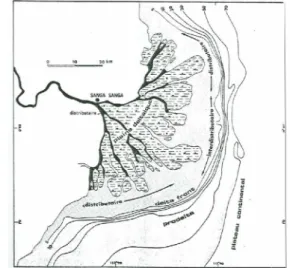
Indonesian government and its society. The area plays an important role as a valuable natural resource for the activities of human beings, such as living marine resource in the form of fish and shellfish, transportation, and recreation. Unfortunately, the harmful effects of society on this resource such as marine pollution, poor control of aquatic environment and fisheries management, and also poor understanding of transport processes of suspended sediments have resulted in cases of reduced yield in some of the major commercial fisheries and deposition in water ways which requires high cost of dredging (Ningsih, N. S., et al, 2005). The present Mahakam delta is a fan-shaped multidistributary lobe as shown in Figure 1.
Figure 1. General morphology of Mahakam delta (from Allen et al, 1979 in Davis, 1985)
4. Numerical simulations
The simulation results from the model were compared with in situ measurements of tidal flow velocity and suspended sediment in Muara Jawa. From the comparison, we concluded that the model is capable to reproduce the cohesive sediment transport in estuary of Mahakam delta.