Journal of the Operations Research Society of Japan
Vol. 33, No. 2, June 1990
A DUAL ALGORITHM FOR FINDING THE MINIMUM-NORM POINT IN A POLYTOPE
Satoru Fujishige Ping Zhan
Univer8it, 01 T8UkubG
(Received August 30, 1989)
A batrnet We give a dual algorithm for the problem oC finding the minimum-norm point in the convex hull of a given finite set oC points in a Euclidean space. Our algorithm repeatedly rotates a separating supporting-hyperplane and in finitely many steps finds the Carthest separating supporting-supporting-hyperplane, whose minimum-norm point is the desired minimum-minimum-norm point in the polytope. During the execution oC the algorithm the distance of the separating supporting-hyperplane monotonically increases. The algorithm is closely related to P. Wolfe's primal algorithm which find. a .equence of norm-decreMing points in the given polytope. Computational experiments are carried out to .how the behavior of our algorithm.
1. Introduction
P. Wolfe
1111
developed a finite algorithm for finding the minimum-norm point in a con-vex polytope expressed as the concon-vex hull of finitely many given points in an n-dimensional Euclidean space Rn. The problem is to solve the following quadratic progromming prob-lem: (1.1a) (1.1b) (1.le) (1.ld) MinimizeIIX
11 m subject to X=
L
PjWj j=1 mL
Wj=1 j=1 Wj:::: 0, (j = 1,2"" ,m),where Pj (j
=
1,2"", m) are given points in Rn and 11 • 11 is the Euclidean norm in RnWolfe's algorithm finds a sequence of norm-decreasing points in the poly to pe by generating simplices contained in the polytope.
It should be noted here that the polytope under consideration is expressed as the convex hull of points but not as the intersection of halfspaces.
The minimum-norm point problem arises directly or indirectly in a lot of problems such as pattern recognition
[1],
the problem of mixing[5],
the nondifferentiable function minimization (see [6]), and the submodular function minimization[31.
The minimum-norm point problem (1.1) is a special case of the quadratic programming problem (see [10]). The minimum-norm point problem and its variants have been
A Dual Method for the Mlnimum·Norm Point 189
ered by P. Wolfe [11], E. G. Gilbert [4], R. O. Ban [2], B. F. Mitchell, V. F. Dem'yanov and V. N. Malozemov [6], K. G. Murty and Y. Fathi [7], and others.
We propose a dual algorithm for the minimum-norm point problem in Section 2. Our algorithm keeps a supporting hyperplane which separates the polytope and the origin, repeatedly rotates the separating supporting-hyperplane in such a way that the distance of the hyperplane monotonically increases, and in finitely many steps finds the farthest separarting-hyperplane, whose minimum-norm point is the desired minimum-norm point in the polytope. Our dual approach also works for more general non linear objective functions. Our dual algorithm initially requires a separating hyperplane between the poly to pe and the origin. In Section 4 we describe methods for treating the case where a separating hyperplane is difficult to find or may not exist. We also discuss the relationship between our algorithm and Wolfe's primal one.
In Section 5 we give results of computational experiments to show the behavior of the proposed algorithm.
2. A Dual Algorithm for the Minimum-Norm Point Problem
For any set Q of points in Rn we denote the affine hull of Q by A(Q) and the convex hull of Q by C(Q). For the definitions of affine hull, convex hull etc. in convex analysis see [8] and
191.
Consider the minimum-norm point problem described by (1.1) in Section 1. We denote by P the set of the given m points Pi (j = 1,2"", m) in Rn.
We identify a hyperplane with the associated linear equation eT
x
(= CIXI+ ... +
CnXn)=
d, where eT=
(Cl,"· ,Cn), XT=
(Xl,·'· ,Xn ) and T denotes the transpose. Ahyperplane eT
x
= d is called a separating hyperp/ane of polytope C(P) if either (i) 0 ~ d and eTx
~ d for every X in C(P), or (ii) 0 ~ d and eT X ~ d for every X in C(P). That is, eT X = d is a separating hyperplane of C(P) if and only if the hyperplane separatesC(P) and the origin in Rn.
Also, a hyperplane eT X = d is called a supporting hyperp/ane of C(P) if eT X ~ d for every X in C(P) and there exists a point Xo in C(P) such that eT Xo
=
d. For a supporting hyperplane eT X=
d of C(P), a point Xo in C(P) satisfying eT Xo=
dis called a supporting point. A separating supporting-hyperp/ane of C(P) is a supporting hyperplane of C(P) which is also a separating hyperplane of C(P).
For any point Xo in Rn we denote by H(Xo) the hyperplane X;J X
=
11 Xo 112. Now, a dual algorithm is furnished as follows.A Dual Algorithm
Input: A set P of points Pi (j = 1,2,·", m) in Rn, a separating supporting-hyperplane
eT X
= d of
C(P) with 11 e 11=
1, and its supporting point Xo=
PJ in P.Output: The minimum-norm point Xo of C(P).
Step 0: Put Q := PJ .
Step 1: If H(Xo) is a separating hyperplane, then stop (Xo is the minimum-norm point in C(P)). Otherwise, find the maximum value of A (0 ~ A ~ 1) for which the hyperplane
1T(A) expressed by
190
s.
Fujllh/fe 11 P. Zhllllis a separating hyperplane of C(P). Let ~ be the maximum value of such A. Choose a point PJ in P lying on
11'().)
n
C(P) such that(2.2)
xci
PJ=
min{xci
Pj1
j=
1,2,'" ,mi Pi E11'(~)
n
C(P)}Put Q := Q U {PJ }, and if ~
>
0, then putC
= (1 - )')C+
~Xo and C :=C /
11 ell.
Step 2: Let Y be the minimum-norm point in A(Q). If Y is in the relative interior of C(Q), then put Xo := Y and go to Step 1. Otherwise go to Step 3.Step 3: Let Z be the point on the line segment C(Q) nXoY which is nearest to Y. Delete from Q the points not in the minimal face of C(Q) on which Z lies. Put Xo := Z and go to Step 2.
(End)
Step 1 rotates the·current separating supporting-hyperplane while keeping Xo to be a supporting point of C(P). The point, PI, in (2.2) prevents the hyperplane from rotating. Moreover, it should be noted that, for PJ chosen in Step 1 by (2.2),
x
= PJ minimizesthe following linear function in X for a sufficiently small positive number c : (2.3) ((1 - ().
+
c))C+
(~+ c)Xo)T X.Note that when (2.3) is minimized,
(1) X must lie o~ the hyperplane 11'(~) since c is a sufficiently small positive number, and
(2) X minimizes (Xo - C)T X on 11'(~) n C(P).
Since we have 0 ~ A
<
1, minimizing (Xo - C)T X on11'(5.)
n
C(P) is equivalent to minimizingXl
Xi to see this, eliminate C T X in (Xo - C) T X by using the equation for11'().) •
Informally, PJ in (2.2) is the point which prevents the current supporting hyperplane from rotating and which is farthest from the rotation axis through Xo.
It should also be noted that if ).
>
0 in Step 1, (2.2) is equivalent to(2.4) CTPJ=max{CTPil j=I,2,"',mj Pj E1I'().)nC(p)}
since 0
<
~<
1 and11'().)
is given by (2.1) with A = )..In Step 1 Xo is in the relative interior of C (Q) .. After augmenting Q as Q : = Q U {P J }
in Step 1, Steps 2 and 3 try to find a new point Xo such that new Xo is in the relative interior of the new C(Q). For these new Q and Xo the current separating supporting-hyperplane may be rotated.
By the rotation of the separating suporting-hyperplane the distance of the hyperplane (from the origin) increases.
We call the cycle formed by Steps 2 and 3 a minor cycle and the one formed by Step 1 and possible repeated minor cycles a major cycle.
The behavior of the algorithm is illustrated in Figure 2.1 and Table 2.1 for a simple two-dimensional example.
The computationally most dominating part of the algorithm is to find the minimum-norm point in the affine hull A(Q) of Q in Step 2, where points in Q are affinely indepen-dent. As shown in [11], the minimum-norm point in A(Q) is found by solving the following system of equations.
(2.5) (2.6)
eT w
=
1, eA+
Q T Qw = 0,A Dual Method 10' the MlnJmum·No,m Point 191 Figure 2.1 Table 2.1 number Step X
C
Q y 1 0 P4Cl
P4 2 1 P"Cl
P",Pa 3 2 P4Cl
P4,Pa R'J 4 3Pa
Cl
Pa
5 2Pa
Ca
Pa
Pa
6 1Pa
Ca
Pa,Pt 7 2 RsCs
Pa,PI Rs 8 1 Stopwhere eT = (I, 1," . ,1), Q should be regarded as the matrix consisting of column vectors which correspond to points in Q, and ). and w := (W1,"" wn ) T are, respectively, scalar
and vector variables to be determined. Here Qw will be the minimum-norm point in A{Q). As suggested by Wolfe [U/, the ~ystem of equations (2.5) and (2.6) is solved by Cholesky decomposition with efficient updating when Q is changed (see [11J).
It should also be noted that in our dual algorithm we keep a separating supporting hyperplane
eT x
=
d (11e
11 = 1) and a supporting point Xo and that d and 11 Xo 11 are, respectively, the lower and the upper bound of the norm of the minimum-norm point in C{P).3. The Validity of the Dual Algorithm
In this section we show that the proposed dual algorithm finds the minimum-norm point in C(P) in a finite number of steps.
Lemma 3.1: Executing each major cycle does not decrease the distance of the separating supporting-hyperplane.
(Proof) When the separating supporting-hyperplane is rotated (i.e.,
A
> 0) in Step 1, the distance of the hyperplane increases, since the distance of the hyperplaneX;r
(X - Xo) =: 0 is greater than that of the hyperplaneeT
(X - Xo) = O. Also Steps 2 and 3 do not change the current separating supporting-hyperplane.192 S. Fujishige & P. Zhan
Lemma 3.2: Executing each major cycle decreases the norm 11 Xo 11 of Xo unless the algorithm terminates.
(Proof) Suppose that we are now carrying out Step 1 and the algorithm does not termi-nate there. Then for the point Y obtained in the next Step 2 we have 11 Y 11<11 Xo 11, since Xci (pJ - Xo)
<
0, i.e., PJ lies in the near side of the halfspace determined by thehyperplane Xci (X - Xo)
,=
O. If we further move to Step 3, Z satisfies 11 Z 11 <I XO 11 since 11 Y 11 < 11 Xo 11, so that 11 Xo 11 decreases. When we go back to Step 2, the current Xo is in the relative interior of C(Q) and the new Y in Step 2 satisfies 11 Y 11<:;11 Xo 11. If Y is not in the relative interior of C( Q), then we have 11 Y 11 < 11 Xo 11 . Therefore, the present lemma follows by induction.o
At the begining of Step L we have a set Q ~ P and a point Xo in the relative interior of C(Q) such that Xo is the minimum-norm point in the affine hull A(Q) of Q. Hence, the hyperplane Jr (.\) in Step 1 for each .\ (0 <:; .\ <:; 1) contains Q. We call such a set Q a
corral (see [11]).
Theorem 3.3: The dual algorithm terminates in a finite number of steps.
(Proof) Each major cycle completes with at most IQI times repeating minor cycles of Steps 2 and 3, where Q is the one obtained at the begining of the major cycle and IQI denotes the number of points in Q. This is because each Step 3 reduces IQI at least by one.
From Lemma 3.2 each major cycle decreases 11 Xo 11, each corral Q obtained at the beginning of Step 1 uniquely determines Xo (the minimum-norm point of the A(Q)), and there are only finitely many corrals for the given set P. Hence the algorithm terminates in a
finite number of steps. 0
4. Initial Separating Supporting-Hyperplanes
The dual algorithm described in Section 2 requires an initial separating supporting-hyperplane and its supporting point. We shall show some methods to deal with the case where a separating supporting-hyperplane is difficult to find or may not exist.
We consider the (n+ 1 )-dimensional Euclidean space Rn+
1 by increasing the dimension
by one. For each point PJ
=
(p l.i,' .. ,Pn.1) T in Rn define Pi= {
(p l.i, ... , Pn.1, 1) } T (j = 1,2,···,m). Note that if we are given the minimum-norm point X(l = (xlO,"',xn(),l)T in C(P') for P'=-~{ PI,"" P,',,}, then Xo = (Xl()"'" xnO)T is the minimum-norm point inC(P).
Now, let
eT
X ~ .. d be any supporting hyperplane of C(P) with Xo being its supporting point. TheneT
X -- dx,,-t-j = 0 is a separating supporting-hyperplane of C(P') andX(l
=
(Xc;, J)T is a supporting point of C(P'). For example, a supporting-hyperplane ofC(P) can be given as follows. For any k (~ {l,···,n} suppose (4.1) Illin { Pk.1 I j - 1,2,' .. , rY!} .""' Pk·.7'
for some j* E" { 1,2"," m}. Then, Xk -= Pl.i' is a supporting hypcrplalH'
or
C(I') wit.ha supporting point Fi ,· It should be noted that if PI.}.,.
?:
0 ill (4.1), then :l:/, PI . .!, I;; asepar,lting su pportillg-hy pcrpiallc of C (1»)
We C"ll al:-;o choo;se a sejl"r,lting Sllpportillg-hYPPfplallC
or (:(/")
ill H"~'l ,'~ i'()I-lows. N'ot(' thal the hyperplaIlC' :C,,+l I is a separating s1Jpporting-hypcrplalJ('or
('[1'/)A Dual Method for the Minimum·Norm Point 19.3
and that any point Pi is a supporting point (j
,=
1,2,···,m). If we choose a separat-ing supportseparat-ing-hyperplane in this way, the dual algorithm becomes essentially the same as Wolfe's primal algorithm and the separating supporting-hyperplane is not rotated through-out the algorithm. It is interesting to see that Wolfe's primal algorithm correspond to the dual algorithm with the above reduction.5. Computational Experiments
We carry out computational experiments for two types of problems where m points
Pj (j
=
0,1,···, m) are given as follows.Type 1: m points Pi = (Pl)",· .. , Pni) T (j = 1,2,··· , m) are chosen at random from the sample space where each component Pki (k
=
1,2,···, n;J
=
1,2,···, rn) is uniformly distributed on { 1,2,·· ·,50}.Type 2: m points Pi
=
(p 1i, ... , Pni) T (j=
1,2,···, m) are chosen at random from the sample space where each first component PI] (.j=
1,2, ... , m) is uniformly distributedon [0.01-0.001, 0.01-+-0.001] and other components Pk.i (k = 2,3,· .. , n;
J
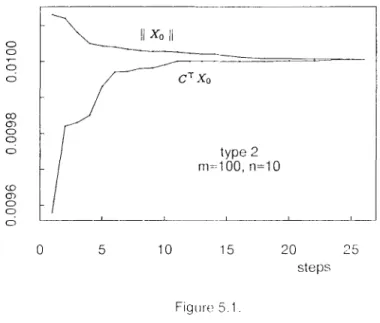
= 1,2,···, m) are uniformly distributed on [-0.001,0.001]. (This problem is also treated by Wolfe [ll].) Initial separating supporting-hyperplanes are found by the method described in Sec-tion 4. Note that we have PkJ·' :;;- 0 in (4.1) for the problems of types 1 and 2.Figure 5.1 shows a sample behavior of vlues !I XI) 11 and CT Xo obtained by the dual
algorithm for the problem of type 2; the average behavior is also shown in Figure 5.2. Figure 5.3 shows the average number of major cycles for the problem of type 1, and Figure 5.4 for the problem of type 2. The dllal algorithm requires more major cycles than the primal one for the problem of type 2. However, as shown in Figure 5.5, each set Q for the dual algorithm consists of significantly smaller number of points than for the primal one. Note that the reduction of the size of
q
strongly contributes to the reduction of time for solving the systf'm of equations (2 . .5) and (2.6).Cl Cl Cl Cl co O"l Cl Cl Cl <.0 O"l Cl Cl Cl
~-
~--~===========~--type 2 rn=1 ~O, n=1 0 L-~~_~~_~ _ _ _ _ _ _ _ I L -_ _ _ _ ~ _ _ _ _ _ _ ~ _ _ _ " 0 5 10 15 20 25 steps Figure 5.1.194 (fJ .32 u >-u o o C? o co (» o o o <D (» o o o 0 C') l{) N 0 N l{) 5 20 type 2 m"'100, n=10 ten samples 10 15 20 25 steps Figure 5.2. dual
0J
primal type 2, m=100 ten samplesS. Fujishige <I P. Zhan
0 co 0 <D C\J 40 60 80 100 points Figure 5.4. 10 primal 0 5 dual type 1 , m=100 ten samples 15 20 dimensions Figure 5.3. , / type 2, m=100 n=10, ten samples 10 15 20 25 steps Figure 5.5.
A Dual Method for the Minimum·Norm Point 195
We see from these computational experiments that the efficiency of the dual algo-rithm is comparable to primal one. However, the efficiency heavily depends on the way of choosing an initial separating supporting-hyperplane.
The dual algorithm may be effective in the sensitivity or parametric analysis with respect to the change of the data Pj (j
=
1,2,· .. , m).It should also be noted that, though Wolfe's primal and the proposed dual algorithms are practically efficient, they may require exponential time as the simplex methods for linear and quadratic programs.
Acknowledgment: The present work is partly supported by a grant in aid of the Ministry of Education, Science and Culture of Japan.
References
[1] L. C. Barbosa and E. Wong: On a class of iterative algorithms for linear inequal-ities with applications to pattern classification, in: Proceedings of the First Annual Princeton Conference of Information Sciences and Systems, 1967, pp. 86 ~ 89. [2] R.
a.
Barr: An efficient computional procedure for a generalized quadraticprogram-ming problem, SIAM Journal on Control 7 (l969) 415 ~ 429.
[3] S. Fujishige: Submodular systems and related topics, Mathematical Programming Study 22 (1984) 113 ~
131-[4] E. G. Gilbert: An iterative procedure for computing the minimum of a quadratic form on a convex set, SIAM Journal on Control 4 (1966) 61 ~ 80.
[5] E. Klafszky, J. Mayer and T. Terlaky: On mathematical programming model of mix-ing, European Journal of Operation Research 42 (1989) 254 ~ 267
[6] B. F. Mitchell, V. F. Dem'yanov and V. N. Malozemov: Finding the point of a poly-hedron closest to the origin, SIAM Journal on Control 12 (1974) 19 ~ 26.
[7] K. G. Murty and Y. Fathi: A critical index algorithm for nearest point problems on simplicial cones, Mathematical Programming 23 (1978) 206 ~ 215.
[8] R. T. Rockafellar: Convex Analysis (Princeton University Press, Princeton, N. J., 1970).
[9] J. Stoer and C. Witzgall: Convexity and Optimization in Finite Dimentions I (Spring-Verlag Berlin, Heidelberg, New York, 1970)
[10] C. van de Panne: Methods for Linear and quadratic Programming (North-Holland, Amsterdam, 1975).
[11] P. Wolfe: Finding the nearest point in a polytope, Mathematical Programming 11
(1976) 128 ~ 149.
Satoru FUJISHIGE and Ping ZHAN Institute of Socio-Economic Planning, University of Tsukuba,