Title
Development of polar stationary phases and investigation of
retention behavior in capillary liquid chromatography( 本文
(Fulltext) )
Author(s)
髙山, 信幸
Report No.(Doctoral
Degree)
博士(工学) 工博甲第517号
Issue Date
2017-03-25
Type
博士論文
Version
ETD
URL
http://hdl.handle.net/20.500.12099/56177
※この資料の著作権は、各資料の著者・学協会・出版社等に帰属します。Development of polar stationary phases and investigation
of retention behavior in capillary liquid chromatography
࢟ࣕࣆ࣮ࣛࣜᾮయࢡ࣐ࣟࢺࢢࣛࣇ࣮࠾ࡅࡿ
ᴟᛶᅛᐃ┦ࡢ㛤Ⓨಖᣢᣲືࡢゎ᫂
Nobuyuki TAKAYAMA
㧘ᒣಙᖾ
Material Engineering Division
Graduate School of Engineering
i
Contents
Contents
ⅰ
Preface
ⅴi
Chapter 1
1
Introduction
1
1.1 Chromatography
1
1.2 Ion exchange chromatography
2
1.3 Zwitterionic stationary phase
3
1.4 Monolithic column
4
1.5 Hydrophilic interaction chromatography (HILIC)
4
1.6 Capillary LC
5
1.7 Objective of the research
6
1.8 References
7
Chapter 2
9Retention behavior of inorganic anions in hydrophilic interaction
chromatography
9
2.1 Introduction
9
2.2 Experimental
11
2. 2.1 Reagents and chemicals
11
2.2.2 Apparatus
11
2.2.3 Structures of stationary phases employed in this study
12
2.3 Results and discussion
13
ii
2.3.2 Retention behavior of inorganic anions on various HILIC stationary
Phases
14
2.3.3 Effect of salt species
16
2.3.4 Effect of salt concentration
17
2.3.5 Effect of ACN concentration
20
2.3.6 Effect of ACN concentrations with another stationary phase
(cross-checking experiment)
23
2.4 Conclusions
25
2.5 References
26
Chapter 3
27Preparation of zwitterionic monolithic columns in capillary
ion chromatography
27
3.1 Introduction
27
3.2 Experimental
29
3.2.1 Reagents and materials
29
3.2.2 Apparatus
29
3.2.3 Preparation of monolithic column
30
3.3 Results and discussion
31
3.3.1 Preparation of zwitterionic sulfobetaine monolithic column
31
3.3.2 Evaluation of zwitterionic monolithic column and comparison with
ZIC-HILIC column
34
3.3.2.1 Separation of inorganic anions
34
3.3.2.2 Pressure of zwitterionic monolithic column vs ZIC-HILIC
35
3.3.2.3 van Deemter plot of zwitterionic monolithic column vs ZIC-HILIC
36
3.3.3 Effect of eluent cation
38
iii
3.3.5 Separation of cation samples
40
3.3.6 Preparation of zwitterionic phosphocholine monolithic column
41
3.3.7 Retention behavior of anions
42
3.4 Conclusion
43
3.5 References
44
Chapter 4
45Preparation of covalently bonded zwitterionic stationary phases
45
4.1 Introduction
45
4.2 Experiment
45
4.2.1 Reagents and material
45
4.2.2 Apparats
46
4.2.3 Preparation of stationary phases
47
4.2.3.1 Preparation of zwitterionic stationary phases
47
4.2.3.1.1 Preparation of tertiary amino stationary phase
47
4.2.3.1.2 Attachment of sulfo group to tertiary amino stationary
phase
47
4.2.3.2 Preparation of alternative zwitterionic stationary phase
48
4.2.3.2.1 Preparation of glycidyl bonded silica
48
4.2.3.2.2 preparation of tertiary amino stationary phase via
glycidyl
group
48
4.2.3.2.3 Application of glycidyl group
49
4.2.3.2.4 Attachment of sulfo group to tertiary amino
stationary phase via glycidyl group
49
4.2.3.3 Hydrophobic phase dynamically coated with zwitterionic molecules 49
iv
4.3.1 Investigation of stationary phases with covalently bonded zwitterionic molecules 50
4.3.1.1 Retention behavior of inorganic anions on dimethylamine-bonded silica 50
4.3.1.2 Retention behavior of inorganic cations on
sulfobetaine-dimethylamine-bonded silica
51
4.3.2 Investigation of stationary phases with covalently bonded zwitterionic
molecules by means of glycidyl groups
52
4.3.2.1 Retention behavior of inorganic anions on diethylamine-bonded silica
52
4.3.2.2 Another usage of glycidyl group
53
4.3.2.3 Retention behavior of inorganic cations on
sulfobetaine-diethylamine-bonded silica
54
4.3.2.4 Retention behavior of inorganic anions on
sulfobetaine-diethylamine-bonded silica under neutral condition
55
4.3.2.5 Retention behavior of inorganic anions on
sulfobetaine-diethylamine-bonded silica under acidic condition
56
4.3.3 Investigation of hydrophobic phase dynamically coated with
zwitterionic molecules
57
4.3.3.1 Retention behavior of inorganic anions under neutral eluent condition
57
4.3.3.2 Effect of the eluent concentration under acidic condition
59
4.4 Conclusions
62
4.5 References
63
Chapter 5
64
Conclusions
64
List of figures
66
List of tables
69
List of publications
70
v
List of presentations
71
Curriculum Vitae
72
vi
Preface
Chromatography was discovered by a Russian scientist named Mikhail Semenovich Tswett in 1903; he separated chlorophylls with calcium carbonate and that was the first separation based on the adsorption mechanism. Since then, various kinds of separation techniques have appeared and been developed. Chromatography has diverged based on its separation mechanism. Now it becomes an indispensable method in analytical field. Chromatography is a separation method by utilizing the interaction between mobile phase and stationary phase. Theses phases are generally classified based-on their physical states, i.e. solid, liquid and/or gas. Liquid chromatography (LC) has general-purpose properties because specimen materials must be able to be dissolved in a carrier and liquid mobile phases can be considered better compatible than anything else.
Since the development of capillary LC, performances of the same kind of analysis could be achieved by using less consumption of solvent and analyte. In contrast, it is recognized that the performance (separation efficiency) of LC decreases by down-sizing the system due to the fact that the system can be easily affected by the surrounding circumstances such as a change in temperature or a little quiver. Nevertheless, capillary LC has many advantages over the conventional LC, i.e. low consumption of mobile phase, mobile additives as well as stationary phase, decreased amount of waste (especially organic solvents), etc. Its low cost and environmentally friendly features favor the development of novel stationary phase, for instance, when research activities carried out in the laboratory.
The establishment of capillary-based techniques allows scientists to study more easily on the development and improvement of chromatographic methods. Investigation of synthesis of stationary phases has been conducted in order to optimize all kinds of complicated separations. Monolithic columns provide a breakthrough that can avoid troubles caused by particle packed columns. Monolithic columns have through-pores as well as meso-pores on the skeleton and this double-pore characteristic greatly reduces the back pressures under chromatographic measurements. Monolithic columns are generally divided into two types, i.e. polymer-based and silica-based. Polymer-based
vii
monolithic columns could be synthesized by easy polymerization and used under a wide range of pH. The preparation of polymer-based monolithic column involves monomers, cross-linkers and porogens. Various types of chemicals were employed to form expected structure and attach functional groups. Silica-based columns were prepared by sol-gel technology. Silanol groups of the surface of silica-based monolith could be modified. And silica-based monolithic columns could show the solvent resistance and mechanical strength.
In ion chromatography, charged functional groups on the surface of stationary phases are the most important points of ion-exchange mechanism. Generally, ionic analyte are retained by electrostatic interaction. There are several ways to introduce electrostatic forces on stationary phases. It is presumed that zwitterionic functional groups could attract both anion and cation samples, whereas repulse them. In this study, zwitterionic reagents were successfully bonded to (what kind of) stationary phases, and zwitterionic surfactant and ion-pair reagents were also dynamically coated on hydrophobic stationary phases. Although the retention mechanism of ionic samples on zwitterionic stationary phases is complex, they have the ability to separate both anion and cation samples within the same column.
Another main application of zwitterionic stationary phases is for hydrophilic interaction chromatograph (HILIC). HILIC is a very useful method especially when it comes to real samples analysis. Samples that are not retained on reversed-phase LC can be separated by the HILIC mode. Stationary phases that have polar structure can be applied for HILIC mode. These polar structure produce hydration layer and hydrophilic samples are attracted by partition. Major functional groups are bare silica, diol, imidazole, pyridine and those with zwitterionic groups such as sulfobetaine.
In this study, various kind of stationary phases for HILC were employed to show the resolution of retention mechanism of inorganic anions under HILIC. It unveiled that electrostatic interaction and hydrophilic partition competed for anion separation under the HILIC condition. Development of zwitterionic monolithic columns and investigation of anion and cation separation were conducted. Reaction condition, ratio of monomer, cross-linker and porogen were also optimized.
1
Chapter 1
Introduction
1.1 Chromatography
Chromatography is a method that separates mixed components using two inter-connected phases, which are called stationary phase and mobile phase. Chromatography conducts separation by taking advantage of physical or chemical interaction between stationary phase and mobile phase, and it is normally categorized according to the condition of mobile phase. If the mobile phase is a liquid, it is called liquid chromatography (LC), and for the case when a gas is used, it is called gas chromatography (GC), etc. [1].
In GC, due to the gas phase, diffusion speed of molecules is fast, which leads to the fact that equilibrium can be achieved very fast and short-time analysis is also obtainable. On the other hand, diffusion speed of respective components in liquid is slower than that of GC, so LC requires longer time to achieve equilibrium and longer analysis is needed, and so this is one of the flaws of LC. However, GC has a different problem, that non-volatile materials or high molecular weights substance cannot be analyzed by GC. Most of these materials are evaluated by LC. Other types of chromatography are shown in Table. 1-1 [2].
To shorten the analysis time, the mobile phase was flowed by adding a pressure. At the same period of time, other equipments and materials for chromatography systems were also developed. Chromatography was originally invented by Tswett, i.e. a Russian botanist, in 1903. He successfully separated the color constituents from a plant pigment, and he then named the method “chromatography” with its original meaning “to write with color”. In present, there are many modifications and improvements to the chromatography system, and high performance liquid chromatography, i.e. more widely known as HPLC, is the improved chromatograph and has been used in various fields such as life sciences, environment, medicals, pharmaceuticals, foods, and etc. [3,4].
2 Table 1-1 Classification of chromatography [2]
Mobile phase Stationary phase Name of chromatography
Gas Gas Gas chromatography Liquid Liquid Solid Liquid chromatography Liquid
Supercritical fluid Supercritical fluid chromatography
Shape of separation bed
Tubular Column chromatography
Planar
Thin layer chromatography Paper chromatography
Type of interaction
Adsorption Adsorption chromatography
Partition Partition chromatography
Ion-exchange Ion-exchange chromatography
Size-exclusion Size-exclusion chromatography Permeation Gel permeation chromatography Filtration Gel filtration chromatography
1.2 Ion exchange chromatography
Materials that have ionic functional group(s) are called ion-exchange resins, and they are utilized in ion-exchange chromatography (IEC) or more specifically they are used as the stationary phase. The main retention mechanism is ion exchange by electrostatic interaction between stationary phase and sample ions. Ionic materials are attracted by either negative or positive charges inner stationary phase [5-8].
3
Typical ion exchangers are sulfonic acid or carboxylic acid groups for cation separation, and quaternary ammonium is often used for anion separation. And three other types of ammonium groups (i.e. primary, secondary and tertiary) also can work as anion exchangers after they are protonated. Examples of ion-exchangers are shown in Table 1-2.
The performance of this mode depends on the exchange capacity, structure of functional group(s), base material, particle size, and etc. In addition, composition of mobile phase also affects the retention of samples. By adjusting these parameters, separation of analyte ions can be achieved.
Table 1-2 Types and functional groups of common ion-exchangers
Type Functional groups Structure
Strongly basic anion exchanger Quaternary ammonium -CH2N+(CH3)3
Weakly basic anion exchanger Amine -CH2NH2
Strongly acidic cation exchanger Sulfonic acid -SO3
-Weakly acidic exchanger Carboxylic acid -COO
-1.3 Zwitterionic stationary phase
Zwitterionic stationary phase has both negative and positive charges. Many reports regarding zwitterionic stationary phase have been published [9-14]. This type of stationary phases have been invented and developed to aim simultaneous separation of cations and anions. The existence of both charges also causes the stationary phase to be highly polarized due to the attraction and repulsion within the stationary phase, and thus it exhibits alternative ion selectivity to those obtained by the conventional anion and cation exchangers, and therefore it has the potential of optimization in IC separation.
Zwitterionic stationary phase can be obtained by covalently attaching zwitterionic molecules to a stationary phase or by dynamically coating zwitterionic surfactants on a hydrophobic stationary phase [15-18]. In covalently-bonded zwitterionic stationary phases, the important factors are distance
4
between the positive and negative charges as well as the position which charge is located at the external site. In case of dynamic modification (coating), it is considered that the retention behavior depends on the chaotropic properties of the analytes ion [19].
1.4 Monolithic column
Monolithic stationary phases could be synthesized by chemical reaction in tubes. The first introduction in capillary columns was in late 1980s [20-22]. In contrast to packed columns, measurements with monolithic columns show low pressure due to the unique structure of the skeleton and through pores, and separation in higher flow late could be achieved. Generally, base materials of monolithic stationary phases are categorized into two types, organic polymer-based and silica-based. Organic polymer-based monolithic columns are prepared by polymerization of mixture, which are monomer, cross-linker, porogens and initiator. The advantages of polymeric columns are the resistance properties under a wide range of pH and the easy preparation. Lots of approaches for preparation of matrix have been conducted. In silica-based monolithic columns, they are prepared through sol-gel technology. The advantages of silica monoliths are their strong mechanical stability and solvent resistance.
1.5 Hydrophilic interaction chromatography (HILIC)
Hydrophilic interaction chromatography (HILIC) has been attracting a lot of attention since it was coined in 1990 [24]. It is normally considered as one type of the normal-phase chromatography. In HILIC, large amount of organic solvent, usually acetonitrile (ACN) is contained in eluent, and stationary phases having high polarity are normally used. In most cases, functionalized groups such as amino, diol and amide are covalently bonded to the stationary phase [25]. It is defined that separation of analytes is dominated by hydrophilic interaction. A water layer forms on the surface of the stationary phase and polar compounds could be retained by partition. The unique nature of HILIC is that it can retain polar compounds which are too hydrophilic for the reversed-phase liquid
5
chromatography (RPLC). So, HILIC is a better approach which can cover the filed that is beyond the control of RPLC, and it has been widely utilized for the separation of various kinds of samples. The popular applications of HILIC are the determination of nucleic acid-based derivatives, vitamins, sugars and amino acids [25, 26]. Obviously, it is expected that HILIC is the most useful method for biological samples [27].
1.6 Capillary LC
LC system can be categorized by their column diameter in Table. 1-3 [28]. Generally, diameter of column for capillary LC is less than 1.0 mm. On the other hand, over 4.0 mm diameter of columns is often used for conventional LC. The biggest advantage of capillary LC is its environmental friendly feature, which means low amount of mobile phases and waste. Extremely small amount of sample volume is also sufficient for the analysis. As the results, expensive reagents for mobile phase additive and scarce samples such as biological samples are also applicable. Nevertheless, it is well-known that the performance (separation efficiency) of LC decreases by down-sizing the system due to the fact that the system can be easily affected by the surrounding circumstances such as a change in temperature or a little quiver.
Table. 1-3 Classification of LC columns based on their I.D. [28]
Purpose Classification I.D. / mm
Analytical Nano-LC ~ 0.075 μLC 0.2 ~ 0.8 Semi-μLC 1.0 ~ 2.1 Conventional LC 4.0 ~ 6.0 Preparative Preparative LC 10 ~
6
1.7 Objectives of the research
A lot of commercial stationary phases for HILIC are available. These stationary phases have polar functional groups to form hydration layer. Most of the functional groups can be charged negatively or positively. Residual silanol groups on silica-based columns can be deprotonated and negatively charged while amine groups can be protonated and charged positively. That means retention mechanism of HILIC is not explained by simple interaction [29]. Chapter 2 shows the specific phenomena of inorganic separation in HILIC mode and provides resolution.
Many papers of zwitterionic monolithic columns have been published [30-33]; those papers discussed applications of these columns for mainly HILIC mode. Chapter 3 shows an easy one-pot synthesis of zwitterionic monolithic columns. The reaction condition was optimized and the prepared columns were evaluated by capillary ion chromatography. Results were reviewed by comparison with commercially available packing columns.
It is known that the amino groups have the ability to react with other reagents by the lone electron pair and is expected to form zwitterionic structure. And a number of articles, detailing stationary phases dynamically coated with zwitterionic molecules, have been published. However, there is still much room to study on the zwitterionic stationary phase. It is expected that zwitterionic stationary phase can separate anions and cations simultaneously and be applied to alternative chromatography. In chapter 4, several types of zwitterionic stationary phases were prepared and the characteristic(s) of each phase was investigated.
7
1.8 References
[1] J. Haggarty, K. EV Burgess, Curr. Opin. Biotechnol, 43 (2017) 77-85.
[2] L.W. Lim, Development of Micro-Flow-Controlled Techniques for capillary Liquid Chromatohraphy, PhD Dissertation, Nagoya University
[3] H. Nakamura, Specific tips for liquid chromatography (edition for separation), (in Japanese), 2007.
[4] H. Nakamura, Tips for using liquid chromatography efficiently (knowhow that is not told elsewhere), (in Japanese), 2004.
[5] T. Okada, A, Yamamoto, Y, Inoue, Separation analysis of ionic chemical species by ion chromatography, (in Japanese), 2010.
[6] K. Tanaka, Useful ion chromatography, (in Japanese), 2009.
[7] K. Oikawa, K, Kawata, K, Suzuki, Ion chromatography, (in Japanese), 2010. [8] M. G. Kiseleva, P. N. Nesterenko, J.Chromatogr. A, 920 (2001) 87-93.
[9] E. P. Nesterenko, P. N. Nesterenko, B. Paull, Anal. Chim. Acta, 652 (2009) 3-21.
[10] H. Qiu, E. Wanigasekara, Y. Zhang, T. Tran, D. W. Armstrong, J. Chromatogr. A, 1218 (2011) 8075-8082.
[11] L. Qiao, A. Dou, X. Shi, H. Li, Y. Shan, X. Lu, G. Xu, J. Chromatogr. A, 1286 (2013) 137-145. [12] L. Sonnenschein, A. Seubert, J. Chromatogr. A, 1218 (2011) 1185-1194.
[13] H. Qiu, Q. Jiang, Z. Wei, X. Wang, X. Liu, S. Jiang, J. Chromatogr. A, 1163 (2007) 63-69. [14] W. Hu, K. Hasebe, K. Tanaka, P. R. Haddad, J. Chromatogr. A, 850 (1999) 161-166.
[15] T. Umemura, S. Kamiya, A. Itoh, K. Chiba, H. Haraguchi, Anal. Chim. Acta, 349 (1997) 231-238. [16] E. P. Nesterenko, P. N. Nesterenko, B. Paull, J. Chromatogr. A, 1178 (2008) 60.
[17] T. Yokoyama, M. Macka, P. R. Haddad Anal. Chim. Acta, 442 (2001) 221-300. [18] C. O. Riordain, P. Nesterenko, B. Paull, J. Chromatogr. A, 1070 (2005) 71-78. [19] T. Cecchi, P. Passamonti, J. Chromatogr. A, 1216 (2009) 1789-1792.
8
[20] K. nakanishi, H. minakuchi, N. soga, J. Sol-Gel Sci. Tech, 8 (1997) 547-552. [21] Q. Tang, B. Xin, M. L. Lee, J. Chromatogr, A, 837 (1999) 35–50.
[22] S. Xie, F. Svec, J. M.J. Fre´chet, J. Chromatogr, A, 775 (1997) 65–72. [23] A. J. Alpert, J. Chromatogr, 499 (1990) 177-196.
[24] D. V. McCalley, J. Chromatogr. A, 1217 (2010) 3408–3417.
[25] S. Noga, P. Jandera, B. Buszewski, Chromatographia, 76 (2013) 929–937. [26] X. Cheng, Y. Hao, X. Peng, B. Yuan, Z. Shi, Y. Feng, Talanta, 141 (2015) 8–14.
[27] W. Yin, L. Cheng, H. Chai, R. Guo, R. Liu, C. Chu, J. A. Palasota, X. Cai, Anal. Bioanal. Chem., 407 (2015) 6217–6220.
[28] T. Takeuchi, Cromatography, 26 (2005) 7-10.
[29] M. E. A. Ibrahim, C. A. Lucy, Talanta, 100 (2012) 313–319.
[30] L. Zhenghua, P. Yongbo, W. Tingting, Y. Guangxin, Z. Qiaoxuan, G. Jialiang, J. Zhengjin, J. Sep. Sci., 36 (2013) 262–269.
[31] W. Xiaochun, L. Xucong, X. Zenghong, Electrophoresis, 30 (2009) 2702-2710. [32] Z. Jiang, J. Reilly, B. Everatt, N. W. Smith, J. Chromatogr, A, 1216 (2009) 2439–2448. [33] E. Sugrue, P. N. Nesterenko, B. Paull, J. Chromatogr, A, 1075 (2005) 167–175.
9
Chapter 2
Retention behavior of inorganic anions in hydrophilic interaction
chromatography
2.1 Introduction
Hydrophilic interaction chromatography (HILIC) has been attracting a lot of attention since it was coined in 1990 [1]. In HILIC, a large amount of organic solvent, usually acetonitrile (ACN) is contained in the eluent, and stationary phases having high polarity are normally used. In most cases, the stationary phase for HILIC are bare silica or functionalized groups such as amino, diol, silica and amide which are covalently bonded to the silica backbone [2]. A water layer forms on the surface of the stationary phase and polar compounds could be retained by partition. The unique nature of HILIC is that it can retain polar compounds which are too hydrophilic for the reversed-phase liquid chromatography (RPLC). So, HILIC is a better approach which can cover the field that is beyond the control of RPLC, and it has been widely utilized for the separation of various kinds of samples. The popular applications of HILIC are the determination of nucleic acid-based derivatives, vitamins, sugars and amino acids [3,4]. Obviously, it is expected that HILIC is a most useful method in biological samples [5].
Ion-exchange chromatography (IEC) is the most common method used to separate and determine ionic samples. Usually ionic functional groups which have negative or positive charge are chemically bonded to the base materials for IEC stationary phase. The main retention mechanism is ion exchange by electrostatic interaction between stationary phase and analyte ions. There are several factors which affect the retention of inorganic ions and their elution order. For examples, they are the strength of electrostatic interaction, the adsorption of analyte ions to the base material of the stationary phase, and the degree of hydration of the analyte ions as well as the surface of the ion exchange sites. Especially, the degree of hydration has a major influence to the elution order. The selectivity of anion exchange chromatography was studied by using methanol, acetonitrile, N,N-dimethylformamide and
10
their mixtures; drastic changes of retention time for inorganic anions were observed according to the composition of mobile phase [6].
Besides, some stationary phases, where there is no positive/negative charge, could achieve the separation of ions by dynamically coating ionic reagents such as ion-pairs reagents or surfactants [7-10]. It was also found that some inorganic anions could be separated on C30 stationary phase by hydrophobic interaction [11]. Separation of inorganic anions in the partition mode was observed by the C30 stationary phase coated by poly(ethylene glycol) (PEG) [12,13]. PEG covers the surface of the C30 and forms layer on it. This layer could be adjusted by the eluent concentration and optimization of the eluent was investigated. Chemically bonded poly(oxyethylene) stationary phase is also examined [14]. It was reported that inorganic anions could be separated by ion-exchange mode. This mechanism is considered that several poly(oxyethylene) chains catch the eluent cation such as sodium ions and potassium ions and they can attract analyte anions.
Recently, it has been found that HILIC stationary phase can also be applied for ion separation. HILIC stationary phase which is a diol-type has achieved ion separation under acidic condition [15]. Mixed mode of HILIC/anion-exchange was investigated on a latex coated monolith column, which implied that the mechanism depends on the partition for kosmotropic anions, while anion-exchange dominates for chaotropic anions [16]. Zwitterionic stationary phase is often used to evaluate the effect of both charges [4, 17-21]. Nucleoside, water soluble vitamins, benzoic acid derivatives and basic compounds were employed as analyte samples [4]. Three types of zwitterionic stationary phases, which have different negative and positive charges’ ratio each, were prepared and various experiment results suggested that protonation of stationary phase and analyte sample is controllable by adjusting the pH. Hence, retention of samples is affected by the electrostatic attraction or repulsion.
Based on the above concepts, there is still plenty of room that has not been understood in HILIC separation. In this paper, we investigated the retention behavior of inorganic anions by using HILIC stationary phases such as TSKgel NH2-60, Polar-Imidazole, TSKgel Amide-80, Polar-Pyridine
11
and ZIC-HILIC. Base material of all stationary phases was silica gel.
2.2 Experimental
2.2.1 Reagents and chemicals
Reagents employed were of guaranteed reagent grade and were obtained from Wako Pure Chemical Industries (Osaka, Japan), unless otherwise noted. Sodium bromate, sodium bromide, sodium iodate, sodium iodide, sodium nitrate, sodium nitrite, sodium thiocyanate and ammonium acetate, were obtained from Nacalai Tesque (Kyoto, Japan). HPLC grade acetonitrile was obtained from Tokyo Chemical Industry (Tokyo, Japan). Ultrapure water was prepared in the laboratory by using a Simplicity UV water purification system (Millipore, Molsheim, France), and all solutions used in this study were prepared using this ultrapure water.
TSKgel NH2-60 and TSKgel Amide-80 were obtained from Tosoh Corporation (Yamaguchi,
Japan). Polar-Imidazole and Polar-Pyridine were obtained from Sepax Technologies (Newark, USA) while ZIC-HILIC was obtained from Merck Millipore (Darmstadt, Germany).
2.2.2 Apparatus
In this work, all experiments were conducted by using a capillary LC system constructed by a microfeeder (L.TEX Corporation, Tokyo, Japan) equipped with a gas-tight syringe (0.5 mL; Ito, Fuji, Japan) as a pump, an M-435 micro injection valve (Upchurch Scientific, Oak Harbor, WA, USA) with an injection volume of 0.2 μL, a microcolumn prepared from a fused-silica capillary tube (100 mm × 0.32 mm I.D.; GL Sciences, Tokyo, Japan), a UV detector (JASCO, Tokyo, Japan) with the wavelength 210 nm, and a data processor (CDS-Lite ver 5.0; LA soft, Chiba, Japan). The inlet pressure was monitored by an L.TEX-8150 pressure sensor (L.TEX). Separation columns were immersed into a water bath for temperature controlled at 20°C throughout the study.
12
2.2.3 Structures of stationary phases employed in this study
Schematic structures of stationary phases employed in this study are shown in Fig. 2-1.
13
2.3 Results and discussion
2.3.1 Retention behavior of inorganic anions under IEC and HILIC modes
Fig. 2-2 compared the difference of elution order of inorganic anions between IEC mode and HILIC mode. As for the IEC mode (Fig. 2-2 A; upper trace), IC-Anion-PWXL and 200 mM sodium
chloride were employed as the stationary phase and eluent, respectively. As can be seen from Fig. 2-2 A, the elution order of IEC is BrO3- <NO2- <Br- <NO3- <I- <SCN-. On the other hand, TSKgel NH2-60
and 30 mM ammonium acetate containing 70 % ACN were employed as the stationary phase and eluent, respectively, and the separation was carried out under HILIC mode (Fig. 2-2 B); opposite elution order was observed, i.e. SCN- <I- <NO
3- <Br- <NO2- <BrO3-. These results suggested that
hydration degree of the analyte anions is the most important factor deciding the elution order. Anions which have smaller radii have stronger electrostatic force per unit area and therefore would be strongly hydrated. And furthermore, the radius of strongly hydrated anion became big and it has weak electrostatic interaction to the anion-exchange site. As a result, small anions retain weakly on the stationary phase and big anions have opposite nature. In HILIC mode, a lot of ACN is added in the eluent; and since ACN promotes the desolvation of analyte anions, small hydrated anions after desolvation can be strongly attracted to the stationary phase. And therefore the elution order became reversed under the HILIC mode.
14
Fig. 2-2 Separation of inorganic anions under IEC (A) and HILIC (B) modes.
Columns: TSKgel IC-Anion-PWXL (A), TSKgel NH2-60 (B), 100 × 0.32 mm i.d. Eluents: 200 mM
NaCl (A), 30 mM CH3COONH4 with 70 % ACN additive (B). Flow-rate: 4.0 μL min-1. Analytes: 1 =
BrO3-, 2 = NO2-, 3 = Br-, 4 = NO3-, 5 = I-, 6 = SCN-, 0.5 mM each. Injection volume: 0.2 μL.
Wavelength of UV detection: 210 nm.
2.3.2 Retention behavior of inorganic anions on various HILIC stationary phases
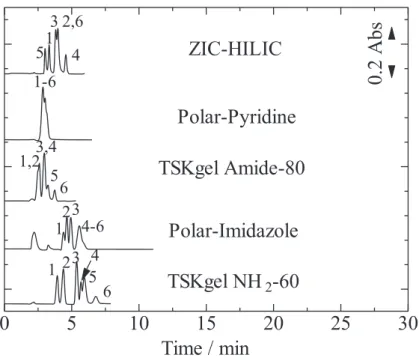
Figs. 2-3 and 2-4 show the retention behavior of inorganic anions. Sodium chloride and sodium perchlorate are used as salt in Fig. 2-3 and Fig. 2-4, respectively. The concentration of salt and ACN were kept constant 20 mM and 70 %. SCN-, I-, NO
3-, Br-, NO2- and BrO3- are used as analyte
anions. The results indicate that TSKgel NH2-60 and Polar-Imidazole could retain the analyte anions.
TSKgel Amide-80 also could retain them weakly while Polar-Pyridine did not show any retention. ZIC-HILIC retained them but showed the asymmetric peaks in Fig. 2-4. The pKa values of conjugate acid for methylamine, imidazole and pyridine are 10.62, 7.00 and 5.29, respectively. That means TSKgel NH2-60 is protonated, Polar-Imidazole is partially protonated and Polar-Pyridine is little
0
5
10
Time / min
0.1 A
bs
1
2
3
4
5
6
1
2
3
4
5
6
A
B
15
protonated under the neutral condition. For this reason, it is expected that TSKgel NH2-60 and
Polar-Imidazole could retain the analyte anions by electrostatic interaction. TSKgel Amide-80 is non-protonable and it does not work via electrostatic interaction but partition. ZIC-HILIC has both positive and negative charges in its structure. In this case, analyte anions can be attracted and repulsed by both charges and the elution order showed irregular and peaks became asymmetry. Therefore, TSKgel NH2-60 and Polar-Imidazole were selected to investigate the effect of other parameters in the
following experiments.
Fig. 2-3 Retention behavior of inorganic anions on various HILIC stationary phases using sodium chloride salt.
Columns: TSKgel NH2-60, Polar-imidazole, TSKgel Amide-80, Polar-Pyridine, ZIC-HILIC, 100 ×
0.32 mm I.D. Eluent: 20 mM NaCl with 70 % ACN. Flow-rate: 3.0 μL min-1. Analytes: 1 = BrO 3-, 2 =
NO2-, 3 = Br-, 4 = NO3-, 5 = I-, 6 = SCN-, 0.5 mM each. Injection volume: 0.2 μL. Wavelength of UV
detection: 210 nm.
0
5
10
15
20
25
30
Time / min
0.2 A
bs
1 23 45 6TSKgel NH
2-60
Polar-Imidazole
Polar-Pyridine
ZIC-HILIC
TSKgel Amide-80
1234-6 5 6 1,23,4 5 2,6 3 1 4 1-616
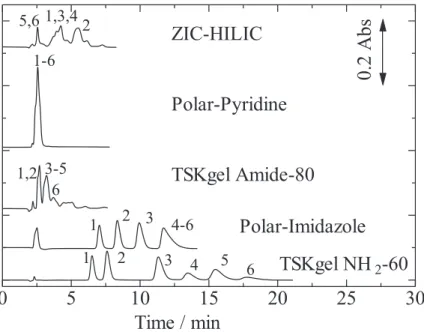
Fig. 2-4 Retention behavior of inorganic anions on various HILIC stationary phases using sodium perchlorate salt.
Columns: TSKgel NH2-60, Polar-imidazole, TSKgel Amide-80, Polar-Pyridine, ZIC-HILIC, 100 ×
0.32 mm I.D. Eluent: 20 mM NaClO4 with 70 % ACN. Flow-rate: 3.0 μL min-1. Analytes: 1 = BrO3-, 2
= NO2-, 3 = Br-, 4 = NO3-, 5 = I-, 6 = SCN-, 0.5 mM each. Injection volume: 0.2 μL. Wavelength of UV
detection: 210 nm.
2.3.3 Effect of salt species
Fig. 2-3 and Fig. 2-4 also show the effect of salt species for TSKgel NH2-60 and
Polar-Imidazole. The investigated salt species are sodium chloride and sodium perchlorate. As can be seen, sodium chloride leads to shorter retention time while sodium perchlorate caused longer retention time, respectively. Usually it is considered that, when sodium perchlorate is used, retention time of analytes should be shorter than that observed when sodium chloride was used. This is because perchlorate can retain on the stationary phase stronger than chloride, and that means perchlorate prevents the retention of analyte anions and leads to shorter retention time eventually. But in this case, converse retention result was observed. This could be explained by the hydration for each chloride and perchlorate become weak due to high ACN concentration. The ACN can disturb the hydration of
0
5
10
15
20
25
30
Time / min
0.2 A
bs
1 2 3 4 5 6TSKgel NH
2-60
Polar-Imidazole
Polar-Pyridine
ZIC-HILIC
TSKgel Amide-80
1 2 3 4-6 1,2 1-6 2 1,3,4 5,6 3-5 617
elution anions and their hydrated ionic radii become smaller than those in water. Thus, chloride can retain stronger than perchlorate and shorter retention time of analyte anions was observed.
2.3.4 Effect of salt concentration
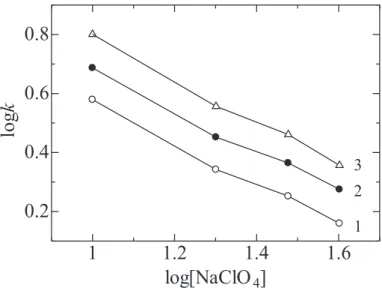
Retention behavior was investigated with various concentrations of sodium perchlorate under HILIC condition. The concentration of ACN was maintained at 70% while sodium perchlorate was varied from 10 to 40 mM, the chromatograms are shown in Figs. 2-5 and 2-6. The retention time of all samples decreased with increasing sodium perchlorate concentration; as commonly observed under the conventional IEC mode. Figs. 2-7 and 2-8 show the logarithm of retention factor (k) of analytes versus the logarithm of the eluent (i.e. sodium perchlorate) concentration. Three anions, thiocyanate, iodide and nitrate are plotted for Polar-Imidazole in Fig. 2-8 because other samples, bromide, nitrite and bromate were coeluted. It is widely known that the plots of log k versus log eluent concentration should be straight lines and the slopes should be –1, when monovalent anions are employed for both analytes and eluent. The slopes obtained in Fig. 2-7 were –0.44, –0.43, –0.43, –0.43, –0.44, and –0.45 for thiocyanate, iodide, nitrate, bromide, nitrite, and bromate, respectively. The slopes obtained in Fig. 2-8 were -0.69, -0.68 and -0.73 for thiocyanate, iodide and nitrate, respectively. Although the slopes do not attain the theoretical values, they can be considered straight lines (with linear correlation coefficients, R2 > 0.99). These results imply that ion-exchange mode works but it is not the only
18
Fig. 2-5 Separation of inorganic anions on a TSKgel NH2-60 column with different eluent
concentrations.
Column: TSKgel NH2-60, 100 × 0.32 mm I.D. Eluents: NaClO4 with 70 % ACN, the concentration of
NaClO4 as indicated. Flow-rate: 3.0 μL min-1. Analytes: 1 = BrO3-, 2 = NO2-, 3 = Br-, 4 = NO3-, 5 = I-,
6 = SCN-, 0.5 mM each. Injection volume: 0.2 μL. Wavelength of UV detection: 210 nm.
0
5
10
15
20
25
30
10 mM
20 mM
30 mM
40 mM
Time / min
0.1 A
bs
[NaClO
4]
1
2
3
5
6
4
19
Fig. 2-6 Separation of inorganic anions on a Polar-imidazole column with different eluent concentrations.
Column: Polar-Imidazole, 100 × 0.32 mm I.D. Eluents: NaClO4 with 70 % ACN additive, the
concentration of NaClO4 as indicated. Flow-rate: 3.0 μL min-1. Analytes: 1 = BrO3-, 2 = NO2-, 3 = Br-,
4 = NO3-, 5 = I-, 6 = SCN-, 0.5 mM each. Injection volume: 0.2 μL. Wavelength of UV detection: 210
nm.
Fig. 2-7 Plotting of logarithm of the retention factor (k) versus logarithm of the NaClO4 concentration
given by a TSKgel NH2-60 column.
Operating conditions as in Fig. 2-5.
0
5
10
15
20
25
Time / min
10 mM
20 mM
30 mM
40 mM
1
2
3
4-6
[NaClO
4]
0.1 A
bs
1
1.2
1.4
1.6
0.2
0.4
0.6
0.8
1
1.2
log[NaClO
4]
lo
gk
1 2 3 4 5 620
Fig. 2-8 Plotting of logarithm of the retention factor (k) versus logarithm of the NaClO4 concentration
given by a Polar-Imidazole column. Operating conditions as in Fig. 2-6.
2.3.5 Effect of ACN concentration
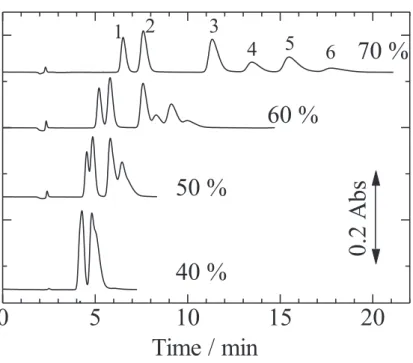
Figs. 2-9 and 2-10 illustrate the effect of ACN concentration. The various concentration of ACN was investigated in the range of 40-70%. 20 mM sodium perchlorate was utilized in these experiments and the chromatograms are shown in Fig. 2-9. As can be seen in Fig. 2-9, the retention time for each anion increased with increasing ACN concentration. All anions could not be separated at 40% ACN whereas the separation of all samples was achieved when the ACN concentration was greater than 60%. In Fig. 2-10, similar phenomenon was observed. The fact that retention time became longer when the amount of ACN increased is a typical mechanism of HILIC.
1
1.2
1.4
1.6
0.2
0.4
0.6
0.8
log[NaClO
4]
lo
gk
1 2 321
Fig. 2-9 Separation of inorganic anions on TSKgel NH2-60 column with different concentration of
ACN.
Column: TSKgel NH2-60, 100 × 0.32 mm I.D. Eluents: 20 mM NaClO4 + ACN with concentration as
indicated. Flow-rate: 3.0 μL min-1. Analytes: 1 = BrO
3-, 2 = NO2-, 3 = Br-, 4 = NO3-, 5 = I-, 6 = SCN-,
0.5 mM each. Injection volume: 0.2 μL. Wavelength of UV detection: 210 nm.
0
5
10
15
20
Time / min
1 2
3
4
5
6
40 %
50 %
60 %
70 %
0.2 A
bs
22
Fig. 2-10 Separation of inorganic anions on Polar-Imidazole column with different concentration of ACN.
Column: Polar-Imidazole, 100 × 0.32 mm I.D. Eluents: 20 mM NaClO4 + ACN with concentration as
indicated. Flow-rate: 3.0 μL min-1. Analytes: 1 = BrO
3-, 2 = NO2-, 3 = Br-, 4 = NO3-, 5 = I-, 6 = SCN-,
0.5 mM each. Injection volume: 0.2 μL. Wavelength of UV detection: 210 nm.
0
5
10
15
1
2
3
4-6
Time / min
70 %
60 %
50 %
40 %
0.2 A
bs
23
2.3.6 Effect of ACN concentrations with another stationary phase (cross-checking
experiment)
In order to compare the effect of stationary phases, investigation of various concentration of ACN was conducted with TSKgel QAE-2SW, which is a silica-based stationary phase with quaternary ammoniums as the ion exchange sites. IO3-, NO2-, NO3-, I- and SCN- are chosen as analyte anions. The
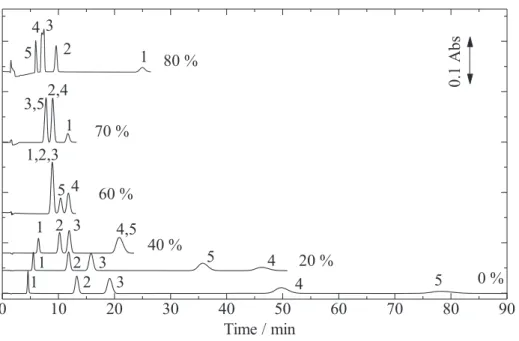
concentration of ACN was examined from 0% to 80%, and sodium chloride was kept at 50 mM, the separation results are summarized in Fig. 2-11. ACN 0% means the retention mechanism is solely depend on ion exchange mode with elution order: IO3- <NO2- <NO3- <I- <SCN-, which is the standard
order for IEC [22]. As increasing of ACN, gradually the elution order became reverse, and the retention times of each sample are represented in Fig. 2-12. Elution order became completely reversed at high ACN concentration. In this study, the same phenomenon was observed when TSKgel NH2-60
was used as the stationary phase. A lot of ACN can promote the desolvation of analyte anions, and their hydrated ionic radii became smaller. As the result, small hydrated anion after desolvation has strong electrostatic force per unit area and can interact strongly to the stationary phase. After the reversed elution order was observed at the 70 % ACN, the retention time of IO3- became longer at the
80% ACN. These results imply that HILIC mode appeared and partition is one of the retention mechanisms.
24
Fig. 2-11 Separation of inorganic anions on a TSKgel QAE-2SW column with different ACN concentrations.
Column: TSKgel QAE-2SW, 100 × 0.32 mm I.D. Eluents: 50 mM NaCl with ACN additive, the concentration of ACN as indicated. Flow-rate: 3.0 μL min-1. Analytes: 1 = IO
3-, 2 = NO2-, 3 = NO3-, 4
= I-, 5 = SCN-, 0.5 mM each. Injection volume: 0.2 μL. Wavelength of UV detection: 210 nm.
Fig. 2-12 Retention time as a function of the ACN concentration in the eluent. Operating conditions as in Fig. 2-11
0 10 20 30 40 50 60 70 80 90 Time / min 0.1 A bs 0 % 20 % 40 % 60 % 70 % 80 % 1 2 3 4 5 1 2 3 4 5 1 2 3 4,5 1 2 3 4 5 1 3,52,4 1,2,3 5 4
0
20
40
60
80
0
20
40
60
80
Re
te
nt
ion t
im
e
/ m
in
[ACN] / %
1
2
3
4
5
25
2.4 Conclusions
Stationary phases that are suitable for the separation of inorganic anions under HILIC condition are TSKgel NH2-60 and Polar-Imidazole. Elution order of inorganic anions was reversed in
HILIC mode in comparison with IEC mode when TSKgel NH2-60 and Polar-Imidazole were used as
the stationary phase. High concentration of ACN facilitates the desolvation of analyte anions as well as anions that are in the eluent. It is presumed that the retention of anions is affected by the electrostatic interaction but the retention mechanism is not purely based on ion-exchange mode. Partition is also competing for retention mechanism due to the fact that retention increases as increasing the concentration of ACN.
26
2.5 References
[1] J. Alpert, J. Chromatogr, 499 (1990) 177-196.
[2] D. V. McCalley, J. Chromatogr. A, 1217 (2010) 3408–3417.
[3] S. Noga, P. Jandera, B. Buszewski, Chromatographia, 76 (2013) 929–937. [4] X. Cheng, Y. Hao, X. Peng, B. Yuan, Z. Shi, Y. Feng, Talanta, 141 (2015) 8–14.
[5] W. Yin, L. Cheng, H. Chai, R. Guo, R. Liu, C. Chu, J. A. Palasota, X. Cai, Anal. Bioanal. Chem., 407 (2015) 6217–6220.
[6] T. Okada, J. Chromatogr. A, 758 (1997) 19-28.
[7] E. P. Nesterenko, P. N. Nesterenko, B. Paull, J. Chromatogr. A, 1178 (2008) 60–70. [8] T. Yokoyama, M. Macka, P. R. Haddad, Anal. Chim. Acta, 442 (2001) 221–230. [9] O. Riordain, P. Nesterenko, B. Paull, J. Chromatogr. A, 1070 (2005) 71–78.
[10] T. Umemura, S. Kamiya, A. Itoh, K. Chiba, H. Haraguchi, Anal. Chim. Acta, 349 (1997) 23 l-238. [11] T. Takeuchi, B. Jiang, L. W. Lim, Anal. Bioanal. Chem., 402 (2012) 551–555.
[12] L. Rong, T. Takeuchi, J. Chromatogr. A, 1042 (2004) 131–135.
[13] L. Rong, L. W. Lim, T. Takeuchi, Chromatographia, 61 (2005) 371-374. [14] T. Takeuchi, L. W. Lim, Anal. Sci., 26 (2010) 937-941.
[15] K. Arai, M. Mori, D. Kozaki, N. Nakatani, H. Itabashi, K. Tanaka, J. Chromatogr. A, 1270 (2012) 147–152.
[16] M. E. A. Ibrahim, C. A. Lucy, Talanta, 100 (2012) 313–319.
[17] H. Qiu, Q. Jiang, Z. Wei, X. Wang, X. Liu, S. Jiang, J. Chromatogr. A, 1163 (2007) 63–69. [18] H. Qiu, E. Wanigasekara, Y. Zhang, T. Tran, D. W. Armstrong, J. Chromatogr. A, 1218 (2011)
8075–8082.
[19] L. Qiao, A. Dou, X. Shi, H. Li, Y. Shan, X. Lu, G. Xu, J. Chromatogr. A, 1286 (2013) 137–145. [20] W. Hu, K. Hasebe, K. Tanaka, P. R. Haddad, J. Chromatogr. A, 850 (1999) 161–166.
[21] L. Sonnenschein, A. Seubert, J. Chromatogr. A, 1218 (2011) 1185–1194. [22] T. Takeuchi, T. Kawasaki, and L. W. Lim, Anal. Sci., 26 (2010) 511-514
27
Chapter 3
Preparation of zwitterionic monolithic columns in capillary ion
chromatography
3.1 Introduction
Monolithic columns are generally categorized into two types, i.e. one is organic polymer base, and another is silica base. Advantages of monolithic columns are derived from their high porous structures. It is consisted by mesopores and through-pores, which enable higher liner flow late and low pressure. Another representative merit of monolithic columns is easy preparation. Fabrication of skeleton and modification of structure could be led by simple chemical reaction. So many kinds of monolithic stationary phases have been synthesized to meet various needs.
Several types of zwitterionic (ZIC) stationary phases were developed for ion chromatography. Zwitterionic structure has both anion and cation exchange sites. The most popular structure is the one that is covalently bonded zwitterionic molecules [1]. ZIC-HILIC, produced by Merck, has sulfobetaine functional groups on its structure [2]. Positively charged and negatively changed groups are covalently bonded to silica particles. 1,3-propane sultone was reacted to imidazolium groups as a quaternizing reaction to form zwitterionic structure [3-4]. Jiang and coworkers reported phosphorylcholine type zwitterionic stationary phase that was synthesized by graft polymerization [5]. In addition, a study that showed how to control the ratio of positively and negatively charged groups was also reported [6]. An effect of the length of alkyl chain between the positively and negatively charged groups was also studied [7].
Another approach is to dynamically coat the stationary phases with zwitterionic surfactants [8-11]. These stationary phases are usually used for reversed-phase chromatography and the surfactants are normally attracted via hydrophobic interaction. In most of cases, zwitterionic chemicals are added to the mobile phase to keep the concentration.
28
attempts to synthesize zwitterionic monolith columns since then. Polymer-based monolithic columns are synthesized by in-situ polymerization. Monomers, cross-linkers, porogens and initiators are important materials for synthesizing monolithic columns. Zwitterionic monolithic stationary phase was prepared based on the thermal-initiated copolymerization of N,N- dimethyl-N- (3-methacryl-amidopropyl)- N- (3-(sulfopropyl) ammonium betaine and ethylene glycol dimethacrylate [15,16]. Another monomer i.e. 2-methacryloyloxyethyl phosphorylcholine was also used to synthesize phosphorylcholine-type zwitterionic monolithic column [17]. Silica monolith was also applied for attachment of lysine (2,6-diaminohexanoic acid) groups [18]. The resultant stationary phase has zwitterionic nature.
The main and ultimate aim to synthesize zwitterionic stationary phases was simultaneous separation of cation and anion samples. And it is well known that zwitterionic stationary phases can be applied for hydrophilic interaction chromatography (HILIC). HILIC is considered as one of the normal phase chromatography. High concentration of polar organic solvent, usually acetonitrile (ACN), and polar stationary phases are chosen [19]. By taking advantage of easy preparation of monolithic columns, optimization for HILIC separation was fulfilled. Buffer salt concentration in mobile phase was investigated [20]. In most cases, when organic polymer-based monolithic columns were synthesized, ethylene dimethacrylate (EDMA) was often used as the cross-linker. Three different types of cross-linkers were utilized to confirm the influence on the retention of analytes [21].
Although zwitterionic monolithic stationary phases have been applied for HILIC mode many times, there are few reports regarding separation of cations and anions. Zwitterionic structure caused attraction and repulsion to inorganic analyte samples. In this study, zwitterionic monolithic columns were synthesized and applied to capillary ion chromatography.
29
3.2 Experimental
3.2.1 Reagents and materials
Reagents employed were of guaranteed reagent grade and were obtained from Wako Pure Chemical Industries (Osaka, Japan), unless otherwise noted. Sodium bromide, sodium iodate, sodium iodide, sodium nitrate, sodium nitrite, sodium thiocyanate, ammonium chloride and benzyltrimethyl- ammonium chloride were obtained from Nacalai Tesque (Kyoto, Japan). 2-(Methacryloyloxy)ethyl 2-(trimethylammonio)ethyl phosphate and 3-(trimethoxysilyl)propyl methacrylate were obtained from Tokyo Chemical Industry (Tokyo, Japan). Lithium Chloride, magnesium chloride hexahydrate and potassium chloride were obtained from Yoneyama Yakuhin Kogyo (Osaka Japan) [2-(methacryloyloxy)ethyl]dimethyl-(3-sulfopropyl)ammonium hydroxide was obtained from Sigma-Aldrich (St. Louis USA) Ultrapure water was prepared in the laboratory by using a Simplicity UV water purification system (Millipore, Molsheim, France), and all solutions used in this study were prepared using this ultrapure water. ZIC-HILIC was obtained from Merck Millipore (Darmstadt, Germany). All packing materials are packed in fused-silica capillary tube (100 mm × 0.32 mm i.d).
3.2.2 Apparatus
In this work, all experiments were conducted by using a capillary LC system constructed by a syringe pump YSP-101 (YMC, Kyoto, Japan) equipped with a gas-tight syringe (0.5 mL; Ito, Fuji, Japan) as a pump, an C4-1004-.2 internal sample injector (VICI Valco Instruments, Houston, USA) with an injection volume of 0.2 μL, a microcolumn prepared from a fused-silica capillary tube (100 mm × 0.32 mm i.d.; GL Sciences, Tokyo, Japan), a UV detector (JASCO, Tokyo, Japan) with the detection wavelength was set at 210 nm, and a data processor (CDS-Lite ver 5.0; LA soft, Chiba, Japan). The inlet pressure was monitored by an L.TEX-8150 pressure sensor (L.TEX). Separation columns were operated under room temperature (controlled at 25°C) throughout the study.
30
3.2.3 Preparation of monolithic column
0.2 M NaOH, 0.2 M HCL and 20 % (v/v) 3-(trimethoxysilyl)propyl methacrylate in ethanol were passed through fused-silica capillary tube in a sequential order for thirty minutes each to attach methacrylate groups on the inner wall of the capillary tube. Then the tube was washed by ethanol and dried by passing nitrogen. A mixture of monomer, cross-linker, porogen and initiator was then filled in the pre-treated tube and it was sealed both sides. The capillary was dipped in water bath at 60 Υ for 18 hours. After reaction, methanol was flashed through the tube to wash out the residuals.
31
3.3 Results and discussion
3.3.1 Preparation of zwitterionic sulfobetaine monolithic column
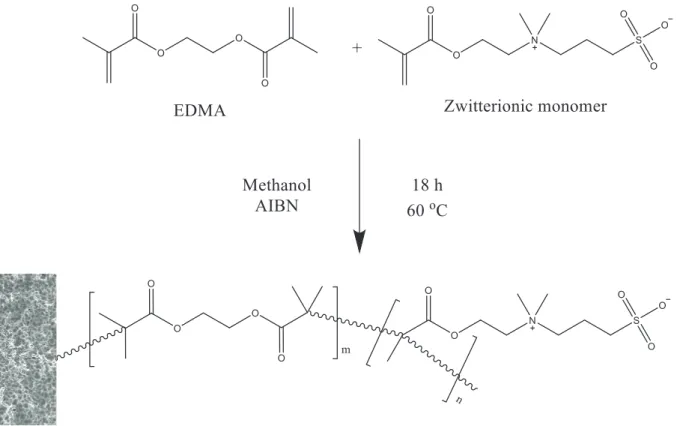
Monolithic columns were prepared by one-pot reaction, as seen in Fig. 3-1. Adjustable parameters were weights of each chemicals, zwitterionic monomer, EDMA and methanol. Table. 3-1 shows the all specific values employed in this study. The reaction temperature and duration was kept constant 60 Υ and 18 h in all situations. Differences among columns A, B, C and D were concentration of methanol. The ratio between zwitterionic monomer to EDMA was one to one. Column A could not be passed mobile phase due to the fact that it had lowest concentration of methanol, which means there was not large enough space of through pore. Columns C and D could be inspected the utility and show 3 peaks (3 samples coeluted). Column D had highest concentration of methanol that caused low density of polymer skeleton. As the result, it did not show a clear chromatogram. Columns E, F, G and H are distinguished from columns A, B, C and D based on the different ratio between zwitterionic monomer and cross-linker. The ratio of zwitteionic monomer is three times of EDMA. Amounts of methanol were varied from 130 mg to 200 mg. Column E showed good separation of anions but the pressure was 3.3 MPa that was still high taking into account a property of monolithic column. Column F, G and H showed better results and Column F is the best of all others. The exact amounts of each reagent were 60.6 mg of zwitterionic monomer, 20.4 mg of EDMA and 140.4 mg of methanol, 27.3 wt %, 9.1 wt % and 63.3 wt % respectively. Column F was chosen for further investigation. Scanning electron microscopy (SEM) photos of cross-sectional surface of Column F was shown in Fig 3-2.
32
33
Table 3-1 Compositions of various polymerization conditions.
Column Monomer (mg) Cross-linker (mg) Porogen (mg)
A 40 40 160 B 40 40 200 C 40 40 220 D 40 40 250 E 60 20 130 F 60 20 140 G 60 20 150 H 60 20 200
34
3.3.2 Evaluation of zwitterionic monolithic column and comparison with ZIC-HILIC
column
3.3.2.1 Separation of inorganic anions
In order to measure utilities of zwitterionic monolith column, ZIC-HILIC was employed to compare the results. IO3-, NO2-, NO3-, I- and SCN- were selected as analytes samples. Although
zwitterionic structure can repulse samples which have negative charges, it can be expected that these samples could be retained. Fig. 3-3 showed the results of inorganic anions separation. All samples were separated on both columns, and elution order of samples was same one obtained by ion exchange chromatography. Retention times of samples on zwitterionic monolithic column are longer than those on ZIC-HILIC. The result may indicate that zwitterionic monolithic columns is more positively charged or less negatively charged than ZIC-HILIC.
Fig. 3-3 Separation of inorganic anions.
Columns: ZIC-HILIC and zwitterionic monolithic column, 100 × 0.32 mm i.d. Eluent: 100 mM NaCl. Flow-rate: 3.0 μL min-1. Analytes: 1 =IO3-, 2 = NO2-, 3 = NO3-, 4 = I-, 5 = SCN-, 0.5 mM each.
Injection volume: 0.2 μL. Wavelength of UV detection: 210 nm.
0
5
10
15
20
0.1 A
bs
Time / min
1
2
3
1
2
3
4
5
5
4
ZIC-HILIC
Column F
35
3.3.2.2 Pressure of zwitterionic monolithic column vs ZIC-HILIC
Pressures were monitored and recorded all times. Flow late was increased from 2.0 μL / min to 5.0 μL / min. As seen in Fig. 3-4, pressure was lower than 1.0 Mpa on zwitterionic monolithic column even when it was operated at 5.0 μL / min. And increment rate is pretty slight, whereas pressures are higher on ZIC-HILIC column and increment rate is also steep. This is the major advantage of monolithic columns.
Fig. 3-4 Plotting of pressures versus flow rate on zwitterionic monolithic column and ZIC-HILIC. Columns: ZIC-HILIC and zwitterionic monolithic column, 100 × 0.32 mm i.d. Eluent: 100 mM NaCl. Flow-rate: 2.0 – 5.0 μL min-1. Analytes: 1 =IO
3-, 2 = NO2-, 3 = NO3-, 4 = I-, 5 = SCN-, 0.5 mM each.
Injection volume: 0.2 μL. Wavelength of UV detection: 210 nm.
2
3
4
5
0
1
2
3
4
P
re
ssur
e /
M
P
a
˩L / min
ZIC-HILIC
Column F
36
3.3.2.3 van Deemter plot of zwitterionic monolithic column vs ZIC-HILIC
van Deemter plot is figured out in Fig. 3-5 to find optimum flow late. Numbers of theoretical plates (N) and height equivalent of one theoretical plate (HETP) were calculated below equations (1) (2), where tr is retention time, H is peak height, A is an area of peak and L is column length. SCN- was
selected as a test sample for calculation of HETP. Table.3-2 shows the N of SCN- on each stationary
phase. Then, calculated HETP were plotted against flow rate in Fig. 3-4. Obviously, HETP given by zwitterionic monolith column are lower than those on ZIC-HILIC. This result means that zwitterionic monolithic column is more suitable for anion separation.
ܰ ൌ ʹߨ ቀ
௧ήு ቁ
ଶ (1)ܪܧܶܲ ൌ
ே (2)Table 3-2 Numbers of theoretical plates of SCN- with various flow rates.
Flow rate (μL / min) 2.0 2.5 3.0 3.5 4.0 4.5 5.0 Monolithic column 3038 2535 2284 2084 1948 1891 1627
37
Fig. 3-5 van Deemter plot of zwitterionic monolithic column and ZIC-HILIC.
Columns: ZIC-HILIC and zwitterionic monolithic column, 100 × 0.32 mm i.d. Eluent: 100 mM NaCl. Flow-rate: 3.0 μL min-1. Analytes: 1 =IO
3-, 2 = NO2-, 3 = NO3-, 4 = I-, 5 = SCN-, 0.5 mM each.
Injection volume: 0.2 μL. Wavelength of UV detection: 210 nm. SCN- was selected to calculate HETP.
2
3
4
5
0
0.1
0.2
˩L / min
ZIC-HILIC
H
E
T
P
/ mm
Column F
38
3.3.3 Effect of eluent cation
Zwitterionic stationary phases have both positive and negative charges. So it can be presumed that cations present in the mobile phases could influence in the retention behavior of anionic samples. Fig. 3-6 shows the retention of analyst anions separated with various eluents that contained deferent cations. The concentrations of chloride were kept constant, i.e. 100 mM. Retention times of all samples became longer as the cations varied from Li+, Na+, K+ to Mg2+. This could be explained by
the retention strength of cations. The order of retention strength is Li+ < Na+ < K+ < Mg2+ on cation
exchange site. Cation that has strong retention such as Mg2+ screens the negative charges on the
external cation exchange groups, and analyte anions were more retained by the quaternary ammonium groups.
Fig. 3-6 Separation on inorganic anions under various mobile phases that contained different kinds of cation.
Column: Zwitterionic monolithic column (Column F), 100 × 0.32 mm i.d. Eluents: as indicated. Flow-rate: 3.0 μL min-1. Analytes: 1 =IO3-, 2 = NO2-, 3 = NO3-, 4 = I-, 5 = SCN-, 0.5 mM each.
Injection volume: 0.2 μL. Wavelength of UV detection: 210 nm.
0
5
10
15
20
25
30
Time / min
0.
1
Abs
1
2 3
4
LiCl 100 mM
5
NaCl 100 mM
KCl 100 mM
MgCl
250 mM
39
3.3.4 Effect of acid in mobile phase
The retention behavior of inorganic anions was also investigated under acidic condition. In this study, analyte NO2- was replaced by Br-. NO2- is not suitable for this measurement because NO2
-cannot be deprotonated and does not behave as an anion analyte. Fig. 3-7 shows the comparison of anions separation between neutral and acidic conditions. Retention times given by acidic condition are longer than those by neutral condition. This is because protons can screen the negative charges on the external cation exchange groups, and anion exchange groups attract analyte samples more strongly.
Fig. 3-7 Separation of inorganic anions under neutral and acidic conditions.
Column: Zwitterionic monolithic column (Column F), 100 × 0.32 mm i.d. Eluents: as indicated. Flow-rate: 3.0 μL min-1. Analytes: 1 =IO3-, 2 = Br-, 3 = NO3-, 4 = I-, 5 = SCN-, 0.5 mM each. Injection
volume: 0.2 μL. Wavelength of UV detection: 210 nm.
0
5
10
15
20
25
30
0.1 A
bs
Time / min
1
2
3
4
5
NaCl 100 mM
NaCl 100 mM + HCl 10 mM
40
3.3.5 Separation of cation samples
Zwitterionic monolithic column can be applied for cation separation. Fig. 3-8 showed the result of cation separation. Salt for eluent was 20 mM benzyltrimethyl ammonium chloride that is neutral reagent. Divalent cations Mg2+ and Ca2+ could be retained and separated. On the other hand,
monovalent cations Na+, NH
4+ and K+ were coeluted. It is considered that cation exchange capacity is
not enough to retain monovalent cations.
Fig. 3-8 Separation of cation samples on zwitterionic monolithic column.
Column: Zwitterionic monolithic column (Column F), 100 × 0.32 mm i.d. Eluent: 20 mM benzyltrimethyl-ammonium chloride (background 0.4 Abs). Flow-rate: 5.0 μL min-1. Analytes: 1 = Na+, NH
4+, K+, 2 = Mg2+, 3 = Ca2+, 1.0 mM each. Injection volume: 0.2 μL. Wavelength of UV
detection: 210 nm.
0
2
4
6
8
10
12
14
0.5 m
A
bs
Time / min
1
2
3
41
3.3.6 Preparation of zwitterionic phosphocholine monolithic column
Phosphorylcholine is also well known for its zwitterionic structure. 2-(Methacryloyloxy)ethyl 2-(trimethylammonio)ethyl phosphate was employed as zwitterionic monomer. The way of preparation of phosphorylcholine zwitterionic monolithic columns was the same as in Session 3.3.1., Fig. 3-9 shows the schematic diagram of the expected reaction. Optimization for synthesis condition was conducted. The best ratio of monomer, cross-linker and porogen were 19.6, 60.8 and 211.5 mg, respectively, equivalent to 27.3, 9.1 and 63.3 wt % if converted to weight ratio. SEM photos of cross-sectional surface of this column is shown in Fig. 3-10.
Fig. 3-9 Expected synthesis steps for preparation of zwitterionic phosphocholine monolithic column.
42
3.3.7 Retention behavior of anions
Inorganic separation was conducted by prepared monolithic column. Fig. 3-11 shows the result. As seen in it, I- and SCN- were retained but IO
3-, NO2-, NO3- could not be separated. The
pressure was 0.3 MPa that is too low. It implies that through pores are too large to retain samples. And that caused samples could not be attracted to the surface of meso-pores.
Fig. 3-11 Separation of inorganic anions on zwitterionic phosphorylcholine monolithic column
Column: zwitterionic phosphorylcholine monolithic column 100 × 0.32 mm I.D. Eluent: 100 mM NaCl. Flow-rate: 3.0 μL min-1. Analytes: 1 =IO3-, NO2-, NO3-, 2 = I-, 3 = SCN-, 0.5 mM each.
Injection volume: 0.2 μL. Wavelength of UV detection: 210 nm.
0
2
4
6
8
Time / min
50 m
A
bs
1
2
3
43
3.4 Conclusion
Synthesis condition was optimized for both zwitterionic monomers, i.e. N,N-dimethyl-N-(3-methacryl-amidopropyl)-N-(3-(sulfopropyl) ammonium betaine and 2-(methacryloyloxy)ethyl 2-(trimethylammonio)ethyl phosphate. Points that are important were to decrease porogen as low as possible and increase the ratio of zwitterionic monomer. Much amount of porogen will cause low density of polymer skeleton and these stationary phases cannot work in ion chromatography mode. Ratio of zwitterionic monomer determines the capacities of ion exchange. Analytes anions could be separated on the sulfobetaine-type monolithic column (Column F) and it could demonstrate low HETP and pressure compared to ZIC-HILIC. Predictively, composition of eluent has influence to retention behavior of inorganic anions. Monovalent cations could not be separated, that may imply that sulfobetaine functional groups are not suitable for attraction of cations. Although it can be expected that zwitterionic phosphorylcholine monolithic column could show equivalent efficacy as the sulfobetaine, the suitable condition was not found.